Metamagnetism in UTe2: the roles of itinerancy and localization
Pith reviewed 2026-06-29 03:08 UTC · model grok-4.3
The pith
In UTe2 the metamagnetic transition shows separate itinerant and localized contributions, and pressure stabilizes the SC2 superconducting phase by collapsing magnetic anisotropy to enhance longitudinal spin fluctuations along the hard b axi
A machine-rendered reading of the paper's core claim, the machinery that carries it, and where it could break.
Core claim
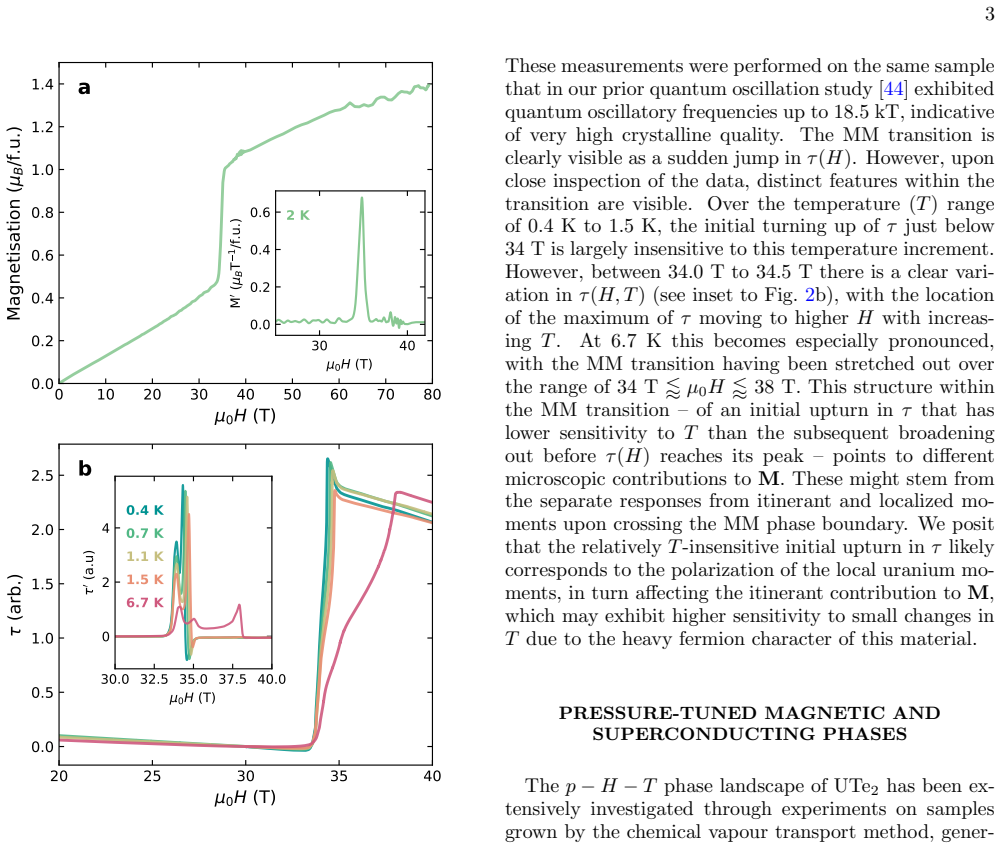
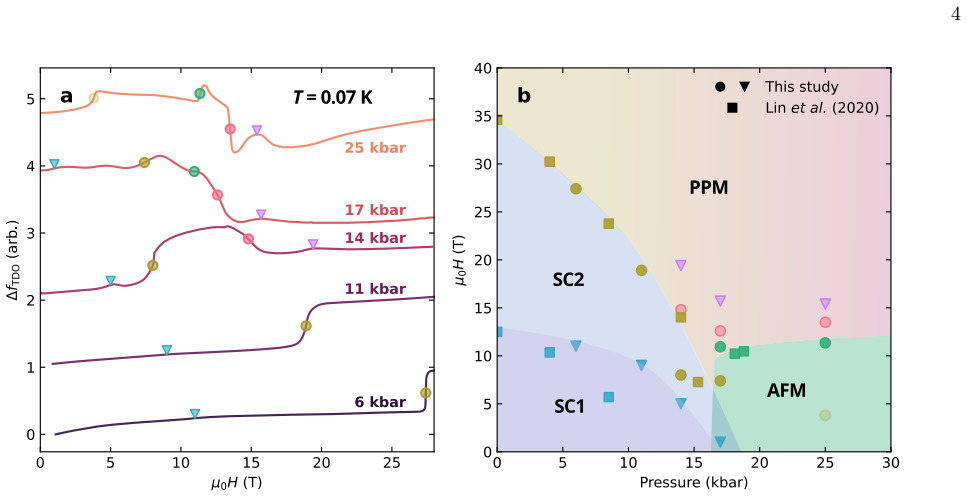
Steady field torque and magnetometry resolve a complex sub-structure within the metamagnetic transition of UTe2, with separate features that possess different temperature evolutions pointing to distinct contributions from itinerant and localized moments. The itinerant contribution might relate to a possible spin-density wave state. Theoretical modeling of the evolution of Kondo and RKKY interactions proposes that the SC2 state is stabilized under pressure due to the collapse of magnetic anisotropy, leading to an enhancement of longitudinal spin fluctuations along the hard b axis, which are pair-forming in the p-wave channel.
What carries the argument
The pressure-driven collapse of magnetic anisotropy that enhances longitudinal spin fluctuations along the hard b axis, modeled through the evolution of Kondo and RKKY interactions.
If this is right
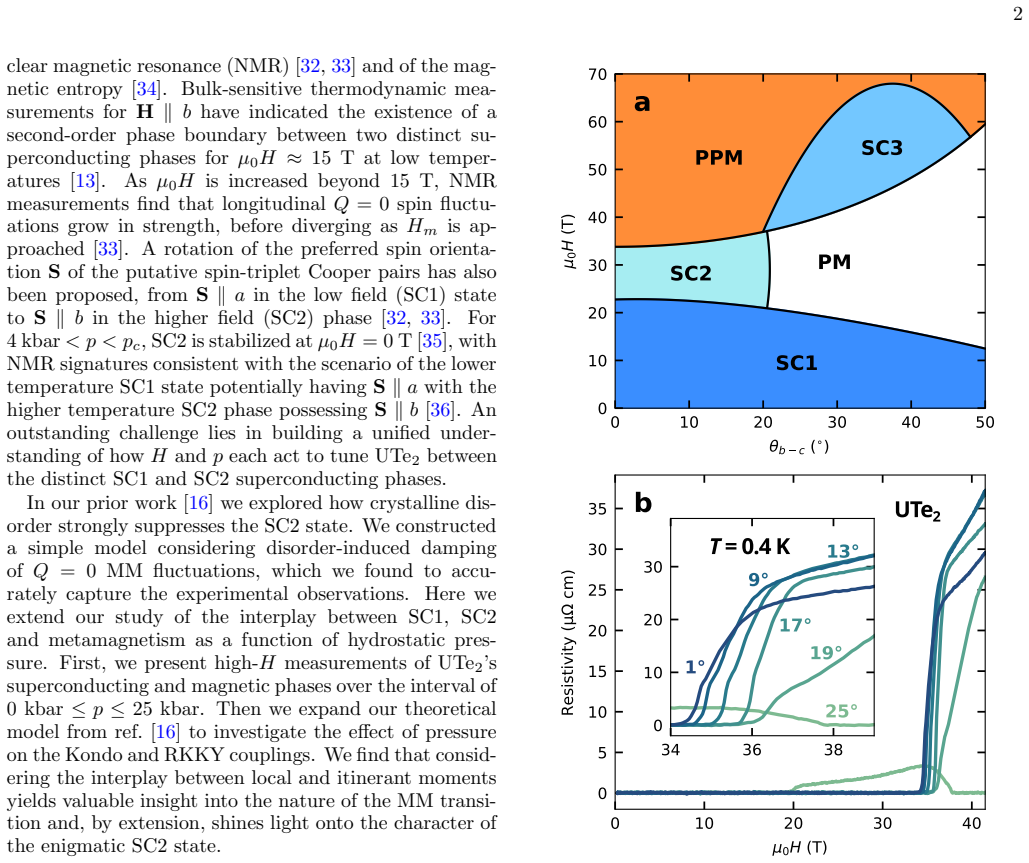
- The SC2 superconducting phase lies directly below the metamagnetic transition and is truncated by it, while SC3 lies predominantly above the transition and is stabilized by it.
- Distinct temperature evolutions of sub-features inside the transition allow separation of itinerant and localized moment responses.
- The itinerant contribution inside the transition may indicate an underlying spin-density wave state.
- Enhancement of longitudinal fluctuations along the hard b axis under pressure is pair-forming specifically in the p-wave channel for SC2.
Where Pith is reading between the lines
- If the anisotropy collapse is a generic response to pressure in uranium heavy-fermion systems, analogous stabilization of field-induced superconducting phases may occur in related compounds.
- The proposed distinction between itinerant and localized contributions could be checked by comparing the temperature scales of the sub-features to neutron-scattering measurements of spin fluctuations.
- The parameter-free modeling implies that the location of the anisotropy collapse is fixed by the ambient-pressure data, providing a sharp target for future pressure experiments.
Load-bearing premise
The temperature-dependent sub-features resolved in steady-field torque and magnetometry data correspond to physically distinct itinerant versus localized moment contributions whose pressure evolution can be captured by Kondo and RKKY changes without additional free parameters.
What would settle it
High-resolution steady-field data showing a single smooth metamagnetic transition without distinct temperature-dependent sub-features, or pressure-dependent measurements in which the anisotropy does not collapse in tandem with the stabilization of the SC2 phase.
Figures
read the original abstract
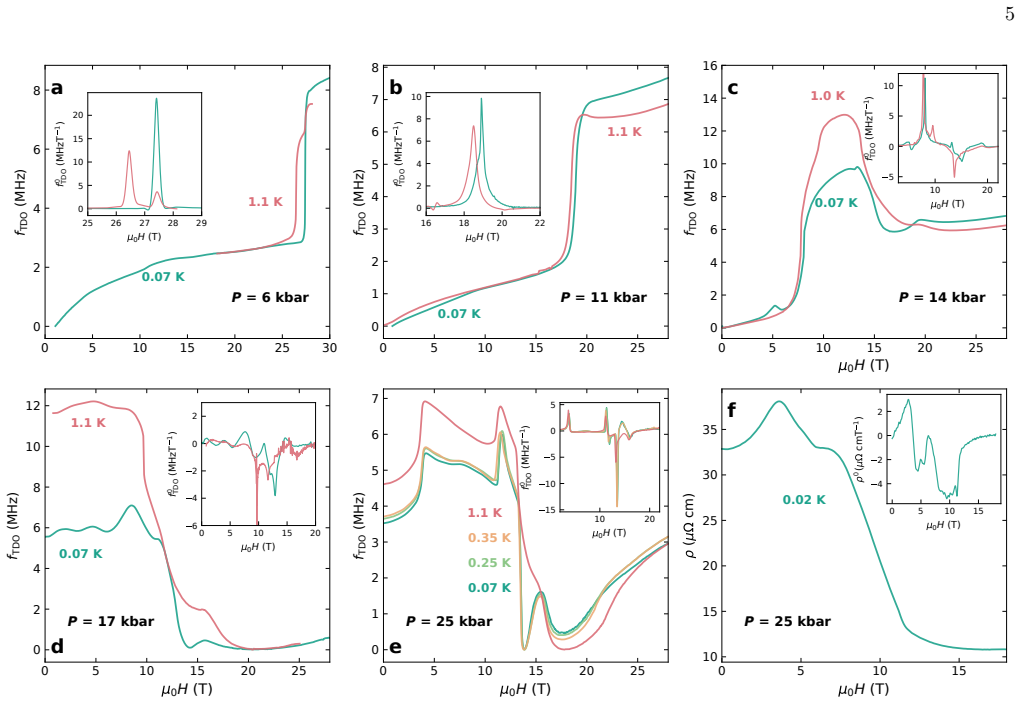
The metamagnetic transition in UTe$_2$ plays a key role in stabilizing two enigmatic field-induced superconducting phases. One of these phases (SC2) is truncated by the transition, lying directly below it, while the other (SC3) sits predominantly above it and appears to be stabilized because of it. While numerous pulsed field studies have examined this transition, comparatively few steady field experiments have investigated it. Here we report a suite of measurements of metamgnetism in UTe$_2$, at ambient pressure by torque magnetometry and extraction magnetometry techniques, and of the magnetoconductance under pressure. Our steady field measurements resolve a complex sub-structure within the transition, with separate features that possess different temperature evolutions, pointing to distinct contributions from itinerant and localized moments. The itinerant contribution might relate to a possible spin-density wave state. We theoretically model the evolution of Kondo and RKKY interactions and propose that the SC2 state is stabilized under pressure due to the collapse of magnetic anisotropy, leading to an enhancement of longitudinal spin fluctuations along the hard $b$ axis, which are pair-forming in the $p$-wave channel.
Editorial analysis
A structured set of objections, weighed in public.
Referee Report
Summary. The manuscript reports steady-field torque magnetometry and extraction magnetometry at ambient pressure on UTe2, resolving sub-structure within the metamagnetic transition whose features exhibit distinct temperature evolutions, interpreted as separate itinerant (possibly SDW) and localized-moment contributions. Magnetoconductance data under pressure are also presented. A theoretical model of the pressure evolution of Kondo and RKKY interactions is advanced to argue that the SC2 superconducting phase is stabilized by collapse of magnetic anisotropy, which enhances longitudinal spin fluctuations along the hard b axis that are pair-forming in the p-wave channel.
Significance. If the sub-structure is shown to arise from physically distinct contributions and the Kondo/RKKY model is demonstrated to be constrained without post-hoc adjustment, the work would clarify the interplay between metamagnetism, anisotropy, and the stabilization of field-induced superconductivity in UTe2, complementing existing pulsed-field studies. The steady-field approach is a clear strength. At present the absence of quantitative metrics, error analysis, and explicit model derivation limits the assessed significance.
major comments (3)
- [Abstract/Results] Abstract and experimental results: the claim that resolved sub-features possess different temperature evolutions pointing to distinct itinerant versus localized contributions supplies no quantitative data, error bars, fitting parameters, or exclusion criteria, rendering the attribution load-bearing for the central interpretation but unsupported.
- [Theoretical model] Theoretical modeling section: the assertion that pressure evolution of Kondo and RKKY interactions produces anisotropy collapse and enhanced b-axis longitudinal fluctuations is presented without derivation details, fitting protocol, or demonstration that parameters are fixed by ambient-pressure data rather than adjusted to the pressure-dependent magnetoconductance; this directly affects the SC2 stabilization argument.
- [Discussion] Discussion: the link from ambient-pressure sub-structure to the pressure-tuned model and the p-wave pairing mechanism requires explicit comparison to alternative models and falsifiable predictions testable against the reported magnetoconductance data.
minor comments (2)
- [Figures] Ensure all figures include error bars and specify the precise criteria used to identify and label the sub-features in torque and magnetometry traces.
- [Notation] Clarify notation for the superconducting phases (SC2, SC3) and metamagnetic features consistently across text and figures.
Simulated Author's Rebuttal
We thank the referee for their careful reading and constructive comments on our manuscript. We address each major comment below and indicate the revisions that will be incorporated to strengthen the presentation.
read point-by-point responses
-
Referee: [Abstract/Results] Abstract and experimental results: the claim that resolved sub-features possess different temperature evolutions pointing to distinct itinerant versus localized contributions supplies no quantitative data, error bars, fitting parameters, or exclusion criteria, rendering the attribution load-bearing for the central interpretation but unsupported.
Authors: We agree that the current version lacks sufficient quantitative support for distinguishing the sub-features. In the revised manuscript we will add error bars to the extracted transition fields, report the fitting parameters and uncertainties for the temperature evolutions of each feature, and explicitly state the criteria used to separate the itinerant and localized contributions. These additions will place the interpretation on a firmer quantitative footing. revision: yes
-
Referee: [Theoretical model] Theoretical modeling section: the assertion that pressure evolution of Kondo and RKKY interactions produces anisotropy collapse and enhanced b-axis longitudinal fluctuations is presented without derivation details, fitting protocol, or demonstration that parameters are fixed by ambient-pressure data rather than adjusted to the pressure-dependent magnetoconductance; this directly affects the SC2 stabilization argument.
Authors: The referee correctly notes that the modeling section is insufficiently detailed. The revised version will include the full derivation of the pressure-dependent Kondo and RKKY terms, the complete fitting protocol, and an explicit demonstration that all parameters are constrained by the ambient-pressure data set. We will show that the pressure evolution of the magnetoconductance is a prediction of the model rather than an input used for adjustment. revision: yes
-
Referee: [Discussion] Discussion: the link from ambient-pressure sub-structure to the pressure-tuned model and the p-wave pairing mechanism requires explicit comparison to alternative models and falsifiable predictions testable against the reported magnetoconductance data.
Authors: We will expand the discussion to include direct comparisons with alternative scenarios for SC2 stabilization. We will also formulate specific, falsifiable predictions arising from the anisotropy-collapse mechanism and show how they can be tested against the magnetoconductance data already presented in the manuscript. revision: yes
Circularity Check
Kondo/RKKY pressure-evolution model invoked to explain SC2 stabilization lacks shown independent constraints from ambient data
specific steps
-
fitted input called prediction
[Abstract]
"We theoretically model the evolution of Kondo and RKKY interactions and propose that the SC2 state is stabilized under pressure due to the collapse of magnetic anisotropy, leading to an enhancement of longitudinal spin fluctuations along the hard b axis, which are pair-forming in the p-wave channel."
The model is asserted to produce the anisotropy collapse and fluctuation enhancement that stabilizes SC2, yet the abstract supplies no fixed parameters constrained solely by ambient data or independent of the temperature-dependent sub-features resolved in the torque/magnetometry measurements; the pressure evolution therefore functions as a fit to the same inputs used to identify itinerant vs localized contributions.
full rationale
The paper's central claim rests on steady-field torque/magnetometry resolving distinct itinerant vs localized sub-features at ambient pressure, followed by a theoretical model of Kondo/RKKY evolution under pressure that produces anisotropy collapse and enhanced b-axis fluctuations. No equations, fixed-parameter protocol, or external benchmark is quoted in the provided text to demonstrate the model is not adjusted to reproduce the same temperature-dependent features used to define the sub-structure. This matches the fitted-input-called-prediction pattern at the load-bearing step, but without explicit reduction to an equation or self-citation chain the circularity is partial rather than total.
Axiom & Free-Parameter Ledger
Reference graph
Works this paper leans on
-
[1]
We can thus see that the anisotropy of the RKKY inter- action is very sensitive to changes in temperature as well as the degree of localization
found that magnetic order along the CEF hard-axis takes place in more itinerant systems, whereas magnetic order along the CEF easy-axis takes place in more local- ized magnets (lower ratio of coherence to RKKY energy). We can thus see that the anisotropy of the RKKY inter- action is very sensitive to changes in temperature as well as the degree of localiz...
-
[2]
S. Ran, C. Eckberg, Q. P. Ding, Y. Furukawa, T. Metz, S. R. Saha, I. L. Liu, M. Zic, H. Kim, J. Paglione, and N. P. Butch, Nearly ferromagnetic spin-triplet supercon- ductivity, Science365, 684 (2019)
2019
-
[3]
D. Aoki, A. Nakamura, F. Honda, D. X. Li, Y. Homma, Y. Shimizu, Y. J. Sato, G. Knebel, J. P. Brison, A. Pour- ret, D. Braithwaite, G. Lapertot, Q. Niu, M. Valiˇ ska, H. Harima, and J. Flouquet, Unconventional Supercon- ductivity in Heavy Fermion UTe2, J. Phys. Soc. Jpn.88, 43702 (2019)
2019
-
[4]
D. Aoki, J. P. Brison, J. Flouquet, K. Ishida, G. Knebel, Y. Tokunaga, and Y. Yanase, Unconventional supercon- ductivity in UTe2, J. Phys. Condens. Matter34, 243002 (2022)
2022
-
[5]
S. K. Lewin, C. E. Frank, S. Ran, J. Paglione, and N. P. Butch, A Review of UTe2 at High Magnetic Fields, Rep. Prog. Phys. (2023)
2023
-
[6]
S. Ran, I. L. Liu, Y. S. Eo, D. J. Campbell, P. M. Neves, W. T. Fuhrman, S. R. Saha, C. Eckberg, H. Kim, D. Graf, F. Balakirev, J. Singleton, J. Paglione, and N. P. Butch, Extreme magnetic field-boosted superconductiv- ity, Nat. Phys.15, 1250 (2019)
2019
-
[7]
Knebel, W
G. Knebel, W. Knafo, A. Pourret, Q. Niu, M. Valiˇ ska, D. Braithwaite, G. Lapertot, M. Nardone, A. Zi- touni, S. Mishra, I. Sheikin, G. Seyfarth, J. P. Brison, D. Aoki, and J. Flouquet, Field-Reentrant Superconduc- tivity Close to a Metamagnetic Transition in the Heavy- Fermion Superconductor UTe 2, J. Phys. Soc. Jpn.88, 63707 (2019)
2019
-
[8]
Braithwaite, M
D. Braithwaite, M. Valiˇ ska, G. Knebel, G. Lapertot, J. P. Brison, A. Pourret, M. E. Zhitomirsky, J. Flou- quet, F. Honda, and D. Aoki, Multiple superconducting phases in a nearly ferromagnetic system, Commun. Phys. 2, 147 (2019)
2019
-
[9]
S. M. Thomas, F. B. Santos, M. H. Christensen, T. Asaba, F. Ronning, J. D. Thompson, E. D. Bauer, R. M. Fernandes, G. Fabbris, and P. F. Rosa, Evidence for a pressure-induced antiferromagnetic quantum criti- cal point in intermediate-valence UTe2, Sci. Adv.6, 8709 (2020)
2020
-
[10]
D. Aoki, F. Honda, G. Knebel, D. Braithwaite, A. Naka- mura, D. Li, Y. Homma, Y. Shimizu, Y. J. Sato, J.-P. Brison,et al., Multiple superconducting phases and un- usual enhancement of the upper critical field in UTe 2, J. Phys. Soc. Jpn.89, 053705 (2020)
2020
-
[11]
W.-C. Lin, D. J. Campbell, S. Ran, I.-L. Liu, H. Kim, A. H. Nevidomskyy, D. Graf, N. P. Butch, and J. Paglione, Tuning magnetic confinement of spin-triplet superconductivity, npj Quantum Mater.5, 68 (2020)
2020
-
[12]
D. Aoki, M. Kimata, Y. J. Sato, G. Knebel, F. Honda, A. Nakamura, D. Li, Y. Homma, Y. Shimizu, W. Knafo, D. Braithwaite, M. Valiˆ ska, A. Pourret, J. P. Brison, and J. Flouquet, Field-Induced Superconductivity near the Superconducting Critical Pressure in UTe2, J. Phys. Soc. Jpn.90, 074705 (2021)
2021
-
[13]
S. Ran, S. R. Saha, I.-L. Liu, D. Graf, J. Paglione, and N. P. Butch, Expansion of the high field-boosted su- perconductivity in UTe 2 under pressure, npj Quantum Mater.6, 75 (2021)
2021
-
[14]
Rosuel, C
A. Rosuel, C. Marcenat, G. Knebel, T. Klein, A. Pourret, N. Marquardt, Q. Niu, S. Rousseau, A. Demuer, G. Sey- farth, G. Lapertot, D. Aoki, D. Braithwaite, J. Flou- quet, and J. P. Brison, Field-Induced Tuning of the Pair- ing State in a Superconductor, Phys. Rev. X13, 011022 (2023)
2023
-
[15]
Honda, S
F. Honda, S. Kobayashi, N. Kawamura, S. I. Kawaguchi, T. Koizumi, Y. J. Sato, Y. Homma, N. Ishimatsu, J. Gouchi, Y. Uwatoko,et al., Pressure-induced Struc- tural Phase Transition and New Superconducting Phase in UTe2, J. Phys. Soc. Jpn.92, 044702 (2023)
2023
-
[16]
Sch¨ onemann, P
R. Sch¨ onemann, P. F. Rosa, S. M. Thomas, Y. Lai, D. N. Nguyen, J. Singleton, E. L. Brosha, R. D. McDonald, V. Zapf, B. Maiorov,et al., Sudden adiabaticity signals reentrant bulk superconductivity in UTe 2, PNAS Nexus 3, pgad428 (2024)
2024
-
[17]
Z. Wu, T. Weinberger, J. Chen, A. Cabala, D. Chichi- nadze, D. Shaffer, J. Posp´ ıˇ sil, J. Prokleˇ ska, T. Haidamak, G. Bastien,et al., Enhanced triplet superconductivity in next-generation ultraclean UTe 2, Proc. Natl. Acad. Sci. USA121, e2403067121 (2024)
2024
-
[18]
T. Helm, M. Kimata, K. Sudo, A. Miyata, J. Stirnat, T. F¨ orster, J. Hornung, M. K¨ onig, I. Sheikin, A. Pourret, et al., Field-induced compensation of magnetic exchange as the possible origin of reentrant superconductivity in UTe2, Nat. Commun.15, 37 (2024)
2024
-
[19]
Z. Wu, J. Chen, T. I. Weinberger, A. Cabala, V. Se- chovsk´ y, M. Valiˇ ska, P. L. Alireza, A. G. Eaton, and F. M. Grosche, Magnetic Signatures of Pressure-Induced Multicomponent Superconductivity in UTe 2, Phys. Rev. Lett.134, 236501 (2025)
2025
-
[20]
Knafo, T
W. Knafo, T. Thebault, S. Raymond, P. Manuel, D. D. Khalyavin, F. Orlandi, E. Ressouche, K. Beauvois, 10 G. Lapertot, K. Kaneko, D. Aoki, D. Braithwaite, and G. Knebel, Incommensurate Antiferromagnetism in UTe2 under Pressure, Phys. Rev. X15, 021075 (2025)
2025
-
[21]
Miyake, Y
A. Miyake, Y. Shimizu, Y. J. Sato, D. Li, A. Nakamura, Y. Homma, F. Honda, J. Flouquet, M. Tokunaga, and D. Aoki, Metamagnetic Transition in Heavy Fermion Su- perconductor UTe2, J. Phys. Soc. Jpn.88(2019)
2019
-
[22]
S. S. Saxena, P. Agarwal, K. Ahilan, F. M. Grosche, R. K. W Haselwimmer, M. J. Steiner, E. Pugh, I. R. Walker, S. R. Julian, P. Monthoux, G. G. Lonzarich, A. Huxley, I. Sheikin, D. Braithwaite, and J. Flouquet, Supercon- ductivity on the border of itinerant-electron ferromag- netism in UGe 2, Nature406, 587 (2000)
2000
-
[23]
D. Aoki, A. Huxley, E. Ressouche, D. Braithwaite, J. Flouquet, J. P. Brison, E. Lhotel, and C. Paulsen, Coexistence of superconductivity and ferromagnetism in URhGe, Nature413, 613 (2001)
2001
-
[24]
N. T. Huy, A. Gasparini, D. E. de Nijs, Y. Huang, J. C. P. Klaasse, T. Gortenmulder, A. de Visser, A. Hamann, T. G¨ orlach, and H. v. L¨ ohneysen, Superconductivity on the Border of Weak Itinerant Ferromagnetism in UCoGe, Phys. Rev. Lett.99, 067006 (2007)
2007
-
[25]
D. Aoki, K. Ishida, and J. Flouquet, Review of U-based Ferromagnetic Superconductors: Comparison between UGe2, URhGe, and UCoGe, J. Phys. Soc. Jpn.88, 022001 (2019)
2019
-
[26]
S. Ran, H. Kim, I.-L. Liu, S. R. Saha, I. Hayes, T. Metz, Y. S. Eo, J. Paglione, and N. P. Butch, Enhancement and reentrance of spin triplet superconductivity in UTe 2 under pressure, Phys. Rev. B101, 140503 (2020)
2020
-
[27]
C. Duan, K. Sasmal, M. B. Maple, A. Podlesnyak, J.- X. Zhu, Q. Si, and P. Dai, Incommensurate Spin Fluc- tuations in the Spin-Triplet Superconductor Candidate UTe2, Phys. Rev. Lett.125, 237003 (2020)
2020
-
[28]
C. Duan, R. E. Baumbach, A. Podlesnyak, Y. Deng, C. Moir, A. J. Breindel, M. B. Maple, E. M. Nica, Q. Si, and P. Dai, Resonance from antiferromagnetic spin fluc- tuations for superconductivity in UTe2, Nature600, 636 (2021)
2021
-
[29]
Knafo, G
W. Knafo, G. Knebel, P. Steffens, K. Kaneko, A. Ro- suel, J.-P. Brison, J. Flouquet, D. Aoki, G. Lapertot, and S. Raymond, Low-dimensional antiferromagnetic fluctu- ations in the heavy-fermion paramagnetic ladder com- pound UTe2, Phys. Rev. B104, L100409 (2021)
2021
-
[30]
Sundar, S
S. Sundar, S. Gheidi, K. Akintola, A. M. Cˆ ot´ e, S. R. Dunsiger, S. Ran, N. P. Butch, S. R. Saha, J. Paglione, and J. E. Sonier, Coexistence of ferromagnetic fluctua- tions and superconductivity in the actinide superconduc- tor UTe2, Phys. Rev. B100, 140502 (2019)
2019
-
[31]
Azari, M
N. Azari, M. Yakovlev, N. Rye, S. R. Dunsiger, S. Sun- dar, M. M. Bordelon, S. M. Thomas, J. D. Thompson, P. F. S. Rosa, and J. E. Sonier, Absence of Spontaneous Magnetic Fields due to Time-Reversal Symmetry Break- ing in Bulk Superconducting UTe2, Phys. Rev. Lett.131, 226504 (2023)
2023
-
[32]
Kreisel, Y
A. Kreisel, Y. Quan, and P. J. Hirschfeld, Spin-triplet superconductivity driven by finite-momentum spin fluc- tuations, Phys. Rev. B105, 104507 (2022)
2022
-
[33]
Kinjo, H
K. Kinjo, H. Fujibayashi, S. Kitagawa, K. Ishida, Y. Tokunaga, H. Sakai, S. Kambe, A. Nakamura, Y. Shimizu, Y. Homma, D. X. Li, F. Honda, D. Aoki, K. Hiraki, M. Kimata, and T. Sasaki, Change of super- conducting character in UTe2 induced by magnetic field, Phys. Rev. B107, L060502 (2023)
2023
-
[34]
Tokunaga, H
Y. Tokunaga, H. Sakai, S. Kambe, P. Opletal, Y. Tokiwa, Y. Haga, S. Kitagawa, K. Ishida, D. Aoki, G. Knebel, G. Lapertot, S. Kr¨ amer, and M. Horvati´ c, Longitudinal Spin Fluctuations Driving Field-Reinforced Supercon- ductivity in UTe2, Phys. Rev. Lett.131, 226503 (2023)
2023
-
[35]
Tokiwa, P
Y. Tokiwa, P. Opletal, H. Sakai, S. Kambe, E. Ya- mamoto, M. Kimata, S. Awaji, T. Sasaki, D. Aoki, Y. Haga, and Y. Tokunaga, Reinforcement of supercon- ductivity by quantum critical fluctuations of metamag- netism in UTe2, Phys. Rev. B109, L140502 (2024)
2024
-
[36]
Vasina, D
T. Vasina, D. Aoki, A. Miyake, G. Seyfarth, A. Pourret, C. Marcenat, M. Amano Patino, G. Lapertot, J. Flou- quet, J.-P. Brison, D. Braithwaite, and G. Knebel, Con- necting High-Field and High-Pressure Superconductivity in UTe2, Phys. Rev. Lett.134, 096501 (2025)
2025
-
[37]
Kinjo, H
K. Kinjo, H. Fujibayashi, H. Matsumura, F. Hori, S. Kitagawa, K. Ishida, Y. Tokunaga, H. Sakai, S. Kambe, A. Nakamura, Y. Shimizu, Y. Homma, D. Li, F. Honda, and D. Aoki, Superconducting spin reorien- tation in spin-triplet multiple superconducting phases of UTe2, Sci. Adv.9, eadg2736 (2023)
2023
-
[38]
Z. Wu, H. Chen, T. I. Weinberger, A. Cabala, D. E. Graf, Y. Skourski, W. Xie, Y. Ling, Z. Zhu, V. Sechovsk´ y, M. Valiˇ ska, F. M. Grosche, and A. G. Eaton, Super- conducting critical temperature elevated by intense mag- netic fields, Proc. Natl. Acad. Sci. USA122, e2422156122 (2025)
2025
-
[39]
Z. Wu, T. I. Weinberger, J. Chen, A. Cabala, D. V. Chichinadze, D. Shaffer, J. Posp´ ıˇ sil, J. Prokleˇ ska, T. Haidamak, G. Bastien, V. Sechovsk´ y, A. J. Hickey, M. J. Mancera-Ugarte, S. Benjamin, D. E. Graf, Y. Sk- ourski, G. G. Lonzarich, M. Valiˇ ska, F. M. Grosche, and A. G. Eaton, Research data supporting: Enhanced triplet superconductivity in next...
2024
-
[40]
Z. Wu, H. Chen, T. I. Weinberger, A. Cabala, D. E. Graf, Y. Skourski, W. Xie, Y. Ling, Z. Zhu, V. Sechovsk´ y, M. Valiˇ ska, F. M. Grosche, and A. G. Eaton, Research data supporting: Superconducting critical temperature elevated by intense magnetic fields (2025), University of Cambridge Apollo Repository
2025
-
[41]
Miyake, Y
A. Miyake, Y. Shimizu, Y. J. Sato, D. Li, A. Naka- mura, Y. Homma, F. Honda, J. Flouquet, M. Tokunaga, and D. Aoki, Enhancement and Discontinuity of Effective Mass through the First-Order Metamagnetic Transition in UTe2, J. Phys. Soc. Jpn.90, 103702 (2021)
2021
-
[42]
Griessen, A capacitance torquemeter for de Haas-van Alphen measurements, Cryogenics13, 375 (1973)
R. Griessen, A capacitance torquemeter for de Haas-van Alphen measurements, Cryogenics13, 375 (1973)
1973
-
[43]
Y. Sato, S. Kasahara, H. Murayama, Y. Kasahara, E.- G. Moon, T. Nishizaki, T. Loew, J. Porras, B. Keimer, T. Shibauchi,et al., Thermodynamic evidence for a ne- matic phase transition at the onset of the pseudogap in YBa2Cu3Oy, Nat. Phys.13, 1074 (2017)
2017
-
[44]
Murayama, Y
H. Murayama, Y. Sato, R. Kurihara, S. Kasahara, Y. Mizukami, Y. Kasahara, H. Uchiyama, A. Yamamoto, E.-G. Moon, J. Cai,et al., Diagonal nematicity in the pseudogap phase of HgBa 2CuO4+δ, Nat. Commun.10, 3282 (2019)
2019
-
[45]
A. G. Eaton, T. I. Weinberger, N. J. M. Popiel, Z. Wu, A. J. Hickey, A. Cabala, J. Posp´ ıˇ sil, J. Prokleˇ ska, T. Haidamak, G. Bastien, P. Opletal, H. Sakai, Y. Haga, R. Nowell, S. M. Benjamin, V. Sechovsk´ y, G. G. Lon- zarich, F. M. Grosche, and M. Valiˇ ska, Quasi-2D Fermi surface in the anomalous superconductor UTe 2, Nat. 11 Commun.15, 223 (2024)
2024
- [46]
-
[47]
M. Valiˇ ska, W. Knafo, G. Knebel, G. Lapertot, D. Aoki, and D. Braithwaite, Magnetic reshuffling and feedback on superconductivity in UTe 2 under pressure, Physical Review B104, 214507 (2021), 2108.13247
-
[48]
Weinberger, Z
T. Weinberger, Z. Wu, A. Hickey, D. Graf, G. Li, P. Wang, R. Zhou, A. Cabala, J. Pu, V. Sechovsky, M. Valiska, G. Lonzarich, F. Grosche, and A. Eaton, Pressure-enhancedf-electron orbital weighting in UTe 2 mapped by quantum interferometry, Commun. Phys.8, 454 (2025)
2025
-
[49]
Sakai, P
H. Sakai, P. Opletal, Y. Tokiwa, E. Yamamoto, Y. Toku- naga, S. Kambe, and Y. Haga, Single crystal growth of superconducting UTe2 by molten salt flux method, Phys. Rev. Mater.6, 073401 (2022)
2022
-
[50]
C. T. Van Degrift, Tunnel diode oscillator for 0.001 ppm measurements at low temperatures, Rev. Sci. Instrum. 46, 599 (1975)
1975
-
[51]
T. I. Weinberger, Z. Wu, D. E. Graf, Y. Skourski, A. Ca- bala, J. Posp´ ıˇ sil, J. Prokleˇ ska, T. Haidamak, G. Bastien, V. Sechovsk´ y, G. G. Lonzarich, M. Valiˇ ska, F. M. Grosche, and A. G. Eaton, Quantum Interference be- tween Quasi-2D Fermi Surface Sheets in UTe 2, Phys. Rev. Lett.132, 266503 (2024)
2024
-
[52]
Knebel, A
G. Knebel, A. Pourret, S. Rousseau, N. Marquardt, D. Braithwaite, F. Honda, D. Aoki, G. Lapertot, W. Knafo, G. Seyfarth, J.-P. Brison, and J. Flouquet,c- axis electrical transport at the metamagnetic transition in the heavy-fermion superconductor UTe 2 under pres- sure, Phys. Rev. B109, 155103 (2024)
2024
- [53]
-
[54]
Burdin and V
S. Burdin and V. Zlati´ c, Multiple temperature scales of the periodic Anderson model: Slave boson approach, Phys. Rev. B79, 115139 (2009)
2009
-
[55]
B. H. Bernhard, Metamagnetism and tricritical behavior in the Kondo lattice model, Phys. Rev. B106, 054436 (2022)
2022
-
[56]
Thomas, S
C. Thomas, S. Burdin, and C. Lacroix, Metamagnetic transition in the twoforbitals Kondo lattice model, J. Phys.: Condens. Matter35, 445601 (2023)
2023
-
[57]
Takabatake, F
T. Takabatake, F. Iga, T. Yoshino, Y. Echizen, K. Ka- toh, K. Kobayashi, M. Higa, N. Shimizu, Y. Bando, G. Nakamoto,et al., Ce-and Yb-based Kondo semicon- ductors, J. Magn. Magn. Mater.177, 277 (1998)
1998
-
[58]
Goltsev and M
A. Goltsev and M. Abd-Elmeguid, Origin of the pres- sure dependence of the Kondo temperature in Ce-and Yb-based heavy-fermion compounds, J. Phys.: Condens. Matter17, S813 (2005)
2005
-
[59]
Altland and B
A. Altland and B. D. Simons,Condensed matter field theory(Cambridge University Press, 2010)
2010
-
[60]
Coleman,Introduction to many-body physics(Cam- bridge University Press, 2015)
P. Coleman,Introduction to many-body physics(Cam- bridge University Press, 2015)
2015
-
[61]
Fujimori, I
S.-i. Fujimori, I. Kawasaki, Y. Takeda, H. Yamagami, A. Nakamura, Y. Homma, and D. Aoki, Electronic Struc- ture of UTe 2 Studied by Photoelectron Spectroscopy, J. Phys. Soc. Jpn.88, 103701 (2019)
2019
-
[62]
L. Miao, S. Liu, Y. Xu, E. C. Kotta, C.-J. Kang, S. Ran, J. Paglione, G. Kotliar, N. P. Butch, J. D. Denlinger, and L. A. Wray, Low Energy Band Structure and Symme- tries of UTe 2 from Angle-Resolved Photoemission Spec- troscopy, Phys. Rev. Lett.124, 076401 (2020)
2020
-
[63]
D. Li, A. Nakamura, F. Honda, Y. J. Sato, Y. Homma, Y. Shimizu, J. Ishizuka, Y. Yanase, G. Knebel, J. Flou- quet, and D. Aoki, Magnetic properties under pressure in novel spin-triplet superconductor UTe 2, J. Phys. Soc. Jpn.90, 073703 (2021)
2021
-
[64]
Ishizuka and Y
J. Ishizuka and Y. Yanase, Periodic Anderson model for magnetism and superconductivity in UTe2, Phys. Rev. B 103, 094504 (2021)
2021
-
[65]
Shishidou, H
T. Shishidou, H. G. Suh, P. M. R. Brydon, M. Weinert, and D. F. Agterberg, Topological band and superconduc- tivity in UTe2, Phys. Rev. B103, 104504 (2021)
2021
-
[66]
A. B. Shick, S.-i. Fujimori, and W. E. Pickett, UTe 2: A nearly insulating half-filledj= 5 25f 3 heavy-fermion metal, Phys. Rev. B103, 125136 (2021)
2021
-
[67]
S. Liu, Y. Xu, E. C. Kotta, L. Miao, S. Ran, J. Paglione, N. P. Butch, J. D. Denlinger, Y.-D. Chuang, and L. A. Wray, Identifyingf-electron symmetries of UTe 2 with O- edge resonant inelastic x-ray scattering, Phys. Rev. B 106, L241111 (2022)
2022
-
[68]
Wilhelm, J.-P
F. Wilhelm, J.-P. Sanchez, D. Braithwaite, G. Knebel, G. Lapertot, and A. Rogalev, Investigating the electronic states of UTe2 using X-ray spectroscopy, Commun. Phys. 6, 96 (2023)
2023
-
[69]
Hazra and P
T. Hazra and P. Coleman, Triplet Pairing Mechanisms from Hund’s-Kondo Models: Applications to UTe 2 and CeRh2As2, Phys. Rev. Lett.130, 136002 (2023)
2023
-
[70]
Khmelevskyi, L
S. Khmelevskyi, L. V. Pourovskii, and E. A. Tereshina- Chitrova, Structure of the normal state and origin of the Schottky anomaly in the correlated heavy-fermion super- conductor UTe2, Phys. Rev. B107, 214501 (2023)
2023
-
[71]
D. S. Christovam, M. Sundermann, A. Marino, D. Takegami, J. Falke, P. Dolmantas, M. Harder, H. Gre- tarsson, B. Keimer, A. Gloskovskii, M. W. Haverkort, I. Elfimov, G. Zwicknagl, A. V. Andreev, L. Havela, M. M. Bordelon, E. D. Bauer, P. F. S. Rosa, A. Severing, and L. H. Tjeng, Stabilization of U 5f 2 configuration in UTe2 through U 6ddimers in the presen...
2024
-
[72]
Z. Wu, T. I. Weinberger, A. J. Hickey, D. V. Chichinadze, D. Shaffer, A. Cabala, H. Chen, M. Long, T. J. Brumm, W. Xie, Y. Ling, Z. Zhu, Y. Skourski, D. E. Graf, V. Se- chovsk´ y, M. Valiˇ ska, G. G. Lonzarich, F. M. Grosche, and A. G. Eaton, A Quantum Critical Line Bounds the High Field Metamagnetic Transition Surface in UTe 2, Phys. Rev. X15, 021019 (2025)
2025
-
[73]
Scott and M
E. Scott and M. Kwasigroch, Destabilization of local magnetic anisotropy in heavy-fermion compounds, Phys. Rev. Res.7, 043225 (2025)
2025
-
[74]
McCollam, M
A. McCollam, M. Fu, and S. Julian, Lifshitz transi- tion underlying the metamagnetic transition of UPt 3, J. Phys.: Condens. Matter33, 075804 (2021)
2021
-
[75]
Tokunaga, H
Y. Tokunaga, H. Sakai, S. Kambe, T. Hattori, N. Higa, G. Nakamine, S. Kitagawa, K. Ishida, A. Nakamura, Y. Shimizu, Y. Homma, D. Li, F. Honda, and D. Aoki, 125Te-NMR Study on a Single Crystal of Heavy Fermion Superconductor UTe 2, J. Phy. Soc. Jpn.88, 073701 (2019)
2019
-
[76]
Azari, M
N. Azari, M. R. Goeks, M. Yakovlev, M. Abedi, S. R. 12 Dunsiger, S. M. Thomas, J. D. Thompson, P. F. S. Rosa, and J. E. Sonier,µ + Knight shift in UTe 2: Evidence for relocalization in a Kondo lattice, Phys. Rev. B108, L081103 (2023)
2023
-
[77]
Azari, M
N. Azari, M. Yakovlev, S. R. Dunsiger, O. P. Uzoh, E. Mun, B. M. Huddart, S. J. Blundell, M. M. Borde- lon, S. M. Thomas, J. D. Thompson, P. F. S. Rosa, and J. E. Sonier, Coexistence of Kondo coherence and local- ized magnetic moments in the normal state of molten salt-flux grown UTe2, Phys. Rev. B111, 014513 (2025)
2025
-
[78]
Amorese, M
A. Amorese, M. Sundermann, B. Leedahl, A. Marino, D. Takegami, H. Gretarsson, A. Gloskovskii, C. Schlueter, M. W. Haverkort, Y. Huang, M. Szlawska, D. Kaczorowski, S. Ran, M. B. Maple, E. D. Bauer, A. Leithe-Jasper, P. Hansmann, P. Thalmeier, L. H. Tjeng, and A. Severing, From antiferromagnetic and hidden order to Pauli paramagnetism in UM 2Si2 com- pound...
2020
-
[79]
Y. Deng, E. Lee-Wong, C. M. Moir, R. S. Kumar, N. Swedan, C. Park, D. Y. Popov, Y. Xiao, P. Chow, R. E. Baumbach, R. J. Hemley, P. S. Riseborough, and M. B. Maple, Structural transition and uranium valence change in ute2 at high pressure revealed by x-ray diffrac- tion and spectroscopy, Phys. Rev. B110, 075140 (2024)
2024
-
[80]
Lester, S
C. Lester, S. Ramos, R. Perry, T. Croft, R. Bewley, T. Guidi, P. Manuel, D. Khalyavin, E. Forgan, and S. Hayden, Field-tunable spin-density-wave phases in Sr3Ru2O7, Nat. Mater.14, 373 (2015)
2015
discussion (0)
Sign in with ORCID, Apple, or X to comment. Anyone can read and Pith papers without signing in.