The ARDoCo Tool Landscape: REST API, TraceView, and TraceViz for Architecture Traceability
Pith reviewed 2026-06-29 03:32 UTC · model grok-4.3
The pith
ARDoCo delivers four traceability pipelines through a public REST API, TraceView browser tool, and TraceViz IDE extension.
A machine-rendered reading of the paper's core claim, the machinery that carries it, and where it could break.
Core claim
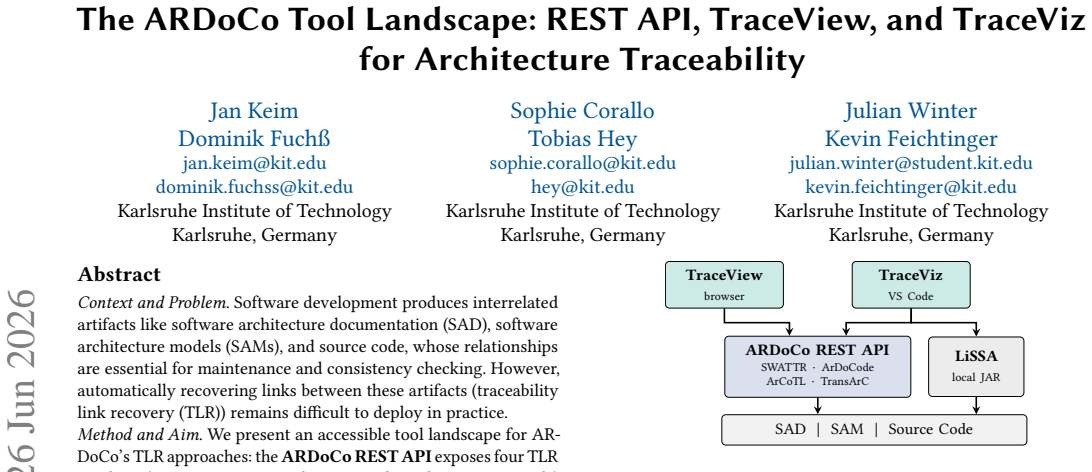
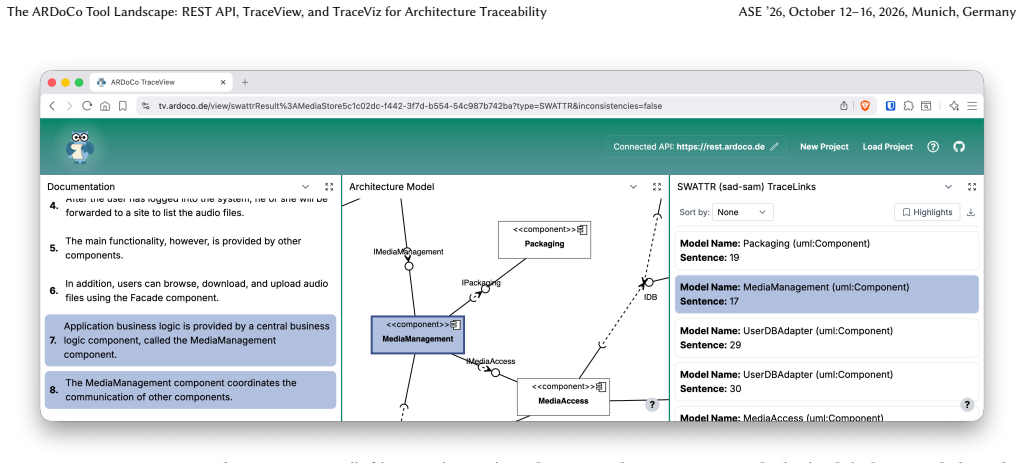
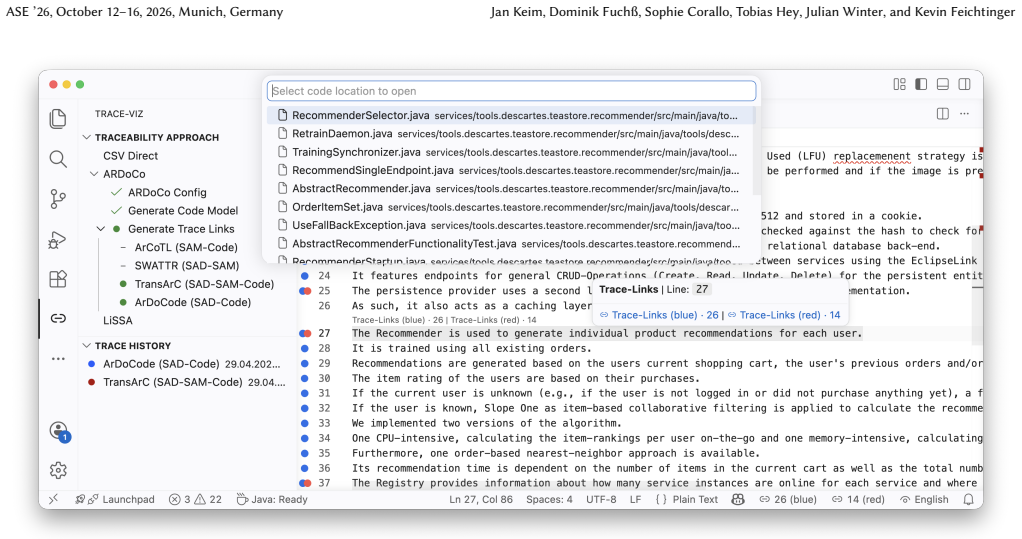
The ARDoCo tool landscape consists of a REST API exposing the SAD-SAM, SAM-Code, SAD-Code, and SAD-SAM-Code pipelines via HTTP endpoints with asynchronous execution and caching; TraceView as a browser-based frontend offering a guided wizard and interactive multi-panel views of links and inconsistencies; and TraceViz as a VS Code extension that overlays trace links onto documentation in the IDE. All three components are publicly deployed. The preliminary study for TraceViz confirmed improved developer comprehension during software understanding tasks, thereby making state-of-the-art TLR accessible to architects, developers, and tool integrators.
What carries the argument
The four TLR pipelines (SAD-SAM, SAM-Code, SAD-Code, SAD-SAM-Code) delivered through the REST API, TraceView, and TraceViz components.
If this is right
- Architects can run any of the four pipeline combinations to check consistency between documentation, models, and code.
- TraceView allows interactive exploration of recovered links and detected inconsistencies without local installation.
- TraceViz places trace information directly in the editor to support day-to-day software understanding.
- Tool integrators can invoke the pipelines through standard HTTP calls and incorporate results into other workflows.
- Public deployment removes setup barriers so practitioners can test the approach immediately.
Where Pith is reading between the lines
- The API-first design opens the possibility of embedding the pipelines inside continuous-integration systems.
- Adoption across multiple projects could generate larger datasets for refining the underlying recovery methods.
- The browser and IDE frontends suggest a pattern that other traceability techniques could follow for wider accessibility.
Load-bearing premise
The four TLR pipelines qualify as state-of-the-art and the preliminary study supplies sufficient evidence that TraceViz improves comprehension.
What would settle it
A controlled experiment in which developers using TraceViz show no measurable gain in comprehension accuracy or speed compared with a control group using plain editors on the same tasks.
Figures
read the original abstract
Context and Problem. Software development produces interrelated artifacts like software architecture documentation (SAD), software architecture models (SAMs), and source code, whose relationships are essential for maintenance and consistency checking. However, automatically recovering links between these artifacts (traceability link recovery (TLR)) remains difficult to deploy in practice. Method and Aim. We present an accessible tool landscape for ARDoCo's TLR approaches: the ARDoCo REST API exposes four TLR pipelines (SAD-SAM, SAM-Code, SAD-Code, and SAD-SAM-Code) via HTTP endpoints with asynchronous execution and caching; TraceView is a browser-based frontend with a guided wizard and interactive multi-panel exploration of recovered links and inconsistencies; and TraceViz, which is a VS Code extension that overlays trace links directly onto documentation in the IDE. Results and Conclusion. All three components are publicly deployed and usable. A preliminary study for TraceViz's in-IDE visualization confirmed that it improves developer comprehension during software understanding tasks. The tool landscape makes state-of-the-art TLR accessible to architects, developers, and tool integrators. Video. We provide a screencast of our ARDoCo Tool Landscape and how it is used here: https://youtu.be/IOTEPZQ3tVs
Editorial analysis
A structured set of objections, weighed in public.
Referee Report
Summary. The paper presents the ARDoCo tool landscape for making traceability link recovery (TLR) more accessible. It describes a REST API exposing four pipelines (SAD-SAM, SAM-Code, SAD-Code, SAD-SAM-Code) with HTTP endpoints, asynchronous execution, and caching; TraceView, a browser frontend with guided wizard and multi-panel link exploration; and TraceViz, a VS Code extension overlaying traces in the IDE. All components are publicly deployed and usable, with a preliminary study cited as confirming that TraceViz improves developer comprehension in software understanding tasks. The conclusion asserts that the landscape makes state-of-the-art TLR accessible to architects, developers, and integrators.
Significance. Public deployment of integrated tools (REST API, web UI, IDE plugin) plus a screencast is a concrete strength that supports practical adoption and reproducibility. If the underlying pipelines prove effective, the work could help bridge the gap between research TLR methods and industrial use. However, absent any benchmarks or comparisons, the significance for advancing TLR research itself remains limited to the engineering contribution of the interfaces.
major comments (2)
- [Abstract] Abstract: The central claim that the tool landscape makes 'state-of-the-art TLR' accessible presupposes that the SAD-SAM, SAM-Code, SAD-Code, and SAD-SAM-Code pipelines are state-of-the-art, yet the manuscript contains no precision/recall results on standard datasets, no comparisons to other TLR techniques, and no citations establishing superiority.
- [Abstract] Abstract (Results and Conclusion): The usability claim for TraceViz rests on a 'preliminary study' that 'confirmed improved developer comprehension,' but the manuscript provides no description of study design, participant numbers, tasks, metrics, or quantitative outcomes, rendering the evidence insufficient to support the accessibility conclusion.
Simulated Author's Rebuttal
We thank the referee for the detailed comments. The manuscript presents an engineering contribution focused on public deployment and accessibility of existing ARDoCo pipelines rather than new empirical evaluation of the TLR methods themselves. We address each major comment below with proposed revisions to the abstract.
read point-by-point responses
-
Referee: [Abstract] Abstract: The central claim that the tool landscape makes 'state-of-the-art TLR' accessible presupposes that the SAD-SAM, SAM-Code, SAD-Code, and SAD-SAM-Code pipelines are state-of-the-art, yet the manuscript contains no precision/recall results on standard datasets, no comparisons to other TLR techniques, and no citations establishing superiority.
Authors: We agree that the abstract's phrasing could be read as claiming new SOTA status within this manuscript. The pipelines originate from prior ARDoCo publications that contain the requested benchmarks and comparisons; this paper's scope is limited to the REST API, TraceView, and TraceViz interfaces. We will revise the abstract to state that the landscape makes 'ARDoCo's TLR pipelines' accessible and will add explicit citations to the prior evaluation papers. This removes any implication of new benchmark results here. revision: yes
-
Referee: [Abstract] Abstract (Results and Conclusion): The usability claim for TraceViz rests on a 'preliminary study' that 'confirmed improved developer comprehension,' but the manuscript provides no description of study design, participant numbers, tasks, metrics, or quantitative outcomes, rendering the evidence insufficient to support the accessibility conclusion.
Authors: The referee is correct that the current abstract presents an unsupported claim. The study is described only as 'preliminary' with no further details provided in the manuscript, as the paper's focus is the tool implementation. We will revise the abstract to remove the assertion that the study 'confirmed' improvements and instead note only that a preliminary study was performed, without claiming specific outcomes. This aligns the text with the evidence actually reported. revision: yes
Circularity Check
No circularity: tool-description paper with no derivations
full rationale
The paper presents a software tool landscape (REST API, TraceView, TraceViz) for four TLR pipelines. No equations, parameters, or derivation steps exist. The accessibility claim is a direct statement about the deployed components rather than a result obtained by reducing inputs to outputs via self-definition, fitted prediction, or self-citation chains. No load-bearing self-referential steps are present.
Axiom & Free-Parameter Ledger
Reference graph
Works this paper leans on
-
[1]
2012.Software and Systems Traceability
Jane Cleland-Huang, Orlena Gotel, and Andrea Zisman (Eds.). 2012.Software and Systems Traceability. Springer London, London. doi:10.1007/978-1-4471-2239-5
-
[2]
Dominik Fuchß, Sophie Corallo, Jan Keim, Janek Speit, and Anne Koziolek. 2023. Establishing a Benchmark Dataset for Traceability Link Recovery Between Soft- ware Architecture Documentation and Models. InSoftware Architecture. ECSA 2022 Tracks and Workshops, Thais Batista, Tomáš Bureš, Claudia Raibulet, and Henry Muccini (Eds.). Springer International Publ...
2023
-
[3]
Dominik Fuchß, Tobias Hey, Jan Keim, Haoyu Liu, Niklas Ewald, Tobias Thirolf, and Anne Koziolek. 2025. LiSSA: Toward Generic Traceability Link Recov- ery Through Retrieval-Augmented Generation. InIEEE/ACM 47th International Conference on Software Engineering (ICSE)(Ottawa, Canada). IEEE, 1396–1408. doi:10.1109/icse55347.2025.00186
-
[4]
Dominik Fuchß, Haoyu Liu, Sophie Corallo, Tobias Hey, Jan Keim, Johannes von Geisau, and Anne Koziolek. 2026. Who’s Who? LLM-assisted Software Traceability with Architecture Entity Recognition.ACM Trans. Auton. Adapt. Syst.(April 2026). doi:10.1145/3807453
-
[5]
Dominik Fuchß, Haoyu Liu, Tobias Hey, Jan Keim, and Anne Koziolek. 2025. Enabling Architecture Traceability by LLM-based Architecture Component Name Extraction. InIEEE 22nd International Conference on Software Architecture (ICSA). IEEE, 1–12. doi:10.1109/icsa65012.2025.00011
-
[6]
Jane Huffman Hayes, Alex Dekhtyar, and Senthil Karthikeyan Sundaram. 2006. Advancing Candidate Link Generation for Requirements Tracing: The Study of Methods.IEEE TSE32, 1 (Jan. 2006), 4–19. doi:10.1109/TSE.2006.3
-
[7]
Tobias Hey, Dominik Fuchß, Jan Keim, and Anne Koziolek. 2025. Requirements Traceability Link Recovery via Retrieval-Augmented Generation, In Lecture Notes in Computer Science, Anne Hess and Angelo Susi (Eds.).Requirements Engineering: Foundation for Software Quality. doi:10.1007/978-3-031-88531-0_27
-
[8]
Jan Keim, Sophie Corallo, Dominik Fuchß, Tobias Hey, Tobias Telge, and Anne Koziolek. 2024. Recovering Trace Links Between Software Documentation And Code, In Proceedings of the IEEE/ACM 46th International Conference on Software Engineering (Lisbon, Portugal).ICSE, 1–13. doi:10.1145/3597503.3639130
-
[9]
Jan Keim, Sophie Corallo, Dominik Fuchß, and Anne Koziolek. 2023. Detecting Inconsistencies in Software Architecture Documentation Using Traceability Link Recovery. InIEEE 20th International Conference on Software Architecture (ICSA). IEEE, 141–152. doi:10.1109/icsa56044.2023.00021
-
[10]
Jan Keim, Sophie Schulz, Dominik Fuchß, Claudius Kocher, Janek Speit, and Anne Koziolek. 2021. Trace Link Recovery for Software Architecture Documentation. InSoftware Architecture, Stefan Biffl, Elena Navarro, Welf Löwe, Marjan Sirjani, Raffaela Mirandola, and Danny Weyns (Eds.). Springer International Publishing
2021
-
[11]
Patrick Mäder and Alexander Egyed. 2012. Assessing the effect of requirements traceability for software maintenance. In2012 28th IEEE International Conference on Software Maintenance. doi:10.1109/ICSM.2012.6405269
-
[12]
2025.Guided Exploration and Visualization of Trace Links in Visual Studio Code
Julian Robin Winter. 2025.Guided Exploration and Visualization of Trace Links in Visual Studio Code. Bachelor’s Thesis. Karlsruher Institut für Technologie (KIT). doi:10.5445/IR/1000192928
discussion (0)
Sign in with ORCID, Apple, or X to comment. Anyone can read and Pith papers without signing in.