A statistically robust framework for detecting and classifying hysteresis patterns in astrophysical spectral evolution
Pith reviewed 2026-06-29 02:30 UTC · model grok-4.3
The pith
A framework uses the normalized signed area of chronologically ordered spectral points to detect and test hysteresis loops against surrogate null models.
A machine-rendered reading of the paper's core claim, the machinery that carries it, and where it could break.
Core claim
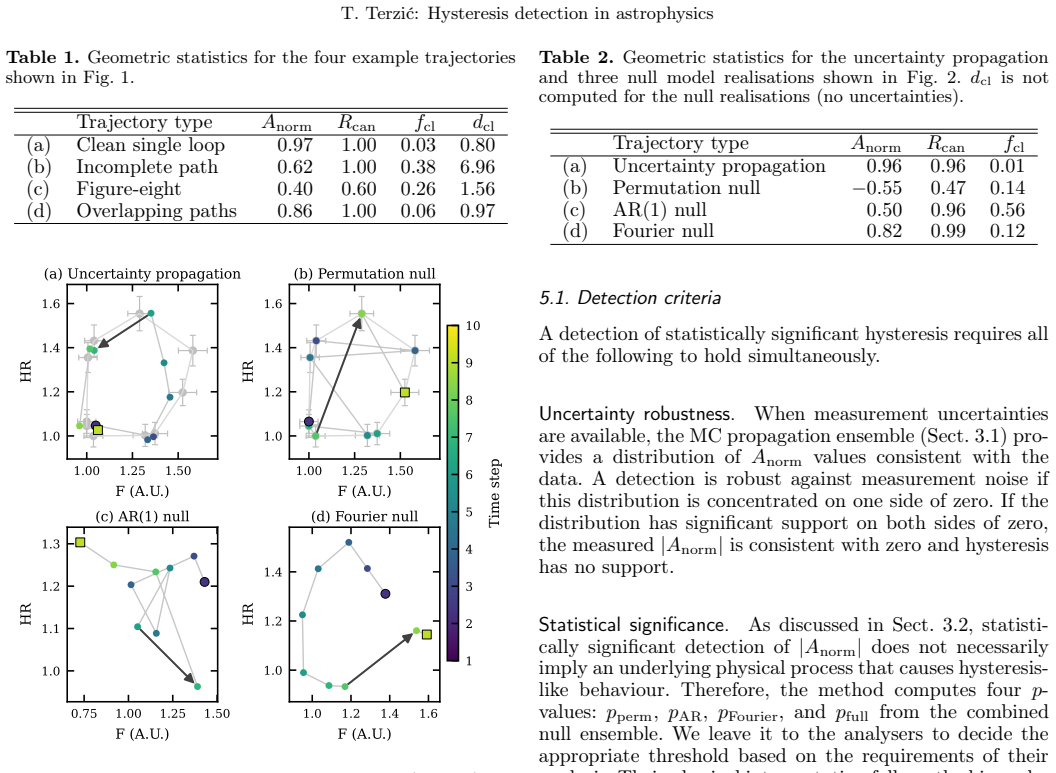
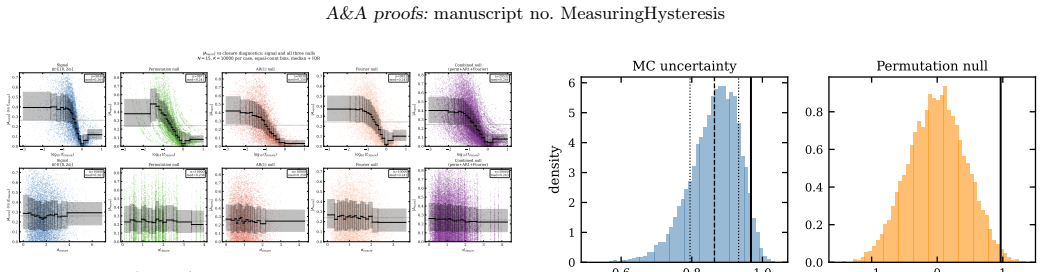
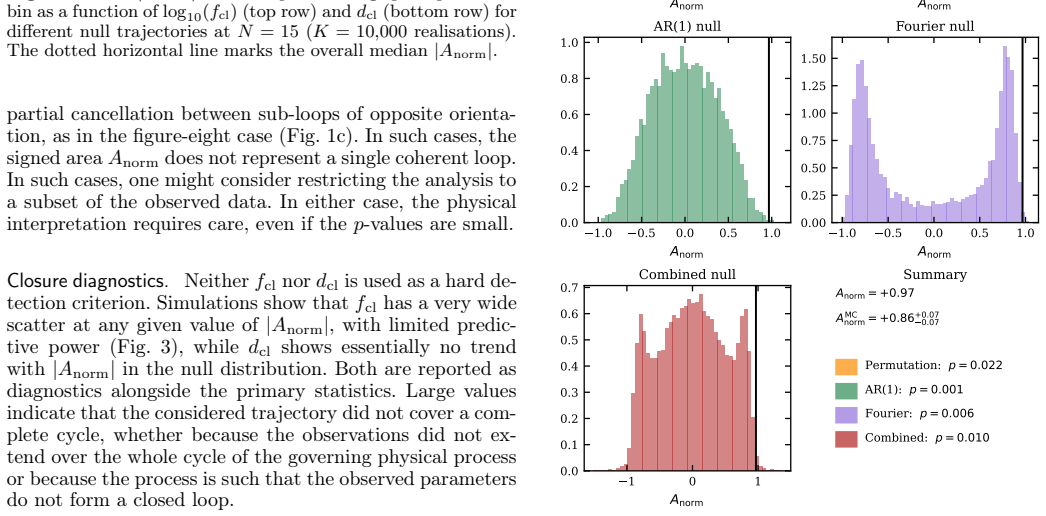
The framework supplies the normalised signed area A_norm, computed from the shoelace formula on time-ordered points in the two-dimensional parameter plane, as a quantifiable and statistically testable indicator of hysteresis; open and closed estimators together with cancellation diagnostics classify trajectory geometry, uncertainties are propagated by Monte Carlo, and significance is evaluated against three families of surrogate models that destroy temporal ordering while preserving marginal statistics.
What carries the argument
The normalised signed area A_norm enclosed by chronologically ordered points, computed via the shoelace formula and tested against time-order, autoregressive, and Fourier-phase surrogate ensembles.
If this is right
- Quantitative comparison of hysteresis strength and direction becomes possible across hardness-intensity diagrams of accreting black holes and radio-to-X-ray planes of outbursts.
- Claims of hysteresis in AGN flaring episodes or solar-cycle indices can be subjected to the same null-model tests.
- Open versus closed trajectory geometries can be distinguished automatically via the cancellation diagnostics.
- Uncertainties in spectral parameters are folded into the area statistic, allowing noise-robust classification.
Where Pith is reading between the lines
- The same area statistic could be applied directly to other ordered two-dimensional astrophysical time series such as solar activity indices without modification.
- If longer or better-sampled observations of the same source were re-analysed, the current non-significant result against surrogates might cross the detection threshold.
- The framework's reliance on surrogate ensembles suggests a natural extension to model-selection problems where the physical process itself generates the null distribution.
Load-bearing premise
The chosen surrogate models correctly represent the null hypothesis of no true hysteresis while preserving the statistical properties of the observed time series.
What would settle it
A set of synthetic trajectories with known injected hysteresis that the framework consistently fails to flag above the surrogate thresholds, or an observed trajectory that yields high A_norm yet shows no physical expectation of hysteresis.
Figures

read the original abstract
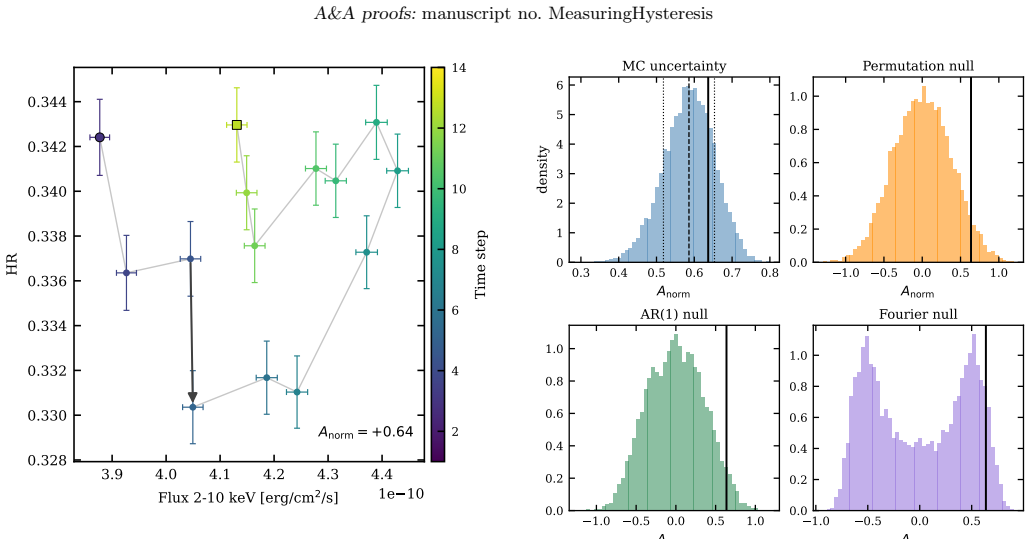
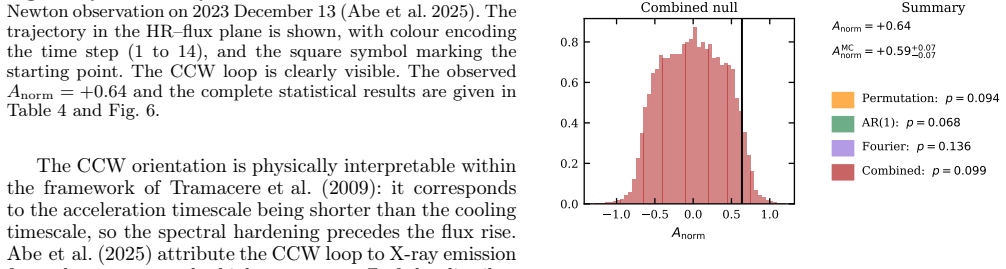
Loop-like patterns between spectral parameters are frequently interpreted as evidence of hysteresis in time-dependent astrophysical emission processes. Such patterns have been reported in hardness-intensity diagrams (HID) of accreting black-hole X-ray binaries during state transitions, in the radio-to-X-ray correlation plane during outbursts, in solar activity indices over the solar cycle, and in the spectral energy distribution of active galactic nuclei during flaring episodes. HID often exhibit apparent loops, whose orientation encodes the relative timescales of particle acceleration and radiative cooling. Visual inspection, however, does not provide a statistically controlled detection method. We develop a statistically robust and empirically calibrated framework for detecting, quantifying, and classifying hysteresis patterns in ordered two-dimensional data with measurement uncertainties. The framework provides the normalised signed area $A_\mathrm{norm}$ enclosed by chronologically ordered points in the plane as the primary detection statistic, computed using the shoelace formula. We define open and closed area estimators, introduce cancellation diagnostics for multi-loop structures, and propagate measurement uncertainties via Monte Carlo sampling. Statistical significance is assessed using null ensembles generated by time-order randomization, physically motivated autoregressive surrogate models, and Fourier phase-randomized surrogates. We validate the method on synthetic blazar flare trajectories, and demonstrate its application to an XMM-Newton observation of Markarian~421 during a December 2023 flaring episode, where we confirm a CCW hysteresis loop with $A_\mathrm{norm} = +0.64$ that is robust against measurement noise but does not reach formal significance against stochastic null models, possibly due to the open trajectory geometry.
Editorial analysis
A structured set of objections, weighed in public.
Referee Report
Summary. The manuscript develops a framework for detecting, quantifying, and classifying hysteresis patterns in ordered two-dimensional astrophysical time-series data. The primary statistic is the normalized signed area A_norm enclosed by chronologically ordered points, computed via the shoelace formula. The work defines open and closed area estimators, cancellation diagnostics, Monte Carlo uncertainty propagation, and significance testing against three surrogate ensembles (time-order randomization, autoregressive processes, Fourier phase randomization). It reports validation on synthetic blazar flare trajectories and applies the method to an XMM-Newton observation of Markarian 421, finding a counterclockwise loop with A_norm = +0.64 that remains robust to measurement noise but does not reach formal significance against the null models, possibly owing to open trajectory geometry.
Significance. If the surrogate-based significance testing and synthetic validation hold, the parameter-free A_norm statistic (derived directly from the shoelace formula without additional fitted parameters) would offer a reproducible, quantitative alternative to visual inspection of hysteresis loops in hardness-intensity diagrams, radio-X-ray correlations, and AGN flares. The explicit handling of open trajectories and measurement uncertainties addresses a practical need in the field. However, the demonstration application does not achieve formal significance, limiting the immediate impact of the empirical result.
major comments (2)
- [Abstract] Abstract and application section: the central claim of a 'statistically robust' framework rests on the fidelity of the three surrogate models to the null hypothesis of no true hysteresis. The reported Mrk 421 result (A_norm = +0.64) does not reach formal significance against these ensembles and is attributed to open trajectory geometry; this indicates that the surrogates may not adequately destroy directional structure or preserve the relevant statistical properties (autocorrelation, power spectrum) for open paths, undermining the robustness assessment.
- [Abstract] Validation paragraph: the manuscript states that the method was validated on synthetic blazar flare trajectories, yet no quantitative performance metrics (e.g., detection power, false-positive rates under controlled hysteresis amplitudes, or calibration of A_norm distributions) are provided. Without these, it is difficult to evaluate whether the framework correctly identifies known hysteresis signals while controlling type-I error.
minor comments (2)
- Notation: clarify whether A_norm is normalized by the convex-hull area or by the total path length, and state the exact normalization formula explicitly.
- Figure captions and text should consistently distinguish the three surrogate types and report the exact number of realizations used to construct the null distributions.
Simulated Author's Rebuttal
We thank the referee for their careful reading and constructive feedback on our manuscript. The comments highlight important points regarding the surrogate ensembles and the need for quantitative validation metrics. We address each below and commit to revisions that strengthen the presentation without altering the core claims.
read point-by-point responses
-
Referee: [Abstract] Abstract and application section: the central claim of a 'statistically robust' framework rests on the fidelity of the three surrogate models to the null hypothesis of no true hysteresis. The reported Mrk 421 result (A_norm = +0.64) does not reach formal significance against these ensembles and is attributed to open trajectory geometry; this indicates that the surrogates may not adequately destroy directional structure or preserve the relevant statistical properties (autocorrelation, power spectrum) for open paths, undermining the robustness assessment.
Authors: We appreciate the referee's scrutiny of the surrogate construction. The three ensembles (time-order randomization, AR(1) processes, and Fourier phase randomization) are standard choices that respectively destroy temporal ordering, preserve linear autocorrelation structure, and preserve the power spectrum while randomizing phases. For open trajectories, these surrogates still eliminate the specific chronological directional bias that produces net signed area in the observed data; any residual structure in the surrogates reflects the null of stochastic processes that could coincidentally produce apparent loops. The non-significance of the Mrk 421 result is reported transparently and is consistent with the open geometry reducing the enclosed area. We will add an explicit paragraph in the revised methods and discussion sections clarifying the behavior of each surrogate on open versus closed paths and noting this as a limitation of the current null models for highly open trajectories. revision: partial
-
Referee: [Abstract] Validation paragraph: the manuscript states that the method was validated on synthetic blazar flare trajectories, yet no quantitative performance metrics (e.g., detection power, false-positive rates under controlled hysteresis amplitudes, or calibration of A_norm distributions) are provided. Without these, it is difficult to evaluate whether the framework correctly identifies known hysteresis signals while controlling type-I error.
Authors: The referee is correct that the current manuscript text does not report explicit quantitative performance metrics such as detection power curves or false-positive rates as a function of hysteresis amplitude. While synthetic trajectories were generated and inspected during method development, the validation section focuses on qualitative demonstration rather than tabulated metrics. We will revise the validation section to include a new table and accompanying text reporting detection power, false-positive rates at fixed significance thresholds, and calibration of the A_norm distribution under controlled synthetic conditions with varying noise and loop amplitudes. revision: yes
Circularity Check
No significant circularity; derivation uses direct geometric statistic and independent surrogates
full rationale
The paper's central statistic A_norm is defined as the normalised signed area computed via the standard shoelace formula applied to chronologically ordered data points with uncertainties propagated by Monte Carlo. This is a direct geometric calculation, not fitted to or defined in terms of any hysteresis property or target result. Significance is assessed against three independently generated surrogate ensembles (time-order randomization, autoregressive models, Fourier phase randomization) constructed from the observed time series properties without reference to the measured A_norm. No self-citations, uniqueness theorems, or ansatzes from prior author work are invoked as load-bearing justifications. Validation on synthetic trajectories and application to Mrk 421 data do not reduce any claim to a tautology or fitted input renamed as prediction. The derivation chain is therefore self-contained against external benchmarks.
Axiom & Free-Parameter Ledger
axioms (2)
- domain assumption Chronological ordering of points is meaningful for computing enclosed area in the chosen parameter plane.
- standard math Shoelace formula computes signed area for any ordered 2D polygon.
Reference graph
Works this paper leans on
-
[1]
Takahashi, T. and Tashiro, M. and Madejski, G. and Kubo, H. and Kamae, T. and Kataoka, J. and Kii, T. and Makino, F. and Makishima, K. and Yamasaki, N. ASCA Observation of an X-Ray/TeV Flare from the BL Lacertae Object Markarian 421. Astrophys. J. Lett. 1996. doi:10.1086/310302
-
[2]
Fossati, G. and Celotti, A. and Chiaberge, M. and Zhang, Y. H. and Chiappetti, L. and Ghisellini, G. and Maraschi, L. and Tavecchio, F. and Pian, E. and Treves, A. X-ray emission of mkn 421: new clues from its spectral evolution. 2. spectral analysis and physical constraints. Astrophys. J. 2000. doi:10.1086/309430. arXiv:astro-ph/0005067
work page internal anchor Pith review Pith/arXiv arXiv doi:10.1086/309430 2000
-
[3]
Large Hysteretic Behavior of Stellar Black Hole Candidate X-Ray Binaries. , keywords =. doi:10.1086/187804 , adsurl =
-
[4]
The evolution of the timing properties of the black-hole transient GX 339-4 during its 2002/2003 outburst. , keywords =. doi:10.1051/0004-6361:20042457 , archivePrefix =. astro-ph/0504577 , primaryClass =
work page internal anchor Pith review Pith/arXiv arXiv doi:10.1051/0004-6361:20042457 2002
-
[5]
Hysteresis in a Solar Activity Cycle
Hysteresis in a Solar Activity Cycle. , keywords =. doi:10.1007/s11207-011-9889-0 , archivePrefix =. 1112.5236 , primaryClass =
work page internal anchor Pith review Pith/arXiv arXiv doi:10.1007/s11207-011-9889-0
-
[6]
Effects of hysteresis in solar cycle variations between flare index and cosmic rays. , keywords =. doi:10.1016/S1384-1076(03)00063-0 , adsurl =
-
[7]
Observations of Hysteresis in Solar Cycle Variations among Seven Solar Activity Indicators. , keywords =. doi:10.1007/BF00712896 , adsurl =
-
[8]
Time-lag Between Disk and Corona Radiation Leads to Hysteresis Effect Observed in Black hole X-Ray Binary MAXI J1348-630. , keywords =. doi:10.3847/2041-8213/ac0a7b , archivePrefix =. 2102.09138 , primaryClass =
-
[9]
GX 339-4: the distance, state transitions, hysteresis and spectral correlations. , keywords =. doi:10.1111/j.1365-2966.2004.07830.x , archivePrefix =. astro-ph/0402380 , primaryClass =
-
[10]
A Search for Spectral Hysteresis and Energy-dependent Time Lags from X-Ray and TeV Gamma-Ray Observations of Mrk 421. , keywords =. doi:10.3847/1538-4357/834/1/2 , archivePrefix =. 1611.04626 , primaryClass =
work page internal anchor Pith review Pith/arXiv arXiv doi:10.3847/1538-4357/834/1/2
-
[11]
M., Tremonti, C., et al.\ 2003, , 346, 1055, doi:10.1111/j.1365-2966.2003.07154.x
On characterizing the variability properties of X-ray light curves from active galaxies. , keywords =. doi:10.1046/j.1365-2966.2003.07042.x , archivePrefix =. astro-ph/0307420 , primaryClass =
-
[12]
2002, MNRAS, 329, 355, doi: 10.1046/j.1365-8711.2002.04988.x
Measuring the broad-band power spectra of active galactic nuclei with RXTE. , keywords =. doi:10.1046/j.1365-8711.2002.05298.x , archivePrefix =. astro-ph/0201134 , primaryClass =
-
[13]
Non-linear X-ray variability in X-ray binaries and active galaxies. , keywords =. doi:10.1111/j.1365-2966.2005.08886.x , archivePrefix =. astro-ph/0502112 , primaryClass =
-
[14]
X-ray continuum variability of MCG-6-30-15. , keywords =. doi:10.1046/j.1365-8711.2003.06285.x , archivePrefix =. astro-ph/0211421 , primaryClass =
-
[15]
Combined long and short time-scale X-ray variability of NGC 4051 with RXTE and XMM-Newton. , keywords =. doi:10.1111/j.1365-2966.2004.07376.x , archivePrefix =. astro-ph/0311220 , primaryClass =
-
[16]
and Kitamoto, S
Miyamoto, S. and Kitamoto, S. and Hayashida, K. and Egoshi, W. , title =. , year =
-
[17]
Zdziarski, A. A. and Gierli. Statistical properties of the variability of. , year =
-
[18]
and Homan, J
Belloni, T. and Homan, J. and Casella, P. and others , title =. , year =
-
[19]
and Cai, Z.-Y
Weng, S.-S. and Cai, Z.-Y. and Zhang, S.-N. and others , title =. , year =
-
[20]
and Tashiro, M
Takahashi, T. and Tashiro, M. and Madejski, G. and others , title =. , year =
-
[21]
and Celotti, A
Fossati, G. and Celotti, A. and Chiaberge, M. and others , title =. , year =
-
[22]
Bachmann, K. T. and White, O. R. , title =. , year =
-
[23]
2003 , volume =
Hysteresis effect in the correlation of solar indices , journal =. 2003 , volume =
2003
-
[24]
and Prasad, A
Suyal, V. and Prasad, A. and Singh, H. P. , title =. , year =
-
[25]
and McHardy, I
Uttley, P. and McHardy, I. M. and Papadakis, I. E. , title =. , year =
-
[26]
and Edelson, R
Vaughan, S. and Edelson, R. and Warwick, R. S. and Uttley, P. , title =. , year =
-
[27]
and Fabian, A
Vaughan, S. and Fabian, A. C. and Nandra, K. , title =. , year =
-
[28]
McHardy, I. M. and Papadakis, I. E. and Uttley, P. and Page, M. J. and Mason, K. O. , title =. , year =
-
[29]
and McHardy, I
Uttley, P. and McHardy, I. M. and Vaughan, S. , title =. , year =
-
[30]
Timmer, J. and K. On generating power law noise , journal =. 1995 , volume =
1995
-
[31]
and McHardy, I
Emmanoulopoulos, D. and McHardy, I. M. and Papadakis, I. E. , title =. , year =
-
[32]
Scargle, J. D. , title =. , year =
-
[33]
, year =
Understanding the. , year =
-
[34]
and Perri, M
Massaro, E. and Perri, M. and Giommi, P. and Nesci, R. , title =. , year =
-
[35]
, title =
Hameury, J.-M. , title =. Adv. Space Res. , year =
-
[36]
Saxton, R. D. and Read, A. M. and Esquej, P. and others , title =. , year =
-
[37]
and Coriat, M
Corbel, S. and Coriat, M. and Brocksopp, C. and others , title =. , year =
-
[38]
Dunn, R. J. H. and Fender, R. P. and K. A global study of the behaviour of black hole X-ray binary discs , journal =. 2010 , volume =
2010
-
[39]
and Steiner, J
Kara, E. and Steiner, J. F. and Fabian, A. C. and others , title =. , year =
-
[40]
and Zhang, S
Hao, J. and Zhang, S. N. , title =. , year =
-
[41]
Ryan, J. L. and Sharma, R. and Marscher, A. P. and others , title =. , year =
-
[42]
, title =
Akaike, H. , title =. IEEE Trans. Autom. Control , year =
-
[43]
Kylafis, N. D. and Reig, P. , title =. , year =
-
[44]
Press, W. H. and Teukolsky, S. A. and Vetterling, W. T. and Flannery, B. P. , title =
-
[45]
Davison, A. C. and Hinkley, D. V. , title =
-
[46]
Brockwell, P. J. and Davis, R. A. , title =
-
[47]
Paolillo, M. and others. The universal shape of the X-ray variability power spectrum of AGN up to z 3. 2023. doi:10.1051/0004-6361/202245291. arXiv:2302.08524
-
[48]
The accretion ejection connection in the black hole X-ray binary MAXI J1820+070. , keywords =. doi:10.1093/mnras/staf1098 , archivePrefix =. 2507.11303 , primaryClass =
-
[49]
and Giommi, P
Tramacere, A. and Giommi, P. and Perri, M. and Verrecchia, F. and Tosti, G. , title =. , year =
-
[50]
Kirk, J. G. and Rieger, F. M. and Mastichiadis, A. , title =. , year =
-
[51]
Li, H. and Kusunose, M. , title =. , year =. doi:10.1086/308971 , archivePrefix =
-
[52]
Tramacere, A. and Massaro, E. and Taylor, A. M. , title =. , year =. doi:10.1088/0004-637X/739/2/66 , archivePrefix =
-
[53]
Fossati, G. and Celotti, A. and Chiaberge, M. and Zhang, Y. H. and Chiappetti, L. and Ghisellini, G. and Maraschi, L. and Tavecchio, F. and Pian, E. and Treves, A. , title =. , year =. doi:10.1086/309411 , archivePrefix =
-
[54]
Roy, N. and Chatterjee, R. and Joshi, M. and Ghosh, A. , title =. , year =. doi:10.1093/mnras/sty2748 , archivePrefix =
-
[55]
Thevenet, P. and Zech, A. and Boisson, C. and Dmytriiev, A. , title =. , year =. doi:10.1051/0004-6361/202554153 , archivePrefix =
-
[56]
Kapanadze, B. and Gurchumelia, A. and Dorner, D. and Vercellone, S. and Romano, P. and Hughes, P. and Aller, M. and Aller, H. and Kharshiladze, O. Swift Observations of Mrk 421 in Selected Epochs. III. Extreme X-Ray Timing/Spectral Properties and Multiwavelength Lognormality during 2015 December 2018 April. Astrophys. J. Suppl. 2020. doi:10.3847/1538-4365...
-
[57]
Kapanadze, B. and Gurchumelia, A. and Aller, M. Swift Observations of Mrk 421 in Selected Epochs. IV. Physical Implications of X-Ray Flaring Activity and Features of Relativistic Magnetic Reconnection in 2018 April 2023 December. Astrophys. J. Suppl. 2024. doi:10.3847/1538-4365/ad7d0c
-
[58]
Levy, C. and Sol, H. and Bolmont, J. Separating source-intrinsic and Lorentz invariance violation induced delays in the very high-energy emission of blazar flares. Astron. Astrophys. 2024. doi:10.1051/0004-6361/202450140. arXiv:2406.01182
-
[59]
Perennes, C. and Sol, H. and Bolmont, J. Modeling spectral lags in active galactic nucleus flares in the context of Lorentz invariance violation searches. Astron. Astrophys. 2020. doi:10.1051/0004-6361/201936430. arXiv:1911.10377
-
[60]
Abe, K. and others. Insights from the first flaring activity of a high synchrotron peaked blazar with X-ray polarization and VHE gamma rays. Astron. Astrophys. 2025. doi:10.1051/0004-6361/202452785. arXiv:2410.23140
-
[61]
Abe, K. and others. Time-dependent Modeling of the Subhour Spectral Evolution during the 2013 Outburst of Mrk 421. Astrophys. J. 2026. doi:10.3847/1538-4357/ae25f0. arXiv:2509.08686
discussion (0)
Sign in with ORCID, Apple, or X to comment. Anyone can read and Pith papers without signing in.