Joint inference of line-of-sight acceleration and orbital eccentricity in neutron-star--black-hole binaries
Pith reviewed 2026-06-29 03:21 UTC · model grok-4.3
The pith
All five neutron-star black-hole mergers remain consistent with zero line-of-sight acceleration.
A machine-rendered reading of the paper's core claim, the machinery that carries it, and where it could break.
Core claim
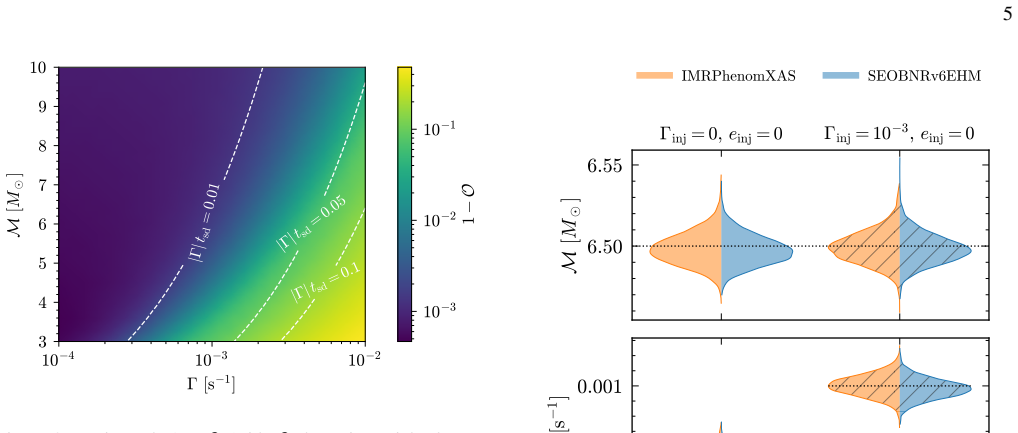
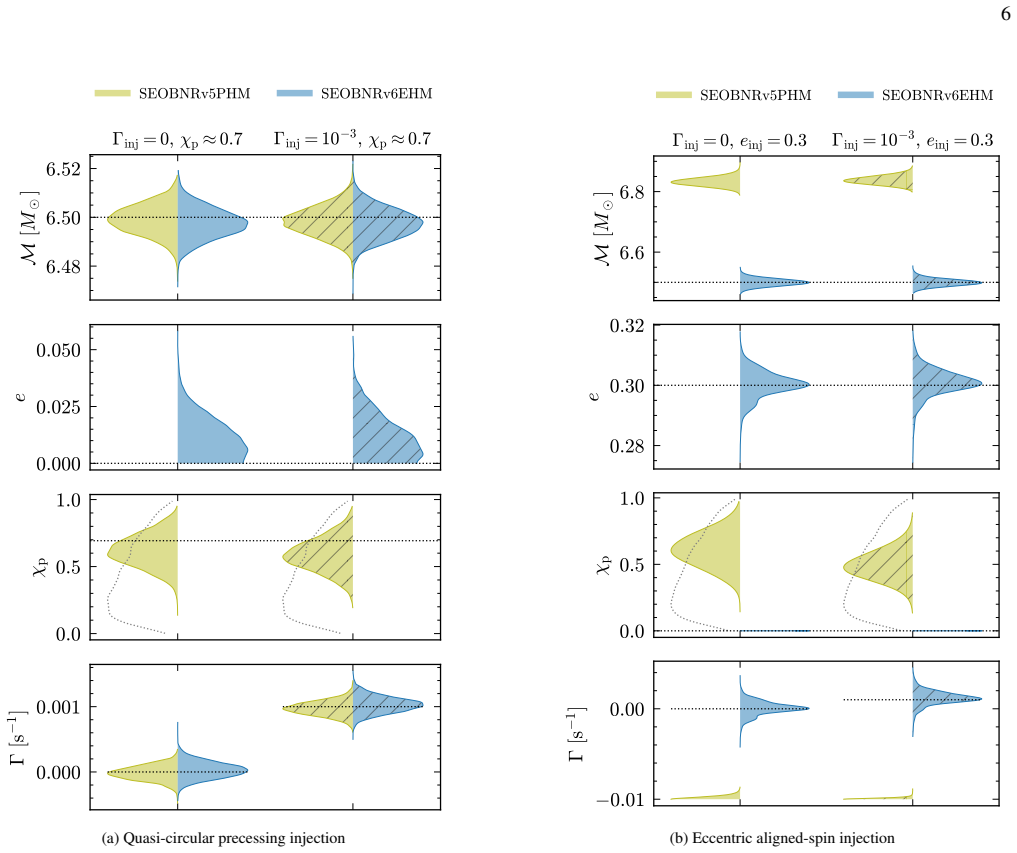
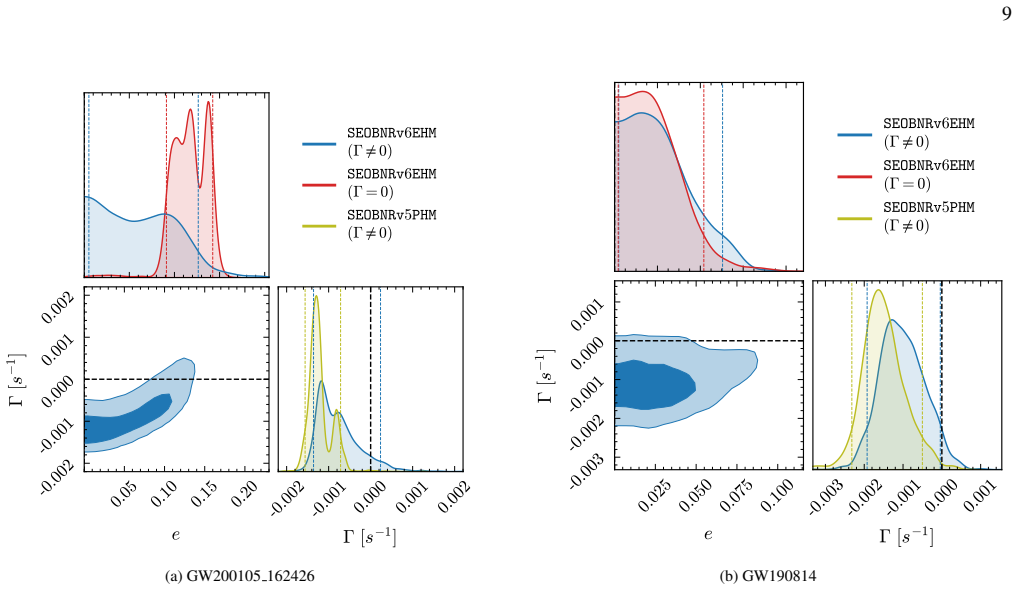
Implementing line-of-sight acceleration as a direct time-domain remap of the strain inside SEOBNRv6EHM recovers the acceleration parameter correctly on both eccentric and spin-precessing injections, whereas SEOBNRv5PHM yields spurious acceleration measurements on eccentric signals. When the same framework is applied to the five NSBH events, every event is consistent with Γ ≡ a∥/c = 0; the joint (Γ, e) posterior for GW200105_162426 nevertheless disfavors the case in which both parameters are simultaneously zero at 90 percent credibility.
What carries the argument
The time-domain remapping of the strain that incorporates the Doppler modulation from line-of-sight acceleration, which applies uniformly across all modes, precession, and eccentricity.
If this is right
- The eccentric waveform model can be trusted for LOSA measurements even when orbital eccentricity is present.
- Three NSBH events receive their first published LOSA constraints.
- Joint inference of LOSA and eccentricity supplies a single-event diagnostic for dynamical formation channels.
- Previous eccentricity hints in GW200105_162426 survive after marginalizing over possible line-of-sight acceleration.
Where Pith is reading between the lines
- Future higher-accuracy waveforms could decide whether the remaining tension in GW200105 reflects a genuine dynamical signature or residual model error.
- Extending the same joint analysis to additional compact-binary classes might reveal statistical patterns linking acceleration to specific tertiary perturbers.
- The uniform treatment of eccentricity and acceleration reduces the chance that one effect is misattributed to the other in upcoming detections.
Load-bearing premise
The chosen SEOBNR waveform models together with the LOSA remapping fully capture all relevant physics and do not introduce unmodeled systematics that could mimic or mask a true LOSA signal.
What would settle it
A future NSBH event whose joint posterior strongly favors non-zero LOSA at high credibility, or an injection-recovery test in which the remapping fails to recover a known injected acceleration once additional physical effects are included.
Figures


read the original abstract
A line-of-sight acceleration (LOSA) of a compact-binary center of mass, imparted for example by a nearby tertiary perturber, imprints a Doppler modulation on the gravitational-wave signal and provides a single-event diagnostic of dynamical formation environments. Waveform-modeling systematics -- missing higher-order modes, spin precession, or orbital eccentricity -- can mimic or mask a non-zero LOSA, making waveform accuracy a leading concern for LOSA inference. We implement LOSA corrections directly in the time domain as a remap of the strain: the treatment applies uniformly to all mode content, spin precession, and orbital eccentricity, and integrates naturally with time-domain inspiral-merger-ringdown models that best capture these effects. We deploy it in the SEOBNRv6EHM (aligned-spin eccentric) and SEOBNRv5PHM (precessing quasi-circular) models, and validate the implementation on simulated signals; we find that SEOBNRv6EHM recovers LOSA correctly on both eccentric and spin-precessing injections, while SEOBNRv5PHM yields a spurious LOSA measurement on eccentric signals. Motivated by the eccentricity hints in the neutron-star--black-hole (NSBH) event GW200105_162426 and the favorable low-mass regime of these sources, we jointly infer LOSA and orbital eccentricity for the five NSBH events in the LIGO-Virgo-KAGRA catalog, reporting the first LOSA constraints on three of them. All five events are consistent with a vanishing LOSA, $\Gamma \equiv a_\parallel/c = 0$; for GW200105_162426, the joint $(\Gamma, e)$ posterior nonetheless disfavors both $\Gamma$ and $e$ being zero simultaneously at 90% credibility, supporting the eccentricity hints reported in previous analyses.
Editorial analysis
A structured set of objections, weighed in public.
Referee Report
Summary. The paper implements line-of-sight acceleration (LOSA, via Γ ≡ a∥/c) as a time-domain remap of the strain that applies uniformly across modes, precession, and eccentricity. It deploys the correction in SEOBNRv6EHM (aligned-spin eccentric) and SEOBNRv5PHM (precessing quasi-circular), validates recovery on simulated signals (correct with v6EHM, spurious LOSA with v5PHM on eccentric injections), and performs joint LOSA+eccentricity inference on the five NSBH events in the LVK catalog. All five events are reported consistent with Γ=0; the joint (Γ,e) posterior for GW200105_162426 disfavors (Γ=0,e=0) simultaneously at 90% credibility.
Significance. If robust, the work supplies the first LOSA constraints on NSBH binaries and bolsters existing eccentricity indications for GW200105_162426 as a formation-channel diagnostic. The time-domain remapping is a technical strength because it integrates directly with inspiral-merger-ringdown models that already include eccentricity and precession. Validation on simulated signals is explicitly credited as demonstrating differential model performance.
major comments (1)
- [Abstract] Abstract: the headline 90% credibility disfavoring of (Γ=0,e=0) for GW200105_162426 is reported without stating which waveform model (SEOBNRv6EHM or SEOBNRv5PHM) was used for that posterior. The manuscript demonstrates that SEOBNRv5PHM returns spurious non-zero LOSA on eccentric injections while SEOBNRv6EHM recovers the injected value correctly; because the joint analysis is motivated by eccentricity hints, the model choice is load-bearing for whether the exclusion is physical or an artifact.
Simulated Author's Rebuttal
We thank the referee for their detailed review and for highlighting the need for clarity in the abstract regarding the waveform model. We address the comment below and will make the requested revision.
read point-by-point responses
-
Referee: [Abstract] Abstract: the headline 90% credibility disfavoring of (Γ=0,e=0) for GW200105_162426 is reported without stating which waveform model (SEOBNRv6EHM or SEOBNRv5PHM) was used for that posterior. The manuscript demonstrates that SEOBNRv5PHM returns spurious non-zero LOSA on eccentric injections while SEOBNRv6EHM recovers the injected value correctly; because the joint analysis is motivated by eccentricity hints, the model choice is load-bearing for whether the exclusion is physical or an artifact.
Authors: We agree that the abstract should explicitly identify the waveform model for the joint (Γ, e) posterior on GW200105_162426. This analysis was performed with SEOBNRv6EHM, the aligned-spin eccentric model, because the joint inference targets orbital eccentricity (the SEOBNRv5PHM results are reported separately for the quasi-circular precessing case). We will revise the abstract to state that the joint posterior was obtained with SEOBNRv6EHM, thereby removing any ambiguity about whether the reported 90% credibility exclusion is physical or an artifact of model mismatch. revision: yes
Circularity Check
No circularity: posteriors are direct Bayesian outputs from catalog data
full rationale
The paper's central results are joint posteriors on LOSA (Γ) and eccentricity (e) obtained via standard Bayesian sampling of LIGO-Virgo-KAGRA strain data using the implemented LOSA remapping inside SEOBNR models. No equation defines a parameter in terms of the target posterior, no fitted input is relabeled as a prediction, and no self-citation chain is invoked to justify the reported consistency with Γ=0 or the 90% disfavoring of (Γ=0,e=0) for GW200105. Validation on injections is external to the real-event inference and does not reduce the claims to internal definitions. The derivation chain is therefore self-contained against the external strain data.
Axiom & Free-Parameter Ledger
axioms (1)
- standard math General relativity governs the propagation and generation of gravitational waves from compact binaries
Reference graph
Works this paper leans on
-
[1]
Analysis of GW200105 162426 For GW200105 162426, multiple independent analyses have indicated signs of non-zero orbital eccentricity, with some sensitivity to prior choices [42, 45, 46, 48, 49, 54]. Ref. [72] additionally reported aΓconstraint with the PN inspiral-only eccentric–precessing modelpyEFPE, finding a broadening of the eccentricity posterior wh...
-
[2]
Among the five events, GW190814 is the only one with a previous LOSA claim in the literature: Ref
Analysis of GW190814 GW190814 has been analyzed several times for LOSA in the recent literature, with conflicting conclusions whose dif- ferences trace to choices of signal duration and waveform modeling systematics; we briefly summarize them before placing our result. Among the five events, GW190814 is the only one with a previous LOSA claim in the liter...
-
[3]
Making Sense of the Unexpected in the Gravitational- Wave Sky
Astrophysical implications The marginalΓposteriors of Table I can be recast as ex- clusion regions on the massM • and separationrof a putative tertiary perturber via Eq. (6) of Ref. [64], Γ≈4.65×10 −12 s−1 M• 1010 M⊙ ! r 1 pc !−2 cosθ,(4) whereθis the angle between the acceleration vector (which, for a spherically symmetric potential, is aligned with the ...
-
[4]
Aasi et al.,Advanced LIGO, Class
LIGO Scientificcollaboration, J. Aasi et al.,Advanced LIGO, Class. Quant. Grav.32(2015) 074001 [1411.4547]
Pith/arXiv arXiv 2015
-
[5]
VIRGO collaboration, F. Acernese et al.,Advanced Virgo: a second-generation interferometric gravitational wave detector,Class. Quant. Grav.32(2015) 024001 [1408.3978]
Pith/arXiv arXiv 2015
-
[6]
KAGRA collaboration, T. Akutsu et al.,Overview of KAGRA: Detector design and construction history,PTEP2021(2021) 05A101 [2005.05574]
arXiv 2021
-
[7]
LIGO Scientific, Virgocollaboration, B. P. Abbott et al., Observation of Gravitational Waves from a Binary Black Hole Merger,Phys. Rev. Lett.116(2016) 061102 [1602.03837]
Pith/arXiv arXiv 2016
-
[8]
LIGO Scientific, Virgocollaboration, B. P. Abbott et al., GWTC-1: A Gravitational-Wave Transient Catalog of Compact Binary Mergers Observed by LIGO and Virgo during the First and Second Observing Runs,Phys. Rev. X9 (2019) 031040 [1811.12907]
Pith/arXiv arXiv 2019
-
[9]
LIGO Scientific, Virgocollaboration, R. Abbott et al., GWTC-2: Compact Binary Coalescences Observed by LIGO and Virgo During the First Half of the Third Observing Run, Phys. Rev. X11(2021) 021053 [2010.14527]
Pith/arXiv arXiv 2021
-
[10]
LIGO Scientific, VIRGO collaboration, R. Abbott et al., GWTC-2.1: Deep extended catalog of compact binary coalescences observed by LIGO and Virgo during the first half of the third observing run,Phys. Rev. D109(2024) 022001 [2108.01045]
Pith/arXiv arXiv 2024
-
[11]
KAGRA, VIRGO, LIGO Scientificcollaboration, R. Abbott et al.,GWTC-3: Compact Binary Coalescences Observed by LIGO and Virgo during the Second Part of the Third Observing Run,Phys. Rev. X13(2023) 041039 [2111.03606]
Pith/arXiv arXiv 2023
-
[12]
LIGO Scientific, VIRGO, KAGRA collaboration, A. G. Abac et al.,GWTC-4.0: Updating the Gravitational-Wave Transient Catalog with Observations from the First Part of the Fourth LIGO-Virgo-KAGRA Observing Run, 2508.18082
-
[13]
LIGO Scientific, VIRGO, KAGRA collaboration, GWTC-5.0: Observations from the Second Part of the Fourth LIGO-Virgo-KAGRA Observing Run and Updates to the Gravitational-Wave Transient Catalog,2605.27225
-
[14]
LIGO Scientific, VIRGO, KAGRA collaboration, GWTC-5.0: Population Properties of Merging Compact Binaries,2605.27226
-
[15]
Peters and J
P. Peters and J. Mathews,Gravitational radiation from point masses in a Keplerian orbit,Phys.Rev.131(1963) 435
1963
-
[16]
P. C. Peters,Gravitational Radiation and the Motion of Two Point Masses,Phys. Rev.136(1964) B1224
1964
-
[17]
L. Wen,On the eccentricity distribution of coalescing black hole binaries driven by the Kozai mechanism in globular clusters,Astrophys. J.598(2003) 419 [astro-ph/0211492]
Pith/arXiv arXiv 2003
-
[18]
R. M. O’Leary, B. Kocsis and A. Loeb,Gravitational waves from scattering of stellar-mass black holes in galactic nuclei, Mon. Not. Roy. Astron. Soc.395(2009) 2127 [0807.2638]
Pith/arXiv arXiv 2009
-
[19]
J. Samsing, M. MacLeod and E. Ramirez-Ruiz,The Formation of Eccentric Compact Binary Inspirals and the Role of Gravitational Wave Emission in Binary-Single Stellar Encounters,Astrophys. J.784(2014) 71 [1308.2964]
Pith/arXiv arXiv 2014
-
[20]
Samsing,Eccentric Black Hole Mergers Forming in Globular Clusters,Phys
J. Samsing,Eccentric Black Hole Mergers Forming in Globular Clusters,Phys. Rev. D97(2018) 103014 [1711.07452]
Pith/arXiv arXiv 2018
-
[21]
C. L. Rodriguez, P. Amaro-Seoane, S. Chatterjee, K. Kremer, F. A. Rasio, J. Samsing et al.,Post-Newtonian Dynamics in Dense Star Clusters: Formation, Masses, and Merger Rates of Highly-Eccentric Black Hole Binaries,Phys. Rev. D98 (2018) 123005 [1811.04926]
Pith/arXiv arXiv 2018
-
[22]
M. Zevin, J. Samsing, C. Rodriguez, C.-J. Haster and E. Ramirez-Ruiz,Eccentric Black Hole Mergers in Dense Star Clusters: The Role of Binary–Binary Encounters, Astrophys. J.871(2019) 91 [1810.00901]
Pith/arXiv arXiv 2019
-
[23]
J. Samsing, I. Bartos, D. J. D’Orazio, Z. Haiman, B. Kocsis, N. W. C. Leigh et al.,AGN as potential factories for eccentric black hole mergers,Nature603(2022) 237 [2010.09765]
arXiv 2022
- [24]
- [25]
-
[26]
D. Chattopadhyay, J. Stegmann, F. Antonini, J. Barber and I. M. Romero-Shaw,Double black hole mergers in nuclear star clusters: eccentricities, spins, masses, and the growth of massive seeds,Mon. Not. Roy. Astron. Soc.526(2023) 4908 [2308.10884]
arXiv 2023
-
[27]
J. Stegmann and J. Klencki,Orbital Eccentricity and Spin–Orbit Misalignment Are Evidence that Neutron Star–Black Hole Mergers Form through Triple Star Evolution,Astrophys. J. Lett.991(2025) L54 [2506.09121]
arXiv 2025
- [28]
-
[29]
A. Ramos-Buades, A. Buonanno, M. Khalil and S. Ossokine, Effective-one-body multipolar waveforms for eccentric binary black holes with nonprecessing spins,Phys. Rev. D 105(2022) 044035 [2112.06952]
arXiv 2022
- [30]
-
[31]
A. Gamboa et al.,Accurate waveforms for eccentric, aligned-spin binary black holes: The multipolar effective-one-body model seobnrv5ehm,Phys. Rev. D112 (2025) 044038 [2412.12823]
arXiv 2025
- [32]
-
[33]
A. Gamboa et al.,Accurate waveforms for generic planar-orbit binary black holes: The multipolar effective-one-body model SEOBNRv6EHM,2605.28715
-
[34]
D. Chiaramello and A. Nagar,Faithful analytical effective-one-body waveform model for spin-aligned, moderately eccentric, coalescing black hole binaries,Phys. Rev. D101(2020) 101501 [2001.11736]
arXiv 2020
- [35]
-
[36]
A. Nagar, D. Chiaramello, R. Gamba, S. Albanesi, S. Bernuzzi, V . Fantini et al.,Effective-one-body waveform model for noncircularized, planar, coalescing black hole binaries. II. High accuracy by improving logarithmic terms in resummations,Phys. Rev. D111(2025) 064050 [2407.04762]
arXiv 2025
-
[37]
S. Albanesi, R. Gamba, S. Bernuzzi, J. Fontbut ´e, A. Gonzalez and A. Nagar,Effective-one-body modeling for generic compact binaries with arbitrary orbits,Phys. Rev. D112 (2025) L121503 [2503.14580]
arXiv 2025
-
[38]
M. d. L. Planas, A. Ramos-Buades, C. Garc ´ıa-Quir´os, H. Estell´es, S. Husa and M. Haney,Time-domain phenomenological multipolar waveforms for aligned-spin binary black holes in elliptical orbits,Phys. Rev. D113 (2026) 024006 [2503.13062]
arXiv 2026
-
[39]
A. Ramos-Buades, Q. Henry and M. Haney,Fast frequency-domain phenomenological modeling of eccentric aligned-spin binary black holes,2601.03340
-
[40]
A. Klein, Y . Boetzel, A. Gopakumar, P. Jetzer and L. de Vittori,Fourier domain gravitational waveforms for precessing eccentric binaries,Phys. Rev. D98(2018) 104043 [1801.08542]
Pith/arXiv arXiv 2018
- [41]
-
[42]
G. Morras, G. Pratten, P. Schmidt and A. Buonanno, Post-Newtonian inspiral waveform model for eccentric precessing binaries with higher-order modes and matter effects,2604.11903
-
[43]
P. J. Nee et al.,Eccentric binary black holes: A new framework for numerical relativity waveform surrogates, 2510.00106
-
[44]
T. Islam et al.,Including higher-order modes in a quadrupolar eccentric numerical relativity surrogate using universal eccentric modulation functions,2604.17868
-
[45]
L. Pompili, A. Gamboa and A. Buonanno,Eccentric and unbound compact binaries in the LIGO-Virgo-KAGRA catalog: parameter estimation and waveform systematics with SEOBNRv6EHM,2605.28716
-
[46]
I. M. Romero-Shaw, P. D. Lasky and E. Thrane,Four Eccentric Mergers Increase the Evidence that LIGO–Virgo–KAGRA’s Binary Black Holes Form Dynamically,Astrophys. J.940(2022) 171 [2206.14695]
arXiv 2022
-
[47]
N. Gupte et al.,Evidence for eccentricity in the population of binary black holes observed by LIGO-Virgo-KAGRA,Phys. Rev. D112(2025) 104045 [2404.14286]
Pith/arXiv arXiv 2025
- [48]
-
[49]
M. d. L. Planas, S. Husa, A. Ramos-Buades and J. Valencia, First Eccentric Inspiral–Merger–Ringdown Analysis of Neutron Star–Black Hole Mergers,Astrophys. J.995(2025) 47 [2506.01760]
arXiv 2025
-
[50]
M. d. L. Planas, A. Ramos-Buades, C. Garc ´ıa-Quir´os, H. Estell´es, S. Husa and M. Haney,Reanalysis of binary black hole gravitational wave events for orbital eccentricity signatures,Phys. Rev. D112(2025) 123004 [2504.15833]
arXiv 2025
- [51]
-
[52]
K. Kacanja, K. Soni and A. H. Nitz,Eccentricity signatures in LIGO-Virgo-KAGRA’s binary neutron star and neutron-star black holes,Phys. Rev. D112(2025) 122007 [2508.00179]
arXiv 2025
-
[53]
N. Gupte et al.,Eccentricity constraints disfavor single-single capture in nuclear star clusters as the origin of all LIGO-Virgo-KAGRA binary black holes,2603.29019
-
[54]
N. Malagon and R. O’Shaughnessy,Assessing the imprint of eccentricity in GW signatures using two independent waveform models,2605.12818
-
[55]
I. M. Romero-Shaw, D. Gerosa and N. Loutrel,Eccentricity or spin precession? Distinguishing subdominant effects in gravitational-wave data,Mon. Not. Roy. Astron. Soc.519 (2023) 5352 [2211.07528]
arXiv 2023
-
[56]
J. Calder ´on Bustillo, N. Sanchis-Gual, A. Torres-Forn´e and J. A. Font,Confusing Head-On Collisions with Precessing Intermediate-Mass Binary Black Hole Mergers,Phys. Rev. Lett.126(2021) 201101 [2009.01066]
arXiv 2021
-
[57]
T. A. Clarke, I. M. Romero-Shaw, C. Hoy, J. Stegmann, P. D. Lasky and E. Thrane,A universal framework to identify eccentric binary mergers: GW200105 case study, 2605.18742. 14
-
[58]
A. Jan, S. Nicolella, D. Shoemaker and R. O’Shaughnessy, Measuring Eccentricity and Addressing Waveform Systematics in GW231123,2512.20060
-
[59]
N. Yunes, M. Coleman Miller and J. Thornburg,The Effect of Massive Perturbers on Extreme Mass-Ratio Inspiral Waveforms,Phys. Rev. D83(2011) 044030 [1010.1721]
Pith/arXiv arXiv 2011
-
[60]
Y . Meiron, B. Kocsis and A. Loeb,Detecting triple systems with gravitational wave observations,Astrophys. J.834 (2017) 200 [1604.02148]
Pith/arXiv arXiv 2017
-
[61]
K. Inayoshi, N. Tamanini, C. Caprini and Z. Haiman,Probing stellar binary black hole formation in galactic nuclei via the imprint of their center of mass acceleration on their gravitational wave signal,Phys. Rev. D96(2017) 063014 [1702.06529]
Pith/arXiv arXiv 2017
-
[62]
T. Robson, N. J. Cornish, N. Tamanini and S. Toonen, Detecting hierarchical stellar systems with LISA,Phys. Rev. D98(2018) 064012 [1806.00500]
Pith/arXiv arXiv 2018
-
[63]
Toubiana et al.,Detectable environmental effects in GW190521-like black-hole binaries with LISA,Phys
A. Toubiana et al.,Detectable environmental effects in GW190521-like black-hole binaries with LISA,Phys. Rev. Lett.126(2021) 101105 [2010.06056]
arXiv 2021
-
[64]
J. Samsing, K. Hendriks, L. Zwick, D. J. D’Orazio and B. Liu,Gravitational Wave Phase Shifts in Eccentric Black Hole Mergers as a Probe of Dynamical Formation Environments,2403.05625
-
[65]
K. Hendriks, L. Zwick and J. Samsing,Eccentric Features in the Gravitational-wave Phase of Dynamically Formed Black Hole Binaries,Astrophys. J.985(2025) 252 [2408.04603]
arXiv 2025
-
[66]
C. Bonvin, C. Caprini, R. Sturani and N. Tamanini,Effect of matter structure on the gravitational waveform,Phys. Rev. D 95(2017) 044029 [1609.08093]
Pith/arXiv arXiv 2017
-
[67]
A. Vijaykumar, A. Tiwari, S. J. Kapadia, K. G. Arun and P. Ajith,Waltzing Binaries: Probing the Line-of-sight Acceleration of Merging Compact Objects with Gravitational Waves,Astrophys. J.954(2023) 105 [2302.09651]
arXiv 2023
-
[68]
E. Barausse, V . Cardoso and P. Pani,Can environmental effects spoil precision gravitational-wave astrophysics?, Phys.Rev.D89(2014) 104059 [1404.7149]
Pith/arXiv arXiv 2014
- [69]
- [70]
-
[71]
J. Tak ´atsy, L. Zwick, K. Hendriks, P. Saini, G. Fabj and J. Samsing,The construction and use of dephasing prescriptions for environmental effects in gravitational wave astronomy,Class. Quant. Grav.42(2025) 215006 [2505.09513]
arXiv 2025
-
[72]
A. Krolak, K. D. Kokkotas and G. Schaefer,On estimation of the postNewtonian parameters in the gravitational wave emission of a coalescing binary,Phys. Rev. D52(1995) 2089 [gr-qc/9503013]
Pith/arXiv arXiv 1995
-
[73]
S. A. Bhat, A. Tiwari, M. A. Shaikh and S. J. Kapadia, Eccentricity evolution consistency test to distinguish eccentric gravitational-wave signals from eccentricity mimickers,Phys. Rev. D112(2025) 124004 [2508.14850]
arXiv 2025
-
[74]
L. Pathak, H. Phurailatpam and A. Gopakumar,On the Presence of a Tertiary Compact Object in GW190814, 2605.21955
-
[75]
S. Roy and J. Janquart,Line-of-sight acceleration in compact binaries with higher harmonics and eccentricity, 2606.08838
-
[76]
Sberna et al.,Observing GW190521-like binary black holes and their environment with LISA,Phys
L. Sberna et al.,Observing GW190521-like binary black holes and their environment with LISA,Phys. Rev. D106 (2022) 064056 [2205.08550]
arXiv 2022
-
[77]
A. Tiwari, A. Vijaykumar, S. J. Kapadia, S. Ghosh and A. B. Nielsen,A pipeline to search for signatures of line-of-sight acceleration in gravitational wave signals produced by compact binary coalescences,2506.22272
-
[78]
K. Hendriks, L. Zwick, P. Saini, J. Tak´atsy and J. Samsing, Towards gravitational wave parameter inference for binaries with an eccentric companion,2601.14918
-
[79]
LIGO Scientific, VIRGO, KAGRA collaboration, A. G. Abac et al.,GWTC-4.0: Tests of General Relativity. II. Parameterized Tests,2603.19020
-
[80]
S.-C. Yang, W.-B. Han, H. Tagawa, S. Li, Y . Jiang, P. Shen et al.,Indication for a Compact Object Next to a LIGO–Virgo Binary Black Hole Merger,Astrophys. J. Lett.988(2025) L41 [2401.01743]
arXiv 2025
discussion (0)
Sign in with ORCID, Apple, or X to comment. Anyone can read and Pith papers without signing in.