Experimental Design When N Equals One
Pith reviewed 2026-06-29 02:27 UTC · model grok-4.3
The pith
Markovian designs for N-of-1 trials minimize OLS error for treatment effects under impulse-response models.
A machine-rendered reading of the paper's core claim, the machinery that carries it, and where it could break.
Core claim
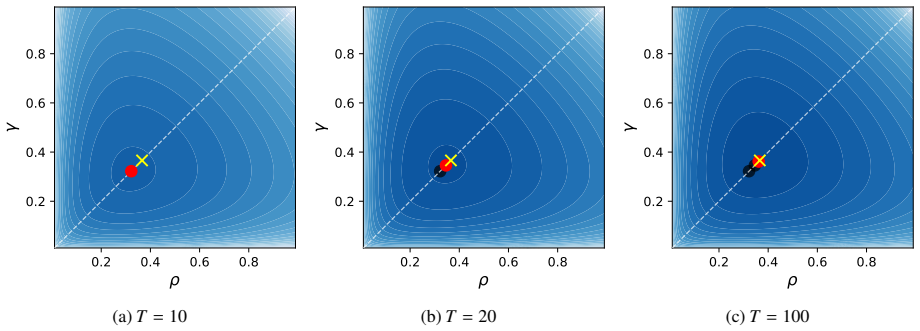
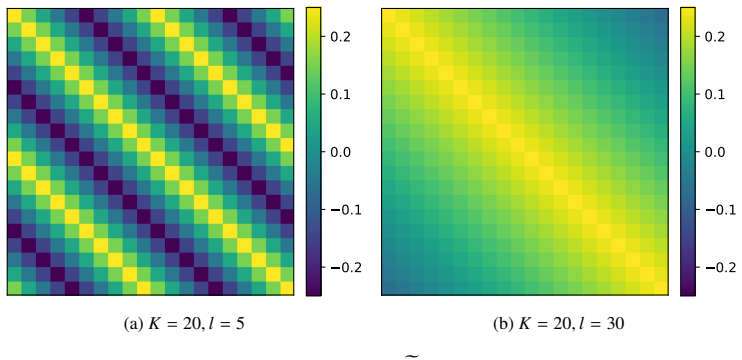
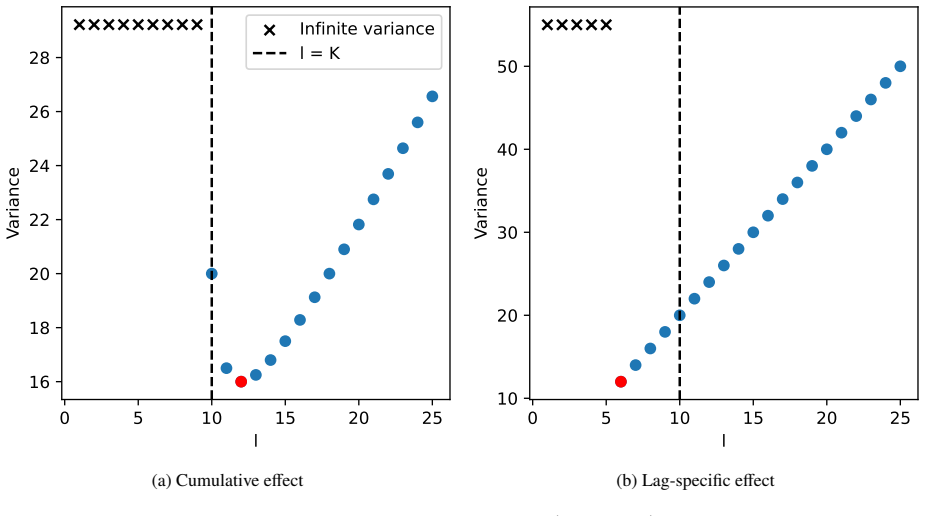
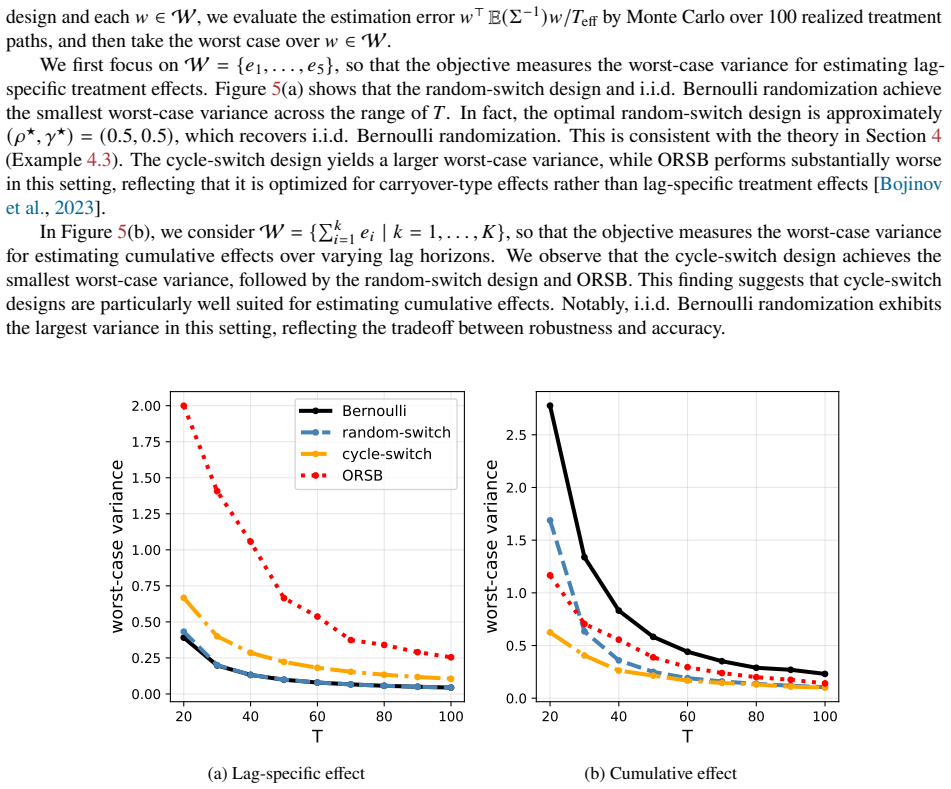
Under a finite-order impulse-response model, the design problem is cast as minimizing the asymptotic variance of the OLS estimator for target treatment effects. Complete large-T asymptotics are established for the optimal random-switch and cycle-switch designs, which justifies the robustness of i.i.d. Bernoulli designs and quantifies the dependence of the optimum on whether the target is a cumulative or lag-specific effect.
What carries the argument
Markovian treatment assignment governed by transition matrices that control the temporal dependence structure of the experiment.
If this is right
- The optimal transition probabilities differ according to whether the target is cumulative treatment effects or lag-specific effects.
- i.i.d. Bernoulli designs achieve near-optimal performance across many settings even if not exactly optimal.
- Cycle-switch designs admit period-specific tuning that can reduce error relative to fully random switching.
- The Markov framework allows explicit control of temporal dependence via the transition probabilities.
Where Pith is reading between the lines
- The asymptotic results could guide selection between random and deterministic switching when treatment effects are expected to persist for known durations.
- The framework might extend to adaptive updating of transition matrices based on accumulating data without losing the large-T guarantees.
- In platform experiments the same structure could inform how to set switch rates when user-level dependence varies across individuals.
Load-bearing premise
The response to treatment follows a finite-order impulse-response model whose order is known or correctly specified.
What would settle it
An N-of-1 dataset where the true impulse response has order higher than assumed and the optimized design produces larger mean squared error for the target effect than a fixed alternating assignment.
Figures

read the original abstract
N-of-1 trials, or time-series experiments, are widely used in clinical research and online platforms. Yet the theoretically optimal design for estimating many treatment effects remains unclear. We propose a simple Markovian framework for experimental design in which the treatment assignment process is governed by possibly time-varying transition matrices. This formulation encompasses many existing N-of-1 designs and provides a principled way to control temporal dependence in treatment assignment through Markov transition probabilities. Under a finite-order impulse-response model, we formulate the design objective as minimizing the estimation error of ordinary least squares estimators for target treatment effects, and propose practical design optimization procedures. To characterize the optimal temporal structure, we focus on two structured design classes, random-switch and cycle-switch designs, and establish a complete large-$T$ asymptotic theory for the optimal designs in both classes. Our results justify the robustness of i.i.d. Bernoulli designs in N-of-1 trials and quantify how the optimal design depends on the target estimand, including cumulative and lag-specific treatment effects. Simulations demonstrate the effectiveness and robustness of the proposed designs across multiple scenarios.
Editorial analysis
A structured set of objections, weighed in public.
Referee Report
Summary. The paper proposes a Markovian framework for N-of-1 trial design in which treatment assignments are governed by (possibly time-varying) transition matrices. Under a finite-order impulse-response outcome model, the design problem is cast as minimization of OLS estimation error for target treatment effects (cumulative or lag-specific). Complete large-T asymptotic characterizations are derived for the optimal designs within the random-switch and cycle-switch classes; these results are used to justify the robustness of i.i.d. Bernoulli designs and to show how the optimal transition probabilities depend on the target estimand.
Significance. If the asymptotic derivations hold, the work supplies a principled, model-based justification for design choices in single-subject experiments that are common in clinical research and online platforms. The explicit dependence of the optimal design on the target estimand (cumulative vs. lag-specific) and the complete large-T theory for two structured design families are concrete contributions. The finding that simple i.i.d. Bernoulli designs remain robust is practically useful when the modeling assumptions are met.
minor comments (2)
- Abstract and formulation section: the finite-order impulse-response assumption is stated as the setting for the OLS objective, but the manuscript would be strengthened by a brief discussion (even without new theorems) of how the optimality results and Bernoulli robustness degrade under order misspecification or non-impulse-response dynamics.
- The abstract claims 'complete large-T asymptotic theory' and 'simulations demonstrate effectiveness,' yet the provided text does not list the precise regularity conditions, convergence rates, or error-bar construction used in the simulations; adding these details would improve verifiability.
Simulated Author's Rebuttal
We thank the referee for the positive summary, significance assessment, and recommendation of minor revision. The report accurately captures the paper's contributions on the Markovian framework, asymptotic optimality results for random-switch and cycle-switch designs, and the robustness of i.i.d. Bernoulli designs under finite-order impulse-response models.
Circularity Check
No circularity; derivation rests on explicit modeling assumption independent of data fits
full rationale
The paper assumes a finite-order impulse-response model as the data-generating process (abstract) and defines the design objective as minimizing OLS estimation error for target effects under that model. Large-T asymptotics for random-switch and cycle-switch designs are then derived from this setup. No step reduces a prediction or optimality result to a fitted parameter from the same data, a self-citation chain, or a definitional tautology; the model choice is stated upfront as an assumption rather than derived from the target estimands. This is a standard modeling framework with independent content.
Axiom & Free-Parameter Ledger
axioms (2)
- domain assumption The outcome process follows a finite-order impulse-response model whose order is known or correctly specified.
- standard math Large-T asymptotics are valid for characterizing optimal designs.
Reference graph
Works this paper leans on
-
[1]
Randomization inference when N equals one , volume =
Liang, Tengyuan and Recht, Benjamin , journal =. Randomization inference when N equals one , volume =
-
[2]
Management Science , volume=
Design and analysis of switchback experiments , author=. Management Science , volume=. 2023 , publisher=
2023
-
[3]
Unifying regression-based and design-based causal inference in time-series experiments , author=. arXiv:2510.22864 , year=
-
[4]
2000 , publisher=
The theory of the design of experiments , author=. 2000 , publisher=
2000
-
[5]
Management Science , year=
Efficient switchback experiments with surrogate variables: Estimation and experimental design , author=. Management Science , year=
-
[6]
2010 , publisher=
Graphs and matrices , author=. 2010 , publisher=
2010
-
[7]
Personalized medicine , volume=
The n-of-1 clinical trial: the ultimate strategy for individualizing medicine? , author=. Personalized medicine , volume=. 2011 , publisher=
2011
-
[8]
Trials , volume=
A methodological review of randomised n-of-1 trials , author=. Trials , volume=. 2024 , publisher=
2024
-
[9]
Journal of the Royal Society of Medicine , volume=
The history and development of N-of-1 trials , author=. Journal of the Royal Society of Medicine , volume=. 2017 , publisher=
2017
-
[10]
2025 , eprint=
Switchback Experiments under Geometric Mixing , author=. 2025 , eprint=
2025
-
[11]
Econometrica , volume=
Investigating causal relations by econometric models and cross-spectral methods , author=. Econometrica , volume=. 1969 , publisher=
1969
-
[12]
The American economic review , volume=
Money, income, and causality , author=. The American economic review , volume=. 1972 , publisher=
1972
-
[13]
Biometrika , volume=
Minimax designs for causal effects in temporal experiments with treatment habituation , author=. Biometrika , volume=. 2023 , publisher=
2023
-
[14]
Mathematical modelling , volume=
A new approach to causal inference in mortality studies with a sustained exposure period-application to control of the healthy worker survivor effect , author=. Mathematical modelling , volume=. 1986 , publisher=
1986
-
[15]
Proceedings of the Second Seattle Symposium in Biostatistics: analysis of correlated data , pages=
Optimal structural nested models for optimal sequential decisions , author=. Proceedings of the Second Seattle Symposium in Biostatistics: analysis of correlated data , pages=. 2004 , organization=
2004
-
[16]
Journal of the American Statistical Association , volume=
Estimation of the causal effect of a time-varying exposure on the marginal mean of a repeated binary outcome , author=. Journal of the American Statistical Association , volume=. 1999 , publisher=
1999
-
[17]
Epidemiology , volume=
Marginal structural models and causal inference in epidemiology , author=. Epidemiology , volume=. 2000 , publisher=
2000
-
[18]
Journal of the Royal Statistical Society Series B: Statistical Methodology , volume=
Optimal dynamic treatment regimes , author=. Journal of the Royal Statistical Society Series B: Statistical Methodology , volume=. 2003 , publisher=
2003
-
[19]
Biometrics , volume =
Longitudinal data analysis for discrete and continuous outcomes , author=. Biometrics , volume =. 1986 , publisher=
1986
-
[20]
Journal of the American Statistical Association , volume=
Marginal mean models for dynamic regimes , author=. Journal of the American Statistical Association , volume=. 2001 , publisher=
2001
-
[21]
American Political Science Review , volume=
How to make causal inferences with time-series cross-sectional data under selection on observables , author=. American Political Science Review , volume=. 2018 , publisher=
2018
-
[22]
Causal Inference: What If , year =
Hern. Causal Inference: What If , year =
-
[23]
The annals of mathematical statistics , volume=
Optimum designs in regression problems , author=. The annals of mathematical statistics , volume=. 1959 , publisher=
1959
-
[24]
Journal of the American Statistical Association , volume=
A basis for the selection of a response surface design , author=. Journal of the American Statistical Association , volume=. 1959 , publisher=
1959
-
[25]
2015 , publisher=
Handbook of design and analysis of experiments , author=. 2015 , publisher=
2015
-
[26]
Journal of the American Statistical Association , volume=
Balancing covariates in randomized experiments with the gram--schmidt walk design , author=. Journal of the American Statistical Association , volume=. 2024 , publisher=
2024
-
[27]
Journal of the Royal Statistical Society Series B: Statistical Methodology , pages =
Guo, Wenxuan and Liang, Tengyuan and Toulis, Panos , title =. Journal of the Royal Statistical Society Series B: Statistical Methodology , pages =
-
[28]
Tutorials in Operations Research: Smarter Decisions for a Better World , pages=
Experimental design for causal inference through an optimization lens , author=. Tutorials in Operations Research: Smarter Decisions for a Better World , pages=. 2024 , publisher=
2024
-
[29]
Journal of the American Statistical Association , volume=
Time series experiments and causal estimands: exact randomization tests and trading , author=. Journal of the American Statistical Association , volume=. 2019 , publisher=
2019
-
[30]
Management Science , volume=
Near-optimal ab testing , author=. Management Science , volume=. 2020 , publisher=
2020
-
[31]
Fisher, R. A. , title =. Journal of the Ministry of Agriculture of Great Britain , year =
-
[32]
1923 , note =
Neyman, Jerzy , title =. 1923 , note =
1923
-
[33]
, author=
Estimating causal effects of treatments in randomized and nonrandomized studies. , author=. Journal of educational Psychology , volume=. 1974 , publisher=
1974
-
[34]
arXiv preprint arXiv:2406.06768 , year=
Data-driven switchback experiments: Theoretical tradeoffs and empirical bayes designs , author=. arXiv preprint arXiv:2406.06768 , year=
-
[35]
2006 , publisher=
Optimal design of experiments , author=. 2006 , publisher=
2006
-
[36]
The Annals of Statistics , volume =
On the robustness and efficiency of some randomized designs , author=. The Annals of Statistics , volume =. 1981 , publisher=
1981
-
[37]
2012 , publisher=
Matrix analysis , author=. 2012 , publisher=
2012
-
[38]
and Wellner, J.A
van der Vaart, A. and Wellner, J.A. , title=. 1996 , publisher =
1996
-
[39]
2012 , publisher=
Markov chains and stochastic stability , author=. 2012 , publisher=
2012
-
[40]
1998 , publisher=
Markov chains , author=. 1998 , publisher=
1998
-
[41]
A survey and some open questions , author=
Basic properties of strong mixing conditions. A survey and some open questions , author=. 2005 , journal=
2005
-
[42]
Annales de l'IHP Probabilit
Covariance inequalities for strongly mixing processes , author=. Annales de l'IHP Probabilit
-
[43]
Harvard Business Review , volume=
Avoid the Pitfalls of A/B Testing Make sure your experiments recognize customers' varying needs , author=. Harvard Business Review , volume=
-
[44]
Journal of Rational Mechanics and Analysis , volume=
On the eigen-values of certain Hermitian forms , author=. Journal of Rational Mechanics and Analysis , volume=. 1953 , publisher=
1953
-
[45]
ANZIAM Journal , volume=
Explicit inverses of Toeplitz and associated matrices , author=. ANZIAM Journal , volume=
discussion (0)
Sign in with ORCID, Apple, or X to comment. Anyone can read and Pith papers without signing in.