Classical versus quantum Anderson localization in disordered systems
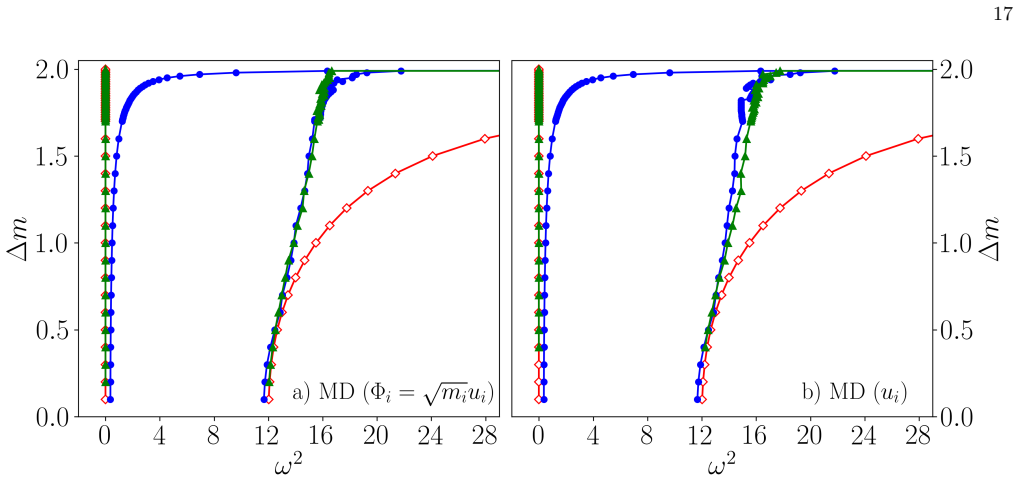
Pith reviewed 2026-06-29 01:36 UTC · model grok-4.3
The pith
Classical-wave systems form a distinct constrained disorder class where the acoustic sum rule blocks direct mapping to standard electronic Anderson models.
A machine-rendered reading of the paper's core claim, the machinery that carries it, and where it could break.
Core claim
Classical-wave systems with mass and force-constant disorder constitute a distinct constrained disorder class in which the acoustic sum rule correlates diagonal and off-diagonal matrix elements and prevents any direct correspondence with the standard electronic disorder models. This is shown by comparing to electronic tight-binding models with diagonal and off-diagonal disorder using complementary spectral, eigenvector, and level-statistics diagnostics within a unified eigenvalue framework.
What carries the argument
The modulus-type formulation of classical waves incorporating the acoustic sum rule that correlates diagonal and off-diagonal elements.
If this is right
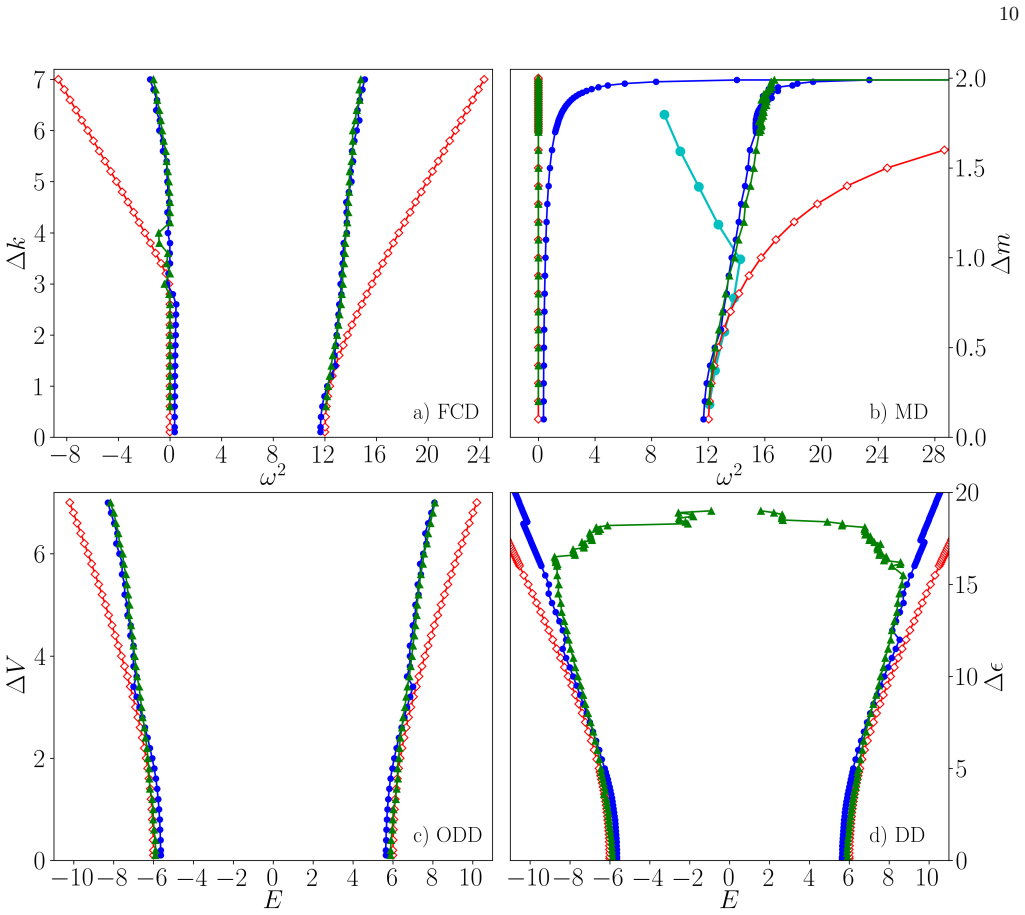
- Classical-wave systems exhibit localized states only near a band edge, similar to electronic off-diagonal disorder.
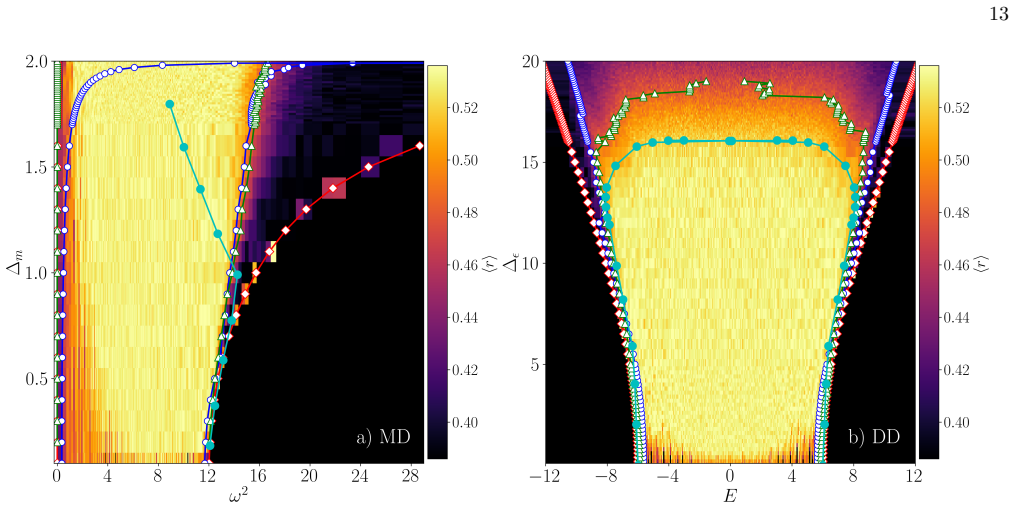
- For mass disorder, an extended localized regime appears near the upper band edge, differing from conventional potential-type results.
- Localization topologies in classical waves differ fundamentally from both types of electronic disorder systems.
- The approach provides new insight into conditions for Anderson localization in three-dimensional photonic and acoustic media.
Where Pith is reading between the lines
- This suggests that theories for localization in photonic and acoustic media should account for the constrained disorder class separately.
- Numerical simulations of 3D acoustic systems could directly test the predicted differences in phase diagrams.
- The distinction may extend to other classical wave systems obeying similar sum rules.
- Experimental observations in disordered media could confirm the band-edge localization preference.
Load-bearing premise
The premise that the modulus-type formulation rather than the conventional potential-type approach is the mathematically correct representation for classical waves with mass and force-constant disorder.
What would settle it
Numerical computation of the localization length or participation ratio in a three-dimensional system with mass disorder to check if it matches the modulus-type phase diagram or previous potential-type predictions.
Figures
read the original abstract
We investigate Anderson localization in three-dimensional disordered systems by comparing scalar classical waves with mass and force-constant disorder to electronic tight-binding models with diagonal and off-diagonal disorder. We show that the commonly employed mapping between classical-wave localization and the electronic Anderson model with diagonal disorder is not mathematically justified. Instead, the correct modulus-type formulation reveals that classical-wave systems constitute a distinct constrained disorder class, in which the acoustic sum rule correlates diagonal and off-diagonal matrix elements and prevents any direct correspondence with the standard electronic disorder models. Within a unified eigenvalue framework, we determine localization phase diagrams for all four disorder classes using complementary spectral, eigenvector, and level-statistics diagnostics. We find that classical-wave systems share a key qualitative feature with electronic off-diagonal disorder: localized states occur only near a band edge, while extended states persist in the central part of the spectrum even at strong disorder. At the same time, the acoustic sum rule produces localization topologies that differ fundamentally from both diagonal- and off-diagonal-disorder electronic systems. In particular, for mass disorder we obtain a phase diagram that differs qualitatively from previous results based on the conventional potential-type approach and reveals an extended localized regime near the upper band edge. Our results establish a unified perspective on localization in quantum and classical wave systems and provide new insight into the conditions under which Anderson localization may occur in three-dimensional photonic and acoustic media.
Editorial analysis
A structured set of objections, weighed in public.
Referee Report
Summary. The paper claims that the commonly employed mapping between classical-wave localization and the electronic Anderson model with diagonal disorder is not mathematically justified. The correct modulus-type formulation instead reveals classical-wave systems as a distinct constrained disorder class in which the acoustic sum rule correlates diagonal and off-diagonal matrix elements. Within a unified eigenvalue framework, the authors determine localization phase diagrams for classical waves (mass and force-constant disorder) and electronic models (diagonal and off-diagonal disorder) using spectral, eigenvector, and level-statistics diagnostics. They report that classical waves exhibit localized states only near band edges (sharing this feature with off-diagonal electronic disorder) but with localization topologies that differ from both electronic classes, including a qualitatively new phase diagram for mass disorder that differs from prior potential-type results.
Significance. If the central distinction and revised phase diagrams hold, the work supplies a unified perspective on Anderson localization across quantum and classical wave systems and new insight into conditions for localization in three-dimensional photonic and acoustic media. The use of complementary diagnostics across four disorder classes is a methodological strength.
major comments (2)
- [model definition / acoustic sum rule argument] The load-bearing premise is that the modulus-type formulation (rather than the conventional potential-type approach) is the mathematically correct representation for scalar classical waves with mass/force-constant disorder. The manuscript must supply an explicit derivation from the equations of motion (likely in the model-construction section) showing how the acoustic sum rule enforces the claimed correlations between diagonal and off-diagonal elements and why this blocks any direct correspondence to standard electronic Anderson models; without this step the distinction, the revised phase diagrams, and the contrast with both diagonal and off-diagonal electronic disorder cannot be assessed.
- [phase-diagram results] The claim of a qualitatively different phase diagram for mass disorder (extended localized regime near the upper band edge) is presented as differing from previous potential-type results. Direct side-by-side quantitative comparison (e.g., critical disorder strengths or mobility-edge locations) with the earlier literature must be provided, together with error bars or convergence checks on the spectral/eigenvector/level-statistics diagnostics used to locate the boundaries.
minor comments (1)
- [notation / model section] Clarify the precise definition of the modulus-type versus potential-type matrix elements at first introduction to ensure readers can follow the subsequent sum-rule argument without ambiguity.
Simulated Author's Rebuttal
We thank the referee for the thorough review and constructive feedback. We address the two major comments below and will revise the manuscript to incorporate the requested additions while preserving the core claims.
read point-by-point responses
-
Referee: [model definition / acoustic sum rule argument] The load-bearing premise is that the modulus-type formulation (rather than the conventional potential-type approach) is the mathematically correct representation for scalar classical waves with mass/force-constant disorder. The manuscript must supply an explicit derivation from the equations of motion (likely in the model-construction section) showing how the acoustic sum rule enforces the claimed correlations between diagonal and off-diagonal elements and why this blocks any direct correspondence to standard electronic Anderson models; without this step the distinction, the revised phase diagrams, and the contrast with both diagonal and off-diagonal electronic disorder cannot be assessed.
Authors: We agree that an explicit derivation from the equations of motion is required to substantiate the distinction. In the revised manuscript we will insert a new subsection (in the model-construction section) that starts from the scalar wave equation of motion, introduces the modulus-type discretization, and derives the acoustic sum rule constraint on the matrix elements. This will explicitly demonstrate the enforced correlations between diagonal and off-diagonal terms and the resulting absence of a direct mapping to either diagonal or off-diagonal electronic Anderson models. revision: yes
-
Referee: [phase-diagram results] The claim of a qualitatively different phase diagram for mass disorder (extended localized regime near the upper band edge) is presented as differing from previous potential-type results. Direct side-by-side quantitative comparison (e.g., critical disorder strengths or mobility-edge locations) with the earlier literature must be provided, together with error bars or convergence checks on the spectral/eigenvector/level-statistics diagnostics used to locate the boundaries.
Authors: We will add a new figure and accompanying table that directly compares our mass-disorder mobility edges and critical disorder strengths with the corresponding quantities reported in the prior potential-type literature. The revised text will also report statistical error bars obtained from multiple disorder realizations and include convergence tests with respect to system size and number of disorder samples for all three diagnostics (spectral, eigenvector, and level statistics). revision: yes
Circularity Check
No circularity: derivation rests on independent matrix construction from equations of motion
full rationale
The paper's central claim—that the modulus-type formulation is required by the acoustic sum rule and blocks mapping to standard electronic Anderson models—is presented as following from the wave equations of motion rather than from any self-definition, fitted parameter, or self-citation chain. The abstract explicitly states that the conventional mapping 'is not mathematically justified' and that the modulus-type version 'reveals' the constrained class; this is framed as a direct consequence of the sum rule correlating diagonal and off-diagonal elements. No quoted step reduces a prediction to its own input by construction, and the phase-diagram results are obtained from a unified eigenvalue framework applied to the four disorder classes. The derivation chain therefore remains self-contained against external benchmarks.
Axiom & Free-Parameter Ledger
Reference graph
Works this paper leans on
-
[1]
Unlike [54, 55], which employed the PT formulation, we do not consider negative masses
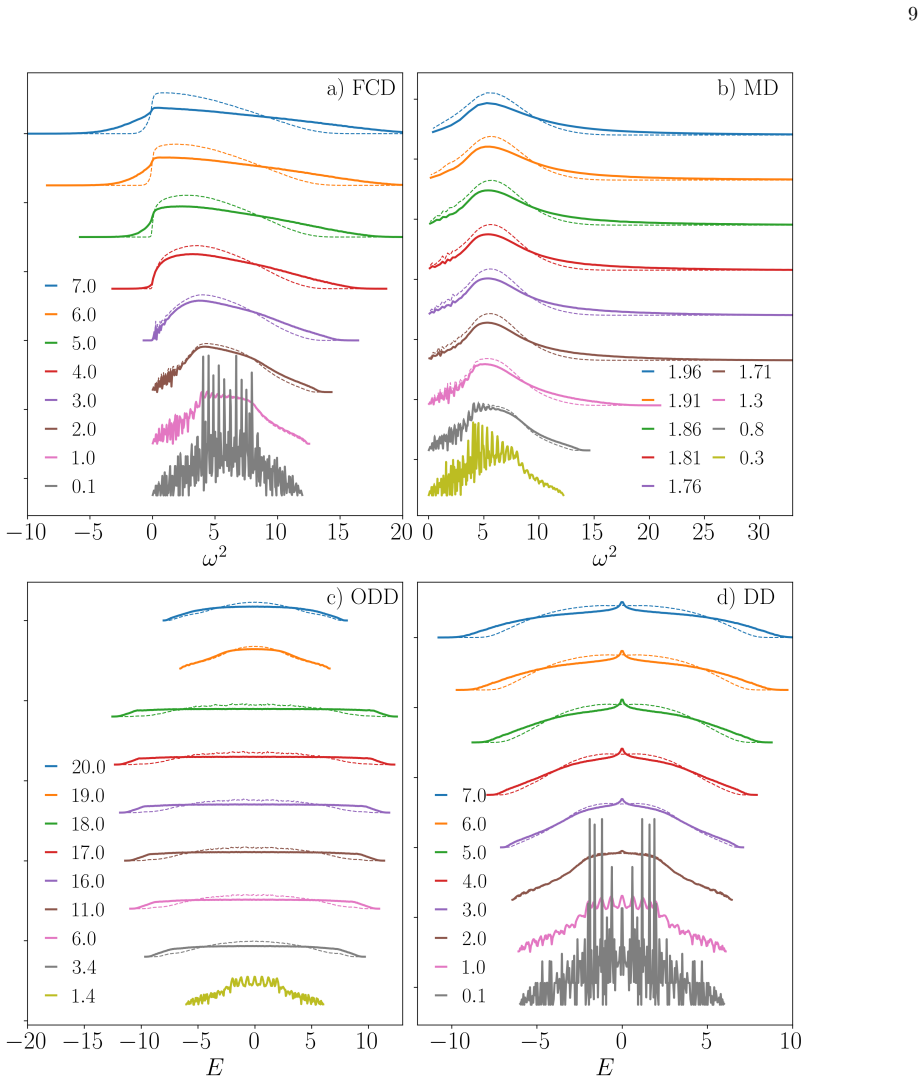
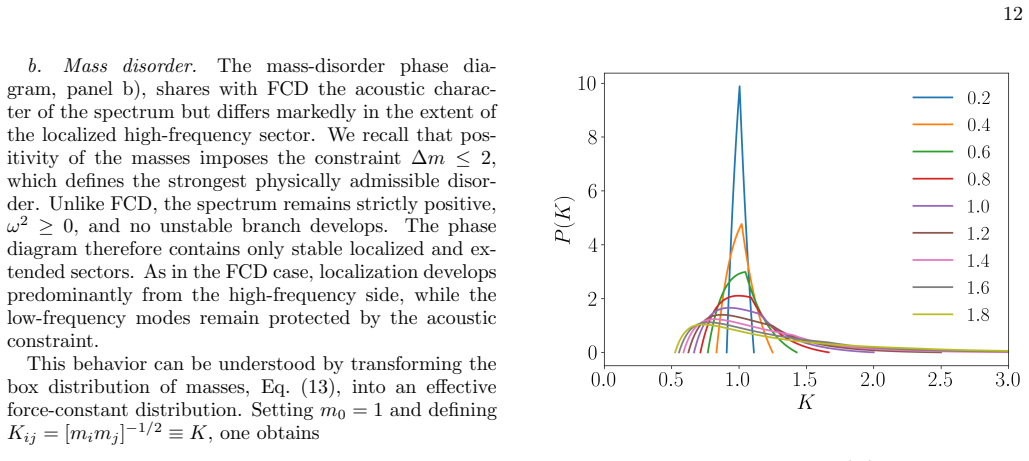
The mass-disorder problem has been investigated pre- viously in [54, 55, 59, 73], among others. Unlike [54, 55], which employed the PT formulation, we do not consider negative masses. Consequently, the physically accessible disorder range is restricted to ∆m <2. b. Force-constant disorder (FCD).When the masses are uniform,m i =m 0, while the spring consta...
-
[2]
Throughout this work,⟨· · · ⟩denotes an average over disorder realizations
Typical density of states The local density of states projected onto siteiis de- fined as [20] ρi(λ) = NX n=1 |ϕ(n) i |2 δ(λ−λ n),(23) from which we construct the arithmetic (arithmetically averaged) density of states and the typical density of states, ρ(λ) = * 1 N NX i=1 ρi(λ) + = * NX n=1 δ(λ−λ n) + ,(24) ρtyp(λ) = exp "* 1 N NX i=1 lnρ i(λ) +# .(25) Th...
-
[3]
Its finite-size scaling distinguishes localized from extended states
Participation ratio As an independent eigenvector-based measure of local- ization we employ the participation ratio, P(λ n) = 1 PN i=1 |ϕ(n) i |4 ,(26) which estimates the effective number of sites occupied by an eigenmode. Its finite-size scaling distinguishes localized from extended states. For extended modes, |ϕi|2 ∼1/N, implyingP∼N∼L 3, whereas for lo...
-
[4]
Its disorder-averaged value,⟨r⟩, distin- guishes localized and extended regimes through the cor- relations between neighboring levels
Level-distance statistics A third, purely spectral diagnostic is provided by the adjacent-gap ratio rn = min(δn, δn+1) max(δn, δn+1) , δ n =λ n+1 −λ n.(30) which depends only on the eigenvalues and not on the eigenvectors. Its disorder-averaged value,⟨r⟩, distin- guishes localized and extended regimes through the cor- relations between neighboring levels....
-
[5]
+K(x)][u(x+a)−u(x)] + [K(x− a
-
[6]
(B.7) If we define u(x) .=u i u(x±a) .=u i±1,(B.8) and 1 a2 K(x± a
+K(x)][u(x−a)−u(x)] . (B.7) If we define u(x) .=u i u(x±a) .=u i±1,(B.8) and 1 a2 K(x± a
-
[7]
+K(x) .=K i,i±1,(B.9) we obtain ∂x K(x)∂ xu(x) → X j=i±1 Kij[uj −u i] (B.10) and, substituting in (B.1), we obtain Eq. (19) b. Mass disorder.For the mass disorder case we have −ω2u(x) = 1 m(x) ∂2 xu(x).(B.11) Similarly to above, simply using (B.6), (B.8), and defin- ingm(x) .=m i, we obtain 1 m(x) ∂2 xu(x)→ 1 mi X j=i±1 [uj −u i],(B.12) recovering Eq. (14...
-
[8]
P. W. Anderson, Absence of diffusion in certain random lattices, Phys. Rev.109, 1492 (1958)
1958
-
[9]
Abrahams, ed.,50 years of Anderson localization (World Scientific, New Jersey, USA, 2010) see also Int
E. Abrahams, ed.,50 years of Anderson localization (World Scientific, New Jersey, USA, 2010) see also Int. J. Mod. Phys.,24, Issue 12n13 (2010)
2010
-
[10]
Mott, Electrons in disordered structures, Advances in Physics16, 49 (1967)
N. Mott, Electrons in disordered structures, Advances in Physics16, 49 (1967)
1967
-
[11]
N. F. Mott, The mobility edge since 1967, J. Phys. C: Solid State Phys.20, 3075 (1987)
1967
-
[12]
Abrahams, P
E. Abrahams, P. W. Anderson, D. C. Licciardello, and T. V. Ramakrishnan, Scaling theory of localization: Ab- 18 sence of quantum diffusion in two dimensions, Phys. Rev. Lett.42, 673 (1979)
1979
-
[13]
P. A. Lee and T. V. Ramakrishnan, Disordered electronic systems, Rev. Mod. Phys.57, 287 (1985)
1985
-
[14]
Chakravarty and A
S. Chakravarty and A. Schmid, Weak localization: The quasiclassical theory of electrons in a random potential, Phys. Reports140, 193 (1986)
1986
-
[15]
Wegner, The mobility edge problem: Continuous sym- metry and a conjecture, Z
F. Wegner, The mobility edge problem: Continuous sym- metry and a conjecture, Z. Phys. B35, 207 (1979)
1979
-
[16]
Sch¨ afer and F
L. Sch¨ afer and F. Wegner, Disordered system withnor- bitals per site: Lagrange formulation, hyperbolic symme- try, and Goldstone modes, Z. Phys. B38, 113 (1980)
1980
-
[17]
A. J. McKane and M. Stone, Localization as an alterna- tive to Goldstone’s theorem, Ann. Phys. (N. Y.)131, 36 (1981)
1981
-
[18]
Vollhardt and P
D. Vollhardt and P. W¨ olfle, Anderson localization in d <∼2 dimensions: A self-consistent diagrammatical theory, Phys. Rev. Lett.45, 842 (1980)
1980
-
[19]
Vollhardt and P
D. Vollhardt and P. W¨ olfle, Diagrammatic, self- consistent treatment of the Anderson localization prob- lem ind≤2 dimensions, Phys. Rev. B22, 4666 (1980)
1980
-
[20]
Vollhardt and P
D. Vollhardt and P. W¨ olfle, Scaling equations from a self- consistent theory of Anderson localization, Phys. Rev. Lett.48, 699 (1982)
1982
-
[21]
E. N. Economou and C. M. Soukoulis, Connection of lo- calization with the problem of the bound state in a po- tential well, Phys. Rev. B28, 1093 (1983)
1983
-
[22]
Dobrosavljevi´ c, A
V. Dobrosavljevi´ c, A. A. Pastor, and B. K. Nikoli´ c, Mean field theory of the Mott-Anderson transition, Phys. Rev. Lett78, 3943 (1997)
1997
-
[23]
Dobrosavljevi´ c, A
V. Dobrosavljevi´ c, A. Pastor, and B. Nikoli´ c, Typical- medium theory of Anderson localization: A local order parameter approach to strong-disorder effects, EPL (Eu- rophysics Letters)62, 76 (2003)
2003
-
[24]
Dobrosavljevi´ c, Typical-medium theory of Mott- Anderson localization, Int
V. Dobrosavljevi´ c, Typical-medium theory of Mott- Anderson localization, Int. J. Mod. Phys. B24, 1680 (2010)
2010
-
[25]
Byczuk, W
K. Byczuk, W. Hofstetter, and D. Vollhardt, Mott–Hubbard transition vs. Anderson localization of correlated, disordered electrons, Phys. Rev. Lett.94, 056404 (2005)
2005
-
[26]
Byczuk, W
K. Byczuk, W. Hofstetter, and D. Vollhardt, Anderson localization vs. Mott–Hubbard metal–insulator transi- tion in disordered, interacting lattice fermion systems, Int. J. Mod. Phys. B24, 1727 (2010)
2010
-
[27]
Weisse, G
G.Schubert, A. Weisse, G. Wellein, and H. Fehske, Hqs@hpc: Comparative numerical study of Anderson lo- calisation in disordered electron systems, inHigh Perfor- mance Computing in Science and Engineering, Garch- ing 2004, Springer, edited by A. Bode and F. Durst (Springer, Heidelberg, 2005)
2004
-
[28]
Schubert, J
G. Schubert, J. Schleede, K. Byczuk, H. Fehske, and D. Vollhardt, Distribution of the local density of states as a criterion for anderson localization: Numerically ex- act results for various lattices in dimensions d = 2 and 3, Phys. Rev. B81, 155106 (2010)
2010
-
[29]
S. John, H. Sompolinsky, and M. J. Stephen, Localiza- tion in a disordered elastic medium near two dimensions, Phys. Rev. B27, 5592 (1983)
1983
-
[30]
John and M
S. John and M. J. Stephen, Wave propagation and lo- calization in a long-range correlated random potential, Phys. Rev. B28, 6358 (1983)
1983
-
[31]
John, Electromagnetic absorption in a disordered medium near a photon mobility edge, Phys
S. John, Electromagnetic absorption in a disordered medium near a photon mobility edge, Phys. Rev. Lett. 53, 2169 (1984)
1984
-
[32]
John, Strong localization of photons in certain disor- dered dielectric superlattices, Phys
S. John, Strong localization of photons in certain disor- dered dielectric superlattices, Phys. Rev. Lett.58, 2486 (1987)
1987
-
[33]
P. E. Wolf and G. Maret, Weak localization and coher- ent backscattering of photons in disordered media, Phys. Rev. Lett.55, 2696 (1985)
1985
-
[34]
P. W. Anderson, The question of classical localization: A theory of white paint?, Philos. Mag. B52, 505 (1985)
1985
-
[35]
D. S. Wiersma, P. Bartolini, A. Lagendijk, and R. Righ- ini, Localization of light in a disordered medium, Nature 390, 671 (1997)
1997
-
[36]
Lagendijk and B
L. Lagendijk and B. A. van Tiggelen, Resonant multiple scattering of light, Phys. Reports270, 143 (1996)
1996
-
[37]
Sheng,Introduction to Wave Scattering, Localiza- tion and Mesoscopic Phenomena(Springer, Heidelberg, 2006)
P. Sheng,Introduction to Wave Scattering, Localiza- tion and Mesoscopic Phenomena(Springer, Heidelberg, 2006)
2006
-
[38]
A. D. Lagendijk, B. van Tiggelen, and D. S. Wiersma, Fifty years of Anderson localization, Phys. Today62, 24 (2009)
2009
-
[39]
Wang and A
J. Wang and A. Z. Genack, Transport through modes in random media, Nature471, 345 (2011)
2011
-
[40]
S. S. Abdullaev and F. K. Abdullaev, On light propaga- tion in a system of tunnelcoupled waveguides, Izv. Vuz. Radiofiz.23, 766 (1980)
1980
-
[41]
DeRaedt, A
H. DeRaedt, A. Lagendijk, and P. deVries, Transverse localization of light, Phys. Rev. Lett.62, 47 (1989)
1989
-
[42]
Schwartz, G
T. Schwartz, G. Bartal, S. Fishman, and M. Segev, Transport and Anderson localization in disordered two- dimensional photonic lattices, Nature446, 52 (2007)
2007
-
[43]
Karbasi, C
S. Karbasi, C. R. Mirr, P. G. Yarandi, R. J. F. K. W. Koch, and A. Mafi, Observation of transverse Ander- son localization in an optical fiber, Opt. Lett.37, 2304 (2012)
2012
-
[44]
Degl’Innocenti, Y
R. Degl’Innocenti, Y. D. Shah, L. Masini, A. Ronzani, A. Pitanti, Y. Ren, D. S. Jessop, A. Tredicucci, H. E. Beere, and D. A. Ritchie, Hyperuniform disordered tera- hertz quantum cascade laser, Scientific Reports6, 19325 (2015)
2015
-
[45]
St¨ orzer, P
M. St¨ orzer, P. Gross, C. M. Aegerter, and G. Maret, Ob- servation of the critical regime near Anderson localization of light, Phys. Rev. Lett.96, 063904 (2006)
2006
-
[46]
Sperling, W
T. Sperling, W. Buehrer, C. Aegerter, and G. Maret, Direct determination of the transition to localization of light in three dimensions, Nature Photonics7, 48 (2012)
2012
-
[47]
Scheffold and D
F. Scheffold and D. Wiersma, Inelastic scattering puts in question recent claims of Anderson localization of light, Nature Photonics7, 934 (2013)
2013
-
[48]
Sperling, L
T. Sperling, L. Schertel, M. A. M, G. J. Aubry, C. M. Aegerter, and G. Maret, Can 3d light localization be reached in ‘white paint’?, New J. Phys.18, 013039 (2016)
2016
-
[49]
S. E. Skipetrov and J. H. Page, Red light for Anderson localization, New Journal of Physics18, 021001 (2016)
2016
-
[50]
Schirmacher, G
W. Schirmacher, G. Diezemann, and C. Ganter, Har- monic vibrational excitations in disordered solids and the boson peak, Phys. Rev. Lett.81, 136 (1998)
1998
-
[51]
A. Amir, J. J. Krich, V. Vitelli, Y. Oreg, , and Y. Imry, Emergent percolation length and localization in random elastic networks, Phys. Rev. X3, 021017 (2013)
2013
-
[52]
T. M. Nieuwenhuizen, A. L. Burin, Y. Kagan, and G. V. Shlyapnikov, Light propagation in a solod with reso- nant atoms at random positions, Phys. Lett. A184, 360 (1994). 19
1994
-
[53]
S. E. Skipetrov and I. M. Sokolov, Absence of Ander- son localization of light in a random ensemble of point scatterers, Phys. Rev. Lett.112, 023905 (2014)
2014
-
[54]
B. A. van Tiggelen and S. E. Skipetrov, Longitudinal modes in diffusion and localization of light, Phys. Rev. B 103, 174204 (2021)
2021
-
[55]
Haberko, L
J. Haberko, L. S. Froufe-P´ erez, and F. Scheffold, Tran- sition from light diffusion to localization in three- dimensional amorphous dielectric networks near the band edge, Nature Comm.11, 4867 (2020)
2020
-
[56]
Scheffold, J
F. Scheffold, J. Haberko, S. Magkiriadou, and L. S. Froufe-P´ erez, Transport though amorphous photonic ma- terials with localization and bandgap, Phys. Rev. Lett. 66, 157402 (2022)
2022
-
[57]
Yamilov, H
A. Yamilov, H. Cao, and S. E. Skipetrov, Anderson tran- sition for light in a three-dimensional random medium, Phys. Rev. Lett.134, 046302 (2025)
2025
-
[58]
Granchi, R
N. Granchi, R. Spalding, K. Stokkereit, M. Lodde, M. Petruzzella, F. V. Otten, R. Sapienza, A. Fiore, M. Florescu, and F. Intonti, High spatial resolution imag- ing of light localization in hyperuniform disordered pat- terns of circular air pores in a dielectric slab, Frontiers in Photonics4(2023)
2023
-
[59]
Schirmacher, B
W. Schirmacher, B. Abaie, A. Mafi, G. Ruocco, and M. Leonetti, What is the right theory for anderson local- ization of light? An experimental test, Phys. Rev. Lett. 120, 067401 (2018)
2018
-
[60]
Kroha, C
J. Kroha, C. M. Soukoulis, and P. W¨ olfle, Localization of classical waves in a random medium: A self-consistent theory, Phys. Rev. B47, 11093 (1993)
1993
-
[61]
Pinski, W
S. Pinski, W. Schirmacher, and R. A. R¨ omer, Anderson universality in a model of disordered phonons, Europhys. Lett.97, 16607 (2012)
2012
-
[62]
Pinski, W
S. Pinski, W. Schirmacher, T. Whall, and R. A. R¨ omer, Localization-delocalization transition for disordered cu- bic harmonic lattices, J. Phys. Condensed Matt.24, 405401 (2012)
2012
-
[63]
Vynck, Light in correlated disordered media, Rev
K. Vynck, Light in correlated disordered media, Rev. Mod. Phys.95, 045003 (2023)
2023
-
[64]
Dyson, The dynamics of a disordered linear chain, Phys
F. Dyson, The dynamics of a disordered linear chain, Phys. Rev.92, 1331 (1953)
1953
-
[65]
A. A. Maradudin and S. H. Vosko, Symmetry properties of the normal vibrations of a crystal, Rev. Mod. Phys. 40, 1 (1968)
1968
-
[66]
Monthus and T
C. Monthus and T. Garel, Anderson localization of phonons in dimension d, Phys. Rev. B.81, 224208 (2010)
2010
-
[67]
Schirmacher, T
W. Schirmacher, T. Franosch, G. Ruocco, and M. Leonetti, Three-dimensional Anderson localization of light in materials with fluctuating electric and magnetic properties, Opt. Express32, 41776 (2024)
2024
-
[68]
J. D. Joannopoulos, S. G. Johnson, J. N. Winn, and R. D. Meade,Photonic crystals(Princeton University Press, Princeton, USA, 2008)
2008
-
[69]
Rotter and S
S. Rotter and S. Gigan, Light fields in complex media: Mesoscopic scattering meets wave control, Rev. Mod. Phys89, 015005 (2017)
2017
-
[70]
Viviescas and G
C. Viviescas and G. Hackenbroich, Field quantization for open optical cavities, Phys. Rev. A67, 01385 (2003)
2003
-
[71]
J. Zhu, T. E. Roth, and W. C. Chew, Generalized Helmholtz decomposition for modal analysis of electro- magnetic problems in inhomogeneous media, IEEE J. Multiscale and Multiphysics Comp. Tech.8, 332 (2021)
2021
-
[72]
Karbasi, C
S. Karbasi, C. R. Mirr, R. J. Frazier, P. G. Yarandi, K. W. Koch, and A. Mafi, Detailed investigation of the impact of the fiber design parameters on the transverse anderson localization of light in disordered optical fibers, Opt. Express20, 18692 (2012)
2012
-
[73]
L´ evy-Leblond, Position-dependent effective mass and Galilei invariance, Phys
J.-M. L´ evy-Leblond, Position-dependent effective mass and Galilei invariance, Phys. Rev. A52, 1845 (1995)
1995
-
[74]
E. N. Economou and P. D. Antoniou, Localization and off-diagonal disorder, Sol. State Comm.21, 285 (1977)
1977
-
[75]
P. D. Antoniou and E. N. Economou, Absence of An- derson’s transition in random lattices with off-diagonal disorder, Phys. Rev. B16, 3768 (1977)
1977
-
[76]
Weaire and V
D. Weaire and V. Srivastava, Numerical results for An- derson localization in the presence of off-diagonal disor- der, Sol. State Comm.23, 863 (1977)
1977
-
[77]
Bulka, M
B. Bulka, M. Schreiber, and B. Kramer, Localization, quantum interference, and the metal-insulator transition, Zeitschrift f¨ ur Physik B Condensed Matter66, 21 (1987)
1987
-
[78]
Grussbach and M
H. Grussbach and M. Schreiber, Determination of the mobility edge in the anderson model of localization in three dimensions by multifractal analysis, Phys. Rev. B 51, 663 (1995)
1995
-
[79]
Schirmacher, T
W. Schirmacher, T. Scopigno, and G. Ruocco, Theory of vibrational anomalies in glasses, J. Noncryst. Sol.407, 133 (2014)
2014
-
[80]
Chaudhuri, A
A. Chaudhuri, A. Kundu, D. Roy, A. Dhar, J. L. Lebowitz, and H. Spohn, Heat transport and phonon localization in mass-disordered harmonic crystals, Phys. Rev. B81, 064301 (2010)
2010
discussion (0)
Sign in with ORCID, Apple, or X to comment. Anyone can read and Pith papers without signing in.