Efficient Approximation of the Wigner Kernel in Phase-Space Quantum Mechanics
Pith reviewed 2026-06-29 03:08 UTC · model grok-4.3
The pith
A series expansion of the potential produces a closed-form approximation to the Wigner kernel for one-dimensional quantum systems.
A machine-rendered reading of the paper's core claim, the machinery that carries it, and where it could break.
Core claim
Exploiting a series-based representation of the potential function yields an efficient analytical approximation to the Wigner kernel and the associated Gamma function for one-dimensional single-body systems; numerical comparisons for several Gaussian-based potentials demonstrate that the approximation captures the main behavior of the exact quantities while significantly reducing computational cost.
What carries the argument
Series-based representation of the potential function, which converts the oscillatory Wigner integral into a usable analytical expression for the kernel and Gamma function.
Load-bearing premise
A truncated series representation of the potential remains accurate enough for the oscillatory Wigner integral when the potential consists of Gaussian profiles over the time scales examined.
What would settle it
Compute the exact Wigner kernel directly for a non-Gaussian potential in one dimension and compare the result to the series approximation at the same grid points.
Figures

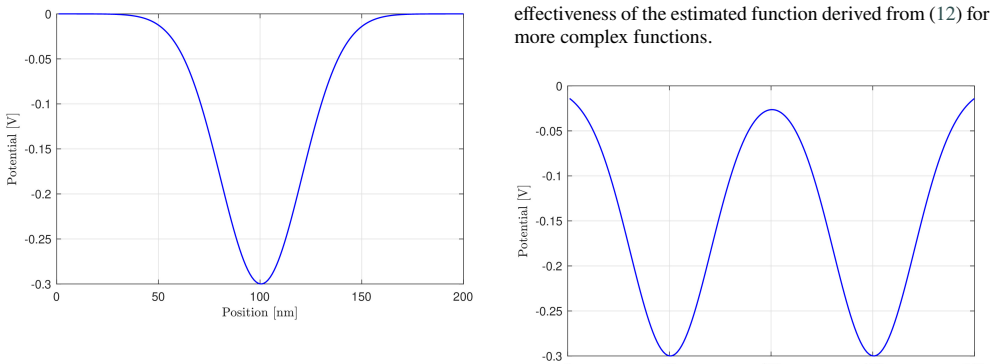
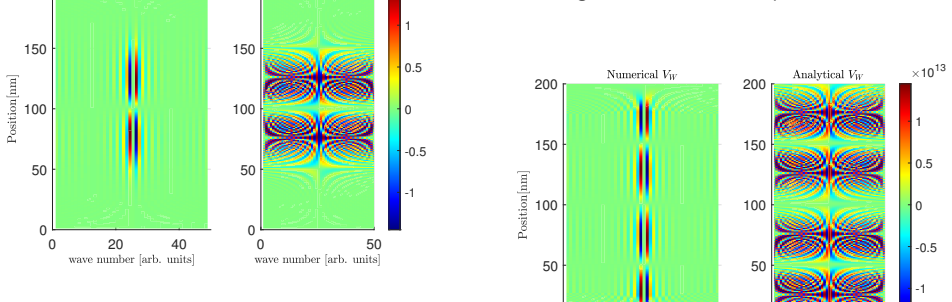
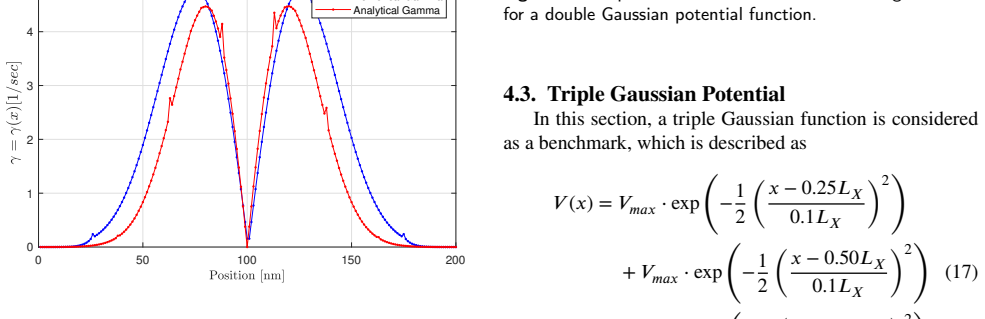


read the original abstract
The Signed Particle Formulation provides a particle-based interpretation of quantum mechanics in phase space, where quantum dynamics are represented through the creation and evolution of signed particles. A central computational challenge in this framework is the evaluation of the Wigner kernel, which generally involves highly oscillatory integrals and can become computationally demanding in time-dependent simulations. This paper proposes an analytical approximation of the Wigner kernel for one-dimensional single body quantum systems by exploiting a series-based representation of the potential function. The resulting expression provides an efficient way to approximate the Wigner kernel and the associated Gamma function, which governs the particle-generation process in the Signed Particle Formulation framework. The proposed approximation is evaluated for several Gaussian-based potential profiles, including single, double, triple, and quadruple Gaussian potentials. Numerical comparisons between the approximated and directly computed Wigner kernels and Gamma functions show that the proposed method captures the main behavior of the exact quantities while significantly reducing the computational cost. These results indicate that the proposed approximation can serve as an efficient computational component for scalable Signed Particle Formulation based quantum simulations.
Editorial analysis
A structured set of objections, weighed in public.
Referee Report
Summary. The paper claims that a series expansion of the potential yields an analytical approximation to the Wigner kernel (and associated Gamma function) in the Signed Particle Formulation for 1D single-body systems. The approximation is tested on single-, double-, triple-, and quadruple-Gaussian potentials; numerical comparisons are said to show that it captures the main behavior of the exact quantities while substantially lowering computational cost.
Significance. If the truncation error can be controlled and the accuracy quantified for the oscillatory integral, the method would supply a practical, parameter-free component for scaling signed-particle simulations in one dimension. The derivation directly from the series expansion (rather than data fitting) is a clear methodological strength.
major comments (2)
- [Abstract] Abstract (paragraph on numerical comparisons): the assertion that the approximation 'captures the main behavior' rests solely on qualitative visual agreement for four specific Gaussian sums; no L2 or pointwise error norms, convergence rates with respect to truncation order, or error bars are supplied, leaving the practical accuracy for the highly oscillatory Wigner integral unquantified.
- [Approximation derivation] Derivation of the approximation (series representation of V(x)): no a-priori bound or estimate is given for the remainder term after truncation and its integrated effect on ∫[V(x+y)−V(x−y)]sin(2py/ℏ) dy; because the integrand is oscillatory, even small pointwise truncation errors in V can produce O(1) relative errors in the kernel, and the four Gaussian test cases do not establish control for general potentials or longer evolution times.
minor comments (1)
- A table or figure caption listing the truncation order employed for each potential profile and the observed wall-clock speedup would improve reproducibility and allow readers to judge the cost-accuracy trade-off directly.
Simulated Author's Rebuttal
We thank the referee for the careful reading and constructive comments on our manuscript. We address each major comment below and outline the revisions we will make.
read point-by-point responses
-
Referee: [Abstract] Abstract (paragraph on numerical comparisons): the assertion that the approximation 'captures the main behavior' rests solely on qualitative visual agreement for four specific Gaussian sums; no L2 or pointwise error norms, convergence rates with respect to truncation order, or error bars are supplied, leaving the practical accuracy for the highly oscillatory Wigner integral unquantified.
Authors: We agree that the current numerical section relies on qualitative visual comparisons. In the revised manuscript we will add quantitative error measures, including L2 norms between the approximated and exact Wigner kernels and Gamma functions for each tested potential, together with convergence plots versus truncation order. These additions will quantify the practical accuracy for the oscillatory integrals in the cases considered. revision: yes
-
Referee: [Approximation derivation] Derivation of the approximation (series representation of V(x)): no a-priori bound or estimate is given for the remainder term after truncation and its integrated effect on ∫[V(x+y)−V(x−y)]sin(2py/ℏ) dy; because the integrand is oscillatory, even small pointwise truncation errors in V can produce O(1) relative errors in the kernel, and the four Gaussian test cases do not establish control for general potentials or longer evolution times.
Authors: The referee correctly identifies the absence of an a-priori remainder bound and the potential sensitivity of the oscillatory integral. A general bound valid for arbitrary potentials and long evolution times is technically demanding and lies outside the scope of the present work, which derives the series approximation and demonstrates it on Gaussian-sum potentials. We will revise the manuscript to include an explicit estimate of the remainder for the Gaussian cases (where convergence is rapid) and a discussion of the method’s intended applicability and limitations. revision: partial
- A rigorous a-priori bound on the truncation remainder that controls the oscillatory integral for general potentials and arbitrary evolution times.
Circularity Check
No significant circularity; derivation from series expansion is independent of validation data
full rationale
The paper derives its Wigner kernel approximation analytically from a truncated series representation of the potential V(x), without any parameter fitting to the target kernel or Gamma function values. Numerical comparisons on Gaussian potentials are presented strictly as post-derivation validation, not as the source of the approximation itself. No self-citations, uniqueness theorems, or ansatzes from prior author work are invoked as load-bearing steps in the central claim. The derivation chain therefore remains self-contained and does not reduce to its inputs by construction.
Axiom & Free-Parameter Ledger
axioms (1)
- domain assumption The potential admits a convergent power-series representation that can be substituted into the Wigner integral without altering its essential oscillatory character.
Reference graph
Works this paper leans on
-
[1]
On the quantum correction for thermodynamic equilibrium
Eugene Wigner. On the quantum correction for thermodynamic equilibrium. Physical review, 40(5):749, 1932
1932
-
[2]
Space-time approach to non-relativistic quantum mechanics.Reviews of modern physics, 20(2):367, 1948
Richard Phillips Feynman. Space-time approach to non-relativistic quantum mechanics.Reviews of modern physics, 20(2):367, 1948
1948
-
[3]
A suggested interpretation of the quantum theory in terms of" hidden" variables
David Bohm. A suggested interpretation of the quantum theory in terms of" hidden" variables. i.Physical review, 85(2):166, 1952
1952
-
[4]
Concerning an heuristic point of view toward the emission and transformation of light.American Journal of Physics, 33(5):367, 1965
Albert Einstein. Concerning an heuristic point of view toward the emission and transformation of light.American Journal of Physics, 33(5):367, 1965
1965
-
[5]
Balfour Stewart. I.—an account of some experiments on radiant heat, involving an extension of prevost’s theory of exchanges.Earth and Environmental Science Transactions of The Royal Society of Edinburgh, 22(1):1–20, 1861
-
[6]
Quantisierung als eigenwertproblem
E Schrodinger. Quantisierung als eigenwertproblem. Annalen der physik, 385(13):437–490, 1926
1926
-
[7]
Unified particle approach to wigner- boltzmanntransportinsmallsemiconductordevices
Mihail Nedjalkov, Hans Kosina, Siegfried Selberherr, Christian Ringhofer, and David K Ferry. Unified particle approach to wigner- boltzmanntransportinsmallsemiconductordevices. PhysicalReview B—Condensed Matter and Materials Physics, 70(11):115319, 2004
2004
-
[8]
Wigner quasi-particle attributes—an asymptotic perspective
Mihail Nedjalkov, Philipp Schwaha, Siegfried Selberherr, Jean Michel Sellier, and Dragica Vasileska. Wigner quasi-particle attributes—an asymptotic perspective. Applied Physics Letters, 102(16), 2013
2013
-
[9]
The many-body wigner monte carlomethodfortime-dependentab-initioquantumsimulations
Jean Michel Sellier and Ivan Dimov. The many-body wigner monte carlomethodfortime-dependentab-initioquantumsimulations. Jour- nal of Computational Physics, 273:589–597, 2014
2014
-
[10]
Some formal properties of the density matrix.Pro- ceedings of the Physico-Mathematical Society of Japan
Kôdi Husimi. Some formal properties of the density matrix.Pro- ceedings of the Physico-Mathematical Society of Japan. 3rd Series, 22(4):264–314, 1940
1940
-
[11]
A signed particle formulation of non-relativistic quantum mechanics
Jean Michel Sellier. A signed particle formulation of non-relativistic quantum mechanics. Journal of Computational Physics, 297:254– 265, 2015
2015
-
[12]
The monte carlo method
Nicholas Metropolis and Stanislaw Ulam. The monte carlo method. Journal of the American statistical association, 44(247):335–341, 1949
1949
-
[13]
Monte Carlo methods for applied scientists
Ivan T Dimov. Monte Carlo methods for applied scientists. World Scientific, 2008
2008
-
[14]
John Wiley & Sons, 2008
Malvin H Kalos and Paula A Whitlock.Monte carlo methods. John Wiley & Sons, 2008. Attar et al.: Preprint submitted to Elsevier Page 7 of 8 # Gaussian 𝑁𝑥 50 100 150 200 500 Single 0.005 0.013 0.031 0.062 0.427 Double 0.003 0.014 0.033 0.061 0.433 Triple 0.003 0.014 0.034 0.067 0.428 Quadruple 0.005 0.016 0.036 0.067 0.491 Table 1 Average execution time for...
2008
-
[15]
The monte carlo method for the solution of charge transport in semiconductors with applications to covalent materials.Reviews of modern Physics, 55(3):645, 1983
Carlo Jacoboni and Lino Reggiani. The monte carlo method for the solution of charge transport in semiconductors with applications to covalent materials.Reviews of modern Physics, 55(3):645, 1983
1983
-
[16]
Theroleofannihilationinawignermontecarloapproach
Jean Michel Sellier, Mihail Nedjalkov, Ivan Dimov, and Siegfried Selberherr. Theroleofannihilationinawignermontecarloapproach. In Large-Scale Scientific Computing: 9th International Conference, LSSC 2013, Sozopol, Bulgaria, June 3-7, 2013. Revised Selected Papers 9, pages 186–193. Springer, 2014
2013
-
[17]
Solid state physics, volume 3
Charles Kittel. Solid state physics, volume 3. Shell Development Company Emeryville, 1955. Biography Mehran Attar received the Ph.D. degree in Infor- mation and Systems Engineering from Concordia University, Montreal, QC, Canada. He is currently a Postdoctoral Researcher with Ericsson, Mon- treal,CanadaandÉcoledeTechnologieSupérieure (ÉTS). His research i...
1955
discussion (0)
Sign in with ORCID, Apple, or X to comment. Anyone can read and Pith papers without signing in.