The subthreshold issue of fusion-based quantum computing
Pith reviewed 2026-06-30 01:19 UTC · model grok-4.3
The pith
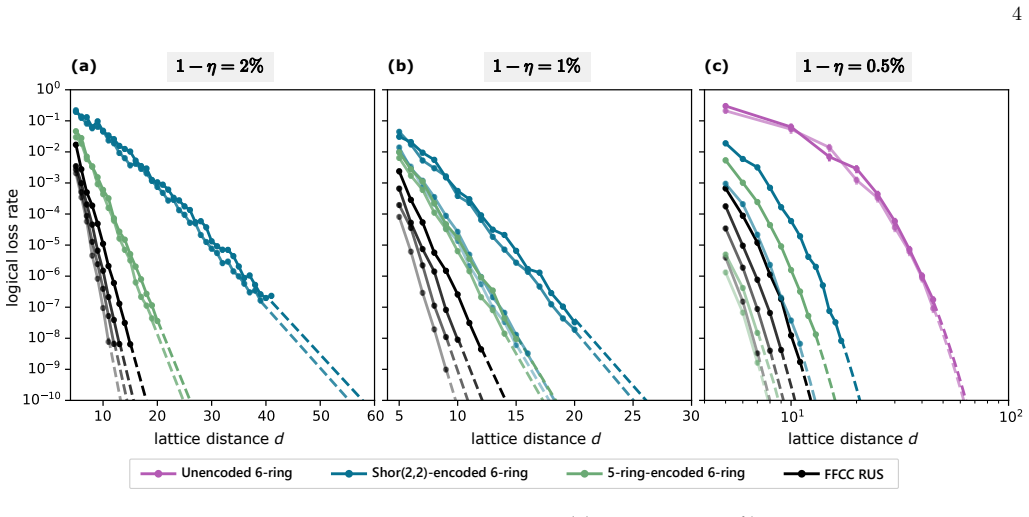
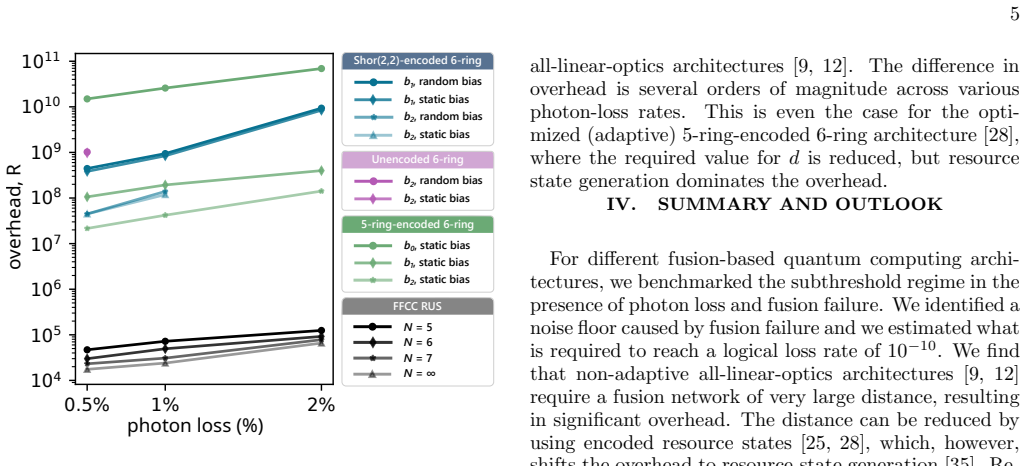
Fusion failure sets a noise floor that stops all-linear-optics photonic quantum computers from reaching useful error rates at low overhead.
A machine-rendered reading of the paper's core claim, the machinery that carries it, and where it could break.
Core claim
In the sub-threshold regime, fusion failure imposes a noise floor on the logical error rate that prevents all-linear-optics architectures from reaching the required rates at low overhead. For fusion-based architectures using quantum emitter spins, the noise floor is reduced by orders of magnitude at a lower overhead.
What carries the argument
The fusion-failure noise floor; it caps how far the logical error rate can fall in the subthreshold regime and determines the overhead needed to reach application targets.
If this is right
- All-linear-optics fusion-based architectures cannot reach application error rates at low overhead.
- Architectures that incorporate quantum emitter spins achieve substantially lower noise floors with reduced overhead.
- Resource estimates for fault-tolerant photonic algorithms must include the fusion-failure floor when operating below threshold.
- Design choices that avoid or mitigate fusion failures become essential once logical error rates enter the subthreshold window.
Where Pith is reading between the lines
- Hybrid linear-optics plus emitter-spin designs may become the minimal viable route to practical photonic quantum computing.
- Overhead calculations for large-scale photonic algorithms should be revisited to incorporate the subthreshold fusion floor.
- Experimental tests that measure logical error rate versus overhead in small fusion networks could directly confirm or refute the predicted floor.
Load-bearing premise
The error models and scaling relations used to compute the size of the fusion-failure noise floor and its dependence on overhead.
What would settle it
A numerical simulation of an all-linear-optics fusion-based architecture that tracks logical error rate versus overhead deep into the subthreshold regime and shows the error rate continuing to fall without flattening into a floor.
Figures

read the original abstract
Fusion-based quantum architectures are the leading approach to photonic quantum computing. However, the sub-threshold regime, where logical error rates must reach the levels required by useful applications, has received little attention. We show that in this regime, fusion failure imposes a noise floor on the logical error rate that prevents all-linear-optics architectures from reaching the required rates at low overhead. For fusion-based architectures using quantum emitter spins, we show that the noise floor is reduced by orders of magnitude at a lower overhead.
Editorial analysis
A structured set of objections, weighed in public.
Referee Report
Summary. The manuscript examines the subthreshold regime of fusion-based quantum computing architectures. It claims that fusion failure imposes a noise floor on logical error rates that prevents all-linear-optics approaches from reaching application-required rates at low overhead. Architectures incorporating quantum emitter spins are shown to reduce this noise floor by orders of magnitude while operating at lower overhead.
Significance. If the underlying error models and quantitative results hold, the finding would be significant for photonic quantum computing, as it identifies a previously under-examined limitation in linear-optics fusion schemes and indicates a concrete advantage for hybrid spin-photonic designs in achieving fault tolerance with reduced overhead.
major comments (1)
- [Abstract] The central claim rests on a specific (unstated in the abstract) error model for fusion failure and its mapping to logical errors in the subthreshold regime. Without the methods section, derivations, or simulation parameters, the noise-floor scaling and overhead comparisons cannot be evaluated for internal consistency or quantitative support.
Simulated Author's Rebuttal
We thank the referee for their review and for highlighting the need for greater clarity on the error model in the abstract. We address this point below.
read point-by-point responses
-
Referee: [Abstract] The central claim rests on a specific (unstated in the abstract) error model for fusion failure and its mapping to logical errors in the subthreshold regime. Without the methods section, derivations, or simulation parameters, the noise-floor scaling and overhead comparisons cannot be evaluated for internal consistency or quantitative support.
Authors: The full manuscript contains a methods section that specifies the error model for fusion failure (including the probabilistic failure probability and its conversion to effective Pauli errors), the mapping to logical errors via the fusion-based error correction protocol, the analytical derivations for the noise floor, and all simulation parameters (e.g., code distances, fusion success probabilities, and Monte Carlo settings). The abstract is written in the conventional concise style that emphasizes results rather than technical assumptions. We agree that explicitly referencing the error model in the abstract would aid evaluation and will revise the abstract to include a brief clause stating the assumed fusion failure model and its mapping. revision: yes
Circularity Check
No significant circularity detected
full rationale
The abstract and visible context contain only high-level claims about noise floors and overhead in fusion-based architectures, with no equations, derivations, fitted parameters, or self-citations presented. No load-bearing steps can be inspected for reduction to inputs by construction, self-definition, or imported uniqueness. The derivation chain is therefore self-contained against external benchmarks, as no internal mathematical structure is available to exhibit circularity.
Axiom & Free-Parameter Ledger
Reference graph
Works this paper leans on
-
[1]
Litinski, A game of surface codes: Large-scale quan- tum computing with lattice surgery, Quantum3, 128 (2019)
D. Litinski, A game of surface codes: Large-scale quan- tum computing with lattice surgery, Quantum3, 128 (2019)
2019
-
[2]
Google Quantum AI and Collaborators, Quantum error correction below the surface code threshold, Nature638, 920 (2025)
2025
-
[3]
Panteleev and G
P. Panteleev and G. Kalachev, Asymptotically good quantum and locally testable classical LDPC codes, in Proceedings of the 54th Annual ACM SIGACT Sympo- sium on Theory of Computing(2022) pp. 375–388
2022
-
[4]
A. Leverrier and G. Z´ emor, Quantum tanner codes (2022), arXiv:2202.13641 [quant-ph]. 6
-
[5]
S. X. Chen, M. C. L¨ obl, M. L. Chan, A. S. Sørensen, and S. Paesani, Fusion-based implementation of qldpc codes with quantum emitters, arXiv:2509.17223 (2025)
work page internal anchor Pith review Pith/arXiv arXiv 2025
-
[6]
Hacker, S
B. Hacker, S. Welte, G. Rempe, and S. Ritter, A photon– photon quantum gate based on a single atom in an optical resonator, Nature536, 193 (2016)
2016
-
[7]
D. E. Browne and T. Rudolph, Resource-efficient lin- ear optical quantum computation, Phys. Rev. Lett.95, 010501 (2005)
2005
-
[8]
Gimeno-Segovia,Towards practical linear optical quantum computing, Ph.D
M. Gimeno-Segovia,Towards practical linear optical quantum computing, Ph.D. thesis, Imperial College Lon- don (2016)
2016
-
[9]
Bartolucci, P
S. Bartolucci, P. Birchall, H. Bombin, H. Cable, C. Daw- son, M. Gimeno-Segovia, E. Johnston, K. Kieling, N. Nickerson, M. Pant,et al., Fusion-based quantum computation, Nat. Commun.14, 912 (2023)
2023
-
[10]
A. Y. Kitaev, Fault-tolerant quantum computation by anyons, Annals of physics303, 2 (2003)
2003
-
[11]
Dennis, A
E. Dennis, A. Kitaev, A. Landahl, and J. Preskill, Topo- logical quantum memory, J. Math. Phys.43, 4452 (2002)
2002
-
[12]
H. Bomb´ ın, C. Dawson, N. Nickerson, M. Pant, and J. Sullivan, Increasing error tolerance in quantum com- puters with dynamic bias arrangement, arXiv:2303.16122 (2023)
-
[13]
M. L. Chan, T. J. Bell, L. A. Pettersson, S. X. Chen, P. Yard, A. S. Sørensen, and S. Paesani, Tailoring fusion- based photonic quantum computing schemes to quantum emitters, PRX Quantum6, 020304 (2025)
2025
-
[14]
PsiQuantum team, A manufacturable platform for pho- tonic quantum computing, Nature641, 876 (2025)
2025
-
[15]
Bravyi and A
S. Bravyi and A. Vargo, Simulation of rare events in quantum error correction, Phys. Rev. A88, 062308 (2013)
2013
- [16]
-
[17]
Benhemou, K
A. Benhemou, K. Sahay, L. Lao, and B. J. Brown, Min- imising surface-code failures using a color-code decoder, Quantum9, 1632 (2025)
2025
-
[18]
C. Gidney and C. Jones, New circuits and an open source decoder for the color code, arXiv:2312.08813 (2023)
-
[19]
Paesani and B
S. Paesani and B. J. Brown, High-threshold quan- tum computing by fusing one-dimensional cluster states, Phys. Rev. Lett.131, 120603 (2023)
2023
-
[20]
W. P. Grice, Arbitrarily complete Bell-state measure- ment using only linear optical elements, Phys. Rev. A 84, 042331 (2011)
2011
-
[21]
M. L. Chan, A. A. Capatos, P. Lodahl, A. S. Sørensen, and S. Paesani, Practical blueprint for low- depth photonic quantum computing with quantum dots, arXiv:2507.16152 (2025)
work page internal anchor Pith review Pith/arXiv arXiv 2025
-
[22]
P. Hilaire, T. Dessertaine, B. Bourdoncle, A. Denys, G. de Gliniasty, G. Valent´ ı-Rojas, and S. Mansfield, En- hanced fault-tolerance in photonic quantum computing: Floquet code outperforms surface code in tailored archi- tecture, arXiv:2410.07065 (2024)
-
[23]
N. H. Lindner and T. Rudolph, Proposal for pulsed on- demand sources of photonic cluster state strings, Phys. Rev. Lett.103, 113602 (2009)
2009
- [24]
-
[25]
T. J. Bell, L. A. Pettersson, and S. Paesani, Optimizing graph codes for measurement-based loss tolerance, PRX Quantum4, 020328 (2023)
2023
-
[26]
Y. Li, P. C. Humphreys, G. J. Mendoza, and S. C. Benjamin, Resource costs for fault-tolerant linear opti- cal quantum computing, Phys. Rev. X5, 041007 (2015)
2015
-
[27]
K. H. Nielsen, E. Corminboeuf, B. Tissot, L. A. Petters- son, S. Scholz, A. Ludwig, L. Midolo, A. S. Sørensen, P. Lodahl, Y. Wang,et al., Photon sorting with a quan- tum emitter, arXiv:2604.21758 (2026)
work page internal anchor Pith review Pith/arXiv arXiv 2026
-
[28]
Pettersson and A
L. Pettersson and A. S. Sørensen, Long-distance quantum communication using concatenated ring graph codes, Phys. Rev. Appl.24, 044090 (2025)
2025
-
[29]
Bombin, D
H. Bombin, D. Litinski, N. Nickerson, F. Pastawski, and S. Roberts, Unifying flavors of fault tolerance with the ZX calculus, Quantum8, 1379 (2024)
2024
-
[30]
P. Birchall, J. Bridgeman, C. Dawson, T. Farrelly, Y. Liu, N. Nickerson, M. Pant, S. Roberts, K. Seetharam, and D. Tuckett, Macromux: scalable postselection for high-threshold fault-tolerant quantum computation, arXiv:2603.04875 (2026)
-
[31]
T. M. Stace, S. D. Barrett, and A. C. Doherty, Thresholds for topological codes in the presence of loss, Phys. Rev. Lett.102, 200501 (2009)
2009
-
[32]
M. C. L¨ oblet al., perqolate,https://github.com/ nbi-hyq/perqolate(2023)
2023
-
[33]
M. C. L¨ obl, S. Paesani, and A. S. Sørensen, Efficient per- colation simulations for lossy photonic fusion networks, Phys. Rev. Res.6, 033273 (2024)
2024
-
[34]
M. E. J. Newman and R. M. Ziff, Fast monte carlo al- gorithm for site or bond percolation, Phys. Rev. E64, 016706 (2001)
2001
-
[35]
Lee and H
S.-H. Lee and H. Jeong, Graph-theoretical optimization of fusion-based graph state generation, Quantum7, 1212 (2023)
2023
-
[36]
S. A. Fldzhyan, M. Y. Saygin, and S. P. Kulik, Compact linear optical scheme for bell state generation, Phys. Rev. Res.3, 043031 (2021)
2021
-
[37]
B. Li, S. E. Economou, and E. Barnes, Photonic resource state generation from a minimal number of quantum emitters, Npj Quantum Inf.8, 11 (2022)
2022
-
[38]
M. C. L¨ obl, L. A. Pettersson, A. Jena, L. Dellantonio, S. Paesani, and A. S. Sørensen, Generating graph states with a single quantum emitter and the minimum number of fusions, Phys. Rev. A111, 052604 (2025)
2025
-
[39]
S. C. Wein, T. Goubault de Brugi` ere, L. Music, P. Senel- lart, B. Bourdoncle, and S. Mansfield, Minimizing re- source overhead in fusion-based quantum computation using hybrid spin-photon devices, PRX Quantum6, 040362 (2025)
2025
-
[40]
N. Manohar, A. Danageozian, E. Takou, E. Barnes, and S. E. Economou, Protocol for efficient generation of fusion-based quantum computing resource states from quantum emitters, arXiv:2605.09325 (2026)
work page internal anchor Pith review Pith/arXiv arXiv 2026
-
[41]
T. G. K. Staudacher, B. Jeevanesan, Adaptive frame- work for failure-aware protocols in fusion-based graph- state generation, arXiv:2601.02087 (2026)
work page internal anchor Pith review Pith/arXiv arXiv 2026
-
[42]
Duan and R
L.-M. Duan and R. Raussendorf, Efficient quantum com- putation with probabilistic quantum gates, Phys. Rev. Lett.95, 080503 (2005)
2005
discussion (0)
Sign in with ORCID, Apple, or X to comment. Anyone can read and Pith papers without signing in.