Twin Peaks: Resolving Features in the Binary Black Hole Mass Function with COSMIC-METISSE
Pith reviewed 2026-06-30 01:21 UTC · model grok-4.3
The pith
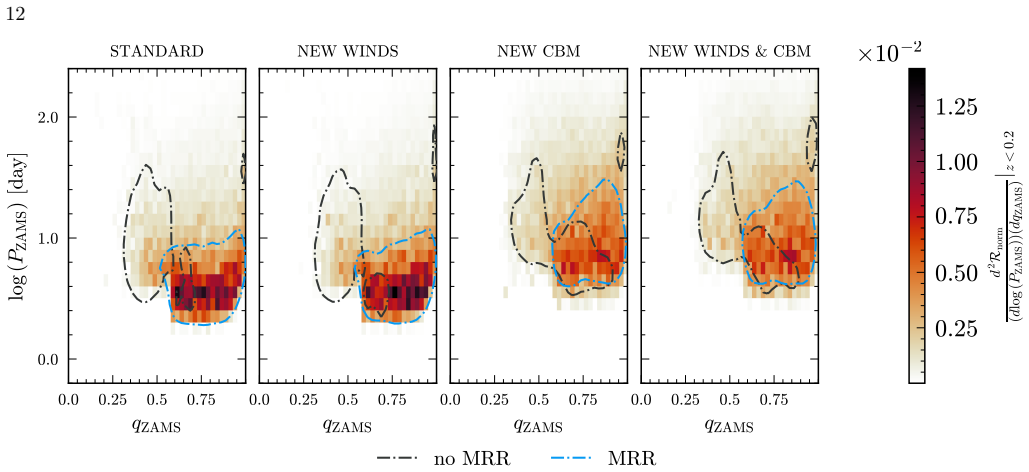
Binary black hole primary masses show twin peaks near 8 and 13 solar masses in most model variations, with the higher peak from mass ratio reversal.
A machine-rendered reading of the paper's core claim, the machinery that carries it, and where it could break.
Core claim
We find a maximum in the primary mass spectrum near 10M_⊙ which in most model variations is composed of two sub-populations at ≈8M_⊙ and ≈13 M_⊙, with the higher-mass population dominated by BBHs whose progenitors underwent a mass ratio reversal (MRR). This population also suggests an anticorrelation between higher primary masses and mass ratio, as BBHs with m1≳10M_⊙ preferentially undergo MRR and prefer a final mass ratio of q≈0.7. Variations in our stellar tracks, especially CBM, lead to a factor of ≈6 difference in the rate, primarily due to modulation of the common envelope formation channel.
What carries the argument
Mass ratio reversal (MRR) in isolated binary evolution, which produces the higher-mass sub-population near 13 solar masses and drives the anticorrelation with final mass ratio.
If this is right
- BBHs with primary masses above 10 solar masses preferentially end with mass ratios near 0.7 after mass ratio reversal.
- Adjusting wind mass loss and convective boundary mixing can merge the two sub-populations into one peak near 9 solar masses.
- Merger rates differ by a factor of approximately 6 across the grid, driven mainly by changes in the common-envelope channel.
- The higher-mass sub-population arises almost entirely from progenitors that experienced mass ratio reversal.
Where Pith is reading between the lines
- If future gravitational-wave catalogs resolve the two peaks, that would directly constrain how often mass ratio reversal occurs in massive binaries.
- The strong sensitivity to convective boundary mixing points to a need for tighter observational or theoretical limits on that process before rates can be predicted reliably.
- Because the rate variation is tied to common-envelope formation, independent constraints on common-envelope efficiency would test whether the modeled factor-of-six spread is realistic.
Load-bearing premise
Isolated binary evolution with the COSMIC code and the chosen MESA tracks, after varying only wind mass loss and convective boundary mixing, captures the dominant channel for merging binary black holes.
What would settle it
A catalog of hundreds of gravitational-wave events whose primary-mass distribution shows only a single peak near 9-10 solar masses, with no resolved sub-structure at 8 and 13 solar masses, would falsify the claim that the twin peaks appear in most model variations.
Figures




read the original abstract
Gravitational waves from inspiraling binary black holes (BBHs) provide insights into the lives and deaths of massive stars. Population synthesis allows us to model these binaries through isolated binary evolution, but its predictive power is limited by difficulties in varying the stellar models and their associated uncertainties. We present a new grid of stellar tracks computed with the open-source stellar evolution code MESA, spanning metallicities $10^{-3} \le Z/Z_{\odot} \le 7$. We vary two stellar physics parameters: wind-driven mass loss and the convective boundary mixing (CBM) mechanism. We pair these models with the Method of Interpolation for Single Stellar Evolution (METISSE) and binary population synthesis code COSMIC to obtain synthetic populations of merging BBHs in the local Universe. We find a maximum in the primary mass spectrum near $10M_\odot$ which in most model variations is composed of two sub-populations at $\approx8M_{\odot}$ and $\approx13 M_\odot$, with the higher-mass population dominated by BBHs whose progenitors underwent a mass ratio reversal (MRR). This population also suggests an anticorrelation between higher primary masses and mass ratio, as BBHs with $m_1\gtrapprox10M_\odot$ preferentially undergo MRR and prefer a final mass ratio of $q\approx0.7$. However, the location and relative strength of these two sub-populations is sensitive to our assumed stellar physics: varying both the wind and CBM treatments can merge the MRR and non-MRR populations into a single peak near $9M_\odot$. Variations in our stellar tracks, especially CBM, lead to a factor of $\approx6$ difference in the rate, primarily due to modulation of the common envelope formation channel.
Editorial analysis
A structured set of objections, weighed in public.
Referee Report
Summary. The paper computes a new grid of MESA stellar evolution tracks at metallicities 10^{-3} ≤ Z/Z_⊙ ≤ 7, varying wind-driven mass loss and convective boundary mixing (CBM). These tracks are interpolated via METISSE and fed into the COSMIC binary population synthesis code to generate synthetic merging BBH populations. The central result is a primary-mass maximum near 10 M_⊙ that, in most explored model variations, splits into sub-populations at ≈8 M_⊙ and ≈13 M_⊙, with the higher-mass peak dominated by systems whose progenitors experienced mass-ratio reversal (MRR); the work also reports an anticorrelation between primary mass and mass ratio for m1 ≳ 10 M_⊙ and a factor-of-≈6 variation in merger rate driven primarily by CBM.
Significance. If the reported twin-peak structure and its MRR association survive broader exploration of binary-physics parameters, the result would provide a concrete, falsifiable link between stellar-evolution uncertainties and features in the GW-observable BBH mass function, offering a potential observational handle on CBM and wind prescriptions.
major comments (2)
- [Abstract] Abstract: the statement that the ≈13 M_⊙ sub-population is 'dominated by BBHs whose progenitors underwent a mass ratio reversal' is presented as a load-bearing interpretive claim, yet the manuscript provides neither the numerical fraction of MRR systems in each sub-population nor the precise algorithmic definition used to tag MRR events in the COSMIC output.
- [Abstract] Abstract and model-description section: the claim that the twin-peak feature appears 'in most model variations' rests on the assumption that the two varied parameters (wind scaling and CBM efficiency) plus the fixed COSMIC settings (including α_CE and supernova kicks) are sufficient to establish robustness; the abstract itself shows that CBM variations alone can erase the split, but no tests of other COSMIC knobs are reported, leaving open whether the MRR-driven feature is generic or an artifact of the default binary-physics choices.
minor comments (2)
- [Abstract] The abstract refers to 'the rate' without specifying whether this is the local merger rate density, the number of systems per unit star-forming mass, or a normalized quantity; a brief clarification of the normalization would aid comparison with other population-synthesis studies.
- [Abstract] Notation for mass ratio q is introduced without an explicit definition in the abstract; while conventional, a parenthetical reminder (q = m2/m1) would remove any ambiguity when discussing the reported anticorrelation.
Simulated Author's Rebuttal
We thank the referee for their thoughtful review and constructive comments on our manuscript. We respond point-by-point to the major comments below, indicating planned revisions where appropriate.
read point-by-point responses
-
Referee: [Abstract] Abstract: the statement that the ≈13 M_⊙ sub-population is 'dominated by BBHs whose progenitors underwent a mass ratio reversal' is presented as a load-bearing interpretive claim, yet the manuscript provides neither the numerical fraction of MRR systems in each sub-population nor the precise algorithmic definition used to tag MRR events in the COSMIC output.
Authors: We agree that explicit fractions and a precise definition of the MRR tagging algorithm would strengthen the presentation. In the revised manuscript we will add both: a description of how MRR systems are identified from the COSMIC output (initially less-massive star becomes the more massive BH after mass transfer) and the numerical fractions of MRR versus non-MRR systems within each sub-population. These additions will appear in the results section and be referenced from the abstract. revision: yes
-
Referee: [Abstract] Abstract and model-description section: the claim that the twin-peak feature appears 'in most model variations' rests on the assumption that the two varied parameters (wind scaling and CBM efficiency) plus the fixed COSMIC settings (including α_CE and supernova kicks) are sufficient to establish robustness; the abstract itself shows that CBM variations alone can erase the split, but no tests of other COSMIC knobs are reported, leaving open whether the MRR-driven feature is generic or an artifact of the default binary-physics choices.
Authors: The referee is correct that our parameter exploration is restricted to stellar-evolution inputs while binary-physics settings remain at COSMIC defaults. The abstract already notes sensitivity to CBM. We will revise the abstract and model-description section to state explicitly that the twin-peak structure is recovered in most of the stellar-physics variations we explored, while clarifying that we do not claim robustness against changes in binary parameters such as α_CE or kick velocities. We will add a brief recommendation for future work on those parameters. revision: yes
Circularity Check
No significant circularity; forward simulation results independent of inputs
full rationale
The paper reports numerical outcomes from COSMIC-METISSE population synthesis runs on a new MESA grid with two explicitly varied stellar parameters (wind mass loss, CBM). The twin-peak structure near 10 M⊙, sub-populations at ≈8 and ≈13 M⊙, MRR dominance, and rate variations are direct outputs of these forward models. No equations, fitted parameters, or self-citations reduce the reported mass-function features or rates to quantities defined by the same data or prior author work. The derivation chain is self-contained against external benchmarks.
Axiom & Free-Parameter Ledger
free parameters (2)
- wind-driven mass loss scaling factor
- convective boundary mixing efficiency parameter
axioms (2)
- domain assumption Isolated binary evolution dominates the local merging BBH population
- domain assumption MESA models with the chosen wind and CBM prescriptions adequately represent real massive-star evolution
Reference graph
Works this paper leans on
-
[1]
2025a, arXiv preprint arXiv:2508.18082
Abac, A., Abouelfettouh, I., Acernese, F., et al. 2025a, arXiv preprint arXiv:2508.18082
-
[2]
2025b, arXiv preprint arXiv:2508.18083
Abac, A., Abouelfettouh, I., Acernese, F., et al. 2025b, arXiv preprint arXiv:2508.18083
-
[3]
P., et al., 2016, @doi [Physical Review Letters] 10.1103/PhysRevLett.116.061102 , 116, 061102
Abbott, B. P., Abbott, R., Abbott, T. D., et al. 2016, Phys. Rev. Lett., 116, 061102, doi: 10.1103/PhysRevLett.116.061102
-
[4]
2023, Physical Review X, 13, 011048
Abbott, R., Abbott, T., Acernese, F., et al. 2023, Physical Review X, 13, 011048
2023
-
[5]
Ade, P. A. R., Aghanim, N., Arnaud, M., et al. 2016, Astronomy & Astrophysics, 594, A13, doi: 10.1051/0004-6361/201525830
-
[6]
2025, The Journal of Open Source Software, 10, 8817, doi: 10.21105/joss.08817
Agrawal, P., Breivik, K., Hurley, J., et al. 2025, The Journal of Open Source Software, 10, 8817, doi: 10.21105/joss.08817
-
[7]
2023, Monthly Notices of the Royal Astronomical Society, 525, 933–951, doi: 10.1093/mnras/stad2334
Agrawal, P., Hurley, J., Stevenson, S., et al. 2023, Monthly Notices of the Royal Astronomical Society, 525, 933–951, doi: 10.1093/mnras/stad2334
-
[8]
2020, Monthly Notices of the Royal Astronomical Society, 497, 4549–4564, doi: 10.1093/mnras/staa2264
Agrawal, P., Hurley, J., Stevenson, S., Sz´ ecsi, D., & Flynn, C. 2020, Monthly Notices of the Royal Astronomical Society, 497, 4549–4564, doi: 10.1093/mnras/staa2264
-
[9]
Anders, E. H., Jermyn, A. S., Lecoanet, D., et al. 2022b, Research Notes of the AAS, 6, 41, doi: 10.3847/2515-5172/ac5892
-
[10]
Andrews, J. J., Bavera, S. S., Briel, M., et al. 2025, The Astrophysical Journal Supplement Series, 281, 3, doi: 10.3847/1538-4365/adfb78
-
[11]
1999, NuPhA, 656, 3, doi: 10.1016/S0375-9474(99)00030-5 Astropy Collaboration, Robitaille, T
Angulo, C., Arnould, M., Rayet, M., et al. 1999, NuPhA, 656, 3, doi: 10.1016/S0375-9474(99)00030-5 Astropy Collaboration, Robitaille, T. P., Tollerud, E. J., et al. 2013, A&A, 558, A33, doi: 10.1051/0004-6361/201322068 Astropy Collaboration, Price-Whelan, A. M., Sip˝ ocz, B. M., et al. 2018, AJ, 156, 123, doi: 10.3847/1538-3881/aabc4f Astropy Collaboratio...
-
[12]
Belczynski, K., Bulik, T., Fryer, C. L., et al. 2010, The Astrophysical Journal, 714, 1217, doi: 10.1088/0004-637X/714/2/1217
-
[13]
Belczynski, K., Kalogera, V., Rasio, F. A., et al. 2008, The Astrophysical Journal Supplement Series, 174, 223, doi: 10.1086/521026
work page internal anchor Pith review doi:10.1086/521026 2008
-
[14]
Blouin, S., Shaffer, N. R., Saumon, D., & Starrett, C. E. 2020, ApJ, 899, 46, doi: 10.3847/1538-4357/ab9e75
-
[15]
2024, Universe, 10, 148
Boccioli, L., & Roberti, L. 2024, Universe, 10, 148
2024
-
[16]
2020, The Astrophysical Journal, 898, 71, doi: 10.3847/1538-4357/ab9d85
Breivik, K., Coughlin, S., Zevin, M., et al. 2020, The Astrophysical Journal, 898, 71, doi: 10.3847/1538-4357/ab9d85
-
[17]
M., Fragos, T., Gallegos-Garcia, M., et al
Briel, M. M., Fragos, T., Gallegos-Garcia, M., et al. 2026, A case for Case A: detailed look at binary black hole formation through stable mass transfer, https://arxiv.org/abs/2602.03629
Pith/arXiv arXiv 2026
-
[18]
S., Stevenson, S., & Thrane, E
Broekgaarden, F. S., Stevenson, S., & Thrane, E. 2022, The Astrophysical Journal, 938, 45, doi: 10.3847/1538-4357/ac8879
-
[19]
S., Lam, A., Levina, S., et al
Broekgaarden, F. S., Lam, A., Levina, S., et al. 2026, How Common Are Common Envelopes? Quantifying Their Role in Forming Gravitational-Wave Sources, https://arxiv.org/abs/2606.05322
Pith/arXiv arXiv 2026
-
[20]
2024, The Astrophysical Journal Letters, 964, L16, doi: 10.3847/2041-8213/ad319e
Burrows, A., Wang, T., & Vartanyan, D. 2024, The Astrophysical Journal Letters, 964, L16, doi: 10.3847/2041-8213/ad319e
-
[21]
A., & Farr, W
Callister, T. A., & Farr, W. M. 2024, Phys. Rev. X., 14
2024
-
[22]
2007, ApJ, 661, 1094, doi: 10.1086/516819
Salaris, M. 2007, ApJ, 661, 1094, doi: 10.1086/516819
-
[23]
Chen, G., Breivik, K., & van Son, L. A. C. 2026, arXiv e-prints, arXiv:2606.26262. https://arxiv.org/abs/2606.26262
Pith/arXiv arXiv 2026
-
[24]
Cheng, A. Q., Zevin, M., & Vitale, S. 2023, The Astrophysical Journal, 955, 127, doi: 10.3847/1538-4357/aced98
-
[25]
MESA Isochrones and Stellar Tracks (MIST). I: Solar-Scaled Models
Choi, J., Dotter, A., Conroy, C., et al. 2016, The Astrophysical Journal, 823, 102, doi: 10.3847/0004-637X/823/2/102 Chru´ sli´ nska, M. 2024, Annalen der Physik, 536, 2200170
work page internal anchor Pith review doi:10.3847/0004-637x/823/2/102 2016
-
[26]
Chruslinska, M., & Nelemans, G. 2019, Monthly Notices of the Royal Astronomical Society, 488, 5300, doi: 10.1093/mnras/stz2057 Chru´ sli´ nska, M., Nelemans, G., Boco, L., & Lapi, A. 2021, Monthly Notices of the Royal Astronomical Society, 508, 4994 20
-
[27]
Chugunov, A. I., Dewitt, H. E., & Yakovlev, D. G. 2007, PhRvD, 76, 025028, doi: 10.1103/PhysRevD.76.025028
-
[28]
Verbunt, F. W. M. 2014, Astronomy & Astrophysics, 563, A83, doi: 10.1051/0004-6361/201322714
-
[29]
Cyburt, R. H., Amthor, A. M., Ferguson, R., et al. 2010, ApJS, 189, 240, doi: 10.1088/0067-0049/189/1/240 de Kool, M. 1990, The Astrophysical Journal, 358, 189, doi: 10.1086/168974
-
[30]
Decin, L., Richards, A. M. S., Marchant, P., & Sana, H. 2023, Astron. Astrophys
2023
-
[31]
2025, The Astrophysical Journal Letters, 989, L8, doi: 10.3847/2041-8213/adf286
Disberg, P., & Mandel, I. 2025, The Astrophysical Journal Letters, 989, L8, doi: 10.3847/2041-8213/adf286
-
[32]
2013, The Astrophysical Journal, 779, 72, doi: 10.1088/0004-637X/779/1/72
Dominik, M., Belczynski, K., Fryer, C., et al. 2013, The Astrophysical Journal, 779, 72, doi: 10.1088/0004-637X/779/1/72
-
[33]
2012, The Astrophysical Journal, 759, 52, doi: 10.1088/0004-637x/759/1/52
Dominik, M., Belczynski, K., Fryer, C., et al. 2012, The Astrophysical Journal, 759, 52, doi: 10.1088/0004-637x/759/1/52
-
[34]
MESA Isochrones and Stellar Tracks (MIST) 0: Methods for the construction of stellar isochrones
Dotter, A. 2016, The Astrophysical Journal Supplement Series, 222, 8, doi: 10.3847/0067-0049/222/1/8
work page internal anchor Pith review doi:10.3847/0067-0049/222/1/8 2016
-
[35]
1976, IAU
Eggleton, P., Mitton, S., & Whelan, J., eds. 1976, IAU
1976
-
[36]
Timmes, F. X. 2022, ApJ, 937, 112, doi: 10.3847/1538-4357/ac8b83
-
[37]
Ferguson, J. W., Alexander, D. R., Allard, F., et al. 2005, ApJ, 623, 585, doi: 10.1086/428642
-
[38]
Fragos, T., J. Andrews, J., Bavera, S. S., et al. 2023, The Astrophysical Journal Supplement Series, 264, 45, doi: 10.3847/1538-4365/ac90c1
-
[39]
L., Belczynski, K., Wiktorowicz, G., et al
Fryer, C. L., Belczynski, K., Wiktorowicz, G., et al. 2012, The Astrophysical Journal, 749, 91, doi: 10.1088/0004-637x/749/1/91
-
[40]
Fuller, G. M., Fowler, W. A., & Newman, M. J. 1985, ApJ, 293, 1, doi: 10.1086/163208
-
[41]
2012, Astronomy & Astrophysics, 542, A29, doi: 10.1051/0004-6361/201118340
Georgy, C., Ekstr¨ om, S., Meynet, G., et al. 2012, Astronomy & Astrophysics, 542, A29, doi: 10.1051/0004-6361/201118340
-
[42]
Godfrey, J., van Son, L., & Farr, B. 2026, arXiv e-prints, arXiv:2605.23083, doi: 10.48550/arXiv.2605.23083
work page internal anchor Pith review Pith/arXiv arXiv doi:10.48550/arxiv.2605.23083 2026
-
[43]
G., Zevin, M., Maclean, D
Guerrero, A. G., Zevin, M., Maclean, D. B., et al. 2026 (in prep.)
2026
-
[44]
Harris, C. R., Millman, K. J., van der Walt, S. J., et al. 2020, Nature, 585, 357, doi: 10.1038/s41586-020-2649-2
-
[45]
Hendriks, D. D., van Son, L. A. C., Renzo, M., Izzard, R. G., & Farmer, R. 2023, Monthly Notices of the Royal Astronomical Society, 526, 4130–4147, doi: 10.1093/mnras/stad2857
-
[46]
2000, The evolution of AGB stars with convective overshoot, https://arxiv.org/abs/astro-ph/0007139
Herwig, F. 2000, The evolution of AGB stars with convective overshoot, https://arxiv.org/abs/astro-ph/0007139
Pith/arXiv arXiv 2000
-
[47]
2022, The Astrophysical Journal Letters, 937, L42, doi: 10.3847/2041-8213/ac9519
Hirai, R., & Mandel, I. 2022, The Astrophysical Journal Letters, 937, L42, doi: 10.3847/2041-8213/ac9519
-
[48]
2017, In revision, J
Hoyer, S., & Hamman, J. 2017, In revision, J. Open Res. Software
2017
-
[49]
Humphreys, R. M., & Davidson, K. 1994, Publications of the Astronomical Society of the Pacific, 106, 1025, doi: 10.1086/133478
-
[50]
Hunter, J. D. 2007, Computing in Science & Engineering, 9, 90, doi: 10.1109/MCSE.2007.55
-
[51]
Hurley, J. R., Pols, O. R., & Tout, C. A. 2000, Monthly Notices of the Royal Astronomical Society, 315, 543, doi: 10.1046/j.1365-8711.2000.03426.x
-
[52]
Hurley, J. R., Tout, C. A., & Pols, O. R. 2002, Monthly Notices of the Royal Astronomical Society, 329, 897, doi: 10.1046/j.1365-8711.2002.05038.x
-
[53]
Iglesias, C. A., & Rogers, F. J. 1993, ApJ, 412, 752, doi: 10.1086/172958
-
[54]
Iglesias, C. A., & Rogers, F. J. 1996, ApJ, 464, 943, doi: 10.1086/177381
-
[55]
2023, MNRAS, 524, 426, doi: 10.1093/mnras/stad1630
Iorio, G., Mapelli, M., Costa, G., et al. 2023, MNRAS, 524, 426, doi: 10.1093/mnras/stad1630
-
[56]
Irwin, A. W. 2004, The FreeEOS Code for Calculating the Equation of State for Stellar Interiors, http://freeeos.sourceforge.net/
2004
-
[57]
1996, ApJS, 102, 411, doi: 10.1086/192264
Itoh, N., Hayashi, H., Nishikawa, A., & Kohyama, Y. 1996, ApJS, 102, 411, doi: 10.1086/192264
-
[58]
2004, MNRAS, 351, 169, doi: 10.1111/j.1365-2966.2004.07765.x Mi´ ci´ c, M., Irwin, J
Izzard, R. G., Tout, C. A., Karakas, A. I., & Pols, O. R. 2004, Monthly Notices of the Royal Astronomical Society, 350, 407–426, doi: 10.1111/j.1365-2966.2004.07446.x
-
[59]
Jager, C de Nieuwenhuijzen, H., & Hucht, K. v. d. 1988, Mass loss rates in the Hertzsprung-Russell diagram,
1988
-
[60]
Potekhin, A. Y. 2021, ApJ, 913, 72, doi: 10.3847/1538-4357/abf48e
-
[61]
Jermyn, A. S., Bauer, E. B., Schwab, J., et al. 2023, ApJS, 265, 15, doi: 10.3847/1538-4365/acae8d
-
[62]
H., et al
Johnston, C., Michielsen, M., Anders, E. H., et al. 2024, Astrophys. J., 964, 170
2024
-
[63]
2023, Galaxies, 11, doi: 10.3390/galaxies11030075
Joyce, M., & Tayar, J. 2023, Galaxies, 11, doi: 10.3390/galaxies11030075
-
[64]
Klencki, J., Nelemans, G., Istrate, A. G., & Chruslinska, M. 2021, Astronomy & Astrophysics, 645, A54, doi: 10.1051/0004-6361/202038707
-
[65]
2001, The Initial Mass Function and its Variation, https://arxiv.org/abs/astro-ph/0102155
Kroupa, P. 2001, The Initial Mass Function and its Variation, https://arxiv.org/abs/astro-ph/0102155
Pith/arXiv arXiv 2001
-
[66]
2023, Astron
Krticka, J., Kubat, J., & Krtickova, I. 2023, Astron. Astrophys. 21
2023
-
[67]
Krticka, J., Kubat, J., & Krtickova, I. 2025, New line-driven wind mass-loss rates for OB stars with metallicities down to 0.01Z ⊙, https://arxiv.org/abs/2508.21702
arXiv 2025
-
[68]
Izzard, R. G. 2018, MNRAS, 481, 1908, doi: 10.1093/mnras/sty2190
-
[69]
2000, Nuclear Physics A, 673, 481, doi: 10.1016/S0375-9474(00)00131-7
Langanke, K., & Mart´ ınez-Pinedo, G. 2000, Nuclear Physics A, 673, 481, doi: 10.1016/S0375-9474(00)00131-7
-
[70]
Lechien, T., de Mink, S. E., Valli, R., et al. 2025, The Astrophysical Journal Letters, 990, L51 LIGO Scientific Collaboration, Virgo Collaboration, KAGRA Collaboration, et al. 2026a, arXiv preprint arXiv:2605.27225 LIGO Scientific Collaboration, Virgo Collaboration, KAGRA Collaboration, et al. 2026b, arXiv preprint arXiv:2605.27226
Pith/arXiv arXiv 2025
-
[71]
B., & Solomon, P
Lucy, L. B., & Solomon, P. M. 1970, Astrophys. J., 159, 879
1970
-
[72]
Maclean, D. 2026a, EEP Files for COSMIC-METISSE, from Maclean et al., 2026, UNC Dataverse, doi: 10.15139/S3/XXQBXM
-
[73]
2026b, d-maclean/UNC-BHNS: Zenodo release, zenodo Zenodo, doi: 10.5281/zenodo.20881972
Maclean, D. 2026b, d-maclean/UNC-BHNS: Zenodo release, zenodo Zenodo, doi: 10.5281/zenodo.20881972
-
[74]
2026c, MC-rates, zenodo Zenodo, doi: 10.5281/zenodo.20799423
Maclean, D. 2026c, MC-rates, zenodo Zenodo, doi: 10.5281/zenodo.20799423
-
[75]
Maltsev, K., Schneider, F. R. N., Mandel, I., et al. 2025, Astronomy & Astrophysics, 700, A20, doi: 10.1051/0004-6361/202554931
-
[76]
Mandel, I., & Broekgaarden, F. S. 2022, Living Reviews in Relativity, 25, doi: 10.1007/s41114-021-00034-3
-
[77]
2020, Frontiers in Astronomy and Space Sciences, 7, doi: 10.3389/fspas.2020.00038
Mapelli, M. 2020, Frontiers in Astronomy and Space Sciences, 7, doi: 10.3389/fspas.2020.00038
-
[78]
Mapelli, M. 2021, Formation Channels of Single and Binary Stellar-Mass Black Holes (Springer Singapore), 1–65, doi: 10.1007/978-981-15-4702-7 16-1
-
[79]
1978, Stellar Atmospheres (San Francisco: W
Mihalas, D. 1978, Stellar Atmospheres (San Francisco: W. H. Freeman)
1978
-
[80]
J., Vigna-G´ omez, A., Stevenson, S., et al
Neijssel, C. J., Vigna-G´ omez, A., Stevenson, S., et al. 2019, Monthly Notices of the Royal Astronomical Society, 490, 3740, doi: 10.1093/mnras/stz2840
discussion (0)
Sign in with ORCID, Apple, or X to comment. Anyone can read and Pith papers without signing in.