Mixed-spin Heisenberg ladders in a magnetic field
Pith reviewed 2026-06-30 00:57 UTC · model grok-4.3
The pith
In (1/2,1) mixed-spin Heisenberg ladders a 1/3 magnetization plateau exists for all positive interchain coupling and over a limited interval for negative coupling, closing at a Kosterlitz-Thouless line located by finite-size scaling of tran
A machine-rendered reading of the paper's core claim, the machinery that carries it, and where it could break.
Core claim
The one-third plateau in the magnetization curve of (1/2,1) ladders is stable for all positive values of the interchain coupling J_perp and persists over a finite interval when J_perp is negative; its upper boundary is a Kosterlitz-Thouless line whose position is determined by finite-size scaling of the transverse spin correlation functions.
What carries the argument
Finite-size scaling of transverse spin correlation functions performed on DMRG chains with variable J_perp and h, used to locate the Kosterlitz-Thouless endpoint at which the 1/3 plateau terminates.
If this is right
- The 1/3 plateau appears for every positive J_perp.
- For negative J_perp the plateau survives only inside a restricted window of coupling strength.
- Critical-line estimates obtained from variable-coupling and uniform-coupling scans remain compatible with each other.
- Linear spin-wave results supply supplementary estimates of the phase boundaries.
Where Pith is reading between the lines
- The same finite-size protocol could be applied to ladders with different mixed-spin pairs to test whether 1/3 or other fractional plateaus appear.
- The limited stability window for antiferromagnetic J_perp suggests that sign changes in interchain coupling may be used to tune the width of magnetization plateaus in related ladder geometries.
- Experimental realizations of mixed-spin ladder compounds could measure the field at which the 1/3 plateau vanishes and thereby test the predicted Kosterlitz-Thouless location.
Load-bearing premise
Finite-size DMRG data together with the chosen scaling of transverse correlations locate the thermodynamic-limit Kosterlitz-Thouless transition without appreciable truncation or finite-size artifacts.
What would settle it
A DMRG run on ladders several times longer than those already studied that places the 1/3-plateau termination at a distinctly different value of J_perp or h would falsify the reported critical line.
Figures
read the original abstract
In this work, we study alternating mixed-spin $(s,S)$ Heisenberg ladders in the magnetic field $h$ using density matrix renormalization group and linear spin-wave calculations. The $h$ \textit{versus} interchain coupling $J_\perp$ phase diagram for the $(1/2,1)$ case is investigated in detail. { In particular, we demonstrate the compatibility between the critical line estimates and magnetic ordering by analyzing chains with variable values of $J_\perp$ and of $h$ along the chain, $J_\perp$ and $h$ scans, and considering the usual case of chains with uniform couplings}. The magnetization plateau at 1/3 of saturation magnetization, 1/3 - plateau, is observed for $J_\perp>0$ and in a limited range for $J_\perp<0$. The critical Kosterlitz-Thouless transition point, where the 1/3 - plateau closes, is identified through a finite-size analysis of the transverse spin correlation functions.
Editorial analysis
A structured set of objections, weighed in public.
Referee Report
Summary. The manuscript examines alternating mixed-spin (s,S) Heisenberg ladders in an external magnetic field h using DMRG and linear spin-wave theory, with detailed focus on the (1/2,1) case. It maps the h versus J_perp phase diagram, reports a 1/3 magnetization plateau for J_perp > 0 and a limited range for J_perp < 0, and locates the Kosterlitz-Thouless point at which the plateau closes via finite-size analysis of transverse spin correlation functions. Compatibility between critical-line estimates and magnetic ordering is claimed through scans of variable J_perp and h (including modulated chains) and uniform-coupling chains.
Significance. If the numerical location of the KT line proves robust, the work adds concrete phase-diagram information for mixed-spin ladders and illustrates how variable-coupling DMRG scans can be used to cross-check plateau boundaries, which is of interest for both theoretical studies of quantum magnetism and potential experimental realizations.
major comments (2)
- [Abstract] Abstract: the central claim that the KT point closing the 1/3 plateau is identified through finite-size analysis of transverse spin correlations rests on DMRG data whose convergence is not documented. No bond-dimension extrapolation, L→∞ scaling collapse, or error bars on the correlation functions are mentioned, yet DMRG truncation damps long-distance correlations and open boundaries introduce Friedel oscillations; without these checks the thermodynamic-limit location of the essential-singularity KT point remains unverified.
- [Abstract] Abstract (variable J_perp/h scans): the compatibility between critical-line estimates and magnetic ordering is asserted via chains with spatially varying J_perp and h, but the manuscript supplies no quantitative comparison (e.g., overlap of plateau boundaries or correlation-length exponents) between these modulated scans and the uniform-chain results, leaving the claimed consistency unquantified.
minor comments (1)
- [Abstract] Abstract: the phrase “limited range for J_perp<0” is vague; a numerical interval or figure reference would clarify the extent of the plateau.
Simulated Author's Rebuttal
We thank the referee for the careful reading and constructive comments. We address the two major points below and will strengthen the manuscript accordingly.
read point-by-point responses
-
Referee: [Abstract] Abstract: the central claim that the KT point closing the 1/3 plateau is identified through finite-size analysis of transverse spin correlations rests on DMRG data whose convergence is not documented. No bond-dimension extrapolation, L→∞ scaling collapse, or error bars on the correlation functions are mentioned, yet DMRG truncation damps long-distance correlations and open boundaries introduce Friedel oscillations; without these checks the thermodynamic-limit location of the essential-singularity KT point remains unverified.
Authors: We agree that explicit documentation of DMRG convergence was omitted. In the revised manuscript we will add an appendix containing bond-dimension extrapolations of the transverse spin correlations, finite-size scaling plots, and truncation-error estimates. We will also clarify that correlations are extracted from the central bulk region to reduce Friedel-oscillation effects and will include error bars on the reported correlation lengths. revision: yes
-
Referee: [Abstract] Abstract (variable J_perp/h scans): the compatibility between critical-line estimates and magnetic ordering is asserted via chains with spatially varying J_perp and h, but the manuscript supplies no quantitative comparison (e.g., overlap of plateau boundaries or correlation-length exponents) between these modulated scans and the uniform-chain results, leaving the claimed consistency unquantified.
Authors: The manuscript presents the modulated J_perp/h scans as an independent cross-check of the uniform-chain plateau boundaries, but we acknowledge that no numerical overlap metrics or exponent comparisons are supplied. In the revision we will add quantitative overlays of the critical lines obtained from both methods together with any available correlation-length estimates to make the claimed consistency explicit. revision: yes
Circularity Check
No significant circularity; results from direct DMRG and spin-wave simulation of the Hamiltonian
full rationale
The paper obtains its phase diagram, 1/3-plateau boundaries, and KT critical line estimates exclusively from numerical DMRG computations on the mixed-spin Heisenberg ladder Hamiltonian (finite-size scans in J_perp and h, transverse correlation analysis) together with linear spin-wave theory. No parameters are fitted to a data subset and then relabeled as predictions of related observables; no self-citation chain supplies the central claims; and the reported critical point is an output of the chosen scaling procedure applied to the simulated correlations rather than a definitional or self-referential input. The derivation chain is therefore self-contained against the model Hamiltonian.
Axiom & Free-Parameter Ledger
free parameters (2)
- J_perp
- h
axioms (1)
- domain assumption Heisenberg exchange interaction between neighboring spins
Reference graph
Works this paper leans on
-
[1]
We estimate the critical point asJ ⊥,KT =−1.32±0.02
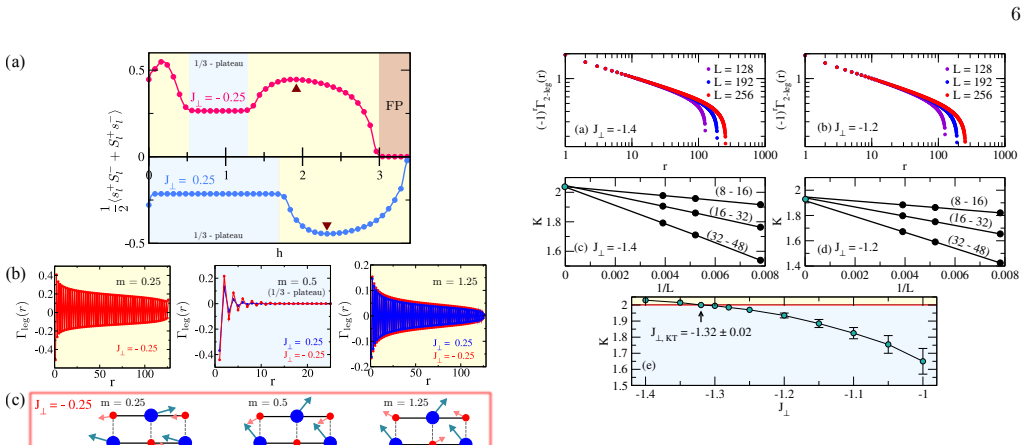
(e) Thermodynamic-limit value ofKas a function ofJ ⊥ near the Kosterlitz-Thouless transition point. We estimate the critical point asJ ⊥,KT =−1.32±0.02. transition point,J ⊥,KT, we can fix the magnetization at its value for the 1/3 – plateau,m= 1/2, and change the value ofJ ⊥ to localize the point at whichK= 2. The procedure is more complex for finite-siz...
-
[2]
V. Zapf, M. Jaime, and C. D. Batista, Bose-Einstein condensation in quantum magnets, Reviews of Modern Physics86, 563 (2014)
2014
-
[3]
Giamarchi, C
T. Giamarchi, C. R¨ uegg, and O. Tchernyshyov, Bose–Einstein condensation in magnetic insulators, Na- ture Physics4, 198 (2008)
2008
-
[4]
Sachdev,Quantum Phase Transitions(Cambridge University Press, 2001)
S. Sachdev,Quantum Phase Transitions(Cambridge University Press, 2001)
2001
-
[5]
J. M. Kosterlitz, Kosterlitz–thouless physics: a re- view of key issues, Reports on Progress in Physics79, 026001 (2016); Nobel Lecture: Topological defects and phase transitions, Reviews of Modern Physics89, 040501 (2017)
2016
-
[6]
haldane gap
M. Oshikawa, M. Yamanaka, and I. Affleck, Magneti- zation plateaus in spin chains: “haldane gap” for half- integer spins, Physical Review Letters78, 1984 (1997)
1984
-
[7]
Giamarchi,Quantum Physics in One Dimension(Ox- ford University Press, 2004)
T. Giamarchi,Quantum Physics in One Dimension(Ox- ford University Press, 2004)
2004
-
[8]
Ishida, Y
K. Ishida, Y. Kitaoka, K. Asayama, M. Azuma, Z. Hi- roi, and M. Takano, Spin gap behavior in ladder-type of quasi-one-dimensional spin (s=1/2) system srcu2o3, Journal of the Physical Society of Japan63, 3222 (1994)
1994
-
[9]
Azuma, Z
M. Azuma, Z. Hiroi, M. Takano, K. Ishida, and Y. Ki- taoka, Observation of a spin gap in srcu 2o3 comprising spin-½quasi-1d two-leg ladders, Phys. Rev. Lett.73, 3463 (1994)
1994
-
[10]
Giamarchi and A
T. Giamarchi and A. M. Tsvelik, Coupled ladders in a magnetic field, Physical Review B59, 11398 (1999)
1999
-
[11]
Dagotto and T
E. Dagotto and T. M. Rice, Surprises on the way from one- to two-dimensional quantum magnets: The ladder materials, Science271, 618 (1996)
1996
-
[12]
R¨ uegg, K
C. R¨ uegg, K. Kiefer, B. Thielemann, D. F. McMor- row, V. Zapf, B. Normand, M. B. Zvonarev, P. Bouil- lot, C. Kollath, T. Giamarchi, S. Capponi, D. Poilblanc, D. Biner, and K. W. Kr¨ amer, Thermodynamics of the Spin Luttinger Liquid in a Model Ladder Material, Phys- ical Review Letters101, 247202 (2008)
2008
-
[13]
Hikihara and O
T. Hikihara and O. A. Starykh, Phase diagram of the frustrated spin ladder, Physical Review B81, 064432 (2010)
2010
-
[14]
S. Ward, M. Mena, P. Bouillot, C. Kollath, T. Giamarchi, K. P. Schmidt, B. Normand, K. W. Kr¨ amer, D. Biner, R. Bewley, T. Guidi, M. Boehm, D. F. McMorrow, and C. R¨ uegg, Bound States and Field-Polarized Haldane Modes in a Quantum Spin Ladder, Physical Review Let- ters118, 10.1103/PhysRevLett.118.177202 (2017)
-
[15]
Nayak, D
M. Nayak, D. Blosser, A. Zheludev, and F. Mila, Magnetic-field-induced bound states in spin-1/2 ladders, Physical Review Letters124, 087203 (2020)
2020
-
[16]
Fukui and N
T. Fukui and N. Kawakami, Alternating-spin ladders, Phys. Rev. B57, 398 (1998)
1998
-
[17]
Langari and M
A. Langari and M. A. Mart´ ın-Delgado, Alternating-spin ladders in a magnetic field: Formation of magnetization plateaux, Phys. Rev. B62, 11725 (2000)
2000
-
[18]
Langari and M
A. Langari and M. A. Mart´ ın-Delgado, Low-energy prop- erties of ferrimagnetic two-leg ladders: A lanczos study, Phys. Rev. B63, 054432 (2001)
2001
-
[19]
N. B. Ivanov and J. Richter, Collective excitations in fer- rimagnetic Heisenberg ladders, Physical Review B63, 144429 (2001)
2001
-
[20]
D. N. Aristov and M. N. Kiselev, Ferrimagnetic mixed- spin ladders in weak- and strong-coupling limits, Physical Review B70, 224402 (2004)
2004
-
[21]
S. Chen, L. Wang, and Y. P. Wang, Phase diagram of frustrated mixed-spin ladders in the strong-coupling limit, The European Physical Journal B57, 265 (2007)
2007
-
[22]
G. I. Japaridze, A. Langari, and S. Mahdavifar, Spin lad- der with anisotropic ferromagnetic legs in a transverse magnetic field, Journal of Physics: Condensed Matter 19, 076201 (2007)
2007
-
[23]
V. R. Chandra, N. B. Ivanov, and J. Richter, Frus- trated spin ladder with alternating spin-1 and spin- $\frac{1}{2}$rungs, Physical Review B81, 024409 (2010)
2010
-
[24]
Qi, S.-W
Y. Qi, S.-W. Lv, A. Du, and N.-s. Yu, Interplay between spin frustration and magnetism in the exactly solved two- leg mixed spin ladder*, Chinese Physics B25, 117501 (2016)
2016
-
[25]
Ahmadi, J
N. Ahmadi, J. Abouie, R. Haghshenas, and D. Baeriswyl, Frustrated mixed-spin ladders: Evidence for a bond- order wave phase between rung-singlet and Haldane phases, Physical Review B106, 174419 (2022). 9
2022
-
[26]
Lieb and D
E. Lieb and D. Mattis, Ordering energy levels of inter- acting spin systems, Journal of Mathematical Physics3 (1962)
1962
-
[27]
G.-S. Tian, Coexistence of the ferromagnetic and antifer- romagnetic long-range orders in the generalized antiferro- magnetic heisenberg model on a bipartite lattice, Journal of Physics A: Mathematical and General27, 2305 (1994)
1994
-
[28]
Noriki and S
Y. Noriki and S. Yamamoto, Modified Spin-Wave Theory on Low-Dimensional Heisenberg Ferrimagnets: A New Robust Formulation, Journal of the Physical Society of Japan86, 034714 (2017)
2017
-
[29]
L. M. Ver´ ıssimo, M. S. S. Pereira, J. Streˇ cka, and M. L. Lyra, Topological quantum phase transition in a mixed- spin Heisenberg tetramer chain with alternating spin-1/2 and spin-5/2 dimers, Journal of Magnetism and Magnetic Materials571, 170595 (2023)
2023
-
[30]
F. C. Alcaraz and A. L. Malvezzi, Critical behaviour of mixed heisenberg chains, Journal of Physics A: Mathe- matical and General30, 767 (1997)
1997
-
[31]
Brehmer, H.-J
S. Brehmer, H.-J. Mikeska, and S. Yamamoto, Low- temperature properties of quantum antiferromagnetic chains with alternating spins and, Journal of Physics: Condensed Matter9, 3921 (1997)
1997
-
[32]
S. K. Pati, S. Ramasesha, and D. Sen, A density ma- trix renormalization group study of low-energy excita- tions and low-temperature properties of alternating spin systems, Journal of Physics: Condensed Matter9, 8707 (1997)
1997
-
[33]
S. K. Pati, S. Ramasesha, and D. Sen, Low-lying excited states and low-temperature properties of an alternating spin-1–spin-1/2 chain: A density-matrix renormalization-group study, Physical Review B55, 8894 (1997)
1997
-
[34]
Yamamoto, S
S. Yamamoto, S. Brehmer, and H.-J. Mikeska, Elemen- tary excitations of heisenberg ferrimagnetic spin chains, Physical Review B57, 13610 (1998)
1998
-
[35]
Maisinger, U
K. Maisinger, U. Schollw¨ ock, S. Brehmer, H. J. Mikeska, and S. Yamamoto, Thermodynamics of the (1,1/2)ferri- magnet in finite magnetic fields, Physical Review B58, R5908 (1998)
1998
-
[36]
A. S. F. Ten´ orio, R. R. Montenegro-Filho, and M. D. Coutinho-Filho, Quantum phase transitions in alter- nating spin-1/2–spin-5/2 heisenberg chains, Journal of Physics: Condensed Matter23, 506003 (2011)
2011
-
[37]
W. M. da Silva and R. R. Montenegro-Filho, The role of density-dependent magnon hopping and magnon- magnon repulsion in ferrimagnetic spin-(1/2,$S$) chains in a magnetic field, Physical Review B103, 054432 (2021)
2021
-
[38]
R. R. Montenegro-Filho, F. S. Matias, and M. D. Coutinho-Filho, Topology of many-body edge and ex- tended quantum states in an open spin chain: 1/3 plateau, kosterlitz-thouless transition, and luttinger liq- uid, Phys. Rev. B102, 035137 (2020)
2020
-
[39]
Karl’ov´ a, J
K. Karl’ov´ a, J. Streˇ cka, and M. L. Lyra, Breakdown of intermediate one-half magnetization plateau of spin-1/2 ising-heisenberg and heisenberg branched chains at triple and kosterlitz-thouless critical points, Phys. Rev. E100, 042127 (2019)
2019
-
[40]
L. M. Ver´ ıssimo, M. S. S. Pereira, J. Streˇ cka, and M. L. Lyra, Kosterlitz-thouless and gaussian criticalities in a mixed spin-( 1 2 , 5 2 , 1
-
[41]
heisenberg branched chain with ex- change anisotropy, Phys. Rev. B99, 134408 (2019)
2019
-
[42]
L. M. Ver´ ıssimo, M. S. S. Pereira, J. Streˇ cka, and M. L. Lyra, Ground-state phase diagram and universality of se- quential topological valence-bond-solid quantum transi- tions in a mixed tetramer chain, Journal of Physics: Con- densed Matter36, 165802 (2024)
2024
-
[43]
R. R. Montenegro-Filho, E. J. P. Silva-J´ unior, and M. D. Coutinho-Filho, Ground-state phase diagram and ther- modynamics of coupled trimer chains, Physical Review B105, 134423 (2022)
2022
-
[44]
Schollw¨ ock, The density-matrix renormalization group, Reviews of Modern Physics77, 259 (2005)
U. Schollw¨ ock, The density-matrix renormalization group, Reviews of Modern Physics77, 259 (2005)
2005
-
[45]
Schollw¨ ock, Progress in density matrix renormaliza- tion: What quantum information is teaching us, Journal of Magnetism and Magnetic Materials310, 1394 (2007)
U. Schollw¨ ock, Progress in density matrix renormaliza- tion: What quantum information is teaching us, Journal of Magnetism and Magnetic Materials310, 1394 (2007)
2007
-
[46]
The density-matrix renormalization group in the age of matrix product states
U. Schollw¨ ock, The density-matrix renormalization group in the age of matrix product states, Annals of Physics 326, 96 (2011), 1008.3477
work page internal anchor Pith review Pith/arXiv arXiv 2011
-
[47]
W. M. da Silva and R. R. Montenegro-Filho, Magnetic- field–temperature phase diagram of alternating ferrimag- netic chains: Spin-wave theory from a fully polarized vac- uum, Physical Review B96, 214419 (2017)
2017
-
[48]
Jiang, J
S. Jiang, J. Romh´ anyi, S. R. White, M. Zhitomirsky, and A. Chernyshev, Where is the Quantum Spin Nematic?, Physical Review Letters130, 116701 (2023), and refer- ences therein
2023
-
[49]
P. A. Lee and X.-G. Wen, Spin-triplet p -wave pairing in a three-orbital model for iron pnictide superconductors, Physical Review B78, 144517 (2008)
2008
-
[50]
Tomi´ c, H
M. Tomi´ c, H. O. Jeschke, and R. Valent´ ı, Unfolding of electronic structure through induced representations of space groups: Application to Fe-based superconductors, Physical Review B90, 195121 (2014)
2014
-
[51]
E. M. Nica, R. Yu, and Q. Si, Glide reflection symmetry, brillouin zone folding, and superconducting pairing for the p 4 / n m m space group, Physical Review B92, 174520 (2015)
2015
-
[52]
Fishman, S
M. Fishman, S. R. White, and E. M. Stoudenmire, The ITensor Software Library for Tensor Network Calcula- tions, SciPost Phys. Codebases , 4 (2022)
2022
-
[53]
M. A. Cazalilla, R. Citro, T. Giamarchi, E. Orignac, and M. Rigol, One dimensional bosons: From condensed mat- ter systems to ultracold gases, Rev. Mod. Phys.83, 1405 (2011)
2011
-
[54]
T. D. K¨ uhner, S. R. White, and H. Monien, One- dimensional bose-hubbard model with nearest-neighbor interaction, Physical Review B61, 12474 (2000)
2000
-
[55]
R. R. Montenegro-Filho, F. S. Matias, and M. D. Coutinho-Filho, Topology of many-body edge and ex- tended quantum states in an open spin chain: 1/3 plateau, Kosterlitz-Thouless transition, and Luttinger liquid, Physical Review B102, 035137 (2020)
2020
-
[56]
D. S. Almeida and R. R. Montenegro-Filho, Quantum bi- critical point and phase separation in a frustrated Heisen- berg ladder, Physical Review B108, 224433 (2023)
2023
-
[57]
Kanbur, H
U. Kanbur, H. Polat, and E. Vatansever, Thermal prop- erties of rung-disordered two-leg quantum spin ladders: Quantum Monte Carlo study, Physical Review E102, 042104 (2020), and references therein
2020
-
[58]
A. S. Ovchinnikov, V. E. Sinitsyn, I. G. Bostrem, Y. Hosokoshi, and K. Inoue, Magnetization and spin gap in two-dimensional organic ferrimagnet BIPNNBNO, Journal of Physics: Condensed Matter24, 306003 (2012)
2012
discussion (0)
Sign in with ORCID, Apple, or X to comment. Anyone can read and Pith papers without signing in.