KoAT: Automatic Complexity and Termination Analysis of Integer Programs
Pith reviewed 2026-06-30 01:07 UTC · model grok-4.3
The pith
KoAT automatically infers upper runtime and size bounds for parts of integer programs to prove termination and complexity.
A machine-rendered reading of the paper's core claim, the machinery that carries it, and where it could break.
Core claim
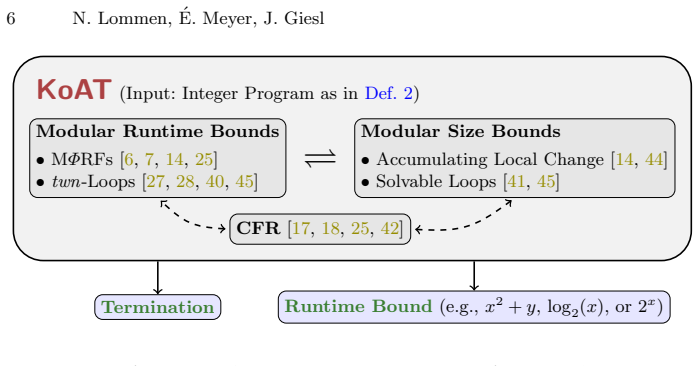
KoAT implements an alternating modular inference of upper runtime and size bounds for program parts using a portfolio of different techniques to analyze subprograms, thereby enabling automatic complexity bound inference and termination proofs for possibly recursive integer programs.
What carries the argument
Alternating modular inference of runtime and size bounds, which decomposes programs into subprograms and aggregates results from a portfolio of analysis techniques.
If this is right
- Termination proofs become available automatically for recursive integer programs.
- Upper bounds on runtime complexity follow directly from the inferred size and runtime results.
- The modular breakdown allows analysis of programs too large for non-decomposed methods.
- Using multiple techniques on subprograms covers cases where any single technique would fail.
Where Pith is reading between the lines
- The same modular structure could be tested on programs with additional features such as arrays or pointers if the subprogram analyzers are extended.
- Results from KoAT could feed into larger verification pipelines that combine complexity information with safety properties.
- Expanding the portfolio over time would likely increase the fraction of programs for which bounds are found without changing the overall inference architecture.
Load-bearing premise
The portfolio of techniques succeeds often enough on subprograms for their modular combination to produce useful overall bounds and termination proofs.
What would settle it
A collection of terminating integer programs on which KoAT returns no finite runtime bound or termination proof despite the programs having finite execution.
Figures

read the original abstract
KoAT is a tool to automatically infer complexity bounds and prove termination of (possibly recursive) integer programs. To this end, KoAT implements an alternating modular inference of upper runtime and size bounds for program parts. In particular, KoAT uses a portfolio of different techniques to analyze subprograms. The power of our approach is demonstrated by an extensive experimental evaluation.
Editorial analysis
A structured set of objections, weighed in public.
Referee Report
Summary. The paper presents KoAT, a tool for automatically inferring complexity bounds and proving termination of possibly recursive integer programs. It implements an alternating modular inference of upper runtime and size bounds for program parts, using a portfolio of different techniques to analyze subprograms, with the approach's power demonstrated through an extensive experimental evaluation.
Significance. If the experimental claims hold and the modular portfolio combination is effective, the work would provide a practical advance in automated analysis of integer programs by integrating multiple techniques in an alternating fashion, potentially improving bound inference and termination proofs over monolithic approaches.
major comments (1)
- [Abstract] Abstract: The central claim that the power of the approach is demonstrated by extensive experimental evaluation is unsupported because the abstract (and provided description) gives no details on benchmarks used, evaluation methodology, how inference steps are justified, or quantitative results; this is load-bearing for assessing whether the portfolio produces useful overall bounds.
Simulated Author's Rebuttal
We thank the referee for the detailed feedback. We address the major comment below and will incorporate revisions to strengthen the manuscript.
read point-by-point responses
-
Referee: [Abstract] Abstract: The central claim that the power of the approach is demonstrated by extensive experimental evaluation is unsupported because the abstract (and provided description) gives no details on benchmarks used, evaluation methodology, how inference steps are justified, or quantitative results; this is load-bearing for assessing whether the portfolio produces useful overall bounds.
Authors: We agree that the abstract would benefit from a concise summary of the experimental evaluation to better support the claim. In the revised version, we will expand the abstract to include: (i) the primary benchmark suites used (e.g., the Termination Problems Data Base for integer programs and additional recursive program collections), (ii) a brief description of the evaluation methodology (comparison against state-of-the-art tools via alternating modular bound inference), and (iii) key quantitative results (e.g., the fraction of benchmarks for which runtime/size bounds were successfully inferred or termination proved). This will provide readers with immediate evidence of the portfolio's effectiveness while keeping the abstract within length limits; full details and justification of inference steps remain in the dedicated evaluation section. revision: yes
Circularity Check
No significant circularity in derivation chain
full rationale
The paper presents KoAT as a tool implementing alternating modular inference of runtime and size bounds for integer programs via a portfolio of analysis techniques on subprograms, with power shown via experimental evaluation. No load-bearing derivation, equation, or prediction is present that reduces by construction to its own inputs, fitted parameters, or self-citation chains. The description is self-contained as an engineering and empirical contribution without mathematical self-definition or renaming of results.
Axiom & Free-Parameter Ledger
Reference graph
Works this paper leans on
-
[1]
Automatic Inference of Upper Bounds for Recurrence Relations in Cost Analysis
E. Albert, P. Arenas, S. Genaim, and G. Puebla. “Automatic Inference of Upper Bounds for Recurrence Relations in Cost Analysis”. In:Proc. SAS ’08. LNCS 5079. 2008, pp. 221–237.doi: 10.1007/978-3-540-69166- 2 15
-
[2]
Cost Analysis of Object-Oriented Bytecode Programs
E. Albert, P. Arenas, S. Genaim, G. Puebla, and D. Zanardini. “Cost Analysis of Object-Oriented Bytecode Programs”. In:Theoretical Com- puter Science413.1 (2012), pp. 142–159.doi: 10.1016/j.tcs.2011.07.009
-
[3]
On the Inference of Resource Us- age Upper and Lower Bounds
E. Albert, S. Genaim, and A. N. Masud. “On the Inference of Resource Us- age Upper and Lower Bounds”. In:ACM Transactions on Computational Logic14.3 (2013).doi: 10.1145/2499937.2499943
-
[4]
Re- source Analysis Driven by (Conditional) Termination Proofs
E. Albert, M. Bofill, C. Borralleras, E. Mart´ ın-Mart´ ın, and A. Rubio. “Re- source Analysis Driven by (Conditional) Termination Proofs”. In:The- ory and Practice of Logic Programming19.5-6 (2019), pp. 722–739.doi: 10.1017/S1471068419000152
-
[5]
Ranking Functions for Linear-Con- straint Loops
A. M. Ben-Amram and S. Genaim. “Ranking Functions for Linear-Con- straint Loops”. In:Journal of the ACM61.4 (2014), 26:1–26:55.doi: 10. 1145/2629488
2014
-
[6]
On Multiphase-Linear Ranking Func- tions
A. M. Ben-Amram and S. Genaim. “On Multiphase-Linear Ranking Func- tions”. In:Proc. CAV ’17. LNCS 10427. 2017, pp. 601–620.doi: 10.1007/ 978-3-319-63390-9 32
2017
-
[7]
Multiphase-Linear Ranking Functions and Their Relation to Recurrent Sets
A. M. Ben-Amram, J. J. Dom´ enech, and S. Genaim. “Multiphase-Linear Ranking Functions and Their Relation to Recurrent Sets”. In:Proc. SAS ’19. LNCS 11822. 2019, pp. 459–480.doi: 10.1007/978-3-030-32304- 2 22
-
[9]
Golem: A Flexible and Efficient Solver for Constrained Horn Clauses
M. Blicha, K. Britikov, and N. Sharygina. “Golem: A Flexible and Efficient Solver for Constrained Horn Clauses”. In:Formal Methods in System De- sign67 (2025), pp. 143–160.doi: 10.1007/s10703-025-00470-9
-
[10]
A Modular Static Cost Analysis for GPU Warp-Level Parallelism
G. Blike, H. Zicarelli, U. Sathiyamoorthy, J. Lange, and T. Cogumbreiro. “A Modular Static Cost Analysis for GPU Warp-Level Parallelism”. In: Proceedings of the ACM on Programming Languages10.POPL (2026), pp. 1471–1499.doi: 10.1145/3776693
-
[11]
Proving Termination Through Conditional Ter- mination
C. Borralleras, M. Brockschmidt, D. Larraz, A. Oliveras, E. Rodr´ ıguez- Carbonell, and A. Rubio. “Proving Termination Through Conditional Ter- mination”. In:Proc. TACAS ’17. LNCS 10205. 2017, pp. 99–117.doi: 10.1007/978-3-662-54577-5 6
-
[12]
Termination of Integer Linear Programs
M. Braverman. “Termination of Integer Linear Programs”. In:Proc. CAV ’06. LNCS 4144. 2006, pp. 372–385.doi: 10.1007/11817963 34
-
[13]
T2: Temporal Property Verification
M. Brockschmidt, B. Cook, S. Ishtiaq, H. Khlaaf, and N. Piterman. “T2: Temporal Property Verification”. In:Proc. TACAS ’16. LNCS 9636. 2016, pp. 387–393.doi: 10.1007/978-3-662-49674-9 22
-
[14]
Analyzing Runtime and Size Complexity of Integer Programs
M. Brockschmidt, F. Emmes, S. Falke, C. Fuhs, and J. Giesl. “Analyzing Runtime and Size Complexity of Integer Programs”. In:ACM Transactions on Programming Languages and Systems38 (2016), pp. 1–50.doi: 10. 1145/2866575
2016
-
[15]
Compositional Certified Re- source Bounds
Q. Carbonneaux, J. Hoffmann, and Z. Shao. “Compositional Certified Re- source Bounds”. In:Proc. PLDI ’15. 2015, pp. 467–478.doi: 10.1145/ 2737924.2737955. [16]ClangCompiler.url: https://clang.llvm.org/
arXiv 2015
-
[16]
iRankFinder
J. J. Dom´ enech and S. Genaim. “iRankFinder”. In:Proc. WST ’18. https: //wst2018.webs.upv.es/wst2018proceedings.pdf. 2018, p. 83
2018
-
[17]
J. J. Dom´ enech, J. P. Gallagher, and S. Genaim. “Control-Flow Refine- ment by Partial Evaluation, and its Application to Termination and Cost Analysis”. In:Theory and Practice of Logic Programming19.5-6 (2019), pp. 990–1005.doi: 10.1017/S1471068419000310
-
[18]
Termination Analysis ofCPrograms Using Compiler Intermediate Languages
S. Falke, D. Kapur, and C. Sinz. “Termination Analysis ofCPrograms Using Compiler Intermediate Languages”. In:Proc. RTA ’11. LIPIcs 10. 2011, pp. 41–50.doi: 10.4230/LIPIcs.RTA.2011.41
-
[19]
Resource Analysis of Complex Pro- grams with Cost Equations
A. Flores-Montoya and R. H¨ ahnle. “Resource Analysis of Complex Pro- grams with Cost Equations”. In:Proc. APLAS ’14. LNCS 8858. 2014, pp. 275–295.doi: 10.1007/978-3-319-12736-1 15
-
[20]
Upper and Lower Amortized Cost Bounds of Pro- grams Expressed as Cost Relations
A. Flores-Montoya. “Upper and Lower Amortized Cost Bounds of Pro- grams Expressed as Cost Relations”. In:Proc. FM ’16. LNCS 9995. 2016, pp. 254–273.doi: 10.1007/978-3-319-48989-6 16
-
[21]
A Calculus for Modular Loop Acceleration and Non-Termination Proofs
F. Frohn and C. Fuhs. “A Calculus for Modular Loop Acceleration and Non-Termination Proofs”. In:International Journal on Software Tools for Technology Transfer24.5 (2022), pp. 691–715.doi: 10.1007/S10009-022- 00670-2. 14 N. Lommen, ´E. Meyer, J. Giesl
-
[22]
Proving Non-Termination and Lower Runtime Bounds withLoAT(System Description)
F. Frohn and J. Giesl. “Proving Non-Termination and Lower Runtime Bounds withLoAT(System Description)”. In:Proc. IJCAR ’22. LNCS 13385. 2022, pp. 712–722.doi: 10.1007/978-3-031-10769-6 41
-
[24]
Improving Automatic Complexity Analysis of Integer Programs
J. Giesl, N. Lommen, M. Hark, and F. Meyer. “Improving Automatic Complexity Analysis of Integer Programs”. In:The Logic of Software. A Tasting Menu of Formal Methods. LNCS 13360. 2022, pp. 193–228.doi: 10.1007/978-3-031-08166-8 10
-
[25]
Liquidate Your Assets: Reasoning about Resource Usage inLiquid Haskell
M. A. T. Handley, N. Vazou, and G. Hutton. “Liquidate Your Assets: Reasoning about Resource Usage inLiquid Haskell”. In:Proceedings of the ACM on Programming Languages4.POPL (2020).doi: 10.1145/3371092
-
[26]
Polynomial Loops: Beyond Termina- tion
M. Hark, F. Frohn, and J. Giesl. “Polynomial Loops: Beyond Termina- tion”. In:Proc. LPAR ’20. EPiC 73. 2020, pp. 279–297.doi: 10.29007/ nxv1
2020
-
[27]
Termination of Triangular Polynomial Loops
M. Hark, F. Frohn, and J. Giesl. “Termination of Triangular Polynomial Loops”. In:Formal Methods in System Design65.1 (2025), pp. 70–132. doi: 10.1007/s10703-023-00440-z
-
[28]
Ranking Templates for Linear Loops
M. Heizmann and J. Leike. “Ranking Templates for Linear Loops”. In: Logical Methods in Computer Science11.1 (2015).doi: 10.2168/LMCS- 11(1:16)2015
-
[29]
Termination and Complexity Analysis for Programs with Bitvector Arithmetic by Symbolic Execution
J. Hensel, J. Giesl, F. Frohn, and T. Str¨ oder. “Termination and Complexity Analysis for Programs with Bitvector Arithmetic by Symbolic Execution”. In:Journal of Logic and Algebraic Methods in Programming97 (2018), pp. 105–130.doi: 10.1016/J.JLAMP.2018.02.004
-
[30]
Multivariate Amortized Re- source Analysis
J. Hoffmann, K. Aehlig, and M. Hofmann. “Multivariate Amortized Re- source Analysis”. In:ACM Transactions on Programming Languages and Systems34.3 (2012).doi: 10.1145/2362389.2362393
-
[31]
Towards Automatic Resource Bound Analysis forOCaml
J. Hoffmann, A. Das, and S.-C. Weng. “Towards Automatic Resource Bound Analysis forOCaml”. In:Proc. POPL ’17. 2017, pp. 359–373.doi: 10.1145/3009837.3009842
-
[32]
Two Decades of Automatic Amortized Resource Analysis
J. Hoffmann and S. Jost. “Two Decades of Automatic Amortized Resource Analysis”. In:Mathematical Structures in Computer Science32.6 (2022), pp. 729–759.doi: 10.1017/S0960129521000487
-
[33]
Termination of Linear Loops over the Integers
M. Hosseini, J. Ouaknine, and J. Worrell. “Termination of Linear Loops over the Integers”. In:Proc. ICALP ’19. LIPIcs 132. 2019.doi: 10.4230/ LIPIcs.ICALP.2019.118
2019
-
[34]
Dynaplex: Analyzing Program Complexity using Dynamically Inferred Recurrence Relations
D. Ishimwe, K. Nguyen, and T. Nguyen. “Dynaplex: Analyzing Program Complexity using Dynamically Inferred Recurrence Relations”. In:Pro- ceedings of the ACM on Programming Languages5.OOPSLA (2021).doi: 10.1145/3485515. KoAT: Automatic Complexity and Termination Analysis of Integer Programs 15
-
[35]
Apron: A Library of Numerical Abstract Do- mains for Static Analysis
B. Jeannet and A. Min´ e. “Apron: A Library of Numerical Abstract Do- mains for Static Analysis”. In:Proc. CAV ’09. LNCS 5643. 2009, pp. 661– 667.doi: 10.1007/978-3-642-02658-4 52. [37]KoAT: Automatic Complexity and Termination Analysis of Integer Pro- grams. Zenodo. 2026.doi: 10.5281/zenodo.18399478
-
[36]
Combining Logic and Algebraic Techniques for Program Verification inTheorema
L. Kov´ acs, N. Popov, and T. Jebelean. “Combining Logic and Algebraic Techniques for Program Verification inTheorema”. In:Proc. ISoLA ’06. 2006, pp. 67–74.doi: 10.1109/ISoLA.2006.46
-
[39]
Targeting Completeness: Using Closed Forms for Size Bounds of Integer Programs
N. Lommen and J. Giesl. “Targeting Completeness: Using Closed Forms for Size Bounds of Integer Programs”. In:Proc. FroCoS ’23. LNCS 14279. 2023, pp. 3–22.doi: 10.1007/978-3-031-43369-6 1
-
[40]
In: The Semantic Web, 6th International Se- mantic Web Conference, ISWC 2007 + ASWC 2007
N. Lommen, ´E. Meyer, and J. Giesl. “Control-Flow Refinement for Com- plexity Analysis of Probabilistic Programs inKoAT(Short Paper)”. In: Proc. IJCAR ’24. LNCS 14739. 2024, pp. 233–243.doi: 10.1007/978-3- 031-63498-7 14
-
[42]
Modular Automatic Complexity Analysis of Re- cursive Integer Programs
N. Lommen and J. Giesl. “Modular Automatic Complexity Analysis of Re- cursive Integer Programs”. In:Proc. ESOP ’26. LNCS 16502. Full version available inCorrabs/2512.18851, https://doi.org/10.48550/arXiv.2512. 18851. 2026, pp. 1–31.doi: 10.1007/978-3-032-22723-2 1
-
[43]
Targeting Completeness: Automated Complexity Analysis of Integer Programs
N. Lommen, ´E. Meyer, and J. Giesl. “Targeting Completeness: Automated Complexity Analysis of Integer Programs”. In:Journal of Automated Rea- soning70:6 (2026).doi: 10.1007/s10817-026-09751-2
-
[44]
KoAT: Automatic Complexity and Termination Analysis of Integer Programs
N. Lommen, ´E. Meyer, and J. Giesl.Experiments and Details for “KoAT: Automatic Complexity and Termination Analysis of Integer Programs”. 2026.url: https://koat.verify.rwth-aachen.de/evaluation
2026
-
[45]
Interval-Based Resource Usage Verification by Translation into Horn Clauses and an Application to Energy Consumption
P. L´ opez-Garc´ ıa, L. Darmawan, M. Klemen, U. Liqat, F. Bueno, and M. V. Hermenegildo. “Interval-Based Resource Usage Verification by Translation into Horn Clauses and an Application to Energy Consumption”. In:Theory and Practice of Logic Programming18.2 (2018), pp. 167–223.doi: 10.1017/ S1471068418000042
2018
-
[46]
R. Metta, P. Yeduru, H. Karmarkar, and R. K. Medicherla. “VeriFuzz 1.4: Checking for (Non-)Termination (Competition Contribution)”. In:Proc. TACAS ’23. LNCS 13994. 2023, pp. 594–599.doi: 10.1007/978-3-031- 30820-8 42. 16 N. Lommen, ´E. Meyer, J. Giesl
-
[47]
Inferring Expected Runtimes of Prob- abilistic Integer Programs Using Expected Sizes
F. Meyer, M. Hark, and J. Giesl. “Inferring Expected Runtimes of Prob- abilistic Integer Programs Using Expected Sizes”. In:Proc. TACAS ’21. LNCS 12651. 2021, pp. 250–269.doi: 10.1007/978-3-030-72016-2 14
-
[49]
D. Mukhopadhyay, R. Metta, H. Karmarkar, and K. Madhukar. “PROTON 2.1: Synthesizing Ranking Functions via Fine-Tuned Locally Hosted LLM (Competition Contribution)”. In:Proc. TACAS ’25. LNCS 15698. 2025, pp. 242–247.doi: 10.1007/978-3-031-90660-2 19
-
[50]
Geometric Higher Groupoids and Categories
M. Naaf, F. Frohn, M. Brockschmidt, C. Fuhs, and J. Giesl. “Complexity Analysis for Term Rewriting by Integer Transition Systems”. In:Proc. FroCoS ’17. LNCS 10483. 2017, pp. 132–150.doi: 10.1007/978- 3- 319- 66167-4 8
-
[51]
Robust Resource Bounds with Static Analysis and Bayesian Inference
L. Pham, F. A. Saad, and J. Hoffmann. “Robust Resource Bounds with Static Analysis and Bayesian Inference”. In:Proceedings of the ACM on Programming Languages8.PLDI (2024).doi: 10.1145/3656380
-
[52]
A Complete Method for the Synthesis of Linear Ranking Functions
A. Podelski and A. Rybalchenko. “A Complete Method for the Synthesis of Linear Ranking Functions”. In:Proc. VMCAI ’04. LNCS 2937. 2004, pp. 239–251.doi: 10.1007/978-3-540-24622-0 20
-
[53]
A Machine Learning-Based Approach for Solving Recurrence Relations and its use in Cost Analysis of Logic Programs
L. Rustenholz, M. Klemen, M. ´A. Carreira-Perpi˜ n´ an, and P. L´ opez-Garc´ ıa. “A Machine Learning-Based Approach for Solving Recurrence Relations and its use in Cost Analysis of Logic Programs”. In:Theory and Prac- tice of Logic Programming24.6 (2024), pp. 1163–1207.doi: 10 . 1017 / S1471068424000413
2024
-
[54]
Complexity and Resource Bound Anal- ysis of Imperative Programs Using Difference Constraints
M. Sinn, F. Zuleger, and H. Veith. “Complexity and Resource Bound Anal- ysis of Imperative Programs Using Difference Constraints”. In:Journal of Automated Reasoning59.1 (2017), pp. 3–45.doi: 10.1007/s10817- 016- 9402-4
-
[55]
Termination of Linear Programs
A. Tiwari. “Termination of Linear Programs”. In:Proc. CAV ’04. LNCS
-
[56]
70–82.doi: 10.1007/978-3-540-27813-9 6
2004, pp. 70–82.doi: 10.1007/978-3-540-27813-9 6
-
[57]
TPDB (Termination Problems Data Base).url: https://github.com/ TermCOMP/TPDB-ARI
-
[58]
Modular Primal-Dual Fixpoint Logic Solving for Temporal Verification
H. Unno, T. Terauchi, Y. Gu, and E. Koskinen. “Modular Primal-Dual Fixpoint Logic Solving for Temporal Verification”. In:Proceedings of the ACM on Programming Languages7.POPL (2023), pp. 2111–2140.doi: 10.1145/3571265
-
[59]
Symbolic Termination Analysis of Solvable Loops
M. Xu and Z.-B. Li. “Symbolic Termination Analysis of Solvable Loops”. In:Journal of Symbolic Computation50 (2013), pp. 28–49.doi: 10.1016/ j.jsc.2012.05.005
2013
discussion (0)
Sign in with ORCID, Apple, or X to comment. Anyone can read and Pith papers without signing in.