In-Vehicle Digital Twin-Based Collision Warning Framework with Sybil Attack Detection
Pith reviewed 2026-06-30 00:31 UTC · model grok-4.3
The pith
An in-vehicle digital twin framework detects Sybil attacks with 98.4 percent accuracy and reduces near-collision exposure by 88 percent.
A machine-rendered reading of the paper's core claim, the machinery that carries it, and where it could break.
Core claim
The framework integrates a Temporal Convolutional Network for learning temporal dependencies in vehicle trajectory data and Hierarchical Navigable Small World algorithms for efficient similarity-based classification of real and Sybil-generated vehicles. When evaluated on real-world Sybil attack data collected through field experiments, it reaches accuracy 0.984, recall 1.00, and F1 0.944 for detecting fake vehicles. The same system lowers mean Time Exposed Time-To-Collision by 88 percent and mean Time Integrated Time-To-Collision by 72 percent while meeting standardized latency limits for safety messages and staying within the compute capacity of modern vehicle processors.
What carries the argument
In-vehicle Digital Twin framework that pairs Temporal Convolutional Network for temporal pattern learning with Hierarchical Navigable Small World for similarity-based classification to flag fake vehicles and issue collision warnings.
If this is right
- Sybil-generated fake vehicles can be identified in real time from trajectory data before they affect safety applications.
- Mean time exposed to time-to-collision events drops by 88 percent when the framework is active.
- Mean time integrated time-to-collision drops by 72 percent under the same conditions.
- The approach satisfies the maximum allowable latency for safety messages and fits inside the processing limits of current vehicle hardware.
Where Pith is reading between the lines
- The same trajectory-learning approach could be tested against other message-fabrication attacks that also create inconsistent vehicle positions.
- Deployment across a fleet would let vehicles share learned patterns without exchanging raw sensor data, lowering privacy exposure.
- The digital twin could be extended to predict attack evolution over longer time windows once more field data becomes available.
Load-bearing premise
The field experiments used to collect the real-world Sybil attack data accurately simulate the conditions and attack vectors that would occur in deployed connected vehicle systems.
What would settle it
A controlled test that runs the framework on live connected vehicles under actual Sybil attacks generated by multiple malicious nodes and records whether detection accuracy falls below 0.95 or the TET reduction drops below 70 percent.
Figures

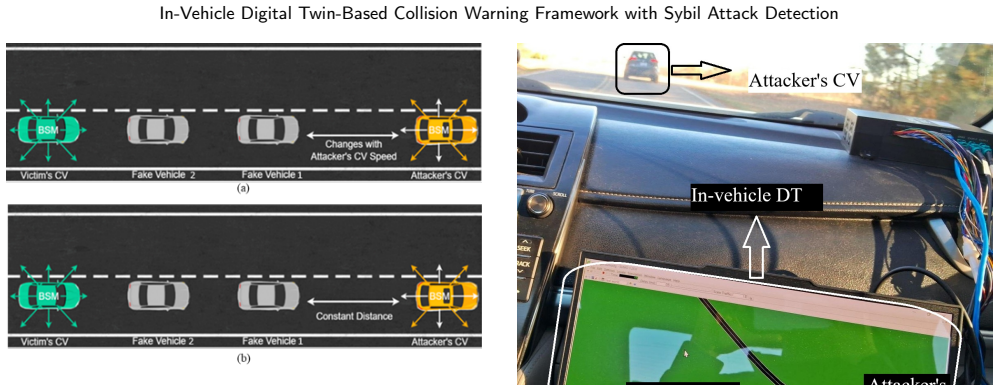




read the original abstract
Connected Vehicles (CVs) rely extensively on communication technologies to enable data-driven predictive analyses for enhancing performance and safety. These communication channels can be exploited by adversaries to launch cyberattacks such as Sybil attacks, which could threaten both safety-critical and mobility applications, leaving CVs vulnerable and putting human lives at risk. As CV deployment continues to expand, the need to detect and mitigate cyberattacks in real-time becomes increasingly urgent. This study presents an in-vehicle Digital Twin (DT)-based collision warning framework with built-in capabilities for Sybil attacks detection. The framework integrates a Temporal Convolutional Network (TCN) for learning temporal dependencies in vehicle trajectory data and Hierarchical Navigable Small World (HNSW) algorithms for efficient similarity-based classification. Our framework is evaluated on real-world Sybil attack data, collected through field experiments. The framework achieved accuracy, recall, and F1 scores of 0.984, 1.00, and 0.944, respectively, in detecting Sybil-generated fake vehicles. During the safety evaluation, the framework reduced the mean Time Exposed Time-To-Collision (TET) and mean Time Integrated Time-To-Collision (TIT) of near-collision events by 88% and 72%, respectively. Furthermore, real-world feasibility evaluation shows that the framework conformed to the standardized maximum allowable latency for safety applications and operated well within the capacity of modern processors -- demonstrating the promise of an in-vehicle DT-based framework as an attack mitigation mechanism against Sybil attacks for next-generation CVs.
Editorial analysis
A structured set of objections, weighed in public.
Referee Report
Summary. The manuscript proposes an in-vehicle Digital Twin-based collision warning framework incorporating Sybil attack detection. It integrates a Temporal Convolutional Network (TCN) to capture temporal dependencies in vehicle trajectory data with Hierarchical Navigable Small World (HNSW) algorithms for similarity-based classification of fake vehicles. The framework is evaluated on real-world Sybil attack data collected via field experiments, reporting detection performance of 0.984 accuracy, 1.00 recall, and 0.944 F1-score. Safety evaluation claims 88% and 72% reductions in mean TET and TIT of near-collision events, with additional feasibility results showing compliance with standardized latency limits for safety applications and operation within modern processor capacities.
Significance. If the reported results hold under realistic attack conditions, the work would offer a concrete, deployable contribution to connected-vehicle security by combining digital-twin modeling with efficient temporal and similarity-based detection, simultaneously improving safety metrics and meeting real-time constraints. The explicit use of field-collected data and the dual safety-plus-security evaluation are positive features that distinguish it from purely simulated studies.
major comments (3)
- [Abstract / Evaluation] Abstract / Evaluation section: The headline performance figures (0.984 accuracy, 1.00 recall, 0.944 F1) and the 88 % / 72 % TET/TIT reductions are derived entirely from the field-experiment Sybil dataset, yet the manuscript provides no description of attack-generation parameters (number of simultaneous fake identities, transmission timing, trajectory consistency, sensor-noise models, or injection method via actual OBU hardware versus post-processing). Without these details it is impossible to determine whether the TCN temporal modeling and HNSW similarity classifier are learning genuine kinematic attack signatures or merely dataset-specific artifacts.
- [Safety evaluation] Safety evaluation: The reported reductions in mean TET and TIT are presented without any baseline comparison to existing collision-warning systems, without statistical significance tests, and without discussion of potential confounding factors in the data collection. This leaves open the possibility that the observed safety gains are not attributable to the proposed framework.
- [Feasibility evaluation] Feasibility evaluation: The claim that the framework meets standardized maximum allowable latency for safety applications and runs within modern processor capacity is stated without quantitative measurements (e.g., end-to-end latency distributions, CPU/memory utilization traces, or hardware platform specifications), preventing independent verification.
minor comments (1)
- [Safety evaluation] Notation for TET and TIT is introduced without an explicit equation or reference to the standard definitions used in the traffic-safety literature.
Simulated Author's Rebuttal
We thank the referee for the constructive comments, which help clarify key aspects of the evaluation. We address each major comment below and will revise the manuscript accordingly.
read point-by-point responses
-
Referee: [Abstract / Evaluation] Abstract / Evaluation section: The headline performance figures (0.984 accuracy, 1.00 recall, 0.944 F1) and the 88 % / 72 % TET/TIT reductions are derived entirely from the field-experiment Sybil dataset, yet the manuscript provides no description of attack-generation parameters (number of simultaneous fake identities, transmission timing, trajectory consistency, sensor-noise models, or injection method via actual OBU hardware versus post-processing). Without these details it is impossible to determine whether the TCN temporal modeling and HNSW similarity classifier are learning genuine kinematic attack signatures or merely dataset-specific artifacts.
Authors: We agree that additional details on attack generation are required for reproducibility and to confirm the detection targets genuine attack signatures. In the revised manuscript we will add a dedicated subsection describing the field-experiment parameters, including the number of simultaneous fake identities, transmission timing, trajectory consistency constraints, sensor-noise models, and the precise injection method (hardware OBU versus post-processing). revision: yes
-
Referee: [Safety evaluation] Safety evaluation: The reported reductions in mean TET and TIT are presented without any baseline comparison to existing collision-warning systems, without statistical significance tests, and without discussion of potential confounding factors in the data collection. This leaves open the possibility that the observed safety gains are not attributable to the proposed framework.
Authors: The current safety evaluation compares near-collision metrics with versus without the Sybil detection module. We acknowledge that an external baseline and statistical analysis would strengthen attribution. In the revision we will add a comparison against a standard collision-warning system without attack mitigation, report statistical significance tests on the TET/TIT reductions, and discuss potential confounding factors arising from the field data collection. revision: yes
-
Referee: [Feasibility evaluation] Feasibility evaluation: The claim that the framework meets standardized maximum allowable latency for safety applications and runs within modern processor capacity is stated without quantitative measurements (e.g., end-to-end latency distributions, CPU/memory utilization traces, or hardware platform specifications), preventing independent verification.
Authors: We agree that quantitative supporting data are needed. The revised manuscript will include end-to-end latency distributions, CPU and memory utilization traces, and the hardware platform specifications from the feasibility experiments to allow independent verification of compliance with latency standards and processor capacity. revision: yes
Circularity Check
No circularity: empirical results from independent field data
full rationale
The paper reports accuracy, recall, F1, TET, and TIT metrics obtained by running the TCN + HNSW classifier on Sybil attack traces collected through separate field experiments. These quantities are direct outputs of the evaluation procedure and do not reduce, by any equation or self-citation, to parameters defined inside the model itself. No self-definitional loops, fitted-input predictions, load-bearing self-citations, or ansatz smuggling appear in the derivation chain. The evaluation therefore remains self-contained against the external benchmark supplied by the collected dataset.
Axiom & Free-Parameter Ledger
free parameters (2)
- TCN model hyperparameters
- HNSW similarity threshold
axioms (1)
- domain assumption The digital twin accurately represents the physical vehicle's state and trajectory in real-time.
Reference graph
Works this paper leans on
-
[1]
K. C. Dey, L. Yan, X. Wang, Y. Wang, H. Shen, M. Chowdhury, L. Yu, C. Qiu, V. Soundararaj, A Review of Communication, Driver Characteristics,andControlsAspectsofCooperativeAdaptiveCruise Control (CACC), IEEE Transactions on Intelligent Transportation Systems 17 (2) (2016) 491–509.doi:10.1109/TITS.2015.2483063. URLhttp://ieeexplore.ieee.org/document/7314936/
-
[2]
K. Abboud, H. A. Omar, W. Zhuang, Interworking of DSRC and CellularNetworkTechnologiesforV2XCommunications:ASurvey, IEEE Transactions on Vehicular Technology 65 (12) (2016) 9457– 9470.doi:10.1109/TVT.2016.2591558. URLhttp://ieeexplore.ieee.org/document/7513432/
-
[3]
Z. Huang, S. Chen, Y. Pian, Z. Sheng, S. Ahn, D. A. Noyce, Toward C-V2X Enabled Connected Transportation System: RSU-Based Co- operative Localization Framework for Autonomous Vehicles, IEEE Transactions on Intelligent Transportation Systems 25 (10) (2024) 13417–13431.doi:10.1109/TITS.2024.3410185. URLhttps://ieeexplore.ieee.org/document/10556814/
-
[4]
J. Petit, S. E. Shladover, Potential Cyberattacks on Automated Vehi- cles,IEEETransactionsonIntelligentTransportationSystems(2014) 1–11doi:10.1109/TITS.2014.2342271. URLhttps://ieeexplore.ieee.org/document/6899663
-
[5]
Checkoway, D
S. Checkoway, D. McCoy, B. Kantor, D. Anderson, H. Shacham, S. Savage, K. Koscher, A. Czeskis, F. Roesner, T. Kohno, Comprehensive Experimental Analyses of Automotive Attack Surfaces, in: 20th USENIX Security Symposium (USENIX Security 11), USENIX Association, San Francisco, CA, 2011. URLhttps://www.usenix.org/conference/usenix-security-11/ comprehensive-...
2011
-
[6]
C. H. O. O. Quevedo, A. M. B. C. Quevedo, G. A. Campos, R. L. Gomes, J. Celestino, A. Serhrouchni, An Intelligent Mechanism for Sybil Attacks Detection in VANETs, in: ICC 2020 - 2020 IEEE International Conference on Communications (ICC), IEEE, Dublin, Ireland, 2020, pp. 1–6.doi:10.1109/ICC40277.2020.9149371. URLhttps://ieeexplore.ieee.org/document/9149371/
-
[7]
Y. Zhong, B. Yang, Y. Li, H. Yang, X. Li, Y. Zhang, Tackling SybilAttacksinIntelligentconnectedvehicles:AReviewofMachine Learning and Deep Learning Techniques, in: 2023 8th International ConferenceonComputationalIntelligenceandApplications(ICCIA), IEEE, Haikou, China, 2023, pp. 8–12.doi:10.1109/ICCIA59741.2023. 00010. URLhttps://ieeexplore.ieee.org/docume...
-
[8]
W.Whyte,A.Weimerskirch,V.Kumar,T.Hehn,Asecuritycredential managementsystemforV2Vcommunications,in:2013IEEEVehic- ularNetworkingConference,IEEE,Boston,MA,USA,2013,pp.1–8. doi:10.1109/VNC.2013.6737583. URLhttp://ieeexplore.ieee.org/document/6737583/
-
[9]
URLhttps://ieeexplore.ieee.org/document/9757751/
B.Hammi,Y.M.Idir,S.Zeadally,R.Khatoun,J.Nebhen,IsitReally Easy to Detect Sybil Attacks in C-ITS Environments: A Position Pa- per,IEEETransactionsonIntelligentTransportationSystems23(10) (2022) 18273–18287.doi:10.1109/TITS.2022.3165513. URLhttps://ieeexplore.ieee.org/document/9757751/
-
[10]
Z. Yang, K. Zhang, L. Lei, K. Zheng, A Novel Classifier Exploit- ing Mobility Behaviors for Sybil Detection in Connected Vehicle Systems, IEEE Internet of Things Journal 6 (2) (2019) 2626–2636. doi:10.1109/JIOT.2018.2872456. URLhttps://ieeexplore.ieee.org/document/8474346/
-
[11]
A. Muhamad, M. Elhadef, Sybil Attacks in Intelligent Vehicular Ad Hoc Networks: A Review, in: J. J. Park, V. Loia, K.-K. R. Choo, G. Yi (Eds.), Advanced Multimedia and Ubiquitous Engineering, Vol. 518, Springer Singapore, Singapore, 2019, pp. 547–555, se- ries Title: Lecture Notes in Electrical Engineering.doi:10.1007/ 978-981-13-1328-8_71. URLhttp://link...
-
[12]
S. E. Carpenter, M. L. Sichitiu, An obstacle model implementation for evaluating radio shadowing with ns-3, in: Proceedings of the 2015 Workshop on ns-3, ACM, Barcelona Spain, 2015, pp. 17–24. doi:10.1145/2756509.2756512. URLhttps://dl.acm.org/doi/10.1145/2756509.2756512
-
[13]
L. Li, S. Aslam, A. Wileman, S. Perinpanayagam, Digital Twin in Aerospace Industry: A Gentle Introduction, IEEE Access 10 (2022) 9543–9562.doi:10.1109/ACCESS.2021.3136458. URLhttps://ieeexplore.ieee.org/document/9656111/
-
[14]
W. A. Ali, M. Roccotelli, M. P. Fanti, Digital Twin in Intelligent Transportation Systems: a Review, in: 2022 8th International Con- ferenceonControl,DecisionandInformationTechnologies(CoDIT), IEEE, Istanbul, Turkey, 2022, pp. 576–581.doi:10.1109/CoDIT55151. 2022.9804017. URLhttps://ieeexplore.ieee.org/document/9804017/
-
[15]
309–315.doi:10.1109/ICEERT53919.2021
L.Bao,Q.Wang,Y.Jiang,ReviewofDigitaltwinforintelligenttrans- portation system, in: 2021 International Conference on Information Control, Electrical Engineering and Rail Transit (ICEERT), IEEE, Lanzhou, China, 2021, pp. 309–315.doi:10.1109/ICEERT53919.2021. 00064. URLhttps://ieeexplore.ieee.org/document/9666030/
-
[16]
X. Gu, M. Abdel-Aty, Q. Xiang, Q. Cai, J. Yuan, Utilizing UAV video data for in-depth analysis of drivers’ crash risk at interchange mergingareas,AccidentAnalysis&Prevention123(2019)159–169. doi:10.1016/j.aap.2018.11.010. URLhttps://linkinghub.elsevier.com/retrieve/pii/ S0001457518309631
-
[17]
X. Gu, Q. Cai, J. Lee, Q. Xiang, Y. Ma, X. Xu, Proactive crash riskpredictionmodelingformergingassistancesystematinterchange mergingareas,TrafficInjuryPrevention21(3)(2020)234–240.doi: 10.1080/15389588.2020.1734581. URLhttps://www.tandfonline.com/doi/full/10.1080/15389588.2020. 1734581
-
[18]
S.Li,Q.Xiang,Y.Ma,X.Gu,H.Li,CrashRiskPredictionModeling BasedontheTrafficConflictTechniqueandaMicroscopicSimulation for Freeway Interchange Merging Areas, International Journal of Environmental Research and Public Health 13 (11) (2016) 1157. doi:10.3390/ijerph13111157. URLhttps://www.mdpi.com/1660-4601/13/11/1157
-
[19]
Y. Zheng, S. Yang, H. Cheng, An application framework of dig- ital twin and its case study, Journal of Ambient Intelligence and Humanized Computing 10 (3) (2019) 1141–1153.doi:10.1007/ s12652-018-0911-3. URLhttp://link.springer.com/10.1007/s12652-018-0911-3
-
[20]
M. Masi, G. P. Sellitto, H. Aranha, T. Pavleska, Securing critical in- frastructures with a cybersecurity digital twin, Software and Systems Modeling 22 (2) (2023) 689–707.doi:10.1007/s10270-022-01075-0. URLhttps://link.springer.com/10.1007/s10270-022-01075-0
-
[21]
M. Korman, M. Välja, G. Björkman, M. Ekstedt, A. Vernotte, R. Lagerström, Analyzing the Effectiveness of Attack Countermea- sures in a SCADA System, in: Proceedings of the 2nd Workshop Hasan et al.:Preprint submitted to ElsevierPage 14 of 15 In-Vehicle Digital Twin-Based Collision Warning Framework with Sybil Attack Detection on Cyber-Physical Security an...
-
[22]
URLhttps://ieeexplore.ieee.org/document/10220152/
M.Ali,G.Kaddoum,W.-T.Li,C.Yuen,M.Tariq,H.V.Poor,ASmart DigitalTwinEnabledSecurityFrameworkforVehicle-to-GridCyber- Physical Systems, IEEE Transactions on Information Forensics and Security 18 (2023) 5258–5271.doi:10.1109/TIFS.2023.3305916. URLhttps://ieeexplore.ieee.org/document/10220152/
-
[23]
M. Eckhart, A. Ekelhart, A Specification-based State Replication Approach for Digital Twins, in: Proceedings of the 2018 Workshop on Cyber-Physical Systems Security and PrivaCy, ACM, Toronto Canada, 2018, pp. 36–47.doi:10.1145/3264888.3264892. URLhttps://dl.acm.org/doi/10.1145/3264888.3264892
-
[24]
M. Eckhart, A. Ekelhart, E. Weippl, Enhancing Cyber Situational Awareness for Cyber-Physical Systems through Digital Twins, in: 201924thIEEEInternationalConferenceonEmergingTechnologies and Factory Automation (ETFA), IEEE, Zaragoza, Spain, 2019, pp. 1222–1225.doi:10.1109/ETFA.2019.8869197. URLhttps://ieeexplore.ieee.org/document/8869197/
-
[25]
A. Kummerow, D. Rosch, C. Monsalve, S. Nicolai, P. Bretschneider, C. Brosinsky, D. Westermann, Challenges and opportunities for pha- sor data based event detection in transmission control centers under cyber security constraints, in: 2019 IEEE Milan PowerTech, IEEE, Milan, Italy, 2019, pp. 1–6.doi:10.1109/PTC.2019.8810711. URLhttps://ieeexplore.ieee.org/d...
-
[26]
J. Guo, X. Wu, H. Liang, J. Hu, B. Liu, Digital-twin based Power SupplySystemModelingandAnalysisforUrbanRailTransportation, in: 2020 IEEE International Conference on Energy Internet (ICEI), IEEE, Sydney, NSW, Australia, 2020, pp. 74–79.doi:10.1109/ ICEI49372.2020.00022. URLhttps://ieeexplore.ieee.org/document/9270257/
-
[27]
URLhttps://iopscience.iop.org/article/10.1088/1742-6596/1802/ 4/042045
S.Wang,F.Zhang,T.Qin,ResearchontheConstructionofHighway Traffic Digital Twin System Based on 3D GIS Technology, Journal of Physics: Conference Series 1802 (4) (2021) 042045.doi:10.1088/ 1742-6596/1802/4/042045. URLhttps://iopscience.iop.org/article/10.1088/1742-6596/1802/ 4/042045
-
[28]
J.-S. Kang, K. Chung, E. J. Hong, Multimedia knowledge-based bridge health monitoring using digital twin, Multimedia Tools and Applications 80 (26-27) (2021) 34609–34624.doi:10.1007/ s11042-021-10649-x. URLhttps://link.springer.com/10.1007/s11042-021-10649-x
-
[29]
T. Li, Z. Bian, H. Lei, F. Zuo, Y.-T. Yang, Q. Zhu, Z. Li, Z. Chen, K.Ozbay,DigitalTwin-basedDriverRisk-AwareIntelligentMobility Analytics for Urban Transportation Management, version Number: 1 (2024).doi:10.48550/ARXIV.2407.15025. URLhttps://arxiv.org/abs/2407.15025
-
[30]
B.Mokhtar,M.Azab,SurveyonSecurityIssuesinVehicularAdHoc Networks,AlexandriaEngineeringJournal54(4)(2015)1115–1126. doi:10.1016/j.aej.2015.07.011. URLhttps://linkinghub.elsevier.com/retrieve/pii/ S1110016815001246
-
[31]
M. Asad, S. Otoum, FL-SATS: Federated Learning for Sybil Attack Detection in Transportation System, in: ICC 2025 - IEEE Interna- tionalConferenceonCommunications,IEEE,Montreal,QC,Canada, 2025, pp. 3376–3381.doi:10.1109/ICC52391.2025.11161123. URLhttps://ieeexplore.ieee.org/document/11161123/
-
[32]
S. Azam, M. Bibi, R. Riaz, S. S. Rizvi, S. J. Kwon, Collabora- tive Learning Based Sybil Attack Detection in Vehicular AD-HOC Networks (VANETS), Sensors 22 (18) (2022) 6934.doi:10.3390/ s22186934. URLhttps://www.mdpi.com/1424-8220/22/18/6934
2022
-
[33]
Y. Yao, B. Xiao, G. Wu, X. Liu, Z. Yu, K. Zhang, X. Zhou, Multi- ChannelBasedSybilAttackDetectioninVehicularAdHocNetworks Using RSSI, IEEE Transactions on Mobile Computing 18 (2) (2019) 362–375.doi:10.1109/TMC.2018.2833849. URLhttps://ieeexplore.ieee.org/document/8356112/
-
[34]
S. Rakhi, K. R. Shobha, LCSS Based Sybil Attack Detection and Avoidance in Clustered Vehicular Networks, IEEE Access 11 (2023) 75179–75190.doi:10.1109/ACCESS.2023.3294469. URLhttps://ieeexplore.ieee.org/document/10179918/
-
[35]
A. El Attar, M. Ali Awali, R. Khatoun, M. Hatoum, K. Samrouth, Detecting Malicious Artificial Congestion in Connected Cars Envi- ronment,in:20255thIEEEMiddleEastandNorthAfricaCommuni- cations Conference (MENACOMM), IEEE, Byblos, Lebanon, 2025, pp. 1–8.doi:10.1109/MENACOMM62946.2025.10911022. URLhttps://ieeexplore.ieee.org/document/10911022/
-
[36]
M.Baza,M.Nabil,M.M.E.A.Mahmoud,N.Bewermeier,K.Fidan, W. Alasmary, M. Abdallah, Detecting Sybil Attacks Using Proofs of Work and Location in VANETs, IEEE Transactions on Dependable and Secure Computing 19 (1) (2022) 39–53.doi:10.1109/TDSC.2020. 2993769. URLhttps://ieeexplore.ieee.org/document/9091099/
-
[37]
URLhttps://link.springer.com/10.1007/s12083-025-02058-w
T.Guven,Z.C.Taysi,Creatingarealisticsybilattackdatasetforinter- vehicle communication, Peer-to-Peer Networking and Applications 18 (4) (2025) 234.doi:10.1007/s12083-025-02058-w. URLhttps://link.springer.com/10.1007/s12083-025-02058-w
-
[38]
Y.Chen,Y.Lai,Z.Zhang,H.Li,Y.Wang,Maliciousattackdetection based on traffic-flow information fusion, in: 2022 IFIP Networking Conference (IFIP Networking), IEEE, Catania, Italy, 2022, pp. 1–9. doi:10.23919/IFIPNetworking55013.2022.9829793. URLhttps://ieeexplore.ieee.org/document/9829793/
work page doi:10.23919/ifipnetworking55013.2022.9829793 2022
-
[39]
A. Enan, A. A. Mamun, J. M. Tine, J. Mwakalonge, D. A. Indah, G.Comert,M.Chowdhury,BasicSafetyMessageGenerationthrough a Video-based Analytics for Potential Safety Applications, ACM Journal on Autonomous Transportation Systems 1 (4) (2024) 1–26. doi:10.1145/3643823. URLhttps://dl.acm.org/doi/10.1145/3643823
-
[40]
URLhttps://saemobilus.sae.org/standards/j2735_ 202409-v2x-communications-message-set-dictionary
V2X Core Technical Committee, V2X Communications Message Set Dictionary.doi:10.4271/J2735_202409. URLhttps://saemobilus.sae.org/standards/j2735_ 202409-v2x-communications-message-set-dictionary
-
[41]
S. Bai, J. Z. Kolter, V. Koltun, An Empirical Evaluation of Generic Convolutional and Recurrent Networks for Sequence Modeling, ver- sion Number: 2 (2018).doi:10.48550/ARXIV.1803.01271. URLhttps://arxiv.org/abs/1803.01271
work page internal anchor Pith review Pith/arXiv arXiv doi:10.48550/arxiv.1803.01271 2018
-
[42]
Y. A. Malkov, D. A. Yashunin, Efficient and Robust Approximate Nearest Neighbor Search Using Hierarchical Navigable Small World Graphs, IEEE Transactions on Pattern Analysis and Machine Intelli- gence 42 (4) (2020) 824–836.doi:10.1109/TPAMI.2018.2889473. URLhttps://ieeexplore.ieee.org/document/8594636/
-
[43]
Williams, Aviation Formulary v1
E. Williams, Aviation Formulary v1. 47 (2013), URL: https://www. edwilliams. org/avform. htm
2013
-
[44]
URLhttps://www.trb.org/Main/Blurbs/164718.aspx
Highway Capacity Manual 2010 (HCM2010). URLhttps://www.trb.org/Main/Blurbs/164718.aspx
2010
-
[45]
M. S. Rahman, M. Abdel-Aty, J. Lee, M. H. Rahman, Safety benefits of arterials’ crash risk under connected and automated vehicles, Transportation Research Part C: Emerging Technologies 100 (2019) 354–371.doi:10.1016/j.trc.2019.01.029. URLhttps://linkinghub.elsevier.com/retrieve/pii/ S0968090X18310349
-
[46]
URLhttps://www.nvidia.com/en-us/autonomous-machines/ embedded-systems/jetson-agx-xavier/
Deploy AI-Powered Autonomous Machines at Scale. URLhttps://www.nvidia.com/en-us/autonomous-machines/ embedded-systems/jetson-agx-xavier/
-
[47]
URLhttps://www.nvidia.com/en-us/autonomous-machines/ embedded-systems/jetson-orin/ Hasan et al.:Preprint submitted to ElsevierPage 15 of 15
NVIDIA Jetson AGX Orin. URLhttps://www.nvidia.com/en-us/autonomous-machines/ embedded-systems/jetson-orin/ Hasan et al.:Preprint submitted to ElsevierPage 15 of 15
discussion (0)
Sign in with ORCID, Apple, or X to comment. Anyone can read and Pith papers without signing in.