Viscosity in error upper bound for a consistent splitting scheme of the Navier-Stokes equations
Pith reviewed 2026-06-30 09:06 UTC · model grok-4.3
The pith
Keeping viscosity symbolic in the error analysis of a Navier-Stokes splitting scheme produces an H1 velocity bound with negative powers of viscosity.
A machine-rendered reading of the paper's core claim, the machinery that carries it, and where it could break.
Core claim
By keeping the viscosity parameter symbolic while following the proof methodology of Huang and Shen, the authors derive an H1 velocity error bound containing negative powers of viscosity. This shows that the consistent splitting scheme is not robust as viscosity tends to zero. The bound is obtained after refining the constant in the Stokes pressure estimate theorem from reference [8] so that it continues to hold for a symbolic positive viscosity.
What carries the argument
The refined Stokes pressure estimate theorem that controls the constant when viscosity remains a positive symbolic parameter.
If this is right
- The scheme's H1 velocity error is not uniformly controlled as viscosity approaches zero.
- The explicit treatment of the convection term is the component responsible for the loss of robustness.
- A fully implicit Newton solver and the time-dependent Stokes version of the same scheme remain stable at the same high Reynolds numbers where the original scheme blows up.
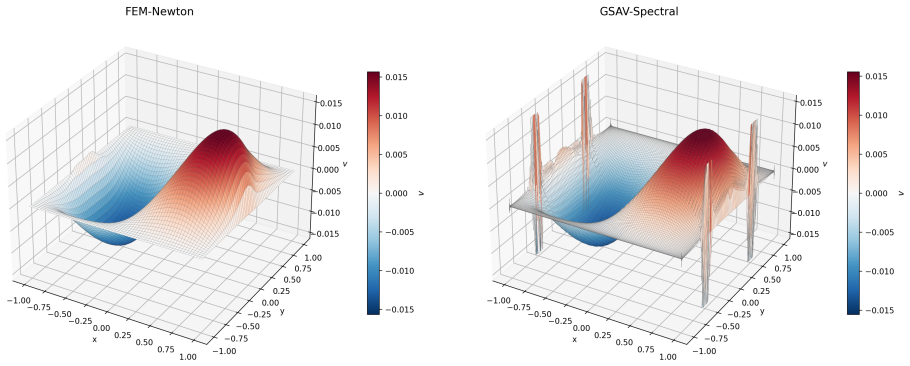
- The targeted numerical experiment on the perturbed Kovasznay flow corroborates the analytical prediction of instability.
Where Pith is reading between the lines
- Similar viscosity-dependent error analyses could be applied to other operator-splitting methods for incompressible flow to check their high-Reynolds-number behavior.
- Replacing the explicit convection step with an implicit or semi-implicit treatment might eliminate the negative powers in the bound.
- Error estimates that keep physical parameters symbolic may be needed more generally when assessing numerical methods for singular limits.
Load-bearing premise
The refined version of the Stokes pressure estimate theorem continues to hold when viscosity is treated as a symbolic positive parameter rather than fixed at unity.
What would settle it
A direct computation of the H1 velocity error for the scheme at successively smaller positive viscosities that fails to exhibit growth matching the negative powers appearing in the derived bound.
Figures
read the original abstract
This paper investigates the role of viscosity in the error upper bounds of a consistent splitting scheme for the Navier-Stokes equations proposed by Huang and Shen [5]. In their original analysis the viscosity is fixed to unity. By following and extending their proof methodology while keeping the viscosity symbolic, we obtain an H1 velocity error bound that contains negative powers of viscosity, indicating that the scheme is not robust as viscosity tends zero. To establish this bound we refine a theorem in [8] on the constant in the Stokes pressure estimate, which is crucial to the error analysis. A targeted numerical experiment based on a perturbation of the Kovasznay flow corroborates this analytical prediction: the scheme of [5] blows up at high Reynolds number, and a comparison with a fully implicit Newton solver and with the time-dependent Stokes counterpart of the same scheme localizes the failure to the explicit treatment of the convection term.
Editorial analysis
A structured set of objections, weighed in public.
Referee Report
Summary. The manuscript extends the error analysis of the consistent splitting scheme for Navier-Stokes equations from Huang and Shen [5] by keeping viscosity ν symbolic rather than fixing it at unity. Following and extending their proof while refining the Stokes pressure estimate theorem from [8], the authors derive an H¹ velocity error bound containing negative powers of ν, concluding that the scheme is not robust as ν → 0. A targeted numerical experiment on a perturbed Kovasznay flow shows blow-up at high Reynolds number, localized to the explicit convection treatment via comparisons with a fully implicit solver and the time-dependent Stokes counterpart.
Significance. If the error bound and its ν-dependence hold, the result is significant for identifying a robustness limitation in splitting schemes at high Reynolds numbers, relevant to CFD practice. The refinement of the pressure estimate from [8] could have broader applicability in variable-viscosity analyses. Credit is due for the targeted numerical corroboration that aligns with the analytic prediction and localizes the failure mode. The contribution is incremental but useful if the central derivation is verified.
major comments (2)
- [Section containing the refined Stokes theorem (likely §3)] Refined Stokes pressure estimate (the refinement of the theorem from [8]): the original result in [8] fixes ν = 1. When ν is kept symbolic in the weak form ν(∇u, ∇v) − (p, div v) = (f, v), the pressure bound ||p|| ≤ C||f|| (C independent of ν) must be re-derived without hidden ν factors entering via the inf-sup argument or the velocity estimate ||∇u|| ≤ (1/ν)||f||. The manuscript must show explicitly that the refined constant tracks all scalings correctly; otherwise the claimed negative powers in the final H¹ error bound do not follow.
- [Section deriving the H¹ error bound (likely §4)] Error recursion in the extension of [5] (the derivation of the H¹ velocity error bound): the contribution of the pressure term to the error estimate must be checked term-by-term to confirm that the negative powers of ν arise solely from the refined pressure bound and not from an inadvertent omission or insertion of ν-dependent constants during the extension of the proof methodology.
minor comments (1)
- [Introduction and notation section] Notation for the viscosity parameter should be introduced consistently at the first appearance and used uniformly in all displayed equations and bounds.
Simulated Author's Rebuttal
We thank the referee for the careful reading and constructive comments on our extension of the Huang-Shen analysis. We address the two major comments point by point below. Both can be resolved by adding explicit derivations and term-by-term checks in a revised manuscript.
read point-by-point responses
-
Referee: Refined Stokes pressure estimate (the refinement of the theorem from [8]): the original result in [8] fixes ν = 1. When ν is kept symbolic in the weak form ν(∇u, ∇v) − (p, div v) = (f, v), the pressure bound ||p|| ≤ C||f|| (C independent of ν) must be re-derived without hidden ν factors entering via the inf-sup argument or the velocity estimate ||∇u|| ≤ (1/ν)||f||. The manuscript must show explicitly that the refined constant tracks all scalings correctly; otherwise the claimed negative powers in the final H¹ error bound do not follow.
Authors: We agree that explicit tracking of ν scalings is required for the refined Stokes pressure estimate. In our derivation, the inf-sup constant remains independent of ν, the velocity estimate contributes a factor of 1/ν that cancels appropriately when recovering the pressure bound, and the final ||p|| ≤ C||f|| holds with C independent of ν. To address the concern, we will expand Section 3 with a complete, step-by-step re-derivation that displays every ν factor at each step of the inf-sup argument and velocity estimate. revision: yes
-
Referee: [Section deriving the H¹ error bound (likely §4)] Error recursion in the extension of [5] (the derivation of the H¹ velocity error bound): the contribution of the pressure term to the error estimate must be checked term-by-term to confirm that the negative powers of ν arise solely from the refined pressure bound and not from an inadvertent omission or insertion of ν-dependent constants during the extension of the proof methodology.
Authors: We concur that a term-by-term inspection of the pressure contributions in the error recursion is necessary. Upon verification, the negative powers of ν enter exclusively through substitution of the refined pressure bound into the relevant error terms; no extraneous ν-dependent constants were introduced when extending the Huang-Shen recursion. In the revision we will insert an expanded, term-by-term accounting of every pressure-related term in Section 4, explicitly identifying the source of each ν power. revision: yes
Circularity Check
Derivation extends external proofs [5] and [8] without reduction to self-defined inputs
full rationale
The paper obtains the H1 velocity error bound containing negative powers of viscosity by extending the proof methodology of external reference [5] while keeping viscosity symbolic, and by refining the Stokes pressure estimate theorem from external reference [8]. No equation or step in the provided abstract or description reduces the claimed bound to a quantity fitted or defined by the authors themselves. The numerical experiment is presented as corroboration rather than the source of the analytic dependence. This is a standard extension of prior analysis and receives the default non-circularity finding.
Axiom & Free-Parameter Ledger
Reference graph
Works this paper leans on
-
[1]
Charnyi, S. and Heister, T. and Olshanskii, M.A. and Rebholz, L.G. , title =. Journal of Computational Physics , volume =. 2017 , doi =. 1605.09763 , archivePrefix =
Pith/arXiv arXiv 2017
-
[2]
A locally conservative
Cockburn, Bernardo and Kanschat, Guido and Sch\". A locally conservative. Mathematics of Computation , volume =. 2005 , doi =
2005
-
[3]
Kovasznay, L. I. G. , title =. Proceedings of the Cambridge Philosophical Society , volume =. 1948 , doi =
1948
-
[4]
BIT Numerical Mathematics , year =
Dahlquist, Germund , title =. BIT Numerical Mathematics , year =. doi:10.1007/BF01932018 , mrnumber =
-
[5]
and Shen, J
Huang, F. and Shen, J. , title =. Mathematics of Computation , year =
-
[6]
Grisvard, Pierre , title =
-
[7]
and Liu, J
Liu, J.-G. and Liu, J. and Pego, R.L. , title =. Communications on Pure and Applied Mathematics , volume =. 2007 , doi =
2007
-
[8]
Garcia-Archilla and V
B. Garcia-Archilla and V. John and J. Novo , journal=. 2021 , pages=
2021
-
[9]
SIAM Journal on Numerical Analysis , volume=
Stability and error analysis of a second-order consistent splitting scheme for the Navier--Stokes equations , author=. SIAM Journal on Numerical Analysis , volume=. 2023 , publisher=
2023
-
[10]
Computer Methods in Applied Mechanics and Engineering , volume=
A new class of implicit--explicit BDFk SAV schemes for general dissipative systems and their error analysis , author=. Computer Methods in Applied Mechanics and Engineering , volume=. 2022 , publisher=
2022
-
[11]
2011 , publisher=
Spectral methods: algorithms, analysis and applications , author=. 2011 , publisher=
2011
-
[12]
Applicable Analysis , volume=
Long time stability and convergence for fully discrete nonlinear Galerkin methods , author=. Applicable Analysis , volume=. 1990 , publisher=
1990
-
[13]
DISCRETE AND CONTINUOUS DYNAMICAL SYSTEMS SERIES B , volume=
Error estimates for finite element approximations of consistent splitting schemes for incompressible flows , author=. DISCRETE AND CONTINUOUS DYNAMICAL SYSTEMS SERIES B , volume=. 2007 , publisher=
2007
-
[14]
Communications in Mathematical Sciences , volume=
Gauge method for viscous incompressible flows , author=. Communications in Mathematical Sciences , volume=. 2003 , publisher=
2003
-
[15]
Journal of computational physics , volume=
A new class of truly consistent splitting schemes for incompressible flows , author=. Journal of computational physics , volume=. 2003 , publisher=
2003
- [16]
discussion (0)
Sign in with ORCID, Apple, or X to comment. Anyone can read and Pith papers without signing in.