Topping Up and Optimal Redistribution
Pith reviewed 2026-06-30 08:27 UTC · model grok-4.3
The pith
Topping up leaves the optimal redistribution mechanism unchanged when demand correlates positively with redistributive priority, but weakens screening and reduces redistribution when the correlation is negative.
A machine-rendered reading of the paper's core claim, the machinery that carries it, and where it could break.
Core claim
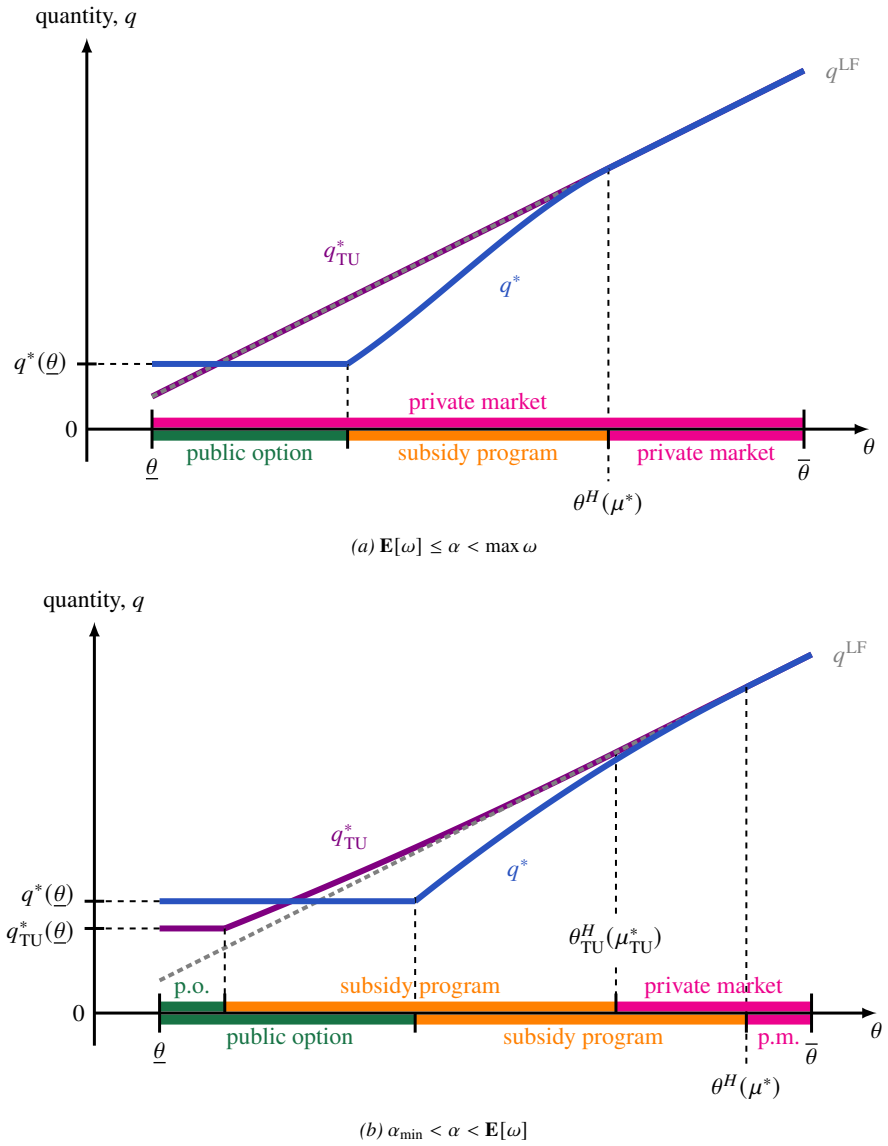
When the correlation between redistributive priority and demand is positive, topping up does not affect the optimal mechanism. When the correlation is negative, topping up weakens screening and reduces redistribution. At the extensive margin, topping up reduces the set of environments in which intervention is optimal. At the intensive margin, topping up weakly reduces both the scope of a free public option and the mass of consumers served, and shifts redistribution away from the consumers with the highest redistributive priority. The paper fully characterizes the optimal mechanisms and the changed comparative statics with respect to redistributive priorities.
What carries the argument
The sign of the correlation between redistributive priority and demand, which governs whether topping up preserves or erodes the planner's screening power through its nonlinear price schedule.
If this is right
- When priority and demand correlate positively, the planner's optimal nonlinear schedule remains the same whether topping up is allowed or banned.
- When priority and demand correlate negatively, allowing topping up strictly lowers total redistribution and shifts it away from highest-priority consumers.
- Topping up shrinks the range of parameter values in which any public intervention is better than leaving the market alone.
- Inside environments where intervention occurs, topping up reduces the size of any free public option and the number of consumers served by it.
Where Pith is reading between the lines
- Policy designers facing negative correlation may prefer to restrict topping up to protect targeting of high-priority groups.
- The same logic could apply to other public-private competition settings, such as public health insurance alongside private markets.
- Empirical work could test whether observed topping-up rules align with the sign of the priority-demand correlation in each market.
Load-bearing premise
Consumers can buy the good in a competitive private market while the planner offers a separate nonlinear price schedule, and redistributive priority is a fixed attribute that can be correlated with demand.
What would settle it
Measure the empirical correlation between demand and redistributive priority for a transferred good, then compare the planner's optimal transfers and who receives them in otherwise identical environments with and without topping up allowed.
Figures



read the original abstract
This paper studies how topping up -- allowing recipients of in-kind transfers to supplement subsidized consumption in a private market -- affects optimal redistribution. Consumers can access a competitive private market, while a social planner offers an alternative nonlinear price schedule. We show that the effect of topping up depends on the correlation between redistributive priority and demand. When the correlation is positive, topping up does not affect the optimal mechanism. When the correlation is negative, topping up weakens screening and reduces redistribution. At the extensive margin, topping up reduces the set of environments in which intervention is optimal. At the intensive margin, topping up weakly reduces both the scope of a free public option and the mass of consumers served, and shifts redistribution away from the consumers with the highest redistributive priority. We characterize the optimal mechanisms and show how topping up changes the comparative statics of optimal redistribution with respect to redistributive priorities.
Editorial analysis
A structured set of objections, weighed in public.
Referee Report
Summary. The paper studies how allowing topping up of in-kind transfers via a competitive private market affects a social planner's optimal nonlinear pricing mechanism for redistribution. It establishes that the effect hinges on the sign of the correlation between redistributive priority and demand: positive correlation leaves the optimal mechanism unchanged, while negative correlation weakens screening and reduces redistribution. The analysis covers extensive-margin effects (smaller set of environments where intervention is optimal) and intensive-margin effects (reduced scope of free public options, lower mass served, and shifts away from highest-priority consumers), with full characterization of the mechanisms and altered comparative statics.
Significance. If the results hold, the paper delivers a clean, correlation-sign-dependent comparative static that clarifies when private-market topping up is neutral versus distortionary for redistribution. This distinction is policy-relevant for the design of in-kind transfers versus cash or mixed mechanisms and extends standard screening models by incorporating redistributive weights explicitly correlated with demand.
minor comments (1)
- The abstract refers to 'characteriz[ing] the optimal mechanisms' but does not indicate whether closed-form solutions, numerical examples, or explicit conditions on the correlation parameter are provided; adding a brief statement on the form of the characterization would improve readability.
Simulated Author's Rebuttal
We thank the referee for the positive summary, significance assessment, and recommendation of minor revision. No specific major comments were listed in the report.
Circularity Check
No significant circularity detected
full rationale
The provided abstract and skeptic summary describe a standard theoretical characterization of optimal nonlinear pricing mechanisms under topping-up, with results conditioned on the sign of a correlation parameter between redistributive priority and demand. No equations, fitted parameters, self-citations, or ansatzes are exhibited that would reduce any claimed prediction to an input by construction. The derivation chain is therefore self-contained against external benchmarks and receives the default non-finding.
Axiom & Free-Parameter Ledger
Reference graph
Works this paper leans on
-
[1]
Observe that the social planner’s objective is continuous in(𝑈, 𝜈)
Existence of solution.To see that an optimal solution to each problem exists, we endowI with 36 the metric 𝑑 (𝜈1, 𝜈2) = ∥𝜈1 − 𝜈2∥ 𝐿1 + | 𝜈1(𝜃) − 𝜈2(𝜃)| . Observe that the social planner’s objective is continuous in(𝑈, 𝜈). Without loss of generality, we focus on the set𝐾 ≔ [𝑈LF, 𝜃𝑣 ( 𝐴)] × n ℎ ∈ I : [𝜃, 𝜃] → [ 𝑣 (0), 𝑣 ( 𝐴)] o . By the Helly selection theo...
-
[2]
Wenowarguethattheoptimalsolutiontoeachproblemisunique when E[𝜔] ≠ 𝛼
Generaluniquenessofsolution. Wenowarguethattheoptimalsolutiontoeachproblemisunique when E[𝜔] ≠ 𝛼. Suppose that (𝑈1, 𝜈1) and (𝑈2, 𝜈2) are distinct optimal solutions with distinct allocation functions 𝜈1 ≠ 𝜈2, and consider(𝑈∗, 𝜈∗) = (𝑈1 + 𝑈2)/2, (𝜈1 + 𝜈2)/2 . Clearly, 𝜈∗ is nondecreasing,and (𝑈∗, 𝜈∗)satisfiestheconstraints(sincetheconstraintsarelinear). How...
-
[3]
For any stochastic mechanism, let𝜈†(𝜃) be the expected subutility allocated to type𝜃, and let𝑈† be the expected utility of the lowest type
Optimality of deterministic mechanisms.Next, we observe that the restriction to deterministic mechanisms entails no loss of generality. For any stochastic mechanism, let𝜈†(𝜃) be the expected subutility allocated to type𝜃, and let𝑈† be the expected utility of the lowest type. The constraints are preserved by linearity, and the deterministic mechanism(𝑈†, 𝜈...
-
[4]
Toillustrate,suppose 37 that the (IR) constraint binds for the highest type
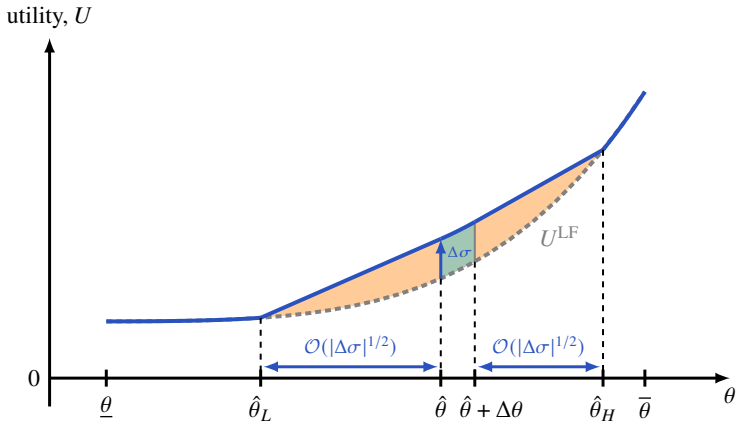
Convex program with majorization constraints.Finally, we point out that the problem without toppingupcanbewrittenasaconvexprogramwithmajorizationconstraints. Toillustrate,suppose 37 that the (IR) constraint binds for the highest type. Then the (IR) constraints can be rewritten as ∫ 𝜃 𝜃 𝜈(𝑠) d𝑠 ≤ ∫ 𝜃 𝜃 𝜈LF(𝑠) d𝑠, for all𝜃 ∈ [ 𝜃, 𝜃]. Since 𝜈 and 𝜈LF are non...
2021
-
[5]
Moreover,for 𝜃 ∈ [ 𝜃 𝐿, 𝜅] and 𝑧 ≥ 𝜃,choose 𝑦 = 𝜃 inthemax-minformula
implies that, for𝜃 ∈ [ 𝜅, 𝜃], 𝐽𝜇∗ | [𝜃 𝐿,𝜃] (𝜃) = inf 𝑧∈[ 𝜃,𝜃] sup 𝑦∈[ 𝜃 𝐿,𝜃] ∫ [𝑦,𝑧] 𝐽𝜇∗ d𝐹 𝐹 (𝑧) − 𝐹 (𝑦) ≥ inf 𝑧∈[ 𝜃,𝜃] sup 𝑦∈[ 𝜅,𝜃 ] ∫ [𝑦,𝑧] 𝐽𝜇∗ d𝐹 𝐹 (𝑧) − 𝐹 (𝑦) = 𝐽𝜇∗ | [𝜅,𝜃] (𝜃) ≥ 𝜃. Moreover,for 𝜃 ∈ [ 𝜃 𝐿, 𝜅] and 𝑧 ≥ 𝜃,choose 𝑦 = 𝜃 inthemax-minformula. If 𝑧 ≤ 𝜅,equation(14) gives ∫ 𝑧 𝜃 𝐽𝜇∗ (𝑠) d𝐹 (𝑠) ≥ 𝜃 [𝐹 (𝑧) − 𝐹 (𝜃)] . If 𝑧 > 𝜅 , equation (14) gi...
1969
discussion (0)
Sign in with ORCID, Apple, or X to comment. Anyone can read and Pith papers without signing in.