Democapsid
Pith reviewed 2026-06-30 08:19 UTC · model grok-4.3
The pith
Democapsid generates atomic coordinates for quasi-spherical and elongated icosahedral capsids via geometric folding constraints.
A machine-rendered reading of the paper's core claim, the machinery that carries it, and where it could break.
Core claim
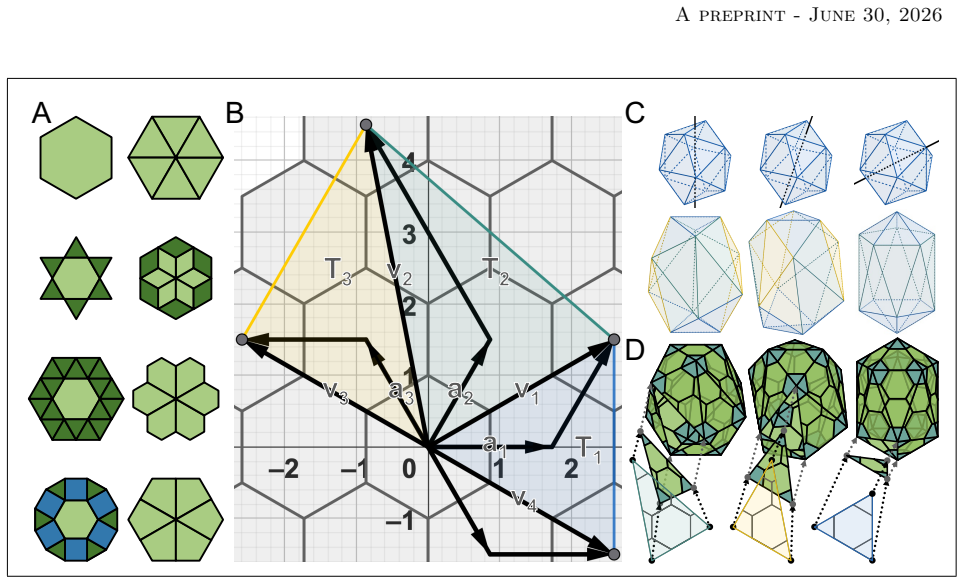
Democapsid implements an algorithm that places protein subunits on generalized icosahedral lattices and adjusts their positions to satisfy local folding constraints, thereby producing coordinate sets for both spherical capsids and prolate or oblate capsids with tunable elongation.
What carries the argument
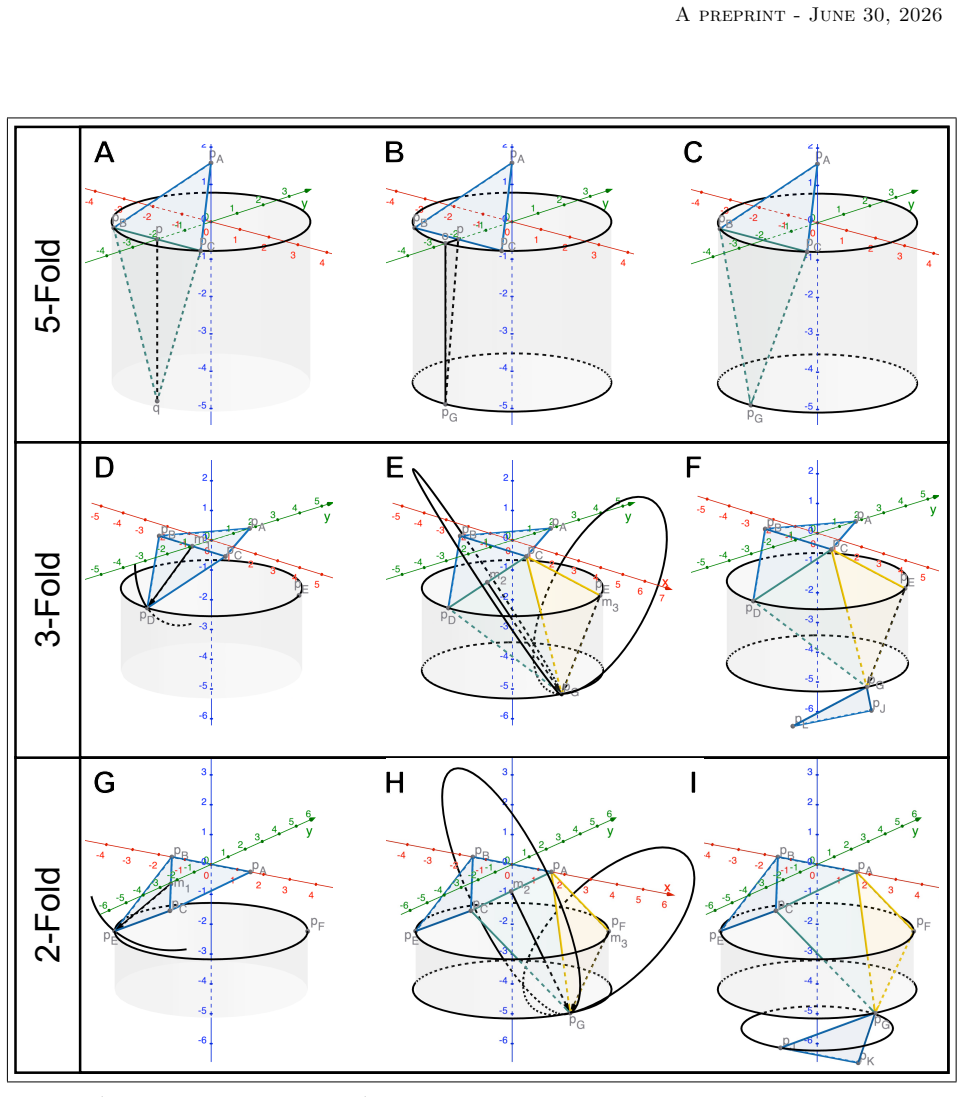
Numerical assembly of capsid elements based on folding constraints from the generalized geometrical theory of viral capsids, controlled by parameters for lattice type, elongation axis, sphericity, and body length.
If this is right
- Researchers can now produce models of elongated capsids with 5-fold, 3-fold, or 2-fold symmetry axes.
- The method covers all eight regular icosahedral lattices for different protein tilings.
- Output formats support both interactive visualization and publication figures.
- Parameters allow discrete control over body length for prolate and oblate forms.
Where Pith is reading between the lines
- Such models could be used to test how elongation affects genome packaging efficiency without new experiments.
- Designers of virus-like particles for biotechnology might use the tool to prototype custom aspect ratios.
- Comparison of generated structures with future high-resolution data on elongated viruses would test the geometric assumptions.
Load-bearing premise
That the geometric folding constraints alone are sufficient to determine accurate protein positions in elongated capsids without needing explicit energy minimization or additional biological rules.
What would settle it
A direct comparison showing that Democapsid coordinates deviate substantially from experimentally determined atomic structures of known elongated capsids would indicate the method fails to capture real geometry.
Figures

read the original abstract
Capsids are the protein shells that protect the genetic material of viruses. The precise structural description of capsids informs how viruses assemble and evolve and is key to the development of antiviral targets. Most viruses form icosahedral capsids; among these, most adopt quasi-spherical shapes, and some form elongated architectures. However, elongated capsids have been understudied, despite their decoupling of width and length providing greater control over their packaging capacity, a feature of particular interest in capsid evolution and in virus-based biotechnological platforms. A key bottleneck is the lack of tools for the analysis and design of elongated viral capsids. To that end, this article introduces Democapsid as a versatile tool for generating coordinates of both quasi-spherical and elongated (and shrunk) icosahedral capsids, as well as for producing customizable graphical models and publication-quality figures. The underlying algorithm builds on the generalized geometrical theory of viral capsids and employs numerical methods to assemble capsid elements based on folding constraints. It includes parameters controlling protein tiling associated with the eight regular icosahedral lattices, elongation axes (5-fold, 3-fold, and 2-fold), sphericity, and discrete body length for prolate (extended) and oblate (shrunk) shapes. It is available as a JavaScript browser application, a Python package powering plugins for UCSF ChimeraX and Blender, and an R package for generating reproducible documents with embedded models. The code (MIT License) is available on GitHub. Democapsid will benefit both researchers and graphic designers by enabling the investigation and communication of research on viral capsids and other icosahedral compartments.
Editorial analysis
A structured set of objections, weighed in public.
Referee Report
Summary. The manuscript introduces Democapsid, a software tool for generating atomic coordinates of quasi-spherical and elongated (prolate and oblate) icosahedral viral capsids. It builds on the generalized geometrical theory of viral capsids and employs numerical methods to assemble elements based on folding constraints, with user parameters for the eight regular icosahedral lattices, elongation axis (5-fold, 3-fold, or 2-fold), sphericity, and discrete body length. Implementations are provided as a JavaScript browser application, a Python package with plugins for UCSF ChimeraX and Blender, and an R package; the MIT-licensed code is available on GitHub.
Significance. If the numerical assembly produces valid coordinates, the tool would address an unmet need for modeling elongated capsids, whose decoupled dimensions are relevant to packaging capacity, capsid evolution, and biotechnological design. A clear strength is the open-source, multi-platform delivery (JavaScript, Python, R) with direct integration into widely used visualization environments, which supports reproducibility and generation of publication-quality figures.
major comments (2)
- [Abstract] Abstract and algorithm description: the central claim of versatility for elongated capsids rests on the numerical methods producing accurate, non-overlapping coordinates, yet the manuscript supplies no validation, convergence criteria, overlap checks, or direct comparison to experimental elongated structures (e.g., known T=3 or T=7 prolate particles).
- [Algorithm description] The description states that coordinates are 'assembled based on folding constraints' without specifying the numerical solver, how steric clashes or topological correctness are enforced when sphericity and body length depart from the spherical limit, or any error metrics across the parameter space.
minor comments (2)
- Consider adding at least one concrete example output (coordinates or rendered model) for a non-spherical case to illustrate the tool's behavior.
- [Abstract] The abstract is information-dense; a short statement on how users can access and run the tool would improve immediate usability for readers.
Simulated Author's Rebuttal
We thank the referee for their thoughtful review and for highlighting key areas where the manuscript can be strengthened. We address each major comment below and will revise the manuscript accordingly to improve the description of the algorithm and its validation.
read point-by-point responses
-
Referee: [Abstract] Abstract and algorithm description: the central claim of versatility for elongated capsids rests on the numerical methods producing accurate, non-overlapping coordinates, yet the manuscript supplies no validation, convergence criteria, overlap checks, or direct comparison to experimental elongated structures (e.g., known T=3 or T=7 prolate particles).
Authors: We agree that the manuscript lacks explicit validation of the generated coordinates for non-spherical capsids. In the revised version, we will add a dedicated validation subsection that includes overlap checks (minimum inter-subunit distances), convergence criteria for the numerical assembly procedure, and direct comparisons to available experimental structures of elongated icosahedral capsids, such as known prolate T=3 and T=7 particles. This will provide quantitative support for the versatility claim. revision: yes
-
Referee: [Algorithm description] The description states that coordinates are 'assembled based on folding constraints' without specifying the numerical solver, how steric clashes or topological correctness are enforced when sphericity and body length depart from the spherical limit, or any error metrics across the parameter space.
Authors: The referee is correct that the current description of the numerical methods is insufficiently detailed. We will expand the algorithm section to specify the numerical solver employed, the constraint formulation used to enforce folding rules, the handling of steric clashes via distance-based penalties or hard constraints, the preservation of topological correctness for non-spherical geometries, and quantitative error metrics (e.g., residual constraint violations) evaluated across ranges of sphericity and body length parameters. revision: yes
Circularity Check
No circularity: tool description with no self-referential derivations
full rationale
The manuscript introduces Democapsid as a software implementation that builds on an existing generalized geometrical theory of viral capsids and applies numerical assembly based on folding constraints. No equations, parameter fits, or predictions are presented that reduce by construction to the paper's own inputs, fitted values, or self-citations. The central contribution is the parameterization and code for coordinate generation across lattices, axes, and shapes; this is a direct algorithmic description rather than a derivation chain whose outputs are forced by its own definitions or prior self-referential claims. The paper is therefore self-contained as a tool paper with no load-bearing circular steps.
Axiom & Free-Parameter Ledger
free parameters (4)
- protein tiling parameters
- elongation axis
- sphericity
- discrete body length
axioms (2)
- domain assumption The generalized geometrical theory of viral capsids provides a valid basis for coordinate generation.
- domain assumption Numerical methods can assemble capsid elements based on folding constraints.
Reference graph
Works this paper leans on
-
[1]
Wiley, 1 edition, September 2002
William Lucas and David M Knipe.Viral Capsids and Envelopes: Structure and Function. Wiley, 1 edition, September 2002
2002
-
[2]
Viral structural proteins as targets for antivirals
Christopher John Schlicksup and Adam Zlotnick. Viral structural proteins as targets for antivirals. Current Opinion in Virology, 45:43–50, 12 2020
2020
-
[3]
Anti-virus reagents targeting the capsid protein assembly.Journal of Materials Chemistry B, 7(21):3331–3340, 2019
Ding-Yi Fu, Ya-Rong Xue, Xianghui Yu, and Yuqing Wu. Anti-virus reagents targeting the capsid protein assembly.Journal of Materials Chemistry B, 7(21):3331–3340, 2019
2019
-
[4]
Steinmetz
Young Hun Chung, Hui Cai, and Nicole F. Steinmetz. Viral nanoparticles for drug delivery, imaging, immunotherapy, and theranostic applications.Advanced Drug Delivery Reviews, 156:214–235, 2020
2020
-
[5]
Douglas, E
T. Douglas, E. Strable, D. Willits, A. Aitouchen, M. Libera, and M. Young. Protein engineering of a viral cage for constrained nanomaterials synthesis.Advanced Materials, 14(6):415–418, 03 2002. 7 A preprint - June 30, 2026
2002
-
[6]
Virus structure and classification.Essential Human Virology, pages 19–29, 2016
Jennifer Louten. Virus structure and classification.Essential Human Virology, pages 19–29, 2016
2016
-
[7]
Structural puzzles in virology solved with an overarching icosahedral design principle.Nature Communications, 10(1):4414, 09 2019
Reidun Twarock and Antoni Luque. Structural puzzles in virology solved with an overarching icosahedral design principle.Nature Communications, 10(1):4414, 09 2019. Number: 1
2019
-
[8]
Parent and Cheryl A
Kristin N. Parent and Cheryl A. Kerfeld. Many paths, similar destinations: viruses and bacterial microcompartments form polyhedra inside cells.Journal of Virology, 100(5):e01577–25, 04 2026
2026
-
[9]
Castón.The Basic Architecture of Viruses, pages 55–78
José R. Castón.The Basic Architecture of Viruses, pages 55–78. Springer Nature Switzerland, Cham, 2024
2024
-
[10]
Ackermann
H.-W. Ackermann. 5500 phages examined in the electron microscope.Archives of Virology, 152(2):227–243, 02 2007
2007
-
[11]
Rossmann, and Venigalla B
Qianglin Fang, Wei-Chun Tang, Andrei Fokine, Marthandan Mahalingam, Qianqian Shao, Michael G. Rossmann, and Venigalla B. Rao. Structures of a large prolate virus capsid in unexpanded and expanded states generate insights into the icosahedral virus assembly.Proceedings of the National Academy of Sciences, 119(40):e2203272119, 10 2022
2022
-
[12]
Prokhorov, Seth D
Michael Woodson, Nikolai S. Prokhorov, Seth D. Scott, Wei Zhao, Wei Zhang, Kyung H. Choi, Paul J. Jardine, and Marc C. Morais. Phi29 assembly intermediates reveal how scaffold interactions with capsid protein drive capsid construction and maturation.Science Advances, 11(12):eadk8779, 03 2025
2025
-
[13]
Thomas Beatty, and Pavel Plevka
Pavol Bárdy, Tibor Füzik, Dominik Hrebík, Roman Pantůček, J. Thomas Beatty, and Pavel Plevka. Structure and mechanism of dna delivery of a gene transfer agent.Nature Communications, 11(1):3034, 06 2020
2020
-
[14]
Hawkins, James L
N’Toia C. Hawkins, James L. Kizziah, José R. Penadés, and Terje Dokland. Shape shifter: redirection of prolate phage capsid assembly by staphylococcal pathogenicity islands.Nature Communications, 12(1):6408, 11 2021
2021
-
[15]
Cryo-em reveals structural diversity in prolate-headed mycobacteriophage mycofy1.Journal of Molecular Biology, 437(12):169126, 06 2025
Xiangyun Li, Qianqian Shao, Lin Li, Linlin Xie, Zhiyang Ruan, and Qianglin Fang. Cryo-em reveals structural diversity in prolate-headed mycobacteriophage mycofy1.Journal of Molecular Biology, 437(12):169126, 06 2025
2025
-
[16]
Gorzelnik, Jirapat Thongchol, and Junjie Zhang
Jeng-Yih Chang, Karl V. Gorzelnik, Jirapat Thongchol, and Junjie Zhang. Structural assembly of qβ virion and its diverse forms of virus-like particles.Viruses, 14(2):225, 01 2022
2022
-
[17]
Optimal architectures of elongated viruses.Proceedings of the National Academy of Sciences, 107(12):5323–5328, March 2010
Antoni Luque, Roya Zandi, and David Reguera. Optimal architectures of elongated viruses.Proceedings of the National Academy of Sciences, 107(12):5323–5328, March 2010
2010
-
[18]
Geometry of phage head construction.Journal of Molecular Biology, 293(2):401–433, 10 1999
Michael F Moody. Geometry of phage head construction.Journal of Molecular Biology, 293(2):401–433, 10 1999
1999
-
[19]
R. Twarock. A tiling approach to virus capsid assembly explaining a structural puzzle in virology. Journal of Theoretical Biology, 226(4):477–482, 02 2004
2004
-
[20]
The structure of elongated viral capsids.Biophysical Journal, 98(12):2993–3003, 06 2010
Antoni Luque and David Reguera. The structure of elongated viral capsids.Biophysical Journal, 98(12):2993–3003, 06 2010
2010
-
[21]
Lee, Colin Brown, and Simon White
Antoni Luque, Sean Benler, Diana Y. Lee, Colin Brown, and Simon White. The missing tailed phages: Prediction of small capsid candidates.Microorganisms, 8(12):1944, 12 2020
1944
-
[22]
Peter Schwerdtfeger, Lukas Wirz, and James Avery. Program fullerene: A software package for constructing and analyzing structures of regular fullerenes.Journal of Computational Chemistry, 34(17):1508–1526, 2013. _eprint: https://onlinelibrary.wiley.com/doi/pdf/10.1002/jcc.23278
-
[23]
Quasi-equivalent viruses: a paradigm for protein assemblies1
John E Johnson and Jeffrey A Speir. Quasi-equivalent viruses: a paradigm for protein assemblies1. Journal of Molecular Biology, 269(5):665–675, 07 1997
1997
-
[24]
Santiago Melchor and José A. Dobado. Contub: an algorithm for connecting two arbitrary carbon nanotubes.Journal of Chemical Information and Computer Sciences, 44(5):1639–1646, 09 2004
2004
-
[25]
D. L. Caspar and A. Klug. Physical principles in the construction of regular viruses.Cold Spring Harbor Symposia on Quantitative Biology, 27:1–24, 1962
1962
-
[26]
Relevance of capsid structure in the buckling and maturation of spherical viruses.Physical Biology, 9(3):036003, 05 2012
María Aznar, Antoni Luque, and David Reguera. Relevance of capsid structure in the buckling and maturation of spherical viruses.Physical Biology, 9(3):036003, 05 2012
2012
-
[27]
Viralzone: a knowledge resource to understand virus diversity.Nucleic Acids Research, 39(suppl_1):D576–D582, 01 2011
Chantal Hulo, Edouard de Castro, Patrick Masson, Lydie Bougueleret, Amos Bairoch, Ioannis Xenarios, and Philippe Le Mercier. Viralzone: a knowledge resource to understand virus diversity.Nucleic Acids Research, 39(suppl_1):D576–D582, 01 2011. 8 A preprint - June 30, 2026
2011
-
[28]
Viperdb v3.0: a structure-based data analytics platform for viral capsids.Nucleic Acids Research, (gkaa1096), 12 2020
Daniel Montiel-Garcia, Nelly Santoyo-Rivera, Phuong Ho, Mauricio Carrillo-Tripp, Charles L Brooks III, John E Johnson, and Vijay S Reddy. Viperdb v3.0: a structure-based data analytics platform for viral capsids.Nucleic Acids Research, (gkaa1096), 12 2020
2020
-
[29]
Vectorized Capsid Rendering in the Browser with Capsid.js, April 2021
Daniel Antonio Negrón. Vectorized Capsid Rendering in the Browser with Capsid.js, April 2021
2021
-
[30]
Elaine C. Meng, Thomas D. Goddard, Eric F. Pettersen, Greg S. Couch, Zach J. Pearson, John H. Morris, and Thomas E. Ferrin. Ucsf chimerax: Tools for structure building and analysis.Protein Science, 32(11):e4792, 2023. _eprint: https://onlinelibrary.wiley.com/doi/pdf/10.1002/pro.4792
-
[31]
Credits, 2024
Blender Foundation. Credits, 2024
2024
-
[32]
Paper.js, 11 2020
Jürg Lehni and Jonathan Puckey.paperjs/paper.js. Paper.js, 11 2020. original-date: 2011-02- 07T18:21:30Z
2020
-
[33]
Harris, K
Charles R. Harris, K. Jarrod Millman, Stéfan J. Van Der Walt, Ralf Gommers, Pauli Virtanen, David Cournapeau, Eric Wieser, Julian Taylor, Sebastian Berg, Nathaniel J. Smith, Robert Kern, Matti Picus, Stephan Hoyer, Marten H. Van Kerkwijk, Matthew Brett, Allan Haldane, Jaime Fernández Del Río, Mark Wiebe, Pearu Peterson, Pierre Gérard-Marchant, Kevin Shepp...
2020
-
[34]
htmlwid- gets: Html widgets for r
Ramnath Vaidyanathan, Yihui Xie, JJ Allaire, Joe Cheng, Carson Sievert, and Kenton Russell. htmlwid- gets: Html widgets for r. Technical report, 2023
2023
-
[35]
shiny: Web application framework for r
Winston Chang, Joe Cheng, JJ Allaire, Carson Sievert, Barret Schloerke, Garrick Aden-Buie, Yihui Xie, Jeff Allen, Jonathan McPherson, Alan Dipert, and Barbara Borges. shiny: Web application framework for r. Technical report, 2026
2026
-
[36]
Markus Hohenwarter.GeoGebra - ein Softwaresystem für dynamische Geometrie und Algebra der Ebene
-
[37]
Citation Key: 8869632bed924cd5b43cc293246ae687. 9
discussion (0)
Sign in with ORCID, Apple, or X to comment. Anyone can read and Pith papers without signing in.