Stabilization without Inclusive Development: Neoliberalism, Economic Liberalization, Poverty, and Inequality in Bolivia
Pith reviewed 2026-06-30 08:03 UTC · model grok-4.3
The pith
Bolivian economic liberalization raised poverty by 3.6 to 7.4 percentage points and the Gini by 3.91 points per 10-point gain in the economic freedom score.
A machine-rendered reading of the paper's core claim, the machinery that carries it, and where it could break.
Core claim
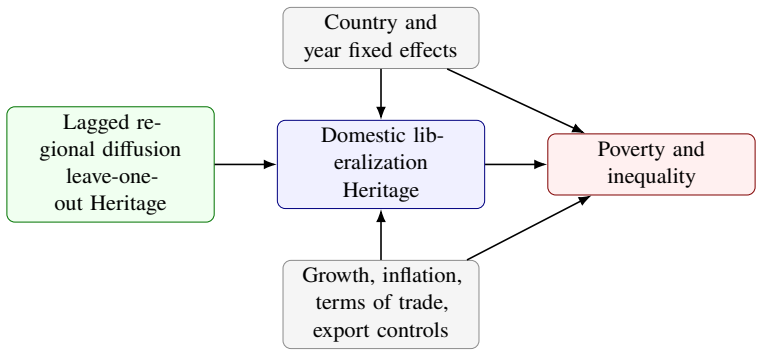
The paper claims that a 10-point increase in the Heritage economic-freedom score is associated, for Bolivia, with approximately +4.46 percentage points of poverty at the USD 4.20/day line, +3.61 percentage points at the USD 3/day line, +7.40 percentage points at the USD 8.30/day line, and +3.91 Gini points. These associations come from a heterogeneous instrumental-variables model that instruments domestic liberalization with lagged regional leave-one-out policy diffusion and allows Bolivia to differ from the Latin American average. The results remain positive after export controls, supporting the conclusion that Bolivian neoliberalism stabilized hyperinflation but increased social vulnerabil
What carries the argument
Heterogeneous instrumental-variables model that instruments domestic liberalization with lagged regional leave-one-out policy diffusion and permits Bolivia-specific coefficients.
If this is right
- The Bolivian liberalization package increased poverty headcounts at multiple income thresholds.
- Income inequality, measured by the Gini coefficient, rose with higher economic-freedom scores.
- The positive associations persist after adding export-structure controls to the specifications.
- Stabilization of hyperinflation occurred alongside heightened social vulnerability rather than inclusive development.
- The neoliberal cycle consisted of layered reforms that displaced labor and deepened commodity dependence.
Where Pith is reading between the lines
- Comparable regressive effects could appear in other Latin American countries that adopted similar regionally diffused policy packages.
- Testing the instrument with alternative regional or temporal instruments would strengthen or weaken the causal claim.
- Development strategies in post-stabilization settings may require explicit redistribution mechanisms to offset the inequality channel identified here.
- The findings suggest limits to treating economic-freedom indices as uniformly development-enhancing without country-specific historical context.
Load-bearing premise
The lagged regional leave-one-out policy diffusion instrument affects Bolivian poverty and inequality only through domestic liberalization and not through other channels.
What would settle it
A statistically significant direct association between the regional diffusion instrument and Bolivian poverty or Gini measures that survives controls for domestic liberalization levels, or the disappearance of the positive coefficients once additional unobserved-confounder proxies are added.
Figures



read the original abstract
This article reconstructs the economic and social history of Bolivian neoliberalism and evaluates whether economic liberalization reduced or increased poverty and inequality in Bolivia. The historical argument is that the Bolivian neoliberal cycle was not a single event but a layered sequence: hyperinflation and emergency stabilization, the 1985 New Economic Policy, labor displacement and mining restructuring, second-generation reform in the 1990s, capitalization, decentralized state restructuring, commodity dependence, and the social conflicts that culminated in the collapse of the party system. The empirical contribution is to integrate macroeconomic indicators, economic-freedom indices, poverty and inequality series, IMF and financial-reform data, commodity and disaster controls, Bolivian export aggregates, and harmonized historical survey indicators. The preferred design is a heterogeneous instrumental-variables model that instruments domestic liberalization with lagged regional leave-one-out policy diffusion and allows Bolivia to differ from the Latin American average. The central estimate is that a 10-point increase in the Heritage economic-freedom score is associated, for Bolivia, with approximately +4.46 percentage points of poverty at the USD 4.20/day line, +3.61 percentage points at the USD 3/day line, +7.40 percentage points at the USD 8.30/day line, and +3.91 Gini points. These results remain socially regressive in sign after adding export-structure controls to the poverty specifications, although the causal interpretation remains conditional on the exclusion restriction. The article therefore advances a qualified conclusion: Bolivian neoliberalism stabilized hyperinflation, but the historically specific liberalization package appears to have increased social vulnerability and inequality rather than producing inclusive development.
Editorial analysis
A structured set of objections, weighed in public.
Referee Report
Summary. The paper reconstructs Bolivian neoliberalism as a multi-stage process from 1985 onward and estimates its effects on poverty and inequality via a heterogeneous IV design. Domestic economic-freedom scores (Heritage index) are instrumented with lagged regional leave-one-out policy diffusion; the Bolivia-specific coefficients indicate that a 10-point rise in the index raises poverty headcounts by 3.61–7.40 pp (across three lines) and the Gini by 3.91 points. The historical narrative emphasizes stabilization without inclusive development; the econometric claim is explicitly conditioned on the instrument’s exclusion restriction.
Significance. If the IV identification is valid, the estimates supply a country-specific falsification of the claim that liberalization produces inclusive growth, complementing the historical account with quantitative magnitudes. The design’s allowance for heterogeneous effects and the inclusion of commodity, disaster, and export controls are strengths; however, the absence of reported first-stage statistics, sample sizes, or exclusion tests limits the weight that can be placed on the point estimates.
major comments (2)
- [preferred heterogeneous IV design (abstract and empirical section)] The central causal claim for Bolivia rests on the exclusion restriction for the lagged regional leave-one-out diffusion instrument (explicitly invoked in the description of the preferred heterogeneous IV design). No reduced-form placebo tests on non-liberalization outcomes, no comparison with an alternative instrument (e.g., lagged regional IMF programs), and no sensitivity analysis to plausible violations are reported, leaving the sign and magnitude of the reported coefficients unidentified if regional diffusion operates through trade spillovers or political demonstration effects.
- [abstract and empirical contribution] The abstract supplies point estimates and states that results remain regressive after export-structure controls, but reports neither the sample size, first-stage F-statistics, nor any robustness tables. Without these diagnostics it is impossible to judge whether the Bolivia-specific coefficients are precisely estimated or sensitive to the included controls (commodity prices, disasters, IMF data).
minor comments (2)
- [data and empirical contribution] The abstract lists harmonized historical survey indicators but does not specify the exact construction of the poverty lines or the export aggregates used as controls; these details belong in the data section.
- [historical argument] The historical narrative is rich but the transition from the qualitative account to the quantitative IV specification could be tightened by explicitly mapping the timing of each reform episode to the variation exploited in the instrument.
Simulated Author's Rebuttal
We thank the referee for the constructive comments. We address each major point below, noting revisions where the manuscript will be updated to improve transparency and robustness.
read point-by-point responses
-
Referee: [preferred heterogeneous IV design (abstract and empirical section)] The central causal claim for Bolivia rests on the exclusion restriction for the lagged regional leave-one-out diffusion instrument (explicitly invoked in the description of the preferred heterogeneous IV design). No reduced-form placebo tests on non-liberalization outcomes, no comparison with an alternative instrument (e.g., lagged regional IMF programs), and no sensitivity analysis to plausible violations are reported, leaving the sign and magnitude of the reported coefficients unidentified if regional diffusion operates through trade spillovers or political demonstration effects.
Authors: We agree that further validation of the exclusion restriction would strengthen the identification argument. The manuscript already conditions the causal claim on this assumption. In revision we will add reduced-form placebo tests on non-liberalization outcomes, sensitivity checks for plausible violations including trade spillovers, and an exploration of an alternative instrument based on lagged regional IMF programs where data availability permits. revision: yes
-
Referee: [abstract and empirical contribution] The abstract supplies point estimates and states that results remain regressive after export-structure controls, but reports neither the sample size, first-stage F-statistics, nor any robustness tables. Without these diagnostics it is impossible to judge whether the Bolivia-specific coefficients are precisely estimated or sensitive to the included controls (commodity prices, disasters, IMF data).
Authors: The empirical tables in the full manuscript report sample sizes and first-stage statistics, but we accept that these should be more prominently displayed and supplemented with additional robustness material. In the revised version we will add first-stage F-statistics to the main text or abstract footnote, include a dedicated robustness table for the controls (commodity prices, disasters, export structure), and clearly state sample sizes. revision: yes
Circularity Check
No significant circularity detected in the derivation chain.
full rationale
The paper obtains its central estimates via a heterogeneous IV regression that instruments domestic economic-freedom scores with a lagged regional leave-one-out policy diffusion measure constructed from other Latin American countries. Poverty and inequality outcomes are taken from external harmonized survey aggregates, and controls draw on commodity prices, IMF data, and export statistics. None of the reported coefficients (e.g., the +3.61 pp poverty effect) reduce by the paper's own equations to quantities defined in terms of the fitted parameters themselves, nor does the argument invoke self-citation load-bearing uniqueness theorems, ansatzes smuggled via prior work, or renaming of known results. The derivation therefore remains self-contained against external benchmarks.
Axiom & Free-Parameter Ledger
free parameters (1)
- choice of poverty lines and export controls
axioms (1)
- domain assumption Lagged regional leave-one-out policy diffusion affects Bolivian outcomes only through domestic liberalization (exclusion restriction)
Reference graph
Works this paper leans on
-
[1]
Abiad, A., Detragiache, E., and Tressel, T. (2008). A new database of financial reforms.IMF Working Paper
2008
-
[2]
Barja, G. (2004). Capitalization, regulation and the poor: access to basic services in Bolivia.WIDER Research Paper
2004
-
[3]
(2000).Políticas de estabilización y reformas estructurales: Bolivia a partir de 1985
Economic Commission for Latin America and the Caribbean. (2000).Políticas de estabilización y reformas estructurales: Bolivia a partir de 1985. Santiago: ECLAC
2000
-
[4]
Historical institutional materials on the restructuring of Bolivian state mining
Corporación Minera de Bolivia (COMIBOL). Historical institutional materials on the restructuring of Bolivian state mining
-
[5]
Republic of Bolivia. (1985). Supreme Decree 21060, New Economic Policy
1985
-
[6]
(2025).EM-DAT: The International Disaster Database
Centre for Research on the Epidemiology of Disasters. (2025).EM-DAT: The International Disaster Database. Brussels: UCLouvain
2025
-
[7]
C., Inklaar, R., and Timmer, M
Feenstra, R. C., Inklaar, R., and Timmer, M. P. (2015). The next generation of the Penn World Table. American Economic Review, 105(10), 3150–3182
2015
-
[8]
(2025).Economic Freedom of the World: 2025 Annual Report
Gwartney, J., Lawson, R., Hall, J., and Murphy, R. (2025).Economic Freedom of the World: 2025 Annual Report. Fraser Institute
2025
-
[9]
(2026).Index of Economic Freedom
Heritage Foundation. (2026).Index of Economic Freedom. Dataset used for annual economic freedom indicators
2026
-
[10]
(2025).ILOSTAT database
International Labour Organization. (2025).ILOSTAT database. Geneva: ILO
2025
-
[11]
(2025).Monitoring of Fund Arrangements, MONA database
International Monetary Fund. (2025).Monitoring of Fund Arrangements, MONA database. Washington, DC: IMF
2025
-
[12]
Klein, H. S. (2011).A Concise History of Bolivia. Cambridge: Cambridge University Press
2011
-
[13]
Kohl, B. (2002). Stabilizing neoliberalism in Bolivia: popular participation and privatization.Political Geography, 21(4), 449–472
2002
-
[14]
and Farthing, L
Kohl, B. and Farthing, L. (2006).Impasse in Bolivia: Neoliberal Hegemony and Popular Resistance. London: Zed Books
2006
-
[15]
Republic of Bolivia. (1994). Law 1544, Capitalization Law
1994
-
[16]
Republic of Bolivia. (1994). Law 1551, Popular Participation Law. 18
1994
-
[17]
and van Zanden, J
Bolt, J. and van Zanden, J. L. (2024). Maddison Project Database 2023
2024
-
[18]
Mesa-Lago, C. (2002). Myth and reality of pension reform: the Latin American evidence.World Development, 30(8), 1309–1321
2002
-
[19]
Perreault,T.(2006).FromtheGuerradelAguatotheGuerradelGas: resourcegovernance,neoliberalism and popular protest in Bolivia.Antipode, 38(1), 150–172
2006
-
[20]
Sachs, J. D. and Morales, J. A. (1988). Bolivia’s economic crisis. In J. D. Sachs (ed.),Developing Country Debt and Economic Performance. Chicago: University of Chicago Press
1988
-
[21]
Spronk, S. (2007). Roots of resistance to urban water privatization in Bolivia.International Labor and Working-Class History, 71(1), 8–28
2007
-
[22]
Webber, J. R. (2011).From Rebellion to Reform in Bolivia: Class Struggle, Indigenous Liberation, and the Politics of Evo Morales. Chicago: Haymarket Books
2011
-
[23]
(2025).World Development Indicators
World Bank. (2025).World Development Indicators. Washington, DC: World Bank. 19
2025
discussion (0)
Sign in with ORCID, Apple, or X to comment. Anyone can read and Pith papers without signing in.