Imaginary pseudo entropy encodes temporal orientation
Pith reviewed 2026-06-30 07:45 UTC · model grok-4.3
The pith
Imaginary pseudo entropy records a measurable distinction between forward and backward quantum time transitions.
A machine-rendered reading of the paper's core claim, the machinery that carries it, and where it could break.
Core claim
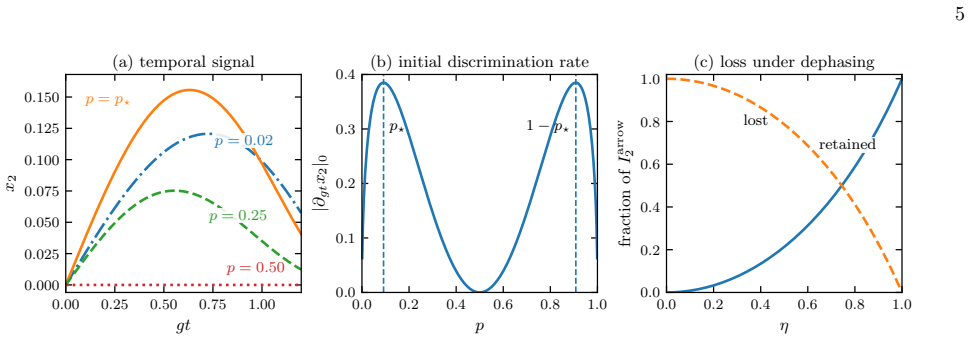
A calibrated replica interferometer converts the pseudo-Rényi phase into a directly measurable record of transition orientation. Together with replica visibility, it exactly determines the trace distance between forward and backward ancilla outputs and hence the Helstrom-optimal single-shot success probability. At short times, the symmetrized covariance of the modular and physical Hamiltonians sets the initial distinguishability response. Under any common quantum channel, the corresponding orientation information can only decrease, with equality characterized by Petz recovery.
What carries the argument
imaginary part of pseudo entropy (pseudo-Rényi phase) extracted by a replica interferometer that converts phase into a record of transition orientation
If this is right
- At short times the symmetrized covariance of modular and physical Hamiltonians fixes the initial rate at which forward and backward outputs become distinguishable.
- Under any quantum channel the distinguishability between orientations can only decrease or stay constant.
- Equality in the decrease holds precisely when the channel admits a Petz recovery map.
- Coarse graining can turn the reversible loss of orientation information into an irreversible one.
Where Pith is reading between the lines
- The same interferometer protocol could be used to test whether a given quantum process preserves or erases a preferred time direction.
- If the imaginary component survives certain open-system dynamics, it might serve as an operational witness for the emergence of a thermodynamic arrow from unitary evolution.
Load-bearing premise
A calibrated replica interferometer exists that converts the pseudo-Rényi phase into a directly measurable record of transition orientation.
What would settle it
An experiment in which the measured pseudo-Rényi phase fails to predict the Helstrom success probability computed from the trace distance between forward and backward ancilla states.
Figures

read the original abstract
Pseudo entropy between quantum states at different times is generally complex, yet its imaginary part has lacked a bounded operational meaning. We show that a calibrated replica interferometer converts the pseudo-R\'enyi phase into a directly measurable record of transition orientation. Together with replica visibility, it exactly determines the trace distance between forward and backward ancilla outputs and hence the Helstrom-optimal single-shot success probability. At short times, the symmetrized covariance of the modular and physical Hamiltonians sets the initial distinguishability response. Under any common quantum channel, the corresponding orientation information can only decrease, with equality characterized by Petz recovery. Imaginary pseudo entropy therefore records a reversible distinction between temporal orientations, while coarse graining can make the loss of that record irreversible.
Editorial analysis
A structured set of objections, weighed in public.
Referee Report
Summary. The manuscript claims that the imaginary part of pseudo entropy between quantum states at different times has a bounded operational meaning: a calibrated replica interferometer converts the pseudo-Rényi phase into a measurable record of transition orientation. Combined with replica visibility, this exactly determines the trace distance between forward and backward ancilla outputs and thus the Helstrom-optimal single-shot success probability. At short times the symmetrized covariance of the modular and physical Hamiltonians governs the initial response; under any common quantum channel the orientation information is non-increasing, with equality characterized by Petz recovery. Consequently imaginary pseudo entropy records a reversible distinction between temporal orientations while coarse-graining can render the loss irreversible.
Significance. If the central construction and equalities hold, the work supplies the first explicit operational interpretation of the imaginary component of pseudo entropy in terms of temporal distinguishability, directly tying it to the data-processing inequality and the Petz-recovery equality case. The replica-interferometer protocol and the short-time covariance statement are potentially falsifiable predictions that could be tested in existing quantum-optics or NMR setups.
major comments (2)
- [Abstract and §1 (opening claim)] The central operational claim—that the calibrated replica interferometer together with replica visibility exactly determines the trace distance (and hence the Helstrom probability)—is asserted in the abstract and opening paragraphs but lacks an explicit circuit diagram, protocol, or proof that the conversion holds for arbitrary states without additional assumptions. This step is load-bearing for all subsequent statements about bounded distinguishability and the data-processing inequality.
- [Abstract (short-time paragraph)] The short-time statement that the symmetrized covariance of the modular and physical Hamiltonians sets the initial distinguishability response is presented without an explicit expansion or derivation showing how the covariance enters the trace-distance expression at linear order in t. If this is only heuristic, the claim that the response is governed by this covariance requires a supporting calculation.
minor comments (2)
- [§2] Notation for the pseudo-Rényi phase and the forward/backward ancilla outputs should be introduced with a single consistent symbol set before the interferometer discussion.
- [§4] The manuscript should clarify whether the Petz-recovery equality case is derived from the general channel inequality or imported from an existing reference; a brief self-contained argument would strengthen the presentation.
Simulated Author's Rebuttal
We thank the referee for the careful reading and for highlighting the load-bearing steps in our operational claims. We address each major comment below and will revise the manuscript accordingly to include the requested explicit elements.
read point-by-point responses
-
Referee: [Abstract and §1 (opening claim)] The central operational claim—that the calibrated replica interferometer together with replica visibility exactly determines the trace distance (and hence the Helstrom probability)—is asserted in the abstract and opening paragraphs but lacks an explicit circuit diagram, protocol, or proof that the conversion holds for arbitrary states without additional assumptions. This step is load-bearing for all subsequent statements about bounded distinguishability and the data-processing inequality.
Authors: We agree that an explicit circuit diagram and a self-contained derivation would improve clarity. In the revised manuscript we will add a dedicated figure showing the calibrated replica-interferometer circuit together with a step-by-step proof that the pseudo-Rényi phase combined with replica visibility yields the trace distance between forward and backward ancilla outputs for arbitrary states, without further assumptions. This material will be placed in Section 2 immediately following the definition of the protocol. revision: yes
-
Referee: [Abstract (short-time paragraph)] The short-time statement that the symmetrized covariance of the modular and physical Hamiltonians sets the initial distinguishability response is presented without an explicit expansion or derivation showing how the covariance enters the trace-distance expression at linear order in t. If this is only heuristic, the claim that the response is governed by this covariance requires a supporting calculation.
Authors: We accept that the short-time claim requires an explicit perturbative derivation. The revised manuscript will contain a new subsection in Section 3 that expands the trace-distance expression to first order in t and shows that the linear response is governed by the symmetrized covariance of the modular and physical Hamiltonians. The calculation will be presented in full. revision: yes
Circularity Check
No significant circularity; derivation self-contained
full rationale
The paper's central claims rest on standard quantum information primitives (trace distance, Helstrom bound, data-processing inequality, Petz recovery) applied to the imaginary part of pseudo-Rényi entropy. The replica interferometer is introduced as an operational construction that converts the phase into a measurable quantity, but this is presented as an interpretive bridge rather than a definitional loop or a fitted parameter renamed as a prediction. No self-citations appear load-bearing, no ansatz is smuggled via prior work by the same authors, and no equation reduces the output to its own inputs by construction. The derivation therefore remains independent of the result it seeks to interpret.
Axiom & Free-Parameter Ledger
axioms (2)
- domain assumption Pseudo entropy between quantum states at different times is generally complex
- domain assumption Under any common quantum channel the orientation information can only decrease with equality characterized by Petz recovery
Reference graph
Works this paper leans on
-
[1]
Complexification 2024
In the |0⟩ branch, prepare |Ψ⊗n 0 ⟩; in the |1⟩ branch, prepare V (n) A |Ψ⊗n t ⟩. Their overlap is GF n . Writing χ = |χ|eiα, a separate one-copy interference measurement determines α. A com- pensating ancilla rotation by −nα then removes the phase coming solely from the normalization χn and leaves the calibrated amplitude AF n =e −inαGF n =V neiθn ,V n ≡...
2024
-
[2]
The maximum of the directly measurable susceptibility is also drawn toward the critical region, with locations 0.9775, 1.0075, 1.0150, 1.0125, 1.0100
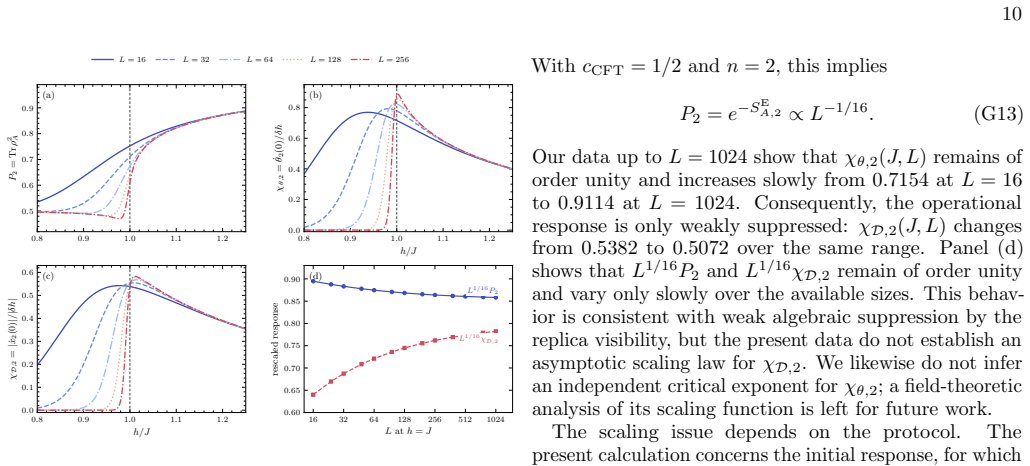
For L = 16 , 32, 64, 128, 256, its peak is located at h/J = 0.9375, 0.9800, 0.9975, 1.0025, 1.0025, respectively. The maximum of the directly measurable susceptibility is also drawn toward the critical region, with locations 0.9775, 1.0075, 1.0150, 1.0125, 1.0100. The two maxima need not coincide at finite size: χθ,2 measures phase production, whereasχ D,...
-
[3]
R´ enyi, inProceedings of the Fourth Berkeley Sympo- sium on Mathematical Statistics and Probability, Vol
A. R´ enyi, inProceedings of the Fourth Berkeley Sympo- sium on Mathematical Statistics and Probability, Vol. 1 (University of California Press, Berkeley, 1961) pp. 547– 561
1961
-
[4]
Entanglement Entropy and Quantum Field Theory
P. Calabrese and J. Cardy, J. Stat. Mech.2004, P06002 (2004), arXiv:hep-th/0405152
work page internal anchor Pith review Pith/arXiv arXiv 2004
-
[5]
A. K. Ekert, C. M. Alves, D. K. L. Oi, M. Horodecki, P. Horodecki, and L. C. Kwek, Phys. Rev. Lett.88, 217901 (2002), arXiv:quant-ph/0203016
work page internal anchor Pith review Pith/arXiv arXiv 2002
-
[6]
D. A. Abanin and E. Demler, Phys. Rev. Lett.109, 020504 (2012), arXiv:1204.2819
work page internal anchor Pith review Pith/arXiv arXiv 2012
-
[7]
A. J. Daley, H. Pichler, J. Schachenmayer, and P. Zoller, Phys. Rev. Lett.109, 020505 (2012), arXiv:1205.1521
work page internal anchor Pith review Pith/arXiv arXiv 2012
- [8]
- [9]
-
[10]
A. Mollabashi, N. Shiba, T. Takayanagi, K. Tamaoka, and Z. Wei, Phys. Rev. Lett.126, 081601 (2021), arXiv:2011.09648
-
[11]
A. Mollabashi, N. Shiba, T. Takayanagi, K. Tamaoka, and Z. Wei, Phys. Rev. Research3, 033254 (2021), arXiv:2106.03118
- [12]
-
[13]
T. Nishioka, T. Takayanagi, and Y. Taki, JHEP09, 015 (2021), arXiv:2107.01797 [hep-th]
- [14]
-
[15]
Mukherjee,Pseudo Entropy in U(1) gauge theory,JHEP10(2022) 016 [2205.08179]
J. Mukherjee, JHEP10, 016 (2022), arXiv:2205.08179 [hep-th]
- [16]
-
[17]
Y. Ishiyama, R. Kojima, S. Matsui, and K. Tamaoka, PTEP2022, 093B10 (2022), arXiv:2206.14551 [hep-th]
-
[18]
Narayan,de Sitter space, extremal surfaces, and time entanglement,Phys
K. Narayan, Phys. Rev. D107, 126004 (2023), arXiv:2210.12963 [hep-th]. 11
-
[19]
K. Narayan and H. K. Saini, Eur. Phys. J. C84, 499 (2024), arXiv:2303.01307 [hep-th]
-
[20]
Narayan,Further remarks on de Sitter space, extremal surfaces, and time entanglement, Phys
K. Narayan, Phys. Rev. D109, 086009 (2024), arXiv:2310.00320 [hep-th]
- [21]
-
[22]
Narayan, (2026), arXiv:2604.00108 [hep-th]
K. Narayan, (2026), arXiv:2604.00108 [hep-th]
- [23]
- [24]
- [25]
- [26]
-
[27]
J. Xu and W.-Z. Guo, J. High Energy Phys.2025, 094 (2025), arXiv:2410.22684
- [28]
-
[29]
Real-time pseudo entropy and modular-Hamiltonian correlations
T. Misumi, arXiv:2606.14208 (2026)
work page internal anchor Pith review Pith/arXiv arXiv 2026
-
[30]
Aharonov, D
Y. Aharonov, D. Z. Albert, and L. Vaidman, Phys. Rev. Lett.60, 1351 (1988)
1988
- [31]
-
[32]
H. Kwon and M. S. Kim, Phys. Rev. X9, 031029 (2019), arXiv:1810.03150
- [33]
-
[34]
A. S. Holevo, J. Multivariate Anal.3, 337 (1973)
1973
-
[35]
C. W. Helstrom,Quantum Detection and Estimation The- ory(Academic Press, New York, 1976)
1976
-
[36]
Pfeuty, Ann
P. Pfeuty, Ann. Phys. (N.Y.)57, 79 (1970)
1970
-
[37]
Calculation of reduced density matrices from correlation functions
I. Peschel, J. Phys. A: Math. Gen.36, L205 (2003), arXiv:cond-mat/0212631
work page internal anchor Pith review Pith/arXiv arXiv 2003
-
[38]
Reduced density matrices and entanglement entropy in free lattice models
I. Peschel and V. Eisler, J. Phys. A: Math. Theor.42, 504003 (2009), arXiv:0906.1663
work page internal anchor Pith review Pith/arXiv arXiv 2009
-
[39]
F. Igl´ oi and Y.-C. Lin, J. Stat. Mech.2008, P06004 (2008), arXiv:0803.3610
work page internal anchor Pith review Pith/arXiv arXiv 2008
-
[40]
Umegaki, Kodai Math
H. Umegaki, Kodai Math. Sem. Rep.14, 59 (1962)
1962
-
[41]
Hiai and D
F. Hiai and D. Petz, Commun. Math. Phys.143, 99 (1991)
1991
-
[42]
Strong Converse and Stein's Lemma in the Quantum Hypothesis Testing
T. Ogawa and H. Nagaoka, IEEE Trans. Inf. Theory46, 2428 (2000), arXiv:quant-ph/9906090
work page internal anchor Pith review Pith/arXiv arXiv 2000
-
[43]
Lindblad, Commun
G. Lindblad, Commun. Math. Phys.40, 147 (1975)
1975
-
[44]
Uhlmann, Commun
A. Uhlmann, Commun. Math. Phys.54, 21 (1977)
1977
-
[45]
Petz, Commun
D. Petz, Commun. Math. Phys.105, 123 (1986)
1986
-
[46]
M. Heyl, A. Polkovnikov, and S. Kehrein, Phys. Rev. Lett.110, 135704 (2013), arXiv:1206.2505
work page internal anchor Pith review Pith/arXiv arXiv 2013
-
[47]
Dynamical quantum phase transitions: a review
M. Heyl, Rep. Prog. Phys.81, 054001 (2018), arXiv:1709.07461
work page internal anchor Pith review Pith/arXiv arXiv 2018
-
[48]
Kullback and R
S. Kullback and R. A. Leibler, Ann. Math. Stat.22, 79 (1951)
1951
-
[49]
A. A. Fedotov, P. Harremo¨ es, and F. Topsøe, IEEE Trans. Inf. Theory49, 1491 (2003)
2003
-
[50]
E. H. Lieb and D. W. Robinson, Commun. Math. Phys. 28, 251 (1972)
1972
discussion (0)
Sign in with ORCID, Apple, or X to comment. Anyone can read and Pith papers without signing in.