Multiphysical impedance spectroscopy of porous electrodes based on linear irreversible thermodynamics
Pith reviewed 2026-06-30 02:48 UTC · model grok-4.3
The pith
A harmonic current applied to a porous electrode produces measurable stack stress whose spectrum encodes the electro-chemo-mechanical coupling coefficients and their relaxation times.
A machine-rendered reading of the paper's core claim, the machinery that carries it, and where it could break.
Core claim
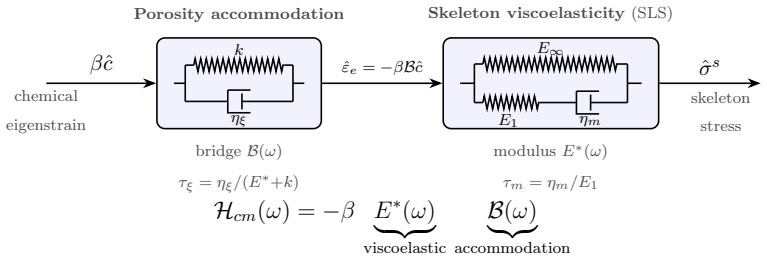
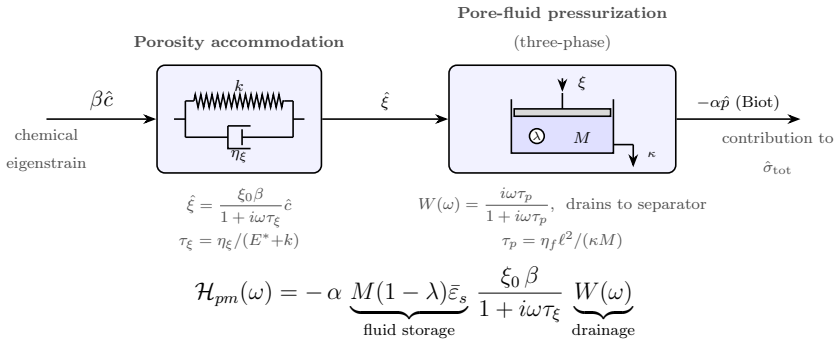
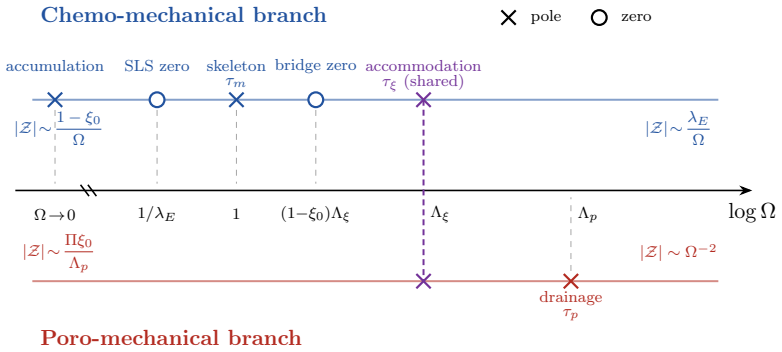
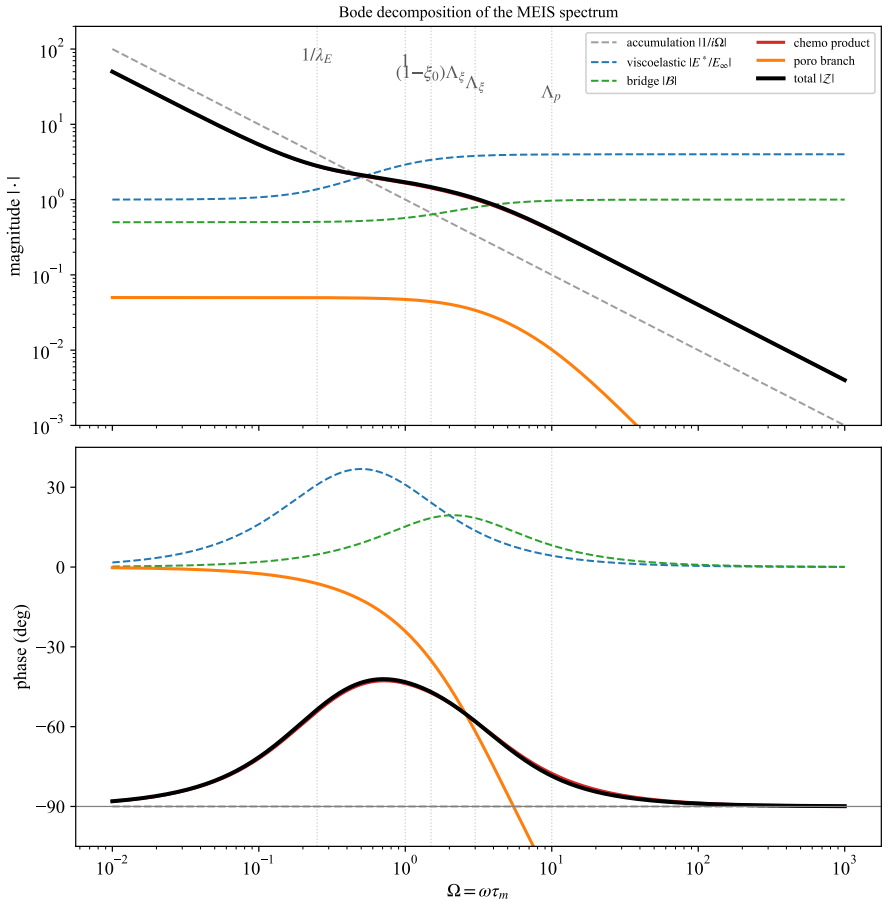
Starting from linear irreversible thermodynamics, a general theory of multiphysical impedance spectroscopy is formulated in which perturbing one field and measuring the conjugate response of another probes an off-diagonal entry of the constitutive matrix, recovering the static coupling coefficient and resolving its relaxation dynamics across frequency. Specializing to the electro-chemo-mechanical pathway yields a closed-form theory of mechano-electrochemical impedance spectroscopy (MEIS), in which a small harmonic current is applied and the stack stress is measured; the impedance factorizes into a chemical-accumulation term multiplying the sum of a chemo-mechanical and a poro-mechanical kern
What carries the argument
The MEIS impedance, which factorizes as a chemical-accumulation term times the sum of chemo-mechanical and poro-mechanical kernels, closed by a porosity-accommodation bridge obtained from a microstructural Helmholtz free energy with three-phase interpolation.
If this is right
- MEIS recovers both the static electro-chemo-mechanical coupling coefficient and the frequency dependence of its relaxation.
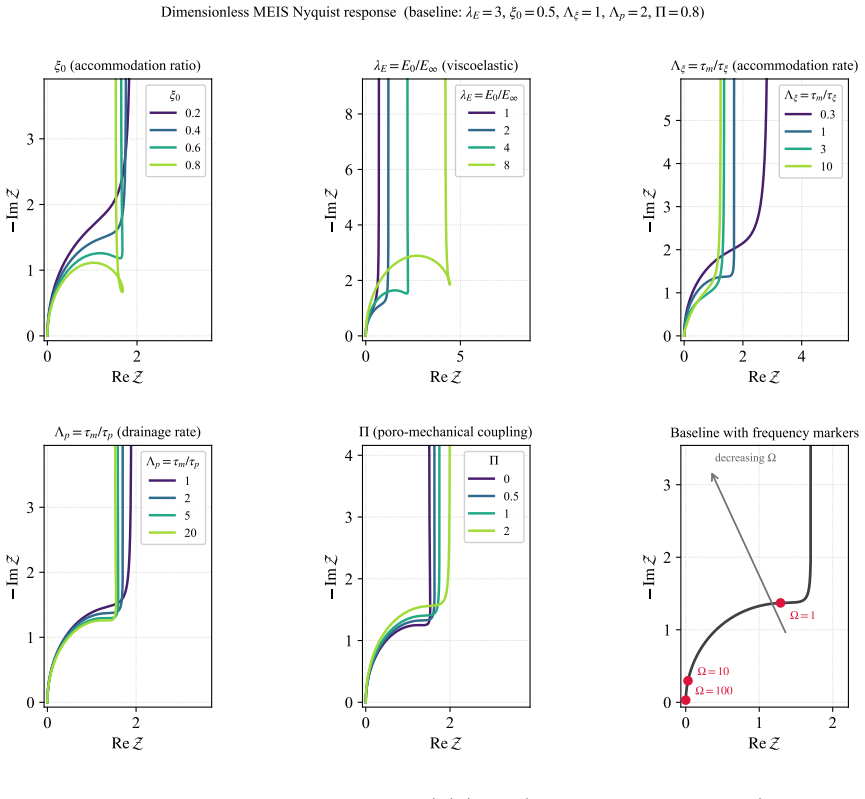
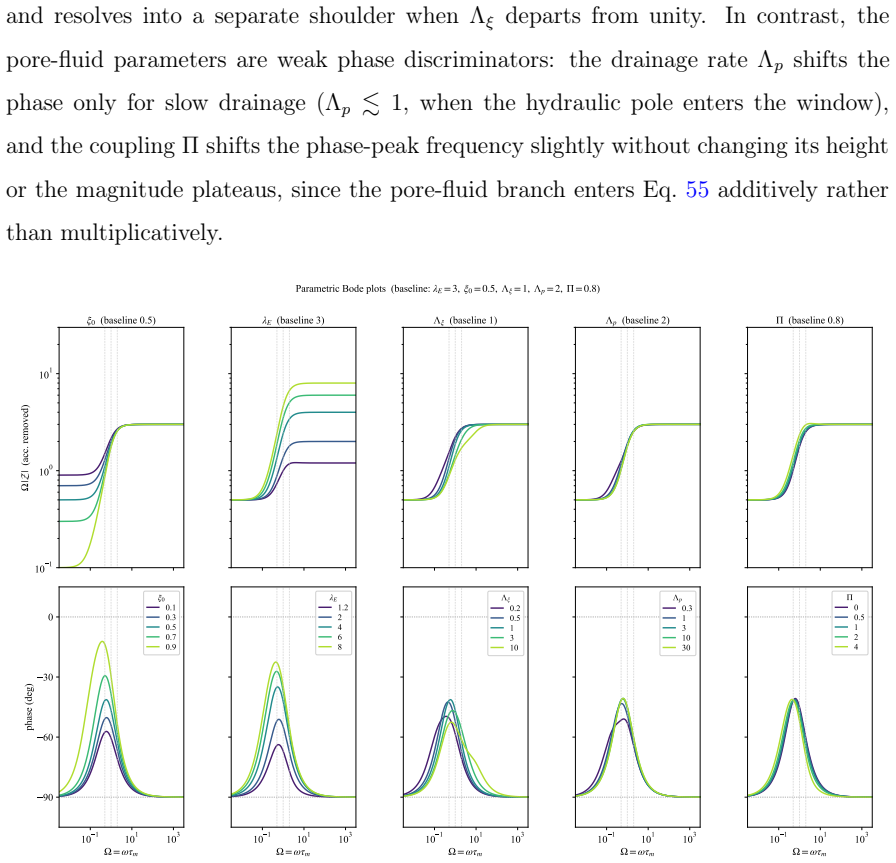
- The spectrum reduces to five dimensionless groups whose phase angle discriminates the chemo-mechanical parameters.
- Second-quadrant impedance appears in a full cell when one electrode expands while the other contracts.
- The same thermodynamic starting point generates an entire family of cross-coupled spectroscopies by choosing different field pairs.
- The three-phase porosity closure supplies a continuous description between dry and fully saturated states without separate models.
Where Pith is reading between the lines
- The same factorization structure could be tested experimentally on other porous systems such as fuel-cell electrodes or geological formations under cyclic loading.
- Because the kernels separate chemo-mechanical from poro-mechanical contributions, MEIS data might allow independent calibration of each mechanism in battery degradation models.
- The continuous three-phase interpolation suggests that partial saturation states inside operating cells can be treated without switching between distinct constitutive laws.
- If the microstructural Helmholtz free energy can be computed from imaging data, the theory supplies a route to predict impedance spectra from electrode microstructure alone.
Load-bearing premise
The porosity-accommodation bridge function is obtained directly from a Helmholtz free energy constructed from microstructural stiffness and viscosity together with a three-phase closure that interpolates between unsaturated and saturated limits.
What would settle it
Apply a small harmonic current to a porous-electrode stack, record the resulting stress amplitude and phase over a wide frequency range, and test whether the spectrum collapses onto the predicted five-group form with a phase angle that isolates the chemo-mechanical parameters and exhibits second-quadrant behavior only when opposing electrodes expand and contract.
Figures




read the original abstract
Porous electrodes couple electrical, chemical, mechanical, hydraulic, and thermal fields, yet conventional frequency-domain diagnostics interrogate only one of them: electrochemical impedance spectroscopy (EIS) the electrical response and dynamic mechanical analysis (DMA) the mechanical. Each reads a diagonal entry of the multiphysical constitutive matrix and is blind to the cross-couplings that govern structural evolution and degradation. Starting from linear irreversible thermodynamics, we formulate a general theory of multiphysical impedance spectroscopy, in which perturbing one field and measuring the conjugate response of another probes an off-diagonal entry of the constitutive matrix, recovering the static coupling coefficient and resolving its relaxation dynamics across frequency. Specializing to the electro-chemo-mechanical pathway yields a closed-form theory of mechano-electrochemical impedance spectroscopy (MEIS), in which a small harmonic current is applied and the stack stress is measured; the impedance factorizes into a chemical-accumulation term multiplying the sum of a chemo-mechanical and a poro-mechanical kernel. The porosity-accommodation bridge function is derived from a Helmholtz free energy -- following from a microstructural stiffness and viscosity rather than a fitted form -- and a three-phase (solid-fluid-void) closure interpolates continuously between unsaturated and Biot-saturated limits through a void-accommodation fraction. Non-dimensionalization reduces the spectrum to five groups, identifies the phase angle as the discriminator of the chemo-mechanical parameters, and locates the onset of second-quadrant behavior, which in a full cell arises from the competition between an expanding and a contracting electrode. MEIS emerges as one member of a family of cross-coupled spectroscopies the same framework brings within reach.
Editorial analysis
A structured set of objections, weighed in public.
Referee Report
Summary. The manuscript develops a general theory of multiphysical impedance spectroscopy for porous electrodes from linear irreversible thermodynamics. Perturbing one field and measuring the conjugate response of another is used to probe off-diagonal entries of the constitutive matrix. Specializing to the electro-chemo-mechanical pathway produces a closed-form theory of mechano-electrochemical impedance spectroscopy (MEIS) in which a small harmonic current is applied and stack stress is measured; the impedance factorizes into a chemical-accumulation term multiplying the sum of a chemo-mechanical and a poro-mechanical kernel. The porosity-accommodation bridge function is derived from a Helmholtz free energy based on microstructural stiffness and viscosity (rather than fitted), and a three-phase (solid-fluid-void) closure interpolates continuously between unsaturated and Biot-saturated limits via a void-accommodation fraction. Non-dimensionalization reduces the spectrum to five groups, identifies the phase angle as the discriminator of chemo-mechanical parameters, and locates the onset of second-quadrant behavior arising from competition between expanding and contracting electrodes in a full cell.
Significance. If the derivations hold, the work is significant for supplying an exact, parameter-free factorization of the MEIS impedance together with a thermodynamically derived three-phase bridge function that respects Onsager symmetry and positivity of dissipation. This framework unifies diagonal spectroscopies (EIS, DMA) with cross-coupled ones and supplies falsifiable predictions for the phase angle and second-quadrant onset, which could be tested directly in porous-electrode experiments. The absence of free parameters and the continuous interpolation between limits are clear strengths.
minor comments (2)
- [Abstract] Abstract: the five non-dimensional groups are referenced but not enumerated; listing them explicitly would allow immediate assessment of the reduction without consulting the main text.
- [Abstract] Abstract: the void-accommodation fraction is introduced without a defining relation; a one-line expression would clarify how the three-phase closure is constructed.
Simulated Author's Rebuttal
We thank the referee for their positive assessment of the manuscript, the clear summary of its contributions, and the recommendation to accept. No major comments were raised in the report.
Circularity Check
No significant circularity identified
full rationale
The derivation begins from linear irreversible thermodynamics and constructs the porosity-accommodation bridge function from a Helmholtz free energy determined by microstructural stiffness and viscosity, with the MEIS impedance factorization presented as a direct consequence of specializing the general multiphysical framework to the electro-chemo-mechanical pathway. No equations reduce a claimed prediction to a fitted input by construction, no load-bearing uniqueness theorems are imported via self-citation, and the three-phase closure is derived rather than assumed or renamed from prior empirical patterns. The paper is therefore self-contained against its stated first-principles starting point.
Axiom & Free-Parameter Ledger
axioms (1)
- domain assumption Linear irreversible thermodynamics governs the multiphysical response of porous electrodes
Reference graph
Works this paper leans on
-
[1]
Accounts of Chemical Research 46, 1144–1160
Theory of Chemical Kinetics and Charge Transfer based on Nonequilibrium Thermodynamics. Accounts of Chemical Research 46, 1144–1160. URL:https://pubs.acs.org/doi/10.1021/ar300145c, doi:10.1021/ar300145c. Bazant, M.Z.,
-
[2]
Faraday Discussions 199, 423–463
Thermodynamic stability of driven open systems and control of phase separation by electro-autocatalysis. Faraday Discussions 199, 423–463. URL: http://xlink.rsc.org/?DOI=C7FD00037E, doi:10.1039/C7FD00037E. Biot, M.A.,
-
[3]
Journal of Applied Physics12(2), 155–164 (1941) https://doi.org/10.1063/1.1712886
General theory of three-dimensional consolidation. Journal of Applied Physics 12, 155–164. doi:10.1063/1.1712886. Chen, Z., Danilov, D.L., Eichel, R., Notten, P.H.L.,
-
[4]
Advanced Energy Materials 12, 2201506
Porous Electrode Modeling and its Applications to Li-Ion Batteries. Advanced Energy Materials 12, 2201506. URL:https://advanced.onlinelibrary.wiley.com/doi/10.1002/ aenm.202201506, doi:10.1002/aenm.202201506. Chester, S.A., Di Leo, C.V., Anand, L.,
-
[5]
International Journal of Solids and Structures 52, 1–18
A finite element implementation of a cou- pled diffusion-deformation theory for elastomeric gels. International Journal of Solids and Structures 52, 1–18. URL:https://linkinghub.elsevier.com/retrieve/ pii/S0020768314003278, doi:10.1016/j.ijsolstr.2014.08.015. Coussy, O.,
-
[6]
Journal of the Mechanics and Physics of Solids 70, 1–29
A Cahn–Hilliard-type phase-field the- ory for species diffusion coupled with large elastic deformations: Application to phase-separating Li-ion electrode materials. Journal of the Mechanics and Physics of Solids 70, 1–29. URL:https://linkinghub.elsevier.com/retrieve/pii/ S0022509614000842, doi:10.1016/j.jmps.2014.05.001. 60 Doyle, M., Fuller, T.F., Newman, J.,
-
[7]
Journal of The Electrochemical Society 140, 1526–1533
Modeling of Galvanostatic Charge and Discharge of the Lithium/Polymer/Insertion Cell. Journal of The Electrochemical Society 140, 1526–1533. URL:https://iopscience.iop.org/article/10.1149/ 1.2221597, doi:10.1149/1.2221597. Fang, R., Jiao, J., Li, W., Ihuaenyi, R.C., Bazant, M.Z., Zhu, J.,
-
[8]
URL:https://www.cell.com/joule/abstract/S2542-4351(25) 00358-7, doi:10.1016/j.joule.2025.102177. Ferry, J.D., Myers, H.S.,
-
[9]
Journal of Applied Mechanics 50, 1010–1020
Continuum thermodynamics. Journal of Applied Mechanics 50, 1010–1020. doi:10.1115/1.3167184. de Groot, S.R., Mazur, P.,
-
[10]
Journal of The Electrochemical Society 167, 166503
Review—Impedance Response of Porous Electrodes: Theoretical Framework, Physical Models and Applications. Journal of The Electrochemical Society 167, 166503. URL:https://iopscience.iop.org/article/10.1149/1945-7111/ abc655, doi:10.1149/1945-7111/abc655. Ipers, G., Jiao, J., Pathak, S., Fang, R., Berliner, M.D., Li, W., Li, W., Braatz, R.D., Bazant, M.Z., Zhu, J.,
-
[11]
Journal of The Elec- trochemical Society 171, 050557
Rapid Simulation of Electro-Chemo-Mechanical Defor- mation of Li-ion Batteries Based On Porous Electrode Theory. Journal of The Elec- trochemical Society 171, 050557. URL:https://iopscience.iop.org/article/ 10.1149/1945-7111/ad4f1e, doi:10.1149/1945-7111/ad4f1e. Jiao, J., Kim, E., Li, W., Xu, Z., Ihuaenyi, R.C., Fang, R., Kim, T., Shin, S., Li, X., Li, W....
-
[12]
Journal of Power Sources 662, 238736
Modeling the powder plasticity of porous electrodes 61 for the prediction of battery breathing and swelling prior to degradation. Journal of Power Sources 662, 238736. URL:https://linkinghub.elsevier.com/retrieve/ pii/S0378775325025728, doi:10.1016/j.jpowsour.2025.238736. Kholkin, A.L., Pertsev, N.A., Goltsev, A.V.,
-
[13]
(Eds.), Piezoelectric and Acous- tic Materials for Transducer Applications
Piezoelectricity and Crys- tal Symmetry, in: Safari, A., Akdoğan, E.K. (Eds.), Piezoelectric and Acous- tic Materials for Transducer Applications. Springer US, Boston, MA, pp. 17–38. URL:http://link.springer.com/10.1007/978-0-387-76540-2_2, doi:10.1007/ 978-0-387-76540-2_2. Klinsmann, M., Hildebrand, F.E., Ganser, M., McMeeking, R.M.,
-
[14]
Journal of Power Sources 442, 227226
Den- dritic cracking in solid electrolytes driven by lithium insertion. Journal of Power Sources 442, 227226. URL:https://linkinghub.elsevier.com/retrieve/pii/ S0378775319312194, doi:10.1016/j.jpowsour.2019.227226. Lai, J., Nsabimana, A., Luque, R., Xu, G.,
-
[15]
Joule 2, 76–93
3D Porous Carbona- ceous Electrodes for Electrocatalytic Applications. Joule 2, 76–93. URL: https://linkinghub.elsevier.com/retrieve/pii/S2542435117301290, doi:10. 1016/j.joule.2017.10.005. Lian, H., Bazant, M.Z.,
2017
-
[16]
Journal of The Electrochemical Society 171, 010526
ModelingLithiumPlatingOnsetonPorousGraphiteElec- trodes Under Fast Charging with Hierarchical Multiphase Porous Electrode Theory. Journal of The Electrochemical Society 171, 010526. URL:https://iopscience. iop.org/article/10.1149/1945-7111/ad1e3d, doi:10.1149/1945-7111/ad1e3d. Menard, K.P., Menard, N.,
-
[17]
Porous-electrode theory with battery applica- tions. AIChE Journal 21, 25–41. URL:https://onlinelibrary.wiley.com/doi/ 10.1002/aic.690210103, doi:10.1002/aic.690210103. Onsager, L., 1931a. Reciprocal Relations in Irreversible Processes. I. Physical Review 37, 405–426. URL:https://link.aps.org/doi/10.1103/PhysRev.37.405, doi:10. 1103/PhysRev.37.405. 62 Ons...
-
[18]
Induced giant piezoelectricity in centrosymmet- ric oxides. Science 375, 653–657. URL:https://www.science.org/doi/10.1126/ science.abm7497, doi:10.1126/science.abm7497. Prigogine, I., Rysselberghe, P.V.,
-
[19]
Journal of The Electrochemical Society 110, 97C
Introduction to Thermodynamics of Irre- versible Processes. Journal of The Electrochemical Society 110, 97C. URL:https: //iopscience.iop.org/article/10.1149/1.2425756, doi:10.1149/1.2425756. Qu, Y., Campbell, P.G., Hemmatifar, A., Knipe, J.M., Loeb, C.K., Reidy, J.J., Hubert, M.A., Stadermann, M., Santiago, J.G.,
-
[20]
The Journal of Physical Chemistry B 122, 240–249
Charging and Transport Dynamics of a Flow-Through Electrode Capacitive Deionization System. The Journal of Physical Chemistry B 122, 240–249. URL:https://pubs.acs.org/doi/10.1021/acs.jpcb. 7b09168, doi:10.1021/acs.jpcb.7b09168. Smith, R.B., Bazant, M.Z.,
-
[21]
Journal of The Electrochemical Society 164, E3291–E3310
Multiphase Porous Electrode Theory. Journal of The Electrochemical Society 164, E3291–E3310. URL:http://arxiv.org/abs/1702. 08432, doi:10.1149/2.0171711jes. Song, J., Ihuaenyi, R.C., Lim, J., Wang, Z., Li, W., Fang, R., Ghamsari, A.K., Xu, H., Lee, Y.M., Zhu, J.,
-
[22]
A microstructural electrochemo-mechanical model of high- nickel composite electrodes towards digital twins to bridge the particle and electrode- levelcharacterizations. Energy&EnvironmentalScience, 10.1039.D4EE04856CURL: https://xlink.rsc.org/?DOI=D4EE04856C, doi:10.1039/D4EE04856C. Wang, H.,
-
[23]
Princeton Series in Geophysics, Princeton University Press, Princeton, NJ
TheoryofLinearPoroelasticitywithApplicationstoGeomechanicsand Hydrogeology. Princeton Series in Geophysics, Princeton University Press, Princeton, NJ. doi:10.1515/9781400885688. Wang, S., Zhang, J., Gharbi, O., Vivier, V., Gao, M., Orazem, M.E.,
-
[24]
Advanced Energy Materials 11, 2003908
Guiding the Design of Heterogeneous Electrode Microstructures for Li-Ion Batteries: Microscopic Imaging, Predictive Modeling, and Machine Learning. Advanced Energy Materials 11, 2003908. URL:https: //onlinelibrary.wiley.com/doi/10.1002/aenm.202003908, doi:10.1002/aenm. 202003908. Zhao, C.X., Wang, Z., Jacobson, D., Li, Y., Khaykovich, B., Fayfar, S., Zhen...
discussion (0)
Sign in with ORCID, Apple, or X to comment. Anyone can read and Pith papers without signing in.