REVIEW 2 major objections 2 cited by
Solver-Verified Formulation Generation and Selection for Multi-Warehouse Inventory Allocation Using Large Language Models
T0 review · 2 major / 0 minor · reviewed 2026-06-30 · grok-4.3
Pith's one-line read Solver feedback lets an LLM generate and select optimization models that improve multi-warehouse inventory allocation accuracy by 4.5 points.
desk verdict ORLA combines LLM formulation generation with solver verification and learned selection for inventory allocation, but the 4.5pp gain on 29 batches rests on an unverified claim that the selector generalizes. read the letter →
The pith
A machine-rendered reading of the paper's core claim, the machinery that carries it, and where it could break.
The reading
What carries the argument
The closed-loop ORLA process of LLM-driven formulation and code generation followed by solver verification and quality-based selection among candidate models.
What would settle it
Evaluating the ORLA system on a fresh collection of production batches drawn after the study period and checking whether the reported accuracy improvement is reproduced.
Extended reading notes
Core claim
ORLA integrates automatic Problem-Model-Code generation from textual specifications, three families of mixed-integer linear programming formulations for deviation minimization, soft band compliance, and knapsack-style allocation, together with solver-verified selection and penalty-based feasibility restoration. The LLM produces executable code while the solver supplies signals for quality and feasibility; a learning component then chooses and combines promising formulations. Experiments on production data from an e-commerce platform demonstrate a 4.5 percentage-point accuracy gain.
Load-bearing premise
The 29 production batches are representative of future allocation instances and the generated formulations do not overfit to the specific accuracy measure used in those batches.
Editorial extensions
If this is right
- Individual formulation families already deliver up to 3.4 percentage points of improvement.
- The combined selection and aggregation step adds further gains and handles instance heterogeneity.
- Modular constraint extensions and penalty relaxation allow the system to accommodate scenario-specific rules and recover from infeasibility.
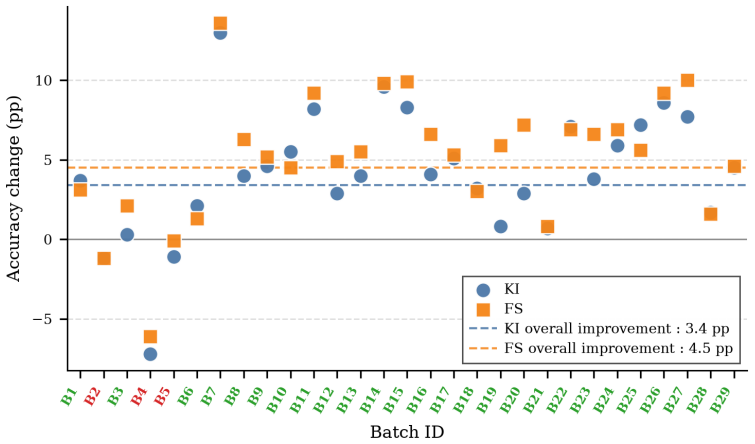
- The approach improves results on 26 of the 29 evaluation batches.
- Solver signals for executability, feasibility, and solution quality guide the entire selection process.
Reading between the lines
- The same generation-plus-verification pattern could transfer to other operations-research tasks where requirements are given in natural language.
- If the production batches capture typical demand patterns and constraint types, the accuracy gains may persist on future data.
- Retraining the formulation selector on accumulated solved instances could lower dependence on the LLM for repeated problems.
Signed reviews
Editorial analysis
A structured set of objections, weighed in public.
Referee Report
Summary. The manuscript proposes the ORLA framework, which uses LLMs to generate candidate MIP formulations for multi-warehouse inventory allocation from textual specifications, verifies them via solver feedback for executability and quality, and applies a learning-based selector with score-aware aggregation to handle heterogeneity. Three formulation families (deviation minimization, soft band compliance, knapsack-inspired) are developed with MILP reformulations and penalty relaxations. On 29 production batches from JD.com, the best single formulation improves accuracy by 3.4 pp and the full ORLA framework by 4.5 pp, succeeding on 26 batches.
Significance. If the evaluation holds, the solver-verified LLM pipeline offers a practical template for generating and selecting instance-specific OR models in supply-chain settings where constraints arrive in natural language. The explicit development of three complementary formulation families and the use of solver signals for verification are concrete strengths that could transfer to other heterogeneous allocation problems.
major comments (2)
- [§5] §5 (Experimental Results): The paper reports performance on 29 production evaluation batches but supplies no information on whether these batches were held out from training or tuning of the learning-based formulation selector. This is load-bearing for the central claim that the selector 'estimates the expected quality of candidate formulations' and produces the 4.5 pp gain, because any overlap would make the reported lift an in-sample rather than out-of-sample result.
- [Abstract and §5] Abstract and §5: No details are provided on the definition of the incumbent baseline, the exact allocation accuracy metric, statistical significance testing, error bars, or how the 29 batches were sampled. These omissions directly affect the interpretability of the headline 4.5 pp improvement and the 26/29 win rate.
Simulated Author's Rebuttal
We thank the referee for the constructive feedback on the experimental evaluation. The points raised are important for strengthening the interpretability of our results, and we will revise the manuscript to address them directly.
read point-by-point responses
-
Referee: [§5] §5 (Experimental Results): The paper reports performance on 29 production evaluation batches but supplies no information on whether these batches were held out from training or tuning of the learning-based formulation selector. This is load-bearing for the central claim that the selector 'estimates the expected quality of candidate formulations' and produces the 4.5 pp gain, because any overlap would make the reported lift an in-sample rather than out-of-sample result.
Authors: We agree that explicit confirmation of the hold-out status is necessary to support the out-of-sample claim. The 29 batches are production evaluation batches that were not used for training, validation, or hyperparameter tuning of the learning-based selector; the selector was developed on a separate collection of historical batches. In the revised manuscript we will add a clear statement in §5 describing the data separation and the selector training procedure. revision: yes
-
Referee: [Abstract and §5] Abstract and §5: No details are provided on the definition of the incumbent baseline, the exact allocation accuracy metric, statistical significance testing, error bars, or how the 29 batches were sampled. These omissions directly affect the interpretability of the headline 4.5 pp improvement and the 26/29 win rate.
Authors: We accept that these details are currently missing and will expand both the abstract and §5. The revision will define the incumbent baseline as JD.com’s existing rule-based allocation procedure, specify the allocation accuracy metric (fraction of demand satisfied subject to all constraints), report paired statistical significance tests, include error bars or standard deviations across batches where relevant, and describe the 29 batches as a random sample drawn from recent production data. revision: yes
Circularity Check
No significant circularity in derivation chain
full rationale
The paper presents an empirical framework (ORLA) whose central claims consist of measured accuracy improvements on 29 external production batches from JD.com. No equations, predictions, or selection mechanisms are shown to reduce by construction to fitted parameters or self-citations internal to the paper; the reported gains are framed as out-of-sample performance against an incumbent on held-out production data. The evaluation is therefore self-contained against external benchmarks.
Assumptions & free parameters
Cite this review
Pith. "Pith review of Solver-Verified Formulation Generation and Selection for Multi-Warehouse Inventory Allocation Using Large Language Models." pith.science (2026). https://pith.science/paper/6LDD355W
@misc{pith2026260629366,
  author       = {Pith},
  title        = {Pith review of: Solver-Verified Formulation Generation and Selection for Multi-Warehouse Inventory Allocation Using Large Language Models},
  year         = {2026},
  howpublished = {\url{https://pith.science/paper/6LDD355W}},
  note         = {Machine review of arXiv:2606.29366}
}
read the original abstract
Balance-oriented multi-warehouse inventory allocation is a recurring decision problem in large-scale e-commerce supply chains, in which a fixed replenishment quantity is distributed across warehouses to balance post-allocation inventory coverage while accounting for demand forecasts and heterogeneous allocation constraints. In practice, allocation requirements are often scenario-dependent and expressed in semi-structured or natural-language form rather than as ready-to-solve operations research (OR) formulations. We propose an OR-guided Large Language Model (LLM) for Allocation (ORLA) that uses solver feedback to generate, verify, and select OR formulations. ORLA integrates automatic "Problem-Model-Code (PMC)" generation, learning-based formulation selection, and feasibility restoration. We develop three complementary mixed-integer programming formulation families based on deviation minimization, soft band compliance, and knapsack-inspired allocation, together with solver-ready mixed-integer linear programming reformulations, modular constraint extensions, and a penalty-based relaxation mechanism for infeasible cases. The LLM component generates candidate formulations and executable solver code from textual or semi-structured specifications, while the solver provides verification signals for executability, feasibility, and solution quality. To address instance heterogeneity, ORLA estimates the expected quality of candidate formulations, selects promising candidates, and combines their outputs through score-aware aggregation. Experimental results on 29 production evaluation batches from JD.com show that the best single OR formulation improves allocation accuracy by 3.4 percentage points over the incumbent approach, while the full ORLA framework achieves a 4.5 percentage-point overall improvement and improves allocation accuracy in 26 of the 29 evaluation batches.
Figures


Figures from the paper (3 more)


Forward citations
Cited by 2 Pith papers
-
Enactive Artificial Intelligence: A Decision-Centric Architecture for Complex Systems
The paper defines a decision-centric architecture with Organizational World, Site World, Schema Intelligence, and an Enactive Decision Cycle, claiming these jointly realize system-grounded forecasting, consequence-gro...
-
Large Language Model for Operations Research Formulation Selection in Multi-Warehouse Inventory Allocation
A GRPO-trained LLM selects per-instance MIP formulations for warehouse allocation, improving Hit Ratio@1 from 21.45% to 50.42% and cutting the gap to the ex-post oracle to 4.85 pp on JD.com instances.
Reference graph
Works this paper leans on
-
[1]
Silver, David F
Edward A. Silver, David F. Pyke, and Rein Peterson. Inventory Management and Production Planning and Scheduling. Wiley, 3 edition, 1998. ISBN 978-0471119470
1998
-
[2]
Paul H. Zipkin. Foundations of Inventory Management. McGraw-Hill, 2000. ISBN 978-0256113792
2000
-
[3]
Inventory Control
Sven Axs\" a ter. Inventory Control. Springer, 3 edition, 2015. ISBN 978-3319157290
2015
-
[4]
Evaluation of stock allocation policies in a divergent inventory system with shipment consolidation
Christian Howard and Johan Marklund. Evaluation of stock allocation policies in a divergent inventory system with shipment consolidation. European Journal of Operational Research, 211 0 (2): 0 298--309, 2011. doi:https://doi.org/10.1016/j.ejor.2010.11.030
-
[5]
Designing and Managing the Supply Chain: Concepts, Strategies, and Case Studies
David Simchi-Levi, Philip Kaminsky, and Edith Simchi-Levi. Designing and Managing the Supply Chain: Concepts, Strategies, and Case Studies. McGraw-Hill, 3 edition, 2008. ISBN 978-0072357561
2008
-
[6]
NL4Opt competition: Formulating optimization problems based on their natural language descriptions
Rindranirina Ramamonjison, Timothy Yu, Raymond Li, Haley Li, Giuseppe Carenini, Bissan Ghaddar, Shiqi He, Mahdi Mostajabdaveh, Amin Banitalebi-Dehkordi, Zirui Zhou, and Yong Zhang. NL4Opt competition: Formulating optimization problems based on their natural language descriptions. In Marco Ciccone, Gustavo Stolovitzky, and Jacob Albrecht, editors, Proceedi...
2022
-
[7]
Autoformulation of mathematical optimization models using LLM s
Nicol\' a s Astorga, Tennison Liu, Yuanzhang Xiao, and Mihaela Van Der Schaar. Autoformulation of mathematical optimization models using LLM s. In Aarti Singh, Maryam Fazel, Daniel Hsu, Simon Lacoste-Julien, Felix Berkenkamp, Tegan Maharaj, Kiri Wagstaff, and Jerry Zhu, editors, Proceedings of the 42nd International Conference on Machine Learning, volume ...
2025
-
[8]
LLMOPT : Learning to define and solve general optimization problems from scratch
Caigao Jiang, Xiang Shu, Hong Qian, Xingyu Lu, Jun Zhou, Aimin Zhou, and Yang Yu. LLMOPT : Learning to define and solve general optimization problems from scratch. In The Thirteenth International Conference on Learning Representations (ICLR 2025), 2025. URL https://openreview.net/forum?id=9OMvtboTJg
2025
Show all 29 references
-
[9]
ORLM : A customizable framework in training large models for automated optimization modeling
Chenyu Huang, Zhengyang Tang, Shixi Hu, Ruoqing Jiang, Xin Zheng, Dongdong Ge, Benyou Wang, and Zizhuo Wang. ORLM : A customizable framework in training large models for automated optimization modeling. Operations Research, 73 0 (6): 0 2986--3009, 2025. doi:https://doi.org/10....
2025 doi
-
[10]
O pti MUS : Scalable optimization modeling with ( MI ) LP solvers and large language models
Ali Ahmaditeshnizi, Wenzhi Gao, and Madeleine Udell. O pti MUS : Scalable optimization modeling with ( MI ) LP solvers and large language models. In Ruslan Salakhutdinov, Zico Kolter, Katherine Heller, Adrian Weller, Nuria Oliver, Jonathan Scarlett, and Felix Berkenkamp, edito...
2024
-
[11]
Long Ouyang, Jeff Wu, Xu Jiang, Diogo Almeida, Carroll L. Wainwright, Pamela Mishkin, Chong Zhang, Sandhini Agarwal, Katarina Slama, Alex Ray, John Schulman, Jacob Hilton, Fraser Kelton, Luke Miller, Maddie Simens, Amanda Askell, Peter Welinder, Paul Christiano, Jan Leike, and...
2022
-
[12]
Training a helpful and harmless assistant with reinforcement learning from human feedback
Yuntao Bai, Andy Jones, Kamal Ndousse, Amanda Askell, Anna Chen, Nova DasSarma, Dawn Drain, Stanislav Fort, Deep Ganguli, Tom Henighan, Nicholas Joseph, Saurav Kadavath, Jackson Kernion, Tom Conerly, Sheer El-Showk, Nelson Elhage, Zac Hatfield-Dodds, Danny Hernandez, Tristan H...
-
[13]
Model alignment as prospect theoretic optimization
Kawin Ethayarajh, Winnie Xu, Niklas Muennighoff, Dan Jurafsky, and Douwe Kiela. Model alignment as prospect theoretic optimization. In Ruslan Salakhutdinov, Zico Kolter, Katherine Heller, Adrian Weller, Nuria Oliver, Jonathan Scarlett, and Felix Berkenkamp, editors, Proceeding...
2024
-
[14]
Towards foundation models for mixed integer linear programming
Sirui Li, Janardhan Kulkarni, Ishai Menache, Cathy Wu, and Beibin Li. Towards foundation models for mixed integer linear programming. In The Thirteenth International Conference on Learning Representations, 2025. URL https://openreview.net/forum?id=6yENDA7J4G
2025
-
[15]
Christiano, Jan Leike, Tom B
Paul F. Christiano, Jan Leike, Tom B. Brown, Miljan Martic, Shane Legg, and Dario Amodei. Deep reinforcement learning from human preferences. In Proceedings of the 31st International Conference on Neural Information Processing Systems (NIPS 2017), page 4302–4310, Red Hook, NY,...
2017
-
[16]
Ziegler, Nisan Stiennon, Jeffrey Wu, Tom B
Daniel M. Ziegler, Nisan Stiennon, Jeffrey Wu, Tom B. Brown, Alec Radford, Dario Amodei, Paul Christiano, and Geoffrey Irving. Fine-tuning language models from human preferences. Technical report, arxiv preprint, arxiv, 2019. doi: https://doi.org/10.48550/arXiv.1909.08593
-
[17]
Direct preference optimization: Your language model is secretly a reward model
Rafael Rafailov, Archit Sharma, Eric Mitchell, Christopher D Manning, Stefano Ermon, and Chelsea Finn. Direct preference optimization: Your language model is secretly a reward model. In A. Oh, T. Naumann, A. Globerson, K. Saenko, M. Hardt, and S. Levine, editors, Advances in N...
2023
-
[18]
A general theoretical paradigm to understand learning from human preferences
Mohammad Gheshlaghi Azar, Zhaohan Daniel Guo, Bilal Piot, Remi Munos, Mark Rowland, Michal Valko, and Daniele Calandriello. A general theoretical paradigm to understand learning from human preferences. In Sanjoy Dasgupta, Stephan Mandt, and Yingzhen Li, editors, Proceedings of...
2024
-
[19]
SimPO : Simple preference optimization with a reference-free reward
Yu Meng, Mengzhou Xia, and Danqi Chen. SimPO : Simple preference optimization with a reference-free reward. In A. Globerson, L. Mackey, D. Belgrave, A. Fan, U. Paquet, J. Tomczak, and C. Zhang, editors, Advances in Neural Information Processing Systems, volume 37, pages 124198...
2024
-
[20]
Sustainable supply chain network design: An optimization-oriented review
Majid Eskandarpour, Pierre Dejax, Joe Miemczyk, and Olivier Péton. Sustainable supply chain network design: An optimization-oriented review. Omega, 54: 0 11--32, 2015. doi:https://doi.org/10.1016/j.omega.2015.01.006
2015 doi
-
[21]
Recent exact algorithms for solving the vehicle routing problem under capacity and time window constraints
Roberto Baldacci, Aristide Mingozzi, and Roberto Roberti. Recent exact algorithms for solving the vehicle routing problem under capacity and time window constraints. European Journal of Operational Research, 218 0 (1): 0 1--6, 2012. doi:https://doi.org/10.1016/j.ejor.2011.07.037
2012 doi
-
[22]
M.T. Melo, S. Nickel, and F. Saldanha-da Gama. Facility location and supply chain management – A review. European Journal of Operational Research, 196 0 (2): 0 401--412, 2009. doi:https://doi.org/10.1016/j.ejor.2008.05.007
2009 doi
-
[23]
Airline crew scheduling: models, algorithms, and data sets
Atoosa Kasirzadeh, Mohammed Saddoune, and François Soumis. Airline crew scheduling: models, algorithms, and data sets. EURO Journal on Transportation and Logistics , 6 0 (2): 0 111--137, 2017. doi:https://doi.org/10.1007/s13676-015-0080-x
2017 doi
-
[24]
Paul Williams
H. Paul Williams. Model Building in Mathematical Programming. Wiley, 5 edition, 2013. ISBN 978-1118443330
2013
-
[25]
Knapsack Problems
Hans Kellerer, Ulrich Pferschy, and David Pisinger. Knapsack Problems. Springer, 2004. ISBN 978-3540402862
2004
-
[26]
Tsitsiklis
Dimitris Bertsimas and John N. Tsitsiklis. Introduction to Linear Optimization. Athena Scientific, 1997. ISBN 978-1886529199
1997
-
[27]
LightGBM : A highly efficient gradient boosting decision tree
Guolin Ke, Qi Meng, Thomas Finley, Taifeng Wang, Wei Chen, Weidong Ma, Qiwei Ye, and Tie-Yan Liu. LightGBM : A highly efficient gradient boosting decision tree. In I. Guyon, U. Von Luxburg, S. Bengio, H. Wallach, R. Fergus, S. Vishwanathan, and R. Garnett, editors, Advances in...
2017
-
[28]
Decoupled weight decay regularization
Ilya Loshchilov and Frank Hutter. Decoupled weight decay regularization. In International Conference on Learning Representations (ICLR 2019), 2019. URL https://openreview.net/forum?id=Bkg6RiCqY7
2019
-
[29]
Bartoldson, Bhavya Kailkhura, Avi Schwarzschild, Aniruddha Saha, Micah Goldblum, Jonas Geiping, and Tom Goldstein
Neel Jain, Ping yeh Chiang, Yuxin Wen, John Kirchenbauer, Hong-Min Chu, Gowthami Somepalli, Brian R. Bartoldson, Bhavya Kailkhura, Avi Schwarzschild, Aniruddha Saha, Micah Goldblum, Jonas Geiping, and Tom Goldstein. NEFT une: Noisy embeddings improve instruction finetuning. In...
2024
Reviewed June 30, 2026 · model on record in the stance chip above.
Discussion (0). Continue with ORCID to comment.