Constraints on Hadronic Emission from Microquasars Detected by LHAASO
Pith reviewed 2026-06-30 05:37 UTC · model grok-4.3
The pith
Hadronic interactions cannot explain the full ultra-high-energy gamma-ray emission detected by LHAASO from any of the six microquasars.
A machine-rendered reading of the paper's core claim, the machinery that carries it, and where it could break.
Core claim
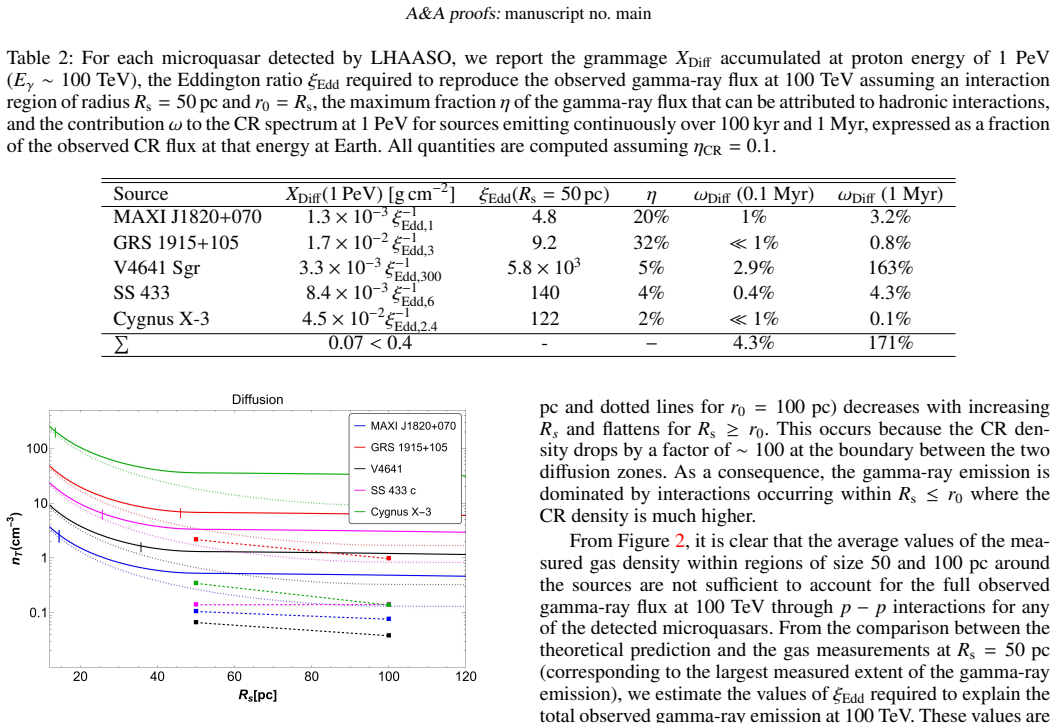
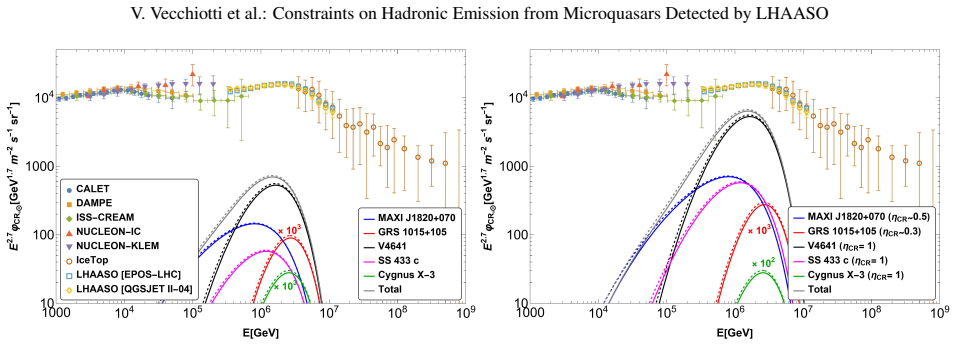
Microquasars detected by LHAASO at ultra-high energies cannot have their gamma-ray emission fully explained by hadronic interactions alone. Using a diffusion-dominated propagation model with suppressed diffusion near the source and continuous injection over 0.1-1 Myr, the calculated hadronic gamma-ray flux is insufficient to match observations for any source. The contribution of these sources to the Galactic cosmic-ray spectrum at 1 PeV is limited to approximately 4% for standard parameters, or up to 37% when using the maximum acceleration efficiency permitted by the gamma-ray data.
What carries the argument
Diffusion-dominated cosmic-ray propagation with a spatially varying diffusion coefficient (suppressed near the source) together with measured gas densities and continuous injection over 0.1-1 Myr, used to compute expected hadronic gamma-ray yields and the resulting contribution to the PeV cosmic-ray spectrum.
If this is right
- Hadronic emission alone is insufficient to account for the observed ultra-high-energy gamma rays in all six detected sources.
- The detected microquasars contribute at most 4 percent to the Galactic cosmic-ray spectrum at 1 PeV under 10 percent efficiency and 0.1 Myr injection.
- Raising acceleration efficiency to the gamma-ray upper limit raises the contribution to 37 percent.
- Injection lasting 1 Myr would exceed existing cosmic-ray observational bounds.
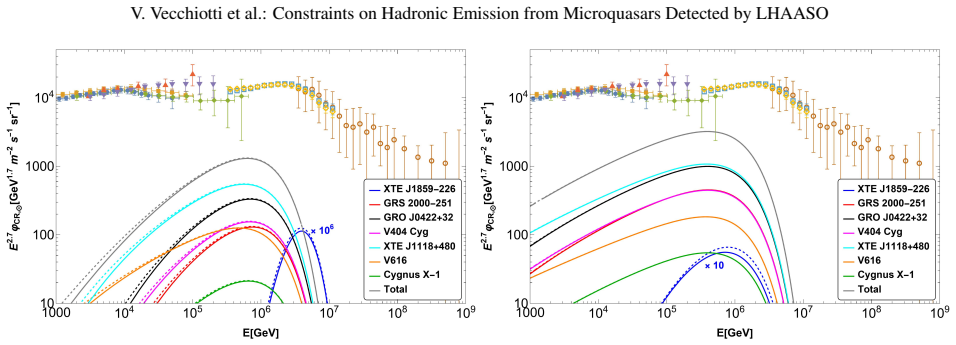
- Non-detected sources are limited to a maximum 17 percent contribution under the longest injection time considered.
Where Pith is reading between the lines
- If leptonic processes dominate the gamma-ray output, coordinated radio and X-ray monitoring could reveal synchrotron or inverse-Compton components that distinguish them from hadronic emission.
- The required suppression of diffusion near the sources points to local magnetic structures whose effect could be tested with targeted particle-transport simulations.
- Applying the same modeling framework to other candidate Galactic PeVatrons would tighten the overall budget of cosmic rays at the knee.
Load-bearing premise
Cosmic rays spread outward mainly by diffusion whose coefficient is lower close to the microquasar than the average Galactic value, and the surrounding gas densities are taken from published maps.
What would settle it
A measurement showing that the actual gas density within a few parsecs of any detected microquasar is high enough, or that the local diffusion coefficient is low enough, for hadronic emission at 10 percent efficiency to reproduce the full LHAASO flux would falsify the conclusion that hadronic processes fall short.
Figures



read the original abstract
Recently, the LHAASO collaboration reported ultra-high-energy (UHE) gamma rays from six microquasars. For five of these sources, the emission extends beyond $100$ TeV, making microquasars promising candidates for Galactic PeVatrons. We investigate whether gamma-rays around $100$ TeV originate from hadronic interactions of accelerated cosmic rays (CRs) with the ambient medium, and we estimate the contribution of these sources to the measured CR spectrum around the knee. We also place upper limits on six LHAASO microquasars with no detected UHE emission. We assume diffusion-dominated propagation of CR, with a diffusion coefficient suppressed compared to the average Galactic value near the source and equal to the Galactic value at large distances. We assume continuous injection over timescales of $t_{\rm age}=0.1-1$ Myrs. Using available measurements of the gas density, we find that hadronic interactions alone cannot fully account for the observed emission for any of the detected sources. However, in the case of GRS 1915+105 and MAXI J1820+070, the hadronic scenario may still be valid when considering acceleration efficiency higher than $10\%$. We then derive upper limits on the hadronic contribution to the observed gamma-ray flux. We estimate that the detected sources contribute at most $\sim4\%$ of the Galactic CR spectrum at $1$ PeV for an injection timescales of $0.1$ Myrs and a CR acceleration efficiency of $10 \%$. When adopting the maximum acceleration efficiency allowed by the gamma-ray observations the contribution rises to $37\%$. Longer injection timescales ($\sim 1$ Myrs) lead to contributions exceeding the observational constraints. For sources not detected at UHE, we obtained a maximum contribution of $\sim 17\%$, achieved assuming continuous injection over $1$ Myr.
Editorial analysis
A structured set of objections, weighed in public.
Referee Report
Summary. The paper claims that hadronic interactions of cosmic rays from six LHAASO-detected microquasars cannot fully account for the observed UHE gamma-ray emission when using published gas-density measurements and a diffusion-dominated propagation model (diffusion coefficient suppressed near the source, Galactic value at large distances, continuous injection over 0.1–1 Myr). For GRS 1915+105 and MAXI J1820+070 the hadronic scenario remains possible at efficiencies >10%. The detected sources contribute at most ~4% to the Galactic CR spectrum at 1 PeV (0.1 Myr, 10% efficiency), rising to 37% at the maximum efficiency allowed by the gamma-ray data; longer injection times exceed constraints. Upper limits are also derived for six non-detected sources (max ~17% at 1 Myr).
Significance. If the modeling assumptions hold, the work supplies quantitative upper limits on the hadronic contribution of microquasars to the PeV CR knee, indicating they are sub-dominant and favoring leptonic channels for the LHAASO fluxes. Credit is due for anchoring the calculation to independent published gas-density data rather than fitting to the gamma-ray fluxes themselves and for producing explicit percentage contributions under stated parameter choices.
major comments (2)
- [§3] §3 (propagation and interaction modeling): the central claim that hadronic emission 'cannot fully account' for any detected source rests on the adopted n_gas values without reported uncertainties or alternative maps; because the gamma-ray yield scales linearly with n_gas, an underestimate by a factor of ~2 would allow 10% efficiency to match the fluxes, directly affecting the 'cannot fully account' statement.
- [Results section] Results section on CR spectrum contribution: the quoted 4% and 37% figures are presented without propagated uncertainties on the diffusion suppression factor or explicit sensitivity tests to the position-dependent D(r); the abstract itself notes the absence of error bars and explicit D values, which is load-bearing for the quantitative upper-limit claim.
minor comments (2)
- [Abstract] Abstract: include at least the range of diffusion coefficients and the specific gas-density references used so that the numerical claims can be assessed without the full methods section.
- Notation: the injection timescale is written both as t_age and t_inj in different paragraphs; standardize to a single symbol.
Simulated Author's Rebuttal
We thank the referee for their thoughtful comments and for acknowledging the significance of our work in providing quantitative upper limits on the hadronic contribution of microquasars to the PeV cosmic-ray spectrum. We address each major comment below.
read point-by-point responses
-
Referee: [§3] §3 (propagation and interaction modeling): the central claim that hadronic emission 'cannot fully account' for any detected source rests on the adopted n_gas values without reported uncertainties or alternative maps; because the gamma-ray yield scales linearly with n_gas, an underestimate by a factor of ~2 would allow 10% efficiency to match the fluxes, directly affecting the 'cannot fully account' statement.
Authors: We agree that the adopted gas density values are central to our conclusions and that their uncertainties should be addressed. The densities are taken from published measurements as cited in the manuscript. We will revise §3 to include the reported uncertainties from those references where available and add a sensitivity analysis showing the impact of varying n_gas by factors of 2 on the required efficiencies and the 'cannot fully account' statement. This will make the dependence explicit without altering the baseline results. revision: yes
-
Referee: [Results section] Results section on CR spectrum contribution: the quoted 4% and 37% figures are presented without propagated uncertainties on the diffusion suppression factor or explicit sensitivity tests to the position-dependent D(r); the abstract itself notes the absence of error bars and explicit D values, which is load-bearing for the quantitative upper-limit claim.
Authors: We acknowledge that the quantitative upper limits would be strengthened by explicit sensitivity tests. The diffusion model parameters are fixed as described in §3 (suppressed D near the source transitioning to Galactic value). We will add a new subsection or appendix with sensitivity tests varying the suppression factor (e.g., by factors of 2-10) and the transition radius, reporting the resulting range in CR contribution percentages. This addresses the lack of propagated uncertainties while maintaining the baseline values under our stated assumptions. revision: yes
Circularity Check
No significant circularity; derivation uses independent external inputs
full rationale
The paper's central results rest on comparing hadronic gamma-ray yields (linear in independently measured n_gas) against LHAASO fluxes, then scaling the implied CR injection to the Galactic spectrum. Gas densities are taken from published measurements, not fitted or defined from the gamma-ray data under analysis. Diffusion suppression and injection timescales are stated modeling assumptions, not derived from the target observables. No self-citation chain, self-definitional loop, or renaming of a fitted quantity as a prediction appears in the provided text. The derivation chain therefore remains self-contained against external benchmarks.
Axiom & Free-Parameter Ledger
free parameters (3)
- diffusion-coefficient suppression factor near source
- injection timescale t_age
- CR acceleration efficiency
axioms (3)
- domain assumption Cosmic-ray transport is diffusion-dominated
- domain assumption Injection is continuous over the source lifetime
- domain assumption Published gas-density measurements are accurate and representative
Reference graph
Works this paper leans on
-
[1]
G., et al
Aartsen, M. G., et al. 2019, Phys. Rev. D, 100, 082002,
2019
-
[2]
E., & Bosch-Ramon, V
Abaroa, L., Romero, G. E., & Bosch-Ramon, V. 2026, Astron. Astrophys., 705, L4,
2026
-
[3]
U., et al
Abeysekara, A. U., et al. 2017, Science, 358, 911,
2017
-
[4]
2018, Nature, 562, 82,
---. 2018, Nature, 562, 82,
2018
-
[5]
2026, Astron
Acharyya, A., et al. 2026, Astron. Astrophys., 706, A8,
2026
-
[6]
2022, Phys
Adriani, O., et al. 2022, Phys. Rev. Lett., 129, 101102,
2022
-
[7]
2024, Science, 383, adi2048,
Aharonian, F., et al. 2024, Science, 383, adi2048,
2024
-
[8]
A., Anchordoqui, L
Aharonian, F. A., Anchordoqui, L. A., Khangulyan, D., & Montaruli, T. 2006, J. Phys. Conf. Ser., 39, 408,
2006
-
[9]
2024, Nature, 634, 557,
Alfaro, R., et al. 2024, Nature, 634, 557,
2024
-
[10]
Aloisio, R., Blasi, P., & Serpico, P. D. 2015, , 583, A95,
2015
-
[11]
2025, Astron
Ambrosone, A., Evoli, C., Schroer, B., & Blasi, P. 2025, Astron. Astrophys., 698, L18,
2025
-
[12]
2019, Sci
An, Q., et al. 2019, Sci. Adv., 5, eaax3793,
2019
-
[13]
2020, Mon
Atri, P., et al. 2020, Mon. Not. Roy. Astron. Soc., 493, L81,
2020
-
[14]
1997, , 290, 303,
Beekman , G., Shahbaz , T., Naylor , T., et al. 1997, , 290, 303,
1997
-
[15]
2025, Astron
Blasi, P. 2025, Astron. Astrophys., 694, A244,
2025
-
[16]
2012, Journal of Cosmology and Astroparticle Physics, 2012, 011–011,
Blasi, P., & Amato, E. 2012, Journal of Cosmology and Astroparticle Physics, 2012, 011–011,
2012
-
[17]
2017, , 471, 1662,
Blasi, P. 2017, , 471, 1662,
2017
-
[18]
2019, , 488, 2068,
Bresci, V., Amato, E., Blasi, P., & Morlino, G. 2019, , 488, 2068,
2019
-
[19]
M., Osipov, S
Bykov, A. M., Osipov, S. M., Romansky, V. I., et al. 2025, Phys. Rev. D, 112, 063017,
2025
-
[20]
G., Bailyn , C
Cantrell , A. G., Bailyn , C. D., Orosz , J. A., et al. 2010, , 710, 1127,
2010
-
[21]
2024 a , Astrophys
Cao, Z., et al. 2024 a , Astrophys. J. Suppl., 271, 25,
2024
-
[22]
2024 b , Sci
---. 2024 b , Sci. Bull., 69, 449,
2024
-
[23]
2025 a , National Science Review, 12, nwaf496,
Cao, Z., Aharonian, F., Bai, Y.-X., et al. 2025 a , National Science Review, 12, nwaf496,
2025
-
[24]
Cao, Z., et al. 2025 b
2025
-
[25]
2025 c , Sci
---. 2025 c , Sci. Bull., 70, 4173,
2025
-
[26]
A., Kheirandish, A., & Zhang, B
Carpio, J. A., Kheirandish, A., & Zhang, B. 2026, JHEAp, 51, 100538,
2026
-
[27]
2024, Astron
Celli, S., & Peron, G. 2024, Astron. Astrophys., 689, A258,
2024
-
[28]
H., Seo , E
Choi , G. H., Seo , E. S., Aggarwal , S., et al. 2022, Astrophys. J., 940, 107,
2022
-
[29]
M., Casares , J., Shahbaz , T., et al
Corral-Santana , J. M., Casares , J., Shahbaz , T., et al. 2011, , 413, L15,
2011
-
[30]
Corral-Santana, J. M. , Casares, J. , Muñoz-Darias, T. , et al. 2016, A&A, 587, A61,
2016
-
[31]
M., Hartmann , D., & Thaddeus , P
Dame , T. M., Hartmann , D., & Thaddeus , P. 2001, , 547, 792,
2001
-
[32]
2018, , 98, 063017
Evoli , C., Linden , T., & Morlino , G. 2018, , 98, 063017
2018
-
[33]
2019, , 99, 103023,
Evoli, C., Aloisio, R., & Blasi, P. 2019, , 99, 103023,
2019
-
[34]
2021, Phys
Evoli, C., Amato, E., Blasi, P., & Aloisio, R. 2021, Phys. Rev. D, 103, 083010,
2021
-
[35]
Fang, K., Halzen, F., Heinz, S., & Gallagher, J. S. 2024, The Astrophysical Journal Letters, 975, L35,
2024
-
[36]
Ferrière , K. M. 2001, Rev. Mod. Phys., 73, 1031,
2001
-
[37]
A., Garc \' a, F., Combi, J
Fogantini, F. A., Garc \' a, F., Combi, J. A., et al. 2023, Astron. Astrophys., 669, A149,
2023
-
[38]
Gaia Collaboration , Brown , A. G. A., Vallenari , A., et al. 2018, A&A, 616, A1,
2018
-
[39]
M., Balman , S ., K z lo g lu , \"U ., et al
Gelino , D. M., Balman , S ., K z lo g lu , \"U ., et al. 2006, , 642, 438,
2006
-
[40]
M., & Harrison , T
Gelino , D. M., & Harrison , T. E. 2003, , 599, 1254,
2003
- [41]
-
[42]
2019, Advances in Space Research, 64, 2546,
Grebenyuk , V., Karmanov , D., Kovalev , I., et al. 2019, Advances in Space Research, 64, 2546,
2019
-
[43]
Heinz, S., & Sunyaev, R. A. 2002, Astron. Astrophys., 390, 751,
2002
-
[44]
2016, , 594, A116,
HI4PI Collaboration , Ben Bekhti , N., Fl \"o er , L., et al. 2016, , 594, A116,
2016
-
[45]
L., Welsh , W
Ioannou , Z., Robinson , E. L., Welsh , W. F., & Haswell , C. A. 2004, , 127, 481,
2004
-
[46]
G., & Nelemans , G
Jonker , P. G., & Nelemans , G. 2004, , 354, 355,
2004
-
[47]
2025, Astron
Kachelriess, M., & Lammert, E. 2025, Astron. Astrophys., 701, A22,
2025
-
[48]
Kaci, S., Giacinti, G., Aharonian, F., & Wang, J.-S. 2025
2025
-
[49]
Kalemci, E., Kara, E., & Tomsick, J. A. 2022,
2022
-
[50]
R., Aharonian, F
Kelner, S. R., Aharonian, F. A., & Bugayov, V. V. 2006, Phys. Rev. D, 74, 034018,
2006
-
[51]
S., & Robinson , E
Khargharia , J., Froning , C. S., & Robinson , E. L. 2010, , 716, 1105,
2010
-
[52]
S., Robinson , E
Khargharia , J., Froning , C. S., Robinson , E. L., & Gelino , D. M. 2013, , 145, 21,
2013
-
[53]
Kleimenov, M., Neronov, A., Oikonomou, F., & Semikoz, D. 2025
2025
-
[54]
Koljonen, K. I. I., Satalecka, K., Lindfors, E. J., & Liodakis, I. 2023, Mon. Not. Roy. Astron. Soc., 524, L89,
2023
-
[55]
A., Sholukhova, O., & Goranskij, V
Kubota, K., Ueda, Y., Fabrika, S., Medvedev, A., Barsukova, E. A., Sholukhova, O., & Goranskij, V. P. 2010
2010
-
[56]
N., Righini , S., Reich , P., Mulas , S., Marongiu , M., Pilia , M., Melis , A., Concu , R., Bufano , F., Buemi , C., Cavallaro , F., Riggi , S., & Schillir \`o , F
Loru , S., Pellizzoni , A., Egron , E., Ingallinera , A., Morlino , G., Celli , S., Umana , G., Trigilio , C., Leto , P., Iacolina , M. N., Righini , S., Reich , P., Mulas , S., Marongiu , M., Pilia , M., Melis , A., Concu , R., Bufano , F., Buemi , C., Cavallaro , F., Riggi , S., & Schillir \`o , F. 2021, , 500, 5177
2021
-
[57]
MacDonald , R. K. D., Bailyn , C. D., Buxton , M., et al. 2014, , 784, 2,
2014
-
[58]
A., Ansoldi , S., et al
MAGIC Collaboration , Acciari , V. A., Ansoldi , S., et al. 2023, , 670, A8
2023
-
[59]
L., Canizares, C
Marshall, H. L., Canizares, C. R., & Schulz, N. S. 2002, Astrophys. J., 564, 941,
2002
-
[60]
2025, Astrophys
Mart \' -Devesa, G., & Olivera-Nieto, L. 2025, Astrophys. J. Lett., 979, L40,
2025
-
[61]
J., et al
Middleton, M. J., et al. 2021, Mon. Not. Roy. Astron. Soc., 506, 1045,
2021
-
[62]
Miller-Jones , J. C. A., Jonker , P. G., Dhawan , V., et al. 2009, , 706, L230,
2009
-
[63]
Miller-Jones, J. C. A., Bahramian, A., Orosz, J. A., Mandel, I., Gou, L., Maccarone, T. J., Neijssel, C. J., Zhao, X., Zi kowski, J., Reid, M. J., Uttley, P., Zheng, X., Byun, D.-Y., Dodson, R., Grinberg, V., Jung, T., Kim, J.-S., Marcote, B., Markoff, S., Rioja, M. J., Rushton, A. P., Russell, D. M., Sivakoff, G. R., Tetarenko, A. J., Tudose, V., & Wilms...
2021
-
[64]
E., et al
Motta, S. E., et al. 2017, Mon. Not. Roy. Astron. Soc., 471, 1797,
2017
-
[65]
M., et al
Mr \'o z , P., Udalski , A., Skowron , D. M., et al. 2019, , 870, L10,
2019
-
[66]
2025, Phys
Neronov, A., Oikonomou, F., & Semikoz, D. 2025, Phys. Rev. D, 111, 103025,
2025
-
[67]
V., & Molteni , D
Okuda , T., Lipunova , G. V., & Molteni , D. 2009, , 398, 1668,
2009
-
[68]
V., Kosmas, O., & Sinatkas, J
Papavasileiou, T. V., Kosmas, O., & Sinatkas, J. 2021, Galaxies, 9, 67,
2021
-
[69]
C., & Bose, D
Paul, B., Roy, A., Joshi, J. C., & Bose, D. 2025
2025
-
[70]
S., & Romero, G
Pepe, C., Vila, G. S., & Romero, G. E. 2015, Astron. Astrophys., 584, A95,
2015
-
[71]
S., et al
Peretti, E., Amato, E., Cerri, S. S., et al. 2026
2026
-
[72]
2025, Astron
Peretti, E., Petropoulou, M., Vasilopoulos, G., & Gabici, S. 2025, Astron. Astrophys., 698, A188,
2025
-
[73]
P., Begelman, M
Ponti, G., Fender, R. P., Begelman, M. C., Dunn, R. J. H., Neilsen, J., & Coriat, M. 2012, MNRAS, 422, L11
2012
-
[74]
J., McClintock, J
Reid, M. J., McClintock, J. E., Steiner, J. F., et al. 2014, Astrophys. J., 796, 2,
2014
-
[75]
J., & Miller-Jones, J
Reid, M. J., & Miller-Jones, J. C. A. 2023, Astrophys. J., 959, 85,
2023
-
[76]
2002, Astron
Revnivtsev, M., Sunyaev, R., Gilfanov, M., & Churazov, E. 2002, Astron. Astrophys., 385, 904,
2002
-
[77]
Rizo, I. V. Y., et al. 2022, Mon. Not. Roy. Astron. Soc., 517, 1476,
2022
-
[78]
E., & Orellana, M
Romero, G. E., & Orellana, M. 2005, Astron. Astrophys., 439, 237,
2005
-
[79]
E., Torres, D
Romero, G. E., Torres, D. F., Bernado, M. M. K., & Mirabel, I. F. 2003, Astron. Astrophys., 410, L1,
2003
-
[80]
1983, , 268, L17,
Samorski , M., & Stamm , W. 1983, , 268, L17,
1983
discussion (0)
Sign in with ORCID, Apple, or X to comment. Anyone can read and Pith papers without signing in.