Dirichlet-Neumann waveform relaxation for heterogeneous heat equations: continuous and time discrete L2 analysis
Pith reviewed 2026-06-30 05:26 UTC · model grok-4.3
The pith
An optimized relaxation parameter produces superlinear L2 convergence for Dirichlet-Neumann waveform relaxation on heterogeneous heat equations when the time interval is small.
A machine-rendered reading of the paper's core claim, the machinery that carries it, and where it could break.
Core claim
The Dirichlet-Neumann waveform relaxation iteration for heterogeneous heat equations admits explicit L2 error estimates derived via exponentially weighted Fourier analysis. These estimates hold for finite time T in both the continuous-time and time-discrete settings, predict linear convergence when T is large and superlinear convergence when T is small, and identify an optimized relaxation parameter that guarantees the superlinear rate. The same estimates show that convergence accelerates when the material contrast is large provided the small-parameter domain uses the Dirichlet transmission condition and the large-parameter domain uses the Neumann condition.
What carries the argument
Exponentially weighted Fourier technique that converts the interface transmission conditions into explicit L2 error recursions for the waveform relaxation iterates.
If this is right
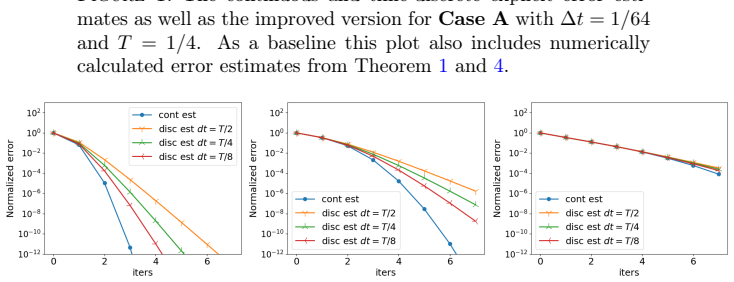
- The continuous-time estimate predicts linear convergence for large T and superlinear convergence for small T.
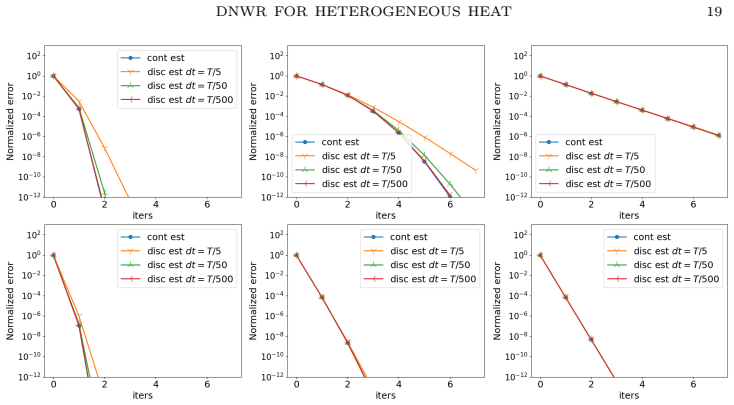
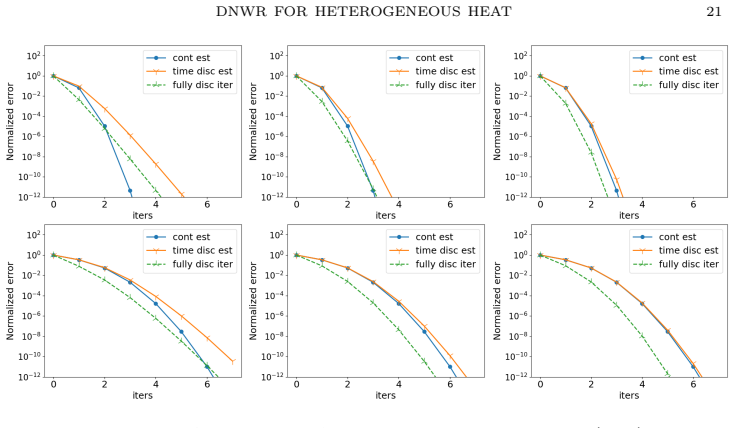
- The time-discrete estimate matches the continuous one for large T but requires sufficiently small time steps to recover superlinear convergence when T is small.
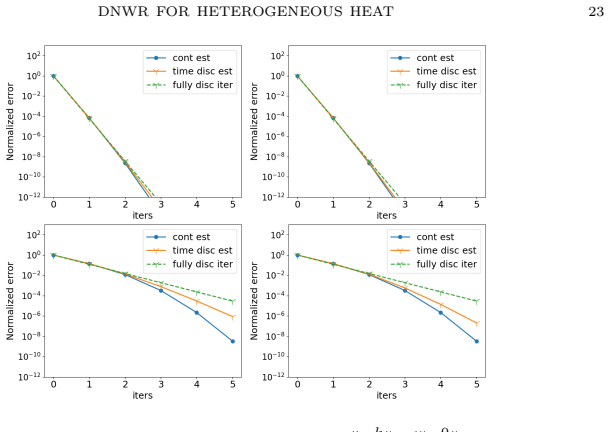
- Convergence rate improves markedly with increasing material contrast when the Dirichlet condition is assigned to the small-parameter subdomain.
- Numerical experiments on the heterogeneous heat problem reproduce the predicted convergence behavior in both regimes.
Where Pith is reading between the lines
- The same Fourier technique could be tested on other transmission conditions such as Robin-Robin to see whether comparable L2 bounds appear.
- The requirement of small time steps for superlinear convergence in the discrete case suggests that adaptive time-stepping might enlarge the regime where the method remains efficient.
- The contrast-dependent rate offers a concrete criterion for deciding which subdomain should receive the Dirichlet condition in other partitioned multiphysics codes.
Load-bearing premise
The exponentially weighted Fourier analysis applies directly to the two-domain heterogeneous problem with the given Dirichlet-Neumann transmission conditions at the interface.
What would settle it
A direct numerical computation of the L2 error history for a small fixed T, using the optimized relaxation parameter, that fails to exhibit superlinear decay with iteration count would falsify the predicted rate.
Figures



read the original abstract
We consider two coupled linear heat equations on different spatial domains that interact through a lower dimensional interface. This models conjugate heat transfer. The problem is solved using Dirichlet-Neumann waveform relaxation. This allows us to couple separate codes for the subproblems, a so-called partitioned approach. Our overall goal is to develop more efficient partitioned methods, and to this end, we want reliable error estimates. We use an exponentially weighted Fourier technique to derive new error estimates in L2 for finite time T in both continuous and time discrete settings. We identify an optimized relaxation parameter that guarantees superlinear convergence. Our new continuous estimate predicts linear convergence when T is large, and superlinear when T is small. For large T, our new time discrete estimate closely mirrors its continuous counterpart, whereas for small T, superlinear convergence in the time discrete case requires small time step dt. We also show that convergence is fast when the contrast is large, provided that the small physical parameter domain (e.g. air) is using the Dirichlet transmission condition, and the large physical parameter domain (e.g. steel) is using the Neumann transmission condition in the Dirichlet-Neumann waveform relaxation method. Our numerical experiments confirm all these findings.
Editorial analysis
A structured set of objections, weighed in public.
Referee Report
Summary. The manuscript analyzes the Dirichlet-Neumann waveform relaxation (DNWR) method for two coupled linear heat equations on heterogeneous domains interacting through a lower-dimensional interface. Using an exponentially weighted Fourier technique, the authors derive new L² error estimates for finite time T in both the continuous and time-discrete settings. They identify an optimized relaxation parameter that guarantees superlinear convergence, show that convergence is linear for large T and superlinear for small T (with small dt required in the discrete case), and demonstrate faster convergence when the material contrast is large provided the small-parameter domain uses the Dirichlet condition. Numerical experiments are reported to confirm the theoretical predictions.
Significance. If the derivations hold, the explicit L² bounds and optimized parameter provide a concrete foundation for analyzing and tuning partitioned coupling schemes in conjugate heat transfer. The distinction between large-T linear and small-T superlinear regimes, together with the contrast-dependent transmission-condition recommendation, supplies practical guidance that is not available from standard energy estimates. The combination of continuous and time-discrete analyses is a strength.
minor comments (3)
- [§3.2] §3.2, after Eq. (3.8): the transition from the weighted Fourier symbol to the L² bound is stated without an explicit constant; inserting the dependence on the weight parameter would make the estimate fully traceable.
- [Table 1] Table 1, last column: the reported rates for the optimized parameter are given to three digits; the manuscript should state whether these are obtained from the closed-form expression or from a numerical minimization.
- [§2 and §4] The notation for the interface transmission operators changes between the continuous (§2) and discrete (§4) sections; a single consistent symbol set would reduce reader effort.
Simulated Author's Rebuttal
We thank the referee for the positive summary, significance assessment, and recommendation of minor revision. No specific major comments were raised in the report.
Circularity Check
Derivation self-contained; no circularity detected
full rationale
The paper applies an exponentially weighted Fourier technique directly to the heterogeneous heat equations and transmission conditions to obtain explicit L2 error bounds for both continuous and time-discrete cases. The optimized relaxation parameter and convergence statements (linear for large T, superlinear for small T) are outputs of this derivation rather than inputs. No self-citation chain, fitted parameter renamed as prediction, or ansatz smuggled via prior work is present in the load-bearing steps. The analysis is parameter-free with respect to the target error estimates and stands on the stated assumptions for linear heat equations.
Axiom & Free-Parameter Ledger
axioms (2)
- domain assumption The subproblems are linear heat equations on heterogeneous domains coupled only through transmission conditions at a lower-dimensional interface.
- domain assumption The exponentially weighted Fourier technique applies to the coupled system and produces explicit L2 bounds for finite T.
Reference graph
Works this paper leans on
-
[1]
Discrete-Time Analysis of Optimized
Arnoult, Arthur and Japhet, Caroline and Omnes, Pascal , year =. Discrete-Time Analysis of Optimized. ESAIM: M2AN , volume =
-
[2]
Domain Decomposition Methods in Science and Engineering XXVIII , year=
Continuous Analysis of Waveform Relaxation for Heterogeneous Heat Equations , author =. Domain Decomposition Methods in Science and Engineering XXVIII , year=
-
[3]
2022 , doi =
Iterative Methods and Preconditioners for Systems of Linear Equations , author =. 2022 , doi =
2022
-
[4]
and Lemari
Clement, S. and Lemari. Discrete Analysis of. 2022 , journal =
2022
-
[5]
2024 , journal =
Linearly Convergent Nonoverlapping Domain Decomposition Methods for Quasilinear Parabolic Equations , author =. 2024 , journal =
2024
-
[6]
Gander, M. J. and Halpern, L. , year =. Optimized. SIAM J. Numer. Anal. , volume =
-
[7]
, journal =
Gander, Martin J. , journal =. Schwarz methods over the course of time. , url =
-
[8]
Gander, M. J. and Kwok, F. and Mandal, B. C. , issn =. ETNA , pages =
-
[9]
2024 , eprint =
Time Parallel Time Integration , author =. 2024 , eprint =
2024
-
[10]
Classical Fourier Analysis , author =. 2014 , series =. doi:10.1007/978-1-4939-1194-3 , isbn =
-
[11]
and Mohammad, Khaled , editor =
Haynes, Ronald D. and Mohammad, Khaled , editor =. Fully Discrete. Domain. 2020 , volume =
2020
-
[12]
Henshaw, W. D. and Chand, K. K. , doi =. A composite grid solver for conjugate heat transfer in fluid–structure systems , volume =. J. Comp. Phys. , number =
-
[13]
Multiphysics Simulations:
Keyes, David E and others , year =. Multiphysics Simulations:. Int. J. High Perform. Comput. Appl. , volume =
-
[14]
2026 , howpublished =
Kotarsky, Niklas , title =. 2026 , howpublished =
2026
-
[15]
Kowollik, D. S. C. and Horst, P. and Haupt, M. C. , year = 2013, pages =. Fluid-Structure Interaction Analysis Applied to Thermal Barrier Coated Cooled Rocket Thrust Chambers with Subsequent Local Investigation of Delamination Phenomena , booktitle =
2013
-
[16]
1982 , journal =
The Waveform Relaxation Method for Time-Domain Analysis of Large Scale Integrated Circuits , author =. 1982 , journal =
1982
-
[17]
Lemarié and L
F. Lemarié and L. Debreu and E. Blayo , journal =. Toward an optimized global-in-time
-
[18]
Non-Homogeneous Boundary Value Problems and Applications II , author =
-
[19]
2020 , journal =
A Numerical Study of Partitioned Fluid-structure Interaction Applied to a Cantilever in Incompressible Turbulent Flow , author =. 2020 , journal =
2020
-
[20]
A Time-Dependent D irichlet- N eumann Method for the Heat Equation
Mandal, Bankim C. A Time-Dependent D irichlet- N eumann Method for the Heat Equation. Domain Decomposition Methods in Science and Engineering XXI. 2014
2014
-
[21]
Meisrimel and A
P. Meisrimel and A. Monge and P. Birken , issue =. ZAMM , title =
-
[22]
2026 , howpublished =
Meisrimel, Peter , title =. 2026 , howpublished =
2026
-
[23]
On the convergence rate of the
Monge, Azahar and Birken, Philipp , doi =. On the convergence rate of the. Comput. Mech. , number =
-
[24]
Oppenheim and Ronald W
Alan V. Oppenheim and Ronald W. Schafer , year =. Discrete-Time Signal Processing , edition =
-
[25]
2025 , journal =
A waveform iteration implementation for black-box multi-rate higher-order coupling , author=. 2025 , journal =
2025
-
[26]
Gander , volume =
Alejandro Alfonso Rodriguez and Felix Kwok and Martin J. Gander , volume =. Convergence analysis of optimized. Submitted , year =
-
[27]
Quantifying Coupling Errors in Atmosphere-Ocean-Sea Ice Models:
Sch. Quantifying Coupling Errors in Atmosphere-Ocean-Sea Ice Models:. 2025 , journal =
2025
discussion (0)
Sign in with ORCID, Apple, or X to comment. Anyone can read and Pith papers without signing in.