Preservation Theorems for Transducer Outputs
Pith reviewed 2026-06-30 03:47 UTC · model grok-4.3
The pith
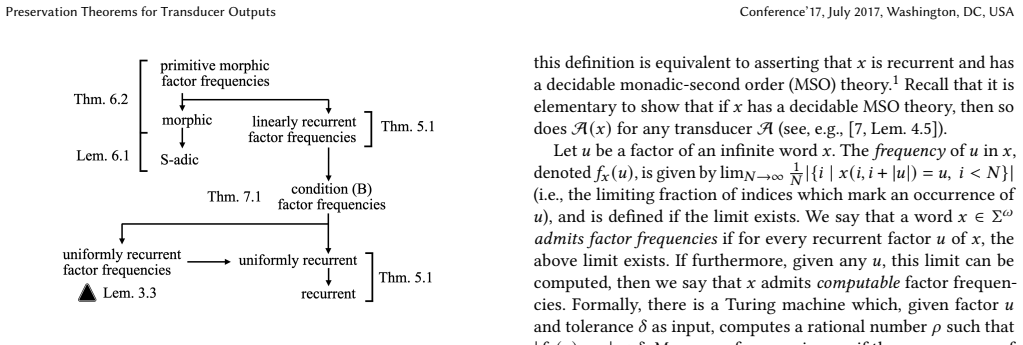
Deterministic transducers preserve recurrence, morphic structure, and factor frequencies of infinite words.
A machine-rendered reading of the paper's core claim, the machinery that carries it, and where it could break.
Core claim
For any deterministic finite-state transducer A and any infinite word x, if x is recurrent then A(x) is recurrent; if x is morphic then A(x) is morphic; and if x possesses well-defined factor frequencies then so does A(x).
What carries the argument
The Krohn-Rhodes theorem, which decomposes any finite automaton into a cascade of simpler automata whose action on words can be analyzed separately using the ergodic theory of shift spaces.
If this is right
- Recurrence passes from input to output under any deterministic finite-state transduction.
- The class of morphic words is closed under deterministic finite-state transduction.
- Existence of factor frequencies is invariant under deterministic finite-state transduction.
Where Pith is reading between the lines
- The same preservation may extend to other shift-space invariants that are stable under finite-to-one factor maps.
- One could test whether the results survive when the transducer is allowed a finite number of nondeterministic choices.
- The approach suggests checking preservation for properties defined by forbidden patterns rather than frequencies.
Load-bearing premise
The Krohn-Rhodes decomposition together with the ergodic theory of shift spaces suffice to transfer the listed combinatorial properties through the transducer.
What would settle it
An explicit recurrent infinite word x and a deterministic transducer A such that A(x) fails to be recurrent.
Figures
read the original abstract
Suppose we have a deterministic finite-state transducer $A$ and an infinite word $x$, and run $A$ on $x$ to obtain an infinite word $A(x)$. Which properties of $x$ are guaranteed to also hold for $A(x)$? In this paper, we study this preservation question for various well-known combinatorial properties, e.g., recurrence, being morphic, and having factor frequencies. The celebrated Krohn-Rhodes theorem provides the framework for proving our preservation results, and our techniques are based on the ergodic theory of symbolic dynamical systems, i.e., shift spaces.
Editorial analysis
A structured set of objections, weighed in public.
Referee Report
Summary. The paper studies preservation of combinatorial properties of infinite words under deterministic finite-state transducers. It claims that if x is recurrent, morphic, or has well-defined factor frequencies, then so does A(x) for any such transducer A, with proofs based on the Krohn-Rhodes decomposition of the transducer's semigroup together with ergodic-theoretic arguments on the induced map on shift spaces.
Significance. If the claims hold, the results give a systematic way to transfer recurrence, morphicity, and frequency properties across transducer outputs, linking automata theory with symbolic dynamics via an established decomposition theorem. The framework is reusable and the reliance on Krohn-Rhodes plus ergodic theory is a methodological strength.
minor comments (2)
- The abstract lists three example properties but does not enumerate the full set considered; the introduction should state the complete list of properties for which preservation is proved.
- Notation for the transducer output A(x) and the induced shift-space map should be introduced with a short diagram or example in §2 to aid readers unfamiliar with the ergodic setting.
Simulated Author's Rebuttal
We thank the referee for the supportive summary, recognition of the significance of linking automata theory with symbolic dynamics via the Krohn-Rhodes theorem, and the recommendation of minor revision. No specific major comments are listed in the report.
Circularity Check
No significant circularity; derivation rests on external theorems
full rationale
The paper's preservation results for recurrence, morphicity, and factor frequencies under deterministic finite-state transducers are derived by applying the Krohn-Rhodes theorem (an external 1965 result by unrelated authors) together with standard ergodic theory on shift spaces. These are independent, pre-existing mathematical frameworks invoked as the proof structure rather than derived or fitted within the paper. No self-definitional equations, fitted inputs renamed as predictions, load-bearing self-citations, or ansatz smuggling appear in the abstract or described approach. The derivation chain is therefore self-contained against external benchmarks.
Axiom & Free-Parameter Ledger
axioms (2)
- standard math Krohn-Rhodes theorem provides a decomposition framework applicable to transducer preservation questions
- domain assumption Ergodic theory of shift spaces can be used to analyze preservation of combinatorial properties under transducers
Reference graph
Works this paper leans on
-
[1]
The ubiquitous Prouhet-Thue-Morse sequence
Jean-Paul Allouche and Jeffrey Shallit. The ubiquitous Prouhet-Thue-Morse sequence. In Sequences and their applications (Singapore, 1998) , Springer Ser. Discrete Math. Theor. Comput. Sci., pages 1–16. Springer, London, 1999
1998
-
[2]
Automatic Sequences: Theory, Applications, Generalizations
Jean-Paul Allouche and Jeffrey Shallit. Automatic Sequences: Theory, Applications, Generalizations. Cambridge University Press, 2003
2003
-
[3]
Aperiodic order
Micael Baake and Uwe Grimm. Aperiodic order. Vol. 1, volume 149 of Encyclopedia of Mathematics and its Application . Cambridge University Press, 2013
2013
-
[4]
Measure and Integration Theory
Heinz Bauer. Measure and Integration Theory . De Gruyter, Berlin, New York, 2001
2001
-
[5]
Normal numbers and finite automata
Verónica Becher and Pablo Ariel Heiber. Normal numbers and finite automata. Theoretical Computer Science, 477:109–116, 2013
2013
-
[6]
On the decidability of monadic second-order logic with arithmetic predicates
Valérie Berthé, Toghrul Karimov, Joris Nieuwveld, Joël Ouaknine, Mihir Vahan- wala, and James Worrell. On the decidability of monadic second-order logic with arithmetic predicates. In Proceedings of the 39th Annual ACM/IEEE Symposium on Logic in Computer Science , pages 1–14, 2024
2024
-
[7]
The monadic theory of toric words
Valérie Berthé, Toghrul Karimov, Joris Nieuwveld, Joël Ouaknine, Mihir Va- hanwala, and James Worrell. The monadic theory of toric words. Theoretical Computer Science, 1025:114959, 2025
2025
-
[8]
Beyond substitutive dynamical systems: S-adic expansions, 2017
Valérie Berthé and Vincent Delecroix. Beyond substitutive dynamical systems: S-adic expansions, 2017
2017
-
[9]
Density of group languages in shift spaces, 2024
Valérie Berthé, Herman Goulet-Ouellet, Carl-Fredrik Nyberg-Brodda, Dominique Perrin, and Karl Petersen. Density of group languages in shift spaces, 2024
2024
-
[10]
Boshernitzan
Michael D. Boshernitzan. A condition for unique ergodicity of minimal symbolic flows. Ergodic Theory and Dynamical Systems , 12(3):425–428, 1992
1992
-
[11]
Preservation of normality by unambiguous transducers
Olivier Carton. Preservation of normality by unambiguous transducers. In Developments in language theory , volume 13257 of Lecture Notes in Comput. Sci. , pages 90–101. Springer, Cham, [2022] ©2022
2022
-
[12]
Preservation of normality by transducers
Olivier Carton and Elisa Orduna. Preservation of normality by transducers. Inform. and Comput., 282:Paper No. 104650, 9, 2022
2022
-
[13]
Skew products over rotations with exotic properties
Jon Chaika. Skew products over rotations with exotic properties. Geometriae Dedicata, 168(1):369–385, 2014. 7We acknowledge that this fact was known to Olivier Carton and Vincent Delecroix. Conference’17, July 2017, Washington, DC, USA Valérie Berthé, Herman Goulet-Ouellet, Toghrul Karimov, Dominique Perrin, and Mihir Vahanwala
2014
-
[14]
Green’s relations and their use in automata theory
Thomas Colcombet. Green’s relations and their use in automata theory. In Adrian- Horia Dediu, Shunsuke Inenaga, and Carlos Martín-Vide, editors, Language and Automata Theory and Applications, pages 1–21, Berlin, Heidelberg, 2011. Springer Berlin Heidelberg
2011
-
[15]
A condition of Boshernitzan and uniform convergence in the multiplicative ergodic theorem
David Damanik and Daniel Lenz. A condition of Boshernitzan and uniform convergence in the multiplicative ergodic theorem. Duke Mathematical Journal, 133(1):95 – 123, 2006
2006
-
[16]
Zero-measure cantor spectrum for schrödinger operators with low-complexity potentials
David Damanik and Daniel Lenz. Zero-measure cantor spectrum for schrödinger operators with low-complexity potentials. Journal de Mathématiques Pures et Appliquées, 85(5):671–686, 2006
2006
-
[17]
Lifting generic points
Tomasz Downarowicz and Benjamin Weiss. Lifting generic points. Ergodic Theory and Dynamical Systems , 44(9):2565–2580, 2024
2024
-
[18]
Durand, B
F. Durand, B. Host, and C. Skau. Substitutional dynamical systems, brat- teli diagrams and dimension groups. Ergodic Theory and Dynamical Systems , 19(4):953–993, 1999
1999
-
[19]
Linearly recurrent subshifts have a finite number of non-periodic subshift factors
Fabien Durand. Linearly recurrent subshifts have a finite number of non-periodic subshift factors. Ergodic Theory and Dynamical Systems , 20, 08 2008
2008
-
[20]
Decidability of the HD0L ultimate periodicity problem
Fabien Durand. Decidability of the HD0L ultimate periodicity problem. RAIRO - Theoretical Informatics and Applications, 47, 11 2011
2011
-
[21]
HD0L 𝜔-equivalence and periodicity problems in the primitive case
Fabien Durand. HD0L 𝜔-equivalence and periodicity problems in the primitive case. Unif. Distrib. Theory, 7(1):199–215, 2012
2012
-
[22]
Decidability of uniform recurrence of morphic sequences
Fabien Durand. Decidability of uniform recurrence of morphic sequences. Inter- national Journal of Foundations of Computer Science , 24(01):123–146, 2013
2013
-
[23]
Dimension Groups and Dynamical Sys- tems: Substitutions, Bratteli Diagrams and Cantor Systems
Fabien Durand and Dominique Perrin. Dimension Groups and Dynamical Sys- tems: Substitutions, Bratteli Diagrams and Cantor Systems . Cambridge Studies in Advanced Mathematics. Cambridge University Press, 2022
2022
-
[24]
Stabil- ity properties for subgroups generated by return words
France Gheeraert, Herman Goulet-Ouellet, Julien Leroy, and Pierre Stas. Stabil- ity properties for subgroups generated by return words. European Journal of Combinatorics, 130:104224, 2025
2025
-
[25]
Episturmian words: a survey
Amy Glen and Jacques Justin. Episturmian words: a survey. RAIRO - Theoretical Informatics and Applications, 43(3):403–442, 3 2009
2009
-
[26]
Suffix-connected languages
Herman Goulet-Ouellet. Suffix-connected languages. Theoretical Computer Science, 923:126–143, 2022
2022
-
[27]
M Guénais and F Parreau. Valeurs propres de transformations liées aux rotations irrationnelles et aux fonctions en escalier (eigenvalues of transformations arising from irrational rotations and step functions) (2006). arXiv preprint math/0605250
work page internal anchor Pith review Pith/arXiv arXiv 2006
-
[28]
On the simplification of infinite morphic words
Juha Honkala. On the simplification of infinite morphic words. Theoretical Computer Science, 410(8):997–1000, 2009
2009
-
[29]
Algorithmic verification of linear dynamical systems, 2023
Toghrul Karimov. Algorithmic verification of linear dynamical systems, 2023
2023
-
[30]
Algebraic theory of machines
Kenneth Krohn and John Rhodes. Algebraic theory of machines. i. prime de- composition theorem for finite semigroups and machines. Transactions of The American Mathematical Society - TRANS AMER MATH SOC , 116, 04 1965
1965
-
[31]
Mariusz Lemańczyk and Mieczysław K. Mentzen. Topological ergodicity of real cocycles over minimal rotations. Monatshefte für Mathematik, 134(3):227–246, 2002
2002
-
[32]
On the Krohn-Rhodes Cascaded Decomposition Theorem , pages 260–
Oded Maler. On the Krohn-Rhodes Cascaded Decomposition Theorem , pages 260–
-
[33]
Springer Berlin Heidelberg, Berlin, Heidelberg, 2010
2010
-
[34]
Robert McNaughton and Seymour A. Papert. Counter-Free Automata (M.I.T. research monograph no. 65). The MIT Press, 1971
1971
-
[35]
Meyer and C
A.R. Meyer and C. Thompson. Remarks on algebraic decomposition of automata. Mathematical Systems Theory, 3:110–118, 1969
1969
-
[36]
Muchnik, A
A. Muchnik, A. Semenov, and M. Ushakov. Almost periodic sequences.Theoretical Computer Science, 304(1):1–33, 2003
2003
-
[37]
Yu. L. Pritykin. Finite-automaton transformations of strictly almost-periodic sequences. Mathematical Notes, 80(5):710–714, 2006
2006
-
[38]
Pytheas Fogg
N. Pytheas Fogg. Substitutions in dynamics, arithmetics and combinatorics, volume 1794 of Lecture Notes in Mathematics . Springer-Verlag, Berlin, 2002
2002
-
[39]
Substitution Dynamical Systems - Spectral Analysis , volume 1294 of Lecture Notes in Mathematics
Martine Queffélec. Substitution Dynamical Systems - Spectral Analysis , volume 1294 of Lecture Notes in Mathematics . Springer, Berlin, Heidelberg, 2nd edition, 2010
2010
-
[40]
On the number of invariant measures for flows on orientable surfaces
Evgueni A Sataev. On the number of invariant measures for flows on orientable surfaces. Mathematics of the USSR-Izvestiya , 9(4):813, 1975
1975
-
[41]
The logical approach to automatic sequences—exploring combina- torics on words with Walnut, volume 482 of London Mathematical Society Lecture Note Series
Jeffrey Shallit. The logical approach to automatic sequences—exploring combina- torics on words with Walnut, volume 482 of London Mathematical Society Lecture Note Series. Cambridge University Press, Cambridge, 2023
2023
-
[42]
Strict ergodicity in zero dimensional dynamical systems and the Kronecker-Weyl theorem mod
William A Veech. Strict ergodicity in zero dimensional dynamical systems and the Kronecker-Weyl theorem mod. 2. Transactions of the American Mathematical Society, 140:1–33, 1969
1969
-
[43]
An introduction to ergodic theory , volume 79
Peter Walters. An introduction to ergodic theory , volume 79. Springer Science & Business Media, 2000
2000
-
[44]
Über die Gleichverteilung von Zahlen mod
Hermann Weyl. Über die Gleichverteilung von Zahlen mod. Eins. Mathematische Annalen, 77(3):313–352, 1916
1916
discussion (0)
Sign in with ORCID, Apple, or X to comment. Anyone can read and Pith papers without signing in.