On the Internet, Nobody Knows You're an LLM Bot: Unmasking Web Agents with Multi-Layer Fingerprinting
Pith reviewed 2026-06-30 05:33 UTC · model grok-4.3
The pith
Multi-layer fingerprinting distinguishes every tested Web Agent from humans and from each other.
A machine-rendered reading of the paper's core claim, the machinery that carries it, and where it could break.
Core claim
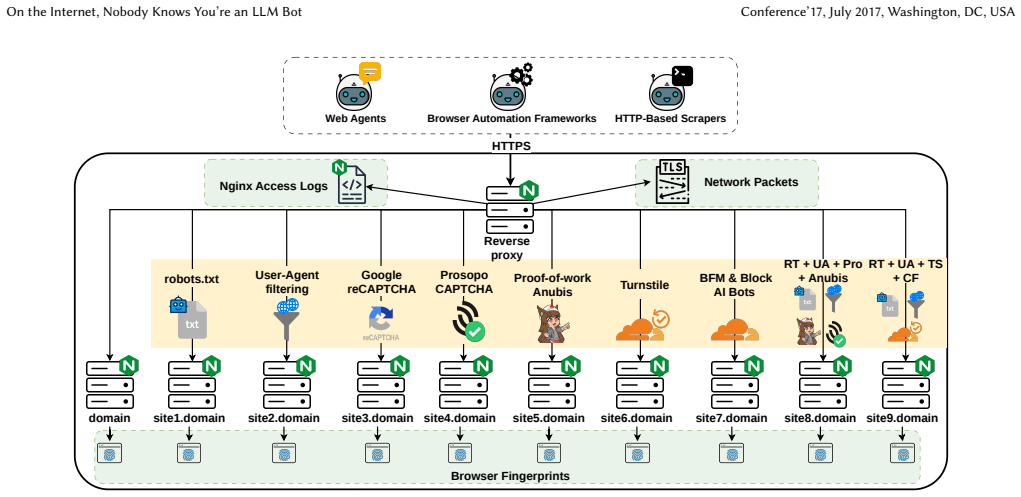
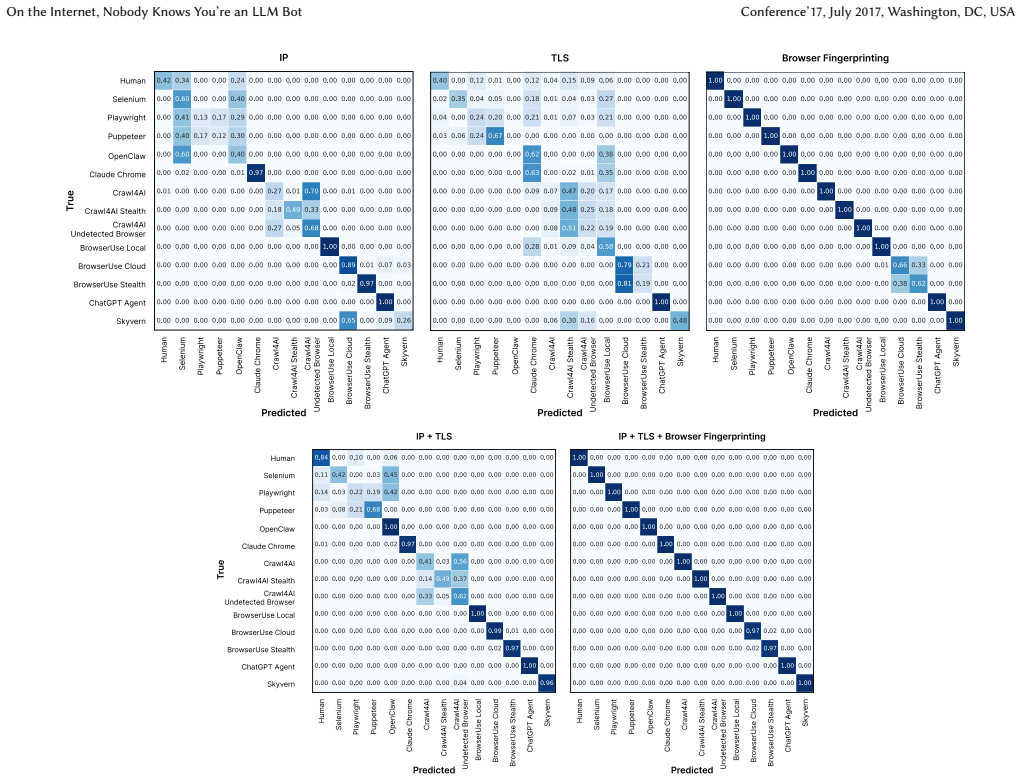
By deploying honeysites protected by mechanisms such as robots.txt, CAPTCHAs, proof-of-work, and Cloudflare solutions, and prompting six LLM-based Web Agents to visit them, the study finds that some agents bypass all anti-bot mechanisms while all agents produce distinguishable fingerprints at network, HTTP, and browser layers; additionally, stealth techniques often increase rather than decrease detectability.
What carries the argument
Multi-layer fingerprinting that collects and compares signals from network traffic, HTTP headers, and browser characteristics to identify Web Agents.
If this is right
- Some Web Agents successfully bypass all evaluated anti-bot mechanisms.
- All evaluated Web Agents produce unique fingerprints that distinguish them from humans and from one another.
- Stealth and anti-detection mechanisms in Web Agents tend to increase their detectability.
- Signals from network, HTTP, and browser layers each contribute to separating the agents.
Where Pith is reading between the lines
- Site operators could combine the three fingerprinting layers into a single detection rule set that blocks agents even after they pass traditional checks.
- Future agent designs may need to coordinate network, HTTP, and browser values simultaneously to reduce distinguishability.
- The same layered approach could be tested against other forms of automated web activity beyond the six agents examined here.
Load-bearing premise
The six tested LLM-based Web Agents and the chosen honeysites with specific anti-bot mechanisms represent real-world deployments and agent behaviors.
What would settle it
A new Web Agent that visits the same honeysites yet produces fingerprints identical to a human user or to another agent across all three layers would falsify the distinguishability result.
Figures
read the original abstract
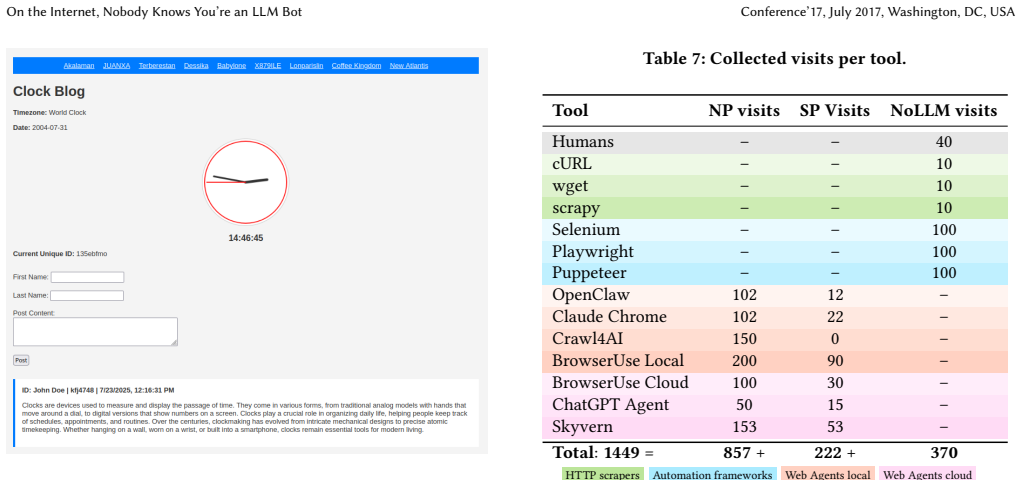
Since 2023, a new class of bots has emerged: Web Agents. They can automate complex tasks on the Web, going beyond traditional browser automation tools such as Selenium, Puppeteer, or Playwright. Leveraging large language models (LLMs), these agents are capable of solving anti-bot mechanisms, mimicking human behavior, and, in some cases, operating directly from the local machine of the user configuring them. As a result, it is becoming increasingly difficult for website administrators to detect and block these LLM-based bots. Modern Web Agents commonly integrate stealth and anti-detection techniques, while numerous proprietary and open-source anti-bot mechanisms have emerged recently, specifically to block them. However, despite their growing prevalence, there is little evaluation of the effectiveness of state-of-the-art anti-bot mechanisms against these LLM-based bots and their stealth capabilities. Likewise, no prior work has comprehensively studied how to characterize and distinguish Web Agents deployed either in the cloud or locally. This paper addresses these open questions by deploying multiple honeysites protected by one or more anti-bot mechanisms (e.g., robots.txt, CAPTCHAs, proof-of-work, and Cloudflare's free proprietary solutions). We integrated network-, HTTP-, and browser-level fingerprinting techniques, and prompted six LLM-based Web Agents to visit the deployed honeysites. Our analysis reveals three main findings: (i) some Web Agents were able to bypass all evaluated anti-bot mechanisms; (ii) all evaluated Web Agents can be distinguished both from humans and from one another using multi-layer fingerprinting techniques across network, HTTP and browser layers; (iii) stealth and anti-detection mechanisms often increase detectability rather than decrease it.
Editorial analysis
A structured set of objections, weighed in public.
Referee Report
Summary. The manuscript reports an empirical study deploying honeysites protected by anti-bot mechanisms (robots.txt, CAPTCHAs, proof-of-work, Cloudflare) and prompting six LLM-based Web Agents to visit them. It integrates network-, HTTP-, and browser-level fingerprinting to claim that (i) some agents bypass all tested mechanisms, (ii) all evaluated agents can be distinguished from humans and from one another via the multi-layer fingerprints, and (iii) stealth/anti-detection techniques often increase rather than decrease detectability.
Significance. If the empirical distinctions hold under the reported conditions, the work is significant for web security research: it provides concrete evidence on the limitations of current anti-bot defenses against LLM agents and demonstrates a practical multi-layer fingerprinting approach. The counter-intuitive result that stealth mechanisms can increase detectability is a useful contribution that could inform both defensive tooling and future agent design. The honeysite methodology is a strength for controlled measurement.
major comments (2)
- [§4] §4 (Experimental results on distinguishability): The central claim that 'all evaluated Web Agents can be distinguished both from humans and from one another using multi-layer fingerprinting' is not supported by any reported quantitative metrics such as overlap rates, false-positive rates, confusion matrices, or statistical significance tests between agent and human fingerprints. Without these, the strength of the separation cannot be assessed.
- [§3.1–3.2] §3.1–3.2 (Agent and honeysite selection): The distinction claim is load-bearing on the specific behaviors of the six chosen agents and the particular anti-bot configurations of the honeysites. No ablation across prompting strategies, local vs. cloud execution, or alternative anti-bot combinations is presented, so the observed unique fingerprints may be artifacts of the narrow test set rather than a general property of LLM Web Agents.
minor comments (3)
- [Abstract, §1] The abstract and introduction would benefit from explicit citations to prior browser-fingerprinting literature (e.g., Panopticlick, FP-Stalker) to better situate the multi-layer contribution.
- [Figures 4–6] Figure captions and axis labels in the fingerprinting results figures are occasionally unclear regarding which layer (network/HTTP/browser) each panel corresponds to.
- [§2.3] A small number of typos and inconsistent capitalization appear in §2.3 (anti-bot mechanism descriptions).
Simulated Author's Rebuttal
We thank the referee for the detailed and constructive feedback on our manuscript. The comments highlight important aspects for strengthening the empirical claims. We address each major comment below, indicating the revisions we will incorporate.
read point-by-point responses
-
Referee: [§4] §4 (Experimental results on distinguishability): The central claim that 'all evaluated Web Agents can be distinguished both from humans and from one another using multi-layer fingerprinting' is not supported by any reported quantitative metrics such as overlap rates, false-positive rates, confusion matrices, or statistical significance tests between agent and human fingerprints. Without these, the strength of the separation cannot be assessed.
Authors: We agree that the absence of quantitative metrics limits the ability to assess the strength of separation. The manuscript demonstrates distinguishability through explicit differences in the collected network, HTTP, and browser fingerprints across the evaluated agents and human baselines. To address this directly, we will add confusion matrices, overlap rates, false-positive rates, and any applicable statistical tests derived from the existing experimental data in the revised §4. revision: yes
-
Referee: [§3.1–3.2] §3.1–3.2 (Agent and honeysite selection): The distinction claim is load-bearing on the specific behaviors of the six chosen agents and the particular anti-bot configurations of the honeysites. No ablation across prompting strategies, local vs. cloud execution, or alternative anti-bot combinations is presented, so the observed unique fingerprints may be artifacts of the narrow test set rather than a general property of LLM Web Agents.
Authors: The six agents represent a mix of prominent open-source and commercial LLM web agents, and the honeysites use standard anti-bot configurations. We acknowledge that the results are tied to this specific selection and that the lack of ablations across prompting, execution environments, or additional anti-bot variants is a limitation. In the revision we will expand the discussion in §3 and the conclusion to explicitly note the scope of the test set and the possibility that fingerprints could vary under other conditions, while maintaining that the multi-layer approach distinguishes the evaluated agents under the reported conditions. revision: partial
Circularity Check
Empirical measurement study with no derivations or fitted predictions
full rationale
The paper describes an observational study: deploying honeysites protected by anti-bot mechanisms, prompting six LLM-based Web Agents to visit them, and collecting network/HTTP/browser fingerprints to observe distinctions. No equations, parameter fits, predictions derived from inputs, or self-citation chains appear in the abstract or described methodology. Central claims rest on measured differences rather than any reduction to prior definitions or self-referential results, satisfying the criteria for a self-contained empirical analysis.
Axiom & Free-Parameter Ledger
axioms (2)
- domain assumption The six LLM-based Web Agents tested are representative of the broader class of such agents in real deployments.
- domain assumption The deployed honeysites and anti-bot mechanisms (robots.txt, CAPTCHAs, proof-of-work, Cloudflare) adequately model real-world website protections.
Reference graph
Works this paper leans on
-
[1]
Perplexity AI. 2026. Perplexity. Retrieved February 19, 2026 from https://www. perplexity.ai/
2026
-
[2]
ai.robots.txt. 2026. Table of bot metrics. Retrieved February 18, 2026 from https: //github.com/ai-robots-txt/ai.robots.txt/blob/main/table-of-bot-metrics.md
2026
-
[3]
John Althouse. 2023. JA4+ Network Fingerprinting. Retrieved February 19, 2026 from https://blog.foxio.io/ja4+-network-fingerprinting?ref=blog.webscout.io
2023
-
[4]
AmIUnique. 2026. AmIUnique. Retrieved February 19, 2026 from https:// amiunique.org/
2026
-
[5]
Anthropic. 2025. Anthropic Claude for Chrome. Retrieved February 18, 2026 from https://claude.com/chrome
2025
-
[6]
Anthropic. 2026. Claude. Retrieved February 19, 2026 from https://claude.ai/
2026
-
[7]
Anthropic. 2026. Introducing Claude Opus 4.7. Retrieved May 15, 2026 from https://www.anthropic.com/news/claude-opus-4-7
2026
-
[8]
Babak Amin Azad, Oleksii Starov, Pierre Laperdrix, and Nick Nikiforakis. 2020. Web Runner 2049: Evaluating Third-Party Anti-bot Services. InDIMV A (Lecture Notes in Computer Science, Vol. 12223). Springer, 135–159
2020
-
[9]
Annabelle Backman, Justin Richer, and Manu Sporny. 2024.HTTP Message Signatures. Request for Comments RFC 9421. Internet Engineering Task Force. doi:10.17487/RFC9421
-
[10]
Alex Bocharov and Adam Martinetti. 2024. Advancing Threat Intelligence: JA4 fingerprints and inter-request signals. Retrieved February 19, 2026 from https://blog.cloudflare.com/ja4-signals/
2024
-
[11]
Alex Bocharov, Santiago Vargas, Adam Martinetti, Reid Tatoris, and Car- los Azevedo. 2024. Declare your AIndependence: block AI bots, scrap- ers and crawlers with a single click. Retrieved February 19, 2026 from https://blog.cloudflare.com/declaring-your-aindependence-block-ai-bots- scrapers-and-crawlers-with-a-single-click/
2024
-
[12]
BoringSSL. 2026. BoringSSL. Retrieved May 22, 2026 from https://boringssl. googlesource.com/boringssl
2026
-
[13]
CatBoost. 2026. CatBoost Documentation. Retrieved May 21, 2026 from https://catboost.ai/docs/
2026
-
[14]
Elisa Chiapponi, Onur Catakoglu, Olivier Thonnard, and Marc Dacier. 2020. HoPLA: a honeypot platform to lure attackers. InComputer & Electronics Security Applications Rendez-vous, Deceptive security Conference (C&ESAR 2020), part of European Cyber Week. Rennes, France
2020
-
[15]
Google Chrome. 2026. Run Chromium with command-line switches. Re- trieved May 22, 2026 from https://www.chromium.org/developers/how-tos/run- chromium-with-flags
2026
-
[16]
Cloudflare. 2025. Bot Traffic Worldwide. Retrieved February 27, 2026 from https://radar.cloudflare.com/bots
2025
-
[17]
Cloudflare. 2025. Introduction to robots.txt. Retrieved February 18, 2026 from https://www.cloudflare.com/learning/bots/what-is-robots-txt/
2025
-
[18]
Cloudflare. 2026. Cloudflare Bot Fight Mode. Retrieved February 19, 2026 from https://developers.cloudflare.com/bots/get-started/bot-fight-mode/
2026
-
[19]
Cloudflare. 2026. Cloudflare: Connect, protect, and build everywhere. Retrieved February 18, 2026 from https://www.cloudflare.com/
2026
-
[20]
Cloudflare. 2026. Cloudflare Doc Clearance. Retrieved May 22, 2026 from https://developers.cloudflare.com/cloudflare-challenges/concepts/clearance/ Conference’17, July 2017, Washington, DC, USA Fayolle et al
2026
-
[21]
Cloudflare. 2026. Cloudflare Super Bot Fight Mode. Retrieved February 19, 2026 from https://developers.cloudflare.com/bots/get-started/super-bot-fight-mode/
2026
-
[22]
Cloudflare. 2026. Cloudflare Turnstile: A verification tool to replace CAPTCHAs. Retrieved February 19, 2026 from https://www.cloudflare.com/application- services/products/turnstile/
2026
-
[23]
Cloudflare. 2026. How CAPTCHAs work. Retrieved February 18, 2026 from https://www.cloudflare.com/learning/bots/how-captchas-work/
2026
-
[24]
Cloudflare. 2026. Usage statistics and market share of Cloudflare. Retrieved February 19, 2026 from https://w3techs.com/technologies/details/cn-cloudflare
2026
-
[25]
Crawl4AI. 2026. Browser, Crawler & LLM Config - Crawl4AI Documentation (v0.8.x). Retrieved June 1, 2026 from https://docs.crawl4ai.com/core/browser- crawler-config/#1-browserconfig-essentials
2026
-
[26]
Jian Cui, Mingming Zha, XiaoFeng Wang, and Xiaojing Liao. 2025. The Odyssey of robots.txt Governance: Measuring Convention Implications of Web Bots in Large Language Model Services. InCCS. ACM, 21–35
2025
-
[27]
cURL. -. cURL. Retrieved February 25, 2026 from https://curl.se/
2026
-
[28]
davepattern. 2024. DDoS from Anthropic AI. Retrieved February 18, 2026 from https://www.linode.com/community/questions/24842/ddos-from- anthropic-ai
2024
- [29]
-
[30]
Drew DeVault. 2025. Please stop externalizing your costs directly into my face. Retrieved February 18, 2026 from https://drewdevault.com/2025/03/17/2025-03- 17-Stop-externalizing-your-costs-on-me.html
2025
-
[31]
Cem Dilmegani. 2026. Best 30+ Open Source Web Agents in 2026. Retrieved February 18, 2026 from https://aimultiple.com/open-source-web-agents
2026
-
[32]
djackson. 2025. Upgrade Firefox 136 to NSS 3.108. Retrieved May 06, 2026 from https://bugzilla.mozilla.org/show_bug.cgi?id=1934958
2025
-
[33]
Peter Eckersley. 2010. How unique is your web browser?. InInternational Symposium on Privacy Enhancing Technologies Symposium. Springer, 1–18
2010
-
[34]
Benchquill Editorial. 2026. GPT-5.5 vs Claude vs Gemini 3.1 Pro. Retrieved May 15, 2026 from https://benchquill.com/post/gpt-5-5-vs-claude-opus-4-7-vs- gemini-3-pro-2026
2026
-
[35]
Inc. F5. 2026. F5 WAF for NGINX - Log types. Retrieved May 21, 2026 from https://docs.nginx.com/waf/logging/logs-overview/
2026
-
[36]
Christine Falokun. 2022. CAPTCHA Farms and Challenges of CAPTCHA Bot Detection. Retrieved May 31, 2026 from https://datadome.co/guides/captcha/ how-to-detect-captcha-farms-and-block-captcha-bots/
2022
-
[37]
SEO Expert Fili. 2026. AI / LLM User-Agents: Blocking Guide. Retrieved May 29, 2026 from https://robotstxt.com/ai
2026
-
[38]
fingerprintjs. 2025. FingerprintJS: Browser Fingerprinting. Retrieved February 18, 2026 from https://github.com/fingerprintjs/fingerprintjs
2025
-
[39]
Mozilla Firefox. 2026. Security and Networking Components. Retrieved May 22, 2026 from https://firefox-source-docs.mozilla.org/networking/sec-necko- components.html
2026
-
[40]
Apache Software Foundation. 2025. Apache HTTP Server Tutorial: .htaccess files. Retrieved February 18, 2026 from https://httpd.apache.org/docs/current/ howto/htaccess.html
2025
-
[41]
FoxIO. 2026. ja4. Retrieved February 19, 2026 from https://github.com/FoxIO- LLC/ja4/tree/main#
2026
-
[42]
Alessandro Ghedini and Victor Vasiliev. 2020. TLS Certificate Compression. RFC 8879. doi:10.17487/RFC8879
-
[43]
GNU. 2017. wget. Retrieved February 25, 2026 from https://www.gnu.org/ software/wget/
2017
-
[44]
Google. 2025. Introduction to robots.txt. Retrieved February 18, 2026 from https://developers.google.com/search/docs/crawling-indexing/robots/intro
2025
-
[45]
Google. 2026. Gemini. Retrieved February 19, 2026 from https://gemini.google. com/
2026
-
[46]
Google. 2026. Puppeteer. Retrieved February 19, 2026 from https://pptr.dev/
2026
-
[47]
Google. 2026. reCAPTCHA. Retrieved February 18, 2026 from https://developers. google.com/recaptcha/
2026
-
[48]
Meriem Guerar, Luca Verderame andbrowser Mauro Migliardi, Francesco Palmieri, and Alessio Merlo. 2022. Gotta CAPTCHA ’Em All: A Survey of 20 Years of the Human-or-computer Dilemma.ACM Comput. Surv.54, 9 (2022), 192:1–192:33
2022
-
[49]
Hongliang He, Wenlin Yao, Kaixin Ma, Wenhao Yu, Yong Dai, Hongming Zhang, Zhenzhong Lan, and Dong Yu. 2024. Webvoyager: Building an end-to-end web agent with large multimodal models. InProceedings of the 62nd Annual Meeting of the Association for Computational Linguistics (Volume 1: Long Papers). 6864–6890
2024
-
[50]
Russ Housley. 2020. TLS 1.3 Extension for Certificate-Based Authentication with an External Pre-Shared Key. RFC 8773. doi:10.17487/RFC8773
-
[51]
Martin Husák, Milan Čermák, Tomáš Jirsík, and Pavel Čeleda. 2016. HTTPS Traffic Analysis and Client Identification Using Passive SSL/TLS Fingerprinting. EURASIP Journal on Information Security2016, 1 (Dec. 2016), 6. doi:10.1186/ s13635-016-0030-7
2016
-
[52]
Xe Iaso. 2025. Bot protection bypass when a sophisticated attacker asks to pass a challenge of difficulty 0. Retrieved February 18, 2026 from https://github.com/ Xe/x/security/advisories/GHSA-56w8-8ppj-2p4f
2025
-
[53]
Christos Iliou, Theodoros Kostoulas, Theodora Tsikrika, Vasilis Katos, Stefanos Vrochidis, and Ioannis Kompatsiaris. 2021. Web bot detection evasion using generative adversarial networks. In2021 IEEE International Conference on Cyber Security and Resilience (CSR). IEEE, 115–120
2021
-
[54]
Imperva. 2025. Bad bot report: the rapid rise of bots and the unseen risk for business. Retrieved February 27, 2026 from https://www.imperva.com/ resources/wp-content/uploads/sites/6/reports/2025-Bad-Bot-Report.pdf
2025
-
[55]
IPLocate. 2026. IPLocate. Retrieved May 22, 2026 from https://www.iplocate.io/
2026
-
[56]
Markus Jakobsson and Ari Juels. 1999. Proofs of Work and Bread Pudding Pro- tocols. InCommunications and Multimedia Security (IFIP Conference Proceedings, Vol. 152). Kluwer, 258–272
1999
- [57]
-
[58]
Taein Kim, Karstan Bock, Claire Luo, Amanda Liswood, Chloe Poroslay, and Emily Wenger. 2025. Scrapers Selectively Respect robots.txt Directives: Evidence From a Large-Scale Empirical Study. InIMC. ACM, 541–557
2025
-
[59]
Robb Knight. 2024. Perplexity AI Is Lying about Their User Agent. Retrieved February 18, 2026 from https://rknight.me/blog/perplexity-ai-is-lying-about- its-user-agent/
2024
-
[60]
Martijn Koster, Gary Illyes, Henner Zeller, and Lizzi Sassman. 2022. Robots Exclusion Protocol. RFC 9309. doi:10.17487/RFC9309
-
[61]
Mohinder Kumar, M. K. Jindal, and Munish Kumar. 2022. A Systematic Survey on CAPTCHA Recognition: Types, Creation and Breaking Techniques.Archives of Computational Methods in Engineering29, 2 (March 2022), 1107–1136. doi:10. 1007/s11831-021-09608-4
2022
-
[62]
Tomer Laor, Naif Mehanna, Antonin Durey, Vitaly Dyadyuk, Pierre Laperdrix, Clémentine Maurice, Yossi Oren, Romain Rouvoy, Walter Rudametkin, and Yuval Yarom. 2022. DRAWN APART: A Device Identification Technique based on Remote GPU Fingerprinting. InNDSS. The Internet Society
2022
-
[63]
Pierre Laperdrix, Gildas Avoine, Benoit Baudry, and Nick Nikiforakis. 2019. Morellian Analysis for Browsers: Making Web Authentication Stronger with Canvas Fingerprinting. InDIMV A (Lecture Notes in Computer Science). Springer, 43–66
2019
-
[64]
Pierre Laperdrix, Nataliia Bielova, Benoit Baudry, and Gildas Avoine. 2020. Browser fingerprinting: A survey.ACM Transactions on the Web (TWEB)14, 2 (2020), 1–33
2020
-
[65]
LeeBrotherston. 2020. FPTLS: TLS Fingerprinting Library. Retrieved February 18, 2026 from https://github.com/LeeBrotherston/tls-fingerprinting
2020
-
[66]
Xigao Li, Babak Amin Azad, Amir Rahmati, and Nick Nikiforakis. 2021. Good Bot, Bad Bot: Characterizing Automated Brobrowserwsing Activity. InSP. IEEE, 1589–1605
2021
-
[67]
Voelker, Ben Y
Enze Liu, Elisa Luo, Shawn Shan, Geoffrey M. Voelker, Ben Y. Zhao, and Stefan Savage. 2025. Somesite I Used To Crawl: Awareness, Agency and Efficacy in Protecting Content Creators From AI Crawlers. InIMC. ACM, 78–99
2025
-
[68]
Jiacheng Liu, Yaxin Luo, Jiacheng Cui, Xinyi Shang, Xiaohan Zhao, and Zhiqiang Shen. 2026. Next-Gen CAPTCHAs: Leveraging the Cognitive Gap for Scalable and Diverse GUI-Agent Defense.CoRRabs/2602.09012 (2026)
work page internal anchor Pith review Pith/arXiv arXiv 2026
-
[69]
Zengrui Liu, Jimmy Dani, Yinzhi Cao, Shujiang Wu, and Nitesh Saxena. 2025. The First Early Evidence of the Use of Browser Fingerprinting for Online Tracking. InProceedings of the ACM on Web Conference 2025. 4980–4995
2025
-
[70]
Mattwmaster58. 2026. playwright-stealth 2.0.2. Retrieved March 10, 2026 from https://pypi.org/project/playwright-stealth/
2026
-
[71]
MDN. 2026. Private State Token API. Retrieved May 15, 2026 from https: //developer.mozilla.org/en-US/docs/Web/API/Private_State_Token_API
2026
-
[72]
Naif Mehanna, Walter Rudametkin, Pierre Laperdrix, and Antoine Vastel. 2024. Free Proxies Unmasked: A Vulnerability and Longitudinal Analysis of Free Proxy Services. InProceedings 2024 Workshop on Measurements, Attacks, and Defenses for the Web. Internet Society, San Diego, CA, USA. doi:10.14722/madweb.2024. 23035
-
[73]
Thibault Meunier and Mari Galicer. 2025. Forget IPs: using cryptography to verify bot and agent traffic. Retrieved May 15, 2026 from https://blog.cloudflare. com/web-bot-auth/
2025
-
[74]
Microsoft. 2026. Playwright. Retrieved February 19, 2026 from https: //playwright.dev/
2026
-
[75]
Atsuyuki Miyai, Zaiying Zhao, Kazuki Egashira, Atsuki Sato, Tatsumi Sunada, Shota Onohara, Hiromasa Yamanishi, Mashiro Toyooka, Kunato Nishina, Ry- oma Maeda, Kiyoharu Aizawa, and Toshihiko Yamasaki. 2025. WebChore- Arena: Evaluating Web Browsing Agents on Realistic Tedious Web Tasks.CoRR abs/2506.01952 (2025)
-
[76]
mozilla.org contributors. 2026. Navigator: userAgentData property. Re- trieved May 29, 2026 from https://developer.mozilla.org/en-US/docs/Web/API/ Navigator/userAgentData
2026
-
[77]
Reiichiro Nakano, Jacob Hilton, Suchir Balaji, Jeff Wu, Long Ouyang, Christina Kim, Christopher Hesse, Shantanu Jain, Vineet Kosaraju, William Saunders, On the Internet, Nobody Knows You’re an LLM Bot Conference’17, July 2017, Washington, DC, USA et al. 2021. Webgpt: Browser-assisted question-answering with human feedback. arXiv preprint arXiv:2112.09332(2021)
work page internal anchor Pith review Pith/arXiv arXiv 2017
- [78]
-
[79]
OpenAI. 2025. OpenAI ChatGPT Agent. Retrieved February 18, 2026 from https://chatgpt.com/features/agent
2025
-
[80]
OpenAI. 2026. ChatGPT. Retrieved February 19, 2026 from https://chatgpt.com/
2026
discussion (0)
Sign in with ORCID, Apple, or X to comment. Anyone can read and Pith papers without signing in.