Gromov's dihedral rigidity conjecture in dimension three
Pith reviewed 2026-06-30 05:09 UTC · model grok-4.3
The pith
Gromov's dihedral rigidity conjecture holds for scalar curvature in three dimensions.
A machine-rendered reading of the paper's core claim, the machinery that carries it, and where it could break.
Core claim
The paper proves that Gromov's dihedral rigidity conjecture on scalar curvature holds in dimension three. The proof is self-contained and illustrates the essential ideas of the general approach while avoiding many of the technical complications that arise in higher dimensions.
What carries the argument
Adaptation of a general proof strategy for dihedral rigidity to the three-dimensional setting.
If this is right
- Scalar curvature lower bounds together with dihedral angle upper bounds imply isometry to the model space in three dimensions.
- The conjecture is settled for every three-dimensional manifold satisfying the stated hypotheses.
- The simplified proof technique supplies a template for related rigidity questions in three-dimensional geometry.
- Manifolds with boundary in three dimensions are rigidly determined by their scalar curvature and dihedral angle data.
Where Pith is reading between the lines
- The simplification achieved in three dimensions suggests the general method may become more tractable in other low-dimensional cases.
- Explicit constructions of three-dimensional examples could now be checked directly against the rigidity conclusion.
- The result may link to other questions about positive scalar curvature and boundary rigidity that are already well-studied in dimension three.
Load-bearing premise
The general approach can be adapted to three dimensions while avoiding the technical complications that arise in higher dimensions.
What would settle it
A three-dimensional manifold with scalar curvature meeting or exceeding the model threshold and dihedral angles no larger than the model's, yet not isometric to the model space.
Figures

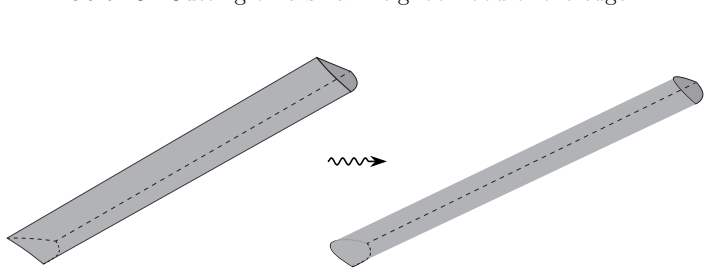
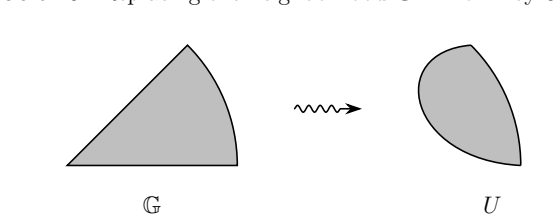
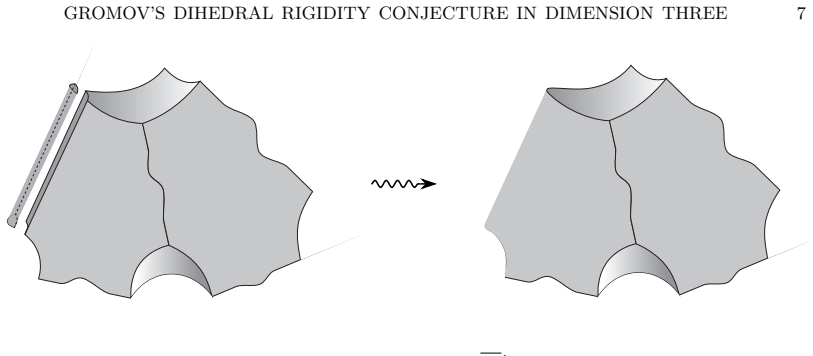
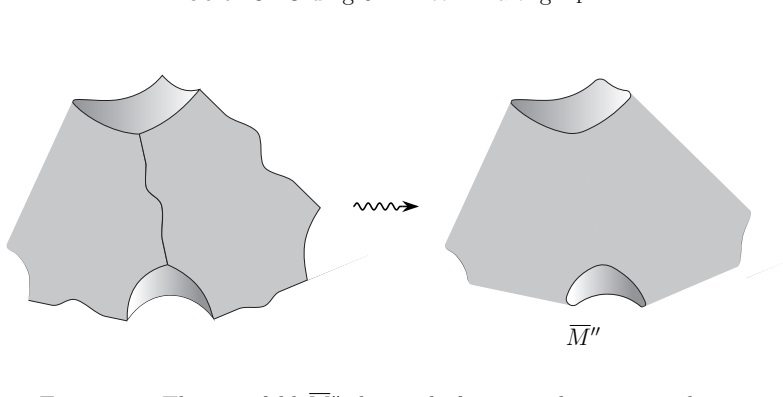



read the original abstract
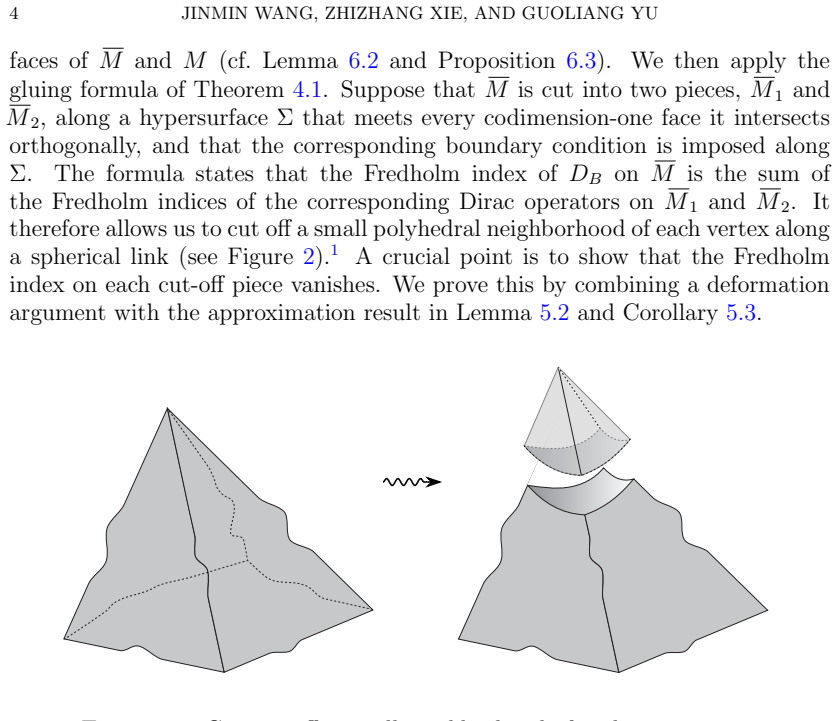
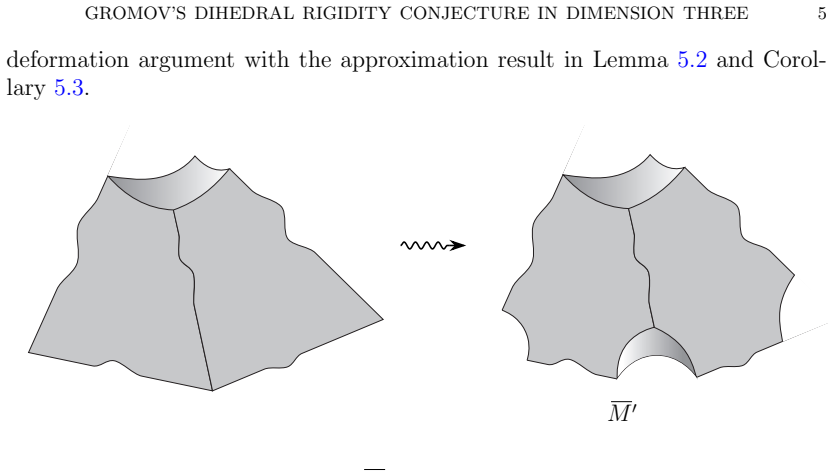
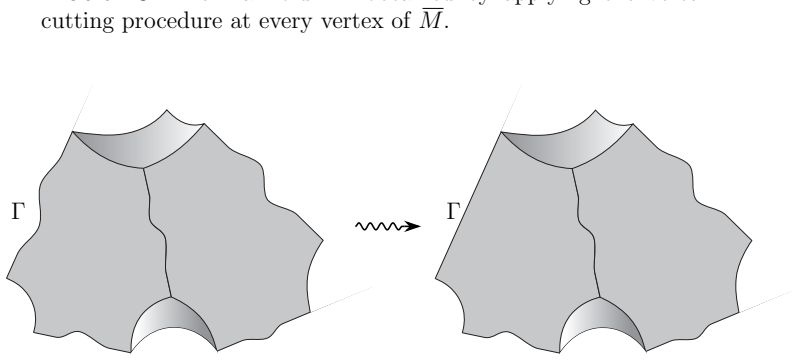
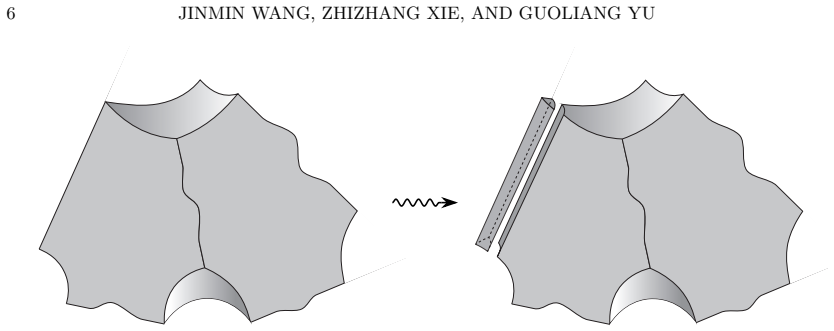
In this article, we present a self-contained proof of Gromov's dihedral rigidity conjecture on scalar curvature in the three-dimensional case. The proof avoids many of the technical complications that arise in higher dimensions, while still illustrating the essential ideas of the general approach developed in arXiv:2112.01510 (version 6) and arXiv:2203.09511. It is significantly shorter than the proof of the general case and is intended to be more accessible.
Editorial analysis
A structured set of objections, weighed in public.
Referee Report
Summary. The manuscript presents a self-contained proof of Gromov's dihedral rigidity conjecture for scalar curvature in three dimensions. It reduces the rigidity statement to an application of the positive mass theorem on a doubled manifold with controlled boundary angles, carrying out all steps in coordinates via the Gauss-Bonnet identity on boundary surfaces and the Schoen-Yau minimal-surface technique.
Significance. If correct, the result establishes the conjecture in dimension three using only standard 3D tools, thereby confirming rigidity for manifolds with positive scalar curvature and prescribed dihedral angles. It supplies an accessible illustration of the general approach from the cited preprints while avoiding higher-dimensional smoothing and spinor estimates, and the explicit coordinate-based argument strengthens the case for the 3D case independently of the general theory.
minor comments (2)
- The abstract states that the proof 'avoids many of the technical complications that arise in higher dimensions'; a brief sentence in the introduction listing the specific complications avoided (e.g., smoothing, spinor estimates) would improve readability.
- Notation for the doubled manifold and the controlled boundary angles should be introduced with a short diagram or coordinate chart in the first section where the construction appears.
Simulated Author's Rebuttal
We thank the referee for their positive assessment of the manuscript, the clear summary of its contributions, and the recommendation to accept. We are pleased that the self-contained 3D argument is viewed as accessible and independent of the higher-dimensional theory.
Circularity Check
Self-contained 3D proof with non-load-bearing citation to authors' prior work
full rationale
The manuscript supplies an explicit self-contained argument for the 3D case that reduces the dihedral rigidity statement to a direct application of the positive-mass theorem on a doubled manifold with controlled boundary angles, using Gauss-Bonnet on boundary surfaces and the standard Schoen-Yau minimal-surface technique. All steps are carried out in coordinates without invoking higher-dimensional smoothing or spinor estimates. The references to arXiv:2112.01510 (v6) and arXiv:2203.09511 are described only as illustrating essential ideas of the general approach, not as supplying any load-bearing steps or uniqueness theorems for the 3D proof itself. This is a minor self-citation that does not reduce the central claim to prior work by the same authors.
Axiom & Free-Parameter Ledger
axioms (1)
- standard math Standard axioms and theorems of Riemannian geometry and scalar curvature (e.g., Gauss-Bonnet, index theory, or comparison theorems as needed for the dihedral setting).
Reference graph
Works this paper leans on
-
[1]
M. F. Atiyah and R. Bott. The index problem for manifolds with boundary. InDifferential Analysis, Bombay Colloq., 1964, pages 175–186. Oxford Univ. Press, London, 1964
1964
-
[2]
Families index for manifolds with boundary, su- perconnections, and cones
Jean-Michel Bismut and Jeff Cheeger. Families index for manifolds with boundary, su- perconnections, and cones. I. Families of manifolds with boundary and Dirac operators. Journal of Functional Analysis, 89(2):313–363, March 1990
1990
-
[3]
Families index for manifolds with boundary, super- connections and cones
Jean-Michel Bismut and Jeff Cheeger. Families index for manifolds with boundary, super- connections and cones. II. The Chern character.Journal of Functional Analysis, 90(2):306– 354, May 1990
1990
-
[4]
Positive scalar curvature on manifolds with fibered singularities.Journal f¨ ur die reine und angewandte Mathematik (Crelles Journal), 0(0), 2023
Boris Botvinnik and Jonathan Rosenberg. Positive scalar curvature on manifolds with fibered singularities.Journal f¨ ur die reine und angewandte Mathematik (Crelles Journal), 0(0), 2023
2023
-
[5]
Scalar curvature rigidity of convex polytopes.Invent
Simon Brendle. Scalar curvature rigidity of convex polytopes.Invent. Math., 235(2):669– 708, 2024
2024
-
[6]
On Gromov’s rigidity theorem for polytopes with acute angles.J
Simon Brendle and Yipeng Wang. On Gromov’s rigidity theorem for polytopes with acute angles.J. Reine Angew. Math., 827:191–225, 2025
2025
-
[7]
An index theorem for first order regular singular op- erators.Amer
Jochen Br¨ uning and Robert Seeley. An index theorem for first order regular singular op- erators.Amer. J. Math., 110(4):659–714, 1988
1988
-
[8]
On the spectral geometry of spaces with cone-like singularities.Proc
Jeff Cheeger. On the spectral geometry of spaces with cone-like singularities.Proc. Nat. Acad. Sci. U.S.A., 76(5):2103–2106, 1979
1979
-
[9]
On the Hodge theory of Riemannian pseudomanifolds
Jeff Cheeger. On the Hodge theory of Riemannian pseudomanifolds. InGeometry of the Laplace operator (Proc. Sympos. Pure Math., Univ. Hawaii, Honolulu, Hawaii, 1979), Proc. Sympos. Pure Math., XXXVI, pages 91–146. Amer. Math. Soc., Providence, R.I., 1980
1979
-
[10]
Spectral geometry of singular Riemannian spaces.J
Jeff Cheeger. Spectral geometry of singular Riemannian spaces.J. Differential Geom., 18(4):575–657 (1984), 1983
1984
-
[11]
Academic Press, Inc., San Diego, CA, 1994
Alain Connes.Noncommutative geometry. Academic Press, Inc., San Diego, CA, 1994
1994
-
[12]
Cyclic cohomology, the Novikov conjecture and hyper- bolic groups.Topology, 29(3):345–388, 1990
Alain Connes and Henri Moscovici. Cyclic cohomology, the Novikov conjecture and hyper- bolic groups.Topology, 29(3):345–388, 1990
1990
-
[13]
Positive mass theorem for asymptoti- cally flat spin manifolds with isolated conical singularities.Transactions of the American Mathematical Society, 378(4):2617–2642, January 2025
Xianzhe Dai, Yukai Sun, and Changliang Wang. Positive mass theorem for asymptoti- cally flat spin manifolds with isolated conical singularities.Transactions of the American Mathematical Society, 378(4):2617–2642, January 2025
2025
-
[14]
Goette and U
S. Goette and U. Semmelmann. Scalar curvature estimates for compact symmetric spaces. Differential Geom. Appl., 16(1):65–78, 2002
2002
-
[15]
Dirac and Plateau billiards in domains with corners.Cent
Misha Gromov. Dirac and Plateau billiards in domains with corners.Cent. Eur. J. Math., 12(8):1109–1156, 2014
2014
-
[16]
A dozen problems, questions and conjectures about positive scalar curva- ture
Misha Gromov. A dozen problems, questions and conjectures about positive scalar curva- ture. InFoundations of mathematics and physics one century after Hilbert, pages 135–158. Springer, Cham, 2018
2018
-
[17]
Metric inequalities with scalar curvature.Geom
Misha Gromov. Metric inequalities with scalar curvature.Geom. Funct. Anal., 28(3):645– 726, 2018. 74 JINMIN W ANG, ZHIZHANG XIE, AND GUOLIANG YU
2018
-
[18]
Convex polytopes, dihedral angles, mean curvature and scalar curvature
Misha Gromov. Convex polytopes, dihedral angles, mean curvature and scalar curvature. arXiv:2207.13346, 07, 2022
-
[19]
Four lectures on scalar curvature.Perspectives on Scalar Curvature (edi- tors: Gromov and Lawson), pages 1–514, 2023
Misha Gromov. Four lectures on scalar curvature.Perspectives on Scalar Curvature (edi- tors: Gromov and Lawson), pages 1–514, 2023
2023
-
[20]
Quantitative K-theory, positive scalar curvature, and band width.Perspectives on Scalar Curvature (editors: Gromov and Lawson), pages 763–798, 2023
Hao Guo, Zhizhang Xie, and Guoliang Yu. Quantitative K-theory, positive scalar curvature, and band width.Perspectives on Scalar Curvature (editors: Gromov and Lawson), pages 763–798, 2023
2023
-
[21]
Blaine Lawson, Jr
H. Blaine Lawson, Jr. and Marie-Louise Michelsohn.Spin geometry, volume 38 ofPrinceton Mathematical Series. Princeton University Press, Princeton, NJ, 1989
1989
-
[22]
Lax.Functional analysis
Peter D. Lax.Functional analysis. Pure and Applied Mathematics (New York). Wiley- Interscience [John Wiley & Sons], New York, 2002
2002
-
[23]
Deficiency indices for symmetric Dirac operators on manifolds with conic singularities.Topology, 32(3):611–623, 1993
Matthias Lesch. Deficiency indices for symmetric Dirac operators on manifolds with conic singularities.Topology, 32(3):611–623, 1993
1993
-
[24]
A polyhedron comparison theorem for 3-manifolds with positive scalar curvature
Chao Li. A polyhedron comparison theorem for 3-manifolds with positive scalar curvature. Invent. Math., 219(1):1–37, 2020
2020
-
[25]
Differential K-theory and localization formula forη-invariants
Bo Liu and Xiaonan Ma. Differential K-theory and localization formula forη-invariants. Inventiones mathematicae, 222(2):545–613, 2020
2020
-
[26]
Index theory for scalar curvature on manifolds with boundary.Proc
John Lott. Index theory for scalar curvature on manifolds with boundary.Proc. Amer. Math. Soc., 149(10):4451–4459, 2021
2021
-
[27]
Schoen and S
R. Schoen and S. T. Yau. On the structure of manifolds with positive scalar curvature. Manuscripta Math., 28(1-3):159–183, 1979
1979
-
[28]
Schoen and Shing Tung Yau
R. Schoen and Shing Tung Yau. Existence of incompressible minimal surfaces and the topology of three-dimensional manifolds with nonnegative scalar curvature.Ann. of Math. (2), 110(1):127–142, 1979
1979
-
[29]
Proof of the positive mass theorem
Richard Schoen and Shing Tung Yau. Proof of the positive mass theorem. II.Comm. Math. Phys., 79(2):231–260, 1981
1981
-
[30]
On Gromov’s flat corner domination conjecture and Stoker’s conjecture
Jinmin Wang and Zhizhang Xie. On Gromov’s flat corner domination conjecture and Stoker’s conjecture. arXiv:2203.09511, 2022
-
[31]
On Gromov’s dihedral extremality and rigidity conjectures
Jinmin Wang, Zhizhang Xie, and Guoliang Yu. On Gromov’s dihedral extremality and rigidity conjectures. arXiv:2112.01510(version 6), 2021
-
[32]
Decay of scalar curvature on uniformly con- tractible manifolds with finite asymptotic dimension.Comm
Jinmin Wang, Zhizhang Xie, and Guoliang Yu. Decay of scalar curvature on uniformly con- tractible manifolds with finite asymptotic dimension.Comm. Pure Appl. Math., 77(1):372– 440, 2024
2024
-
[33]
A proof of Gromov’s cube inequality on scalar curvature.J
Jinmin Wang, Zhizhang Xie, and Guoliang Yu. A proof of Gromov’s cube inequality on scalar curvature.J. Differential Geom., 128(3):1285–1300, 2024
2024
-
[34]
A new proof of the positive energy theorem.Comm
Edward Witten. A new proof of the positive energy theorem.Comm. Math. Phys., 80(3):381–402, 1981
1981
-
[35]
A quantitative relative index theorem and Gromov’s conjectures on positive scalar curvature.J
Zhizhang Xie. A quantitative relative index theorem and Gromov’s conjectures on positive scalar curvature.J. Noncommut. Geom., 17(2):609–662, 2023. With an appendix by Jinmin Wang and Xie
2023
-
[36]
Positive scalar curvature on foliations.Annals of Mathematics, 185(3), May 2017
Weiping Zhang. Positive scalar curvature on foliations.Annals of Mathematics, 185(3), May 2017. (Jinmin Wang)State Key Laboratory of Mathematical Sciences, Academy of Mathematics and Systems Science, Chinese Academy of Sciences Email address:jinmin@amss.ac.cn (Zhizhang Xie)Department of Mathematics, Texas A&M University Email address:xie@tamu.edu (Guolian...
2017
discussion (0)
Sign in with ORCID, Apple, or X to comment. Anyone can read and Pith papers without signing in.