BayesEvolve: Explicit Belief States for Autonomous Scientific Discovery
Pith reviewed 2026-06-30 05:55 UTC · model grok-4.3
The pith
Autonomous discovery agents achieve higher sample efficiency by maintaining explicit uncertainty-aware belief states over hypothesis quality rather than conditioning only on experimental memory or archives.
A machine-rendered reading of the paper's core claim, the machinery that carries it, and where it could break.
Core claim
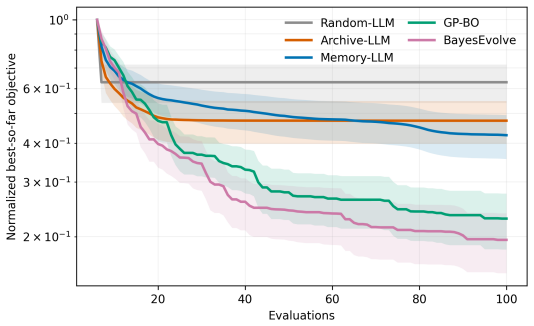
BayesEvolve converts experimental evidence into an explicit predictive belief state about hypothesis quality and uses this state, including an annealed uncertainty bonus, to select future candidates; the resulting system improves sample efficiency over memory- and archive-guided LLM baselines on shifted BBOB-style tasks, the belief state proves predictive on held-out candidate pools, controlled ablations favor belief-guided selection, and the method exhibits productive late-stage concentration.
What carries the argument
The predictive belief state that aggregates evidence and supplies an uncertainty bonus for candidate selection.
If this is right
- Belief-guided selection yields higher sample efficiency than memory- or archive-guided selection under a fixed evaluation budget.
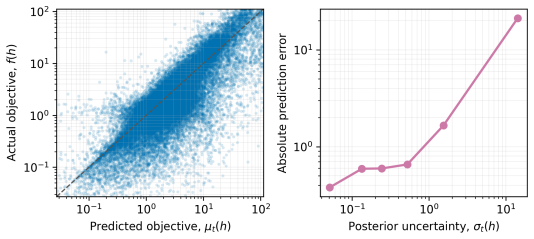
- The belief state ranks unseen candidates accurately enough to be used for prediction on held-out pools.
- Ablations show that the annealed uncertainty bonus component improves decisions relative to pure belief-mean selection.
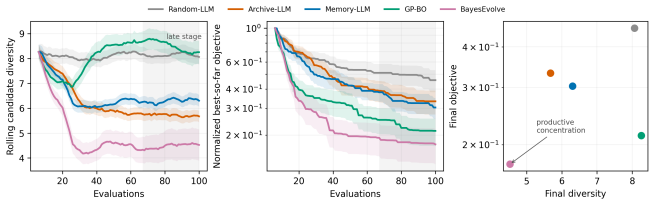
- The method produces productive late-stage concentration on promising regions rather than continued unfocused exploration.
- The approach is demonstrated on shifted BBOB-style tasks as a controlled testbed before extension to program or laboratory domains.
Where Pith is reading between the lines
- If the conversion from evidence to belief state can be made domain-general, the same machinery could replace heuristic memory summaries in other autonomous agents.
- One could test whether belief states improve performance on non-shifted or real-world scientific tasks where the cost of each evaluation is higher than in simulation.
- The explicit separation of belief from memory opens the possibility of auditing or transferring the belief state across different discovery runs or models.
- If the uncertainty bonus proves robust, similar bonuses could be added to other selection heuristics without adopting a full Bayesian update.
Load-bearing premise
That experimental evidence can be converted into a predictive belief state whose uncertainty bonus produces measurably better selection decisions than simple memory or archive heuristics.
What would settle it
On the same shifted BBOB tasks, belief-guided selection with the uncertainty bonus shows no sample-efficiency gain or lower performance than the memory- and archive-guided baselines, or the belief state fails to rank held-out candidates better than chance.
Figures
read the original abstract
Autonomous scientific discovery systems increasingly use large language models (LLMs) to propose new hypotheses, but many such systems condition primarily on experimental memory: archives of high-scoring candidates or heuristic summaries of recent trials. We argue that discovery agents should instead maintain explicit, uncertainty-aware beliefs about hypothesis quality. We introduce BayesEvolve, a belief-guided discovery framework that converts experimental evidence into a predictive belief state and uses this belief to guide future experimentation. As a controlled testbed for belief-guided discovery, we evaluate BayesEvolve on shifted BBOB-style black-box optimization tasks, leaving program and laboratory discovery domains to future work. BayesEvolve improves sample efficiency over memory- and archive-guided LLM baselines under a fixed evaluation budget. We further show that the belief state is predictive on held-out candidate pools, that controlled decision-rule ablations favor belief-guided selection with an annealed uncertainty bonus, and that BayesEvolve exhibits productive late-stage concentration rather than unfocused exploration.
Editorial analysis
A structured set of objections, weighed in public.
Referee Report
Summary. The paper introduces BayesEvolve, a belief-guided discovery framework that converts experimental evidence into an explicit, uncertainty-aware predictive belief state over hypothesis quality. This state is used to guide selection via an annealed uncertainty bonus. On shifted BBOB-style black-box optimization tasks (as a controlled testbed), BayesEvolve improves sample efficiency over memory- and archive-guided LLM baselines under fixed evaluation budgets, shows that the belief state is predictive on held-out candidate pools, and exhibits productive late-stage concentration; controlled ablations favor the belief-guided rule.
Significance. If the results hold, the work supplies a concrete, uncertainty-aware alternative to heuristic memory/archive conditioning in LLM-based discovery agents. The explicit conversion from evidence to belief, the decision-rule ablations, and the predictive tests on held-out pools provide a falsifiable basis for claiming that belief states improve selection decisions. The standardized shifted-BBOB testbed supports reproducible comparisons within the stated scope.
minor comments (3)
- [§3.1] §3.1: the precise functional form of the evidence-to-belief conversion (including how the posterior over quality is represented) should be stated explicitly before the selection rule is introduced, to allow readers to verify the claimed parameter-free character of the uncertainty bonus.
- [Figure 4] Figure 4: the held-out predictive accuracy curves lack error bars or run counts; adding these would strengthen the claim that the belief state is reliably predictive.
- [§5] §5: the BBOB shift parameters (location, scale, and which functions are shifted) are described only at high level; a short table or explicit list would improve reproducibility.
Simulated Author's Rebuttal
We thank the referee for the positive assessment of BayesEvolve, the recognition of its contribution as an uncertainty-aware alternative to memory-based conditioning, and the recommendation for minor revision. The report correctly identifies the core elements: explicit belief-state construction, the annealed uncertainty bonus, predictive validation on held-out pools, decision-rule ablations, and the shifted-BBOB testbed. No major comments requiring rebuttal or revision were raised.
Circularity Check
No significant circularity; derivation is self-contained against external benchmarks
full rationale
The provided abstract and reader summary contain no equations, parameter-fitting procedures, or self-citation chains that could reduce any claimed prediction or belief-update rule to a quantity defined by the authors' own inputs. The central claims rest on empirical comparisons (sample efficiency on shifted BBOB tasks, predictive accuracy on held-out pools, and ablation results favoring belief-guided selection) that are externally falsifiable and do not invoke uniqueness theorems or ansatzes from prior author work. No load-bearing step is shown to be equivalent to its inputs by construction.
Axiom & Free-Parameter Ledger
Reference graph
Works this paper leans on
-
[1]
Nature , volume =
Mathematical Discoveries from Program Search with Large Language Models , author =. Nature , volume =. 2024 , doi =
2024
-
[2]
2025 , eprint =
AlphaEvolve: A Coding Agent for Scientific and Algorithmic Discovery , author =. 2025 , eprint =
2025
-
[3]
A Probabilistic Framework for LLM-Based Model Discovery
Wahl, Stefan and Schenk, Raphaela and Farnoud, Ali and Macke, Jakob H. and Gedon, Daniel , year =. A Probabilistic Framework for. 2602.18266 , archivePrefix =
work page internal anchor Pith review Pith/arXiv arXiv
-
[4]
Proceedings of the Genetic and Evolutionary Computation Conference Companion Workshop on Black-Box Optimization Benchmarking , year =
Real-Parameter Black-Box Optimization Benchmarking 2009: Noiseless Functions Definitions , author =. Proceedings of the Genetic and Evolutionary Computation Conference Companion Workshop on Black-Box Optimization Benchmarking , year =
2009
-
[5]
Journal of Global Optimization , volume =
Efficient Global Optimization of Expensive Black-Box Functions , author =. Journal of Global Optimization , volume =. 1998 , doi =
1998
-
[6]
Proceedings of the 27th International Conference on Machine Learning , pages =
Gaussian Process Optimization in the Bandit Setting: No Regret and Experimental Design , author =. Proceedings of the 27th International Conference on Machine Learning , pages =
-
[7]
Biometrika , volume =
On the Likelihood that One Unknown Probability Exceeds Another in View of the Evidence of Two Samples , author =. Biometrika , volume =. 1933 , doi =
1933
discussion (0)
Sign in with ORCID, Apple, or X to comment. Anyone can read and Pith papers without signing in.