Reweighting Framewise Attention in Video Transformers for Facial Expression Understanding
Pith reviewed 2026-06-30 05:52 UTC · model grok-4.3
The pith
MiRA redistributes attention weights in video ViTs by deriving frame-level importance from existing self-attention maps to better capture localized facial dynamics.
A machine-rendered reading of the paper's core claim, the machinery that carries it, and where it could break.
Core claim
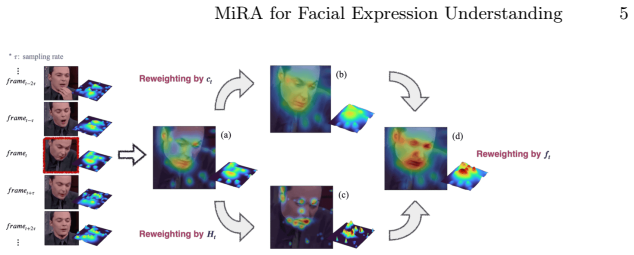
MiRA derives frame-level confidence and intra-frame concentration statistics from self-attention maps to estimate frame-wise marginal importance and redistribute attention toward spatiotemporally localized facial cues without introducing additional trainable parameters. The method operates in an exact post-softmax mode and a lightweight pre-softmax flashLite mode that integrates directly into FlashAttention kernels.
What carries the argument
MiRA, the frame-marginal attention redistribution that extracts confidence and concentration statistics from pretrained self-attention maps to reweight frames.
If this is right
- Performance improves consistently on challenging video FER benchmarks relative to strong ViT baselines.
- No new trainable parameters are added to the backbone.
- The flashLite mode preserves effectiveness while integrating into existing FlashAttention implementations.
- Attention becomes more selective for spatiotemporally localized facial cues rather than dominant global motion.
Where Pith is reading between the lines
- The same redistribution logic could be tested on other video tasks that require sensitivity to small local changes, such as action recognition with fine hand movements.
- Because MiRA only reads existing attention maps, it offers a route to adapt large pretrained video models to new domains without retraining the backbone.
- The efficiency of the flashLite variant suggests the method could be deployed in resource-constrained settings where full attention recomputation is costly.
Load-bearing premise
Statistics drawn from the self-attention maps of a standard pretrained ViT already contain enough reliable signal about subtle localized facial movements to guide useful redistribution.
What would settle it
Running MiRA on a fixed pretrained ViT backbone on FER benchmarks and observing no accuracy gain or a drop relative to the unmodified baseline would falsify the central claim.
Figures






read the original abstract
Understanding facial expressions in videos requires modeling subtle and localized facial dynamics under unconstrained conditions. Although recent Vision Transformer~(ViT)-based video models have shown strong performance through large-scale self-supervised pretraining, their attention mechanisms often emphasize dominant global motions and coarse temporal dynamics, limiting sensitivity to fine-grained facial variations. To address this limitation, we propose MiRA (Marginal-induced Attention Redistribution), a plug-in frame-marginal attention redistribution framework for ViT backbones that enhances spatio-temporal selectivity toward subtle facial dynamics without introducing additional trainable parameters. MiRA derives frame-level confidence and intra-frame concentration statistics from self-attention maps to estimate frame-wise marginal importance and redistribute attention toward spatiotemporally localized facial cues. We first introduce a principled \textit{exact mode} based on post-softmax attention redistribution. To further improve efficiency, we propose \textit{flashLite mode}, a lightweight pre-softmax approximation that integrates frame-marginal redistribution into FlashAttention kernels while preserving the effectiveness of the exact formulation. Experimental results on challenging Facial Expression Recognition~(FER) benchmarks demonstrate consistent improvements over strong ViT baselines.
Editorial analysis
A structured set of objections, weighed in public.
Referee Report
Summary. The manuscript proposes MiRA, a parameter-free plug-in for video ViT backbones in facial expression recognition. It derives frame-level confidence and intra-frame concentration statistics from self-attention maps to compute frame-wise marginal importance and redistribute attention toward spatiotemporally localized facial cues. Two variants are introduced: an exact post-softmax redistribution mode and a flashLite pre-softmax approximation that integrates into FlashAttention kernels. Experiments report consistent benchmark gains over strong ViT baselines on FER tasks.
Significance. If the results hold, the work provides a lightweight, zero-parameter enhancement to existing pretrained video transformers for fine-grained facial analysis tasks. Explicit credit is due for the absence of additional trainable parameters and the practical FlashAttention integration, which preserves efficiency while targeting a known limitation of attention maps emphasizing global motion over subtle dynamics.
major comments (2)
- [§3] §3 (Method): The central redistribution mechanism rests on the assumption that frame-level confidence and intra-frame concentration statistics extracted from a standard pretrained ViT's self-attention maps already encode reliable signals about subtle, localized facial dynamics. No independent verification, correlation analysis with facial landmarks, or ablation isolating expression-relevant regions versus dominant motion is provided; this is load-bearing because both the exact and flashLite modes derive the marginal importance estimates solely from those maps with zero additional supervision or parameters.
- [§4] §4 (Experiments): The reported consistent improvements on FER benchmarks are presented without statistical significance tests, error bars across multiple runs, or controls that isolate whether gains arise from the claimed redistribution mechanism versus incidental regularization effects. This weakens the link between the method and the observed performance.
minor comments (2)
- [Abstract, §3] Abstract and §3: The description of the exact and flashLite modes would benefit from an explicit equation for the marginal importance computation and the redistribution operator to allow direct reproduction.
- [§3] Notation: The terms 'frame-level confidence' and 'intra-frame concentration' are introduced without a clear mathematical definition or reference to prior attention statistics literature in the initial presentation.
Simulated Author's Rebuttal
We thank the referee for the constructive feedback on the assumptions underlying MiRA and the experimental validation. We address each major comment below and commit to revisions that strengthen the manuscript without altering its core claims.
read point-by-point responses
-
Referee: [§3] §3 (Method): The central redistribution mechanism rests on the assumption that frame-level confidence and intra-frame concentration statistics extracted from a standard pretrained ViT's self-attention maps already encode reliable signals about subtle, localized facial dynamics. No independent verification, correlation analysis with facial landmarks, or ablation isolating expression-relevant regions versus dominant motion is provided; this is load-bearing because both the exact and flashLite modes derive the marginal importance estimates solely from those maps with zero additional supervision or parameters.
Authors: We agree that the manuscript does not provide explicit correlation analysis with facial landmarks or ablations isolating expression-relevant regions from dominant motion. The design of MiRA is motivated by the observed limitations of pretrained ViT attention on FER tasks, with performance gains serving as indirect validation. To directly address this, the revised manuscript will include a new analysis correlating frame-marginal importance scores with facial action units and an ablation comparing against random redistribution baselines. revision: yes
-
Referee: [§4] §4 (Experiments): The reported consistent improvements on FER benchmarks are presented without statistical significance tests, error bars across multiple runs, or controls that isolate whether gains arise from the claimed redistribution mechanism versus incidental regularization effects. This weakens the link between the method and the observed performance.
Authors: We concur that the current experiments lack statistical significance testing, error bars, and controls for regularization effects. The reported gains are consistent across multiple FER benchmarks and ViT backbones, but additional rigor is warranted. In revision we will report results over multiple random seeds with error bars, include paired statistical tests, and add a control experiment comparing MiRA against a non-semantic redistribution variant to isolate the mechanism. revision: yes
Circularity Check
No circularity: redistribution derived directly from pretrained attention maps
full rationale
The paper's central mechanism extracts frame-level confidence and intra-frame concentration statistics from a standard pretrained ViT's self-attention maps, then computes marginal importance and redistributes attention in exact post-softmax or flashLite pre-softmax modes. This is a direct, parameter-free computation from the input maps with no fitting to target labels, no self-citation load-bearing the uniqueness of the statistics, and no ansatz or renaming of prior results. The derivation chain is self-contained against external benchmarks because the redistribution rule is fully specified by the maps themselves rather than by any fitted parameter or external theorem that reduces to the authors' prior work.
Axiom & Free-Parameter Ledger
Reference graph
Works this paper leans on
-
[1]
Alwassel, H., Mahajan, D., Korbar, B., Torresani, L., Ghanem, B., Tran, D.: Self- supervised learning by cross-modal audio-video clustering. In: Adv. Neural Inform. 16 Yoon et al. Process. Syst. (2020)
2020
-
[2]
Arnab, A., Dehghani, M., Heigold, G., Sun, C., Lučić, M., Schmid, C.: Vivit: A video vision transformer. In: Int. Conf. Comput. Vis. pp. 6836–6846 (2021)
2021
-
[3]
In: IEEE Conf
Bandara, W.G.C., Patel, N., Gholami, A., Nikkhah, M., Agrawal, M., Patel, V.M.: Adamae: Adaptive masking for efficient spatiotemporal learning with masked au- toencoders. In: IEEE Conf. Comput. Vis. Pattern Recog. pp. 14507–14517 (2023)
2023
-
[4]
arXiv preprint arXiv:2404.08471 (2024)
Bardes, A., Garrido, Q., Ponce, J., Chen, X., Rabbat, M., LeCun, Y., Assran, M., Ballas, N.: Revisiting feature prediction for learning visual representations from video. arXiv preprint arXiv:2404.08471 (2024)
Pith/arXiv arXiv 2024
-
[5]
IEEE Trans
Ben, X., Ren, Y., Zhang, J., Wang, S.J., Kpalma, K., Meng, W., Liu, Y.J.: Video- based facial micro-expression analysis: A survey of datasets, features and algo- rithms. IEEE Trans. Pattern Anal. Mach. Intell.44(9), 5826–5846 (2021)
2021
-
[6]
Bertasius, G., Wang, H., Torresani, L.: Is space-time attention all you need for video understanding? In: Int. Conf. Mach. Learn. (2021)
2021
-
[7]
arXiv e-prints pp
Chen, Y., Li, J., Zhang, Y., Hu, Z., Shan, S., Wang, M., Hong, R.: Unilearn: Enhancing dynamic facial expression recognition through unified pre-training and fine-tuning on images and videos. arXiv e-prints pp. arXiv–2409 (2024)
2024
-
[8]
Cheng, Z., Cheng, Z.Q., He, J.Y., Wang, K., Lin, Y., Lian, Z., Peng, X., Haupt- mann, A.: Emotion-llama: Multimodal emotion recognition and reasoning with in- struction tuning. In: Adv. Neural Inform. Process. Syst. vol. 37, pp. 110805–110853 (2024)
2024
-
[9]
In: IEEE Conf
Chumachenko, K., Iosifidis, A., Gabbouj, M.: Mma-dfer: Multimodal adaptation of unimodal models for dynamic facial expression recognition in-the-wild. In: IEEE Conf. Comput. Vis. Pattern Recog. pp. 4673–4682 (2024)
2024
-
[10]
In: Proceedings of Interspeech (2018)
Chung, J.S., Nagrani, A., Zisserman, A.: Voxceleb2: Deep speaker recognition. In: Proceedings of Interspeech (2018)
2018
-
[11]
Cuturi, M.: Sinkhorn distances: Lightspeed computation of optimal transport. In: Adv. Neural Inform. Process. Syst. vol. 26 (2013)
2013
-
[12]
Dao, T., Fu, D.Y., Ermon, S., Rudra, A., Ré, C.: Flashattention: Fast and memory- efficient exact attention with io-awareness. In: Adv. Neural Inform. Process. Syst. (2022)
2022
-
[13]
Dao, T., Fu, D.Y., Song, S.D., Rudra, A., Ré, C.: Flashattention-2: Faster attention with better parallelism and work partitioning. In: Int. Conf. Mach. Learn. (2023)
2023
-
[14]
Dave, I., Khattar, D., Anastasopoulos, A., Metze, F., Bansal, M.: Tclr: Temporal contrastivelearningforvideorepresentation.In:Adv.NeuralInform.Process.Syst. vol. 34, pp. 16981–16994 (2021)
2021
-
[15]
IEEE transactions on affective computing9(1), 116–129 (2016)
Davison, A.K., Lansley, C., Costen, N., Tan, K., Yap, M.H.: Samm: A spontaneous micro-facial movement dataset. IEEE transactions on affective computing9(1), 116–129 (2016)
2016
-
[16]
NAACL-HLT (2019)
Devlin, J., Chang, M.W., Lee, K., Toutanova, K.: Bert: Pre-training of deep bidi- rectional transformers for language understanding. NAACL-HLT (2019)
2019
-
[17]
In: IEEE Conf
Ding, H., Guo, J., Ding, S., Han, J., Wang, Y.: DFEW: A large-scale database for facial expression recognition in the wild. In: IEEE Conf. Comput. Vis. Pattern Recog. pp. 8526–8535 (2020)
2020
-
[18]
arXiv preprint arXiv:2010.11929 (2020)
Dosovitskiy, A.: An image is worth 16x16 words: Transformers for image recogni- tion at scale. arXiv preprint arXiv:2010.11929 (2020)
Pith/arXiv arXiv 2010
-
[19]
Fan, H., Xiong, B., Mangalam, K., Li, Y., Yan, Z., Malik, J., Feichtenhofer, C.: Multiscale vision transformers. In: Int. Conf. Comput. Vis. pp. 6824–6835 (2021)
2021
-
[20]
Feichtenhofer, C., Fan, H., Li, Y., He, K.: Masked autoencoders as spatiotemporal learners. In: Adv. Neural Inform. Process. Syst. vol. 35, pp. 35946–35958 (2022) MiRA for Facial Expression Understanding 17
2022
-
[21]
In: 2024 IEEE 18th international conference on automatic face and gesture recognition (FG)
Foteinopoulou, N.M., Patras, I.: Emoclip: A vision-language method for zero-shot video facial expression recognition. In: 2024 IEEE 18th international conference on automatic face and gesture recognition (FG). pp. 1–10. IEEE (2024)
2024
-
[22]
Gundavarapu, N.B., Friedman, L., Goyal, R., Hegde, C., Agustsson, E., Wagh- mare, S., Sirotenko, M., Yang, M.H., Weyand, T., Gong, B., et al.: Extending video masked autoencoders to 128 frames. Adv. Neural Inform. Process. Syst.37, 121376–121400 (2024)
2024
-
[23]
Gupta, A., Wu, J., Deng, J., Li, F.F.: Siamese masked autoencoders. In: Adv. Neural Inform. Process. Syst. vol. 36, pp. 40676–40693 (2023)
2023
-
[24]
Han, T., Xie, W., Zisserman, A.: Self-supervised co-training for video representa- tion learning. In: Adv. Neural Inform. Process. Syst. (2020)
2020
-
[25]
Hara, K., Kataoka, H., Satoh, Y.: Can spatiotemporal 3d cnns retrace the history of 2d cnns and imagenet? In: IEEE Conf. Comput. Vis. Pattern Recog. pp. 6546–6555 (2018)
2018
-
[26]
In: IEEE Conf
He, K., Chen, X., Xie, S., Li, Y., Dollár, P., Girshick, R.: Masked autoencoders are scalable vision learners. In: IEEE Conf. Comput. Vis. Pattern Recog. (2022)
2022
-
[27]
In: IEEE Conf
He, K., Fan, H., Wu, Y., Xie, S., Girshick, R.: Momentum contrast for unsupervised visual representation learning. In: IEEE Conf. Comput. Vis. Pattern Recog. pp. 9729–9738 (2020)
2020
-
[28]
Huang, B., Zhao, Z., Zhang, G., Qiao, Y., Wang, L.: Mgmae: Motion guided mask- ing for video masked autoencoding. In: Int. Conf. Comput. Vis. pp. 13493–13504 (2023)
2023
-
[29]
arXiv preprint arXiv:2410.21276 (2024)
Hurst, A., Lerer, A., Goucher, A.P., Perelman, A., Ramesh, A., Clark, A., Os- trow, A., Welihinda, A., Hayes, A., Radford, A., et al.: Gpt-4o system card. arXiv preprint arXiv:2410.21276 (2024)
Pith/arXiv arXiv 2024
-
[30]
Hwang, S., Yoon, J., Lee, Y., Hwang, S.J.: Everest: Efficient masked video autoen- coder by removing redundant spatiotemporal tokens. In: Int. Conf. Mach. Learn. (2024)
2024
-
[31]
In: AAAI
Li, H., Niu, H., Zhu, Z., Zhao, F.: Intensity-aware loss for dynamic facial expression recognition in the wild. In: AAAI. vol. 37, pp. 67–75 (2023)
2023
-
[32]
In: 2024 IEEE international conference on multimedia and expo (ICME)
Li, H., Niu, H., Zhu, Z., Zhao, F.: Cliper: A unified vision-language framework for in-the-wild facial expression recognition. In: 2024 IEEE international conference on multimedia and expo (ICME). pp. 1–6. IEEE (2024)
2024
-
[33]
arXiv preprint arXiv:2206.04975 (2022)
Li, H., Sui, M., Zhu, Z., et al.: Nr-dfernet: Noise-robust network for dynamic facial expression recognition. arXiv preprint arXiv:2206.04975 (2022)
arXiv 2022
-
[34]
In: IEEE Conf
Li, Y., Wu, C.Y., Fan, H., Mangalam, K., Xiong, B., Malik, J., Feichtenhofer, C.: Mvitv2: Improved multiscale vision transformers for classification and detection. In: IEEE Conf. Comput. Vis. Pattern Recog. pp. 4804–4814 (2022)
2022
-
[35]
Li, Y., Wu, C.Y., Fan, H., Mangalam, K., Xiong, B., Malik, J., Feichtenhofer, C.: Uniformer: Unified transformer for efficient spatial-temporal representation learn- ing. In: Int. Conf. Learn. Represent. (2022)
2022
-
[36]
IEEE Transactions on Biometrics, Behavior, and Identity Science (2025)
Liu, F., Wang, H., Shen, S.: Robust dynamic facial expression recognition. IEEE Transactions on Biometrics, Behavior, and Identity Science (2025)
2025
-
[37]
Information Sciences598, 182–195 (2022)
Liu, Y., Feng, C., Yuan, X., Zhou, L., Wang, W., Qin, J., Luo, Z.: Clip-aware ex- pressive feature learning for video-based facial expression recognition. Information Sciences598, 182–195 (2022)
2022
-
[38]
In: IEEE Conf
Liu, Z., Ning, J., Cao, Y., Wei, Y., Zhang, Z., Lin, S., Hu, H.: Video swin trans- former. In: IEEE Conf. Comput. Vis. Pattern Recog. pp. 3202–3211 (2022)
2022
-
[39]
arXiv preprint arXiv:2205.04749 (2022) 18 Yoon et al
Ma, F., Sun, B., Li, S.: Spatio-temporal transformer for dynamic facial expression recognition in the wild. arXiv preprint arXiv:2205.04749 (2022) 18 Yoon et al
arXiv 2022
-
[40]
In: ICASSP
Ma, F., Sun, B., Li, S.: Logo-former: Local-global spatio-temporal transformer for dynamic facial expression recognition. In: ICASSP. pp. 1–5. IEEE (2023)
2023
-
[41]
arXiv preprint arXiv:2304.07193 (2023)
Oquab, M., Darcet, T., Moutakanni, T., Vo, H.V., Szafraniec, M., Khalidov, V., Fernandez, P., Haziza, D., Massa, F., El-Nouby, A., Assran, M., Ballas, N., Galuba, W.,Howes,R.,Huang,P.Y.,Li,S.W.,Misra,I.,Rabbat,M.,Sharma,V.,Synnaeve, G., Xu, H., Jégou, H., Mairal, J., Schmid, C., Bojanowski, P.: Dinov2: Learning robust visual features without supervision. ...
Pith/arXiv arXiv 2023
-
[42]
In: IEEE Conf
Pei, G., Chen, T., Jiang, X., Liu, H., Sun, Z., Yao, Y.: Videomac: Video masked autoencoders meet convnets. In: IEEE Conf. Comput. Vis. Pattern Recog. pp. 22733–22743 (2024)
2024
-
[43]
SIAM Journal on Control and Optimization30(4), 838–855 (1992)
Polyak, B.T., Juditsky, A.B.: Acceleration of stochastic approximation by averag- ing. SIAM Journal on Control and Optimization30(4), 838–855 (1992)
1992
-
[44]
In: IEEE Conf
Qian, R., Meng, T., Gong, B., Yang, M.H., Wang, H., Belongie, S., Cui, Y.: Spa- tiotemporal contrastive video representation learning. In: IEEE Conf. Comput. Vis. Pattern Recog. pp. 6964–6974 (2021)
2021
-
[45]
In: IEEE Conf
Rai, N., Adeli, E., Lee, K.H., Gaidon, A., Niebles, J.C.: Cocon: Cooperative- contrastive learning. In: IEEE Conf. Comput. Vis. Pattern Recog. pp. 3384–3393 (2021)
2021
-
[46]
In: AAAI
Sarkar, P., Posen, A., Etemad, A.: AVCAffe: A large scale audio-visual dataset of cognitive load and affect for remote work. In: AAAI. pp. 76–85 (2023)
2023
-
[47]
In: ACM Int
Sun, L., Lian, Z., Liu, B., Tao, J.: Mae-dfer: Efficient masked autoencoder for self- supervised dynamic facial expression recognition. In: ACM Int. Conf. Multimedia. pp. 6110–6121 (2023)
2023
-
[48]
Information Fusion 108, 102382 (2024)
Sun, L., Lian, Z., Liu, B., Tao, J.: Hicmae: Hierarchical contrastive masked au- toencoder for self-supervised audio-visual emotion recognition. Information Fusion 108, 102382 (2024)
2024
-
[49]
IEEE Transactions on Affective Computing (2024)
Sun, L., Lian, Z., Wang, K., He, Y., Xu, M., Sun, H., Liu, B., Tao, J.: Svfap: Self- supervised video facial affect perceiver. IEEE Transactions on Affective Computing (2024)
2024
-
[50]
Tarvainen, A., Valpola, H.: Mean teachers are better role models: Weight-averaged consistency targets improve semi-supervised deep learning results. In: Adv. Neural Inform. Process. Syst. vol. 30 (2017)
2017
-
[51]
Tong, Z., Song, Y., Wang, J., Wang, L.: Videomae: Masked autoencoders are data- efficient learners for self-supervised video pre-training. In: Adv. Neural Inform. Process. Syst. vol. 35, pp. 10078–10093 (2022)
2022
-
[52]
Tran, D., Bourdev, L., Fergus, R., Torresani, L., Paluri, M.: Learning spatiotem- poral features with 3d convolutional networks. In: Int. Conf. Comput. Vis. pp. 4489–4497 (2015)
2015
-
[53]
Vaswani,A.,Shazeer,N.,Parmar,N.,Uszkoreit,J.,Jones,L.,Gomez,A.N.,Kaiser, Ł., Polosukhin, I.: Attention is all you need. In: Adv. Neural Inform. Process. Syst. vol. 30 (2017)
2017
-
[54]
In: IEEE Conf
Wang, H., Li, B., Wu, S., Shen, S., Liu, F., Ding, S., Zhou, A.: Rethinking the learn- ing paradigm for dynamic facial expression recognition. In: IEEE Conf. Comput. Vis. Pattern Recog. pp. 17958–17968 (2023)
2023
-
[55]
In: IEEE Conf
Wang, L., Huang, B., Zhao, Z., Tong, Z., He, Y., Wang, Y., Wang, Y., Qiao, Y.: Videomae v2: Scaling video masked autoencoders with dual masking. In: IEEE Conf. Comput. Vis. Pattern Recog. pp. 14549–14560 (2023)
2023
-
[56]
In: IEEE Conf
Wang, Y., Sun, Y., Huang, Y., Liu, Z., Gao, S., Zhang, W., Ge, W., Zhang, W.: Ferv39k: A large-scale multi-scene dataset for facial expression recognition in videos. In: IEEE Conf. Comput. Vis. Pattern Recog. pp. 20922–20931 (2022) MiRA for Facial Expression Understanding 19
2022
-
[57]
In: IEEE Conf
Wang, Y., Wu, Z., Chen, Z., Jiang, Y., Loy, C.C., Dai, B.: Bevt: Bert pretraining of video transformers. In: IEEE Conf. Comput. Vis. Pattern Recog. pp. 14733–14743 (2022)
2022
-
[58]
In: IEEE Conf
Wei, C., Fan, H., Xie, S., Wu, C.Y., Yuille, A., Feichtenhofer, C.: Masked feature prediction for self-supervised visual pre-training. In: IEEE Conf. Comput. Vis. Pattern Recog. pp. 14668–14678 (2022)
2022
-
[59]
In: IEEE Conf
Wu, Q., Yang, T., Liu, Z., Wu, B., Shan, Y., Chan, A.B.: Dropmae: Masked autoen- coders with spatial-attention dropout for tracking tasks. In: IEEE Conf. Comput. Vis. Pattern Recog. pp. 14561–14570 (2023)
2023
-
[60]
In: IEEE Conf
Wu, X., Sun, H., Wang, Y., Nie, J., Zhang, J., Wang, Y., Xue, J., He, L.: Avf- mae++: Scaling affective video facial masked autoencoders via efficient audio- visual self-supervised learning. In: IEEE Conf. Comput. Vis. Pattern Recog. pp. 9142–9153 (2025)
2025
-
[61]
Zhang, B., Yang, X., Li, J., Lin, D.C., Zhou, H., Wang, Y., Pang, G., Yu, Z., Yu, F., Chen, T.: Vidtr: Video transformer without convolutions. In: Int. Conf. Comput. Vis. pp. 13577–13587 (2021)
2021
-
[62]
In: IEEE Conf
Zhang, Y., Liu, W., Li, B., Zhao, X., Mao, Q., Zhan, L.: MAFW: A large-scale dataset for multi-label and multi-task affect recognition. In: IEEE Conf. Comput. Vis. Pattern Recog. pp. 5077–5086 (2022)
2022
-
[63]
In: IEEE Conf
Zhang, Z., Zhao, P., Park, E., Yang, J.: Mart: Masked affective representation learning via masked temporal distribution distillation. In: IEEE Conf. Comput. Vis. Pattern Recog. pp. 12830–12840 (2024)
2024
-
[64]
In: ACM Int
Zhao, Z., Liu, Q.: Former-dfer: Dynamic facial expression recognition transformer. In: ACM Int. Conf. Multimedia. pp. 1553–1561 (2021)
2021
-
[65]
arXiv preprint arXiv:2308.13382 (2023)
Zhao, Z., Patras, I.: Prompting visual-language models for dynamic facial expres- sion recognition. arXiv preprint arXiv:2308.13382 (2023)
arXiv 2023
-
[66]
Zhou, J., Wei, C., Shen, X., Yao, L., Yu, Z., Wu, Y., Wang, Z., Xie, S.: ibot: Image bert pre-training with online tokenizer. In: Int. Conf. Learn. Represent. (2022) 20 Yoon et al. A Appendix A.1 Preliminary on Video Transformers Fig.6: Trans- former block. In recent ViT-based video representation learning meth- ods, an input video is divided into non-ove...
2022
discussion (0)
Sign in with ORCID, Apple, or X to comment. Anyone can read and Pith papers without signing in.