Prescriptions for the stochasticity effect on the integrated X-ray luminosity of star-forming galaxies:Implications for selecting star-forming galaxies and AGN in X-ray surveys
Pith reviewed 2026-06-30 04:43 UTC · model grok-4.3
The pith
Stochastic sampling of high-mass X-ray binaries creates up to 1 dex scatter in galaxy X-ray luminosity that must be corrected before interpreting observations.
A machine-rendered reading of the paper's core claim, the machinery that carries it, and where it could break.
Core claim
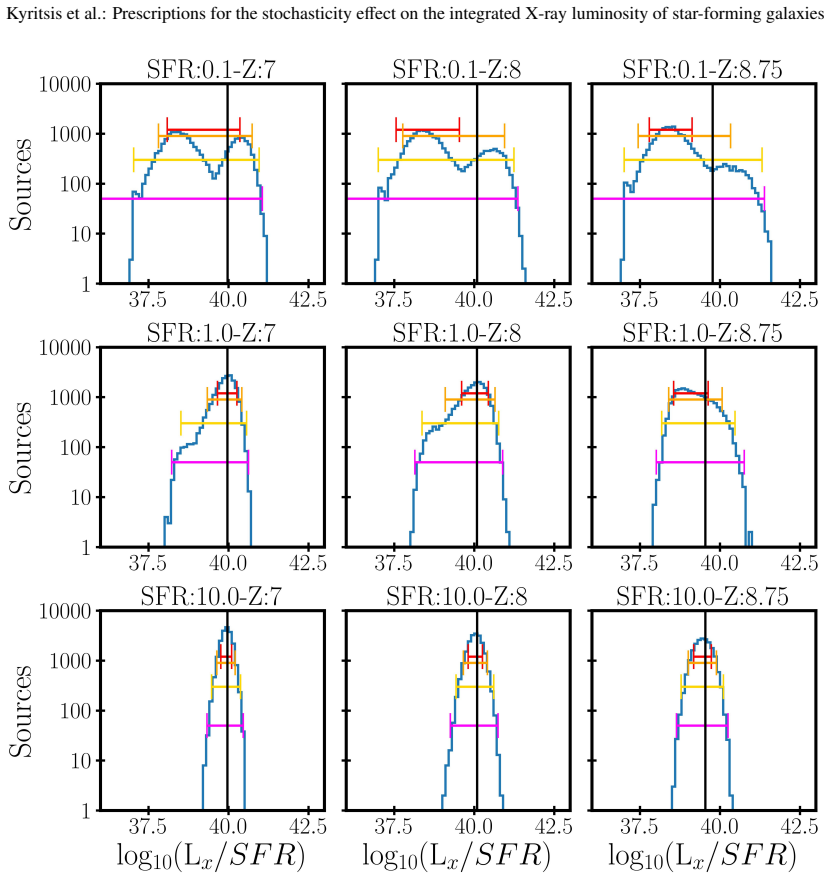
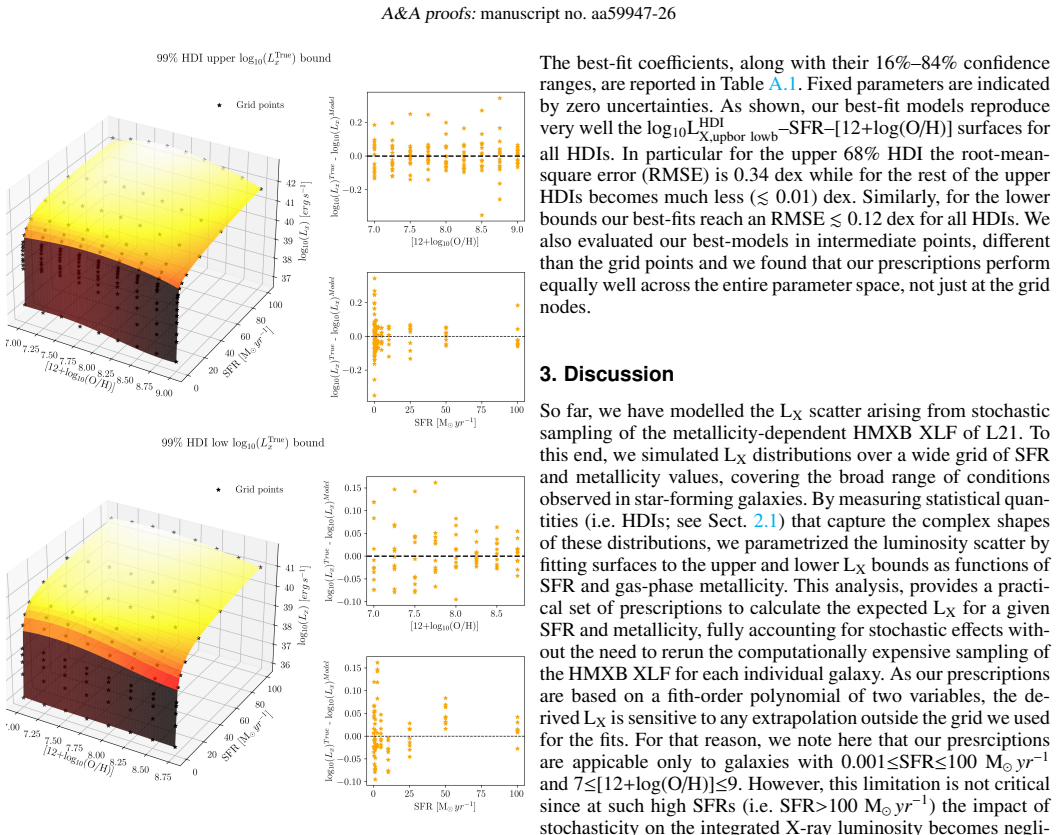
Monte Carlo sampling of the HMXB XLF over a broad SFR-metallicity grid yields Lx probability distributions whose upper and lower envelopes are parametrized by fitted surfaces; these surfaces supply practical formulas that return the stochastic bounds on integrated X-ray luminosity for any input SFR and metallicity.
What carries the argument
Fitted surfaces to the upper and lower bounds of Monte Carlo-derived Lx distributions from the HMXB XLF.
If this is right
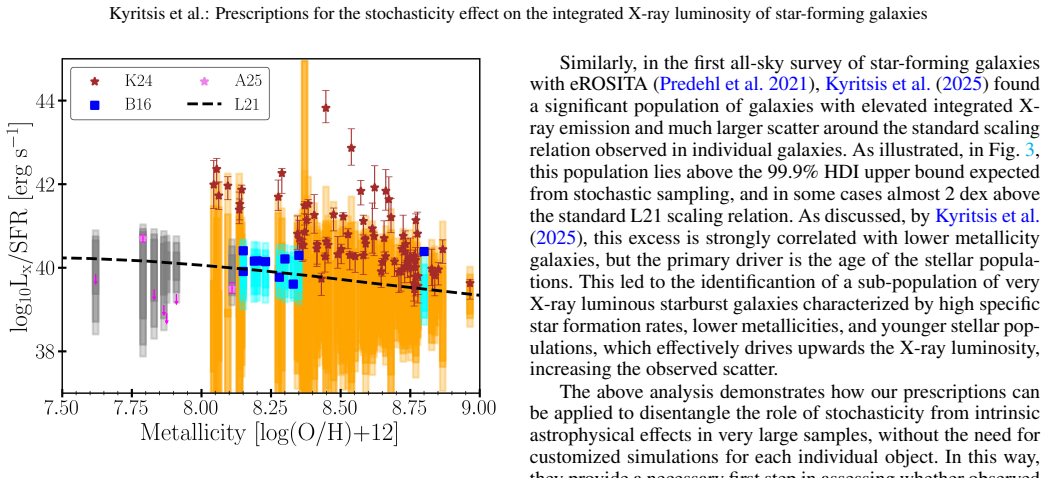
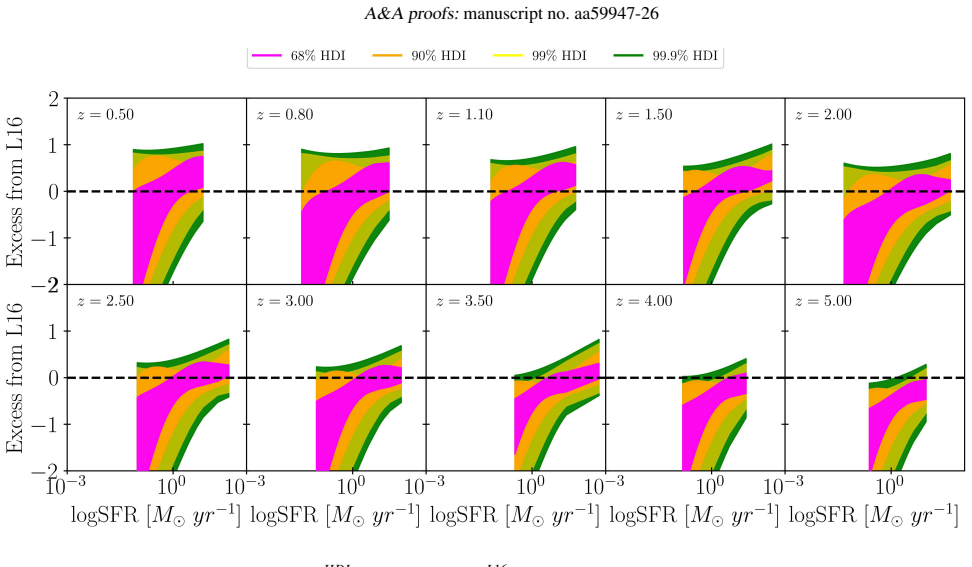
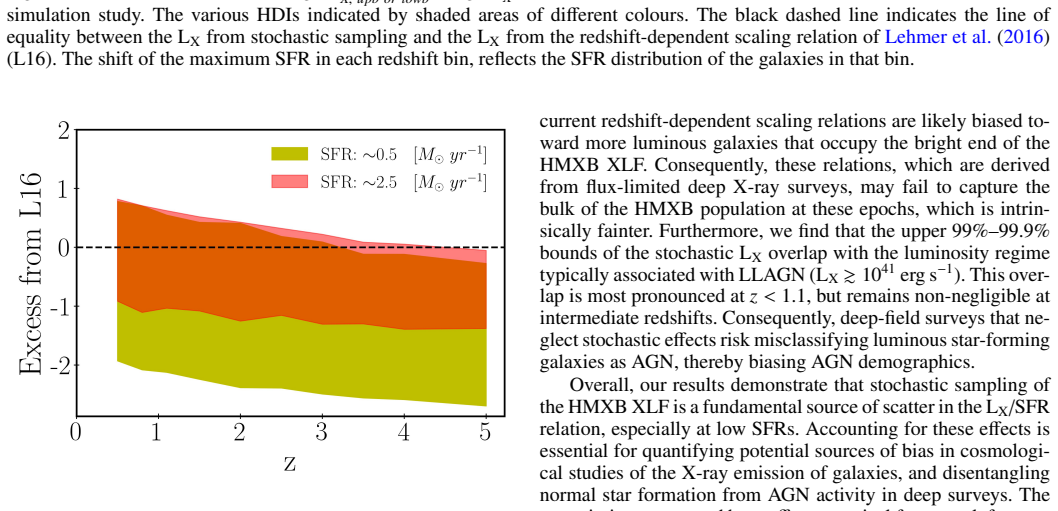
- Stochastic scatter can increase observed Lx by up to 1 dex at low redshift, causing overlap with the low-luminosity AGN regime and biasing source classification.
- Mild redshift evolution of the scatter appears between z=0.5 and z=5, with the smallest scatter near z~2.5.
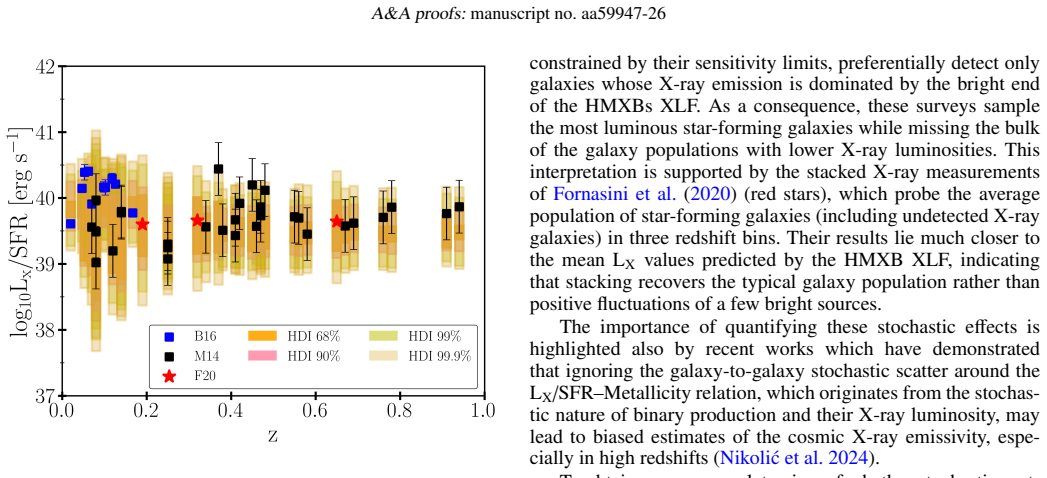
- Flux-limited surveys introduce quantifiable biases in Lx-SFR scaling relations that the prescriptions can correct.
- Outliers in observed Lx can be tested against the stochastic bounds rather than interpreted solely as unusual intrinsic galaxy properties.
Where Pith is reading between the lines
- The prescriptions could be folded into Bayesian source classification pipelines for wide-field X-ray surveys to reduce AGN contamination.
- If the XLF normalization itself varies with redshift or environment, the reported minimum scatter at z~2.5 would shift.
- Analogous stochastic corrections might be derived for other discrete tracers such as supernova rates or gamma-ray burst counts.
- Direct application to individual galaxies would require an estimate of their recent star-formation history rather than a single SFR value.
Load-bearing premise
The underlying shape and normalization of the high-mass X-ray binary luminosity function are treated as fixed and known at all star-formation rates and metallicities.
What would settle it
Comparison of the predicted Lx scatter envelopes against the observed luminosity distribution in a large, SFR- and metallicity-matched sample of star-forming galaxies would show whether the simulated bounds reproduce the data.
Figures
read the original abstract
(abridged) The integrated X-ray luminosity (Lx) of star-forming galaxies is dominated by high-mass X-ray binary (HMXB) populations. The discrete nature of these populations introduces stochastic sampling effects that distort the X-ray Luminosity Function (XLF) and bias observed scaling relations. We investigate how stochastic sampling of the HMXB XLF affects the predicted integrated Lx across a wide range of star-formation and metallicity conditions, quantifying the scatter to provide a statistical framework for interpreting X-ray observations. Using Monte Carlo simulations, we derive Lx distributions over a broad grid of star-formation rate (SFR) and metallicity values. By measuring statistical quantities describing these distributions, we parametrize the luminosity scatter by fitting surfaces to the upper and lower Lx bounds as functions of SFR and metallicity. We provide practical prescriptions to compute the expected Lx for given SFR and metallicity, fully accounting for stochastic effects without rerunning costly XLF sampling. Applying these to local and high-redshift samples shows stochasticity must be considered before attributing Lx differences to intrinsic properties. A simulation study across z=0.5-5 reveals mild redshift evolution of stochastic scatter, with minimum scatter at z~2.5. Our prescriptions quantify biases in scaling relations introduced by flux-limited surveys. At low redshifts, stochastic effects can raise Lx by up to 1 dex, overlapping with the low-luminosity AGN regime and biasing source classification in deep surveys. These prescriptions offer a framework for constraining scatter, quantifying extreme outliers, and refining X-ray source classification in current and future surveys.
Editorial analysis
A structured set of objections, weighed in public.
Referee Report
Summary. The paper uses Monte Carlo sampling of a fixed HMXB XLF across a grid of SFR and metallicity values to generate distributions of integrated Lx. It then fits parametric surfaces to the upper and lower bounds of these distributions, yielding prescriptions for the expected Lx (including stochastic scatter) as functions of SFR and metallicity. These are applied to local/high-z samples and a z=0.5-5 simulation to argue that stochasticity must be accounted for before attributing Lx variations to intrinsic galaxy properties or AGN, with implications for source classification in flux-limited surveys.
Significance. If validated, the prescriptions would supply a practical, reusable tool for incorporating stochastic sampling effects into Lx-SFR-metallicity scaling relations without repeated XLF sampling. The approach of generating independent MC realizations and fitting bounding surfaces is a clear strength, as is the redshift-evolution analysis showing minimum scatter near z~2.5. However, the overall significance is limited by the absence of any propagation of input XLF uncertainties or direct comparison against observed Lx scatter.
major comments (2)
- [Abstract / Methods] Abstract and method description: The HMXB XLF shape and normalization are taken as fixed and known across the entire SFR-metallicity grid, with no propagation of their parameter uncertainties or covariance into the Monte Carlo Lx distributions or the fitted bounding surfaces. Because the prescriptions are derived directly from this single input XLF, any systematic error in it shifts the entire set of surfaces and quoted scatter bounds by a comparable amount.
- [Results / Surface fitting] Surface-fitting procedure (post-MC analysis): No validation metrics, cross-validation, or comparison to observed Lx scatter in real galaxies are reported. The post-hoc fitting of upper/lower bounds to the MC output therefore risks over-fitting the particular simulation realizations without demonstrating that the surfaces recover the true stochastic scatter when tested against independent data.
minor comments (1)
- [Results] The notation for the fitted bounding surfaces (e.g., functional form, coefficients) should be presented with explicit equations and tabulated best-fit parameters for reproducibility.
Simulated Author's Rebuttal
We thank the referee for the constructive report and the recommendation for major revision. Below we respond point-by-point to the two major comments. We agree that both points identify genuine limitations and will revise the manuscript accordingly by adding explicit discussion of the fixed XLF assumption and by including a direct comparison of the predicted scatter to observed local samples.
read point-by-point responses
-
Referee: [Abstract / Methods] Abstract and method description: The HMXB XLF shape and normalization are taken as fixed and known across the entire SFR-metallicity grid, with no propagation of their parameter uncertainties or covariance into the Monte Carlo Lx distributions or the fitted bounding surfaces. Because the prescriptions are derived directly from this single input XLF, any systematic error in it shifts the entire set of surfaces and quoted scatter bounds by a comparable amount.
Authors: We agree that the adopted HMXB XLF (taken from the literature) is held fixed, so that the derived surfaces and scatter bounds are conditional on that specific choice. Our focus is the additional stochastic variance arising from discrete sampling of a known XLF rather than a full marginalization over XLF parameter uncertainties. A complete propagation would require a hierarchical Bayesian treatment that lies outside the present scope. In the revised manuscript we will insert a dedicated paragraph in the Methods section that states this assumption explicitly, quantifies the sensitivity to plausible XLF variations where possible, and cautions users that the quoted bounds do not include XLF systematic errors. revision: partial
-
Referee: [Results / Surface fitting] Surface-fitting procedure (post-MC analysis): No validation metrics, cross-validation, or comparison to observed Lx scatter in real galaxies are reported. The post-hoc fitting of upper/lower bounds to the MC output therefore risks over-fitting the particular simulation realizations without demonstrating that the surfaces recover the true stochastic scatter when tested against independent data.
Authors: The surfaces are analytic fits to the statistical quantiles of the Monte Carlo distributions; because the input model is fully known, the fits reproduce the simulated scatter by construction and we have verified internal goodness-of-fit. We nevertheless accept that external validation against real data is desirable. In the revised manuscript we will add a new subsection that compares the predicted Lx scatter (at fixed SFR and metallicity) with the observed dispersion in local star-forming galaxy samples for which independent SFR and metallicity measurements exist. Any residual differences will be discussed in terms of additional physical or observational scatter sources. revision: yes
Circularity Check
No significant circularity; derivation is simulation-driven and independent
full rationale
The paper runs Monte Carlo realizations of HMXB XLF sampling over an SFR-metallicity grid, measures the resulting Lx distribution statistics, and fits bounding surfaces to produce the prescriptions. This is an independent computational mapping, not a self-definition, fitted-input-as-prediction, or self-citation reduction. No load-bearing step reduces by construction to the input XLF parameters; the output parametrizes stochastic scatter that is not algebraically forced. The approach is self-contained against external simulation benchmarks.
Axiom & Free-Parameter Ledger
Reference graph
Works this paper leans on
-
[1]
2024, A&A, 691, A27
Adamcová, B., Svoboda, J., Kyritsis, E., et al. 2024, A&A, 691, A27
2024
-
[2]
2019, MNRAS, 483, 711
Anastasopoulou, K., Zezas, A., Gkiokas, V ., & Kovlakas, K. 2019, MNRAS, 483, 711
2019
-
[3]
R., Lehmer, B., Fragos, T., et al
Basu-Zych, A. R., Lehmer, B., Fragos, T., et al. 2016, ApJ, 818, 140
2016
-
[4]
R., Lehmer, B
Basu-Zych, A. R., Lehmer, B. D., Hornschemeier, A. E., et al. 2013, ApJ, 774, 152
2013
-
[5]
Brorby, M., Kaaret, P., Prestwich, A., & Mirabel, I. F. 2016, MNRAS, 457, 4081
2016
-
[6]
2024, A&A, 684, A75
Curti, M., Maiolino, R., Curtis-Lake, E., et al. 2024, A&A, 684, A75
2024
-
[7]
2020, MNRAS, 491, 944
Curti, M., Mannucci, F., Cresci, G., & Maiolino, R. 2020, MNRAS, 491, 944
2020
-
[8]
Das, A., Mesinger, A., Pallottini, A., Ferrara, A., & Wise, J. H. 2017, MNRAS, 469, 1166
2017
-
[9]
2017, A&A, 605, A70
Davidzon, I., Ilbert, O., Laigle, C., et al. 2017, A&A, 605, A70
2017
-
[10]
B., Graziani, L., Ciardi, B., et al
Eide, M. B., Graziani, L., Ciardi, B., et al. 2018, MNRAS, 476, 1174
2018
-
[11]
W., Lang, D., & Goodman, J
Foreman-Mackey, D., Hogg, D. W., Lang, D., & Goodman, J. 2013, PASP, 125, 306
2013
-
[12]
M., Civano, F., Fabbiano, G., et al
Fornasini, F. M., Civano, F., Fabbiano, G., et al. 2018, ApJ, 865, 43
2018
-
[13]
M., Civano, F., & Suh, H
Fornasini, F. M., Civano, F., & Suh, H. 2020, MNRAS, 495, 771
2020
-
[14]
D., Lehmer, B
Geda, R., Goulding, A. D., Lehmer, B. D., Greene, J. E., & Kulkarni, A. 2024, ApJ, 965, 67
2024
-
[15]
D., Doore, K., et al
Gilbertson, W., Lehmer, B. D., Doore, K., et al. 2022, ApJ, 926, 28
2022
-
[16]
2022, in Handbook of X- ray and Gamma-ray Astrophysics, ed
Gilfanov, M., Fabbiano, G., Lehmer, B., & Zezas, A. 2022, in Handbook of X- ray and Gamma-ray Astrophysics, ed. C. Bambi & A. Sangangelo, 105
2022
-
[17]
J., & Sunyaev, R
Gilfanov, M., Grimm, H. J., & Sunyaev, R. 2004, MNRAS, 351, 1365
2004
-
[18]
J., Gilfanov, M., & Sunyaev, R
Grimm, H. J., Gilfanov, M., & Sunyaev, R. 2002, A&A, 391, 923
2002
-
[19]
J., Gilfanov, M., & Sunyaev, R
Grimm, H. J., Gilfanov, M., & Sunyaev, R. 2003, MNRAS, 339, 793
2003
-
[20]
Kaaret, P., Feng, H., & Roberts, T. P. 2017, ARA&A, 55, 303
2017
-
[21]
2024, A&A, 688, A159
Kouroumpatzakis, K., Svoboda, J., Zezas, A., et al. 2024, A&A, 688, A159
2024
-
[22]
2020, MNRAS, 494, 5967
Kouroumpatzakis, K., Zezas, A., Sell, P., et al. 2020, MNRAS, 494, 5967
2020
-
[23]
2021, MNRAS, 500, 962
Kouroumpatzakis, K., Zezas, A., Wolter, A., et al. 2021, MNRAS, 500, 962
2021
-
[24]
2022, A&A, 665, A28
Kovlakas, K., Fragos, T., Schaerer, D., & Mesinger, A. 2022, A&A, 665, A28
2022
-
[25]
J., et al
Kovlakas, K., Zezas, A., Andrews, J. J., et al. 2020, MNRAS, 498, 4790
2020
-
[26]
2019, Journal of Open Source Software, 4, 1143
Kumar, R., Carroll, C., Hartikainen, A., & Martin, O. 2019, Journal of Open Source Software, 4, 1143
2019
-
[27]
2025, A&A, 694, A128
Kyritsis, E., Zezas, A., Haberl, F., et al. 2025, A&A, 694, A128
2025
-
[28]
J., Ilbert, O., et al
Laigle, C., McCracken, H. J., Ilbert, O., et al. 2016, ApJS, 224, 24
2016
-
[29]
J., Reines, A
Latimer, L. J., Reines, A. E., Bogdan, A., & Kraft, R. 2021, ApJ, 922, L40
2021
-
[30]
D., Basu-Zych, A
Lehmer, B. D., Basu-Zych, A. R., Mineo, S., et al. 2016, ApJ, 825, 7
2016
-
[31]
D., Eufrasio, R
Lehmer, B. D., Eufrasio, R. T., Basu-Zych, A., et al. 2021, ApJ, 907, 17
2021
-
[32]
D., Eufrasio, R
Lehmer, B. D., Eufrasio, R. T., Tzanavaris, P., et al. 2019, ApJS, 243, 3
2019
-
[33]
D., Ferrell, A
Lehmer, B. D., Ferrell, A. P., Doore, K., et al. 2020, ApJS, 248, 31
2020
-
[34]
D., Tyler, J
Lehmer, B. D., Tyler, J. B., Hornschemeier, A. E., et al. 2015, ApJ, 806, 126
2015
-
[35]
F., et al
Linden, T., Kalogera, V ., Sepinsky, J. F., et al. 2010, ApJ, 725, 1984
2010
-
[36]
& Dickinson, M
Madau, P. & Dickinson, M. 2014, ARA&A, 52, 415
2014
-
[37]
& Fragos, T
Madau, P. & Fragos, T. 2017, ApJ, 840, 39
2017
-
[38]
M., & Moriya, T
Marchant, P., Langer, N., Podsiadlowski, P., Tauris, T. M., & Moriya, T. J. 2016, A&A, 588, A50
2016
-
[39]
2018, MNRAS, 478, 2576
Mezcua, M., Civano, F., Marchesi, S., et al. 2018, MNRAS, 478, 2576
2018
-
[40]
D., Morrison, G
Mineo, S., Gilfanov, M., Lehmer, B. D., Morrison, G. E., & Sunyaev, R. 2014, MNRAS, 437, 1698
2014
-
[41]
2012, MNRAS, 419, 2095
Mineo, S., Gilfanov, M., & Sunyaev, R. 2012, MNRAS, 419, 2095
2012
-
[42]
2023, A&A, 672, A99 Nikoli´c, I., Mesinger, A., Davies, J
Misra, D., Kovlakas, K., Fragos, T., et al. 2023, A&A, 672, A99 Nikoli´c, I., Mesinger, A., Davies, J. E., & Prelogovi´c, D. 2024, A&A, 692, A142
2023
-
[43]
2021, A&A, 647, A1
Predehl, P., Andritschke, R., Arefiev, V ., et al. 2021, A&A, 647, A1
2021
-
[44]
2023, A&A, 678, A164
Riccio, G., Yang, G., Małek, K., et al. 2023, A&A, 678, A164
2023
-
[45]
2024, ApJ, 974, 14
Sacchi, A., Bogdán, Á., Chadayammuri, U., & Ricarte, A. 2024, ApJ, 974, 14
2024
-
[46]
S., Steinhardt, C
Speagle, J. S., Steinhardt, C. L., Capak, P. L., & Silverman, J. D. 2014, ApJS, 214, 15
2014
-
[47]
E., et al
Virtanen, P., Gommers, R., Oliphant, T. E., et al. 2020, Nature Methods, 17, 261
2020
-
[48]
2026, in Encyclopedia of Astrophysics, V ol
Zezas, A. 2026, in Encyclopedia of Astrophysics, V ol. 3, 299–324
2026
-
[49]
2012, A&A, 546, A36 Article number, page 11 of 14 A&A proofs:manuscript no
Zhang, Z., Gilfanov, M., & Bogdán, Á. 2012, A&A, 546, A36 Article number, page 11 of 14 A&A proofs:manuscript no. aa59947-26 Appendix A: Best-fit surfaces for the 68%, 90%, and 99.9% HDIs In this Appendix we present the best-fit surfaces of the upper and lower LX bounds of the 68%, 90%, and 99.9% HDIs together with their residuals as a function of the SFR...
2012
discussion (0)
Sign in with ORCID, Apple, or X to comment. Anyone can read and Pith papers without signing in.