Finite Order Transcendental Entire Solutions of Coupled Fermat-Type Difference Equations in Several Complex Variables
Pith reviewed 2026-07-01 06:42 UTC · model grok-4.3
The pith
Finite-order transcendental entire solutions to coupled Fermat-type difference equations in C^n are completely characterized by the relative sizes of the exponents.
A machine-rendered reading of the paper's core claim, the machinery that carries it, and where it could break.
Core claim
We establish a complete characterization of all finite-order transcendental entire solutions of the coupled Fermat-type difference system in C^n. We have determined that the solution structure is completely determined by the relative sizes of the exponents.
What carries the argument
The coupled Fermat-type difference system consisting of the two equations f1 to the n1 at z plus f2 to the m1 at z plus c equals 1, and f2 to the n2 at z plus f1 to the m2 at z plus c equals 1.
If this is right
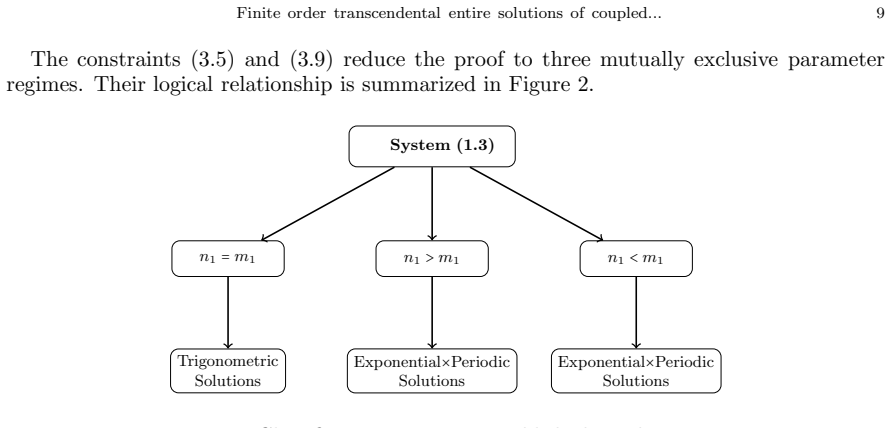
- All finite-order transcendental entire solutions fall into cases distinguished by whether one exponent exceeds, equals, or is less than its counterpart in the paired equation.
- The classification applies uniformly for any dimension n of the complex space.
- No other solution forms are possible once the exponent sizes are fixed.
- The results cover all natural number exponents satisfying ni + mi >= 2.
Where Pith is reading between the lines
- Similar exponent-driven classifications could apply to uncoupled or multi-function systems in several variables.
- The methods might extend to meromorphic solutions or to equations with more than two functions.
- Testing the characterization numerically for small n and specific exponents could confirm the predicted forms.
Load-bearing premise
The functions f1 and f2 are finite-order transcendental entire functions in C^n that satisfy the given coupled system for natural numbers ni, mi with ni + mi >= 2.
What would settle it
A finite-order transcendental entire solution pair in C^n whose form does not match the classification predicted by comparisons of the exponents ni and mi would falsify the complete characterization.
Figures
read the original abstract
Motivated by recent developments in complex difference equations and Nevanlinna theory in several complex variables, we investigate finite-order transcendental entire solutions of the coupled Fermat-type difference system: \beas \begin{cases} f_1^{n_1}(z)+ f_2^{m_1} \left(z+c \right) = 1,\\ f_2^{n_2}(z) + f_1^{m_2} \left(z+c\right) = 1, \end{cases} \eeas where $z,c=(c_1,c_2,\ldots,c_n) \in \mathbb{C}^n$ for various choices of $n_i,m_i$, $i=1,2$. where $n_i,m_i\in\mathbb N$ and $n_i+m_i\ge2$ $(i=1,2)$. Extending the classical investigations of Gross--Yang, Liu, Liu--Cao--Cao and more recently, Xu \emph{et al.} in one and two complex variables, to a general coupled system in $\mathbb C^n$ we establish a complete characterization of all finite-order transcendental entire solutions. We have determined that the solution structure is completely determined by the relative sizes of the exponents.
Editorial analysis
A structured set of objections, weighed in public.
Referee Report
Summary. The paper studies finite-order transcendental entire solutions f1, f2 in C^n to the coupled Fermat-type difference system f1^{n1}(z) + f2^{m1}(z+c) = 1 and f2^{n2}(z) + f1^{m2}(z+c) = 1 (with ni + mi >= 2). It claims a complete characterization of all such solutions, with the explicit form of the solutions determined by case analysis on the relative sizes of the four exponents ni, mi, via difference Nevanlinna estimates in several variables.
Significance. If the classification holds, the work extends one- and two-variable results (Gross-Yang, Liu et al., Xu et al.) to several complex variables and supplies an exhaustive case division that yields explicit algebraic or exponential forms. The finite-order hypothesis is used precisely to control proximity functions after shifts, which is a methodological strength.
minor comments (2)
- Abstract: the sentence beginning 'where z,c=(c1,...)' contains a repeated 'where' and awkward phrasing that should be tightened for readability.
- The system is displayed with \beas, which appears to be a nonstandard environment; standard LaTeX array or cases would improve consistency with the journal style.
Simulated Author's Rebuttal
We thank the referee for their positive assessment of the manuscript, recognition of its extension of prior one- and two-variable results to several complex variables, and recommendation to accept. We are pleased that the finite-order hypothesis and difference Nevanlinna estimates in several variables are viewed as methodological strengths.
Circularity Check
No significant circularity; derivation is self-contained via case analysis on exponents
full rationale
The paper performs a case-by-case classification of solutions to the coupled system by comparing the four exponents ni, mi (with ni + mi ≥ 2). It applies standard difference Nevanlinna estimates in several complex variables to bound orders and force explicit forms. No step reduces a claimed result to a fitted parameter, self-defined quantity, or load-bearing self-citation. The cited prior results (Gross–Yang, Liu et al., Xu et al.) are external and concern one- or two-variable cases; the multi-variable extension uses independent estimates. The finite-order hypothesis is applied directly to control proximity functions after shifts, without smuggling ansatzes or renaming known patterns as new derivations. The central claim therefore rests on external theory rather than internal reduction.
Axiom & Free-Parameter Ledger
Reference graph
Works this paper leans on
-
[1]
T. B. Cao , Difference analogues of the second main theorem for meromor phic functions in several complex variables, Math. Nachr. , 287 (5) (2014), 530-545
2014
-
[2]
T. B. Cao and R. J. Korhonen , A new version of the second main theorem for meromorphic map pings intersecting hyperplanes in several complex variables, J. Math. Anal. Appl. , 444 (2) (2016), 1114-1132
2016
-
[3]
T. B. Cao and L. Xu , Logarithmic difference lemma in several complex variables and partial difference equations, Ann. Mat. Pura. Appl. , 199 (2) (2020), 767-794
2020
-
[4]
P. V. Dovbush , Zalcman-Pang’s lemma in C N , Complex Var. Elliptic Equ. , 66 (12) (2021), 1991-1997
2021
-
[5]
Gross , On the functional equation f n + gn = hn, Amer
F. Gross , On the functional equation f n + gn = hn, Amer. Math. Mon. , 73 (1966), 1093-1096
1966
-
[6]
W. Hao and Q. Zhang , Meromorphic solutions of a class of nonlinear partial diffe rential equations, Indian J. Pure Appl. Math. , 2025: 1-11, doi.org/10.1007/s13226-025-00779-5
-
[7]
P. C. Hu and C. C. Yang , Factorization of holomorphic mappings, Complex variables , 27 (1995), 235- 244
1995
-
[8]
P. C. Hu and C. C. Yang , Uniqueness of meromorphic functions on Cm, Complex variables , 30 (1996), 235-270
1996
-
[9]
P. C. Hu , P. Li and C. C. Yang , Unicity of Meromorphic Mappings. Springer, New York (2003 )
2003
-
[10]
R. J. Korhonen , A difference Picard theorem for meromorphic functions of se veral variables, Comput. Methods Funct. Theory , 12 (1) (2012), 343-361
2012
-
[11]
R. A. Kramer , Zeros of entire functions in several complex variables, Trans. Amer. Math. Soc., 172 (1972), 143 - 160. Finite order transcendental entire solutions of coupled.. . 13
1972
-
[12]
B. Q. Li , On entire solutions of Fermat type partial differential equ ations, Int. J. Math. , 15 (2004), 473-485
2004
-
[13]
B. Q. Li , On meromorphic solutions of f 2 + g2 = 1, Math. Z. , 258 (4) (2008), 763-771
2008
-
[14]
B. Q. Li and L. Yang, Picard type theorems and entire solutions of certain nonli near partial differential equations, J. Geom. Anal. , (2025) 35:234, https://doi.org/10.1007/s12220-025-02 067-4
-
[15]
Li and H
Y. Li and H. Sun , A note on unicity of meromorphic functions in several varia bles, J. Korean Math. Soc., 60 (4) (2023), 859-876
2023
-
[16]
Liu , Meromorphic functions sharing a set with applications to d ifference equations, J
K. Liu , Meromorphic functions sharing a set with applications to d ifference equations, J. Math. Anal. Appl., 359 (2009), 384-393
2009
-
[17]
K. Liu , T. B. Cao and H. Z. Cao , Entire solutions of Fermat type differential-difference eq uations, Arch. Math., 99 (2012), 147-155
2012
-
[18]
L ¨u and W
F. L ¨u and W. Bi , On entire solutions of certain partial differential equati ons, J. Math. Anal. Appl. , 516 (1) (2022), 126476
2022
-
[19]
L ¨u, On meromorphic solutions of certain partial differential e quations, Canadian Math
F. L ¨u, On meromorphic solutions of certain partial differential e quations, Canadian Math. Bull. , 2025:1- 15, doi:10.4153/S0008439525000347
-
[20]
S. Majumder , The Clunie-Hayman theorem in Cm and normality criteria concerning partial derivative, Complex Var. Elliptic Equ. DOI: 10.1080/17476933.2026.2638291
-
[21]
S. Majumder and P. Das , Periodic behavior of meromorphic functions sharing value s with their shifts in several complex variables, Indian J. Pure Appl. Math. https://doi.org/10.1007/s13226-025-00778-6
-
[22]
Majumder , P
S. Majumder , P. Das and D. Pramanik , Sufficient condition for entire solution of a certain type of partial differential equation in Cm, J. Contemp. Math. Anal. , 60 (5) (2025), 378-395
2025
-
[23]
S. Majumder and N. Sarkar , Periodic behavior of meromorphic functions sharing val- ues with their difference operators in several complex varia bles, Indian J. Pure Appl. Math. https://doi.org/10.1007/s13226-025-00916-0
-
[24]
Majumder and N
S. Majumder and N. Sarkar , Bergweiler-Langley lemmas in several complex variables, Bull. Belgian Math. Soc. , 33 (2026), 190-211
2026
-
[25]
S. Majumder and N. Sarkar , Meromorphic functions in several complex variables satis fying partial derivative conditions, Iran J. Sci. , DOI: 10.1007/s40995-026-01986-3
-
[26]
Majumder , N
S. Majumder , N. Sarkar and D. Pramanik , Solutions of complex Fermat-type difference equations in several variables, Houston J. math., 51 (3) (2025), 453-482
2025
-
[27]
Montel , Lecons sur les familles normales de fonctions analytiques et leurs applications, Gauthier- Villars, Paris (1927), 135-136
P. Montel , Lecons sur les familles normales de fonctions analytiques et leurs applications, Gauthier- Villars, Paris (1927), 135-136
1927
-
[28]
E. G. Saleeby , Entire and meromorphic solutions of Fermat type partial di fferential equations, Analysis, 19 (1999), 369-376
1999
-
[29]
E. G. Saleeby , On complex analytic solutions of certain trinomial functi onal and partial differential equations, Aequat. Math., 85 (2013), 553-562
2013
-
[30]
Stoll , Holomorphic functions of finite order in several complex va riables, Conference Board of the Mathematical Sciences, Regional Conference Series in Math ematics 21, Amer
W. Stoll , Holomorphic functions of finite order in several complex va riables, Conference Board of the Mathematical Sciences, Regional Conference Series in Math ematics 21, Amer. Math. Soc., 1974
1974
-
[31]
Stoll , Value distribution on parabolic spaces, Lecture Notes in M ath., 600 (1977), Springer-Verlag
W. Stoll , Value distribution on parabolic spaces, Lecture Notes in M ath., 600 (1977), Springer-Verlag
1977
-
[32]
Taylor and A
R. Taylor and A. Wiles , Ring-theoretic properties of certain Hecke algebra, Ann. Math. , 141 (1995), 553-572
1995
-
[33]
Wiles , Modular elliptic curves and Fermats last theorem, Ann
A. Wiles , Modular elliptic curves and Fermats last theorem, Ann. Math. , 141 (1995), 443–551
1995
-
[34]
Xu and T
L. Xu and T. B. Cao , Solutions of complex Fermat-Type partial difference and di fferential-difference equations, Mediterr. J. Math. , 15 (2018), 227
2018
-
[35]
Xu and T
L. Xu and T. B. Cao , Correction to: Solutions of Complex Fermat-Type Partial D ifference and Differential-Difference Equations, Mediterr. J. Math. , 17 (2020), 1-4
2020
-
[36]
H. Y. Xu , S. Liu and Q. P. Li , Entire solutions for several systems of nonlinear differen ce and partial differential-difference equations of Fermat-type, J. Math. Anal. Appl. , 483 (2) (2020), 123641
2020
-
[37]
H. Y. Xu and H. W ang, Notes on the existence of entire solutions for several part ial differential-difference equations, Bull. Iran. Math. Soc. , 47 (2020), 1477-1489
2020
-
[38]
H. Y. Xu and H. M. Srivastava , A study of transcendental entire solutions of several nonlinear partial differential equations, Proc. Edinb. Math. Soc. Published online 2025:1-41. doi:10.1017/S0013091525100825. 1Department of Mathematics, University of Kalyani, West Ben gal 741235, India. Email address : jhilikbanerjee38@gmail.com, jhilikmath24@klyuniv.ac....
discussion (0)
Sign in with ORCID, Apple, or X to comment. Anyone can read and Pith papers without signing in.