NLTE Spectral Modelling of the Nearby Stripped-Envelope Supernova 2024ehs
Pith reviewed 2026-07-01 01:52 UTC · model grok-4.3
The pith
Nebular spectral modeling of SN 2024ehs indicates a progenitor helium core mass of roughly 6 solar masses.
A machine-rendered reading of the paper's core claim, the machinery that carries it, and where it could break.
Core claim
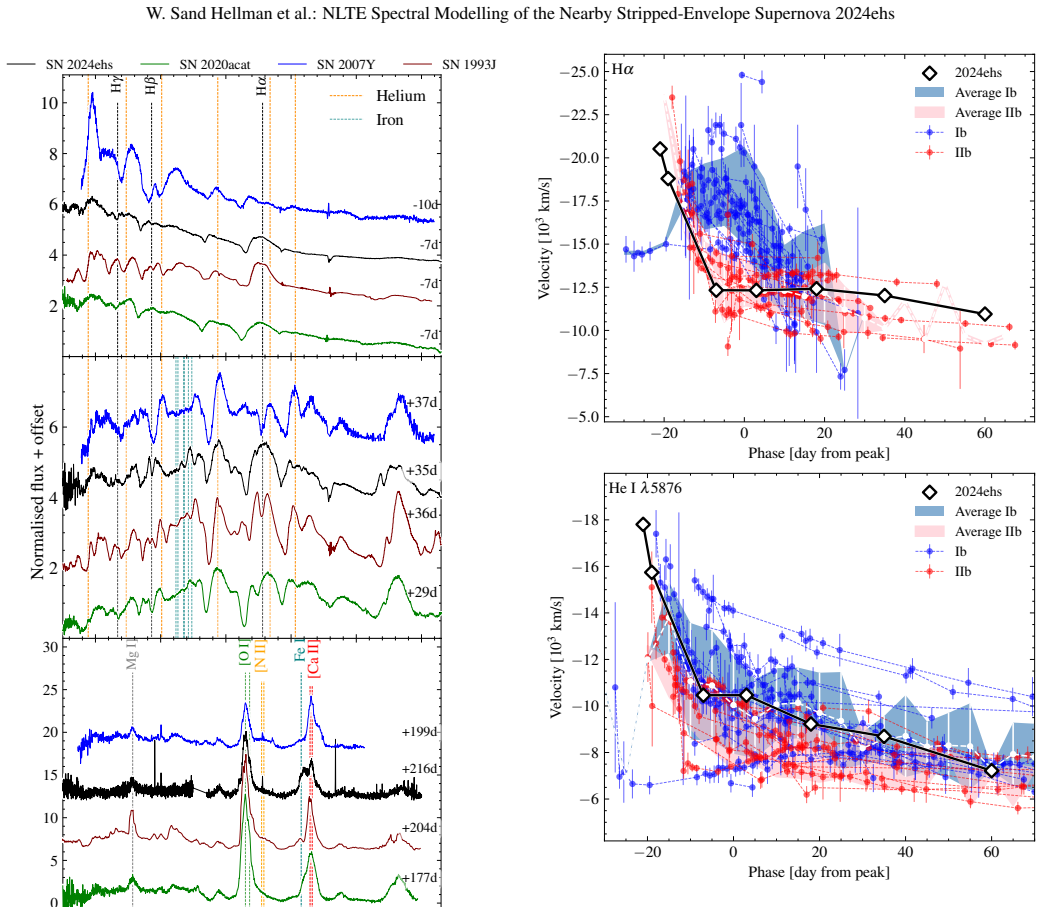
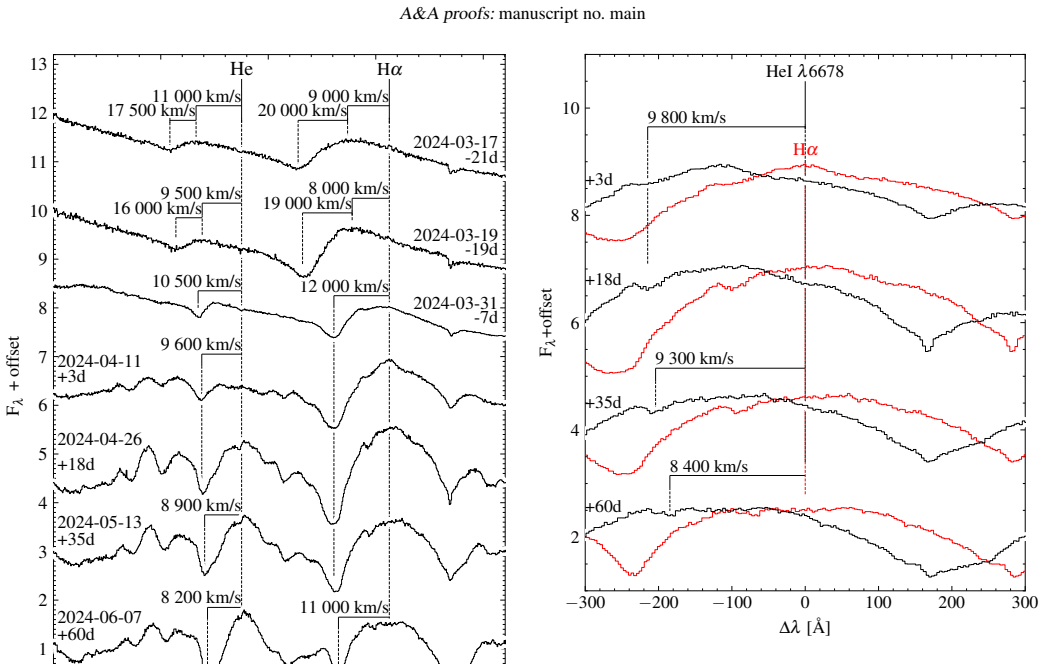
Through detailed NLTE spectral modeling with the SUMO code, the observations of SN 2024ehs reveal a progenitor with a helium core mass of ∼6 M⊙, consistent with a zero-age main-sequence mass of ∼23 M⊙. The supernova exhibits a narrow light-curve peak, rapid decline, weak helium lines, low ejecta mass, high velocities around 20,000 km/s, and a 56Ni mass just below 0.1 M⊙. Photospheric modeling links expansion velocity to the relative strength of different element lines.
What carries the argument
The SUMO radiative transfer code for non-local thermodynamic equilibrium (NLTE) spectral modeling, which is used to fit observed line strengths and derive physical parameters including progenitor core mass from nebular spectra.
Load-bearing premise
The SUMO radiative transfer code provides accurate NLTE spectral models that reliably translate observed line strengths and light-curve shapes into the reported ejecta mass, velocity, and core-mass values without large systematic biases.
What would settle it
A measurement of the helium core mass through an independent method, such as pre-explosion imaging of the progenitor or modeling with a different radiative transfer code, that differs substantially from 6 solar masses.
Figures




read the original abstract
We present a detailed study of the Type IIb supernova 2024ehs, discovered in March 2024 in the nearby galaxy NGC 3443 at a distance of $23.8\pm 0.9$ Mpc. Using photometric and spectroscopic observations spanning 10 months, we analyse its light curve, spectral evolution, and physical properties with the \texttt{SUMO} radiative transfer code. SN 2024ehs exhibits a narrow light-curve peak, rapid decline, and weak helium lines, distinguishing it from typical Type IIb supernovae. Comparisons with other objects, including SNe 1993J and 2020acat, and modelling of nebular spectra suggest a low ejecta mass, high velocities ($\sim$20,000 \kms), and a $^{56}$Ni mass just below $\sim0.1 \, \mathrm{M}_{\odot}$. Furthermore, the nebular spectral models indicate a progenitor with a helium core mass of $\sim 6 \, \mathrm{M}_{\odot}$, consistent with a zero-age main-sequence mass of $\sim 23\, \mathrm{M}_{\odot}$. The composition of spectra is explored through photospheric modelling, finding a link between expansion velocity and the relative strength of different element lines. This work discusses further the diversity of stripped-envelope supernovae and the role of binary interactions for their progenitors, and demonstrates the need for further modelling to refine $^{56}$Ni mass estimates and to understand the physical mechanisms driving their evolution.
Editorial analysis
A structured set of objections, weighed in public.
Referee Report
Summary. The manuscript presents photometric and spectroscopic observations of the nearby Type IIb supernova 2024ehs spanning 10 months, analyzed with the SUMO NLTE radiative transfer code. It reports a narrow light-curve peak, rapid decline, weak helium lines, low ejecta mass, high velocities (~20,000 km/s), 56Ni mass just below 0.1 M_⊙, and nebular modeling that indicates a helium core mass of ~6 M_⊙ (implying ZAMS mass ~23 M_⊙). The work explores composition via photospheric modeling and discusses diversity among stripped-envelope SNe and binary progenitor channels.
Significance. If the central inferences hold, the result adds a well-observed nearby event to the sample of stripped-envelope SNe with inferred low-mass progenitors, supporting binary-interaction scenarios over single-star channels for some IIb events. The linkage between expansion velocity and relative line strengths in the photospheric phase is a potentially useful diagnostic, though its generality remains to be tested.
major comments (2)
- [Abstract, §4] Abstract and §4 (nebular spectral modelling): the claim that the models 'indicate a progenitor with a helium core mass of ∼6 M_⊙' is load-bearing for the main physical conclusion, yet the text provides no quantitative validation (recovery tests on synthetic spectra, cross-code comparisons, or sensitivity to density profile/ionization assumptions) that would demonstrate the mapping from observed line strengths to core mass is unbiased at the reported low ejecta mass and high velocity. Without such tests the inference cannot be assessed for systematic offset.
- [§3, §5] §3 (light-curve and spectral evolution) and §5 (photospheric modelling): the reported 56Ni mass 'just below ∼0.1 M_⊙' and ejecta mass are derived from SUMO fits, but no formal uncertainties, degeneracy analysis, or comparison to independent codes (e.g., TARDIS or CMFGEN) are shown; this directly affects the reliability of the core-mass scaling.
minor comments (3)
- [Introduction] The distance modulus and its uncertainty (23.8 ± 0.9 Mpc) are stated without reference to the method or source catalog; this should be cited explicitly.
- [Figures] Figure captions and axis labels in the spectral comparison panels should include the exact epochs and the velocity scale used for the model overlays.
- [§2] The statement that the object is 'distinguishing it from typical Type IIb supernovae' would benefit from a quantitative metric (e.g., peak luminosity or decline rate relative to the sample in Table 1).
Simulated Author's Rebuttal
We thank the referee for the constructive and detailed comments. We address the two major comments point by point below, indicating where revisions will be made to the manuscript.
read point-by-point responses
-
Referee: [Abstract, §4] Abstract and §4 (nebular spectral modelling): the claim that the models 'indicate a progenitor with a helium core mass of ∼6 M_⊙' is load-bearing for the main physical conclusion, yet the text provides no quantitative validation (recovery tests on synthetic spectra, cross-code comparisons, or sensitivity to density profile/ionization assumptions) that would demonstrate the mapping from observed line strengths to core mass is unbiased at the reported low ejecta mass and high velocity. Without such tests the inference cannot be assessed for systematic offset.
Authors: We agree that the nebular modeling inference would be strengthened by explicit validation. The current analysis matches observed line strengths with SUMO models at the reported ejecta mass and velocity, but the manuscript does not contain recovery tests or cross-code comparisons. In the revision we will add a dedicated paragraph in §4 discussing the sensitivity of the core-mass mapping to the adopted density profile and ionization assumptions, and we will qualify the ∼6 M_⊙ helium-core (∼23 M_⊙ ZAMS) statement in both the abstract and §4 as model-dependent with the associated systematic uncertainties noted. revision: yes
-
Referee: [§3, §5] §3 (light-curve and spectral evolution) and §5 (photospheric modelling): the reported 56Ni mass 'just below ∼0.1 M_⊙' and ejecta mass are derived from SUMO fits, but no formal uncertainties, degeneracy analysis, or comparison to independent codes (e.g., TARDIS or CMFGEN) are shown; this directly affects the reliability of the core-mass scaling.
Authors: We concur that formal uncertainties and degeneracy analysis are desirable. The quoted 56Ni mass is already presented as approximate ('just below ∼0.1 M_⊙') and the ejecta mass is obtained from the same SUMO fits. In the revised manuscript we will expand the description in §5 to outline the fitting procedure, identify the principal parameter degeneracies (particularly between ejecta mass, 56Ni mass and velocity), and provide a qualitative discussion of how these values compare with literature results from other codes. A quantitative cross-code comparison lies outside the present scope and would require substantial additional computational resources. revision: partial
Circularity Check
No circularity: standard radiative-transfer fitting to spectra
full rationale
The paper applies the SUMO NLTE code to fit observed nebular spectra and light curves of SN 2024ehs, yielding best-fit parameters including a helium core mass of ~6 M⊙. No quoted step shows a self-definitional loop (e.g., mass defined via the same line ratios it is said to predict), a fitted parameter relabeled as an independent prediction, or a load-bearing claim resting solely on self-citation. The central inference is an ordinary model-to-data comparison whose validity rests on external validation of SUMO rather than on any internal reduction to the paper's own inputs.
Axiom & Free-Parameter Ledger
free parameters (3)
- ejecta mass
- 56Ni mass
- helium core mass
axioms (2)
- domain assumption The SUMO code accurately models NLTE radiative transfer in supernova atmospheres
- domain assumption Distance to NGC 3443 is 23.8 ± 0.9 Mpc
Reference graph
Works this paper leans on
-
[1]
Arnett, W. D. 1982, ApJ, 253, 785, doi:10.1086/159681
-
[2]
1934, Proceedings of the National Academy of Science, 20, 254, doi:10.1073/pnas.20.5.254
Baade, W., & Zwicky, F. 1934, Proceedings of the National Academy of Science, 20, 254, doi:10.1073/pnas.20.5.254
-
[3]
2024, MNRAS, 533, 1251, doi:10.1093/mnras/stae1811
Barmentloo, S., Jerkstrand, A., Iwamoto, K., et al. 2024, MNRAS, 533, 1251, doi:10.1093/mnras/stae1811
-
[4]
Bellm, E. C., Kulkarni, S. R., Graham, M. J., et al. 2019, PASP, 131, 018002, doi:10.1088/1538-3873/aaecbe
-
[5]
Blinnikov, S. I., Eastman, R., Bartunov, O. S., Popolitov, V . A., & Woosley, S. E. 1998, The Astrophysical Journal, 496, 454–472, doi:10.1086/305375
-
[6]
2017, Supernova Explosions (Springer Berlin, Hei- delberg), doi:10.1007/978-3-662-55054-0
Branch, D., & Wheeler, J. 2017, Supernova Explosions (Springer Berlin, Hei- delberg), doi:10.1007/978-3-662-55054-0
-
[8]
W., Inserra, C., Fraser, M., et al
Chen, T. W., Inserra, C., Fraser, M., et al. 2018, ApJ, 867, L31, doi:10.3847/ 2041-8213/aaeb2e
2018
-
[9]
Chevalier, R. A., & Soderberg, A. M. 2010, The Astrophysical Journal Letters, 711, L40, doi:10.1088/2041-8205/711/1/L40
-
[10]
W., Bloom, J
Coughlin, M. W., Bloom, J. S., Nir, G., et al. 2023, ApJS, 267, 31, doi:10. 3847/1538-4365/acdee1
2023
-
[11]
M., Riddle, R., et al
Dekany, R., Smith, R. M., Riddle, R., et al. 2020, PASP, 132, 038001, doi:10. 1088/1538-3873/ab4ca2
2020
-
[12]
Dessart, L., Hillier, D. J., Li, C., & Woosley, S. 2012, MNRAS, 424, 2139, doi:10.1111/j.1365-2966.2012.21374.x
-
[13]
Dessart, L., Hillier, D. J., Livne, E., et al. 2011, Monthly Notices of the Royal As- tronomical Society, 414, 2985, doi:10.1111/j.1365-2966.2011.18598. x
-
[14]
Dessart, L., Hillier, D. J., Woosley, S. E., & Kuncarayakti, H. 2023, A&A, 677, A7, doi:10.1051/0004-6361/202346626
-
[15]
2015, A&A, 580, A142, doi:10
Ergon, M., Jerkstrand, A., Sollerman, J., et al. 2015, A&A, 580, A142, doi:10. 1051/0004-6361/201424592
2015
-
[16]
2023, Lightcurve and spectral mod- elling of the Type IIb SN 2020acat
Ergon, M., Lundqvist, P., Fransson, C., et al. 2023, Lightcurve and spectral mod- elling of the Type IIb SN 2020acat. Evidence for a strong Ni bubble effect on the diffusion time.https://arxiv.org/abs/2308.07158
-
[17]
E., Sukhbold, T., & Janka, H
Ertl, T., Woosley, S. E., Sukhbold, T., & Janka, H. T. 2020, ApJ, 890, 51, doi:10. 3847/1538-4357/ab6458
2020
-
[18]
Falk, S. W., & Arnett, W. D. 1977, ApJS, 33, 515, doi:10.1086/190440
-
[19]
Filippenko, A. V . 1988, AJ, 96, 1941, doi:10.1086/114940 —. 1997, ARA&A, 35, 309, doi:10.1146/annurev.astro.35.1.309
-
[20]
V ., Matheson, T., & Ho, L
Filippenko, A. V ., Matheson, T., & Ho, L. C. 1993, ApJ, 415, L103, doi:10. 1086/187043
1993
-
[21]
D., Azalee Bostroem, K., Van Dyk, S
Fox, O. D., Azalee Bostroem, K., Van Dyk, S. D., et al. 2014, ApJ, 790, 17, doi:10.1088/0004-637X/790/1/17
-
[22]
Fransson, C., & Chevalier, R. A. 1989, ApJ, 343, 323, doi:10.1086/167707
-
[23]
2017, in Handbook of Supernovae, ed
Gal-Yam, A. 2017, in Handbook of Supernovae, ed. A. W. Alsabti & P. Murdin (Springer), 195, doi:10.1007/978-3-319-21846-5_35
-
[24]
2023, ApJ, 957, 100, doi:10
Gangopadhyay, A., Maeda, K., Singh, A., et al. 2023, ApJ, 957, 100, doi:10. 3847/1538-4357/acfa94
2023
-
[26]
Graham, M. J., Kulkarni, S. R., Bellm, E. C., et al. 2019, PASP, 131, 078001, doi:10.1088/1538-3873/ab006c
-
[27]
Hachinger, S., Mazzali, P. A., Taubenberger, S., et al. 2012, MNRAS, 422, 70, doi:10.1111/j.1365-2966.2012.20464.x
-
[28]
2011, PhD thesis, Stockholm University —
Jerkstrand, A. 2011, PhD thesis, Stockholm University —. 2017, in Handbook of Supernovae, ed. A. W. Alsabti & P. Murdin, 795, doi:10.1007/978-3-319-21846-5_29
-
[29]
J., et al
Jerkstrand, A., Ergon, M., Smartt, S. J., et al. 2015, A&A, 573, A12, doi:10. 1051/0004-6361/201423983
2015
-
[30]
2012, A&A, 546, A28, doi:10
Jerkstrand, A., Fransson, C., Maguire, K., et al. 2012, A&A, 546, A28, doi:10. 1051/0004-6361/201219528
2012
-
[31]
Jerkstrand, A., Milisavljevic, D., & Müller, B. 2025, Core-collapse supernovae. https://arxiv.org/abs/2503.01321
-
[32]
Jerkstrand, A., Smartt, S. J., Fraser, M., et al. 2014, MNRAS, 439, 3694, doi:10. 1093/mnras/stu221 Krtiˇcka, J., & Kubát, J. 2014, A&A, 567, A63, doi:10.1051/0004-6361/ 201423845
-
[33]
Kumar, B., Singh, A., Sahu, D. K., & Anupama, G. C. 2022, ApJ, 927, 61, doi:10.3847/1538-4357/ac4bb9
-
[34]
Kumar, B., Pandey, S. B., Sahu, D. K., et al. 2013, Monthly Notices of the Royal Astronomical Society, 431, 308–321, doi:10.1093/mnras/stt162
-
[35]
2024, Transient Name Server Classification Report, 2024-872, 1
Leadbeater, R. 2024, Transient Name Server Classification Report, 2024-872, 1
2024
-
[36]
2024, Transient Name Server Classification Report, 2024-724, 1
Li, L., Cai, Y ., Zhai, Q., et al. 2024, Transient Name Server Classification Report, 2024-724, 1
2024
-
[37]
Liu, Y .-Q., Modjaz, M., Bianco, F. B., & Graur, O. 2016, The Astrophysical Journal, 827, 90, doi:10.3847/0004-637X/827/2/90
-
[38]
S., Fremling, C., & Kasliwal, M
Mandigo-Stoba, M. S., Fremling, C., & Kasliwal, M. 2022, The Journal of Open Source Software, 7, 3612, doi:10.21105/joss.03612
-
[39]
2024, ARA&A, 62, 21, doi:10.1146/ annurev-astro-052722-105936
Marchant, P., & Bodensteiner, J. 2024, ARA&A, 62, 21, doi:10.1146/ annurev-astro-052722-105936
2024
-
[40]
J., Laher, R
Masci, F. J., Laher, R. R., Rusholme, B., et al. 2019, PASP, 131, 018003, doi:10. 1088/1538-3873/aae8ac
2019
-
[41]
Matheson, T., Filippenko, A. V ., Ho, L. C., Barth, A. J., & Leonard, D. C. 2000, AJ, 120, 1499, doi:10.1086/301519
-
[42]
Maund, J. R., Smartt, S. J., Kudritzki, R. P., Podsiadlowski, P., & Gilmore, G. F. 2004, Nature, 427, 129–131, doi:10.1038/nature02161
-
[43]
R., Arcavi, I., Ergon, M., et al
Maund, J. R., Arcavi, I., Ergon, M., et al. 2015, Monthly Notices of the Royal Astronomical Society, 454, 2580, doi:10.1093/mnras/stv2098
-
[44]
A., Teffs, J., et al
Medler, K., Mazzali, P. A., Teffs, J., et al. 2022, MNRAS, 513, 5540, doi:10. 1093/mnras/stac1192
2022
-
[45]
1941, PASP, 53, 224, doi:10.1086/125315
Minkowski, R. 1941, PASP, 53, 224, doi:10.1086/125315
-
[46]
Morales-Garoffolo, A., Elias-Rosa, N., Bersten, M., et al. 2015, Monthly No- tices of the Royal Astronomical Society, 454, 95–114, doi:10.1093/mnras/ stv1972
-
[47]
B., Kumar, A., Kumar, B., et al
Pandey, S. B., Kumar, A., Kumar, B., et al. 2021, MNRAS, 507, 1229, doi:10. 1093/mnras/stab1889
2021
-
[48]
1994, A&A, 282, 731
Patat, F., Barbon, R., Cappellaro, E., & Turatto, M. 1994, A&A, 282, 731
1994
-
[49]
Prochaska, J. X., Hennawi, J. F., Westfall, K. B., et al. 2020a, arXiv e-prints, arXiv:2005.06505.https://arxiv.org/abs/2005.06505
-
[50]
X., Hennawi, J., Cooke, R., et al
Prochaska, J. X., Hennawi, J., Cooke, R., et al. 2020b, pypeit/PypeIt: Release 1.0.0, v1.0.0, Zenodo, doi:10.5281/zenodo.3743493
-
[51]
Prochaska, J. X., Hennawi, J. F., Westfall, K. B., et al. 2020, Journal of Open Source Software, 5, 2308, doi:10.21105/joss.02308
-
[52]
S., & Najarro, F
Puls, J., Vink, J. S., & Najarro, F. 2008, A&A Rev., 16, 209, doi:10.1007/ s00159-008-0015-8
2008
-
[53]
R., et al
Roy, R., Kumar, B., Maund, J. R., et al. 2013, MNRAS, 434, 2032, doi:10. 1093/mnras/stt1148
2013
-
[54]
Ryder, S. D., Dyk, S. D. V ., Fox, O. D., et al. 2018, The Astrophysical Journal, 856, 83, doi:10.3847/1538-4357/aaaf1e
-
[55]
2013, Monthly Notices of the Royal Astronomical Society, 433, doi:10.1093/mnras/stt647
Sahu, D., Anupama, G., & Chakradhari, N. 2013, Monthly Notices of the Royal Astronomical Society, 433, doi:10.1093/mnras/stt647
-
[56]
Sana, H., & Evans, C. J. 2011, in IAU Symposium, V ol. 272, Active OB Stars:
2011
-
[57]
Structure, Evolution, Mass Loss, and Critical Limits, ed. C. Neiner, G. Wade, G. Meynet, & G. Peters, 474–485, doi:10.1017/S1743921311011124
-
[58]
E., de Koter, A., et al
Sana, H., de Mink, S. E., de Koter, A., et al. 2012, Science, 337, 444, doi:10. 1126/science.1223344
2012
-
[59]
Shenar, T. 2024, arXiv e-prints, arXiv:2410.04436, doi:10.48550/arXiv. 2410.04436
work page internal anchor Pith review doi:10.48550/arxiv 2024
-
[60]
W., Young, D
Shingles, L., Smith, K. W., Young, D. R., et al. 2021, Transient Name Server AstroNote, 7, 1
2021
-
[61]
Smith, K. W., Smartt, S. J., Young, D. R., et al. 2020, PASP, 132, 085002, doi:10.1088/1538-3873/ab936e
-
[62]
W., Young, D
Smith, K. W., Young, D. R., Nicholl, M., et al. 2024, Transient Name Server AstroNote, 78, 1
2024
-
[63]
Smith, N., Li, W., Filippenko, A. V ., & Chornock, R. 2011, Monthly Notices of the Royal Astronomical Society, 412, 1522, doi:10.1111/j.1365-2966. 2011.17229.x
-
[64]
Stritzinger, M., Mazzali, P., Phillips, M. M., et al. 2009, The Astrophysical Jour- nal, 696, 713–728, doi:10.1088/0004-637x/696/1/713
-
[65]
2024, Transient Name Server Discov- ery Report, 2024-701, 1
Tonry, J., Denneau, L., Weiland, H., et al. 2024, Transient Name Server Discov- ery Report, 2024-701, 1
2024
-
[66]
L., Denneau, L., Flewelling, H., et al
Tonry, J. L., Denneau, L., Flewelling, H., et al. 2018, ApJ, 867, 105, doi:10. 3847/1538-4357/aae386
2018
-
[67]
Valenti, S., Fraser, M., Benetti, S., et al. 2011, Monthly Notices of the Royal As- tronomical Society, 416, 3138, doi:10.1111/j.1365-2966.2011.19262. x van Baal, B. F. A., Jerkstrand, A., Wongwathanarat, A., & Janka, H.-T. 2024, MNRAS, 532, 4106, doi:10.1093/mnras/stae1603 van der Walt, S., Crellin-Quick, A., & Bloom, J. 2019, The Journal of Open Source ...
-
[68]
2021, ApJ, 908, 150, doi:10
Williamson, M., Kerzendorf, W., & Modjaz, M. 2021, ApJ, 908, 150, doi:10. 3847/1538-4357/abd244
2021
-
[69]
Woosley, S. E. 2019, ApJ, 878, 49, doi:10.3847/1538-4357/ab1b41
-
[70]
Woosley, S. E., Eastman, R. G., Weaver, T. A., & Pinto, P. A. 1994, ApJ, 429, 300, doi:10.1086/174319
-
[71]
2017, ApJ, 840, 10, doi:10.3847/ 1538-4357/aa6afe Article number, page 16
Yoon, S.-C., Dessart, L., & Clocchiatti, A. 2017, ApJ, 840, 10, doi:10.3847/ 1538-4357/aa6afe Article number, page 16
2017
discussion (0)
Sign in with ORCID, Apple, or X to comment. Anyone can read and Pith papers without signing in.