Scalarization and descalarization in hyperbolic encounters of black holes
Pith reviewed 2026-07-01 01:19 UTC · model grok-4.3
The pith
Black holes in hyperbolic encounters temporarily scalarize even when their static parameters forbid scalar hair, and spin changes can make it permanent.
A machine-rendered reading of the paper's core claim, the machinery that carries it, and where it could break.
Core claim
Configurations which initially cannot sustain a scalar hair temporarily scalarize during an encounter and thereby exhibit dynamical scalarization. The change in the spin magnitude of black holes during certain hyperbolic encounters can lead to permanent spin-induced scalarization (or descalarization). This occurs in the decoupling limit for both positive and negative couplings with zero and non-zero spins.
What carries the argument
Evolution of the scalar field on a fixed background metric of the black hole binary in quadratic scalar Gauss-Bonnet gravity.
Load-bearing premise
The scalar field does not back-react on the spacetime geometry.
What would settle it
A calculation or simulation that includes the scalar field's effect on the metric and shows the absence of dynamical scalarization in the same setups would falsify the decoupling-limit results.
Figures






read the original abstract
We use numerical relativity to study the scalar field evolution sourced by hyperbolic encounters of black holes in quadratic scalar Gauss-Bonnet gravity. In this theory, single black holes are known to acquire a scalar hair through scalarization for certain values of their mass and spin. We work in the decoupling limit and evolve the scalar field on top of a background metric. Seeding binary black holes with an initial scalar field, we find that configurations which initially cannot sustain a scalar hair temporarily scalarize during an encounter and thereby exhibit dynamical scalarization. This is possible for both positive and negative couplings between the scalar field and curvature in black hole binaries with zero and non-zero initial spins, respectively. Furthermore, we find that the change in the spin magnitude of black holes during certain hyperbolic encounters can lead to permanent spin-induced scalarization (or descalarization), which we refer to as spin-up (de)scalarization.
Editorial analysis
A structured set of objections, weighed in public.
Referee Report
Summary. The paper uses numerical relativity simulations in the decoupling limit to evolve a scalar field on a fixed binary black hole background in quadratic scalar-Gauss-Bonnet gravity. It reports that black hole configurations initially unable to sustain scalar hair can temporarily scalarize during hyperbolic encounters (dynamical scalarization) for both positive and negative couplings, and that spin changes during the encounter can induce permanent spin-induced scalarization or descalarization.
Significance. If the decoupling limit remains valid, the results identify new dynamical channels for scalar hair formation and loss in black hole encounters, extending scalarization phenomenology beyond isolated or orbiting black holes. This could inform strong-field tests of modified gravity and potential gravitational-wave signatures from close encounters.
major comments (1)
- [Abstract and decoupling-limit setup] The decoupling limit (invoked to evolve the scalar on a fixed metric without backreaction) is load-bearing for both the dynamical scalarization and spin-induced (de)scalarization claims. When the scalar reaches O(1) amplitudes, the neglected scalar stress-energy could alter curvature invariants, orbital dynamics, and final spins, potentially shifting or eliminating the reported thresholds. The manuscript should supply quantitative estimates of backreaction (e.g., via the magnitude of the scalar stress-energy relative to the background curvature) or convergence tests against the full Einstein-scalar system in representative regimes.
minor comments (1)
- [Abstract] The abstract summarizes the central numerical findings but omits any mention of error bars, resolution studies, or validation against known single-BH scalarization thresholds; adding a brief statement on these would strengthen the presentation.
Simulated Author's Rebuttal
We thank the referee for the positive assessment of the significance of our results and for the detailed major comment on the decoupling limit. We address the comment below.
read point-by-point responses
-
Referee: [Abstract and decoupling-limit setup] The decoupling limit (invoked to evolve the scalar on a fixed metric without backreaction) is load-bearing for both the dynamical scalarization and spin-induced (de)scalarization claims. When the scalar reaches O(1) amplitudes, the neglected scalar stress-energy could alter curvature invariants, orbital dynamics, and final spins, potentially shifting or eliminating the reported thresholds. The manuscript should supply quantitative estimates of backreaction (e.g., via the magnitude of the scalar stress-energy relative to the background curvature) or convergence tests against the full Einstein-scalar system in representative regimes.
Authors: We agree that the decoupling limit is a central approximation whose validity must be assessed, especially when scalar amplitudes reach O(1). In the revised manuscript we will add a dedicated discussion that supplies quantitative estimates of backreaction. These will consist of direct comparisons between the magnitude of the scalar stress-energy tensor and the background curvature invariants (Ricci scalar and Gauss-Bonnet invariant) evaluated at the times and locations of peak scalarization for representative encounters. This will allow readers to judge the regimes in which the reported dynamical and spin-induced (de)scalarization channels are expected to survive in the fully coupled theory. We note that full convergence tests against the coupled Einstein-scalar system lie outside the present scope, as they would require an entirely different numerical infrastructure. revision: yes
Circularity Check
No circularity: numerical evolution outputs independent of inputs
full rationale
The paper reports outcomes of numerical relativity simulations evolving a scalar field on a fixed binary black hole background in the decoupling limit. No equations reduce a claimed prediction to a fitted parameter or self-definition by construction. No load-bearing self-citations, uniqueness theorems, or ansatzes imported from prior author work are quoted. Results are framed as simulation findings rather than renamings or statistical forcings, satisfying the criteria for a self-contained derivation chain.
Axiom & Free-Parameter Ledger
free parameters (2)
- scalar-curvature coupling strength
- initial black hole masses and spins
axioms (1)
- domain assumption Decoupling limit: scalar field evolved on fixed background metric
Reference graph
Works this paper leans on
-
[1]
dumbbell
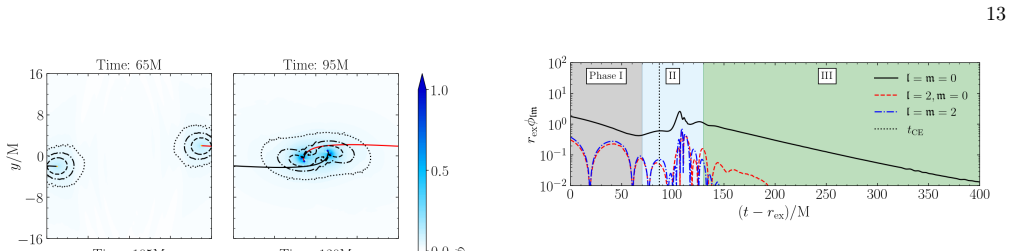
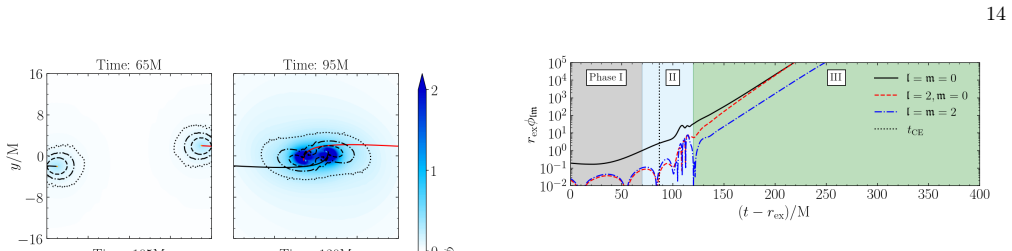
Scalarized black holes:β=−3.50 Here we present the CtrlBm350Xp07 run. In this case, the dimensionless coupling, β = −3.50, is chosen to be large so that the BHs scalarize. Recall that the initial scalar field amplitude isc0 = 0.1; see Sec IV. In Fig. 10, we plot snapshots of the scalar field in the orbital plane at four different times. The value of the s...
-
[2]
In this simulation, the BHs undergo a single zoom-whirl before merging
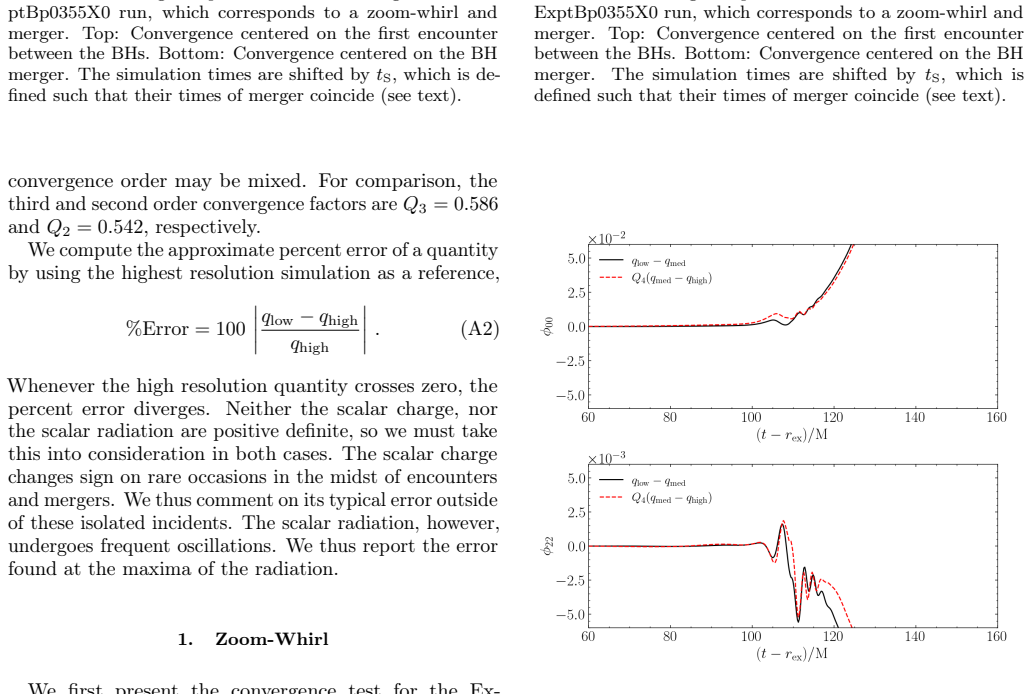
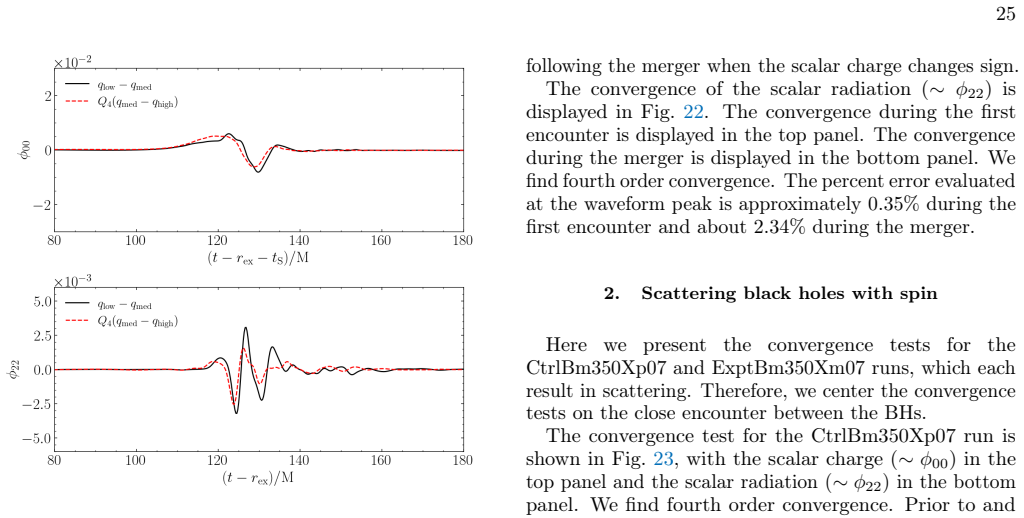
Zoom-Whirl We first present the convergence test for the Ex- ptBp0355X0 run. In this simulation, the BHs undergo a single zoom-whirl before merging. Depending on the resolution, the separation of the BHs during this inter- mediate phase varies. The BH trajectories realign as they approach merger. However, this variation leads to a shift in the merger time...
-
[3]
Therefore, we center the convergence tests on the close encounter between the BHs
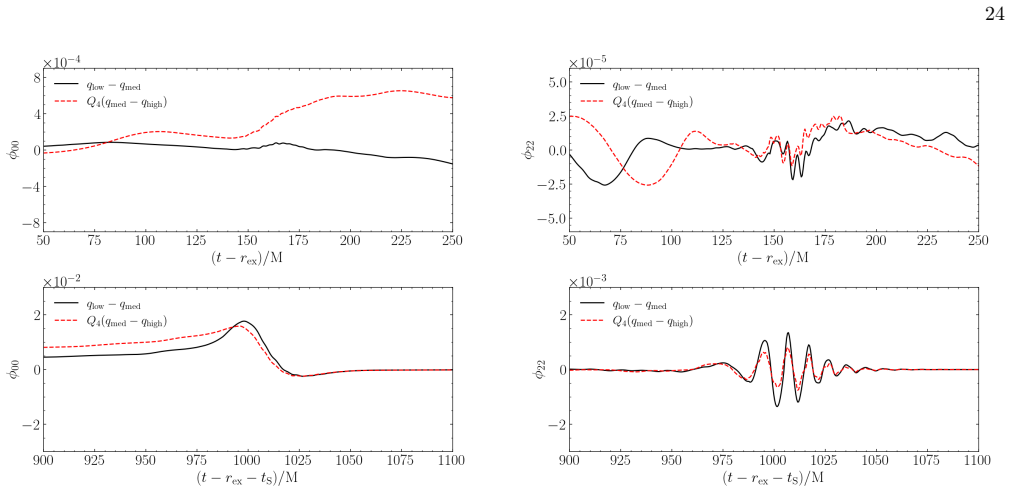
Scattering black holes with spin Here we present the convergence tests for the CtrlBm350Xp07 and ExptBm350Xm07 runs, which each result in scattering. Therefore, we center the convergence tests on the close encounter between the BHs. The convergence test for the CtrlBm350Xp07 run is shown in Fig. 23, with the scalar charge (∼ϕ 00) in the top panel and the ...
-
[4]
C. M. Will, The Confrontation between General Rela- tivity and Experiment, Living Rev. Rel.17, 4 (2014), arXiv:1403.7377 [gr-qc]
Pith/arXiv arXiv 2014
-
[5]
Bertiet al., Testing General Relativity with Present and Future Astrophysical Observations, Class
E. Bertiet al., Testing General Relativity with Present and Future Astrophysical Observations, Class. Quant. Grav.32, 243001 (2015), arXiv:1501.07274 [gr-qc]
Pith/arXiv arXiv 2015
-
[6]
C. M. Will,Theory and Experiment in Gravitational Physics(Cambridge University Press, 2018)
2018
- [7]
-
[8]
B. P. Abbottet al.(LIGO Scientific, Virgo), Observation of Gravitational Waves from a Binary Black Hole Merger, Phys. Rev. Lett.116, 061102 (2016), arXiv:1602.03837 [gr-qc]
Pith/arXiv arXiv 2016
-
[9]
B. P. Abbottet al.(LIGO Scientific, Virgo), Tests of general relativity with GW150914, Phys. Rev. Lett.116, 221101 (2016), [Erratum: Phys.Rev.Lett. 121, 129902 (2018)], arXiv:1602.03841 [gr-qc]
Pith/arXiv arXiv 2016
-
[10]
B. P. Abbottet al.(LIGO Scientific, Virgo), Tests of General Relativity with GW170817, Phys. Rev. Lett. 123, 011102 (2019), arXiv:1811.00364 [gr-qc]
Pith/arXiv arXiv 2019
-
[11]
B. Abbottet al.(LIGO Scientific, Virgo), Tests of Gen- eral Relativity with the Binary Black Hole Signals from the LIGO-Virgo Catalog GWTC-1, Phys. Rev. D100, 104036 (2019), arXiv:1903.04467 [gr-qc]
Pith/arXiv arXiv 2019
-
[12]
R.Abbottet al.(LIGOScientific, Virgo),Testsofgeneral 26 relativity with binary black holes from the second LIGO- Virgo gravitational-wave transient catalog, Phys. Rev. D103, 122002 (2021), arXiv:2010.14529 [gr-qc]
Pith/arXiv arXiv 2021
-
[13]
Abbottet al.(LIGO Scientific, VIRGO, KAGRA), Tests of General Relativity with GWTC-3, Phys
R. Abbottet al.(LIGO Scientific, VIRGO, KAGRA), Tests of General Relativity with GWTC-3, Phys. Rev. D112, 084080 (2025), arXiv:2112.06861 [gr-qc]
Pith/arXiv arXiv 2025
-
[14]
A. G. Abacet al.(LIGO Scientific, Virgo, KAGRA), Black Hole Spectroscopy and Tests of General Relativity with GW250114, Phys. Rev. Lett.136, 041403 (2026), arXiv:2509.08099 [gr-qc]
Pith/arXiv arXiv 2026
-
[15]
A. G. Abacet al.(LIGO Scientific, Virgo, KAGRA), GW250114: Testing Hawking’s Area Law and the Kerr Nature of Black Holes, Phys. Rev. Lett.135, 111403 (2025), arXiv:2509.08054 [gr-qc]
Pith/arXiv arXiv 2025
-
[16]
A. G. Abacet al.(LIGO Scientific, VIRGO, KAGRA), GWTC-4.0: Tests of General Relativity. I. Overview and General Tests (2026), arXiv:2603.19019 [gr-qc]
Pith/arXiv arXiv 2026
-
[17]
A. G. Abacet al.(LIGO Scientific, VIRGO, KAGRA), GWTC-4.0: Tests of General Relativity. II. Parameter- ized Tests (2026), arXiv:2603.19020 [gr-qc]
Pith/arXiv arXiv 2026
-
[18]
A. G. Abacet al.(LIGO Scientific, VIRGO, KAGRA), GWTC-4.0: Tests of General Relativity. III. Tests of the Remnants (2026), arXiv:2603.19021 [gr-qc]
Pith/arXiv arXiv 2026
-
[19]
P. Kocherlakotaet al.(Event Horizon Telescope), Con- straints on black-hole charges with the 2017 EHT ob- servations of M87*, Phys. Rev. D103, 104047 (2021), arXiv:2105.09343 [gr-qc]
arXiv 2017
-
[20]
Akiyamaet al.(Event Horizon Telescope), First Sagit- tarius A* Event Horizon Telescope Results
K. Akiyamaet al.(Event Horizon Telescope), First Sagit- tarius A* Event Horizon Telescope Results. VI. Testing the Black Hole Metric, Astrophys. J. Lett.930, L17 (2022), arXiv:2311.09484 [astro-ph.HE]
arXiv 2022
-
[21]
Q. Liang, M.-X. Lin, and M. Trodden, A test of gravity with Pulsar Timing Arrays, JCAP11, 042, arXiv:2304.02640 [astro-ph.CO]
-
[22]
Amaro-Seoaneet al.(LISA), Laser Interferometer Space Antenna (2017), arXiv:1702.00786 [astro-ph.IM]
P. Amaro-Seoaneet al.(LISA), Laser Interferometer Space Antenna (2017), arXiv:1702.00786 [astro-ph.IM]
Pith/arXiv arXiv 2017
-
[23]
Punturoet al., The Einstein Telescope: A third- generation gravitational wave observatory, Class
M. Punturoet al., The Einstein Telescope: A third- generation gravitational wave observatory, Class. Quant. Grav.27, 194002 (2010)
2010
-
[24]
Reitzeet al., Cosmic Explorer: The U.S
D. Reitzeet al., Cosmic Explorer: The U.S. Contribution to Gravitational-Wave Astronomy beyond LIGO, Bull. Am.Astron.Soc.51,035(2019),arXiv:1907.04833[astro- ph.IM]
Pith/arXiv arXiv 2019
-
[25]
S. Shankaranarayanan and J. P. Johnson, Modified the- ories of gravity: Why, how and what?, Gen. Rel. Grav. 54, 44 (2022), arXiv:2204.06533 [gr-qc]
arXiv 2022
-
[26]
T. Clifton, P. G. Ferreira, A. Padilla, and C. Skordis, Modified Gravity and Cosmology, Phys. Rept.513, 1 (2012), arXiv:1106.2476 [astro-ph.CO]
Pith/arXiv arXiv 2012
-
[27]
G. W. Horndeski, Second-order scalar-tensor field equa- tions in a four-dimensional space, Int. J. Theor. Phys. 10, 363 (1974)
1974
-
[28]
Lovelock, The Einstein tensor and its generalizations, J
D. Lovelock, The Einstein tensor and its generalizations, J. Math. Phys.12, 498 (1971)
1971
-
[29]
Lovelock, Divergence-free tensorial concomitants, Ae- quat
D. Lovelock, Divergence-free tensorial concomitants, Ae- quat. Math.4, 127 (1970)
1970
-
[30]
Lovelock, The four-dimensionality of space and the einstein tensor, J
D. Lovelock, The four-dimensionality of space and the einstein tensor, J. Math. Phys.13, 874 (1972)
1972
-
[31]
Charmousis, From Lovelock to Horndeski‘s General- ized Scalar Tensor Theory, Lect
C. Charmousis, From Lovelock to Horndeski‘s General- ized Scalar Tensor Theory, Lect. Notes Phys.892, 25 (2015), arXiv:1405.1612 [gr-qc]
Pith/arXiv arXiv 2015
-
[32]
P. G. S. Fernandes, P. Carrilho, T. Clifton, and D. J. Mulryne, The 4D Einstein–Gauss–Bonnet theory of grav- ity: a review, Class. Quant. Grav.39, 063001 (2022), arXiv:2202.13908 [gr-qc]
arXiv 2022
-
[33]
T. Kobayashi, M. Yamaguchi, and J. Yokoyama, Gen- eralized G-inflation: Inflation with the most general second-order field equations, Prog. Theor. Phys.126, 511 (2011), arXiv:1105.5723 [hep-th]
Pith/arXiv arXiv 2011
-
[34]
Kobayashi, Horndeski theory and beyond: a review, Rept
T. Kobayashi, Horndeski theory and beyond: a review, Rept. Prog. Phys.82, 086901 (2019), arXiv:1901.07183 [gr-qc]
Pith/arXiv arXiv 2019
-
[35]
P. A. Cano and A. Ruipérez, String gravity in D=4, Phys. Rev. D105, 044022 (2022), arXiv:2111.04750 [hep-th]
arXiv 2022
-
[36]
Metsaev and A
R. Metsaev and A. A. Tseytlin, Orderα′ (Two Loop) Equivalence of the String Equations of Motion and the Sigma Model Weyl Invariance Conditions: Dependence on the Dilaton and the Antisymmetric Tensor, Nucl. Phys. B293, 385 (1987)
1987
-
[37]
P. Kanti and K. Tamvakis, Classical moduli O (alpha- prime) hair, Phys. Rev. D52, 3506 (1995), arXiv:hep- th/9504031
arXiv 1995
- [38]
-
[39]
T. P. Sotiriou and S.-Y. Zhou, Black hole hair in general- ized scalar-tensor gravity, Phys. Rev. Lett.112, 251102 (2014), arXiv:1312.3622 [gr-qc]
Pith/arXiv arXiv 2014
-
[40]
T. P. Sotiriou and S.-Y. Zhou, Black hole hair in gener- alized scalar-tensor gravity: An explicit example, Phys. Rev. D90, 124063 (2014), arXiv:1408.1698 [gr-qc]
Pith/arXiv arXiv 2014
-
[41]
D. D. Doneva and S. S. Yazadjiev, New Gauss-Bonnet Black Holes with Curvature-Induced Scalarization in Extended Scalar-Tensor Theories, Phys. Rev. Lett.120, 131103 (2018), arXiv:1711.01187 [gr-qc]
Pith/arXiv arXiv 2018
-
[42]
H. O. Silva, J. Sakstein, L. Gualtieri, T. P. Sotiriou, and E. Berti, Spontaneous scalarization of black holes and compact stars from a Gauss-Bonnet coupling, Phys. Rev. Lett.120, 131104 (2018), arXiv:1711.02080 [gr-qc]
Pith/arXiv arXiv 2018
-
[43]
Damour and G
T. Damour and G. Esposito-Farèse, Nonperturbative strong field effects in tensor-scalar theories of gravitation, Phys. Rev. Lett.70, 2220 (1993)
1993
-
[44]
T. Damour and G. Esposito-Farèse, Tensor-scalar gravity and binary pulsar experiments, Phys. Rev. D54, 1474 (1996), arXiv:gr-qc/9602056
Pith/arXiv arXiv 1996
-
[45]
D. D. Doneva, F. M. Ramazanoğlu, H. O. Silva, T. P. Sotiriou, and S. S. Yazadjiev, Spontaneous scalarization, Rev. Mod. Phys.96, 015004 (2024), arXiv:2211.01766 [gr-qc]
arXiv 2024
-
[46]
A. Dima, E. Barausse, N. Franchini, and T. P. Sotiriou, Spin-induced black hole spontaneous scalarization, Phys. Rev. Lett.125, 231101 (2020), arXiv:2006.03095 [gr-qc]
arXiv 2020
-
[47]
C. A. R. Herdeiro, E. Radu, H. O. Silva, T. P. Sotiriou, and N. Yunes, Spin-induced scalarized black holes, Phys. Rev. Lett.126, 011103 (2021), arXiv:2009.03904 [gr-qc]
arXiv 2021
-
[48]
Hod, Onset of spontaneous scalarization in spinning Gauss-Bonnet black holes, Phys
S. Hod, Onset of spontaneous scalarization in spinning Gauss-Bonnet black holes, Phys. Rev. D102, 084060 (2020), arXiv:2006.09399 [gr-qc]
arXiv 2020
-
[49]
E. Barausse, C. Palenzuela, M. Ponce, and L. Lehner, Neutron-star mergers in scalar-tensor theories of gravity, Phys. Rev. D87, 081506 (2013), arXiv:1212.5053 [gr-qc]
Pith/arXiv arXiv 2013
-
[50]
M. Shibata, K. Taniguchi, H. Okawa, and A. Buonanno, Coalescence of binary neutron stars in a scalar-tensor theory of gravity, Phys. Rev. D89, 084005 (2014), arXiv:1310.0627 [gr-qc]
Pith/arXiv arXiv 2014
-
[51]
C. Palenzuela, E. Barausse, M. Ponce, and L. Lehner, Dynamical scalarization of neutron stars in scalar- 27 tensor gravity theories, Phys. Rev. D89, 044024 (2014), arXiv:1310.4481 [gr-qc]
Pith/arXiv arXiv 2014
-
[52]
H.O.Silva, H.Witek, M.Elley,andN.Yunes,Dynamical Descalarization in Binary Black Hole Mergers, Phys. Rev. Lett.127, 031101 (2021), arXiv:2012.10436 [gr-qc]
arXiv 2021
- [53]
-
[54]
D. D. Doneva, A. Vañó Viñuales, and S. S. Yazad- jiev, Dynamical descalarization with a jump during a black hole merger, Phys. Rev. D106, L061502 (2022), arXiv:2204.05333 [gr-qc]
arXiv 2022
-
[55]
W. E. East and J. L. Ripley, Dynamics of Spontaneous Black Hole Scalarization and Mergers in Einstein-Scalar- Gauss-Bonnet Gravity, Phys. Rev. Lett.127, 101102 (2021), arXiv:2105.08571 [gr-qc]
arXiv 2021
-
[56]
L. Aresté Saló, K. Clough, and P. Figueras, Puncture gauge formulation for Einstein-Gauss-Bonnet gravity and four-derivative scalar-tensor theories in d+1 space- time dimensions, Phys. Rev. D108, 084018 (2023), arXiv:2306.14966 [gr-qc]
arXiv 2023
-
[57]
P. J. Nee, G. Lara, H. P. Pfeiffer, and N. L. Vu, Quasis- tationary hair for binary black hole initial data in scalar Gauss-Bonnet gravity, Phys. Rev. D111, 024061 (2025), arXiv:2406.08410 [gr-qc]
arXiv 2025
-
[58]
G. Laraet al., Signatures from metastable oppositely- charged black hole binaries in scalar Gauss-Bonnet grav- ity (2025), arXiv:2505.14785 [gr-qc]
arXiv 2025
-
[59]
Julié, Dynamical scalarization in Schwarzschild binary inspirals (2023), arXiv:2312.16764 [gr-qc]
F.-L. Julié, Dynamical scalarization in Schwarzschild binary inspirals (2023), arXiv:2312.16764 [gr-qc]
arXiv 2023
-
[60]
H. Witek, L. Gualtieri, P. Pani, and T. P. Sotiriou, Black holes and binary mergers in scalar Gauss-Bonnet gravity: scalar field dynamics, Phys. Rev. D99, 064035 (2019), arXiv:1810.05177 [gr-qc]
Pith/arXiv arXiv 2019
-
[61]
G. Lara, H. P. Pfeiffer, N. A. Wittek, N. L. Vu, K. C. Nelli, A. Carpenter, G. Lovelace, M. A. Scheel, and W. Throwe, Scalarization of isolated black holes in scalar Gauss-Bonnet theory in the fixing-the- equations approach, Phys. Rev. D110, 024033 (2024), arXiv:2403.08705 [gr-qc]
arXiv 2024
- [62]
-
[63]
W. E. East and J. L. Ripley, Evolution of Einstein- scalar-Gauss-Bonnet gravity using a modified har- monic formulation, Phys. Rev. D103, 044040 (2021), arXiv:2011.03547 [gr-qc]
arXiv 2021
-
[64]
A. D. Kovács and H. S. Reall, Well-posed formulation of Lovelock and Horndeski theories, Phys. Rev. D101, 124003 (2020), arXiv:2003.08398 [gr-qc]
arXiv 2020
- [65]
- [66]
-
[67]
B. Shiralilou, T. Hinderer, S. M. Nissanke, N. Ortiz, and H. Witek, Post-Newtonian gravitational and scalar waves in scalar-Gauss–Bonnet gravity, Class. Quant. Grav.39, 035002 (2022), arXiv:2105.13972 [gr-qc]
arXiv 2022
-
[68]
J. L. Ripley, Numerical relativity for Horndeski gravity, Int. J. Mod. Phys. D31, 2230017 (2022), arXiv:2207.13074 [gr-qc]
arXiv 2022
-
[69]
F. Pretorius and D. Khurana, Black hole mergers and unstable circular orbits, Class. Quant. Grav.24, S83 (2007), arXiv:gr-qc/0702084
Pith/arXiv arXiv 2007
-
[70]
M. Shibata, H. Okawa, and T. Yamamoto, High-velocity collision of two black holes, Phys. Rev. D78, 101501 (2008), arXiv:0810.4735 [gr-qc]
Pith/arXiv arXiv 2008
-
[71]
U. Sperhake, V. Cardoso, F. Pretorius, E. Berti, T. Hin- derer, and N. Yunes, Cross section, final spin and zoom- whirl behavior in high-energy black hole collisions, Phys. Rev. Lett.103, 131102 (2009), arXiv:0907.1252 [gr-qc]
Pith/arXiv arXiv 2009
-
[72]
J. Healy, J. Levin, and D. Shoemaker, Zoom-Whirl Or- bits in Black Hole Binaries, Phys. Rev. Lett.103, 131101 (2009), arXiv:0907.0671 [gr-qc]
Pith/arXiv arXiv 2009
-
[73]
R. Gold and B. Bruegmann, Radiation from low- momentum zoom-whirl orbits, Class. Quant. Grav.27, 084035 (2010), arXiv:0911.3862 [gr-qc]
Pith/arXiv arXiv 2010
-
[74]
R. Gold and B. Brügmann, Eccentric black hole merg- ers and zoom-whirl behavior from elliptic inspirals to hyperbolic encounters, Phys. Rev. D88, 064051 (2013), arXiv:1209.4085 [gr-qc]
Pith/arXiv arXiv 2013
-
[75]
J. Fontbuté, S. Bernuzzi, P. Rettegno, S. Albanesi, and W. Tichy, Gravitational scattering of two neutron stars, Phys. Rev. D112, L121501 (2025), arXiv:2506.11204 [gr-qc]
arXiv 2025
-
[76]
A. Neuweiler, T. Dietrich, and B. Brügmann, Magne- tohydrodynamic simulations of eccentric binary neu- tron star mergers, Phys. Rev. D112, 023033 (2025), arXiv:2504.10228 [gr-qc]
arXiv 2025
-
[77]
R. Gold, S. Bernuzzi, M. Thierfelder, B. Brugmann, and F. Pretorius, Eccentric binary neutron star mergers, Phys. Rev. D86, 121501 (2012), arXiv:1109.5128 [gr-qc]
Pith/arXiv arXiv 2012
-
[78]
W. E. East and F. Pretorius, Dynamical Capture Bi- nary Neutron Star Mergers, Astrophys. J. Lett.760, L4 (2012), arXiv:1208.5279 [astro-ph.HE]
Pith/arXiv arXiv 2012
-
[79]
D. Radice, F. Galeazzi, J. Lippuner, L. F. Roberts, C. D. Ott, and L. Rezzolla, Dynamical Mass Ejection from Binary Neutron Star Mergers, Mon. Not. Roy. Astron. Soc.460, 3255 (2016), arXiv:1601.02426 [astro-ph.HE]
Pith/arXiv arXiv 2016
-
[80]
L. J. Papenfort, R. Gold, and L. Rezzolla, Dynamical ejecta and nucleosynthetic yields from eccentric binary neutron-star mergers, Phys. Rev. D98, 104028 (2018), arXiv:1807.03795 [gr-qc]
Pith/arXiv arXiv 2018
discussion (0)
Sign in with ORCID, Apple, or X to comment. Anyone can read and Pith papers without signing in.