Energetics of non-Gaussianity in single mode cavities
Pith reviewed 2026-07-01 05:42 UTC · model grok-4.3
The pith
The non-Gaussian part of a bosonic state's energy forms a valid measure of non-Gaussianity for pure states and a witness for mixed states.
A machine-rendered reading of the paper's core claim, the machinery that carries it, and where it could break.
Core claim
The authors partition the expectation value of the Hamiltonian of a single-mode cavity into a Gaussian contribution (fixed by the first and second moments) and a remainder that isolates the non-Gaussian content. For any pure state the non-Gaussian remainder is non-negative, vanishes if and only if the state is Gaussian, and is monotonically related to the relative entropy of non-Gaussianity. For mixed states the same remainder is strictly positive whenever the state is non-Gaussian, thereby serving as a faithful witness.
What carries the argument
The energetic decomposition of the total energy into Gaussian and non-Gaussian contributions, obtained by subtracting the energy fixed by the covariance matrix from the full energy expectation value.
If this is right
- Any protocol that lowers the non-Gaussian energy component must also reduce the relative entropy of non-Gaussianity for pure states.
- The non-Gaussian energy witness can be evaluated from a single energy measurement once the Gaussian part has been subtracted via quadrature measurements.
- States that maximize Wigner negativity are expected to lie near the states that maximize the non-Gaussian energy component.
- The decomposition supplies a concrete energy cost for generating non-Gaussianity that is independent of the particular form of the driving Hamiltonian.
Where Pith is reading between the lines
- If the non-Gaussian energy can be extracted by a Gaussian operation, it would furnish a thermodynamic resource theory of non-Gaussianity.
- The same partition may extend to multimode systems and thereby link non-Gaussianity to multipartite entanglement measures.
- Experimental platforms that already track total energy (optomechanical cavities, superconducting resonators) could monitor the witness in real time without full state tomography.
Load-bearing premise
The total energy of the state can be cleanly split into a part determined solely by its first two moments and a remainder that captures everything else.
What would settle it
Prepare a pure single-mode state whose covariance matrix is fixed but whose higher moments are varied; measure whether the excess energy above the Gaussian value remains constant or changes with those higher moments.
Figures


read the original abstract
Non-Gaussian states play a central role in quantum technologies, making the ability to quantify non-Gaussianity essential. We introduce an energetic framework to characterize non-Gaussianity in single-mode bosonic states by decomposing the total energy into Gaussian and non-Gaussian contributions. For pure states, we show that the non-Gaussian component defines a valid measure of non-Gaussianity and establish its connection to the relative entropy of non-Gaussianity. As an illustration, we compare this measure with Wigner negativity and find that both are maximized in closely related parameter regimes. For mixed states, we demonstrate that the non-Gaussian contribution acts as a faithful witness of non-Gaussianity. Our results reveal an energetic fine structure underlying non-Gaussianity and may provide practical insights for the efficient generation of non-Gaussian states.
Editorial analysis
A structured set of objections, weighed in public.
Referee Report
Summary. The paper introduces an energetic framework for characterizing non-Gaussianity in single-mode bosonic states by decomposing the total energy into Gaussian (E_G) and non-Gaussian (E_NG) contributions. For pure states, it claims that E_NG defines a valid measure of non-Gaussianity and is connected to the relative entropy of non-Gaussianity. For mixed states, E_NG acts as a faithful witness. The approach is illustrated by comparing the measure to Wigner negativity, with both maximized in related parameter regimes.
Significance. If the energy decomposition were rigorously valid and consistent with standard bosonic Hamiltonians, the framework would provide a novel energetic interpretation of non-Gaussianity with potential practical value for state generation in quantum technologies. However, the central construction appears internally inconsistent with the properties of quadratic Hamiltonians, limiting any potential significance.
major comments (2)
- [Abstract] Abstract, paragraph 2: The claim that the total energy can be cleanly partitioned into Gaussian and non-Gaussian contributions without additional assumptions about the state preparation or Hamiltonian form is contradicted by the standard single-mode cavity Hamiltonian H = ω(a†a + 1/2). For this H, <H> is a function of the covariance matrix alone, so any Gaussian reference state with matching first and second moments yields identical <H>, forcing E_NG ≡ 0 for every state. This directly undermines the assertion that E_NG is positive for non-Gaussian states and connected to the relative entropy of non-Gaussianity.
- [Abstract] Abstract: The abstract asserts that for pure states the non-Gaussian component defines a valid measure and establishes a connection to the relative entropy of non-Gaussianity, yet supplies no derivation steps, explicit conditions on the decomposition, or error analysis. The central claim that E_NG serves as a measure or witness cannot be checked or verified from the available text.
minor comments (1)
- The abstract refers to an illustration comparing the energetic measure with Wigner negativity but provides no details on the specific states, parameter regimes, or quantitative comparison results.
Simulated Author's Rebuttal
We thank the referee for the careful reading and the detailed comments on our manuscript. We address each major comment below and indicate where revisions will be made to improve clarity and rigor.
read point-by-point responses
-
Referee: [Abstract] Abstract, paragraph 2: The claim that the total energy can be cleanly partitioned into Gaussian and non-Gaussian contributions without additional assumptions about the state preparation or Hamiltonian form is contradicted by the standard single-mode cavity Hamiltonian H = ω(a†a + 1/2). For this H, <H> is a function of the covariance matrix alone, so any Gaussian reference state with matching first and second moments yields identical <H>, forcing E_NG ≡ 0 for every state. This directly undermines the assertion that E_NG is positive for non-Gaussian states and connected to the relative entropy of non-Gaussianity.
Authors: We agree that the referee's observation is correct for the standard harmonic-oscillator Hamiltonian H = ω(a†a + 1/2): the energy expectation value is fully determined by the second moments, so the proposed decomposition would yield E_NG = 0 for all states. Our framework is formulated under the assumption of a Hamiltonian containing non-quadratic terms (or an effective energetic functional that isolates higher-order contributions), which permits a non-trivial partition. We will revise the abstract and add an explicit statement of the Hamiltonian assumptions together with the derivation of the decomposition in the main text. revision: yes
-
Referee: [Abstract] Abstract: The abstract asserts that for pure states the non-Gaussian component defines a valid measure and establishes a connection to the relative entropy of non-Gaussianity, yet supplies no derivation steps, explicit conditions on the decomposition, or error analysis. The central claim that E_NG serves as a measure or witness cannot be checked or verified from the available text.
Authors: Abstracts are necessarily concise and cannot contain full derivations. The manuscript body contains the proofs that E_NG is a valid measure for pure states, its connection to the relative entropy of non-Gaussianity, the explicit conditions on the decomposition, and the witness property for mixed states. We will revise the abstract to better signpost these results and to qualify the claims by reference to the main text. revision: partial
Circularity Check
No circularity; derivation defines new decomposition independently
full rationale
Abstract and provided text introduce an energetic decomposition of total energy into Gaussian and non-Gaussian parts as a new framework. No equations, self-citations, or fitted parameters are visible that would reduce the non-Gaussian component to a tautological input or prior self-result. The connection to relative entropy of non-Gaussianity is asserted as a shown property rather than presupposed by definition. This is the common case of a self-contained proposal with no load-bearing circular steps.
Axiom & Free-Parameter Ledger
Reference graph
Works this paper leans on
-
[1]
It is a well-defined, non-negative quantity,i.e., EN G ≥0
-
[2]
(Faithfulness)E N G = 0, iff|ψ⟩is pure Gaussian state
-
[3]
maximally non- Gaussian
(Invariant under Gaussian unitaries)E N G[|ψ⟩] = EN G[ ˆUG |ψ⟩], where ˆUG is a Gaussian unitary,i.e., ˆUG =e i ˆG where ˆGis a Hermitian operator at most quadratic in annihilation and creation operators. Properties 1 and 2 follow directly from the Robertson- Schr¨ odinger uncertainty relation [13, 44], which states that, detV≥ 1 4 .(7) The equality is sa...
-
[4]
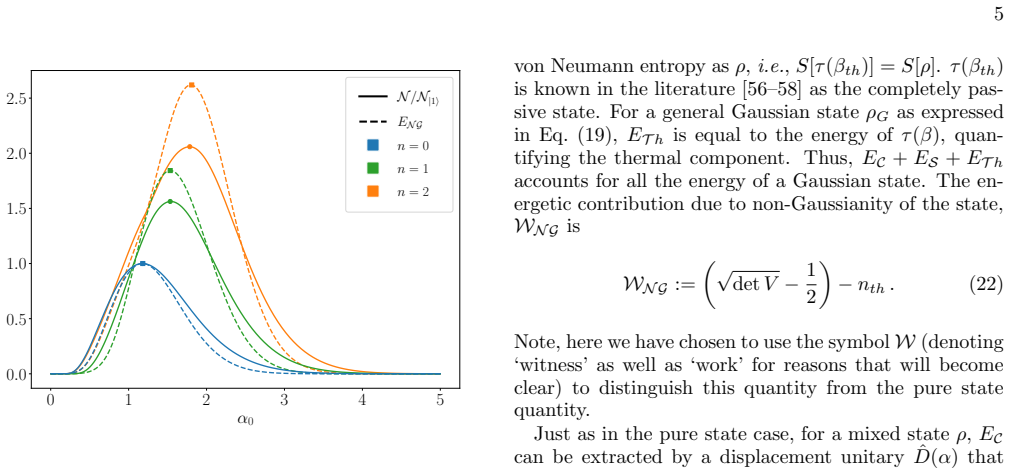
This means that, under a fixed total energy budget, the class of pure states with zero first and second moment uniquely define the most non-Gaussian states. In the same spirit, one may ask: given a class of non- Gaussian unitaries, which Gaussian input state yields an output state with maximum non-Gaussianity? As an ex- ample, consider the Selective Numbe...
-
[5]
It is a well defined non-negative quantity,i.e., WN G ≥0
-
[6]
(Faithfulness)W N G = 0, iffρis Gaussian
-
[7]
This follows from the property (3) of non-Gaussian energy for pure states and the fact thatn th, which depends on the von Neumann entropy, is invariant under unitaries
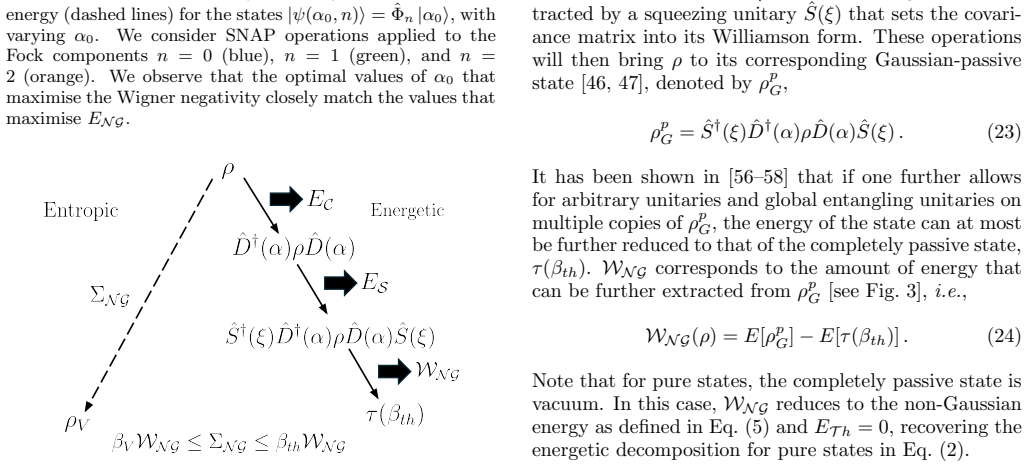
(Invariant under Gaussian unitaries)W N G[ρ] = WN G[ ˆUGρ ˆU † G], where ˆUG is a Gaussian unitary. This follows from the property (3) of non-Gaussian energy for pure states and the fact thatn th, which depends on the von Neumann entropy, is invariant under unitaries. These properties makeW N G a faithful witness of non- Gaussianity. Physically, it quanti...
2000
-
[8]
However, they exhibit qualitatively similar behavior, in the sense that both the quantities increase in the regime of large √ detVand smalln th + 1 2
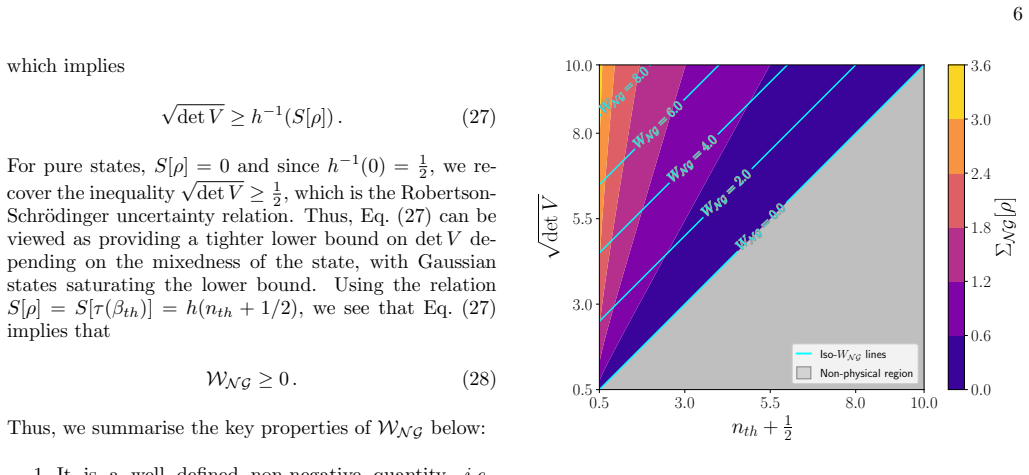
As expected, the constant lines of these quantities are not parallel. However, they exhibit qualitatively similar behavior, in the sense that both the quantities increase in the regime of large √ detVand smalln th + 1 2. AlthoughW N G and ΣN G[ρ] are not equivalent quanti- fiers for mixed states, in Appendix A, we derive a neces- sary and sufficient condi...
2030
-
[9]
Ob- serving the progressive decoherence of the “meter
M. Brune, E. Hagley, J. Dreyer, X. Maˆ ıtre, A. Maali, C. Wunderlich, J. M. Raimond, and S. Haroche, “Ob- serving the progressive decoherence of the “meter” in a quantum measurement,” Phys. Rev. Lett.77, 4887–4890 (1996)
1996
-
[10]
Haroche and J.-M
S. Haroche and J.-M. Raimond,Exploring the quantum: atoms, cavities, and photons(Oxford University Press, 2006)
2006
-
[11]
Fast generation of Schr¨ odinger cat states using a Kerr-tunable superconducting resonator,
X. L. He, Y. Lu, D. Q. Bao, H. Xue, W. B. Jiang, Z. Wang, A. F. Roudsari, P. Delsing, J. S. Tsai, and Z. R. Lin, “Fast generation of Schr¨ odinger cat states using a Kerr-tunable superconducting resonator,” Nat. Commun.14, 6358 (2023)
2023
-
[12]
H. M. Wiseman and G. J. Milburn,Quantum Measure- ment and Control(Cambridge University Press, Cam- bridge, 2010)
2010
-
[13]
Schlosshauer,Decoherence and the Quantum-To- Classical Transition(Springer, 2007)
M. Schlosshauer,Decoherence and the Quantum-To- Classical Transition(Springer, 2007)
2007
-
[14]
Decoherence, einselection, and the quan- tum origins of the classical,
W. H. Zurek, “Decoherence, einselection, and the quan- tum origins of the classical,” Rev. Mod. Phys.75, 715– 775 (2003)
2003
-
[15]
Quantum computation over continuous variables,
S. Lloyd and S. L. Braunstein, “Quantum computation over continuous variables,” Phys. Rev. Lett.82, 1784– 1787 (1999)
1999
-
[16]
Resources for bosonic quantum computational advantage,
U. Chabaud and M. Walschaers, “Resources for bosonic quantum computational advantage,” Phys. Rev. Lett. 130, 090602 (2023)
2023
-
[17]
Bounding the computational power of bosonic systems,
V. Upreti, D. Rudolph, and U. Chabaud, “Bounding the computational power of bosonic systems,” npj Quantum Inf. (2026), 10.1038/s41534-026-01255-6
-
[18]
Quantum informa- tion with continuous variables,
S. L. Braunstein and P. van Loock, “Quantum informa- tion with continuous variables,” Rev. Mod. Phys.77, 513–577 (2005)
2005
-
[19]
Continuous- variable quantum communication,
V. C. Usenko, A. Ac´ ın, R. All´ eaume, U. L. Andersen, E. Diamanti, T. Gehring, A. A. E. Hajomer, F. Kan- itschar, C. Pacher, S. Pirandola,et al., “Continuous- variable quantum communication,” Rev. Mod. Phys.98, 015003 (2026)
2026
-
[20]
Quantum information processing with bosonic qubits in circuit QED,
A. Joshi, K. Noh, and Y. Y. Gao, “Quantum information processing with bosonic qubits in circuit QED,” Quan- tum Sci. Technol.6, 033001 (2021)
2021
-
[21]
Gaus- sian quantum information,
C. Weedbrook, S. Pirandola, R. Garc´ ıa-Patr´ on, N. J. Cerf, T. C. Ralph, J. H. Shapiro, and S. Lloyd, “Gaus- sian quantum information,” Rev. Mod. Phys.84, 621– 669 (2012)
2012
-
[22]
Advances in photonic quantum sensing,
S. Pirandola, B. R. Bardhan, T. Gehring, C. Weedbrook, and S. Lloyd, “Advances in photonic quantum sensing,” Nat. Photonics12, 724–733 (2018)
2018
-
[23]
Distilling Gaussian states with Gaussian operations is impossible,
J. Eisert, S. Scheel, and M. B. Plenio, “Distilling Gaussian states with Gaussian operations is impossible,” Phys. Rev. Lett.89, 137903 (2002)
2002
-
[24]
No-go theorem for Gaussian quantum error correction,
J. Niset, J. Fiur´ aˇ sek, and N. J. Cerf, “No-go theorem for Gaussian quantum error correction,” Phys. Rev. Lett. 102, 120501 (2009)
2009
-
[25]
No-Go Theorem for Gaussian Quantum Repeaters from Fractional Extendibility
R. G. Ahmed and G. Smith, “No-go theorem for Gaus- sian quantum repeaters from fractional extendibility,” (2026), arXiv:2606.05097 [quant-ph]
work page internal anchor Pith review Pith/arXiv arXiv 2026
-
[26]
Positive Wigner functions render classical simulation of quantum computation efficient,
A. Mari and J. Eisert, “Positive Wigner functions render classical simulation of quantum computation efficient,” Phys. Rev. Lett.109, 230503 (2012)
2012
-
[27]
Nega- tive quasi-probability as a resource for quantum compu- tation,
V. Veitch, C. Ferrie, D. Gross, and J. Emerson, “Nega- tive quasi-probability as a resource for quantum compu- tation,” New J. Phys.14, 113011 (2012)
2012
-
[28]
Nonlocality of the Einstein-Podolsky-Rosen state in the Wigner represen- tation,
K. Banaszek and K. W´ odkiewicz, “Nonlocality of the Einstein-Podolsky-Rosen state in the Wigner represen- tation,” Phys. Rev. A58, 4345–4347 (1998)
1998
-
[29]
Con- textuality and Wigner negativity are equivalent for continuous-variable quantum measurements,
R. I. Booth, U. Chabaud, and P.-E. Emeriau, “Con- textuality and Wigner negativity are equivalent for continuous-variable quantum measurements,” Phys. Rev. Lett.129, 230401 (2022)
2022
-
[30]
Quan- tifying the non-Gaussian character of a quantum state by quantum relative entropy,
M. G. Genoni, M. G. A. Paris, and K. Banaszek, “Quan- tifying the non-Gaussian character of a quantum state by quantum relative entropy,” Phys. Rev. A78, 060303 (2008)
2008
-
[31]
Quantifying non- Gaussianity for quantum information,
M. G. Genoni and M. G. A. Paris, “Quantifying non- Gaussianity for quantum information,” Phys. Rev. A82, 052341 (2010)
2010
-
[32]
Relative entropy is an exact measure of non-Gaussianity,
P. Marian and T. A. Marian, “Relative entropy is an exact measure of non-Gaussianity,” Phys. Rev. A88, 012322 (2013)
2013
-
[33]
Faithful measure of quantum non-Gaussianity via quantum rela- tive entropy,
J. Park, J. Lee, K. Baek, S.-W. Ji, and H. Nha, “Faithful measure of quantum non-Gaussianity via quantum rela- tive entropy,” Phys. Rev. A100, 012333 (2019)
2019
-
[34]
Mea- sure of the non-Gaussian character of a quantum state,
M. G. Genoni, M. G. A. Paris, and K. Banaszek, “Mea- sure of the non-Gaussian character of a quantum state,” Phys. Rev. A76, 042327 (2007). 9
2007
-
[35]
Negativity of the Wigner function as an indicator of non-classicality,
A. Kenfack and K. ˙Zyczkowski, “Negativity of the Wigner function as an indicator of non-classicality,” J. Opt. B: Quantum and Semiclass. Opt.6, 396 (2004)
2004
-
[36]
Resource theory of quantum non-Gaussianity and Wigner negativity,
F. Albarelli, M. G. Genoni, M. G. A. Paris, and A. Fer- raro, “Resource theory of quantum non-Gaussianity and Wigner negativity,” Phys. Rev. A98, 052350 (2018)
2018
-
[37]
Quantifying non- Gaussianity of a quantum state by the negative entropy of quadrature distributions,
J. Park, J. Lee, K. Baek, and H. Nha, “Quantifying non- Gaussianity of a quantum state by the negative entropy of quadrature distributions,” Phys. Rev. A104, 032415 (2021)
2021
-
[38]
Op- erational quantification of continuous-variable quantum resources,
B. Regula, L. Lami, G. Ferrari, and R. Takagi, “Op- erational quantification of continuous-variable quantum resources,” Phys. Rev. Lett.126, 110403 (2021)
2021
-
[39]
Frame- work for resource quantification in infinite-dimensional general probabilistic theories,
L. Lami, B. Regula, R. Takagi, and G. Ferrari, “Frame- work for resource quantification in infinite-dimensional general probabilistic theories,” Phys. Rev. A103, 032424 (2021)
2021
-
[40]
Stellar representation of non-Gaussian quantum states,
U. Chabaud, D. Markham, and F. Grosshans, “Stellar representation of non-Gaussian quantum states,” Phys. Rev. Lett.124, 063605 (2020)
2020
-
[41]
Beyond stellar rank: Control parameters for scalable op- tical non-Gaussian state generation,
F. Hanamura, K. Takase, H. Nagayoshi, R. Ide, W. Asa- vanant, K. Fukui, P. Marek, R. Filip, and A. Furusawa, “Beyond stellar rank: Control parameters for scalable op- tical non-Gaussian state generation,” Phys. Rev. X16, 021034 (2026)
2026
-
[42]
Ergotropic characterization of continuous- variable entanglement,
B. Polo-Rodr´ ıguez, F. Centrone, G. Adesso, and M. Al- imuddin, “Ergotropic characterization of continuous- variable entanglement,” Phys. Rev. Lett.136, 050201 (2026)
2026
-
[43]
Energetics of correlations in interacting systems,
N. Friis, M. Huber, and M. Perarnau-Llobet, “Energetics of correlations in interacting systems,” Phys. Rev. E93, 042135 (2016)
2016
-
[44]
Detecting entanglement by symplectic un- certainty relations,
A. Serafini, “Detecting entanglement by symplectic un- certainty relations,” J. Opt. Soc. Am. B24, 347–354 (2007)
2007
-
[45]
Optimal entanglement witnesses for continuous-variable systems,
P. Hyllus and J. Eisert, “Optimal entanglement witnesses for continuous-variable systems,” New J. Phys.8, 51 (2006)
2006
-
[46]
An Energetic Constraint for Qubit-Qubit Entanglement
K. T. Laverick, S. P. Prasad, P. Senellart, M. Maffei, and A. Auff` eves, “An energetic constraint for qubit-qubit entanglement,” (2026), arXiv:2603.16225 [quant-ph]
work page internal anchor Pith review Pith/arXiv arXiv 2026
-
[47]
Characterizing bipartite entanglement via the er- gotropic gap,
X. Yang, M. Alimuddin, Y.-H. Yang, and M.-X. Luo, “Characterizing bipartite entanglement via the er- gotropic gap,” Quantum Inf. Process.23, 382 (2024)
2024
-
[48]
Indepen- dence of work and entropy for equal-energetic finite quan- tum systems: Passive-state energy as an entanglement quantifier,
M. Alimuddin, T. Guha, and P. Parashar, “Indepen- dence of work and entropy for equal-energetic finite quan- tum systems: Passive-state energy as an entanglement quantifier,” Phys. Rev. E102, 012145 (2020)
2020
-
[49]
Extractable work from correlations,
M. Perarnau-Llobet, K. V. Hovhannisyan, M. Huber, P. Skrzypczyk, N. Brunner, and A. Ac´ ın, “Extractable work from correlations,” Phys. Rev. X5, 041011 (2015)
2015
-
[50]
Optimizing Wigner Negativity in Scattering Processes Using Energetic Cost Functions
K. H. Lim, K. T. Laverick, S. S. Jafar, S. P. Prasad, M. Maffei, and A. Auff` eves, “Optimizing Wigner neg- ativity in scattering processes using energetic cost func- tions,” (2026), arXiv:2606.15101 [quant-ph]
work page internal anchor Pith review Pith/arXiv arXiv 2026
-
[51]
Cavity state manipulation using photon-number selec- tive phase gates,
R. W. Heeres, B. Vlastakis, E. Holland, S. Krastanov, V. V. Albert, L. Frunzio, L. Jiang, and R. J. Schoelkopf, “Cavity state manipulation using photon-number selec- tive phase gates,” Phys. Rev. Lett.115, 137002 (2015)
2015
-
[52]
Serafini,Quantum Continuous Variables: A Primer of Theoretical Methods(CRC Press, 2017)
A. Serafini,Quantum Continuous Variables: A Primer of Theoretical Methods(CRC Press, 2017)
2017
-
[53]
Thermodynamics of autonomous optical Bloch equations,
S. P. Prasad, M. Maffei, P. A. Camati, C. Elouard, and A. Auff` eves, “Thermodynamics of autonomous optical Bloch equations,” SciPost Phys.20, 112 (2026)
2026
-
[54]
Passivity and practical work extraction using Gaussian operations,
E. G. Brown, N. Friis, and M. Huber, “Passivity and practical work extraction using Gaussian operations,” New J. Phys.18, 113028 (2016)
2016
-
[55]
Extract- ing energy via bosonic Gaussian operations,
F. E. Q Rodriguez, F. A. Mele, S. F. E Oliviero, V. Giovannetti, L. Lami, and V. Cavina, “Extract- ing energy via bosonic Gaussian operations,” (2025), arXiv:2503.21748 [quant-ph]
-
[56]
On the algebraic problem concerning the normal forms of linear dynamical systems,
J. Williamson, “On the algebraic problem concerning the normal forms of linear dynamical systems,” Am. J. Math. 58, 141–163 (1936)
1936
-
[57]
Pedagogical introduction to the entropy of entanglement for Gaussian states,
T. F. Demarie, “Pedagogical introduction to the entropy of entanglement for Gaussian states,” Eur. J. Phys.39, 035302 (2018)
2018
-
[58]
Universal control of an oscillator with dispersive cou- pling to a qubit,
S. Krastanov, V. V. Albert, C. Shen, C.-L. Zou, R. W. Heeres, B. Vlastakis, R. J. Schoelkopf, and L. Jiang, “Universal control of an oscillator with dispersive cou- pling to a qubit,” Phys. Rev. A92, 040303 (2015)
2015
-
[59]
Robust preparation of Wigner-negative states with op- timized SNAP-displacement sequences,
M. Kudra, M. Kervinen, I. Strandberg, S. Ahmed, M. Scigliuzzo, A. Osman, D. P Lozano, M. O. Thol´ en, R. Borgani, D. B. Haviland, G. Ferrini, J. Bylander, A. F. Kockum, F. Quijandr´ ıa, P. Delsing, and S. Gasparinetti, “Robust preparation of Wigner-negative states with op- timized SNAP-displacement sequences,” PRX Quantum 3, 030301 (2022)
2022
-
[60]
On the quantum correction for thermody- namic equilibrium,
E. Wigner, “On the quantum correction for thermody- namic equilibrium,” Phys. Rev.40, 749–759 (1932)
1932
-
[61]
Wigner function as the expectation value of a parity operator,
A. Royer, “Wigner function as the expectation value of a parity operator,” Phys. Rev. A15, 449–450 (1977)
1977
-
[62]
When is the Wigner quasi-probability density non-negative?
R. L. Hudson, “When is the Wigner quasi-probability density non-negative?” Rep. Math. Phys.6, 249 (1974)
1974
-
[63]
Ordering states with en- tanglement measures,
S. Virmani and M. B. Plenio, “Ordering states with en- tanglement measures,” Phys. Lett. A268, 31–34 (2000)
2000
-
[64]
Thermodynamical proof of the Gibbs for- mula for elementary quantum systems,
A. Lenard, “Thermodynamical proof of the Gibbs for- mula for elementary quantum systems,” J. Stat. Phys. 19, 575–586 (1978)
1978
-
[65]
Passive states and KMS states for general quantum systems,
W. Pusz and S. L. Woronowicz, “Passive states and KMS states for general quantum systems,” Commun. Math. Phys.58, 273–290 (1978)
1978
-
[66]
Entanglement boost for ex- tractable work from ensembles of quantum batteries,
R. Alicki and M. Fannes, “Entanglement boost for ex- tractable work from ensembles of quantum batteries,” Phys. Rev. E87, 042123 (2013)
2013
-
[67]
Extremality of Gaussian quantum states,
M. M. Wolf, G. Giedke, and J. I. Cirac, “Extremality of Gaussian quantum states,” Phys. Rev. Lett.96, 080502 (2006)
2006
-
[68]
Sub-bath cooling in bosonic systems: Gaussian constraints and non-Gaussian enhancements,
W.-H. Png, X. Hu, and V. Scarani, “Sub-bath cooling in bosonic systems: Gaussian constraints and non-Gaussian enhancements,” PRX Quantum7, 020316 (2026)
2026
-
[69]
Induced measures in the space of mixed quantum states,
K. ˙Zyczkowski and H.-J. Sommers, “Induced measures in the space of mixed quantum states,” J. Phys. A: Math. Gen.34, 7111 (2001)
2001
- [70]
-
[71]
Gaus- sian states minimize the output entropy of one-mode quantum Gaussian channels,
G. De Palma, D. Trevisan, and V. Giovannetti, “Gaus- sian states minimize the output entropy of one-mode quantum Gaussian channels,” Phys. Rev. Lett.118, 160503 (2017). Appendix A: Proof of inequality(32) Let us consider an infinitesimal operation on the state ρwhich changes the state fromρ→ρ+ dρ. Beginning 10 from Eq. (29), and simplifying the notation s...
2017
discussion (0)
Sign in with ORCID, Apple, or X to comment. Anyone can read and Pith papers without signing in.