Incentivizing Data Trading via Profit Reallocation
Pith reviewed 2026-07-01 03:43 UTC · model grok-4.3
The pith
Reallocating profits along data resale chains expands trade volume and raises social welfare.
A machine-rendered reading of the paper's core claim, the machinery that carries it, and where it could break.
Core claim
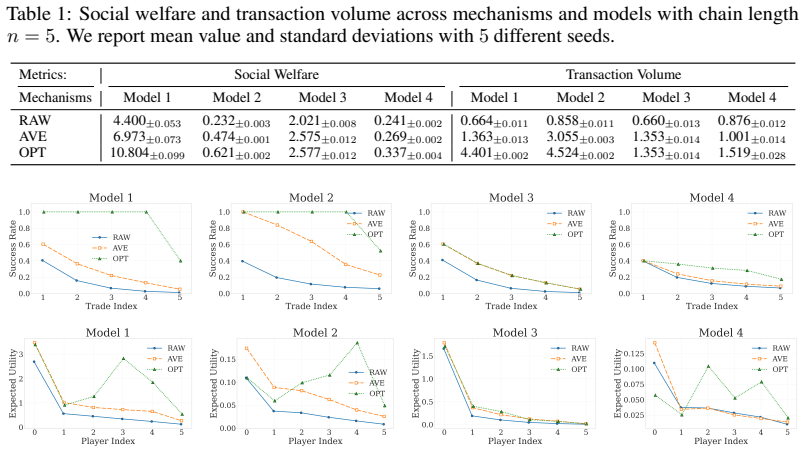
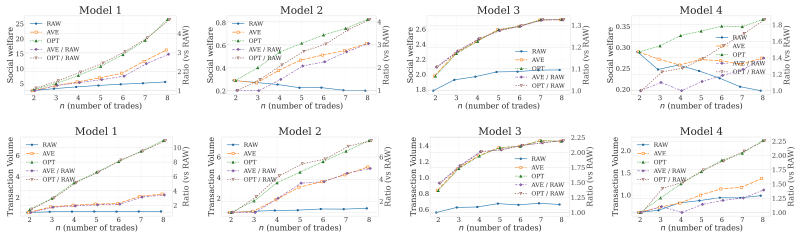
A sequential chain-based trading model captures data resale. Integrating a profit reallocation mechanism ensures upstream sellers receive portions of downstream resale revenue. Efficient algorithms compute the sequential equilibria of the resulting game. The mechanism expands the volume of trade and improves social welfare under stated conditions; experiments confirm 120.0 percent higher transaction volume and 50.4 percent higher welfare than the baseline without reallocation.
What carries the argument
Profit reallocation mechanism inside the sequential chain-based trading model, which distributes fractions of each resale profit to all prior sellers in the chain.
If this is right
- More data owners enter the market because they anticipate revenue from future resales.
- Equilibrium computation remains tractable even when chains lengthen.
- Social welfare rises whenever the reallocation rule satisfies the paper's stated conditions.
- Transaction volume increases by more than 100 percent in environments matching the synthetic test setup.
Where Pith is reading between the lines
- The same reallocation logic could apply to any infinitely replicable digital asset whose ownership is tracked on a ledger.
- Implementation would require a verifiable chain of custody so that profit shares can be automatically routed.
- If chains contain cycles or side payments, the current equilibrium algorithms would need extension.
- Real LLM training-data markets could serve as a natural test bed for measuring the predicted welfare gains.
Load-bearing premise
Resales occur in clean sequential chains whose equilibria are computable by the given algorithms, and profit shares can be enforced at no extra strategic or legal cost.
What would settle it
Run a controlled market experiment in which identical data items are offered with and without enforceable resale-profit shares and measure whether upstream participation and total volume differ by the predicted margins.
Figures

read the original abstract
Data trading is a central approach to data circulation, yet data markets remain far less active than expected. A primary bottleneck is the lack of effective economic incentives. Existing approaches often treat data as traditional goods, overlooking its inherent replicability and resale potential: buyers can replicate and resell data products, thereby forming transaction chains. Upstream sellers do not benefit from downstream resales and thus have limited incentives to sell. However, the impact of data resale on market performance remains insufficiently understood. To address this gap, we propose a sequential, chain-based data trading model that explicitly captures data resale. The model reflects data flows in settings such as LLM training and strategic decision-making. We integrate this model with a profit reallocation mechanism. By reallocating profits along the transaction chain, this mechanism ensures upstream sellers benefit from downstream resales. We next develop efficient algorithms, including a polynomial-time exact algorithm for the discrete model and an FPTAS for the continuous model, to compute its sequential equilibria. We theoretically show that profit reallocation expands trade and improves social welfare under certain conditions, and empirical results demonstrate that our mechanism increases transaction volume by 120.0\% and social welfare by 50.4\% in synthetic environments, compared with the baseline mechanism that does not reallocate profits.
Editorial analysis
A structured set of objections, weighed in public.
Referee Report
Summary. The paper introduces a sequential chain-based model for data trading that accounts for resale of replicable data, integrates a profit reallocation mechanism so upstream sellers benefit from downstream transactions, develops a polynomial-time exact algorithm for the discrete case and an FPTAS for the continuous case to compute sequential equilibria, proves that reallocation expands trade and improves social welfare under certain conditions, and reports that the mechanism increases transaction volume by 120.0% and social welfare by 50.4% versus a non-reallocating baseline in synthetic environments.
Significance. If the results hold, the work provides a concrete mechanism and algorithms to address incentive misalignment in data markets arising from replicability, with potential relevance to settings such as LLM training data flows. The polynomial-time and FPTAS algorithms constitute a computational strength, and the theoretical welfare result is a clear contribution if the conditions are realistic.
major comments (2)
- [Abstract] Abstract: the headline empirical claims of a 120.0% increase in transaction volume and 50.4% increase in social welfare are stated without error bars, without any description of how the synthetic environments or chain lengths were generated, and without verification that the percentages survive changes in chain length or the parameter r; these omissions make the quantitative claims impossible to assess for robustness.
- [Model definition] Model and equilibrium sections: the central claim that profit reallocation expands trade and raises welfare rests on the premise that reallocation can be enforced along the chain without additional monitoring costs, strategic frictions, or legal barriers; the paper does not model or bound these enforcement costs, so the equilibrium computation and the reported welfare gains do not necessarily follow from the stated algorithms once replicability and observability issues are taken into account.
minor comments (1)
- [Abstract] The abstract states that the mechanism improves welfare 'under certain conditions' but does not list or characterize those conditions; a brief explicit statement would improve readability.
Simulated Author's Rebuttal
We thank the referee for the constructive feedback. We address each major comment below and indicate planned revisions.
read point-by-point responses
-
Referee: [Abstract] Abstract: the headline empirical claims of a 120.0% increase in transaction volume and 50.4% increase in social welfare are stated without error bars, without any description of how the synthetic environments or chain lengths were generated, and without verification that the percentages survive changes in chain length or the parameter r; these omissions make the quantitative claims impossible to assess for robustness.
Authors: We agree that additional context would improve transparency. The full experimental section already details the synthetic environment generation process (including how chain lengths and parameters such as r are sampled from specified distributions), reports results averaged over multiple independent runs, and includes sensitivity analyses. In the revision we will condense these elements into the abstract, add explicit error bars or standard deviations, and include a sentence confirming that the reported percentage gains are robust across the tested ranges of chain length and r. revision: yes
-
Referee: [Model definition] Model and equilibrium sections: the central claim that profit reallocation expands trade and raises welfare rests on the premise that reallocation can be enforced along the chain without additional monitoring costs, strategic frictions, or legal barriers; the paper does not model or bound these enforcement costs, so the equilibrium computation and the reported welfare gains do not necessarily follow from the stated algorithms once replicability and observability issues are taken into account.
Authors: The model is an abstract mechanism-design framework whose focus is the incentive and computational properties of profit reallocation assuming the mechanism can be implemented. This is standard in the literature; the algorithms and welfare theorems are derived under the stated model. We will add an explicit paragraph in the model section stating the enforcement assumption, noting that real-world monitoring or legal costs are not modeled, and clarifying that such costs are orthogonal to the incentive analysis presented. The reported gains therefore hold conditionally on enforcement being feasible. revision: partial
Circularity Check
No significant circularity; derivation remains self-contained
full rationale
The abstract and claims describe a sequential chain model, profit reallocation integration, polynomial-time algorithms/FPTAS for equilibria, theoretical expansion of trade under stated conditions, and empirical gains measured explicitly against a non-reallocating baseline in synthetic environments. No self-definitional reductions, fitted inputs renamed as predictions, or load-bearing self-citations appear in the provided text. The central results rest on independent algorithmic computation and comparative evaluation rather than re-expressing inputs by construction.
Axiom & Free-Parameter Ledger
axioms (1)
- domain assumption Data products are replicable and can be resold, forming transaction chains in which upstream sellers receive no automatic benefit from downstream trades.
Reference graph
Works this paper leans on
-
[1]
Deep learning with differential privacy
Martin Abadi, Andy Chu, Ian Goodfellow, H Brendan McMahan, Ilya Mironov, Kunal Talwar, and Li Zhang. Deep learning with differential privacy. InProceedings of the 2016 ACM SIGSAC Conference on Computer and Communications Security, pages 308–318, 2016
2016
-
[2]
The economics of privacy.Journal of Economic Literature, 54(2):442–492, 2016
Alessandro Acquisti, Curtis Taylor, and Liad Wagman. The economics of privacy.Journal of Economic Literature, 54(2):442–492, 2016
2016
-
[3]
A marketplace for data: An algorithmic solution
Anish Agarwal, Munther Dahleh, and Tuhin Sarkar. A marketplace for data: An algorithmic solution. InProceedings of the 2019 ACM Conference on Economics and Computation, pages 701–726, 2019
2019
-
[4]
Towards data auctions with externalities.Games and Economic Behavior, 148:323–356, 2024
Anish Agarwal, Munther Dahleh, Thibaut Horel, and Maryann Rui. Towards data auctions with externalities.Games and Economic Behavior, 148:323–356, 2024
2024
-
[5]
Aws data exchange documentation
Amazon Web Services, Inc. Aws data exchange documentation. AWS Documentation. URL https://docs.aws.amazon.com/data-exchange/
-
[6]
A survey of data marketplaces and their business models.ACM SIGMOD Record, 51(3):18–29, 2022
Santiago Andrés Azcoitia and Nikolaos Laoutaris. A survey of data marketplaces and their business models.ACM SIGMOD Record, 51(3):18–29, 2022
2022
-
[7]
Designing a blockchain-based data market and pricing data to optimize data trading and welfare.Interna- tional Journal of Electronic Commerce, 28(1):3–30, 2024
Ingrid Bauer-Hänsel, Qianyu Liu, Claudio J Tessone, and Gerhard Schwabe. Designing a blockchain-based data market and pricing data to optimize data trading and welfare.Interna- tional Journal of Electronic Commerce, 28(1):3–30, 2024
2024
-
[8]
An incentive mechanism for trading personal data in data markets
Sayan Biswas, Kangsoo Jung, and Catuscia Palamidessi. An incentive mechanism for trading personal data in data markets. InInternational Colloquium on Theoretical Aspects of Computing, pages 197–213. Springer, 2021
2021
-
[9]
On the Opportunities and Risks of Foundation Models
Rishi Bommasani. On the opportunities and risks of foundation models.arXiv preprint arXiv:2108.07258, 2021
work page internal anchor Pith review Pith/arXiv arXiv 2021
-
[10]
Towards federated learning at scale: System design.Proceedings of Machine Learning and Systems, 1: 374–388, 2019
Keith Bonawitz, Hubert Eichner, Wolfgang Grieskamp, Dzmitry Huba, Alex Ingerman, Vladimir Ivanov, Chloe Kiddon, Jakub Koneˇcn`y, Stefano Mazzocchi, Brendan McMahan, et al. Towards federated learning at scale: System design.Proceedings of Machine Learning and Systems, 1: 374–388, 2019
2019
-
[11]
A game-theoretic framework for revenue sharing in edge-cloud computing system
Zhi Cao, Honggang Zhang, Benyuan Liu, and Bo Sheng. A game-theoretic framework for revenue sharing in edge-cloud computing system. In2018 IEEE 37th International Performance Computing and Communications Conference, pages 1–8, 2018. doi: 10.1109/PCCC.2018. 8710866
-
[12]
Franklin
Raul Castro Fernandez, Pranav Subramaniam, and Michael J. Franklin. Data market platforms: Trading data assets to solve data problems.Proceedings of the VLDB Endowment, 13(12): 1933–1947, 2020
1933
-
[13]
Common Crawl: Open repository of web crawl data
Common Crawl. Common Crawl: Open repository of web crawl data. Website. URL https://commoncrawl.org/. 10
-
[14]
Bilateral trading in networks.The Review of Economic Studies, 84(1):82–105, 2017
Daniele Condorelli, Andrea Galeotti, and Ludovic Renou. Bilateral trading in networks.The Review of Economic Studies, 84(1):82–105, 2017
2017
-
[15]
Data marketplace: Dawex data exchange technology
Dawex Systems. Data marketplace: Dawex data exchange technology. Dawex official website. URLhttps://www.dawex.com/en/data-exchange-platform/data-marketplace/
-
[16]
Mechanisms for multi-level marketing
Yuval Emek, Ron Karidi, Moshe Tennenholtz, and Aviv Zohar. Mechanisms for multi-level marketing. InProceedings of the 12th ACM conference on Electronic commerce, pages 209–218, 2011
2011
-
[17]
Data Act: Meps back new rules for fair ac- cess to and use of industrial data, March 2023
European Parliament. Data Act: Meps back new rules for fair ac- cess to and use of industrial data, March 2023. URL https:// www.europarl.europa.eu/news/en/press-room/20230310IPR77226/ data-act-meps-back-new-rules-for-fair-access-to-and-use-of-industrial-data
-
[18]
Data Brokers: A call for transparency and accountability
Federal Trade Commission. Data Brokers: A call for transparency and accountability. Technical report, Federal Trade Commission,
-
[19]
URL https://www.ftc.gov/system/files/documents/reports/ data-brokers-call-transparency-accountability-report-federal-trade-commission-may-2014/ 140527databrokerreport.pdf
2014
-
[20]
Selling privacy at auction
Arpita Ghosh and Aaron Roth. Selling privacy at auction. InProceedings of the 12th ACM Conference on Electronic Commerce, pages 199–208, 2011
2011
-
[21]
Dynamic stochastic general equilibrium models.Springer Texts in Business and Economics, 2024
Hamilton Galindo Gil, Alexis Montecinos Bravo, and Marco Antonio Ortiz Sosa. Dynamic stochastic general equilibrium models.Springer Texts in Business and Economics, 2024
2024
-
[22]
Federated Learning for Mobile Keyboard Prediction
Andrew Hard, Kanishka Rao, Rajiv Mathews, Swaroop Ramaswamy, Françoise Beaufays, Sean Augenstein, Hubert Eichner, Chloé Kiddon, and Daniel Ramage. Federated learning for mobile keyboard prediction.arXiv preprint arXiv:1811.03604, 2018
work page internal anchor Pith review Pith/arXiv arXiv 2018
-
[23]
Charles I. Jones and Christopher Tonetti. Nonrivalry and the economics of data.American Economic Review, 110(9):2819–2858, 2020. doi: 10.1257/aer.20191330
-
[24]
A blockchain-based healthcare data marketplace: prototype and demonstration.JAMIA open, 7(2), 2024
KangHyun Kim, Sung-Min Kim, YoungMin Park, EunSol Lee, SungJae Jung, Jeongyong Kang, DongUk An, Kyungil Min, Sung Ryul Shim, Hyeong Won Yu, et al. A blockchain-based healthcare data marketplace: prototype and demonstration.JAMIA open, 7(2), 2024
2024
-
[25]
Pantelis Koutroumpis, Aija Leiponen, and Llewellyn D. W. Thomas. The (unfulfilled) potential of data marketplaces. ETLA Working Papers 53, ETLA – The Research Insti- tute of the Finnish Economy, 2017. URL https://www.etla.fi/wp-content/uploads/ etla-working-papers-53.pdf
2017
-
[26]
Sequential equilibria.Econometrica: Journal of the Econometric Society, pages 863–894, 1982
David M Kreps and Robert Wilson. Sequential equilibria.Econometrica: Journal of the Econometric Society, pages 863–894, 1982
1982
-
[27]
Mechanism design in social networks
Bin Li, Dong Hao, Dengji Zhao, and Tao Zhou. Mechanism design in social networks. In Proceedings of the AAAI Conference on Artificial Intelligence, volume 31, 2017
2017
-
[28]
Diffusion auction design.Artificial Intelligence, 303:103631, 2022
Bin Li, Dong Hao, Hui Gao, and Dengji Zhao. Diffusion auction design.Artificial Intelligence, 303:103631, 2022
2022
-
[29]
martfl: Enabling utility-driven data marketplace with a robust and verifiable federated learning architecture
Qi Li, Zhuotao Liu, Qi Li, and Ke Xu. martfl: Enabling utility-driven data marketplace with a robust and verifiable federated learning architecture. InProceedings of the 2023 ACM SIGSAC Conference on Computer and Communications Security, pages 1496–1510, 2023
2023
-
[30]
Dealer: An end-to-end model marketplace with differential privacy.Proceedings of the VLDB Endowment, 14(6), 2021
Jinfei Liu, Jian Lou, Junxu Liu, Li Xiong, Jian Pei, and Jimeng Sun. Dealer: An end-to-end model marketplace with differential privacy.Proceedings of the VLDB Endowment, 14(6), 2021
2021
-
[31]
Intermediation and resale in networks.Journal of Political Economy, 126(3): 1250–1301, 2018
Mihai Manea. Intermediation and resale in networks.Journal of Political Economy, 126(3): 1250–1301, 2018
2018
-
[32]
Oxford university press New York, 1995
Andreu Mas-Colell, Michael Dennis Whinston, Jerry R Green, et al.Microeconomic theory, volume 1. Oxford university press New York, 1995. 11
1995
-
[33]
Optimal auction design.Mathematics of Operations Research, 6(1):58–73, 1981
Roger B Myerson. Optimal auction design.Mathematics of Operations Research, 6(1):58–73, 1981
1981
-
[34]
Vazirani, editors.Algorithmic Game Theory
Noam Nisan, Tim Roughgarden, Eva Tardos, and Vijay V . Vazirani, editors.Algorithmic Game Theory. Cambridge University Press, Cambridge, 2007. ISBN 978-0-521-87282-
2007
-
[35]
URL https://www.cambridge.org/core/books/ algorithmic-game-theory/0092C07CA8B724E1B1BE2238DDD66B38
doi: 10.1017/CBO9780511800481. URL https://www.cambridge.org/core/books/ algorithmic-game-theory/0092C07CA8B724E1B1BE2238DDD66B38
-
[36]
Enhancing access to and sharing of data: Reconciling risks and benefits for data re-use across societies, 2019
OECD. Enhancing access to and sharing of data: Reconciling risks and benefits for data re-use across societies, 2019. URL https://www.oecd.org/content/dam/oecd/en/ publications/reports/2019/11/enhancing-access-to-and-sharing-of-data_ 070835df/276aaca8-en.pdf
2019
-
[37]
Measuring the economic value of data
OECD. Measuring the economic value of data. Technical report, OECD, 2021
2021
-
[38]
Data market design through deep learning.Advances in Neural Information Processing Systems, 36:6662–6689, 2023
Sai Srivatsa Ravindranath, Yanchen Jiang, and David C Parkes. Data market design through deep learning.Advances in Neural Information Processing Systems, 36:6662–6689, 2023
2023
-
[39]
About snowflake marketplace
Snowflake Inc. About snowflake marketplace. Snowflake Documentation. URL https: //docs.snowflake.com/en/collaboration/collaboration-marketplace-about
-
[40]
Reimagining data ownership: Incentivised data flows for web 3 data solutions
Swash Data Tech. Reimagining data ownership: Incentivised data flows for web 3 data solutions. Technical report, Swash Data Tech Ltd, 2021. URLhttps://swashapp.io/static/files/ paper/whitepaper-v1-july-2021.pdf
2021
-
[41]
TBDS: transaction-based data sharing
Wu Xin, Hongyin Chen, Xiaoqi Dong, Jichen Li, Xiaotie Deng, Zhonghai Wu, and Bin Xiao. TBDS: transaction-based data sharing. InFrontiers of Algorithmics - 19th International Joint Conference, volume 15828, pages 222–237. Springer, 2025. doi: 10.1007/978-981-96-8312-3\ _17
-
[42]
A fairness-aware incentive scheme for federated learning
Han Yu, Zelei Liu, Yang Liu, Tianjian Chen, Mingshu Cong, Xi Weng, Dusit Niyato, and Qiang Yang. A fairness-aware incentive scheme for federated learning. InProceedings of the AAAI/ACM Conference on AI, Ethics, and Society, pages 393–399, 2020
2020
-
[43]
An incentive mechanism for privacy preserved data trading with verifiable data disturbance
Man Zhang, Xinghua Li, Bin Luo, Yanbing Ren, Yinbin Miao, Ximeng Liu, and Robert H Deng. An incentive mechanism for privacy preserved data trading with verifiable data disturbance. IEEE Transactions on Dependable and Secure Computing, 2025
2025
-
[44]
Selling data at an auction under privacy constraints
Mengxiao Zhang, Fernando Beltran, and Jiamou Liu. Selling data at an auction under privacy constraints. InConference on Uncertainty in Artificial Intelligence, pages 669–678. PMLR, 2020
2020
-
[45]
Redistribution mechanism on networks
Wen Zhang, Dengji Zhao, and Hanyu Chen. Redistribution mechanism on networks. In Proceedings of the 19th International Conference on Autonomous Agents and MultiAgent Systems, pages 1620–1628, 2020. 12 Appendix A Further Related Work A line of works focus on ensuring the security, privacy, trustworthiness, and tractability of data utilization through feder...
2020
-
[46]
Our study differs from these works in many aspects
also study players’ equilibrium behavior on sequential trades by explicitly modeling each trade process as a take-it-or-leave-it offer. Our study differs from these works in many aspects. First, the traded object is replicable data rather than non-replicable traditional goods, so the seller can sell the data without losing it. Second, we explicitly study ...
discussion (0)
Sign in with ORCID, Apple, or X to comment. Anyone can read and Pith papers without signing in.