Unresolved-Sideband Optomechanics with Hexagonal Boron Nitride: Induced Transparency, Gain, and Frequency Combs
Pith reviewed 2026-07-01 04:32 UTC · model grok-4.3
The pith
Optomechanically induced transparency crosses over to a gain feature in the unresolved-sideband regime using hBN drums.
A machine-rendered reading of the paper's core claim, the machinery that carries it, and where it could break.
Core claim
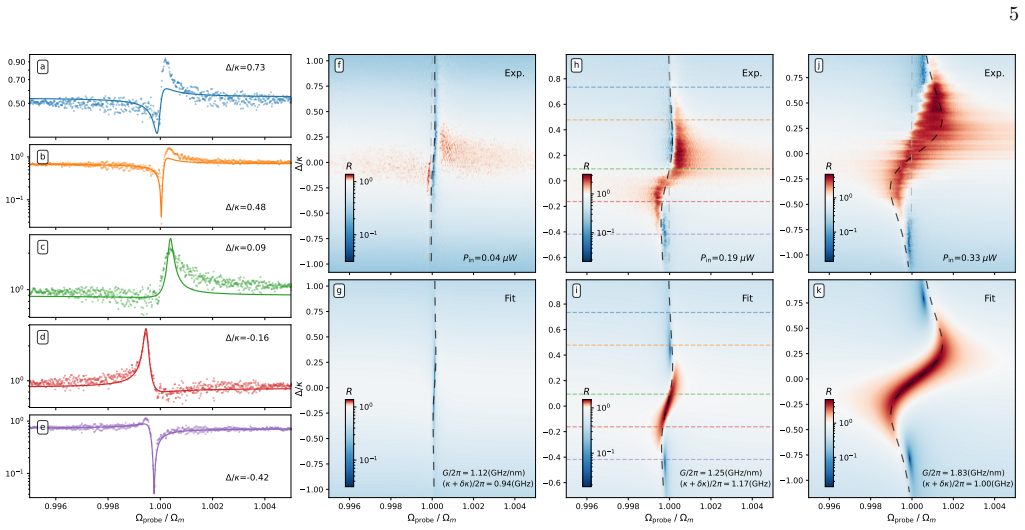
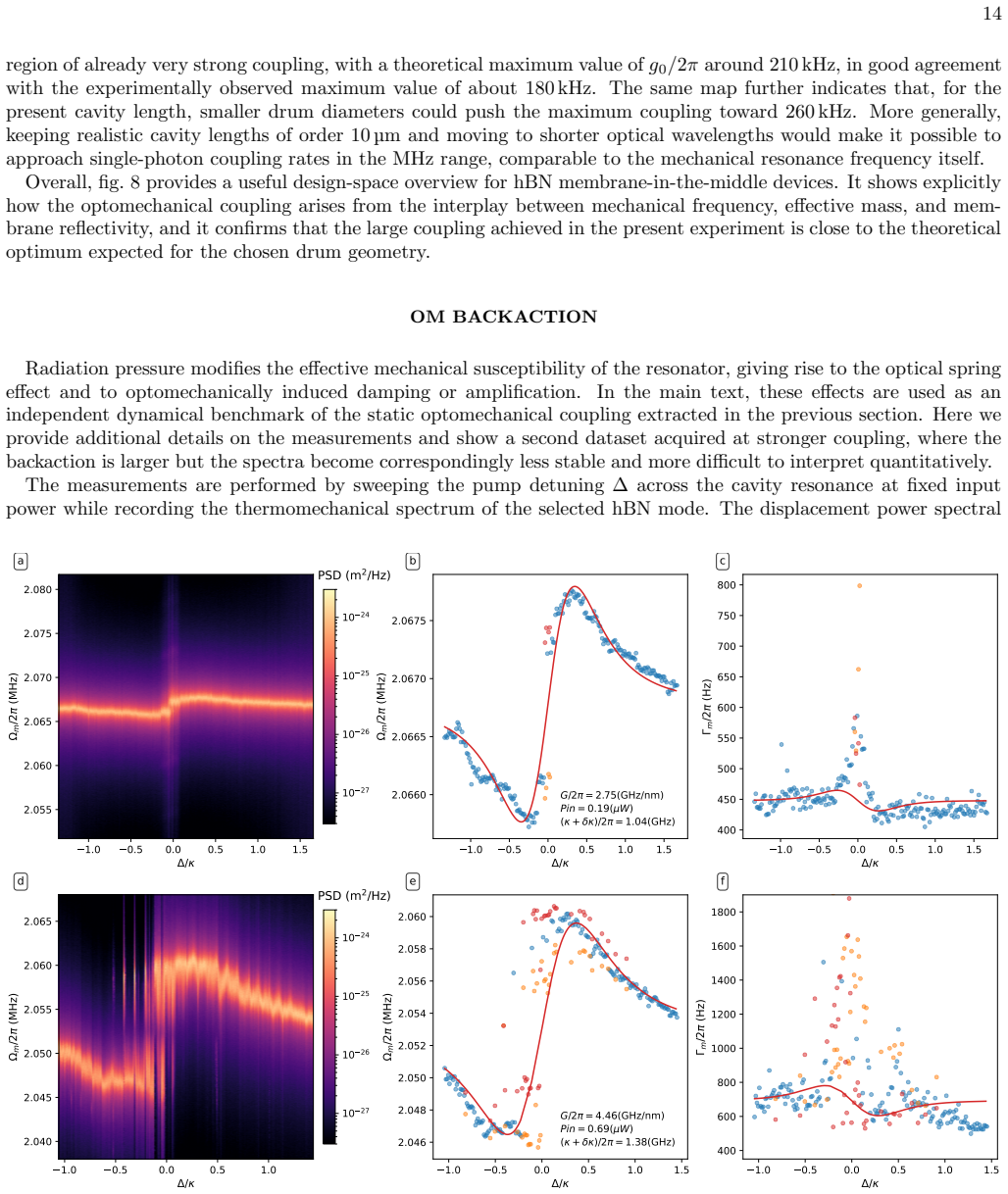
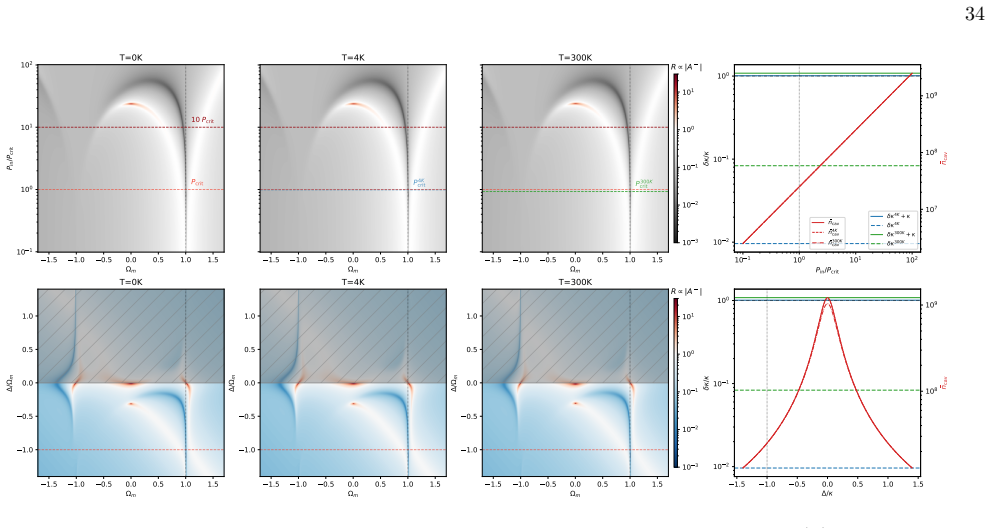
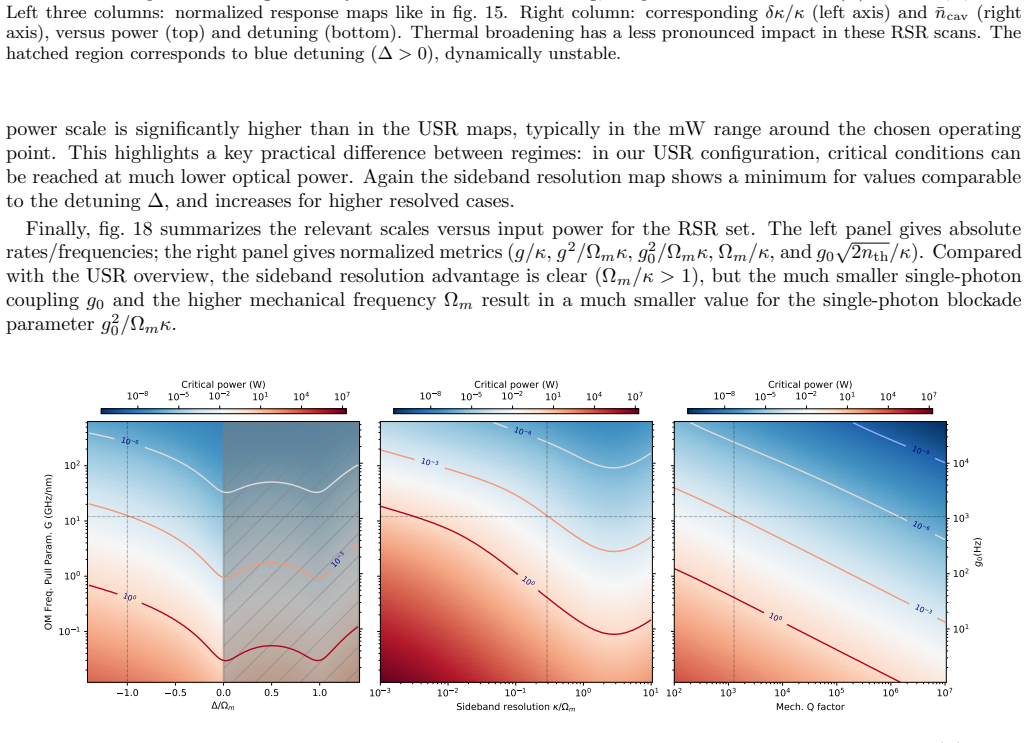
In the unresolved-sideband limit, increasing pump power in a hBN membrane-in-the-middle system produces a crossover in the probe reflection from a transparency-like dip to a gain feature; the maps are reproduced by the complete linearized optomechanical response, demonstrating breakdown of the rotating-wave approximation.
What carries the argument
the full linearized optomechanical response that retains counter-rotating terms
If this is right
- The rotating-wave approximation used in resolved-sideband treatments fails to describe the response when cavity linewidth greatly exceeds mechanical frequency.
- hBN-based fiber cavities support strong radiation-pressure back-action and can be driven into nonlinear regimes to generate frequency combs.
- The architecture enables study of unresolved-sideband dynamics in a compact, integrable geometry.
- Quantitative agreement between data and the complete model confirms that material-specific effects remain negligible at the powers used.
Where Pith is reading between the lines
- Similar crossovers may appear in other 2D-material or microcavity systems operating far from the resolved-sideband limit.
- The gain feature could be harnessed for narrowband optical amplification in integrated devices.
- Extensions to multi-mode mechanical resonators might produce more complex comb structures or dynamical instabilities.
Load-bearing premise
The hBN drum behaves as an ideal harmonic oscillator whose only interaction with the optical field is radiation-pressure back-action.
What would settle it
A set of OMIT spectra at multiple pump powers and detunings that deviate systematically from the predictions of the full linearized response, especially by lacking the observed gain feature.
Figures











read the original abstract
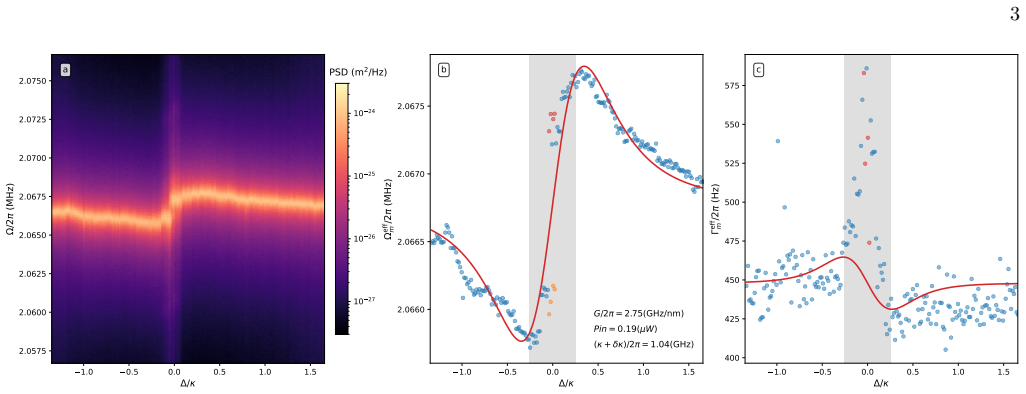
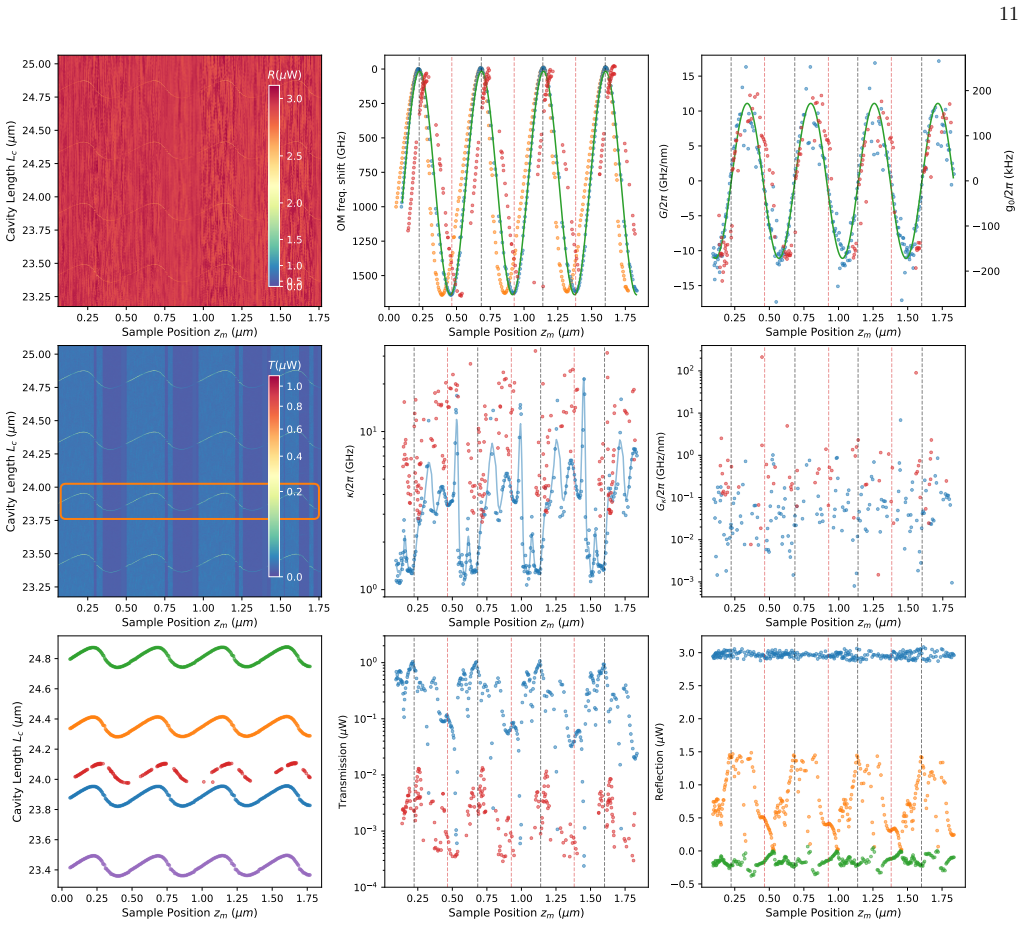
Optomechanically induced transparency (OMIT) is usually modeled and studied in the resolved-sideband regime, but many compact microcavity platforms operate in the unresolved-sideband limit $(\kappa \gg \Omega_m)$. Here we investigate OMIT in this regime using a tunable fiber-based Fabry-Perot microcavity coupled to a suspended hexagonal boron nitride (hBN) drum resonator in a membrane-in-the-middle geometry. The system achieves a large single-photon coupling rate of $g_0/2\pi \sim 180$ kHz and exhibits strong radiation-pressure backaction. By measuring OMIT spectra as a function of pump power and cavity detuning, we observe a crossover from a transparency-like dip to a gain feature in the reflected response. These maps are quantitatively reproduced by the full linearized optomechanical response, demonstrating the breakdown of the standard rotating-wave approximation used in the resolved-sideband limit. Finally, we drive the system into a nonlinear regime to generate optomechanical frequency combs. These results establish hBN fiber-cavities as a versatile architecture for unresolved-sideband optomechanics, nonlinear dynamics, and hybrid device integration.
Editorial analysis
A structured set of objections, weighed in public.
Referee Report
Summary. The manuscript investigates optomechanically induced transparency (OMIT) in the unresolved-sideband regime (κ ≫ Ω_m) using a tunable fiber Fabry-Perot cavity coupled to a suspended hBN drum in membrane-in-the-middle geometry. It reports a single-photon coupling g0/2π ∼ 180 kHz, observation of a crossover from transparency dip to gain feature in reflected OMIT spectra versus pump power and detuning, quantitative reproduction of these maps by the full linearized optomechanical response (claimed to demonstrate RWA breakdown), and generation of optomechanical frequency combs in the nonlinear regime.
Significance. If the central claim holds, the work would establish hBN fiber-cavities as a platform for unresolved-sideband optomechanics and nonlinear dynamics. The quantitative match to the full model (rather than RWA) and the comb generation would be notable strengths, but the significance is limited by the absence of an explicit side-by-side test against the RWA.
major comments (2)
- [Abstract] Abstract: the claim that the OMIT maps 'demonstrate the breakdown of the standard rotating-wave approximation' is not supported by the reported evidence. The text states only that the maps are reproduced by the full linearized response; no comparison is described showing that the RWA model (neglecting counter-rotating terms) fails to fit the observed crossover from dip to gain while the full model succeeds. This comparison is load-bearing for the central claim.
- [Abstract] The weakest assumption (ideal harmonic oscillator with only radiation-pressure back-action) is not tested against possible material-specific effects in hBN (e.g., absorption or nonlinear damping) that could distort the lineshape at the powers used; this must be addressed to confirm the crossover is purely optomechanical.
Simulated Author's Rebuttal
We thank the referee for their careful reading and constructive comments on our manuscript. We address each major comment below and agree that the suggested additions will strengthen the presentation of our results.
read point-by-point responses
-
Referee: [Abstract] Abstract: the claim that the OMIT maps 'demonstrate the breakdown of the standard rotating-wave approximation' is not supported by the reported evidence. The text states only that the maps are reproduced by the full linearized response; no comparison is described showing that the RWA model (neglecting counter-rotating terms) fails to fit the observed crossover from dip to gain while the full model succeeds. This comparison is load-bearing for the central claim.
Authors: We agree that an explicit comparison is needed to substantiate the claim. In the revised manuscript we will add a direct side-by-side fit of the data to both the RWA and full linearized models, showing that the RWA cannot reproduce the observed crossover from dip to gain while the full model matches quantitatively. The abstract will be updated to reflect this addition. revision: yes
-
Referee: [Abstract] The weakest assumption (ideal harmonic oscillator with only radiation-pressure back-action) is not tested against possible material-specific effects in hBN (e.g., absorption or nonlinear damping) that could distort the lineshape at the powers used; this must be addressed to confirm the crossover is purely optomechanical.
Authors: We acknowledge that material-specific effects in hBN must be explicitly ruled out. While the quantitative match to the optomechanical model across multiple powers and detunings already supports a purely optomechanical origin, we will add a dedicated discussion and supporting checks (e.g., power dependence of mechanical linewidth and absence of absorption-induced shifts) in the revised manuscript to address this point directly. revision: yes
Circularity Check
No circularity: experimental spectra compared to standard linearized optomechanics
full rationale
The paper reports measured OMIT spectra versus pump power and detuning, then states that these are reproduced by the full linearized optomechanical response (standard equations, not derived or fitted within the paper). No step reduces a claimed prediction to a parameter fitted from the same dataset, no self-citation chain bears the central claim, and the RWA-breakdown statement is an interpretive comparison rather than a definitional equivalence. The derivation chain is therefore self-contained against external benchmarks.
Axiom & Free-Parameter Ledger
axioms (1)
- domain assumption The optical cavity and mechanical resonator interact solely via radiation-pressure force; no material-specific absorption or Kerr nonlinearity in hBN affects the linear response.
Reference graph
Works this paper leans on
-
[1]
Ruelle, D
T. Ruelle, D. Jaeger, F. Fogliano, F. Braakman, and M. Poggio, Review of Scientific Instruments93, 095003 (2022)
2022
-
[2]
Koks and M
C. Koks and M. P. Van Exter, Optics Express29, 6879 (2021)
2021
-
[3]
Shkarin, A
A. Shkarin, A. Kashkanova, C. Brown, S. Garcia, K. Ott, J. Reichel, and J. Harris, Physical Review Letters122, 153601 (2019)
2019
-
[4]
Jaeger, F
D. Jaeger, F. Fogliano, T. Ruelle, A. Lafranca, F. Braakman, and M. Poggio, Nano Letters23, 2016 (2023)
2016
-
[5]
Gallego, S
J. Gallego, S. Ghosh, S. K. Alavi, W. Alt, M. Martinez-Dorantes, D. Meschede, and L. Ratschbacher, Applied Physics B 122, 47 (2016)
2016
-
[6]
Aspelmeyer, T
M. Aspelmeyer, T. J. Kippenberg, and F. Marquardt, Reviews of Modern Physics86, 1391 (2014), tex.ids= as- pelmeyer cavity 2014-2
2014
-
[7]
W. P. Bowen,Quantum Optomechanics, 0th ed. (CRC Press, 2015)
2015
-
[8]
S. Weis, R. Rivi` ere, S. Del´ eglise, E. Gavartin, O. Arcizet, A. Schliesser, and T. J. Kippenberg, Science330, 1520 (2010)
2010
-
[9]
G. S. Agarwal and S. Huang, Physical Review A81, 041803 (2010)
2010
-
[10]
Yan, Journal of Physics B: Atomic, Molecular and Optical Physics54, 035401 (2021)
X.-B. Yan, Journal of Physics B: Atomic, Molecular and Optical Physics54, 035401 (2021)
2021
-
[11]
Yan, Physical Review A101, 043820 (2020)
X.-B. Yan, Physical Review A101, 043820 (2020)
2020
-
[12]
Leijssen, G
R. Leijssen, G. R. L. Gala, L. Freisem, J. T. Muhonen, and E. Verhagen, Nature Communications8, ncomms16024 (2017)
2017
-
[13]
S´ anchez Arribas, T
I. S´ anchez Arribas, T. Taniguchi, K. Watanabe, and E. M. Weig, Nano Letters23, 6301 (2023)
2023
-
[14]
E. D. Black, American Journal of Physics69, 79 (2000), tex.ids= black introduction 2000-1
2000
-
[15]
Karuza, C
M. Karuza, C. Biancofiore, M. Bawaj, C. Molinelli, M. Galassi, R. Natali, P. Tombesi, G. Di Giuseppe, and D. Vitali, Physical Review A88, 013804 (2013)
2013
-
[16]
F. M. Buters, F. Luna, M. J. Weaver, H. J. Eerkens, K. Heeck, S. De Man, and D. Bouwmeester, Optics Express25, 12935 (2017)
2017
-
[17]
Bodiya, V
T. Bodiya, V. Sudhir, C. Wipf, N. Smith, A. Buikema, A. Kontos, H. Yu, and N. Mavalvala, Physical Review A100, 013853 (2019), tex.ids= bodiya sub-hertz 2019-1
2019
-
[18]
Sbarra, P
S. Sbarra, P. E. Allain, S. Suffit, A. Lemaˆ ıtre, and I. Favero, APL Photonics6, 086111 (2021)
2021
-
[19]
Y. Hu, S. Ding, Y. Qin, J. Gu, W. Wan, M. Xiao, and X. Jiang, Physical Review Letters127, 134301 (2021)
2021
-
[20]
M.-A. Miri, G. D’Aguanno, and A. Al` u, New Journal of Physics20, 043013 (2018)
2018
-
[21]
X. Gu, J. Zhang, S. Ding, X. Jiang, B. He, and Q. Lin, Photonics Research12, 1981 (2024)
1981
-
[22]
Rochau, I
F. Rochau, I. S´ anchez Arribas, A. Brieussel, S. Stapfner, D. Hunger, and E. M. Weig, Physical Review Applied16, 014013 (2021), tex.ids= rochau dynamical 2021-1
2021
-
[23]
Tenbrake, A
L. Tenbrake, A. Faßbender, S. Hofferberth, S. Linden, and H. Pfeifer, Nature Communications15, 209 (2024)
2024
-
[24]
Guo and S
J. Guo and S. Gr¨ oblacher, Light: Science & Applications11, 282 (2022)
2022
-
[25]
Planz, X
E. Planz, X. Xi, T. Capelle, E. C. Langman, and A. Schliesser, Optics Express31, 41773 (2023)
2023
-
[26]
Mercad´ e, L
L. Mercad´ e, L. L. Mart´ ın, A. Griol, D. Navarro-Urrios, and A. Mart´ ınez, Nanophotonics9, 3535 (2020)
2020
-
[27]
X. Gou, W. Privratsky, W. Sun, Y. Liu, H. Abiri, and Q. Li, Nano Letters25, 17644 (2025)
2025
discussion (0)
Sign in with ORCID, Apple, or X to comment. Anyone can read and Pith papers without signing in.