Optimization Algorithms for Joint OFDM Waveform Design and RIS Configuration in 6G Networks: From Convex Relaxation to Foundation Models
Pith reviewed 2026-07-01 05:27 UTC · model grok-4.3
The pith
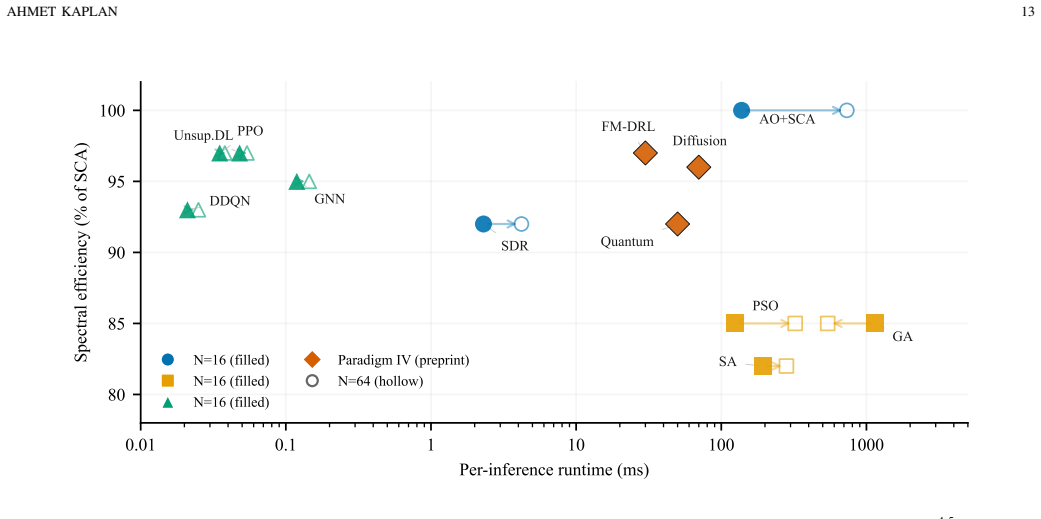
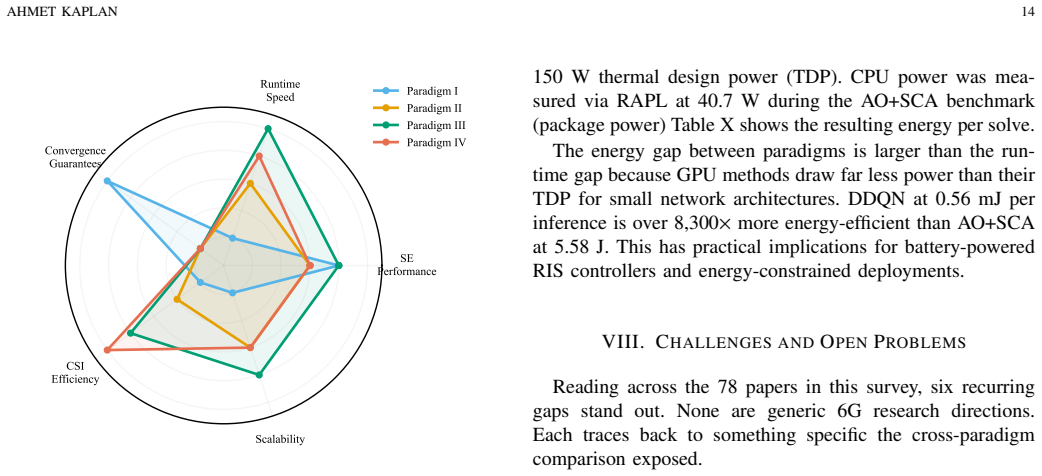
Machine learning methods reach 95-99 percent of model-based spectral efficiency in joint OFDM-RIS optimization at 100 to 10,000 times faster inference.
A machine-rendered reading of the paper's core claim, the machinery that carries it, and where it could break.
Core claim
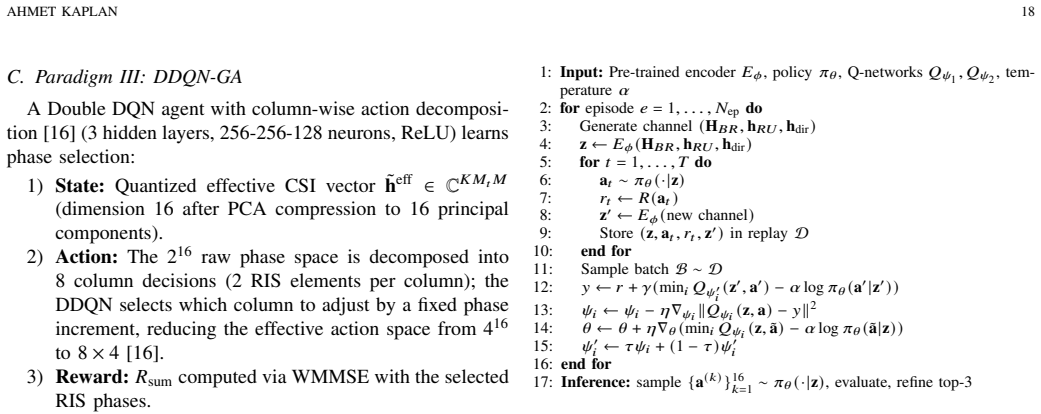
Seventy-eight joint OFDM-RIS optimization works are classified into model-based convex relaxation, heuristic search, deep reinforcement and unsupervised learning, and emerging foundation model methods. Literature synthesis shows ML-based methods report 95-99% of model-based spectral efficiency at 10^2-10^4 x faster per-inference runtime. A companion benchmark reveals GPU-based neural network inference is invariant to RIS size N while iterative solvers scale polynomially.
What carries the argument
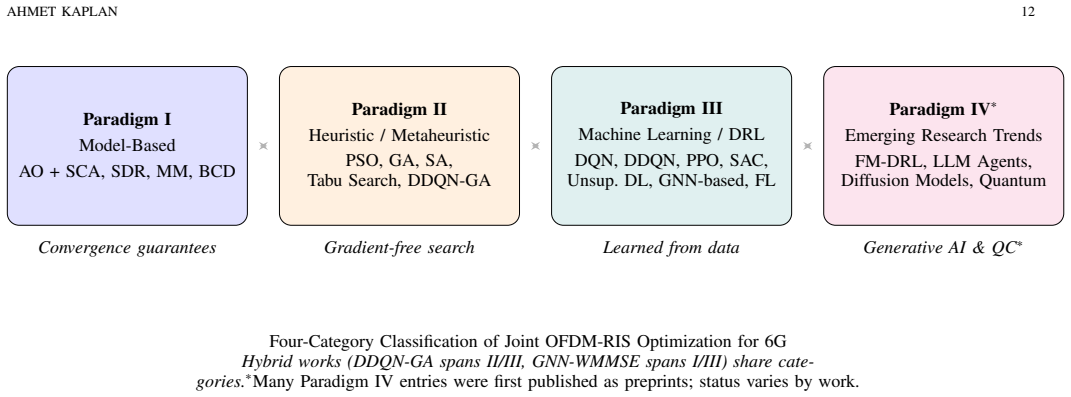
The four-paradigm classification of algorithms for the mixed-integer nonlinear programming problem of joint OFDM waveform design and RIS configuration.
If this is right
- Neural network inference remains constant in runtime as RIS size N increases from 16 to 128.
- Iterative solvers scale polynomially with N.
- Standardized power models are needed for energy efficiency and PAPR benchmarks.
- Six open challenges include hardware deployment and doubly-dispersive channels.
Where Pith is reading between the lines
- A shared benchmark would make cross-paradigm comparisons feasible and reliable.
- The runtime invariance of neural methods points to advantages in scaling to very large RIS arrays.
- The listed LLM safety challenge suggests that foundation model deployment in networks requires new verification methods.
Load-bearing premise
Self-reported performance figures from independent papers can be aggregated into meaningful comparisons despite the acknowledged absence of any standardized benchmark or common evaluation protocol.
What would settle it
Publication of results from a unified benchmark suite applied to instances of each paradigm that shows ML methods falling below 90% of model-based efficiency or losing their runtime advantage.
Figures
read the original abstract
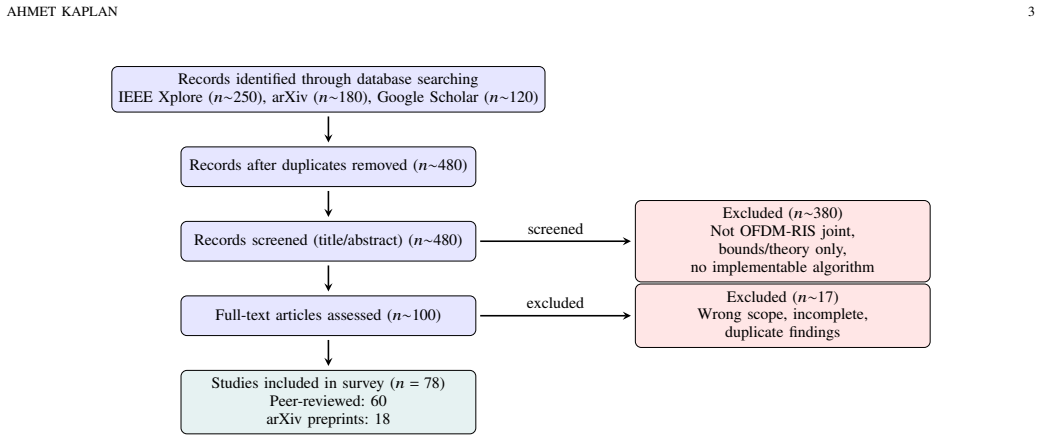
Joint OFDM-RIS optimization for 6G is a mixed-integer nonlinear programming (MINLP) problem covering sum-rate maximization, energy efficiency, max-min fairness, and peak-to-average power ratio (PAPR)-constrained objectives. Seventy-eight joint OFDM-RIS optimization works published between 2021 and 2026 are surveyed. No standardized benchmark exists, and cross-paper comparisons remain infeasible. This survey classifies these works into four paradigms: (I) model-based convex relaxation, (II) heuristic and metaheuristic search, (III) deep reinforcement and unsupervised learning, and (IV) emerging methods including foundation models (FM), diffusion-based generative AI, and quantum optimization. A literature synthesis of self-reported benchmarks shows that ML-based methods (Paradigm~III) report 95-99\% of model-based spectral efficiency at 10^2-10^4 x faster per-inference runtime (method-pair dependent; literature values are self-reported and exclude ML pre-training cost). A companion tutorial benchmark at N=16, N=64, and N=128 reveals a critical scaling property: GPU-based neural network inference (DDQN, PPO, graph neural network (GNN), unsupervised DL) is N-invariant, with identical runtime at N=16 and N=128, while iterative solvers (AO+SCA, PSO) scale polynomially. Energy efficiency (P2) and PAPR-constrained (P4) benchmarks are deferred to future work with standardized power models and waveform generators. Six open challenges emerge from the synthesis: the cross-paradigm benchmark deficit, real-world hardware-constrained deployment, joint waveform-RIS optimization for doubly-dispersive channels, multi-objective PAPR trade-offs, LLM safety in live network control, and diminishing returns of standalone heuristics. We specify requirements for a standardized benchmark. This study serves as a roadmap for researchers and practitioners working on joint OFDM-RIS optimization in 6G networks.
Editorial analysis
A structured set of objections, weighed in public.
Referee Report
Summary. The manuscript surveys 78 papers (2021-2026) on joint OFDM waveform design and RIS configuration for 6G, which is formulated as a MINLP problem under objectives including sum-rate, energy efficiency, max-min fairness, and PAPR constraints. It classifies the works into four paradigms—(I) model-based convex relaxation, (II) heuristic/metaheuristic, (III) deep RL and unsupervised learning, and (IV) emerging methods (foundation models, diffusion, quantum)—and performs a literature synthesis of self-reported results claiming that Paradigm III achieves 95-99% of model-based spectral efficiency at 10^2-10^4× faster per-inference runtime. A companion tutorial benchmark at N=16/64/128 demonstrates that GPU-based NN inference is N-invariant while iterative solvers scale polynomially. The paper lists six open challenges and specifies requirements for a standardized benchmark.
Significance. If the synthesis and scaling observations hold, the work provides a useful roadmap that quantifies the performance-runtime trade-off across paradigms and highlights the cross-paradigm benchmark deficit as a central obstacle for 6G research. The tutorial benchmark's demonstration of N-invariant GPU inference versus polynomial scaling of AO+SCA/PSO is a concrete, falsifiable observation that could guide deployment choices.
major comments (2)
- [Abstract; literature synthesis] Abstract and literature-synthesis section: The central quantitative claim that 'ML-based methods (Paradigm III) report 95-99% of model-based spectral efficiency at 10^2-10^4× faster per-inference runtime' is obtained by aggregating self-reported values across 78 papers. The manuscript simultaneously states that 'no standardized benchmark exists, and cross-paper comparisons remain infeasible' because works optimize distinct objectives, use non-identical channel models, antenna/RIS sizes, and power constraints. This internal tension makes the headline performance numbers rest on an assumption the authors themselves reject; the claim is therefore not supported by the evidence presented.
- [Tutorial benchmark] Tutorial benchmark description: The scaling result (GPU inference N-invariant at N=16 vs. N=128) is presented as a 'critical scaling property,' yet the manuscript defers energy-efficiency (P2) and PAPR-constrained (P4) benchmarks to future work without providing the standardized power models or waveform generators needed to replicate or extend the N=16/64/128 experiments. This limits the load-bearing status of the scaling observation for the multi-objective claims.
minor comments (2)
- [Classification section] The four-paradigm taxonomy is clearly motivated, but the boundary between Paradigm III (deep RL/unsupervised) and Paradigm IV (foundation models, diffusion) is not sharply delineated; several works could plausibly fit both.
- [Literature synthesis] Citation of the 78 papers is comprehensive, but the manuscript would benefit from an explicit table or appendix listing the exact objective, channel model, and reported metric for each work used in the 95-99% synthesis.
Simulated Author's Rebuttal
We thank the referee for the constructive feedback and for recognizing the potential value of the survey as a roadmap. We address each major comment below with specific revisions planned for the manuscript.
read point-by-point responses
-
Referee: [Abstract; literature synthesis] Abstract and literature-synthesis section: The central quantitative claim that 'ML-based methods (Paradigm III) report 95-99% of model-based spectral efficiency at 10^2-10^4× faster per-inference runtime' is obtained by aggregating self-reported values across 78 papers. The manuscript simultaneously states that 'no standardized benchmark exists, and cross-paper comparisons remain infeasible' because works optimize distinct objectives, use non-identical channel models, antenna/RIS sizes, and power constraints. This internal tension makes the headline performance numbers rest on an assumption the authors themselves reject; the claim is therefore not supported by the evidence presented.
Authors: We agree that the aggregation of self-reported results across heterogeneous experimental setups creates a tension with the explicit statement that standardized benchmarks are absent. The 95-99% figure is presented with the qualifier that values are self-reported and exclude pre-training costs, but the framing can be strengthened. In the revised manuscript we will edit both the abstract and the literature-synthesis section to state more explicitly that these numbers represent indicative trends drawn from the surveyed literature rather than direct, controlled comparisons, and we will add a dedicated caveat paragraph underscoring the infeasibility of cross-paper quantitative claims. revision: yes
-
Referee: [Tutorial benchmark] Tutorial benchmark description: The scaling result (GPU inference N-invariant at N=16 vs. N=128) is presented as a 'critical scaling property,' yet the manuscript defers energy-efficiency (P2) and PAPR-constrained (P4) benchmarks to future work without providing the standardized power models or waveform generators needed to replicate or extend the N=16/64/128 experiments. This limits the load-bearing status of the scaling observation for the multi-objective claims.
Authors: We accept that the current tutorial benchmark is scoped to runtime scaling under sum-rate maximization and that the deferred objectives limit its applicability to the full multi-objective setting. In the revision we will (i) add an explicit scope statement to the benchmark subsection clarifying that the N-invariance result applies to the tested objective and configurations, and (ii) expand the 'requirements for a standardized benchmark' section with concrete proposals for power-consumption models and PAPR waveform generators. These additions will both acknowledge the present limitation and supply the missing elements needed for future multi-objective extensions. revision: partial
Circularity Check
No circularity: survey reports external literature values without internal derivation reducing to fitted inputs
full rationale
The manuscript is a literature survey classifying 78 external papers into paradigms and reporting their self-stated performance numbers. No equations, derivations, fitted parameters, or model predictions are defined within the paper itself. The synthesis of 95-99% SE and speed-up figures is presented as an aggregation of external self-reported results (with explicit caveats on incomparability), not as a quantity derived from the paper's own inputs or ansatz. No self-citation chain, uniqueness theorem, or renaming of known results occurs in a load-bearing derivation. The central claims rest on external sources rather than reducing to the paper's own construction.
Axiom & Free-Parameter Ledger
axioms (1)
- domain assumption Self-reported performance metrics from surveyed papers are comparable enough for synthesis despite no standardized benchmark existing
Reference graph
Works this paper leans on
-
[1]
B. Zheng, C. You, W. Mei, and R. Zhang, “A survey on channel estimation and practical passive beamforming design for intelligent reflecting surface aided wireless communications,”IEEE Commun. Surveys Tuts., vol. 24, no. 2, pp. 1035–1071, 2022. [Online]. Available: https://doi.org/10.1109/comst.2022.3155305
-
[2]
A unifying view of OTFS and its many variants,
Q. Deng, Z. Ding, and Z. Wang, “A unifying view of OTFS and its many variants,”IEEE Commun. Surveys Tuts., vol. 27, no. 4, pp. 1–1, 2025. [Online]. Available: https://doi.org/10.1109/COMST.2025.3542467
-
[3]
Performance evaluation and optimization for 6G networks: A survey of KPIs, tools, and AI models,
M. M. Islam, K. Hasan, and S. H. Jeong, “Performance evaluation and optimization for 6G networks: A survey of KPIs, tools, and AI models,” ICT Express, vol. 12, no. 2, pp. 390–416, Apr. 2026. [Online]. Available: https://doi.org/10.1016/j.icte.2025.12.012
-
[4]
H. Zhou, M. Erol-Kantarci, Y . Liu, and H. V . Poor, “A survey on model- based, heuristic, and machine learning optimization approaches in RIS- aided wireless networks,”IEEE Commun. Surveys Tuts., vol. 26, no. 2, pp. 781–823, 2024. [Online]. Available: https://doi.org/10.1109/comst. 2023.3340099
-
[5]
A survey of PAPR techniques based on machine learning,
B. S. de C. da Silva, V . D. P. Souto, R. D. Souza, and L. L. Mendes, “A survey of PAPR techniques based on machine learning,”Sensors, vol. 24, no. 6, p. 1918, Mar. 2024. [Online]. Available: https://doi.org/ 10.3390/s24061918
-
[6]
R. Greidi and K. Cohen, “DeepOFW: Deep learning-driven OFDM- flexible waveform modulation for peak-to-average power ratio reduc- tion,”arXiv:2603.23544, Mar. 2026. [Online]. Available: https://arxiv. org/abs/2603.23544
-
[7]
Recon- figurable intelligent surfaces: Principles and design considerations,
K. K. Biliaminu, J. Rodriguez, F. Gil-Casti ˜neira, and J. Bastos, “Recon- figurable intelligent surfaces: Principles and design considerations,”In- techOpen, 2024. [Online]. Available: https://doi.org/10.5772/intechopen. 1012750
-
[8]
Heuristic algorithms for RIS-assisted wireless networks: Exploring heuristic-aided machine learning,
H. Zhou, M. Erol-Kantarci, Y . Liu, and H. V . Poor, “Heuristic algorithms for RIS-assisted wireless networks: Exploring heuristic-aided machine learning,”IEEE Wireless Commun., vol. 31, no. 4, pp. 106–114, 2024. [Online]. Available: https://doi.org/10.1109/mwc.010.2300321
-
[9]
H. Zhou, C. Hu, and X. Liu, “An overview of machine learning-enabled optimization for RIS-aided 6G networks: From reinforcement learning to large language models,”arXiv:2405.17439, 2024. [Online]. Available: https://arxiv.org/abs/2405.17439
-
[10]
Machine learning approaches for reconfig- urable intelligent surfaces: A survey,
K. M. Faisal and W. Choi, “Machine learning approaches for reconfig- urable intelligent surfaces: A survey,”IEEE Access, vol. 10, pp. 27343– 27367, 2022. [Online]. Available: https://doi.org/10.1109/access.2022. 3157651
-
[11]
L. Ibrahim, M. N. Mahmud, M. F. M. Salleh, and A. Al-Rimawi, “Joint beamforming optimization design and performance evaluation of RIS- aided wireless networks: A comprehensive state-of-the-art review,”IEEE Access, vol. 11, pp. 141801–141859, 2023. [Online]. Available: https: //doi.org/10.1109/access.2023.3342320
-
[12]
Beam- forming and resource allocation for delay minimization in RIS-assisted OFDM systems,
Y . Ma, X. Li, C. Guo, L. Liang, M. Matthaiou, and S. Jin, “Beam- forming and resource allocation for delay minimization in RIS-assisted OFDM systems,”arXiv:2506.03586, Jun. 2025. [Online]. Available: https://arxiv.org/abs/2506.03586
-
[13]
Resource allocation for RIS-enhanced OFDM-MIMO ISAC systems,
P. Zivuku, V .-D. Nguyen, N. T. Nguyen, K. Ntontin, S. Chatzinotas, and B. Ottersten, “Resource allocation for RIS-enhanced OFDM-MIMO ISAC systems,”IEEE Trans. Commun., vol. 74, 2026. [Online]. Avail- able: https://doi.org/10.1109/tcomm.2025.3637097
-
[14]
DRL-based RIS phase shift design for OFDM communication systems,
P. Chen, X. Li, M. Matthaiou, and S. Jin, “DRL-based RIS phase shift design for OFDM communication systems,”IEEE Wireless Commun. Lett., vol. 12, no. 4, pp. 733–737, Apr. 2023. [Online]. Available: https: //doi.org/10.1109/lwc.2023.3242449
-
[15]
Y . Ma, X. Zhou, X. Li, L. Liang, and S. Jin, “Unsupervised learning- based joint resource allocation and beamforming design for RIS-assisted MISO-OFDMA systems,”IEEE Trans. Cogn. Commun. Netw., vol. 12, pp. 2251–2264, 2026. [Online]. Available: https://doi.org/10.1109/tccn. 2025.3592931
-
[16]
A heuristic-integrated DRL approach for phase optimization in large-scale RISs,
W. Wang, P. Li, A. Doufexi, and M. A. Beach, “A heuristic-integrated DRL approach for phase optimization in large-scale RISs,”IEEE Com- mun. Lett., vol. 29, no. 7, pp. 1579–1583, 2025. [Online]. Available: https://doi.org/10.1109/lcomm.2025.3568652
-
[17]
P.-H. Chou, B.-R. Zheng, W.-J. Huang, W. Saad, Y . Tsao, and R. Y . Chang, “Deep reinforcement learning-based precoding for multi- RIS-aided multiuser downlink systems with practical phase shift,”IEEE Wireless Commun. Lett., vol. 14, no. 1, pp. 23–27, Jan. 2025. [Online]. Available: https://doi.org/10.1109/lwc.2024.3482720
-
[18]
H. Zhang, X. Huang, Z. Guan, R.-R. Chen, A. Farhang, and M. Ji, “Deep reinforcement learning for maximizing downlink spectral efficiency in non-stationary RIS-aided multiuser-MISO systems,”European WIRE- LESS 2025; 30th European Wireless Conference. pp. 196-201 (2025) [Online]. Available: https://ieeexplore.ieee.org/document/10164189
-
[19]
Intelligent reflecting surface enhanced wireless network via joint active and passive beamforming,
Q. Wu and R. Zhang, “Intelligent reflecting surface enhanced wireless network via joint active and passive beamforming,”IEEE Trans. Wire- less Commun., vol. 18, no. 11, pp. 5394–5409, Nov. 2019. [Online]. Available: https://doi.org/10.1109/twc.2019.2936025
-
[20]
Reconfigurable intelligent surfaces for energy efficiency in wire- less communication,
C. Huang, G. C. Alexandropoulos, A. Zappone, C. Yuen, and M. Deb- bah, “Reconfigurable intelligent surfaces for energy efficiency in wire- less communication,”IEEE Trans. Wireless Commun., vol. 18, no. 8, AHMET KAPLAN 20 pp. 4157–4170, Aug. 2019. [Online]. Available: https://doi.org/10.1109/ twc.2019.2922609
-
[21]
Intelligent reflect- ing surface enhanced wireless networks: Two-timescale beamforming optimization,
M. M. Zhao, Q. Wu, M. J. Zhao, and R. Zhang, “Intelligent reflect- ing surface enhanced wireless networks: Two-timescale beamforming optimization,”IEEE Trans. Wireless Commun., vol. 20, no. 1, pp. 2– 17, Jan. 2021. [Online]. Available: https://doi.org/10.1109/twc.2020. 3022297
-
[22]
Intelligent reflecting surface: Practical phase shift model and beamforming optimization,
S. Abeywickrama, R. Zhang, Q. Wu, and C. Yuen, “Intelligent reflecting surface: Practical phase shift model and beamforming optimization,” IEEE Trans. Commun., vol. 68, no. 9, pp. 5849–5863, Sep. 2020. [Online]. Available: https://doi.org/10.1109/icc40277.2020.9148961
-
[23]
W. Luo, X. Huang, and Y . Fang, “Optimization in RIS-empowered wireless networks,” inEncyclopedia of Optimization. P. M. Pardalos and O. A. Prokopyev, Eds., Cham: Springer Nature Switzerland, pp. 1– 10, 2025, doi:10.1007/978−3−030−54621−2 476−1. [Online]. Available: https://doi.org/10.1007/978-3-030-54621-2 476-1
work page doi:10.1007/978 2025
-
[24]
N. Panuganti, P. Ranjan, and A. Shukla, “Impact of metaheuristic optimization algorithms on wireless network coverage enhancement with reconfigurable intelligent surfaces,”Int. J. Commun. Syst., vol. 38, no. 5, p. e70026, Mar. 2025. [Online]. Available: https://doi.org/10.1002/dac. 70026
work page doi:10.1002/dac 2025
-
[25]
E. A. Zaoutis, G. S. Liodakis, A. T. Baklezos, C. D. Nikolopoulos, M. P. Ioannidou, and I. O. Vardiambasis, “6G wireless communications and AI-controlled reconfigurable intelligent surfaces: From supervised to federated learning,”Appl. Sci. (MDPI), vol. 15, no. 6, p. 3252, Mar. 2025. [Online]. Available: https://doi.org/10.3390/app15063252
-
[26]
Large wireless foundation models: Stronger over bigger,
X. Cheng, B. Liu, X. Liu, and X. Cai, “Large wireless foundation models: Stronger over bigger,”arXiv:2601.10963, Jan. 2026. [Online]. Available: https://arxiv.org/abs/2601.10963
-
[27]
Foundation model-aided deep reinforcement learning for RIS-assisted wireless communication,
M. Ghassemi, S. F. Mobarak, H. Zhang, A. Afana, A. B. Sediq, and M. Erol-Kantarci, “Foundation model-aided deep reinforcement learning for RIS-assisted wireless communication,” inProc. IEEE PIMRC, 2025, pp. 1–6. [Online]. Available: https://doi.org/10.1109/pimrc62392.2025. 11274561
-
[28]
M. Ghassemi, H. Zhang, A. Afana, A. B. Sediq, and M. Erol-Kantarci, “Foundation model-aided hierarchical deep reinforcement learning for blockage-aware link in RIS-assisted networks,”arXiv:2602.09157, Feb. 2026. [Online]. Available: https://arxiv.org/abs/2602.09157
-
[29]
Large language model (LLM)-enabled reinforcement learning for wireless network optimization,
J. Zheng, R. Zhang, D. Niyato, H. Zhang, J. Wang, H. Du, J. Kang, and Z. Xiong, “Large language model (LLM)-enabled reinforcement learning for wireless network optimization,”IEEE Commun. Mag., vol. 64, no. 4, pp. 82–89, 2026. [Online]. Available: https://doi.org/10.1109/mcom.001. 2500384
-
[30]
ComAgent: Multi-LLM based agentic AI empowered intelligent wire- less networks,
H. Li, M. Xiao, K. Wang, R. Schober, D. I. Kim, and Y . L. Guan, “ComAgent: Multi-LLM based agentic AI empowered intelligent wire- less networks,”arXiv:2601.19607, 2026. [Online]. Available: https: //arxiv.org/abs/2601.19607
-
[31]
Towards native intelligence: 6G-LLM trained with reinforcement learning from NDT feedback,
Z. Xiao, T. Tao, C. Ye, Y . Hu, Y . Feng, T. Jiao, and L. Cai, “Towards native intelligence: 6G-LLM trained with reinforcement learning from NDT feedback,”arXiv:2601.09992, Jan. 2026. [Online]. Available: https://arxiv.org/abs/2601.09992
-
[32]
Large language models in 6G from standard to on- device networks,
H. Zou, Q. Zhao, S. Lasaulce, C. Zhang, Y . Tian, L. Bariah, F. Bader, and M. Debbah, “Large language models in 6G from standard to on- device networks,”Nat. Rev. Electr. Eng., vol. 3, pp. 123–134, Jan. 2026. [Online]. Available: https://doi.org/10.1038/s44287-025-00239-6
-
[33]
A Graph Foundation Model for Wireless Resource Allocation
Y . Sheng, J. Wang, L. Liang, H. Ye, and S. Jin, “A graph foundation model for wireless resource allocation,”arXiv:2604.07390, Apr. 2026. [Online]. Available: https://arxiv.org/abs/2604.07390
work page internal anchor Pith review Pith/arXiv arXiv 2026
-
[34]
Large language model enhanced multi-agent systems for 6G communications,
F. Jiang, Y . Peng, L. Dong, K. Wang, K. Yang, C. Pan, D. Niyato, and O. A. Dobre, “Large language model enhanced multi-agent systems for 6G communications,”IEEE Wireless Commun., vol. 31, no. 6, pp. 48– 55, Dec. 2024. [Online]. Available: https://doi.org/10.1109/mwc.016. 2300600
-
[35]
When large language model agents meet 6G networks: Perception, grounding, and alignment,
M. Xu, D. Niyato, J. Kang, Z. Xiong, S. Mao, Z. Han, D. I. Kim, and K. B. Letaief, “When large language model agents meet 6G networks: Perception, grounding, and alignment,”IEEE Wireless Commun., vol. 31, no. 6, pp. 63–71, 2024. [Online]. Available: https://doi.org/10.1109/mwc. 005.2400019
work page doi:10.1109/mwc 2024
-
[36]
Channel estimation for RIS-assisted mmWave systems via diffusion models,
Y . Wang, Y . Xu, C. Zhang, Z. Chen, M. Dai, H. Wang, B. Liu, D. He, and M. Tao, “Channel estimation for RIS-assisted mmWave systems via diffusion models,”IEEE Commun. Lett., vol. 30, pp. 597–601, 2026. [Online]. Available: https://doi.org/10.1109/lcomm.2025.3645078
-
[37]
Diffusion model- based channel estimation for RIS-aided communication systems,
W. Tong, W. Xu, F. Wang, W. Ni, and J. Zhang, “Diffusion model- based channel estimation for RIS-aided communication systems,”IEEE Wireless Commun. Lett., vol. 13, no. 9, pp. 2586–2590, Sep. 2024. [Online]. Available: https://doi.org/10.1109/lwc.2024.3431525
-
[38]
Generative diffusion models for wireless networks: Fundamental, architecture, and state-of- the-art,
D. Fan, R. Meng, X. Xu, Y . Liu, G. Nan, C. Feng, S. Han, S. Gao, B. Xu, D. Niyato, T. Q. S. Quek, and P. Zhang, “Generative diffusion models for wireless networks: Fundamental, architecture, and state-of- the-art,”arXiv:2507.16733, Jul. 2025. [Online]. Available: https://arxiv. org/abs/2507.16733
-
[39]
Generative AI-driven phase control for RIS-aided cell-free massive MIMO sys- tems,
K. K. Patel, M. Chakraborty, E. Sharma, and S. K. Singh, “Generative AI-driven phase control for RIS-aided cell-free massive MIMO sys- tems,”arXiv:2602.11226, Feb. 2026. [Online]. Available: https://arxiv. org/abs/2602.11226
-
[40]
Trajectory-aware multi- RIS activation and configuration: A Riemannian diffusion method,
K. Wang, B. Yang, Y . Lei, Z. Li, Z. Yu, X. Cao, B. Guo, G. C. Alexan- dropoulos, D. Niyato, M. Debbah, and Z. Han, “Trajectory-aware multi- RIS activation and configuration: A Riemannian diffusion method,” arXiv:2602.07937, Feb. 2026. [Online]. Available: https://arxiv.org/abs/ 2602.07937
-
[41]
Decision transformers for RIS-assisted systems with dif- fusion model-based channel acquisition,
J. Zhang, Y . Ni, J. Li, G. Chen, Z. Wang, L. Shi, S. Jin, W. Chen, and H. V . Poor, “Decision transformers for RIS-assisted systems with dif- fusion model-based channel acquisition,”arXiv:2501.08007, Jan. 2025. [Online]. Available: https://arxiv.org/abs/2501.08007
-
[42]
Quantum Graph Neural Networks for Double-Sided Reconfigurable Intelligent Surface Optimization
N. Hassan, X. Fernando, and H. Yanikomeroglu, “Quantum graph neural networks for double-sided reconfigurable intelligent surface op- timization,”arXiv:2604.10453, Apr. 2026. [Online]. Available: https: //arxiv.org/abs/2604.10453
work page internal anchor Pith review Pith/arXiv arXiv 2026
-
[43]
Quantum manifold optimization: A design framework for future communications systems,
G. Rexhepi, H. S. Rou, and G. T. F. de Abreu, “Quantum manifold optimization: A design framework for future communications systems,” arXiv:2504.09667, Apr. 2025. [Online]. Available: https://arxiv.org/abs/ 2504.09667
-
[44]
Path-Based Quantum Meta-Learning for Adaptive Optimization of Reconfigurable Intelligent Surfaces
N. Hassan, X. Fernando, and H. Yanikomeroglu, “Path-based quantum meta-learning for adaptive optimization of reconfigurable intelligent surfaces,”arXiv:2604.17690, Apr. 2026. [Online]. Available: https:// arxiv.org/abs/2604.17690
work page internal anchor Pith review Pith/arXiv arXiv 2026
-
[45]
Quantum-inspired resource optimization for 6G networks: A survey,
M. O. Butt, N. Waheed, T. Q. Duong, and W. Ejaz, “Quantum-inspired resource optimization for 6G networks: A survey,”IEEE Commun. Surveys Tuts., vol. 27, no. 5, pp. 2973–3019, 2025. [Online]. Available: https://doi.org/10.1109/comst.2024.3519865
-
[46]
M. Liu, C. Huang, A. Alhammadi, M. Di Renzo, M. Debbah, and C. Yuen, “Beamforming design and association scheme for multi-RIS multi-user mmWave systems through graph neural networks,”IEEE Trans. Wireless Commun., vol. 24, no. 9, pp. 7940–7954, 2025. [Online]. Available: https://doi.org/10.1109/twc.2025.3563529
-
[47]
GNN based joint beamforming design for extremely large-scale RIS assisted near- field ISAC systems,
J. Chen, F. Wang, G. Han, X. Wang, and V . K. N. Lau, “GNN based joint beamforming design for extremely large-scale RIS assisted near- field ISAC systems,”arXiv:2603.01379, Mar. 2026. [Online]. Available: https://arxiv.org/abs/2603.01379
-
[48]
H. Tang, J. Zhang, Z. Zhao, H. Wu, H. Sun, and P. Jiao, “Joint optimization based on two-phase GNN in RIS- and DF-assisted MISO systems with fine-grained rate demands,”arXiv:2506.02642, Jun. 2025. [Online]. Available: https://arxiv.org/abs/2506.02642
-
[50]
RIS-assisted OTFS commu- nications: Phase configuration via received-energy maximization,
M. H. Dinan and A. Farhang, “RIS-assisted OTFS commu- nications: Phase configuration via received-energy maximization,” arXiv:2404.07759, Apr. 2024. [Online]. Available: https://arxiv.org/abs/ 2404.07759
-
[51]
Coef- ficients optimization and low-complexity equalization for OTFS-RIS system,
R. Ouchikh, T. Chonavel, A. A ¨ıssa-El-Bey, and M. Djeddou, “Coef- ficients optimization and low-complexity equalization for OTFS-RIS system,” inProc. IEEE Middle East Conf. Commun. Netw. (MECOM), Nov. 2025. [Online]. Available: https://doi.org/10.1109/mecom67453. 2025.11439645
-
[52]
Comparison of OTFS and OFDM for RIS-aided systems in the presence of phase noise,
S. McWade and A. Farhang, “Comparison of OTFS and OFDM for RIS-aided systems in the presence of phase noise,”arXiv:2602.12804, Feb. 2026. [Online]. Available: https://arxiv.org/abs/2602.12804
-
[53]
Hybrid PSO-GD phase opti- mization for RIS-assisted AFDM systems,
V . Saiprudhvi and H. Subramaniyam, “Hybrid PSO-GD phase opti- mization for RIS-assisted AFDM systems,”Phys. Commun., vol. 73, Art. 102891, Oct. 2025. [Online]. Available: https://www.sciencedirect. com/science/article/pii/S1874490725002940
2025
-
[54]
Deep learning optimization of STAR-RIS for en- hanced data rate and energy efficiency in 6G wireless networks,
A. Megahed, A. M. Abd El-Haleem, M. M. Elmesalawy, and I. I. Ibrahim, “Deep learning optimization of STAR-RIS for en- hanced data rate and energy efficiency in 6G wireless networks,” Sci. Rep., vol. 15, 2025. [Online]. Available: https://doi.org/10.1038/ s41598-025-09774-6
2025
-
[55]
M. Ejaz, G. Jinsong, M. Asim, M. A. Wani, and K. A. Shakil, “Joint phase-shift and power allocation optimization in RIS-enhanced wireless networks: An intelligent framework,”IEEE Open J. Commun. Soc., AHMET KAPLAN 21 vol. 6, pp. 7389–7404, 2025. [Online]. Available: https://doi.org/10. 1109/ojcoms.2025.3602856
-
[56]
Channel estimation for reconfigurable intelligent surface- aided 6G NOMA systems using CNN-based quantum LSTM model,
N. Q. T. Thoong, A. A. Cheema, S. R. Khosravirad, O. A. Dobre, and T. Q. Duong, “Channel estimation for reconfigurable intelligent surface- aided 6G NOMA systems using CNN-based quantum LSTM model,” inProc. IEEE 100th Veh. Technol. Conf. (VTC2024-Fall), 2024, pp. 1–
2024
-
[57]
Available: https://doi.org/10.1109/vtc2024-fall63153.2024
[Online]. Available: https://doi.org/10.1109/vtc2024-fall63153.2024. 10757552
-
[58]
Semidefinite relaxation of quadratic optimization problems,
Z.-Q. Luo, W.-K. Ma, A. M.-C. So, Y . Ye, and S. Zhang, “Semidefinite relaxation of quadratic optimization problems,”IEEE Signal Process. Mag., vol. 27, no. 3, pp. 20–34, May 2010. [Online]. Available: https: //doi.org/10.1109/msp.2010.936019
-
[59]
Robust optimization for IRS- assisted SAGIN under channel uncertainty,
Y . Li, X. Wang, J. Zhang, and Z. Chen, “Robust optimization for IRS- assisted SAGIN under channel uncertainty,”Future Internet, vol. 17, no. 10, p. 452, 2025. [Online]. Available: https://doi.org/10.3390/ fi17100452
2025
-
[60]
Hybrid vector message passing for cascaded channel estimation in RIS-aided multi-user MIMO-OFDM systems,
W. Jiang, X. Yuan, and M. Di Renzo, “Hybrid vector message passing for cascaded channel estimation in RIS-aided multi-user MIMO-OFDM systems,”IEEE Trans. Wireless Commun., vol. 24, no. 5, pp. 4174–4189,
-
[61]
Available: https://doi.org/10.1109/twc.2025.3536283
[Online]. Available: https://doi.org/10.1109/twc.2025.3536283
-
[62]
Multi-scale attention based channel estimation for RIS- aided massive MIMO systems,
Y . Jinet al., “Multi-scale attention based channel estimation for RIS- aided massive MIMO systems,”IEEE Trans. Wireless Commun., vol. 23, no. 4, pp. 3680–3694, 2024. [Online]. Available: https://doi.org/10.1109/ twc.2023.3329387
-
[63]
W. Shen, Z. Qin, and A. Nallanathan, “Deep learning for super- resolution channel estimation in reconfigurable intelligent surface aided systems,”IEEE Trans. Commun., vol. 71, no. 3, pp. 1491–1503, 2023. [Online]. Available: https://doi.org/10.1109/tcomm.2023.3239621
-
[65]
Y . Geet al., “Reconfigurable intelligent surface-based multi-user system: Channel estimation and beamforming design with experimental valida- tion,”IEEE Trans. Commun., vol. 72, no. 10, pp. 6569–6582, 2024. [Online]. Available: https://doi.org/10.1109/TCOMM.2024.3400909
-
[66]
Y . Zhanget al., “Model-driven Bayesian reinforcement learning for IRS- assisted massive MIMO-OFDM channel feedback, beamforming, and IRS control,”IEEE Trans. Commun., vol. 73, no. 1, pp. 1–16, 2025. [Online]. Available: https://doi.org/10.1109/twc.2024.3522098
-
[67]
WMMSE-based joint transceiver design for multi-RIS- assisted cell-free networks using hybrid CSI,
Z. Wanget al., “WMMSE-based joint transceiver design for multi-RIS- assisted cell-free networks using hybrid CSI,”IEEE Trans. Wireless Commun., vol. 24, no. 9, pp. 6310–6325, 2025. [Online]. Available: https://doi.org/10.1109/twc.2025.3562138
-
[68]
Y . Liet al., “Joint precoding and AP selection for energy-efficient RIS- aided cell-free massive MIMO with multi-agent reinforcement learning,” IEEE Trans. Wireless Commun., vol. 25, no. 2, pp. 1234–1249, 2026. [Online]. Available: https://doi.org/10.1109/twc.2026.3678661
-
[69]
Beamforming optimization and ADMM-based detection in IRS-aided OTFS systems,
K. Dekaet al., “Beamforming optimization and ADMM-based detection in IRS-aided OTFS systems,”IEEE Trans. Veh. Technol., vol. 74, no. 5, pp. 7890–7904, 2025. [Online]. Available: https://doi.org/10.1109/ ojcoms.2025.3548271
-
[70]
IRS-OTFS systems: Design of reflection coefficients for low-complexity ZF equalizer,
R. K. Yadav, H. B. Mishra, and S. Mukhopadhyay, “IRS-OTFS systems: Design of reflection coefficients for low-complexity ZF equalizer,”IEEE Trans. Veh. Technol., vol. 73, no. 11, pp. 17430–17435, 2024. [Online]. Available: https://doi.org/10.1109/tvt.2024.3400529
-
[72]
X. Chenet al., “Channel estimation and detection for intelligent reflect- ing surface-assisted orthogonal time frequency space systems,”IEEE Trans. Wireless Commun., vol. 23, no. 8, pp. 8419–8433, Aug. 2024. [Online]. Available: https://doi.org/10.1109/twc.2024.3349707
-
[73]
IRS-assisted OTFS: Beamforming design and signal detection,
K. Dekaet al., “IRS-assisted OTFS: Beamforming design and signal detection,”arXiv:2408.02219, Aug. 2024. [Online]. Available: https:// arxiv.org/abs/2408.02219
-
[74]
A survey on reconfigurable intelligent surface-assisted orthogonal time frequency space systems,
X. Liuet al., “A survey on reconfigurable intelligent surface-assisted orthogonal time frequency space systems,”IEEE Open J. Veh. Technol., vol. 6, pp. 1881–1909, 2025. [Online]. Available: https://doi.org/10. 1109/ojvt.2025.3573208
-
[75]
Input-output relation and performance of RIS- aided OTFS with fractional delay-Doppler,
S. R. Kumariet al., “Input-output relation and performance of RIS- aided OTFS with fractional delay-Doppler,” inProc. IEEE Int. Conf. Commun. (ICC), 2024, pp. 1–6. [Online]. Available: https://doi.org/10. 1109/lcomm.2022.3214678
-
[76]
R. M. Asifet al., “Active reconfigurable intelligent surfaces: Expanding the frontiers of wireless communication — A survey,”IEEE Commun. Surveys Tuts., vol. 26, no. 4, pp. 2361–2407, 2024. [Online]. Available: https://doi.org/10.1109/comst.2024.3423460
-
[77]
Active RIS-assisted MIMO-OFDM system: Analy- ses and prototype measurements,
D. M. Chianet al., “Active RIS-assisted MIMO-OFDM system: Analy- ses and prototype measurements,”IEEE Commun. Lett., vol. 28, no. 1, pp. 208–212, Jan. 2024. [Online]. Available: https://doi.org/10.1109/ lcomm.2023.3333688
-
[78]
Trials for RIS-aided wireless com- munications,
S. Hassouna, J. u. R. Kazim, J. Rains, M. A. Jamshed, M. u. Rehman, M. A. Imran, and Q. H. Abbasi, “Trials for RIS-aided wireless com- munications,” inProc. IEEE Int. Symp. Antennas Propag. (APS), 2023, pp. 75–76. [Online]. Available: https://doi.org/10.1109/APS.2023.00000
-
[79]
H. Liet al., “Beyond diagonal reconfigurable intelligent surfaces in wideband OFDM communications: Circuit-based modeling and opti- mization,”IEEE Trans. Wireless Commun., vol. 23, no. 10, pp. 14780– 14795, 2024. [Online]. Available: https://doi.org/10.1109/twc.2025. 3532616
-
[80]
Y . Liuet al., “Variational Bayesian multiuser tracking for reconfigurable intelligent surface-aided MIMO-OFDM systems,”IEEE J. Sel. Areas Commun., vol. 41, no. 12, pp. 3806–3821, 2023. [Online]. Available: https://doi.org/10.1109/jsac.2023.3322792
-
[81]
K. Wanget al., “Reconfigurable intelligent surface-aided OFDM wire- less communications: Hardware aspects of reflection optimization meth- ods,”IEEE J. Sel. Areas Commun., vol. 42, no. 6, pp. 1680–1694, 2024. [Online]. Available: https://doi.org/10.1109/mocast54814.2022.9837634
-
[82]
Y . Zhanget al., “A gradient ascent based low complexity rate maximiza- tion algorithm for intelligent reflecting surface-aided OFDM systems,” IEEE Trans. Veh. Technol., vol. 72, no. 10, pp. 13590–13595, 2023. [Online]. Available: https://doi.org/10.1109/lcomm.2023.3289865
-
[83]
S. Zhanget al., “Reconfigurable intelligent surfaces: A hardware-centric review of structures, implementation, evaluation, and integration with UA V and ML,”IEEE Commun. Surveys Tuts., vol. 27, no. 3, pp. 1682– 1720, 2025. [Online]. Available: https://doi.org/10.1109/access.2025. 3575583
discussion (0)
Sign in with ORCID, Apple, or X to comment. Anyone can read and Pith papers without signing in.