Interstellar filament detection and characterization: methods and implications for studies of magnetized interstellar medium
Pith reviewed 2026-07-01 04:30 UTC · model grok-4.3
The pith
Filament detection methods for the interstellar medium fall into categories that differ in their suitability for studying alignments with magnetic fields.
A machine-rendered reading of the paper's core claim, the machinery that carries it, and where it could break.
Core claim
The paper establishes a systematic overview of filament detection methods by grouping them into methodological categories, discussing their principles, demonstrating their application on one common observational field, and evaluating advantages and limitations especially for analyses of relative alignments between magnetic fields and filaments in the magnetized interstellar medium.
What carries the argument
The classification of filament detection approaches into methodological categories, which enables direct comparison of principles, performance on shared data, and implications for magnetic field alignment studies.
If this is right
- Different method categories can produce varying conclusions about filament-magnetic field alignments from the same data.
- Limitations of each category must be accounted for when using filaments as diagnostics of magnetohydrodynamic processes.
- The classification helps evaluate which techniques are best suited for specific scientific questions in star formation studies.
- Perspectives for future work include handling ever-growing volumes of astronomical data from multiple observational modes.
Where Pith is reading between the lines
- The review's comparison framework could help researchers select detection methods matched to particular data characteristics or scientific goals.
- Extending the single-field test to multiple independent regions might expose method-dependent biases more robustly.
- Combining filament detection outputs with spectroscopic velocity information could refine characterizations of accretion and turbulence.
Load-bearing premise
A single observational field can serve as a fair and representative testbed for comparing all method categories without selection effects that favor certain techniques.
What would settle it
Demonstrating that the same set of methods applied to several distinct observational fields produces inconsistent patterns of filament-magnetic field alignments that depend on the chosen field would indicate the single-field illustration does not generalize.
Figures
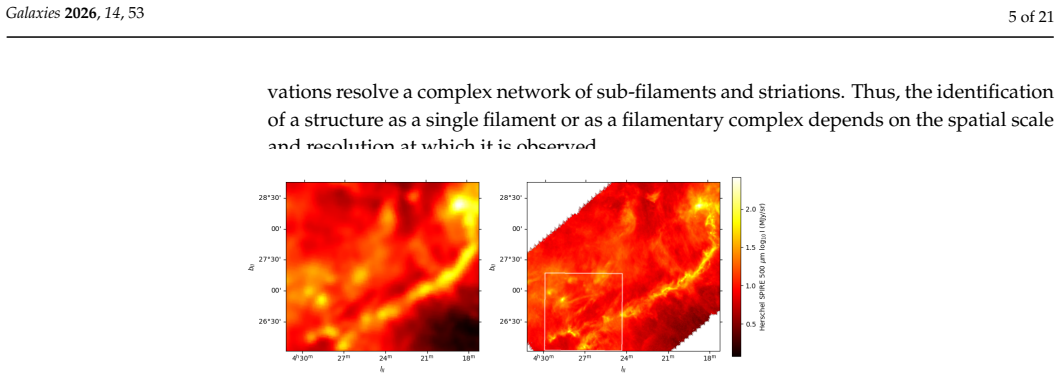

read the original abstract
Filamentary structures are ubiquitous in the interstellar medium and play a key role in the evolution of molecular clouds and star formation. Their morphology and relative orientation with respect to magnetic fields have been widely used as a diagnostic of magnetohydrodynamic processes, turbulence, and gravitational accretion. In recent years, the growing availability of large continuum, spectroscopic, and polarization data stimulated the development of various filament detection techniques. In this review, we present a systematic overview of filament detection methods applied to observations of the interstellar medium. We classify the existing approaches into methodological categories, discuss underlying principles, illustrate their application on a same observational field, discuss limitations and advantages, in particular with respect to the studies of the relative alignment between magnetic fields and filaments. We conclude with presenting a point of view on the perspectives for filament studies in the era of ever-growing astronomical data volume.
Editorial analysis
A structured set of objections, weighed in public.
Referee Report
Summary. The manuscript is a review that classifies filament detection methods applied to interstellar medium observations into methodological categories, discusses their underlying principles, illustrates their application on a single shared observational field, evaluates limitations and advantages (with emphasis on magnetic field-filament alignment studies), and outlines perspectives for future work with increasing data volumes.
Significance. A systematic classification and side-by-side illustration of methods could help standardize choices in magnetized ISM studies and clarify biases in B-field alignment diagnostics. The single-field comparison is a potentially useful concrete element, but its value hinges on whether the chosen field is representative; without that, the comparative claims on advantages/limitations remain field-specific rather than general.
major comments (1)
- [Abstract] Abstract (and the section describing the illustration): the central comparative claim rests on applying all method categories to one observational field, yet no justification or quantification is given for how the field's column-density range, noise properties, or filament orientation distribution interact with each method's assumptions; this leaves open the possibility that observed performance differences are partly selection-driven rather than intrinsic.
minor comments (1)
- Clarify the exact criteria used to assign methods to categories and ensure each category is accompanied by at least one canonical reference.
Simulated Author's Rebuttal
We thank the referee for their thoughtful review and constructive comments on our manuscript. We address the major comment point by point below and outline the revisions we will make.
read point-by-point responses
-
Referee: [Abstract] Abstract (and the section describing the illustration): the central comparative claim rests on applying all method categories to one observational field, yet no justification or quantification is given for how the field's column-density range, noise properties, or filament orientation distribution interact with each method's assumptions; this leaves open the possibility that observed performance differences are partly selection-driven rather than intrinsic.
Authors: We agree that the manuscript would benefit from greater transparency on this point. The chosen field was selected because it provides overlapping continuum, spectroscopic, and polarization data suitable for applying the full range of detection methods, and because its filamentary structures have been previously studied in the context of magnetic field alignment. However, we did not include explicit quantification of its column-density distribution, noise characteristics, or filament orientation statistics relative to each method's assumptions. We will revise the abstract and the illustration section to (i) state the selection criteria for the field, (ii) summarize its key observational properties (column-density range, noise level, and orientation distribution), and (iii) clarify that the side-by-side application serves as an illustrative demonstration rather than a statistically general ranking of method performance. These changes will make explicit that any observed differences are tied to the specific field properties and will prevent over-generalization of the comparative claims. revision: yes
Circularity Check
No circularity: purely descriptive survey of external methods
full rationale
This is a review paper that classifies existing filament detection techniques from the literature, discusses their principles, and illustrates application on one shared observational field. It contains no derivations, predictions, fitted parameters, or uniqueness theorems. All content references external work without self-referential reduction of claims to the paper's own inputs. The single-field illustration is a methodological choice for comparison, not a derivation that collapses by construction. Score 0 is the appropriate finding for a self-contained descriptive survey.
Axiom & Free-Parameter Ledger
Reference graph
Works this paper leans on
-
[1]
From filamentary clouds to prestellar cores to the stellar IMF: Initial highlights from the Herschel Gould Belt Survey
André, P .; Men’shchikov , A.; Bontemps, S.; Könyves, V .; Motte, F.; Schneider, N. From filamentary clouds to prestellar cores to the stellar IMF: Initial highlights from the Herschel Gould Belt Survey . Astron. Astrophys. 2010, 518, L102
2010
-
[2]
Clouds, filaments and protostars: The Herschel Hi-GAL Milky Way .A&A 2010, 518, L100
Molinari, S.; Swinyard, B.; Bally , J.; Barlow, M.; Bernard, J.P .; Martin, P . Clouds, filaments and protostars: The Herschel Hi-GAL Milky Way .A&A 2010, 518, L100
2010
-
[3]
Filamentary structures and compact objects in the Aquila and Polaris clouds observed by Herschel
Men’shchikov , A.; André, P .; Didelon, P .; Könyves, V .; Schneider, N.; Motte, F.; Bontemps, S.; Arzoumanian, D.; Attard, M.; Abergel, A.; et al. Filamentary structures and compact objects in the Aquila and Polaris clouds observed by Herschel. Astron. Astrophys. 2010, 518, L103
2010
-
[4]
How filaments of galaxies are woven into the cosmic web
Bond, J.R.; Kofman, L.; Pogosyan, D. How filaments of galaxies are woven into the cosmic web. Nature 1996, 380, 603–606
1996
-
[5]
Automatic Solar Filament Segmentation and Characterization
Yuan, Y .; Shih, F.Y .; Jing, J.; Wang, H.; Chae, J. Automatic Solar Filament Segmentation and Characterization. Sol. Phys. 2011, 272, 101
2011
-
[6]
The persistent cosmic web and its filamentary structure—I: Theory and implementation
Sousbie, T. The persistent cosmic web and its filamentary structure—I: Theory and implementation. Mon. Not. R. Astron. Soc. 2011, 401
2011
-
[7]
The Turbulent Shock Origin of Proto-Stellar Cores
Padoan, P .; Juvela, M.; Goodman, A.A.; Nordlund, A. The Turbulent Shock Origin of Proto-Stellar Cores. Astrophys. J. 2001, 553, 227–234
2001
-
[8]
Fragmentation of Shocked Flows: Gravity , Turbulence, and Cooling
Heitsch, F.; Hartmann, L.W.; Burkert, A. Fragmentation of Shocked Flows: Gravity , Turbulence, and Cooling. Astrophys. J. 2008, 683, 786–795
2008
-
[9]
Modeling Collapse and Accretion in Turbulent Gas Clouds: Implementation and Comparison of Sink Particles in AMR and SPH
Federrath, C.; Banerjee, R.; Clark, P .C.; Klessen, R.S. Modeling Collapse and Accretion in Turbulent Gas Clouds: Implementation and Comparison of Sink Particles in AMR and SPH. Astrophys. J. 2010, 713, 269–290
2010
-
[10]
Turbulent molecular clouds
Hennebelle, P .; Falgarone, E. Turbulent molecular clouds. Astron. Astrophys. 2012, 20, 55
2012
-
[11]
Probing the role of the magnetic field in the formation of structure in molecular clouds
Ade, P .A.R.; Aghanim, N.; Alves, M.I.R.; Arnaud, M.; Arzoumanian, D.; Ashdown, M.; Aumont, J.;Baccigalupi, C.; B..; et al. Probing the role of the magnetic field in the formation of structure in molecular clouds. Astron. Astrophys. 2016, 586,A138
2016
-
[12]
Magnetic Fields in Molecular Clouds
Crutcher, R. Magnetic Fields in Molecular Clouds. Annu. Rev. Astron. Astrophys. 2012, 50, 29–64
2012
-
[13]
Does near-infrared polarimetry reveals the magnetic field in cold dark clouds?
Goodman, A.A.; Jones, T.J.; Lada, E.A. Does near-infrared polarimetry reveals the magnetic field in cold dark clouds?. Astrophys. J. 1995, 448, 748–765
1995
-
[14]
First observations of the magnetic field geometry in prestellar cores
Ward-Thompson, D.; Kirk, J.M. First observations of the magnetic field geometry in prestellar cores. Astrophys. J. 2000, 537, 135–138
2000
-
[15]
Ade, P . A. R.; Aghanim, N.; Alina, D.; Alves,M. I. R.; Armitage-Caplan, C.; Arnaud, M.; Arzoumanian, D.; Ashdown, M.;Atrio- Barandela, F.; Aumont, J.; Baccigalupi, C.; Banday , A. J.;Barreiro, R. B.; et al. Planckintermediate results. XIX. An overview of the polarized thermal emission from Galactic dust. Astron. Astrophys. 2015, 576, A104
2015
-
[18]
Cores, filaments, and bundles: hierarchical core formation in the L1495/B213 Taurus region
Hacar, A.; Tafalla, M.; Kauffmann, J.; Kovács, A. Cores, filaments, and bundles: hierarchical core formation in the L1495/B213 Taurus region. Astron. Astrophys. 2013, 554, A55
2013
-
[19]
What are we learning from the relative orientation between density structures and the magnetic field in molecular clouds? Astron
Soler, J.D.; Hennebelle, P . What are we learning from the relative orientation between density structures and the magnetic field in molecular clouds? Astron. Astrophys. 2017, 603, A64
2017
-
[20]
Ade, P .A.R.; Aghanim, N.; Alves, M.I.R.; Arnaud, M.; Arzoumanian, D.; Aumont, J.; Baccigalupi, C.; Banday , A.J.; Barreiro, R.B.; Bartolo, N.; et al Planck intermediate results. XXXIII. Signature of the magnetic field geometry of interstellar filaments in dust polarization maps. Astron. Astrophys. 2016, 586, A136
2016
-
[21]
The JCMT Gould Belt Survey: first results from SCUBA-2 observations of the Cepheus Flare region
Pattle, K.; Ward-Thompson, D.; Kirk, J.M.; Di Francesco, J.; Kirk, H.; Mottram, J.C.; Keown, J.; Buckle, J.; Beaulieu, S.F.; Berry , D.S.; et al. The JCMT Gould Belt Survey: first results from SCUBA-2 observations of the Cepheus Flare region. Mon. Not. R. Astron. Soc. 2017, 464, 4255–4281
2017
-
[22]
Statistical analysis of the interplay between interstellar magnetic fields and filaments hosting Planck Galactic cold clumps
Alina, D.; Ristorcelli, I.; Montier, L.; Abdikamalov , E.; Juvela, M.; Ferrière; Bernard, J.P .; Micelotta, E.M. Statistical analysis of the interplay between interstellar magnetic fields and filaments hosting Planck Galactic cold clumps. Mon. Not. R. Astron. Soc. 2019, 485, 2825–2843
2019
-
[23]
Interferometric observations of magnetic fields in forming stars
Hull, C.L.H.; Zhang, Q. Interferometric observations of magnetic fields in forming stars. Front. Astron. Space Sci. 2019, 6, 3
2019
-
[24]
The role of magnetic field in molecular cloud formation and evolution
Hennebelle, P .; Inutsuka, S.I. The role of magnetic field in molecular cloud formation and evolution. Front. Astron. Space Sci. 2019, 6, 5
2019
-
[25]
Magnetized filamentary gas flows feeding the young embedded cluster in Serpens South
Pillai, T.G.S.; Clemens, D.P .; Reissl, S.; Myers, P .C.; Kauffmann, J.; Lopez-Rodriguez, E.; Alves, F.O.; Franco, G.A.P .; Henshaw, J.; Menten, K.M.; et al. Magnetized filamentary gas flows feeding the young embedded cluster in Serpens South. Nat. Astron. 2020, 4, 1195–1201
2020
-
[26]
Gravity-driven Magnetic Field at 1000 au Scales in High-mass Star Formation
Sanhueza, P .; Girart, J.M.; Padovani, M.; Galli, D.; Hull, C.L.H.; Zhang, Q.; Cortes, P .; Stephens, I.W.; Fernández-López, M.; Jackson, J.M.; et al. Gravity-driven Magnetic Field at 1000 au Scales in High-mass Star Formation. Astrophys. J. 2021, 915, L10
2021
-
[27]
Filament identification through mathematical morphology
Koch, E.W.; Rosolowsky , E.W. Filament identification through mathematical morphology . Mon. Not. R. Astron. Soc. 2015, 452, 3435–3450
2015
-
[28]
A multi-scale filament extraction method: Getfilaments
Men’shchikov , A. A multi-scale filament extraction method: Getfilaments. Astron. Astrophys. 2013, 560, A63
2013
-
[29]
magnetically aligned HI fibers and the rolling hough transform
Clark, S.E.; Peek, J.E.G.; Putman, M.E. magnetically aligned HI fibers and the rolling hough transform. Astrophys. J. 2014, 789, 82
2014
-
[30]
Template matching method for the analysis of interstellar cloud structure
Juvela, M. Template matching method for the analysis of interstellar cloud structure. Astron. Astrophys. 2016, 593, A58
2016
-
[31]
FilDReaMS—I: Presentation of a new method for Filament Detection and Reconstruction at Multiple Scales
Carrière, J.S.; Montier, L.; Ferrière, K.; Ristorcelli, I. FilDReaMS—I: Presentation of a new method for Filament Detection and Reconstruction at Multiple Scales. Astronomy Astrophysics 2022, 668, A41
2022
-
[32]
MaLeFiSenta: Machine Learning for FilamentS Identification and orientation in the ISM
Alina, D.; Shomanov , A.; Baimukhametova, S. MaLeFiSenta: Machine Learning for FilamentS Identification and orientation in the ISM. IEEE Access 2022, 10, 74472–74482
2022
-
[33]
Supervised machine learning on Galactic filaments
Zavagno, A.; Dupé, F.X.; Bensaid, S.; Schisano, E.; Li Causi, G.; Gray , M.; Molinari, S.; Elia, D.; Lambert, J.C.; Brescia, M.; et al. Supervised machine learning on Galactic filaments. Revealing the filamentary structure of the Galactic interstellar medium. Astron. Astrophys. 2023, 669, A120
2023
-
[34]
Deep Learning for Position Angle Quantification Applied to Interstellar Filaments
Umetaliev , T.; Alina, D.; Salmenova, A. Deep Learning for Position Angle Quantification Applied to Interstellar Filaments. Astron. J. 2025, 170, 207
2025
-
[35]
Helical fields and filamentary molecular clouds - I
Fiege, J.; Pudritz, R.E. Helical fields and filamentary molecular clouds - I. Mon. Not. R. Astron. Soc. 2000, 311, 85–104
2000
-
[36]
An Imprint of Molecular Cloud Magnetization in the Morphology of the Dust Polarized Emission
Soler, J.D.; Hennebelle, P .; Martin, P .G.; Miville-Deschênes, M.A.; Netterfield, C.B.; Fissel, L.M. An Imprint of Molecular Cloud Magnetization in the Morphology of the Dust Polarized Emission. Astrophys. J. 2013, 774, 128
2013
-
[37]
HI4PI: A full-sky H I survey based on EBHIS and GASS
Collaboration, H.; Ben Bekhti, N.; Flöer, L.; Keller, R.; Kerp, J.; Lenz, D.; Winkel, B.; Bailin, J.; Calabretta, M.R.; Dedes, L.; et al. HI4PI: A full-sky H I survey based on EBHIS and GASS. Astron. Astrophys. 2016, 594, A116
2016
-
[38]
CHIMPS2: survey description and 12CO emission in the Galactic Centre
Eden, D.J.; Moore, T.J.T.; Currie, M.J.; Rigby , A.J.; Rosolowsky , E.; Su, Y .; Kim, K.T.; Parsons, H.; Morata, O.; et al. CHIMPS2: survey description and 12CO emission in the Galactic Centre. Mon. Not. R. Astron. Soc. 2020, 498, 5936–5951
2020
-
[39]
HAWC+, the Far-Infrared Camera and Polarimeter for SOFIA
Harper, D.A.; Runyan, M.C.; Dowell, C.D.; Wirth, C.J.; Amato, M.; Ames, T.; Amiri, M.; Banks, S.; Bartels, A.; Benford, D.J.; et al. HAWC+, the Far-Infrared Camera and Polarimeter for SOFIA. Journal of Astronomical Instrumentation 2018, 7, 1840008–1025
2018
-
[40]
The balloon-borne large-aperture submillimeter telescope for polarimetry: BLAST-Pol
Fissel, L.M.; Ade, P .A.R.; Angilè, F.E.; Benton, S.J.; Chapin, E.L.; Devlin, M.J.; Gandilo, N.N.; Gundersen, J.O.; Hargrave, P .C.; Hughes, D.H.; et al. The balloon-borne large-aperture submillimeter telescope for polarimetry: BLAST-Pol. In Millimeter, Sub- millimeter, and Far-Infrared Detectors and Instrumentation for Astronomy V ; SPIE: Cergy-Pontoise,...
2010
-
[42]
PILOT: a balloon-borne experiment to measure the polarized FIR emission of dust grains in the interstellar medium
Bernard, J.P .; Ade, P .; André, Y .; Aumont, J.; Bautista, L.; Bray , N.; Bernardis, P .D.; Boulade, O.; Bousquet, F.; Bouzit, M.; et al. PILOT: a balloon-borne experiment to measure the polarized FIR emission of dust grains in the interstellar medium. Exp. Astron. 2016, 42, 199–227
2016
-
[43]
HAWC+/SOFIA Multiwavelength Polarimetric Observations of OMC-1
Chuss, D.T.; Andersson, B.G.; Bally , J.; Dotson, J.L.; Dowell, C.D.; Guerra, J.A.; Harper, D.A.; Houde, M.; Jones, T.J.; Lazarian, A.; et al. HAWC+/SOFIA Multiwavelength Polarimetric Observations of OMC-1. Astrophys. J. 2019, 872, 187
2019
-
[44]
Balloon-Borne Submillimeter Polarimetry of the V ela C Molecular Cloud: Systematic Dependence of Polarization Fraction on Column Density and Local Polarization-Angle Dispersion
Fissel, L.M.; Ade, P .A.R.; Angilè, F.E.; Ashton, P .; Benton, S.J.; Devlin, M.J.; Dober, B.; Fukui, Y .; Galitzki, N.; Gandilo, N.N.; et al. Balloon-Borne Submillimeter Polarimetry of the V ela C Molecular Cloud: Systematic Dependence of Polarization Fraction on Column Density and Local Polarization-Angle Dispersion. Astrophys. J. 2016, 824, 134
2016
-
[45]
The geometry of the magnetic field in the central molecular zone measured by PILOT
Mangilli, A.; Aumont, J.; Bernard, J.P .; Buzzelli, A.; de Gasperis, G.; Durrive, J.B.; Ferriere, K.; Foënard, G.; Hughes, A.; Lacourt, A.; et al. The geometry of the magnetic field in the central molecular zone measured by PILOT. Astron. Astrophys. 2019, 630, A74
2019
-
[46]
Unveiling the Role of the Magnetic Field at the Smallest Scales of Star Formation
Hull, C.L.H.; Mocz, P .; Burkhart, B.; Goodman, A.A.; Girart, J.M.; Cortés, P .C.; Hernquist, L.; Springel, V .; Li, Z.Y .; Lai, S.P . Unveiling the Role of the Magnetic Field at the Smallest Scales of Star Formation. Astrophys. J. 2017, 842, L9
2017
-
[47]
Science with ASKAP
Johnston, S.; Taylor, R.; Bailes, M.; Bartel, N.; Baugh, C.; Bietenholz, M.; Blake, C.; Braun, R.; Brown, J.; Chatterjee, S.; et al. Science with ASKAP . The Australian square-kilometre-array pathfinder. Exp. Astron. 2008, 22, 151–273
2008
-
[48]
MeerKAT—The South African Array With Composite Dishes and Wide-Band Single Pixel Feeds
Jonas, J.L. MeerKAT—The South African Array With Composite Dishes and Wide-Band Single Pixel Feeds. IEEE Proc. 2009, 97, 1522–1530
2009
-
[49]
LOFAR: The LOw-Frequency ARray
van Haarlem, M.P .; Wise, M.W.; Gunst, A.W.; Heald, G.; McKean, J.P .; Hessels, J.W.T.; de Bruyn, A.G.; Nijboer, R.; Swinbank, J.; Fallows, R.; et al. LOFAR: The LOw-Frequency ARray . Astron. Astrophys. 2013, 556, A2
2013
-
[50]
Using the morphology and magnetic fields of tailed radio galaxies as environmen- tal probes
Johnston-Hollitt, M.; Dehghan, S.; Pratley , L. Using the morphology and magnetic fields of tailed radio galaxies as environmen- tal probes. In Extragalactic Jets from Every Angle ; Harvard University: Cambridge, MA, USA, 2015; pp. 321–326
2015
-
[51]
Broadband Polarimetry with the Square Kilometre Array: A Unique Astrophysical Probe
Gaensler, B.; Agudo, I.; Akahori, T.; Banfield, J.; Beck, R.; Carretti, E.; Farnes, J.; Haverkorn, M.; Heald, G.; Jones, D.; et al. Broadband Polarimetry with the Square Kilometre Array: A Unique Astrophysical Probe. In Advancing Astrophysics with the Square Kilometre Array (AASKA14) ; Proceeding of Science (PoS), Trieste, Italy , 2015; pp. 103
2015
-
[52]
The NIKA2 large-field-of-view millimetre continuum camera for the 30 m IRAM telescope
Adam, R.; Adane, A.; Ade, P .A.R.; André, P .; Andrianasolo, A.; Aussel, H.; Beelen, A.; Benoˆ, A.; Bideaud, A.; Billot, N.; et al. The NIKA2 large-field-of-view millimetre continuum camera for the 30 m IRAM telescope. Astron. Astrophys. 2018, 609, A115
2018
-
[53]
Polarimetry with the TolTEC Camera: a new imaging polarimeter for the Large Millimeter Telescope
Lee, D.; The TolTEC Collaboration. Polarimetry with the TolTEC Camera: a new imaging polarimeter for the Large Millimeter Telescope. In Proceedings of the American Astronomical Society Meeting #243, New Orleans, LA, USA, 711 January 2024
2024
-
[54]
The optical design and performance of TolTEC: a millimeter-wave imaging polarimeter
Lunde, E.; Ade, P .; Berthoud, M.; Contente, R.; DeNigris, N.S.; Doyle, S.; Ferrusca, D.; Golec, J.; Kuczarski, S.; Lee, D.; et al. The optical design and performance of TolTEC: a millimeter-wave imaging polarimeter. In Proceedings of the Millimeter, Submillimeter, and Far-Infrared Detectors and Instrumentation for Astronomy X, Online, 14–18 December 2020
2020
-
[55]
LiteBIRD: A Satellite for the Studies of B-Mode Polarization and Inflation from Cosmic Background Radiation Detection
Hazumi, M.; Ade, P .A.R.; Akiba, Y .; Alonso, D.; Arnold, K.; Aumont, J.; Baccigalupi, C.; Barron, D.; Basak, S.; Beckman, S.; et al. LiteBIRD: A Satellite for the Studies of B-Mode Polarization and Inflation from Cosmic Background Radiation Detection. J. Low T emp. Phys. 2019, 194, 443–452
2019
-
[56]
Dust polarization studies on MHD simulations of molecular clouds: comparison of methods for the relative-orientation analysis
Micelotta, E.R.; Juvela, M.; Padoan, P .; Ristorcelli, I.; Alina, D.; Malinen, J. Dust polarization studies on MHD simulations of molecular clouds: comparison of methods for the relative-orientation analysis. Astron. Astrophys. 2021, 647, A121
2021
-
[57]
From parallel to perpendicular - On the orientation of magnetic fields in molecular clouds
Seifried, D.; Walch, S.; Weis, M.; Reissl, S.; Soler, J.D.; Klessen, R.S.; Joshi, P .R. From parallel to perpendicular - On the orientation of magnetic fields in molecular clouds. Mon. Not. R. Astron. Soc. 2020, 497, 4196–4212
2020
-
[58]
Formation of Turbulent and Magnetized Molecular Clouds via Accretion Flows of H I Clouds
Inoue, T.; Inutsuka, S.I. Formation of Turbulent and Magnetized Molecular Clouds via Accretion Flows of H I Clouds. Astrophys. J. 2012, 759, 35
2012
-
[59]
Change of Magnetic Field-gas Alignment at the Gravity-driven Alfvénic Transition in Molecular Clouds: Implications for Dust Polarization Observations
Chen, C.Y .; King, P .K.; Li, Z.Y . Change of Magnetic Field-gas Alignment at the Gravity-driven Alfvénic Transition in Molecular Clouds: Implications for Dust Polarization Observations. Astrophys. J. 2016, 829, 84
2016
-
[60]
The formation of massive molecular filaments and massive stars triggered by a magnetohydrodynamic shock wave
Inoue, T.; Hennebelle, P .; Fukui, Y .; Matsumoto, T.; Iwasaki, K.; Inutsuka, S.I. The formation of massive molecular filaments and massive stars triggered by a magnetohydrodynamic shock wave. Publ. Astron. Soc. Jpn. 2018, 70, S53
2018
-
[61]
The basis for cosmic ray feedback: Written on the wind
Zweibel, E.G. The basis for cosmic ray feedback: Written on the wind. Phys. Plasmas 2017, 24, 055402
2017
-
[62]
Trapping of Cosmic Rays in MHD Turbulence
Xu, S.; Lazarian, A. Trapping of Cosmic Rays in MHD Turbulence. Astrophys. J. 2020, 894, 63
2020
-
[63]
Matching dust emission structures and magnetic field in high-latitude cloud L1642: comparing Herschel and Planck maps
Malinen, J.; Montier, L.; Montillaud, J.; Juvela, M.; Ristorcelli, I.; Clark, S.E.; Berné, O.; Bernard, J.P .; Pelkonen, V .M.; Collins, D.C. Matching dust emission structures and magnetic field in high-latitude cloud L1642: comparing Herschel and Planck maps. Mon. Not. R. Astron. Soc. 2016, 460, 1934–1945
2016
-
[64]
Filamentary structure and magnetic field orientation in Musca
Cox, N.L.J.; Arzoumanian, D.; André, P .; Rygl, K.L.J.; Prusti, T.; Men’shchikov , A.; Royer, P .; Kóspál, A.; Palmeirim, P .; Ribas, A.; et al. Filamentary structure and magnetic field orientation in Musca. Astron. Astrophys. 2016, 590, A110
2016
-
[65]
Using Herschel and Planck observations to delineate the role of magnetic fields in molecular cloud structure
Soler, J.D. Using Herschel and Planck observations to delineate the role of magnetic fields in molecular cloud structure. Astron. Astrophys. 2019, 629, A96
2019
-
[67]
Galactic cold cores—III: General cloud properties
Juvela, M.; Ristorcelli, I.; Pagani, L.; Doi, Y .; Pelkonen, V .M.; Marshall, D.J.; Bernard, J.P .; Falgarone, E.; Malinen, J.; Marton, G.; et al. Galactic cold cores—III: General cloud properties. Astron. Astrophys. 2012, 541, A12
2012
-
[68]
A closer look at the ‘characteristic’ width of molecular cloud filaments
Panopoulou, G.V .; Psaradaki, I.; Skalidis, R.; Tassis, K.; Andrews, J.J. A closer look at the ‘characteristic’ width of molecular cloud filaments. Mon. Not. R. Astron. Soc. 2017, 466, 2529–2541
2017
-
[69]
The Hi-GAL catalogue of dusty filamentary structures in the Galactic plane
Schisano, E.; Molinari, S.; Elia, D.; Benedettini, M.; Olmi, L.; Pezzuto, S.; Traficante, A.; Brescia, M.; Cavuoti, S.; di Giorgio, A.M.; et al. The Hi-GAL catalogue of dusty filamentary structures in the Galactic plane. Mon. Not. R. Astron. Soc. 2020, 492, 5420–5456
2020
-
[70]
Gravitational Infall onto Molecular Filaments
Heitsch, F. Gravitational Infall onto Molecular Filaments. Astrophys. J. 2013, 769, 115
2013
-
[71]
Magnetic seismology of interstellar gas clouds: Unveiling a hidden dimension
Tritsis, A.; Tassis, K. Magnetic seismology of interstellar gas clouds: Unveiling a hidden dimension. Science 2018, 360, 635–638
2018
-
[72]
An ALMA study of the Orion Integral Filament
Hacar, A.; Tafalla, M.; Forbrich, J.; Alves, J.; Meingast, S.; Grossschedl, J.; Teixeira, P .S. An ALMA study of the Orion Integral Filament. I. Evidence for narrow fibers in a massive cloud. Astron. Astrophys. 2018, 610, A77
2018
-
[73]
Mapping the Galactic magnetic field orientation and strength in three dimensions
Hu, Y .; Lazarian, A. Mapping the Galactic magnetic field orientation and strength in three dimensions. Mon. Not. R. Astron. Soc. 2023, 524, 2379–2394
2023
-
[75]
Mapping the Magnetic Interstellar Medium in Three Dimensions over the Full Sky with Neutral Hydrogen
Clark, S.E.; Hensley , B.S. Mapping the Magnetic Interstellar Medium in Three Dimensions over the Full Sky with Neutral Hydrogen. Astrophys. J. 2019, 887, 136
2019
-
[76]
Cold Milky Way HI Gas in Filaments
Kalberla, P .M.W.; Kerp, J.; Haud, U.; Winkel, B.; Ben Bekhti, N.; Flöer, L.; Lenz, D. Cold Milky Way HI Gas in Filaments. Astrophys. J. 2016, 821, 117
2016
-
[77]
Three-dimensional magnetic fields of molecular clouds Frontiers in Astronomy and Space Sciences 2022 9, 940027
Tahani, M.. Three-dimensional magnetic fields of molecular clouds Frontiers in Astronomy and Space Sciences 2022 9, 940027
2022
-
[78]
The impact of turbulence and magnetic field orientation on star-forming filaments
Seifried, D.; Walch, S. The impact of turbulence and magnetic field orientation on star-forming filaments. Mon. Not. R. Astron. Soc. 2015, 452, 2410–2422
2015
-
[79]
Synthetic observations of dust emission and polarisation of Galactic cold clumps
Juvela, M.; Padoan, P .; Ristorcelli, I.; Pelkonen, V .M. Synthetic observations of dust emission and polarisation of Galactic cold clumps. Astron. Astrophys. 2019, 629, A63
2019
-
[80]
The Identification of Filaments on Far-infrared and Submillimiter Images: Morphology , Physical Conditions and Relation with Star Formation of Filamentary Structure
Schisano, E.; Rygl, K.L.J.; Molinari, S.; Busquet, G.; Elia, D.; Pestalozzi, M.; Polychroni, D.; Billot, N.; Carey , S.; Paladini, R.; et al. The Identification of Filaments on Far-infrared and Submillimiter Images: Morphology , Physical Conditions and Relation with Star Formation of Filamentary Structure. Astrophys. J. 2014, 791, 27
2014
-
[81]
Multiscale, multiwavelength extraction of sources and filaments using separation of the structural compo- nents: getsf
Men’shchikov , A. Multiscale, multiwavelength extraction of sources and filaments using separation of the structural compo- nents: getsf. Astron. Astrophys. 2021, 649, A89
2021
-
[82]
U-Net: Convolutional Networks for Biomedical Image Segmentation
Ronneberger, O.; Fischer, P .; Brox, T. U-Net: Convolutional Networks for Biomedical Image Segmentation. In Medical Image Computing and Computer-Assisted Intervention—MICCAI 2015 ; Springer: Cham, Switzerland, 2015; pp. 234–241
2015
-
[83]
Fragmentation and OB Star Formation in High-mass Molecular Hub-Filament Systems
Liu, H.B.; Jiménez-Serra, I.; Ho, P .T.P .; Chen, H.R.; Zhang, Q.; Li, Z.Y . Fragmentation and OB Star Formation in High-mass Molecular Hub-Filament Systems. Astrophys. J. 2012, 756, 10
2012
-
[84]
Dynamics of cluster-forming hub-filament systems
Trevi no-Morales, S.P .; Fuente, A.; Sánchez-Monge, A.; Kainulainen, J.; Didelon, P .; Suri, S.; Schneider, N.; Ballesteros-Paredes, J.; Lee, Y .N.; Hennebelle, P .; et al. Dynamics of cluster-forming hub-filament systems. The case of the high-mass star-forming complex Monoceros R2. Astron. Astrophys. 2019, 629, A81
2019
-
[85]
Formation of the Hub-Filament System G33.92+0.11: Local Interplay between Gravity , V elocity , and Magnetic Field.Astrophys
Wang, J.W.; Koch, P .M.; Galván-Madrid, R.; Lai, S.P .; Liu, H.B.; Lin, S.J.; Pattle, K. Formation of the Hub-Filament System G33.92+0.11: Local Interplay between Gravity , V elocity , and Magnetic Field.Astrophys. J. 2020, 905, 158
2020
discussion (0)
Sign in with ORCID, Apple, or X to comment. Anyone can read and Pith papers without signing in.