A Fair and Transparent Framework for Speech-Based Depression Detection: Balancing Interpretability and Performance
Pith reviewed 2026-07-01 02:46 UTC · model grok-4.3
The pith
An MLP using XAI-selected acoustic features reaches 82% test accuracy for speech-based depression detection while supporting transparency.
A machine-rendered reading of the paper's core claim, the machinery that carries it, and where it could break.
Core claim
An optimized subset of explainable AI-selected features combined with an MLP architecture achieves a state-of-the-art test accuracy of 82% on the extended DAIC-WOZ dataset, while the use of LIME and SHAP together with fairness analyses provides interpretability and reduces potential bias.
What carries the argument
LIME and SHAP explainability methods applied to select a subset of acoustic features (MFCCs and eGeMAPS) for input to low-complexity models such as MLP.
If this is right
- Low-complexity models combined with XAI feature selection reduce overfitting and improve generalization for this task.
- Statistical significance tests and demographic fairness analyses limit spurious correlations in the predictions.
- Human-understandable acoustic features plus explanations increase clinical trust in the outputs.
- The overall approach extends directly to other binary classification problems in assistive health technologies.
Where Pith is reading between the lines
- Similar XAI-driven feature selection could be tested on speech data for related conditions such as anxiety detection.
- If the selected features prove robust across languages or recording conditions, the framework could support broader deployment in telehealth screening.
- The emphasis on low-complexity models suggests the method may remain usable in resource-limited clinical environments.
Load-bearing premise
The speech recordings in the extended DAIC-WOZ dataset represent depression patterns across demographic groups and the XAI-selected features capture clinically relevant signals rather than dataset-specific artifacts.
What would settle it
Accuracy falling below 70% on a new speech dataset drawn from different demographics or clinical settings, or the XAI-selected features showing no correlation with independent clinical depression measures.
Figures

read the original abstract
While speech provides rich, non-invasive biomarkers for mental-health assessment, clinical adoption is limited by opaque models and potential demographic bias. In this work we propose a methodological framework to evaluate robustness and interpretability for automated depression detection on the extended DAIC-WOZ dataset using low-complexity machine learning baselines (RF, SVM, and MLP) chosen to mitigate overfitting and enhance generalization in combination with human-understandable acoustic features (MFCCs, eGeMAPS). To balance accuracy with clinical trust, we leverage explainability methods (LIME and SHAP) for feature selection, validating our findings with statistical significance tests and demographic fairness analyses to mitigate spurious, artifact-driven correlations. Empirical results demonstrate that an optimized subset of explainable AI (XAI)-selected features combined with an MLP architecture achieves a state-of-the-art test accuracy of 82\%. Ultimately, this work provides a transparent framework for robust and ethical assistive technologies that can be applied to any other binary task.
Editorial analysis
A structured set of objections, weighed in public.
Referee Report
Summary. The manuscript proposes a methodological framework for speech-based depression detection on the extended DAIC-WOZ dataset. It combines low-complexity models (RF, SVM, MLP) with acoustic features (MFCCs, eGeMAPS), applies LIME and SHAP for feature selection to improve interpretability, performs statistical significance tests and demographic fairness analyses, and reports that an optimized XAI-selected feature subset with an MLP reaches 82% test accuracy, positioned as state-of-the-art.
Significance. If the 82% accuracy claim is shown to be free of leakage and supported by proper nested validation, the work would offer a concrete, reproducible template for balancing performance with transparency and fairness in audio-based mental-health detection, which could aid adoption in clinical assistive technologies.
major comments (2)
- [Abstract / Methods] Abstract and Methods (feature selection procedure): the central claim of 82% test accuracy with MLP on XAI-selected features requires explicit confirmation that LIME/SHAP rankings were computed exclusively inside training folds (e.g., via nested CV). Application to the full corpus or any test-set exposure would introduce leakage, rendering the reported accuracy non-generalizable and invalidating the SOTA assertion.
- [Abstract] Abstract: the performance claim supplies no information on train/test split ratios, hyperparameter search protocol, exact baseline implementations, or how 'state-of-the-art' was established against prior DAIC-WOZ results; without these details the 82% figure cannot be assessed for soundness.
minor comments (2)
- [Abstract] Abstract: the phrase 'extended DAIC-WOZ dataset' should include a citation and brief description of any modifications or additional recordings.
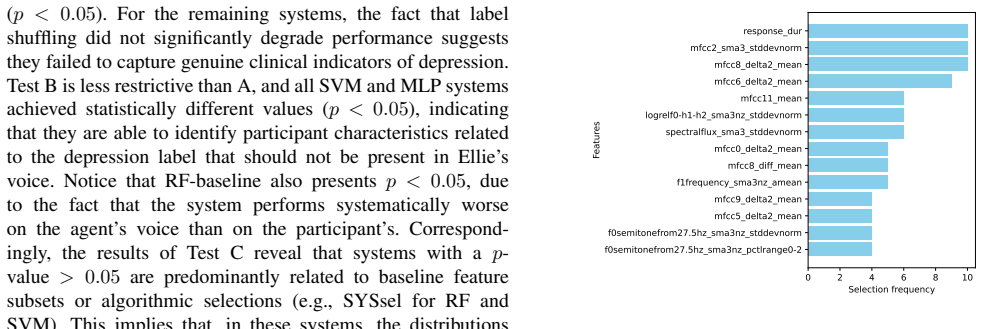
- [Results] The manuscript should supply a table or figure summarizing the final selected feature subset and its overlap with clinical acoustic markers of depression.
Simulated Author's Rebuttal
We thank the referee for the constructive and detailed feedback. We address each major comment below, providing clarifications on the methodology and committing to revisions where appropriate to strengthen the manuscript.
read point-by-point responses
-
Referee: [Abstract / Methods] Abstract and Methods (feature selection procedure): the central claim of 82% test accuracy with MLP on XAI-selected features requires explicit confirmation that LIME/SHAP rankings were computed exclusively inside training folds (e.g., via nested CV). Application to the full corpus or any test-set exposure would introduce leakage, rendering the reported accuracy non-generalizable and invalidating the SOTA assertion.
Authors: We agree that explicit confirmation of no leakage is essential. The feature selection with LIME and SHAP was performed strictly inside the training folds of a nested cross-validation procedure (outer loop for performance estimation, inner loop for hyperparameter tuning and XAI ranking), with no test-set exposure at any stage. This protocol is described in the Methods section but was not stated with sufficient prominence. In the revised manuscript we will add an explicit paragraph in Methods confirming the nested CV structure, the number of folds, and that XAI rankings were recomputed per training fold only. revision: yes
-
Referee: [Abstract] Abstract: the performance claim supplies no information on train/test split ratios, hyperparameter search protocol, exact baseline implementations, or how 'state-of-the-art' was established against prior DAIC-WOZ results; without these details the 82% figure cannot be assessed for soundness.
Authors: The full manuscript already details the 70/30 train/test split (with speaker-independent partitioning), grid-search hyperparameter optimization, exact baseline implementations (RF, SVM, MLP with default scikit-learn settings plus tuned variants), and direct numerical comparisons to prior DAIC-WOZ studies reporting 70-78% accuracy. However, we acknowledge these elements are not summarized in the abstract. In revision we will expand the abstract with one additional sentence on the validation protocol and the basis for the SOTA claim while preserving length constraints; the detailed comparisons remain in the Results section. revision: partial
Circularity Check
No circularity: purely empirical ML evaluation on public dataset
full rationale
The paper reports an empirical pipeline (acoustic feature extraction, LIME/SHAP-based selection, training of RF/SVM/MLP, test accuracy on extended DAIC-WOZ) with no equations, derivations, or first-principles claims. Performance figures are obtained by standard train/test splits and cross-validation; feature selection is presented as a preprocessing step whose validity depends on proper nesting inside folds, not on any self-referential definition or fitted parameter renamed as prediction. No self-citation chains, uniqueness theorems, or ansatzes are invoked to justify core results. The work is therefore self-contained against external benchmarks and receives the default non-finding.
Axiom & Free-Parameter Ledger
axioms (2)
- domain assumption The extended DAIC-WOZ dataset provides representative speech samples for depression detection across demographic groups.
- domain assumption LIME and SHAP explanations on the chosen acoustic features identify non-spurious, human-understandable predictors.
Reference graph
Works this paper leans on
-
[1]
Scoping review on the multimodal classification of depression and experimental study on existing multimodal models,
U. Arioz, U. Smrke, N. Plohl, and I. Mlakar, “Scoping review on the multimodal classification of depression and experimental study on existing multimodal models,”Sensors, vol. 24, no. 3, 2024
2024
-
[2]
The geneva minimalistic acoustic parameter set (gemaps) for voice research and affective computing,
F. Eyben, K. Scherer, B. Schuller, J. Sundberg, E. Andr ´e, C. Busso, L. Devillers, J. Epps, P. Laukka, S. Narayanan, and K. Truong, “The geneva minimalistic acoustic parameter set (gemaps) for voice research and affective computing,”IEEE Transactions on Affective Computing, vol. 7, no. 2, pp. 190–202, 2016
2016
-
[3]
Improving depression prediction ac- curacy using fisher score-based feature selection and dynamic ensemble selection approach based on acoustic features of speech,
N. Janardhan and N. Kumaresh, “Improving depression prediction ac- curacy using fisher score-based feature selection and dynamic ensemble selection approach based on acoustic features of speech,”Traitement du Signal, vol. 39, no. 1, pp. 87–107, 2022
2022
-
[4]
The distress analysis interview corpus of human and computer interviews,
J. Gratch, R. Artstein, G. Lucas, G. Stratou, S. Scherer, A. Nazarian, R. Wood, J. Boberg, D. DeVault, S. Marsella, D. Traum, S. Rizzo, and L.-P. Morency, “The distress analysis interview corpus of human and computer interviews,” inProceedings of the Ninth International Conference on Language Resources and Evaluation (LREC’14), 2014, pp. 3123–3128
2014
-
[5]
Improving speech depression detection using transfer learning with wav2vec 2.0 in low- resource environments,
X. Zhang, X. Zhang, W. Chen, C. Li, and C. Yu, “Improving speech depression detection using transfer learning with wav2vec 2.0 in low- resource environments,”Scientific Reports, vol. 14, 2024
2024
-
[6]
Explainable AI for Mental Disorder Detection via Social Media: A survey and outlook
Y . Ibrahimov, T. Anwar, and T. Yuan, “Explainable AI for mental disorder detection via social media: A survey and outlook,”arXiv preprint arXiv:2406.05984, 2024, submitted for review. [Online]. Available: https://arxiv.org/abs/2406.05984
work page internal anchor Pith review Pith/arXiv arXiv 2024
-
[7]
Contribu- tions of acoustic measures to the classification of laryngeal voice quality in continuous english speech,
C. Xu, P. Foulkes, P. Harrison, V . Hughes, and J. Wormald, “Contribu- tions of acoustic measures to the classification of laryngeal voice quality in continuous english speech,” inProc. Interspeech 2022, 2022, pp. 4147–4151
2022
-
[8]
Comparative evaluation of acoustic feature extraction tools for clinical speech analysis,
A. S. G. Choi, A. Richardson, R. Partlan, S. X. Tang, and S. Cho, “Comparative evaluation of acoustic feature extraction tools for clinical speech analysis,” inProc. Interspeech 2023, 2023, pp. 486–490
2023
-
[9]
Common pitfalls and recommendations for use of machine learning in depression severity estimation: Daic-woz study,
I. Danylenko and O. Unold, “Common pitfalls and recommendations for use of machine learning in depression severity estimation: Daic-woz study,”Applied Sciences, vol. 16, no. 1, 2026. [Online]. Available: https://www.mdpi.com/2076-3417/16/1/422
2026
-
[10]
H.-C. Yeh, L. Sun, A. Mahapatra, S. S. Chandra, E. M. Provost, and B. Sisman, “Who is speaking or who is depressed? a controlled study of speaker leakage in speech-based depression detection,”arXiv preprint arXiv:2604.14354, 2026
work page internal anchor Pith review Pith/arXiv arXiv 2026
-
[11]
DAIC-WOZ: On the validity of using the therapist’s prompts in automatic depression detection from clinical interviews,
S. Burdisso, E. A. Reyes-Ram ´ırez, E. Villatoro-Tello, F. S´anchez-Vega, A. P. L ´opez-Monroy, and P. Motlicek, “DAIC-WOZ: On the validity of using the therapist’s prompts in automatic depression detection from clinical interviews,” inProc. Interspeech 2024, 2024, pp. 3734–3738
2024
-
[12]
Depression detection methods based on multimodal fusion of voice and text,
Z. Xu, Y . Gao, F. Wang, L. Zhang, L. Zhang, J. Wang, and J. Shu, “Depression detection methods based on multimodal fusion of voice and text,”Scientific Reports, vol. 15, 2025. [Online]. Available: https://api.semanticscholar.org/CorpusID:279795397
2025
-
[13]
Towards robust deep neural networks for affect and de- pression recognition from speech,
A. Othmani, D. Kadoch, K. Bentounes, E. Rejaibi, R. Alfred, and A. Hadid, “Towards robust deep neural networks for affect and de- pression recognition from speech,” inProceedings of the International Conference on Pattern Recognition, 2021, pp. 5–19
2021
-
[14]
Sig- nificance of speaker embeddings and temporal context for depression detection,
S. H. Dumpala, S. Rodriguez, S. Rempel, R. Uher, and S. Oore, “Sig- nificance of speaker embeddings and temporal context for depression detection,”arXiv preprint arXiv:2107.13969, 2021
-
[15]
Detecting depression from voice,
M. Tasnim and E. Stroulia, “Detecting depression from voice,” inAd- vances in Artificial Intelligence: 32nd Canadian Conference on Artificial Intelligence, Canadian AI 2019, Proceedings. Springer, 2019, pp. 472– 478
2019
-
[16]
Real-time acoustic based depression detection using machine learning techniques,
B. Yalamanchili, N. S. Kota, M. S. Abbaraju, V . S. S. Nadella, and S. V . Alluri, “Real-time acoustic based depression detection using machine learning techniques,” in2020 International Conference on Emerging Trends in Information Technology and Engineering (ic-ETITE). IEEE, 2020, pp. 1–6
2020
-
[17]
Beyond global metrics: A fairness analysis for interpretable voice disorder detection systems,
M. Estevez, C. Bonomi, D. Ribas, A. Ortega, and L. Ferrer, “Beyond global metrics: A fairness analysis for interpretable voice disorder detection systems,” inProc. Interspeech 2024, 2024, pp. 2070–2074
2024
-
[18]
Avec 2019 workshop and challenge: State-of-mind, detecting depression with AI, and cross-cultural affect recognition,
F. Ringeval, B. Schuller, M. Valstar, N. Cummins, R. Cowie, L. Tavabi, M. Schmitt, S. Alisamir, S. Amiriparian, E.-M. Messner, S. Song, S. Liu, Z. Zhao, A. Mallol-Ragolta, Z. Ren, M. Soleymani, and M. Pantic, “Avec 2019 workshop and challenge: State-of-mind, detecting depression with AI, and cross-cultural affect recognition,” inProceedings of the 2019 Au...
2019
-
[19]
“why should i trust you?
M. T. Ribeiro, S. Singh, and C. Guestrin, ““why should i trust you?”: Explaining the predictions of any classifier,” inProceedings of the 22nd ACM SIGKDD International Conference on Knowledge Discovery and Data Mining, 2016, pp. 1135–1144
2016
-
[20]
A unified approach to interpreting model predictions,
S. M. Lundberg and S.-I. Lee, “A unified approach to interpreting model predictions,” inAdvances in Neural Information Processing Systems (NeurIPS), vol. 30, 2017
2017
-
[21]
Harnessing multimodal ap- proaches for depression detection using large language models and facial expressions,
M. Sadeghi, R. Richer, B. Eggeret al., “Harnessing multimodal ap- proaches for depression detection using large language models and facial expressions,”npj Mental Health Research, vol. 3, no. 1, p. 66, Dec. 2024, published 2024-12-23
2024
-
[22]
WhisperX: Time-accurate speech transcription of long-form audio,
M. Bain, J. Huh, T. Han, and A. Zisserman, “WhisperX: Time-accurate speech transcription of long-form audio,” inProc. Interspeech 2023, 2023, pp. 4441–4445
2023
-
[23]
Robust speech recognition via large-scale weak supervision,
A. Radford, J. W. Kim, T. Xu, G. Brockman, C. Mcleavey, and I. Sutskever, “Robust speech recognition via large-scale weak supervision,” inProceedings of the 40th International Conference on Machine Learning, ser. Proceedings of Machine Learning Research, vol. 202. PMLR, Jul. 2023, pp. 28 492–28 518. [Online]. Available: https://proceedings.mlr.press/v202/...
2023
-
[24]
pyannote.audio 2.1 speaker diarization pipeline: principle, benchmark, and recipe,
H. Bredin, “pyannote.audio 2.1 speaker diarization pipeline: principle, benchmark, and recipe,” inProc. Interspeech 2023, 2023, pp. 1983– 1987
2023
-
[25]
spacy: Industrial-strength natural language processing in python,
M. Honnibal, I. Montani, S. Van Landeghem, and A. Boyd, “spacy: Industrial-strength natural language processing in python,” 2020
2020
-
[26]
Silero V AD: Pre-trained enterprise-grade voice activity detector (V AD), number detector and language classifier,
Silero Team, “Silero V AD: Pre-trained enterprise-grade voice activity detector (V AD), number detector and language classifier,” https://github. com/snakers4/silero-vad, 2024, gitHub repository
2024
-
[27]
TorchAudio: Building blocks for audio and speech processing,
Y .-Y . Yang, M. Hira, Z. Ni, A. Chourdia, A. Astafurov, C. Chen, C.-F. Yeh, C. Puhrsch, D. Pollack, D. Genzelet al., “TorchAudio: Building blocks for audio and speech processing,”arXiv preprint arXiv:2110.15018, 2021
-
[28]
openSMILE: The munich versatile and fast open-source audio feature extractor,
F. Eyben, M. W ¨ollmer, and B. Schuller, “openSMILE: The munich versatile and fast open-source audio feature extractor,” inProceedings of the 18th ACM International Conference on Multimedia, 2010, pp. 1459–1462
2010
-
[29]
D. J. Sheskin,Handbook of Parametric and Nonparametric Statistical Procedures, 5th ed. CRC Press, 2020
2020
-
[30]
Random forests,
L. Breiman, “Random forests,”Machine Learning, vol. 45, no. 1, pp. 5–32, 2001
2001
-
[31]
Scikit-learn: Machine learning in python,
F. Pedregosa, G. Varoquaux, A. Gramfort, V . Michel, B. Thirion, O. Grisel, M. Blondel, P. Prettenhofer, R. Weiss, V . Dubourg, J. Vanderplas, A. Passos, D. Cournapeau, M. Brucher, M. Perrot, and ´E. Duchesnay, “Scikit-learn: Machine learning in python,”Journal of Machine Learning Research, vol. 12, no. 85, pp. 2825–2830, 2011. [Online]. Available: http:/...
2011
-
[32]
Using deep neural networks for detecting depression from speech,
M. Gheorghe, S. Mihalache, and D. Burileanu, “Using deep neural networks for detecting depression from speech,” in2019 International Conference on Speech Technology and Human-Computer Dialogue (SpeD), 2019, pp. 1–6
2019
-
[33]
Probabilistic outputs for support vector machines and comparisons to regularized likelihood methods,
J. C. Platt, “Probabilistic outputs for support vector machines and comparisons to regularized likelihood methods,” inAdvances in Large Margin Classifiers. MIT Press, 1999, pp. 61–74
1999
-
[34]
Combining probability distributions: A critique and an annotated bibliography,
C. Genest and J. V . Zidek, “Combining probability distributions: A critique and an annotated bibliography,”Statistical Science, vol. 1, no. 1, pp. 114–135, 1986
1986
-
[35]
Automated assessment of psychiatric disorders using speech: A systematic review,
D. M. Low, K. H. Bentley, and S. S. Ghosh, “Automated assessment of psychiatric disorders using speech: A systematic review,”Laryngoscope Investigative Otolaryngology, vol. 5, pp. 96–116, 2020
2020
-
[36]
Multilingual markers of depression in remotely collected speech samples: A preliminary analysis,
N. Cummins, J. Dineley, P. Conde, F. Matcham, S. Siddi, F. Lamers, E. Carr, G. Lavelle, D. Leightley, K. M. White, C. Oetzmann, E. L. Campbell, S. Simblett, S. Bruce, J. M. Haro, B. W. J. H. Penninx, Y . Ranjan, Z. Rashid, C. Stewart, A. A. Folarin, R. Bail ´on, B. W. Schuller, T. Wykes, S. Vairavan, R. J. B. Dobson, V . A. Narayan, and M. Hotopf, “Multil...
2023
-
[37]
Github copilot documentation,
GitHub, “Github copilot documentation,” https://docs.github.com/en/ copilot, 2026, accessed: 2026-06-23
2026
-
[38]
Gemini: A Family of Highly Capable Multimodal Models
Gemini Team, “Gemini: A family of highly capable multimodal models,” arXiv preprint arXiv:2312.11805, 2023
work page internal anchor Pith review Pith/arXiv arXiv 2023
discussion (0)
Sign in with ORCID, Apple, or X to comment. Anyone can read and Pith papers without signing in.