COSMOS-Web: does halo mass alone shape the clustering of star-forming and quiescent galaxies?
Pith reviewed 2026-07-01 03:52 UTC · model grok-4.3
The pith
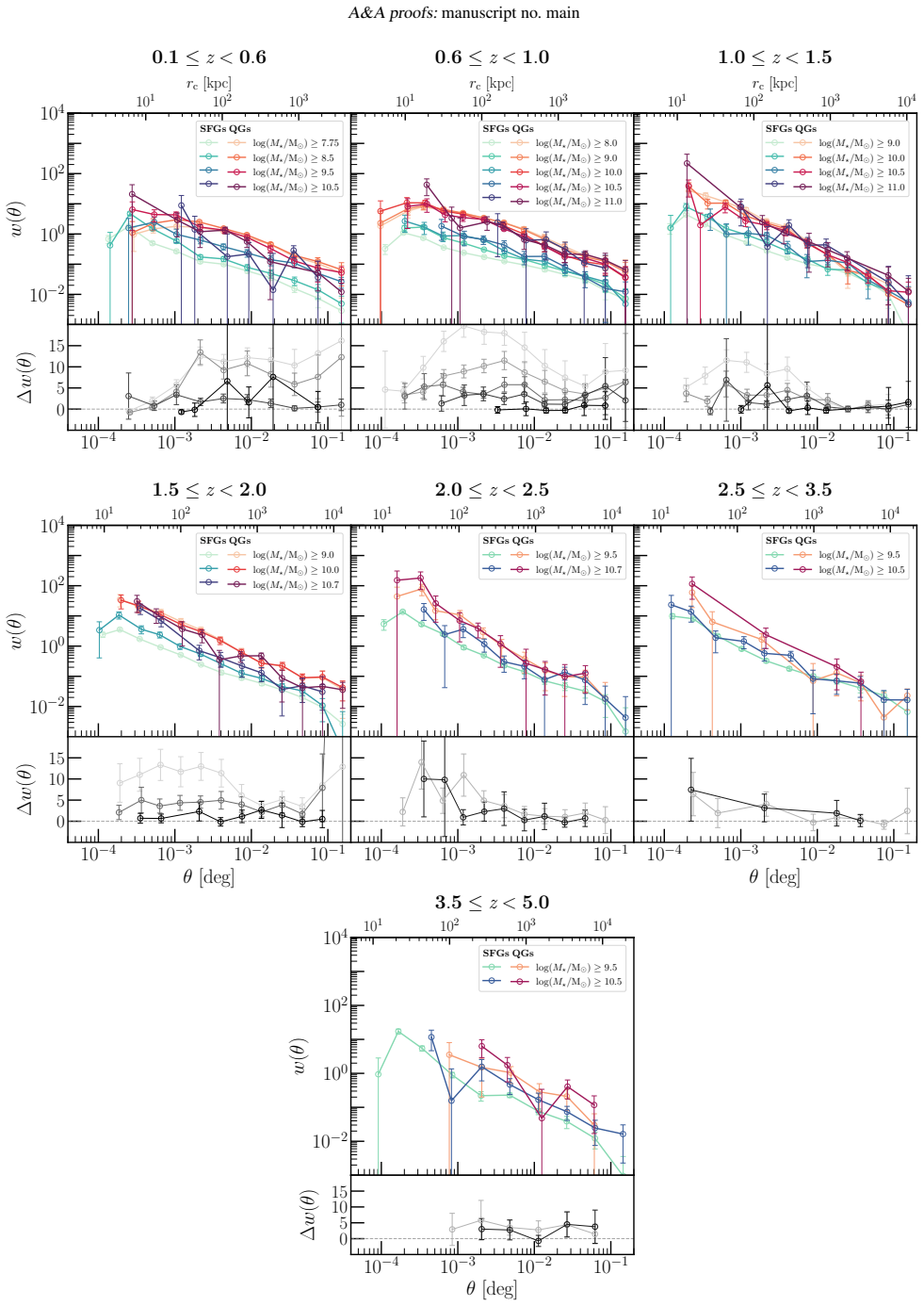
Quiescent galaxies remain more strongly clustered than star-forming systems by 0.5-1 dex at all redshifts even after halo mass matching.
A machine-rendered reading of the paper's core claim, the machinery that carries it, and where it could break.
Core claim
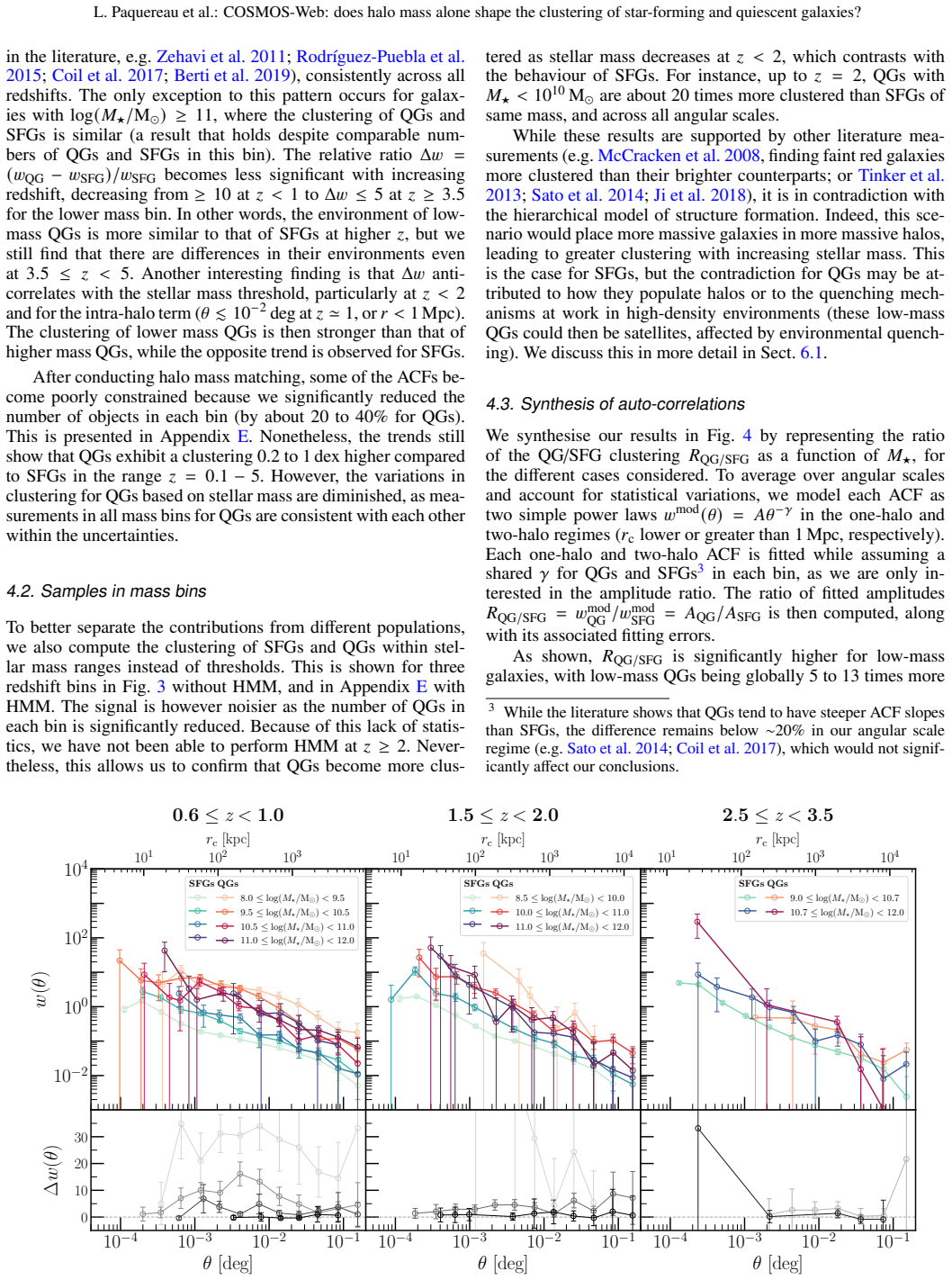
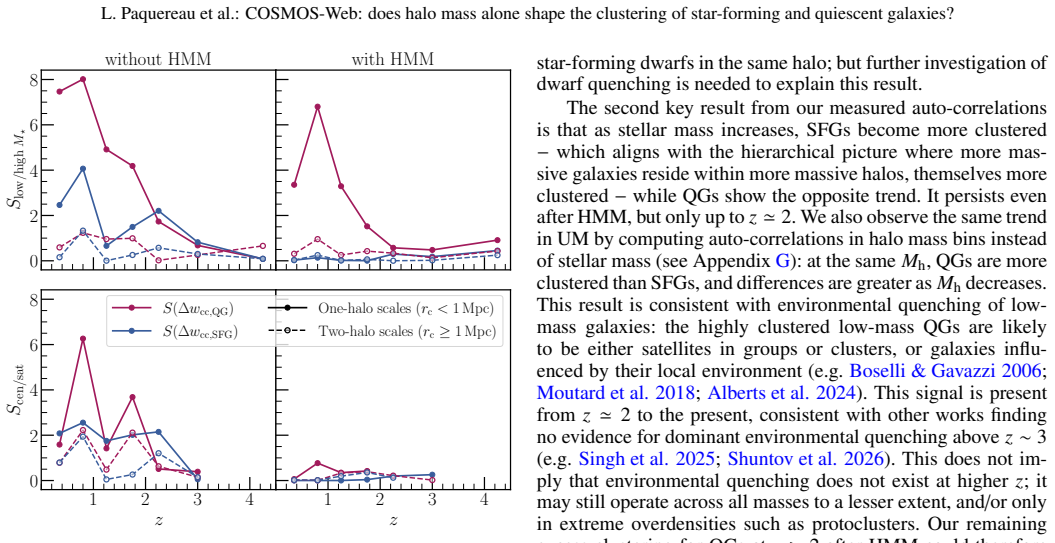
After matching halo mass distributions of star-forming and quiescent galaxies using the UniverseMachine model, auto- and cross-correlations in COSMOS-Web show quiescent galaxies remain more strongly clustered by at least 0.5-1 dex at all redshifts. At z ≤ 2 the excess grows toward lower stellar masses, low-mass quiescent galaxies exhibit disky morphologies, and one-halo conformity appears such that low-mass or satellite quiescent galaxies cluster more around massive or central quiescent galaxies than around star-forming centrals of equal halo mass. Both the excess clustering and conformity signals vanish between z ≃ 5 and z ≃ 2.
What carries the argument
Halo-mass distribution matching with the UniverseMachine model, which equalizes the halo mass functions of the two populations so that any remaining clustering difference can be attributed to environment or secondary halo properties.
If this is right
- Environmental quenching via ram-pressure stripping or suppressed cold-gas accretion operates on low-mass disky galaxies at z ≤ 2.
- One-halo conformity up to z ≃ 2 can arise from shared quenching mechanisms, correlated assembly histories, or secondary halo properties affecting both centrals and satellites.
- Clustering and star-formation activity cannot be assumed to depend solely on halo mass at least up to z ~ 2.
- Both environmental quenching and conformity effects are absent at z between 5 and 2.
Where Pith is reading between the lines
- Galaxy formation simulations must add explicit environmental or secondary-halo terms to reproduce the observed clustering offset at fixed halo mass.
- Repeating the halo-mass-matched analysis in other wide deep fields would test whether the conformity signal is universal or survey-dependent.
- The high-redshift disappearance of both signals suggests the dominant quenching channel changes with cosmic time.
Load-bearing premise
The UniverseMachine model produces halo mass distributions for star-forming and quiescent galaxies that contain no residual differences in secondary halo properties or environment capable of biasing the measured clustering.
What would settle it
An independent survey that performs precise halo-mass matching and finds identical clustering amplitudes for star-forming and quiescent galaxies at fixed halo mass would falsify the reported excess.
Figures




read the original abstract
While stellar mass correlates strongly with halo mass, it remains unclear whether halo mass alone governs galaxy star-formation activity, or whether secondary halo properties and environment also play a role. We investigate these effects beyond halo mass by measuring the auto- and cross-correlations of star-forming and quiescent galaxies in the COSMOS-Web survey from $z = 5$ to the present day. To isolate environmental contributions, we introduce a method that matches the halo mass distributions of both populations using the UniverseMachine model. We find that quiescent galaxies remain more strongly clustered than star-forming systems by at least $0.5-1$ dex at all redshifts, even after controlling for halo mass. At $z \le 2$, this excess clustering increases towards lower stellar masses, with the most clustered objects being $\log(M_\star/{\rm M}_\odot) \le 9.5$ quiescent galaxies. This points to environmental quenching significantly affecting low-mass galaxies at $z \le 2$, likely driven by ram-pressure stripping or the suppression of cold gas accretion, as these objects show disky morphologies. Cross-correlations further reveal one-halo conformity up to $z \simeq 2$: low-mass (or satellite) quiescent galaxies are more strongly clustered around massive (or central) quiescent galaxies than around star-forming centrals of the same halo mass. This signal may arise from quenching mechanisms affecting both centrals and satellites, correlated assembly histories prior to infall, or dependencies on secondary halo properties. Both environmental quenching and conformity appear to vanish between $z \simeq 5$ and $2$. Together, these results challenge the common assumption that clustering and star-formation activity depend solely on halo mass.
Editorial analysis
A structured set of objections, weighed in public.
Referee Report
Summary. The paper measures auto- and cross-correlations of star-forming and quiescent galaxies in COSMOS-Web from z=5 to z=0. It introduces a halo-mass matching procedure based on the UniverseMachine model to control for halo mass and reports that quiescent galaxies remain more strongly clustered by 0.5-1 dex at all redshifts, with the excess increasing at low stellar masses (log M* <= 9.5) for z <= 2. Cross-correlations show one-halo conformity up to z ~ 2 that vanishes at higher redshift. The results are interpreted as evidence for environmental quenching and conformity beyond halo mass alone.
Significance. If the central claim survives rigorous statistical validation, the work would challenge the standard assumption that halo mass is the sole driver of galaxy clustering and star-formation activity, with direct implications for models of ram-pressure stripping, cold-gas accretion, and assembly bias. The use of a wide-area survey and explicit model-based matching is a methodological strength that could be extended to other datasets.
major comments (2)
- [Abstract] Abstract: the central quantitative claim of a 0.5-1 dex excess clustering after halo-mass matching is presented without error bars, covariance estimates, sample sizes, or any statistical significance test, so the result cannot be evaluated from the given text.
- [Methods] Methods (halo-mass matching section): the procedure relies on UniverseMachine to assign halo masses and match distributions, yet no test is shown that the matching proxy is independent of the model's internal quenching prescription; residual correlations between assembly history, concentration, or environment and the SF/Q label inside the model could propagate into the matched samples and bias the reported excess.
minor comments (1)
- [Abstract] Abstract: the phrase 'at least 0.5-1 dex' is imprecise; a precise range or lower limit with uncertainty should be stated.
Simulated Author's Rebuttal
We thank the referee for their constructive comments on our manuscript. We address each major comment below and will incorporate revisions to strengthen the presentation of our results.
read point-by-point responses
-
Referee: [Abstract] Abstract: the central quantitative claim of a 0.5-1 dex excess clustering after halo-mass matching is presented without error bars, covariance estimates, sample sizes, or any statistical significance test, so the result cannot be evaluated from the given text.
Authors: We agree that the abstract would benefit from additional quantitative context. In the revised manuscript we will update the abstract to note that the reported 0.5-1 dex excess is measured at >4σ significance using bootstrap covariance estimates, with sample sizes of order 10^4 galaxies per population at z<2 (full details and covariance matrices are provided in Section 3.2). revision: yes
-
Referee: [Methods] Methods (halo-mass matching section): the procedure relies on UniverseMachine to assign halo masses and match distributions, yet no test is shown that the matching proxy is independent of the model's internal quenching prescription; residual correlations between assembly history, concentration, or environment and the SF/Q label inside the model could propagate into the matched samples and bias the reported excess.
Authors: This is a valid concern regarding model assumptions. While UniverseMachine halo masses are assigned via the stellar-to-halo mass relation calibrated primarily on clustering and abundance data, we will add to the methods section an explicit test comparing results with an alternative abundance-matching halo mass estimator that does not incorporate quenching prescriptions. We will also include a discussion of this as a potential systematic in the revised text. revision: yes
Circularity Check
No significant circularity; clustering excess is an observational measurement after external model matching
full rationale
The paper's central result is the measured excess clustering (0.5-1 dex) of quiescent vs. star-forming galaxies in COSMOS-Web data after matching halo-mass distributions via the external UniverseMachine model. No equations, fitted parameters, or self-citations are shown that would make this excess reduce by construction to a quantity defined from the same clustering data or from the matching procedure itself. The derivation chain remains self-contained against external benchmarks: halo-mass matching is performed with a pre-existing model, and the clustering signal is extracted directly from the survey observations.
Axiom & Free-Parameter Ledger
Reference graph
Works this paper leans on
-
[1]
Tracing the galaxy-halo connection with galaxy clustering in COSMOS-Web from z = 0.1 to z 12. , keywords =. doi:10.1051/0004-6361/202553828 , archivePrefix =. 2501.11674 , primaryClass =
-
[2]
Annual Review of Nuclear and Particle Science , keywords =
Weak Gravitational Lensing and Its Cosmological Applications. Annual Review of Nuclear and Particle Science , keywords =. doi:10.1146/annurev.nucl.58.110707.171151 , archivePrefix =. 0805.0139 , primaryClass =
-
[3]
Large Scale Structure and the Cosmic Web. arXiv e-prints , keywords =. doi:10.48550/arXiv.2503.21759 , archivePrefix =. 2503.21759 , primaryClass =
-
[4]
Mergers of galaxies. arXiv e-prints , keywords =. doi:10.48550/arXiv.2506.09136 , archivePrefix =. 2506.09136 , primaryClass =
-
[5]
Green Valley Galaxies. Serbian Astronomical Journal , keywords =. doi:10.2298/SAJ1489001S , archivePrefix =. 1501.01963 , primaryClass =
work page internal anchor Pith review Pith/arXiv arXiv doi:10.2298/saj1489001s
-
[6]
Weak lensing for precision cosmology
Weak Lensing for Precision Cosmology. , keywords =. doi:10.1146/annurev-astro-081817-051928 , archivePrefix =. 1710.03235 , primaryClass =
work page internal anchor Pith review Pith/arXiv arXiv doi:10.1146/annurev-astro-081817-051928
-
[7]
Gas Accretion and Angular Momentum
Gas Accretion and Angular Momentum. Gas Accretion onto Galaxies , year = 2017, editor =. doi:10.1007/978-3-319-52512-9_11 , archivePrefix =. 1612.00513 , primaryClass =
work page internal anchor Pith review Pith/arXiv arXiv doi:10.1007/978-3-319-52512-9_11 2017
-
[8]
Radio galaxies and feedback from AGN jets. , keywords =. doi:10.1016/j.newar.2020.101539 , archivePrefix =. 2003.06137 , primaryClass =
-
[9]
Large-Scale Structure of the Universe and Cosmological Perturbation Theory
Large-scale structure of the Universe and cosmological perturbation theory. , keywords =. doi:10.1016/S0370-1573(02)00135-7 , archivePrefix =. astro-ph/0112551 , primaryClass =
work page internal anchor Pith review Pith/arXiv arXiv doi:10.1016/s0370-1573(02)00135-7
-
[10]
The Cosmological Constant. Living Reviews in Relativity , keywords =. doi:10.12942/lrr-2001-1 , archivePrefix =. astro-ph/0004075 , primaryClass =
work page internal anchor Pith review Pith/arXiv arXiv doi:10.12942/lrr-2001-1 2001
-
[11]
Challenges for CDM: An update. , keywords =. doi:10.1016/j.newar.2022.101659 , archivePrefix =. 2105.05208 , primaryClass =
-
[12]
Theoretical Challenges in Galaxy Formation
Theoretical Challenges in Galaxy Formation. , keywords =. doi:10.1146/annurev-astro-081913-040019 , archivePrefix =. 1612.06891 , primaryClass =
work page internal anchor Pith review Pith/arXiv arXiv doi:10.1146/annurev-astro-081913-040019
-
[13]
The Dawes Review 10: The impact of deep learning for the analysis of galaxy surveys. , keywords =. doi:10.1017/pasa.2022.55 , archivePrefix =. 2210.01813 , primaryClass =
-
[14]
The Open Journal of Astrophysics , keywords =
The halo model for cosmology: a pedagogical review. The Open Journal of Astrophysics , keywords =. doi:10.21105/astro.2303.08752 , archivePrefix =. 2303.08752 , primaryClass =
-
[15]
Physical Properties of Galaxies from z=2-4
Physical Properties of Galaxies from z = 2-4. , keywords =. doi:10.1146/annurev-astro-081710-102542 , archivePrefix =. 1107.5060 , primaryClass =
work page internal anchor Pith review Pith/arXiv arXiv doi:10.1146/annurev-astro-081710-102542
-
[16]
The [O III]+H equivalent width distribution at z ≃ 7: implications for the contribution of galaxies to reionization. , keywords =. doi:10.1093/mnras/staa3370 , archivePrefix =. 2005.02402 , primaryClass =
-
[17]
The Frontier Fields: Survey Design
The Frontier Fields: Survey Design and Initial Results. , keywords =. doi:10.3847/1538-4357/837/1/97 , archivePrefix =. 1605.06567 , primaryClass =
work page internal anchor Pith review Pith/arXiv arXiv doi:10.3847/1538-4357/837/1/97
-
[18]
Insight from JWST/Near Infrared Camera into galaxy overdensities around bright Lyman-alpha emitters during reionization: implications for ionized bubbles at z 9. , keywords =. doi:10.1093/mnras/stae516 , archivePrefix =. 2305.16670 , primaryClass =
-
[19]
The Universe Is Reionizing at z 7: Bayesian Inference of the IGM Neutral Fraction Using Ly Emission from Galaxies. , keywords =. doi:10.3847/1538-4357/aab0a7 , archivePrefix =. 1709.05356 , primaryClass =
work page internal anchor Pith review Pith/arXiv arXiv doi:10.3847/1538-4357/aab0a7
-
[20]
Spectroscopic constraints on UV metal line emission at z ≃ 6-9: the nature of Ly emitting galaxies in the reionization era. , keywords =. doi:10.1093/mnras/sty1640 , archivePrefix =. 1804.00041 , primaryClass =
work page internal anchor Pith review Pith/arXiv arXiv doi:10.1093/mnras/sty1640
-
[21]
The Detection of Ionized Carbon Emission at z 8. , keywords =. doi:10.3847/2041-8213/ac1a79 , archivePrefix =. 2107.06295 , primaryClass =
-
[22]
Hubble Space Telescope/Advanced Camera for Surveys Morphology of Ly Emitters at Redshift 5.7 in the COSMOS Field. , keywords =. doi:10.1088/0004-637X/701/2/915 , adsurl =
-
[23]
, year = 1967, month = mar, volume =
Are Young Galaxies Visible?. , year = 1967, month = mar, volume =. doi:10.1086/149079 , adsurl =
-
[24]
A Galaxy at z = 5.34. , keywords =. doi:10.1086/311331 , archivePrefix =. astro-ph/9803137 , primaryClass =
work page internal anchor Pith review Pith/arXiv arXiv doi:10.1086/311331
-
[25]
Systematic Identification of LAEs for Visible Exploration and Reionization Research Using Subaru HSC (SILVERRUSH). I. Program strategy and clustering properties of 2000 Ly emitters at z = 6-7 over the 0.3-0.5 Gpc ^ 2 survey area. , keywords =. doi:10.1093/pasj/psx074 , archivePrefix =. 1704.07455 , primaryClass =
work page internal anchor Pith review Pith/arXiv arXiv doi:10.1093/pasj/psx074 2000
-
[26]
Observations of the Lyman- Universe. , keywords =. doi:10.1146/annurev-astro-032620-021859 , archivePrefix =. 2012.07960 , primaryClass =
-
[27]
The First Stars: Formation, Properties, and Impact. , keywords =. doi:10.1146/annurev-astro-071221-053453 , archivePrefix =. 2303.12500 , primaryClass =
-
[28]
Galaxy Formation and Reionization: Key Unknowns and Expected Breakthroughs by the James Webb Space Telescope. , keywords =. doi:10.1146/annurev-astro-120221-044656 , archivePrefix =. 2110.13160 , primaryClass =
-
[29]
Small-Scale Challenges to the CDM Paradigm. , keywords =. doi:10.1146/annurev-astro-091916-055313 , archivePrefix =. 1707.04256 , primaryClass =
-
[30]
The Evolution of Galaxy Structure over Cosmic Time
The Evolution of Galaxy Structure Over Cosmic Time. , keywords =. doi:10.1146/annurev-astro-081913-040037 , archivePrefix =. 1403.2783 , primaryClass =
work page internal anchor Pith review Pith/arXiv arXiv doi:10.1146/annurev-astro-081913-040037
-
[31]
The Connection between Galaxies and their Dark Matter Halos
The Connection Between Galaxies and Their Dark Matter Halos. , keywords =. doi:10.1146/annurev-astro-081817-051756 , archivePrefix =. 1804.03097 , primaryClass =
work page internal anchor Pith review Pith/arXiv arXiv doi:10.1146/annurev-astro-081817-051756
-
[32]
Encyclopedia of Astrophysics, Volume 4 , year = 2026, volume =
Observations of the first galaxies in the Era of JWST. Encyclopedia of Astrophysics, Volume 4 , year = 2026, volume =. doi:10.1016/B978-0-443-21439-4.00128-0 , archivePrefix =. 2501.17078 , primaryClass =
-
[33]
Halo Models of Large Scale Structure
Halo models of large scale structure. , keywords =. doi:10.1016/S0370-1573(02)00276-4 , archivePrefix =. astro-ph/0206508 , primaryClass =
work page internal anchor Pith review Pith/arXiv arXiv doi:10.1016/s0370-1573(02)00276-4
-
[34]
doi:10.1515/9780691206721 , adsurl =
Principles of Physical Cosmology. doi:10.1515/9780691206721 , adsurl =
-
[35]
doi:10.1017/CBO9780511807244 , adsurl =
Galaxy Formation and Evolution. doi:10.1017/CBO9780511807244 , adsurl =
-
[36]
Malicious User Experience Design Research for Cybersecurity
Theory of Star Formation. , keywords =. doi:10.1146/annurev.astro.45.051806.110602 , archivePrefix =. 0707.3514 , primaryClass =
work page internal anchor Pith review Pith/arXiv arXiv doi:10.1146/annurev.astro.45.051806.110602
-
[37]
Notes on Star Formation. arXiv e-prints , keywords =. doi:10.48550/arXiv.1511.03457 , archivePrefix =. 1511.03457 , primaryClass =
work page internal anchor Pith review Pith/arXiv arXiv doi:10.48550/arxiv.1511.03457
-
[38]
Physical Models of Galaxy Formation in a Cosmological Framework
Physical Models of Galaxy Formation in a Cosmological Framework. , keywords =. doi:10.1146/annurev-astro-082812-140951 , archivePrefix =. 1412.2712 , primaryClass =
work page internal anchor Pith review Pith/arXiv arXiv doi:10.1146/annurev-astro-082812-140951
-
[39]
The impact of cosmic filaments on starburst galaxies across cosmic times
The impact of cosmic filaments on starburst galaxies across cosmic times. arXiv e-prints , keywords =. doi:10.48550/arXiv.2602.21890 , archivePrefix =. 2602.21890 , primaryClass =
work page internal anchor Pith review Pith/arXiv arXiv doi:10.48550/arxiv.2602.21890
-
[40]
Large-scale Structure in COSMOS-Web: Tracing Galaxy Evolution in the Cosmic Web up to z 7 with the Largest JWST Survey. , keywords =. doi:10.3847/1538-4357/ae5bac , archivePrefix =. 2511.10727 , primaryClass =
-
[41]
COSMOS-Web galaxy groups: Evolution of red sequence and quiescent galaxy fraction
COSMOS-Web galaxy groups: Evolution of red sequence and quiescent galaxy fraction. , keywords =. doi:10.1051/0004-6361/202557183 , archivePrefix =. 2509.08040 , primaryClass =
work page internal anchor Pith review Pith/arXiv arXiv doi:10.1051/0004-6361/202557183
-
[42]
Molecular gas properties of star-forming brightest group galaxies at $z \sim 0.3$
Molecular gas properties of star-forming brightest group galaxies at z 0.3. arXiv e-prints , keywords =. doi:10.48550/arXiv.2605.21592 , archivePrefix =. 2605.21592 , primaryClass =
work page internal anchor Pith review Pith/arXiv arXiv doi:10.48550/arxiv.2605.21592
-
[43]
An ultra-high-resolution map of (dark) matter. Nature Astronomy , keywords =. doi:10.1038/s41550-025-02763-9 , archivePrefix =. 2601.17239 , primaryClass =
-
[44]
Deep Realistic Extragalactic Model (DREaM) Galaxy Catalogs: Predictions for a Roman Ultra-deep Field. , keywords =. doi:10.3847/1538-4357/ac46fb , archivePrefix =. 2110.10703 , primaryClass =
-
[45]
The Spitzer Legacy Survey of the HST-ACS 2 sq. deg. COSMOS Field: survey strategy and first analysis
S-COSMOS: The Spitzer Legacy Survey of the Hubble Space Telescope ACS 2 deg ^ 2 COSMOS Field I: Survey Strategy and First Analysis. , keywords =. doi:10.1086/517885 , archivePrefix =. astro-ph/0701318 , primaryClass =
work page internal anchor Pith review Pith/arXiv arXiv doi:10.1086/517885
-
[46]
The Chandra COSMOS Legacy survey: optical/IR identifications
The Chandra COSMOS Legacy survey: optical/IR identifications. , keywords =. doi:10.3847/0004-637X/817/1/34 , archivePrefix =. 1512.01105 , primaryClass =
work page internal anchor Pith review Pith/arXiv arXiv doi:10.3847/0004-637x/817/1/34
-
[47]
Survey strategy, observations, and sample properties of 118 star-forming galaxies at 4 < z < 6
The ALPINE-ALMA [CII] survey. Survey strategy, observations, and sample properties of 118 star-forming galaxies at 4 < z < 6. , keywords =. doi:10.1051/0004-6361/201936965 , archivePrefix =. 1910.09517 , primaryClass =
-
[48]
The First Release COSMOS Optical and Near-IR Data and Catalog
The First Release COSMOS Optical and Near-IR Data and Catalog. , keywords =. doi:10.1086/519081 , archivePrefix =. 0704.2430 , primaryClass =
work page internal anchor Pith review Pith/arXiv arXiv doi:10.1086/519081
-
[49]
Brightest group galaxies in COSMOS-Web: Evolution of the size-mass relation since z = 3.7. , keywords =. doi:10.1051/0004-6361/202556085 , archivePrefix =. 2506.04031 , primaryClass =
-
[50]
COSMOS-Web: MIRI Data Reduction and Number Counts at 7.7 m Using JWST. , keywords =. doi:10.3847/1538-4357/adfa1e , archivePrefix =. 2506.03306 , primaryClass =
-
[51]
COSMOS-Web: Comprehensive Data Reduction for Wide-area JWST NIRCam Imaging. , keywords =. doi:10.3847/1538-4357/ae3aa1 , archivePrefix =. 2506.03256 , primaryClass =
-
[52]
COSMOS2025: The COSMOS-Web galaxy catalog of photometry, morphology, redshifts, and physical parameters from JWST, HST, and ground-based imaging. , keywords =. doi:10.1051/0004-6361/202555799 , archivePrefix =. 2506.03243 , primaryClass =
-
[53]
Testing for Intrinsic Type Ia Supernova Luminosity Evolution at z > 2 with JWST. , keywords =. doi:10.3847/2041-8213/adb1d9 , archivePrefix =. 2411.11953 , primaryClass =
-
[54]
Tracing High-z Galaxies in X-Rays with JWST and Chandra. , keywords =. doi:10.3847/1538-4357/adcede , archivePrefix =. 2502.09705 , primaryClass =
-
[55]
Going deeper into the dark with COSMOS-Web: JWST unveils the total contribution of radio-selected NIR-faint galaxies to the cosmic star formation rate density. , keywords =. doi:10.1051/0004-6361/202452461 , archivePrefix =. 2503.00112 , primaryClass =
-
[56]
Not-so-little Red Dots: Two Massive and Dusty Starbursts at z 5 7 Pushing the Limits of Star Formation Discovered by JWST in the COSMOS-Web Survey. , keywords =. doi:10.3847/2041-8213/ad738a , archivePrefix =. 2408.10305 , primaryClass =
-
[57]
The COSMOS-Web Lens Survey (COWLS) II: Depth, resolution, and NIR coverage from JWST reveals 17 spectacular lenses. , keywords =. doi:10.1093/mnrasl/slaf088 , archivePrefix =. 2503.08782 , primaryClass =
-
[58]
The COSMOS-Web Lens Survey(COWLS) III: forecasts versus data. , keywords =. doi:10.1093/mnras/staf1678 , archivePrefix =. 2503.08785 , primaryClass =
-
[59]
COSMOS-Web: The Role of Galaxy Interactions and Disk Instabilities in Producing Starbursts at z < 4. , keywords =. doi:10.3847/1538-4357/ada566 , archivePrefix =. 2405.09619 , primaryClass =
-
[60]
Resolving Galactic-scale Obscuration of X-Ray AGNs at z 1 with COSMOS-Web. , keywords =. doi:10.3847/2041-8213/acdef4 , archivePrefix =. 2306.03205 , primaryClass =
-
[61]
SCUBADive. I. JWST+ALMA Analysis of 289 Submillimeter Galaxies in COSMOS-web. , keywords =. doi:10.3847/1538-4357/ada357 , archivePrefix =. 2408.08346 , primaryClass =
-
[62]
The COSMOS-Web ring: In-depth characterization of an Einstein ring lensing system at z 2. , keywords =. doi:10.1051/0004-6361/202348095 , archivePrefix =. 2309.15986 , primaryClass =
-
[63]
The COSMOS-Web ring: Spectroscopic confirmation of the background source at z = 5.1. , keywords =. doi:10.1051/0004-6361/202554273 , archivePrefix =. 2502.20136 , primaryClass =
-
[64]
The COSMOS-Web Lens Survey (COWLS) I: discovery of >100 high redshift strong lenses in contiguous JWST imaging. , keywords =. doi:10.1093/mnras/staf1253 , archivePrefix =. 2503.08777 , primaryClass =
-
[65]
JWST Discovery of a High-redshift Tidal Disruption Event Candidate in COSMOS-Web. , keywords =. doi:10.3847/1538-4357/adf216 , archivePrefix =. 2504.13248 , primaryClass =
-
[66]
Uncovering a Massive z 7.7 Galaxy Hosting a Heavily Obscured Radio-loud Active Galactic Nucleus Candidate in COSMOS-Web. , keywords =. doi:10.3847/2041-8213/ad11ee , archivePrefix =. 2308.12823 , primaryClass =
-
[67]
Two Massive, Compact, and Dust-obscured Candidate z ≃ 8 Galaxies Discovered by JWST. , keywords =. doi:10.3847/1538-4357/acef21 , archivePrefix =. 2304.12347 , primaryClass =
-
[68]
COSMOS-Web: Unraveling the Evolution of Galaxy Size and Related Properties at 2 < z < 10. , keywords =. doi:10.3847/1538-4365/ae0e1b , archivePrefix =. 2504.07185 , primaryClass =
-
[69]
COSMOS-Web: The emergence of the Hubble sequence. , keywords =. doi:10.1051/0004-6361/202553782 , archivePrefix =. 2502.03532 , primaryClass =
-
[70]
The Extended Mapping Obscuration to Reionization with ALMA (Ex-MORA) Survey: 5 Source Catalog and Redshift Distribution. , keywords =. doi:10.3847/1538-4357/ae2fda , archivePrefix =. 2408.14546 , primaryClass =
-
[71]
Characterisation of SCUBA-2 450um and 850um-selected Galaxies in the COSMOS Field
Characterization of SCUBA-2 450 m and 850 m selected galaxies in the COSMOS field. , keywords =. doi:10.1093/mnras/stt1673 , archivePrefix =. 1302.2619 , primaryClass =
work page internal anchor Pith review Pith/arXiv arXiv doi:10.1093/mnras/stt1673
-
[72]
An Ultradeep Multiband VLA Survey of the Faint Radio Sky (COSMOS-XS): Source Catalog and Number Counts. , keywords =. doi:10.3847/1538-4357/abcaa3 , archivePrefix =. 2009.13528 , primaryClass =
-
[73]
The VLA-COSMOS 3 GHz Large Project: Continuum data and source catalog release
The VLA-COSMOS 3 GHz Large Project: Continuum data and source catalog release. , keywords =. doi:10.1051/0004-6361/201628704 , archivePrefix =. 1703.09713 , primaryClass =
work page internal anchor Pith review Pith/arXiv arXiv doi:10.1051/0004-6361/201628704
-
[74]
Euclid preparation. XVII. Cosmic Dawn Survey: Spitzer Space Telescope observations of the Euclid deep fields and calibration fields. , keywords =. doi:10.1051/0004-6361/202142361 , archivePrefix =. 2110.13928 , primaryClass =
-
[75]
Mapping Obscuration to Reionization with ALMA (MORA): 2 mm Efficiently Selects the Highest-redshift Obscured Galaxies. , keywords =. doi:10.3847/1538-4357/ac2eb4 , archivePrefix =. 2110.06930 , primaryClass =
-
[76]
COSMOS : Hubble Space Telescope Observations
COSMOS: Hubble Space Telescope Observations. , keywords =. doi:10.1086/516580 , archivePrefix =. astro-ph/0612306 , primaryClass =
work page internal anchor Pith review Pith/arXiv arXiv doi:10.1086/516580
-
[77]
Nature versus Nurture: Revisiting the Environmental Impact on Star Formation Activities of Galaxies. , keywords =. doi:10.3847/1538-4357/ad11d7 , archivePrefix =. 2311.18427 , primaryClass =
-
[78]
Large-scale Structures in COSMOS2020: Evolution of Star Formation Activity in Different Environments at 0.4 < z < 4. , keywords =. doi:10.3847/1538-4357/ad32c5 , archivePrefix =. 2312.10222 , primaryClass =
-
[79]
COSMOS Spectroscopic Redshift Compilation (First Data Release): 488,000 Redshifts Encompassing Two Decades of Spectroscopy. , keywords =. doi:10.3847/1538-4365/ae1cb9 , archivePrefix =. 2503.00120 , primaryClass =
-
[80]
The COSMOS-Web deep galaxy group catalog up to z = 3.7. , keywords =. doi:10.1051/0004-6361/202553759 , archivePrefix =. 2501.09060 , primaryClass =
discussion (0)
Sign in with ORCID, Apple, or X to comment. Anyone can read and Pith papers without signing in.