Simulation of Two-qubit Gate Variability and Fidelity of Spin Qubits Built on Nanosheet Technology
Pith reviewed 2026-07-01 04:52 UTC · model grok-4.3
The pith
Millivolt-level bias variations at plunger and middle barrier gates can reduce two-qubit gate fidelity below 99% in nanosheet silicon spin qubits.
A machine-rendered reading of the paper's core claim, the machinery that carries it, and where it could break.
Core claim
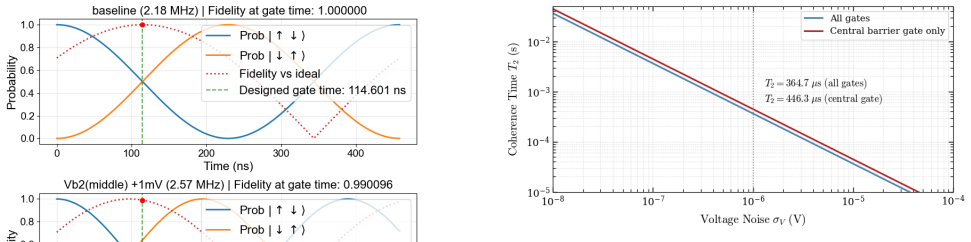
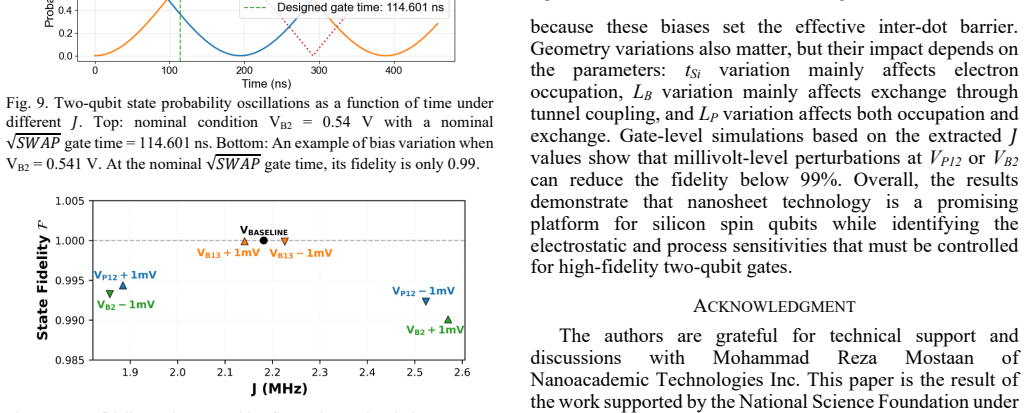
Simulations of silicon spin-qubit double quantum dots built on nanosheet technology show that millivolt-level bias variations at the plunger and middle barrier gates reduce the two-qubit gate fidelity below 99%, a common threshold for fault-tolerant quantum-computing algorithms; gate-referred 1/f charge-noise effects are also analyzed through the resulting coherence time.
What carries the argument
Three-dimensional Poisson and Schrödinger solvers followed by a many-body solver to extract exchange interactions and their sensitivity to bias variations, then master-equation solution for gate fidelity.
If this is right
- Millivolt-level bias variations at plunger and middle barrier gates reduce fidelity below 99%.
- Gate-referred 1/f charge noise shortens coherence time.
- Nanosheet platforms require precise bias control to reach fault-tolerant thresholds.
- Exchange energy must be evaluated under realistic process and voltage spreads.
Where Pith is reading between the lines
- Tighter voltage regulation or on-chip calibration circuits may be needed to keep bias fluctuations below the millivolt scale.
- Statistical variation across an array of nanosheet qubits would determine whether the sensitivity observed in single devices prevents large-scale integration.
- Alternative gate layouts that reduce exchange dependence on middle-barrier voltage could be tested to relax the observed constraint.
Load-bearing premise
The three-dimensional Poisson-Schrödinger solvers and many-body solver accurately capture the exchange interaction and its sensitivity to bias variations in real nanosheet devices.
What would settle it
Fabricate nanosheet double quantum dot devices, apply controlled millivolt bias shifts to plunger and middle barrier gates during two-qubit gate operation, and measure whether the observed fidelity falls below 99%.
Figures

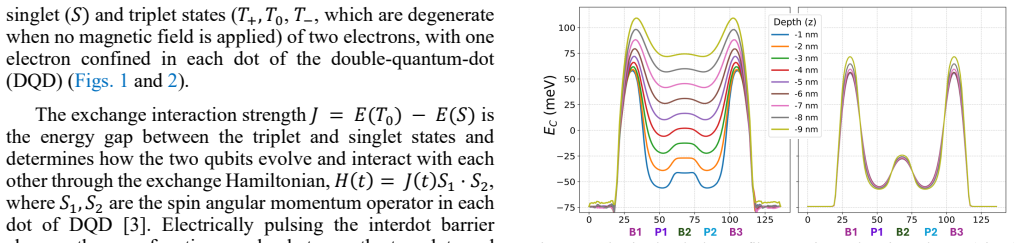
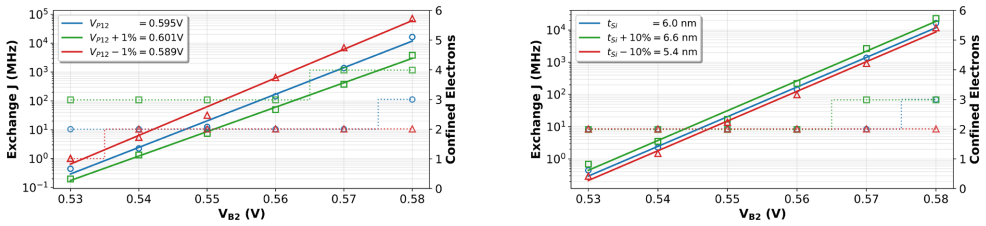
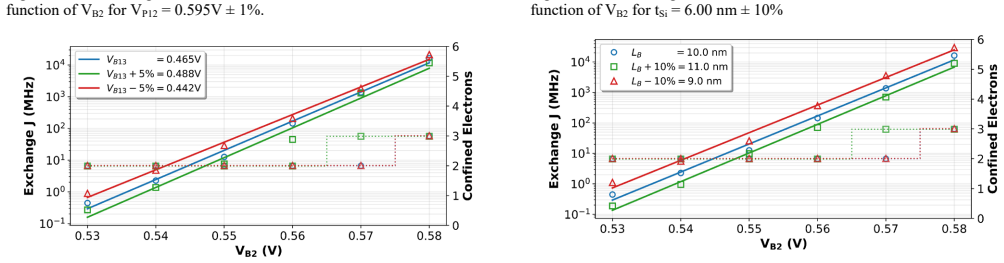
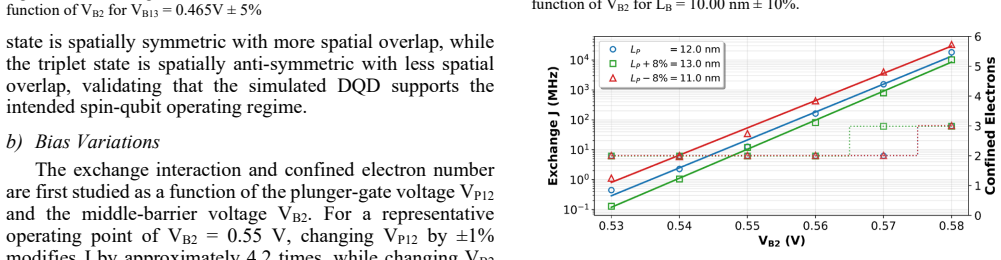
read the original abstract
Silicon spin qubits are promising for large-scale quantum-computer integration because they can fully leverage the well-developed semiconductor infrastructure. However, the low fidelity of two-qubit entanglement gates remains a key barrier to large-scale integrations. Recent simulations of silicon spin-qubit two-qubit gates have been performed on silicon-on-insulator (SOI) platforms, while nanosheet-based charge-qubit work has been limited to single-qubit operation using a two-dimensional Schr\"odinger approximation. In this work, we study silicon spin-qubit double quantum dots built on nanosheet technology using the Quantum Technology Computer-Aided Design (QTCAD) simulation suite to run three-dimensional Poisson and Schroedinger solvers, followed by a many-body solver to extract exchange interactions. We evaluate the exchange energy sensitivity to process and bias variations and then use QuTiP to solve the master equation for a two-qubit gate. The results show that millivolt-level bias variations at the plunger and middle barrier gates can reduce the gate fidelity below 99%, a common threshold target for many fault-tolerant quantum-computing algorithms. Gate-referred 1/f charge-noise effects are also analyzed through the resulting coherence time.
Editorial analysis
A structured set of objections, weighed in public.
Referee Report
Summary. The manuscript presents a computational study of two-qubit spin-qubit gates realized in double quantum dots on nanosheet technology. The authors employ the QTCAD package to perform three-dimensional Poisson and Schrödinger solves followed by a many-body calculation to extract the exchange interaction J, then integrate the two-qubit master equation in QuTiP to obtain gate fidelities under static bias offsets and 1/f charge noise. The central numerical claim is that millivolt-scale variations at the plunger and middle-barrier gates drive the CZ or CNOT fidelity below the 99 % threshold commonly required for fault-tolerant algorithms.
Significance. If the QTCAD model chain accurately reproduces real nanosheet devices, the work supplies a concrete, device-specific estimate of the voltage-control precision needed for scalable silicon spin qubits. The use of full 3D electrostatics rather than the 2D Schrödinger approximation employed in earlier nanosheet charge-qubit papers is a methodological advance. The study also supplies a reproducible workflow (QTCAD + QuTiP) that other groups can apply to different process stacks, which is a positive contribution to the variability literature.
major comments (2)
- [Abstract / §3] Abstract and §3 (Simulation workflow): The headline result that mV-level bias variations reduce fidelity below 99 % rests entirely on the output of the QTCAD 3D Poisson-Schrödinger + many-body solver. No comparison to experimental exchange values from nanosheet devices, no convergence study with respect to mesh density or many-body basis size, and no cross-check against an independent solver are reported; this directly affects the credibility of the quantitative fidelity numbers.
- [§4] §4 (Fidelity results): The master-equation fidelities are stated without accompanying statistical uncertainties arising from the extracted J values or from the charge-noise spectral density; without these, it is impossible to judge whether the reported crossing of the 99 % threshold is robust or an artifact of a particular noise realization.
minor comments (2)
- [Figures 4-6] Figure captions and text should explicitly state the target two-qubit gate (CZ or CNOT) and the precise pulse sequence used in the QuTiP integration.
- [Introduction] The distinction between the present spin-qubit study and the cited prior nanosheet charge-qubit work should be drawn more sharply in the introduction to avoid reader confusion.
Simulated Author's Rebuttal
We thank the referee for the constructive comments on our manuscript. We address each major point below, indicating where revisions will be made and where limitations of the current study prevent full compliance.
read point-by-point responses
-
Referee: [Abstract / §3] Abstract and §3 (Simulation workflow): The headline result that mV-level bias variations reduce fidelity below 99 % rests entirely on the output of the QTCAD 3D Poisson-Schrödinger + many-body solver. No comparison to experimental exchange values from nanosheet devices, no convergence study with respect to mesh density or many-body basis size, and no cross-check against an independent solver are reported; this directly affects the credibility of the quantitative fidelity numbers.
Authors: We agree that the quantitative fidelity claims rely on the QTCAD solver chain. The manuscript is a computational study; experimental exchange data for nanosheet spin qubits are not yet available in the literature, precluding direct comparison. We will add a convergence study with respect to mesh density and many-body basis size to the revised §3, along with explicit statements of model assumptions and limitations. A cross-check against an independent solver is not feasible within the scope and resources of this work. revision: partial
-
Referee: [§4] §4 (Fidelity results): The master-equation fidelities are stated without accompanying statistical uncertainties arising from the extracted J values or from the charge-noise spectral density; without these, it is impossible to judge whether the reported crossing of the 99 % threshold is robust or an artifact of a particular noise realization.
Authors: We accept this criticism. In the revised manuscript we will propagate uncertainties from the extracted J values (arising from bias variations) and from the 1/f noise spectral density parameters into the fidelity calculations, presenting them as error estimates or ranges in §4 to demonstrate robustness of the 99 % threshold crossing. revision: yes
- Direct comparison to experimental exchange values from nanosheet devices, as no such published data exist for the devices modeled.
Circularity Check
No significant circularity; forward simulation only
full rationale
The paper reports a purely computational workflow: 3D Poisson-Schrödinger solvers plus many-body solver in QTCAD extract exchange energies from device geometry and bias voltages, followed by QuTiP master-equation integration to obtain gate fidelity. No parameter is fitted to the reported fidelity or exchange values and then re-presented as an independent prediction; the headline result is the direct numerical output of the described simulation chain. No self-citation, uniqueness theorem, or ansatz is invoked to close any derivation loop. The derivation is therefore self-contained against external benchmarks.
Axiom & Free-Parameter Ledger
Reference graph
Works this paper leans on
-
[1]
H. Y. Wong, Quantum Computing Architecture and Hardware for Engineers: Step by Step. Cham: Springer Nature Switzerland, 2025
2025
-
[2]
Quantum computation with quantum dots,
D. Loss and D. P. DiVincenzo, “Quantum computation with quantum dots,” Phys. Rev. A, vol. 57, no. 1, pp. 120–126, Jan. 1998
1998
-
[3]
Coupled quantum dots as quantum gates,
G. Burkard et al., “Coupled quantum dots as quantum gates,” Phys. Rev. B, vol. 59, no. 3, pp. 2070 –2078, Jan. 1999, doi: 10.1103/PhysRevB.59.2070
-
[4]
G. Burkard et al., “Semiconductor spin qubits,” Rev. Mod. Phys., vol. 95, no. 2, Art. no. 025003, Jun. 2023, doi: 10.1103/RevModPhys.95.025003
-
[5]
A two -qubit logic gate in silicon,
M. Veldhorst et al., “A two -qubit logic gate in silicon,” Nature, vol. 526, no. 7573, pp. 410–414, Oct. 2015, doi: 10.1038/nature15263
-
[6]
A programmable two-qubit quantum processor in silicon,
T. F. Watson et al., “A programmable two-qubit quantum processor in silicon,” Nature, vol. 555, no. 7698, pp. 633– 637, Mar. 2018, doi: 10.1038/nature25766
-
[7]
Assessment of the errors of high -fidelity two-qubit gates in silicon quantum dots,
T. Tanttu et al., “Assessment of the errors of high -fidelity two-qubit gates in silicon quantum dots,” Nature Physics, vol. 20, no. 11, 2024, doi: 10.1038/s41567-024-02614-w
-
[8]
Industry-compatible silicon spin-qubit unit cells exceeding 99% fidelity,
J. D. Cifuentes et al., “Industry-compatible silicon spin-qubit unit cells exceeding 99% fidelity,” Nature, vol. 646, pp. 81 –87, 2025, doi: 10.1038/s41586-025-09531-9
-
[9]
Spin decoherence in a two -qubit CPHASE gate: the critical role of tunneling noise,
P. Huang, N. M. Zimmerman, and G. W. Bryant, “Spin decoherence in a two -qubit CPHASE gate: the critical role of tunneling noise,” npj Quantum Inf., vol. 4, Art. no. 62, Nov. 2018, doi: 10.1038/s41534-018- 0112-0
-
[10]
M. El Kordy Shehata et al., “Modeling semiconductor spin qubits and their charge noise environment for quantum gate fidelity estimation,” Phys. Rev. B, vol. 108, no. 4, Art. no. 045305, Jul. 2023, doi: 10.1103/PhysRevB.108.045305
-
[11]
Simulating two -qubit gates under the influence of charge defects in an FD -SOI device,
P. Philippopouloset al., “Simulating two -qubit gates under the influence of charge defects in an FD -SOI device,” in Proc. Int. Conf. Simulation of Semiconductor Processes and Devices (SISPAD), 2025, doi: 10.1109/SISPAD66610.2025.11186312
-
[12]
Stacked nanosheet gate-all- around transistor to enable scaling beyond FinFET,
N. Loubet et al., “Stacked nanosheet gate-all- around transistor to enable scaling beyond FinFET,” in Proc. Symp. VLSI Technol., Kyoto, Japan, 2017, pp. T230–T231, doi: 10.23919/VLSIT.2017.7998183
-
[13]
N. Pandey et al., “Three- dimensional electrostatic and quantum - confinement modeling of silicon nanowire double quantum dots,” arXiv preprint arXiv:2510.07831, 2025. [Online]. Available: https://arxiv.org/abs/2510.07831
-
[14]
Available: https://nanoacademic.com/solutions/qtcad/
Nanoacademic Technologies Inc., “QTCAD,” [Online]. Available: https://nanoacademic.com/solutions/qtcad/
-
[15]
QuTiP 5: The Quantum Toolbox in Python,
N. Lambert et al., “QuTiP 5: The Quantum Toolbox in Python,” Phys. Rep., vol. 1153, pp. 1–62, 2026
2026
-
[16]
Reduced sensitivity to charge noise in semiconductor spin qubits via symmetric operation,
M. D. Reed et al., “Reduced sensitivity to charge noise in semiconductor spin qubits via symmetric operation,” Phys. Rev. Lett., vol. 116, no. 11, Art. no. 110402, Mar. 2016, doi: 10.1103/PhysRevLett.116. 110402. Fig. 9. Two-qubit state probability oscillations as a function of time under different 𝐽𝐽. Top: nominal condition V B2 = 0.54 V with a nominal √...
discussion (0)
Sign in with ORCID, Apple, or X to comment. Anyone can read and Pith papers without signing in.