Gravitating Tubes Beyond World Line Paradigm In General Relativity
Pith reviewed 2026-07-02 21:02 UTC · model grok-4.3
The pith
Timelike tubes with brane-like foliations produce smooth stress-energy tensors that respect the Geroch-Traschen obstruction.
A machine-rendered reading of the paper's core claim, the machinery that carries it, and where it could break.
Core claim
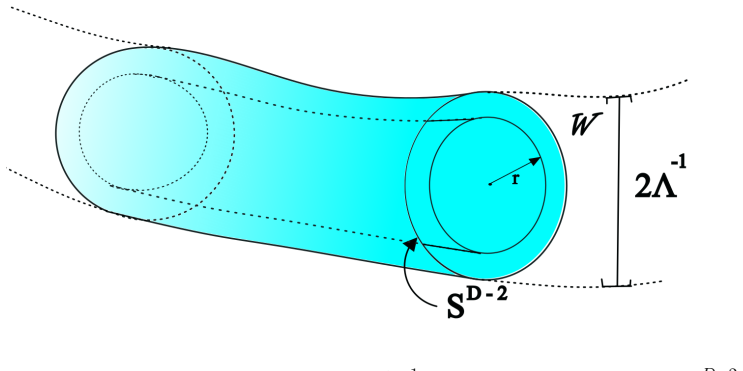
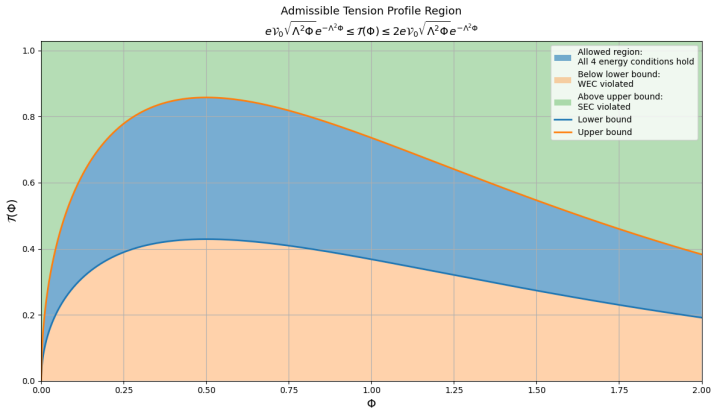
The central claim is that gravitating tubes constructed within the tubular neighbourhood of an auxiliary timelike curve, with interiors foliated by timelike codimension-one hypersurfaces governed by a brane-like action, generate a smooth collective stress-energy tensor. For a broad class of tension and potential profiles the strong energy condition is violated inside the tube while the null and weak energy conditions remain satisfied. In the ultraviolet limit an appropriate rescaling of the Lagrangian density reduces the tube action to the point-particle action together with a canonical self-force-like term, rendering the particle's rest mass an effective quantity.
What carries the argument
A timelike tube foliated by codimension-one timelike hypersurfaces whose dynamics are governed by a brane-like action, which produces the collective stress-energy tensor.
If this is right
- The stress-energy tensor of the tube remains smooth for the chosen profiles.
- The strong energy condition is violated inside the tube while null and weak conditions hold.
- An ultraviolet rescaling reduces the tube dynamics to point-particle dynamics plus a self-force term with effective rest mass.
- Field perturbations of the foliation scalar yield an infinite sound speed, rendering the scalar non-dynamical.
- Small deformations of the hypersurface leaves obey the Jacobi equation, which further restricts admissible tension and potential profiles.
Where Pith is reading between the lines
- The construction could be extended to model extended sources in other gravitational theories that currently rely on distributional matter.
- The emergence of rest mass as an effective quantity suggests examining whether similar effective-mass mechanisms appear in other thin-limit reductions of extended objects.
- The cuscuton-like character of the foliation scalar may connect to other non-dynamical scalar models used to evade certain no-go theorems in modified gravity.
- Stability constraints from the Jacobi equation could be tested numerically by evolving small deformations of sample tube profiles.
Load-bearing premise
A timelike tube can be foliated by codimension-one timelike hypersurfaces governed by a brane-like action without introducing inconsistencies that would violate the Geroch-Traschen obstruction or render the collective stress-energy non-smooth.
What would settle it
An explicit example in which the collective stress-energy tensor of the tube develops a non-smooth component or a curvature singularity for an admissible tension and potential profile would falsify the construction.
Figures



read the original abstract
The simplest point-particle description of classical matter is incompatible with Einstein's General Relativity because the stress-energy tensor of a point particle is distributional and concentrated on a one-dimensional worldline. For such higher-codimension sources, smooth spacetime solutions generally do not exist. This obstruction was established by Geroch and Traschen for sources of codimension $\geq2$. Motivated by this result, this thesis proposes codimension-zero tubes as a fundamental description of gravitating matter. Timelike tubes are constructed within the tubular neighbourhood of an auxiliary timelike curve. The tube interior is foliated by timelike codimension-one hypersurfaces whose dynamics are governed by a brane-like action. The resulting collective stress-energy tensor is smooth, unlike that of a point particle. For a broad class of tension and potential profiles, the strong energy condition is violated inside the tube, while the null and weak energy conditions remain satisfied. In the ultraviolet limit, where the tube radius vanishes, an appropriate rescaling of the Lagrangian density reduces the tube action to the point-particle action together with a canonical self-force-like term. The particle's rest mass then emerges as an effective quantity rather than a fundamental localized parameter. Perturbative stability is analysed at two levels. Field perturbations yield an infinite squared sound speed, showing that the foliation-generating scalar is non-dynamical and cuscuton-like. Small deformations of the leaves lead to the Jacobi equation for timelike hypersurface congruences, further constraining admissible tension and potential profiles. These results establish gravitating tubes as a geometrically and dynamically consistent description of matter that respects the Geroch--Traschen obstruction.
Editorial analysis
A structured set of objections, weighed in public.
Referee Report
Summary. The manuscript proposes codimension-zero timelike tubes around an auxiliary worldline as a fundamental description of gravitating matter in GR. The tube interior is foliated by codimension-one timelike hypersurfaces whose dynamics follow a brane-like action; the resulting collective stress-energy tensor is asserted to be smooth (unlike point-particle sources), to violate the strong energy condition inside the tube while satisfying the null and weak conditions, and, under an appropriate UV rescaling of the Lagrangian density, to reduce to the point-particle action plus a canonical self-force term with the rest mass emerging as an effective quantity. Perturbative stability is analyzed via field perturbations (yielding infinite sound speed, rendering the foliation scalar cuscuton-like) and via the Jacobi equation for hypersurface deformations, which further constrains admissible tension and potential profiles. The construction is claimed to evade the Geroch-Traschen obstruction while remaining geometrically and dynamically consistent.
Significance. If the central regularity and reduction claims can be established with explicit derivations, the work would supply a concrete mechanism for embedding extended classical sources in GR that remain regular, satisfy selected energy conditions, and recover the point-particle limit with self-force corrections. This could inform modeling of finite-size effects and effective masses without distributional sources. The perturbative analysis also identifies non-dynamical aspects of the foliation scalar, which may be of independent interest for cuscuton-like theories.
major comments (3)
- [tube interior foliation paragraph] The paragraph describing the tube interior foliation and the choice of action: the central claim that the collective stress-energy tensor is everywhere smooth (C² or better) and matches smoothly onto the exterior vacuum region rests on an unverified regularity property of the brane-like action on the foliating hypersurfaces. No explicit expression for the action is supplied, nor is T_{\mu\nu} derived from the hypersurface equations of motion, and no check is performed that the foliation leaves produce no discontinuities or delta-function contributions at the tube boundary.
- [UV-limit reduction section] UV-limit reduction section: the assertion that an appropriate rescaling reduces the tube action to the point-particle action together with a self-force term, with rest mass emerging as an effective quantity, is load-bearing for the world-line paradigm claim, yet the rest mass is extracted from the same tension and potential profiles used to define the tube; this introduces a circularity that is not resolved by independent external data or a separate fixing procedure.
- [Abstract and stability analysis] Abstract and stability analysis: the statements that 'perturbative stability yields an infinite sound speed' and that the Jacobi equation further constrains admissible profiles are presented without explicit equations, error estimates, or verification that the collective stress-energy remains smooth for the claimed class of profiles; these omissions undermine the dynamical-consistency part of the central claim.
minor comments (2)
- [Abstract] The manuscript refers to itself as 'this thesis' in the abstract; if submitted as a journal article, the language should be adjusted for consistency with article format.
- [tube construction] Notation for the foliation-generating scalar field is introduced without a clear definition of its relation to the hypersurface normals; a brief clarifying equation would improve readability.
Simulated Author's Rebuttal
We thank the referee for their careful reading of the manuscript and for the constructive comments. We address each major comment below and indicate the revisions planned for the next version.
read point-by-point responses
-
Referee: The paragraph describing the tube interior foliation and the choice of action: the central claim that the collective stress-energy tensor is everywhere smooth (C² or better) and matches smoothly onto the exterior vacuum region rests on an unverified regularity property of the brane-like action on the foliating hypersurfaces. No explicit expression for the action is supplied, nor is T_{\mu\nu} derived from the hypersurface equations of motion, and no check is performed that the foliation leaves produce no discontinuities or delta-function contributions at the tube boundary.
Authors: We agree that the smoothness claim requires explicit support. In the revised manuscript we will supply the explicit brane-like action for the foliating hypersurfaces, derive the collective stress-energy tensor from the hypersurface equations of motion, and verify that the resulting T_{\mu\nu} is C² and matches continuously onto the exterior vacuum without delta-function contributions at the tube boundary. revision: yes
-
Referee: UV-limit reduction section: the assertion that an appropriate rescaling reduces the tube action to the point-particle action together with a self-force term, with rest mass emerging as an effective quantity, is load-bearing for the world-line paradigm claim, yet the rest mass is extracted from the same tension and potential profiles used to define the tube; this introduces a circularity that is not resolved by independent external data or a separate fixing procedure.
Authors: The effective rest mass arises as an integral of the tension profile after the UV rescaling; the profiles are selected to satisfy the energy conditions and the reduction itself. This is not circular because the mass is a derived quantity once the rescaling is performed. To remove any ambiguity we will add an explicit subsection that (i) states the rescaling of the Lagrangian density, (ii) computes the effective mass, and (iii) shows how the mass can be fixed by an independent normalization condition (e.g., asymptotic matching). revision: partial
-
Referee: Abstract and stability analysis: the statements that 'perturbative stability yields an infinite sound speed' and that the Jacobi equation further constrains admissible profiles are presented without explicit equations, error estimates, or verification that the collective stress-energy remains smooth for the claimed class of profiles; these omissions undermine the dynamical-consistency part of the central claim.
Authors: We accept that the stability section needs the supporting equations. The revised version will include the explicit perturbation equations that produce the infinite sound speed, the derivation of the Jacobi equation for the hypersurface deformations, error estimates where relevant, and a direct check that the collective stress-energy tensor remains smooth for the admissible tension and potential profiles. revision: yes
Circularity Check
No circularity: derivation proceeds from assumed foliation and action without reducing to inputs by construction
full rationale
The paper defines tubes via an auxiliary curve and codimension-one foliation governed by a brane-like action, then asserts that the integrated stress-energy is smooth for a broad class of tension/potential profiles and that the UV rescaling limit yields the point-particle action plus self-force term with effective mass. These are presented as consequences of the construction rather than definitional equivalences or fitted parameters renamed as predictions. No self-citations appear as load-bearing premises, no uniqueness theorem is imported from prior author work, and no equation is shown to equal its input by construction. The smoothness and energy-condition claims rest on the choice of action and foliation (an assumption, not a circular step), while the effective-mass emergence is the intended outcome of the limit process. The derivation chain is therefore self-contained against external benchmarks.
Axiom & Free-Parameter Ledger
free parameters (1)
- tension and potential profiles
axioms (2)
- standard math Geroch-Traschen obstruction for codimension >=2 sources
- domain assumption Existence of a tubular neighborhood around an auxiliary timelike curve
invented entities (2)
-
codimension-zero gravitating tube with foliation by timelike hypersurfaces
no independent evidence
-
foliation-generating scalar field
no independent evidence
Reference graph
Works this paper leans on
-
[1]
The foundation of the general theory of relativity
A. Einstein. “The foundation of the general theory of relativity”. In:The Road to Relativity. Ed. by H. Gutfreund and J. Renn. English translation of “Die Grund- lage der allgemeinen Relativit¨ atstheorie” (Annalen der Physik, 1916). Princeton University Press, 2015, pp. 179–226
1916
-
[2]
Robert M. Wald.General Relativity. Chicago, USA: Chicago Univ. Pr., 1984.doi: 10.7208/chicago/9780226870373.001.0001
-
[3]
New York: John Wiley and Sons, 1972.isbn: 9780471925675
Steven Weinberg.Gravitation and Cosmology: Principles and Applications of the General Theory of Relativity. New York: John Wiley and Sons, 1972.isbn: 9780471925675
1972
-
[4]
Strings and other distributional sources in general relativity
Robert Geroch and Jennie Traschen. “Strings and other distributional sources in general relativity”. In:Phys. Rev. D36 (4 Aug. 1987), pp. 1017–1031.doi: 10 . 1103 / PhysRevD . 36 . 1017.url: https : / / link . aps . org / doi / 10 . 1103 / PhysRevD.36.1017
1987
-
[6]
Leor Barack and Adam Pound. “Self-force and radiation reaction in general relativ- ity”. In:Reports on Progress in Physics82.1 (Nov. 2018), p. 016904.issn: 1361-6633. doi: 10.1088/1361- 6633/aae552 .url: http://dx.doi.org/10.1088/1361- 6633/aae552
-
[7]
Introduction to Gravitational Self-Force
Robert M. Wald. “Introduction to Gravitational Self-Force”. In:Fundam. Theor. Phys.162 (2011). Ed. by Luc Blanchet, Alessandro Spallicci, and Bernard Whiting, pp. 253–262. arXiv:0907.0412 [gr-qc]
work page internal anchor Pith review Pith/arXiv arXiv 2011
-
[8]
Singular hypersurfaces and thin shells in general relativity
W. Israel. “Singular hypersurfaces and thin shells in general relativity”. In:Nuovo Cim. B44S10 (1966). [Erratum: Nuovo Cim.B 48, 463 (1967)], p. 1.doi: 10.1007/ BF02710419. 109
1966
-
[9]
Equivalence of Darmois-Israel and Distributional-Methods for Thin Shells in General Relativity
R. Mansouri and M. Khorrami. “Equivalence of Darmois-Israel and distributional methods for thin shells in general relativity”. In:J. Math. Phys.37 (1996), pp. 5672– 5683.doi:10.1063/1.531740. arXiv:gr-qc/9608029
work page internal anchor Pith review Pith/arXiv arXiv doi:10.1063/1.531740 1996
-
[10]
Dynamics of Extended Bodies in General Relativity. I. Momentum and Angular Momentum
W. G. Dixon. “Dynamics of Extended Bodies in General Relativity. I. Momentum and Angular Momentum”. In:Proceedings of the Royal Society of London. Series A, Mathematical and Physical Sciences314.1519 (1970), pp. 499–527.issn: 00804630. url:http://www.jstor.org/stable/2416466(visited on 05/21/2026)
-
[11]
Spinning Test-Particles in General Relativity. I
A. Papapetrou. “Spinning Test-Particles in General Relativity. I”. In:Proceedings of the Royal Society of London Series A209.1097 (Oct. 1951), pp. 248–258.doi: 10.1098/rspa.1951.0200
-
[12]
Classical theory of radiating electrons
Paul Adrien Maurice Dirac. “Classical theory of radiating electrons”. In:Proceedings of the Royal Society of London. A. Mathematical and Physical Sciences167.929 (Aug. 1938), pp. 148–169.issn: 0080-4630.doi: 10.1098/rspa.1938.0124. eprint: https : / / royalsocietypublishing . org / rspa / article - pdf / 167 / 929 / 148 / 35258/rspa.1938.0124.pdf.url:http...
-
[13]
Semiclassical Quantization of the Supermembrane
M. J. Duff et al. “Semiclassical Quantization of the Supermembrane”. In:Nucl. Phys. B297 (1988), pp. 515–538.doi:10.1016/0550-3213(88)90316-1
-
[14]
Quantum geometry of bosonic strings
A.M. Polyakov. “Quantum geometry of bosonic strings”. In:Physics Letters B103.3 (1981), pp. 207–210.issn: 0370-2693.doi: https : / / doi . org / 10 . 1016 / 0370 - 2693(81)90743-7 .url: https://www.sciencedirect.com/science/article/ pii/0370269381907437
-
[15]
Barton Zwiebach.A First Course in String Theory. 2nd ed. Cambridge University Press, 2009
2009
-
[16]
Canonical formulation of the Conformal p-brane
J. David Vergara. “Canonical formulation of the Conformal p-brane”. In:Proceedings of Third Latin American Symposium on High Energy Physics — PoS(silafae-III). Vol. 005. 2000, p. 039.doi:10.22323/1.005.0039
-
[17]
http://www.blau.itp.unibe
Mathias Blau.Lecture Notes on General Relativity. http://www.blau.itp.unibe. ch/newlecturesGR.pdf. University of Bern lecture notes. 2015
2015
-
[18]
Cambridge University Press, Dec
Eric Poisson.A Relativist’s Toolkit: The Mathematics of Black-Hole Mechanics. Cambridge University Press, Dec. 2009.doi:10.1017/CBO9780511606601
-
[19]
Geometry of deformations of relativistic membranes
Riccardo Capovilla and Jemal Guven. “Geometry of deformations of relativistic membranes”. In:Physical Review D51.12 (June 1995), pp. 6736–6743.issn: 0556- 2821.doi: 10.1103/physrevd.51.6736 .url: http://dx.doi.org/10.1103/ PhysRevD.51.6736
-
[20]
Large deformations of relativistic membranes: A generalization of the Raychaudhuri equations
Riccardo Capovilla and Jemal Guven. “Large deformations of relativistic membranes: A generalization of the Raychaudhuri equations”. In:Physical Review D52.2 (July 1995), pp. 1072–1081.issn: 0556-2821.doi: 10.1103/physrevd.52.1072 .url: http://dx.doi.org/10.1103/PhysRevD.52.1072. 110
-
[21]
Mukherjee.Differential Topology
A. Mukherjee.Differential Topology. Springer International Publishing, 2015.isbn: 9783319190457.url:https://books.google.co.in/books?id=aD8PCgAAQBAJ
2015
-
[22]
“Pseudo-Riemannian Submersions”. In:Pseudo-Riemannian Geometry and Ap- plications, pp. 227–240.doi: 10 . 1142 / 9789814329644 _ 0011. eprint: https : / / www . worldscientific . com / doi / pdf / 10 . 1142 / 9789814329644 _ 0011.url: https://www.worldscientific.com/doi/abs/10.1142/9789814329644_0011
-
[23]
Differentiable Manifolds
Hassler Whitney. “Differentiable Manifolds”. In:Annals of Mathematics37.3 (1936), pp. 645–680.issn: 0003486X, 19398980.url: http://www.jstor.org/stable/ 1968482(visited on 01/18/2026)
1936
-
[24]
Misner, K
Charles W. Misner, K. S. Thorne, and J. A. Wheeler.Gravitation. San Francisco: W. H. Freeman, 1973.isbn: 9780716703440
1973
-
[25]
Eric Gourgoulhon.3+1 Formalism and Bases of Numerical Relativity. 2007. arXiv: gr-qc/0703035 [gr-qc].url:https://arxiv.org/abs/gr-qc/0703035
work page internal anchor Pith review Pith/arXiv arXiv 2007
-
[26]
H. Blaine Jr. Lawson. “Foliations”. In:Bulletin of the American Mathematical Society 80.3 (1974). MSC (1970): Primary 57D30, pp. 369–418.doi: 10.1090/S0002-9904- 1974-13432-4
-
[27]
Oliva.Geometric Mechanics
W.M. Oliva.Geometric Mechanics. Geometric Mechanics no. 1798. Springer, 2002. isbn: 9783540442424.url: https://books.google.co.in/books?id=CBwkHrEpQ3oC
2002
-
[28]
Lee.Introduction to Smooth Manifolds
John M. Lee.Introduction to Smooth Manifolds. 2nd. Vol. 218. Graduate Texts in Mathematics. New York, NY: Springer, 2013.isbn: 978-1-4419-9981-8.doi: 10.1007/978-1-4419-9982-5
-
[29]
Spivak.A Comprehensive Introduction to Differential Geometry
M. Spivak.A Comprehensive Introduction to Differential Geometry. A Comprehen- sive Introduction to Differential Geometry v. 1. Publish or Perish, Incorporated, 1975.isbn: 9780914098843.url: https : / / books . google . co . in / books ? id = HFTvAAAAMAAJ
1975
-
[30]
Petersen.Riemannian Geometry
P. Petersen.Riemannian Geometry. Graduate Texts in Mathematics. Springer New York, 2006.isbn: 9780387294032.url: https://books.google.gm/books?id= 9cekXdo52hEC
2006
-
[31]
Jost.Riemannian Geometry and Geometric Analysis
J. Jost.Riemannian Geometry and Geometric Analysis. Universitext. Springer Berlin Heidelberg, 2013.isbn: 9783662223857.url: https://books.google.co. in/books?id=VRz2CAAAQBAJ
2013
-
[32]
O’Neill.Semi-Riemannian Geometry With Applications to Relativity
B. O’Neill.Semi-Riemannian Geometry With Applications to Relativity. Pure and Applied Mathematics. Academic Press, 1983.isbn: 9780080570570.url: https: //books.google.co.in/books?id=CGk1eRSjFIIC
1983
- [33]
-
[34]
Codimension 1 foliations with Bott–Morse singular- ities II
Bruno Sc´ ardua and Jos´ e Seade. “Codimension 1 foliations with Bott–Morse singular- ities II”. In:Journal of Topology4.2 (Jan. 2011), pp. 343–382.issn: 1753-8416.doi: 10.1112/jtopol/jtr004. eprint: https://academic.oup.com/jtopol/article- pdf/4/2/343/2743680/jtr004.pdf .url: https://doi.org/10.1112/jtopol/ jtr004
-
[35]
Bruno Scardua and Jose Seade.Codimension one foliations with Bott-Morse singu- larities I. 2006. arXiv: math/0608585 [math.DG] .url: https://arxiv.org/abs/ math/0608585
work page internal anchor Pith review Pith/arXiv arXiv 2006
-
[36]
Michael E. Peskin and Daniel V. Schroeder.An Introduction to quantum field theory. Reading, USA: Addison-Wesley, 1995.isbn: 9780201503975, 9780429503559, 9780429494178.doi:10.1201/9780429503559
-
[37]
Mach’s principle and a relativistic theory of gravitation
C. Brans and R. H. Dicke. “Mach’s principle and a relativistic theory of gravitation”. In:Phys. Rev.124 (1961). Ed. by Jong-Ping Hsu and D. Fine, pp. 925–935.doi: 10.1103/PhysRev.124.925
-
[38]
Causal field theory with an infinite speed of sound
Niayesh Afshordi, Daniel J. H. Chung, and Ghazal Geshnizjani. “Causal field theory with an infinite speed of sound”. In:Physical Review D75.8 (Apr. 2007).issn: 1550-2368.doi: 10.1103/physrevd.75.083513 .url: http://dx.doi.org/10. 1103/PhysRevD.75.083513
-
[39]
Mechanics of extended masses in general relativity
Abraham I Harte. “Mechanics of extended masses in general relativity”. In:Classical and Quantum Gravity29.5 (Feb. 2012), p. 055012.issn: 1361-6382.doi: 10.1088/ 0264-9381/29/5/055012 .url: http://dx.doi.org/10.1088/0264-9381/29/5/ 055012
-
[40]
Motion in Classical Field Theories and the Foundations of the Self-force Problem
Abraham I. Harte. “Motion in Classical Field Theories and the Foundations of the Self-force Problem”. In:Equations of Motion in Relativistic Gravity. Springer International Publishing, 2015, pp. 327–398.isbn: 9783319183350.doi: 10.1007/ 978-3-319-18335-0_12 .url: http://dx.doi.org/10.1007/978-3-319-18335- 0_12
-
[41]
Self-consistent gravitational self-force
Adam Pound. “Self-consistent gravitational self-force”. In:Physical Review D81.2 (Jan. 2010).issn: 1550-2368.doi: 10 . 1103 / physrevd . 81 . 024023.url: http : //dx.doi.org/10.1103/PhysRevD.81.024023
-
[42]
Stephen W. Hawking and George F. R. Ellis.The Large Scale Structure of Space- Time. Cambridge Monographs on Mathematical Physics. Cambridge University Press, Feb. 2023.isbn: 9781009253161.doi:10.1017/9781009253161
-
[43]
The Singularities of gravitational collapse and cosmology
S. W. Hawking and R. Penrose. “The Singularities of gravitational collapse and cosmology”. In:Proc. Roy. Soc. Lond. A314 (1970), pp. 529–548.doi: 10.1098/ rspa.1970.0021. 112
-
[44]
Non-singular general relativistic gravitational collapse
James Bardeen. “Non-singular general relativistic gravitational collapse”. In:Pro- ceedings of the 5th International Conference on Gravitation and the Theory of Relativity. Sept. 1968, p. 87
1968
-
[45]
Nonsingular general relativistic gravitational collapse
James Bardeen. “Nonsingular general relativistic gravitational collapse”. In: ()
- [46]
-
[47]
Formation and Evaporation of Nonsingular Black Holes
Sean A. Hayward. “Formation and Evaporation of Nonsingular Black Holes”. In:Physical Review Letters96.3 (Jan. 2006).issn: 1079-7114.doi: 10 . 1103 / physrevlett.96.031103 .url: http://dx.doi.org/10.1103/PhysRevLett.96. 031103
-
[48]
Irina Dymnikova. “Vacuum nonsingular black hole”. In:General Relativity and Gravitation24.3 (Mar. 1992), pp. 235–242.doi:10.1007/BF00760226
-
[49]
Stefano Ansoldi.Spherical black holes with regular center: a review of existing models including a recent realization with Gaussian sources. 2008. arXiv: 0802.0330 [gr-qc].url:https://arxiv.org/abs/0802.0330
work page internal anchor Pith review Pith/arXiv arXiv 2008
-
[50]
Abramowitz and I.A
M. Abramowitz and I.A. Stegun.Handbook of Mathematical Functions: With For- mulas, Graphs, and Mathematical Tables. Applied mathematics series. Dover Publi- cations, 1965.isbn: 9780486612720.url: https://books.google.co.in/books? id=MtU8uP7XMvoC. 113
1965
discussion (0)
Sign in with ORCID, Apple, or X to comment. Anyone can read and Pith papers without signing in.