Progressive Pose-Guided 4D Animal Reconstruction from Monocular Video
Pith reviewed 2026-07-02 19:31 UTC · model grok-4.3
The pith
Coarse shape priors suffice for high-fidelity 4D animal reconstruction from monocular video when paired with progressive pose-disentangling optimization.
A machine-rendered reading of the paper's core claim, the machinery that carries it, and where it could break.
Core claim
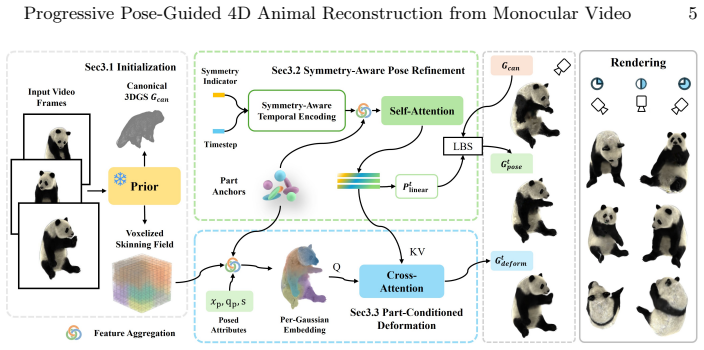
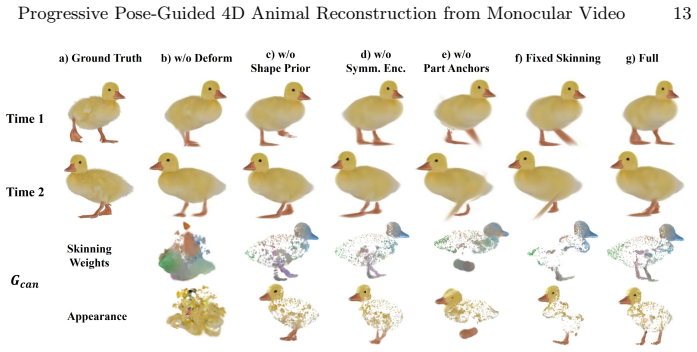
Our key insight is that a coarse shape prior suffices when coupled with a progressive strategy that disentangles articulated pose from non-rigid deformation. We employ a symmetry-aware temporal encoding that exploits bilateral cues while absorbing camera estimation drift and a part-conditioned deformation mechanism guided by learnable part anchors and a learnable skinning field. Extensive experiments demonstrate that our approach generalizes robustly across diverse species, achieving superior geometric accuracy, temporal consistency, and visual fidelity compared to existing baselines, even under severe prior mismatch.
What carries the argument
progressive test-time optimization framework on 3D Gaussian Splatting that disentangles articulated pose from non-rigid deformation via symmetry-aware temporal encoding and part-conditioned deformation with learnable part anchors and skinning field
If this is right
- The method generalizes robustly across diverse animal species without category-specific priors.
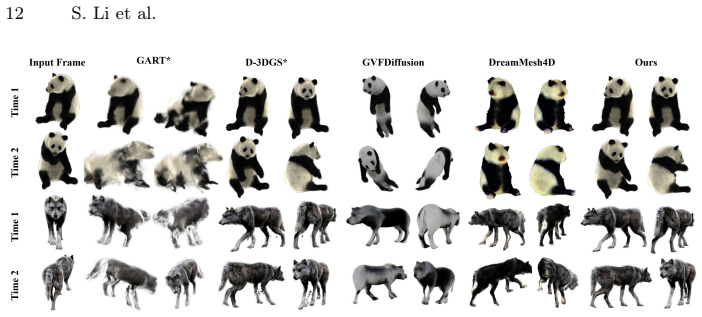
- Reconstructions achieve superior geometric accuracy relative to prior baselines.
- Temporal consistency improves because the progressive steps separate pose from deformation.
- Visual fidelity stays high even when the initial shape prior is severely mismatched.
- Input video fidelity is preserved better than with unconstrained generative approaches.
Where Pith is reading between the lines
- The same progressive disentangling could be tested on other articulated subjects such as humans or robots in monocular video.
- Once pose and deformation are separated, the resulting models might support independent editing of each component.
- Applying the symmetry-aware encoding to videos with fast camera motion or heavy occlusion would test whether bilateral cues remain reliable.
Load-bearing premise
A coarse shape prior suffices when coupled with a progressive strategy that disentangles articulated pose from non-rigid deformation.
What would settle it
A monocular video of an animal with extreme non-rigid deformations where the reconstructed sequence shows clear temporal inconsistencies or geometric errors despite the progressive strategy would falsify the claim.
Figures



read the original abstract
Reconstructing 4D animals from monocular videos is challenging due to large inter-species variation, complex articulations, and the lack of reliable templates. Existing approaches typically rely on either strict category-specific priors that restrict generalization, or unconstrained generative models that sacrifice input fidelity. To bridge this gap, we present a progressive test-time optimization framework built on 3D Gaussian Splatting for high-fidelity 4D animal reconstruction from a single video. Our key insight is that a coarse shape prior suffices when coupled with a progressive strategy that disentangles articulated pose from non-rigid deformation. Specifically, we employ a symmetry-aware temporal encoding that exploits bilateral cues while absorbing camera estimation drift and a part-conditioned deformation mechanism guided by learnable part anchors and a learnable skinning field. Extensive experiments demonstrate that our approach generalizes robustly across diverse species, achieving superior geometric accuracy, temporal consistency, and visual fidelity compared to existing baselines, even under severe prior mismatch.
Editorial analysis
A structured set of objections, weighed in public.
Referee Report
Summary. The paper presents a progressive test-time optimization framework using 3D Gaussian Splatting for 4D animal reconstruction from monocular video. It claims that a coarse shape prior is sufficient when combined with a progressive strategy to disentangle articulated pose from non-rigid deformation, employing symmetry-aware temporal encoding to handle bilateral cues and camera drift, plus part-conditioned deformation via learnable part anchors and a learnable skinning field. Extensive experiments are said to show robust generalization across diverse species with superior geometric accuracy, temporal consistency, and visual fidelity over baselines, even under severe prior mismatch.
Significance. If the results are reproducible and the experiments support the claims, the work could advance monocular 4D reconstruction by reducing dependence on rigid category-specific templates while maintaining input fidelity, offering a practical middle ground between prior-heavy and fully generative approaches. The progressive disentanglement and learnable deformation components are presented as enabling broader species coverage.
major comments (1)
- [Experiments] Experiments section: the central claim of superior performance across species rests on quantitative and qualitative comparisons, but the provided manuscript text does not include sufficient experimental details, datasets, or verification protocols to assess whether the results support the generalization and superiority assertions. This is load-bearing for the primary contribution.
minor comments (2)
- [Abstract] Abstract: the description of 'learnable part anchors' and 'learnable skinning field' is introduced without prior definition or reference to their initialization or optimization schedule.
- [Abstract] The symmetry-aware temporal encoding is described as absorbing camera estimation drift, but the mechanism for this absorption is not elaborated in the high-level overview.
Simulated Author's Rebuttal
We thank the referee for their review and for highlighting the importance of experimental details in supporting our claims of generalization and superiority. We address the single major comment below.
read point-by-point responses
-
Referee: [Experiments] Experiments section: the central claim of superior performance across species rests on quantitative and qualitative comparisons, but the provided manuscript text does not include sufficient experimental details, datasets, or verification protocols to assess whether the results support the generalization and superiority assertions. This is load-bearing for the primary contribution.
Authors: We agree that the current manuscript text provides insufficient detail on datasets, metrics, and verification protocols to allow full assessment of the claims. In the revised version we will expand the Experiments section with: (1) explicit dataset descriptions including video sources, species counts, frame numbers, and any preprocessing; (2) precise definitions of all quantitative metrics (geometric, temporal, and visual) together with implementation details; (3) the full evaluation protocol, including how baselines were run and how prior mismatch was controlled; and (4) additional verification steps such as per-species breakdowns and statistical significance where applicable. These additions will directly address the load-bearing nature of the experimental evidence. revision: yes
Circularity Check
No significant circularity identified
full rationale
The provided abstract and description outline a test-time optimization method using 3D Gaussian Splatting with symmetry-aware encoding and part-conditioned skinning. No equations, parameter fits, or self-citations are quoted that reduce a claimed prediction or uniqueness result to an input by construction. The central insight (coarse prior + progressive disentanglement) is presented as a methodological choice supported by experiments, without load-bearing self-referential loops or renaming of known results. The derivation chain is self-contained against external benchmarks.
Axiom & Free-Parameter Ledger
invented entities (2)
-
learnable part anchors
no independent evidence
-
learnable skinning field
no independent evidence
Reference graph
Works this paper leans on
-
[1]
In: Proceedings of the IEEE/CVF Conference on Computer Vision and Pattern Recognition
Aygun, M., Mac Aodha, O.: Saor: Single-view articulated object reconstruction. In: Proceedings of the IEEE/CVF Conference on Computer Vision and Pattern Recognition. pp. 10382–10391 (2024)
work page 2024
-
[2]
In: European conference on computer vision
Badger, M., Wang, Y., Modh, A., Perkes, A., Kolotouros, N., Pfrommer, B.G., Schmidt, M.F., Daniilidis, K.: 3d bird reconstruction: a dataset, model, and shape recovery from a single view. In: European conference on computer vision. pp. 1–17. Springer (2020)
work page 2020
-
[3]
In: International Conference on Learning Representations (2018)
Bińkowski, M., Sutherland, D.J., Arbel, M., Gretton, A.: Demystifying mmd gans. In: International Conference on Learning Representations (2018)
work page 2018
-
[4]
Ester, M., Kriegel, H.P., Sander, J., Xu, X., et al.: A density-based algorithm for discovering clusters in large spatial databases with noise. In: kdd. vol. 96, pp. 226–231 (1996)
work page 1996
-
[5]
In: Proceedings of the IEEE/CVF conference on computer vision and pattern recognition
Huang, Y.H., Sun, Y.T., Yang, Z., Lyu, X., Cao, Y.P., Qi, X.: Sc-gs: Sparse- controlled gaussian splatting for editable dynamic scenes. In: Proceedings of the IEEE/CVF conference on computer vision and pattern recognition. pp. 4220–4230 (2024)
work page 2024
-
[6]
In: 2024 International Conference on 3D Vision (3DV)
Jakab, T., Li, R., Wu, S., Rupprecht, C., Vedaldi, A.: Farm3d: Learning articulated 3d animals by distilling 2d diffusion. In: 2024 International Conference on 3D Vision (3DV). pp. 852–861. IEEE (2024)
work page 2024
-
[7]
In: IEEE/CVF Conference on Computer Vision and Pattern Recognition (CVPR) (2022)
Jiang, B., Hong, Y., Bao, H., Zhang, J.: Selfrecon: Self reconstruction your digital avatar from monocular video. In: IEEE/CVF Conference on Computer Vision and Pattern Recognition (CVPR) (2022)
work page 2022
-
[8]
In: IEEE/CVF International Conference on Computer Vision (ICCV) (2025)
Jiang, B., Hong, Y., Bao, H., Zhang, J.: Gaussian variation field diffusion for high-fidelity video-to-4d synthesis. In: IEEE/CVF International Conference on Computer Vision (ICCV) (2025)
work page 2025
-
[9]
The Thirty-eighth Annual Conference on Neural Information Processing Systems (2024)
Jiawei, X., Zexin, F., Jian, Y., Jin, X.: Grid4D: 4D decomposed hash encoding for high-fidelity dynamic gaussian splatting. The Thirty-eighth Annual Conference on Neural Information Processing Systems (2024)
work page 2024
- [10]
-
[11]
In: Proceedings of the IEEE/CVF Conference on Computer Vision and Pattern Recognition
Kulkarni, N., Gupta, A., Fouhey, D.F., Tulsiani, S.: Articulation-aware canonical surface mapping. In: Proceedings of the IEEE/CVF Conference on Computer Vision and Pattern Recognition. pp. 452–461 (2020)
work page 2020
-
[12]
In: Proceedings of the IEEE/CVF International Conference on Computer Vision
Kulkarni, N., Gupta, A., Tulsiani, S.: Canonical surface mapping via geometric cycle consistency. In: Proceedings of the IEEE/CVF International Conference on Computer Vision. pp. 2202–2211 (2019)
work page 2019
-
[13]
In: Proceedings of the IEEE/CVF conference on computer vision and pattern recognition
Lei, J., Wang, Y., Pavlakos, G., Liu, L., Daniilidis, K.: Gart: Gaussian articulated template models. In: Proceedings of the IEEE/CVF conference on computer vision and pattern recognition. pp. 19876–19887 (2024)
work page 2024
-
[14]
Li, X., Liu, S., Kim, K., De Mello, S., Jampani, V., Yang, M.H., Kautz, J.: Self- supervised single-view 3d reconstruction via semantic consistency. In: Computer Vision–ECCV 2020: 16th European Conference, Glasgow, UK, August 23–28, 2020, Proceedings, Part XIV 16. pp. 677–693. Springer (2020)
work page 2020
-
[15]
In: Advances in Neural Information Processing Systems (NeurIPS) (2024)
Li, Z., Chen, Y., Liu, P.: Dreammesh4d: Video-to-4d generation with sparse- controlled gaussian-mesh hybrid representation. In: Advances in Neural Information Processing Systems (NeurIPS) (2024)
work page 2024
-
[16]
In: Proceedings of the IEEE/CVF Conference on Computer Vision and Pattern Recognition
Li, Z., Litvak, D., Li, R., Zhang, Y., Jakab, T., Rupprecht, C., Wu, S., Vedaldi, A., Wu, J.: Learning the 3d fauna of the web. In: Proceedings of the IEEE/CVF Conference on Computer Vision and Pattern Recognition. pp. 9752–9762 (2024) Progressive Pose-Guided 4D Animal Reconstruction from Monocular Video 17
work page 2024
-
[17]
Liao, T.H., Liu, H., Xu, Y., Ge, S., Yang, G., Huang, J.B.: Pad3r: Pose-aware dynamic 3d reconstruction from casual videos. SIGGRAPH ASIA (2025)
work page 2025
-
[18]
Advances in Neural Information Processing Systems36, 54187–54198 (2023)
Liu, D., Stathopoulos, A., Zhangli, Q., Gao, Y., Metaxas, D.: Lepard: Learning explicit part discovery for 3d articulated shape reconstruction. Advances in Neural Information Processing Systems36, 54187–54198 (2023)
work page 2023
-
[19]
In: Proceedings of the IEEE/CVF international conference on computer vision
Liu, R., Wu, R., Van Hoorick, B., Tokmakov, P., Zakharov, S., Vondrick, C.: Zero-1-to-3: Zero-shot one image to 3d object. In: Proceedings of the IEEE/CVF international conference on computer vision. pp. 9298–9309 (2023)
work page 2023
-
[20]
In: Seminal Graphics Papers: Pushing the Boundaries, Volume 2, pp
Loper, M., Mahmood, N., Romero, J., Pons-Moll, G., Black, M.J.: Smpl: A skinned multi-person linear model. In: Seminal Graphics Papers: Pushing the Boundaries, Volume 2, pp. 851–866 (2023)
work page 2023
-
[21]
ACM Transactions on Graphics (TOG)41(4), 1–19 (2022)
Luo, H., Xu, T., Jiang, Y., Zhou, C., Qiu, Q., Zhang, Y., Yang, W., Xu, L., Yu, J.: Artemis: articulated neural pets with appearance and motion synthesis. ACM Transactions on Graphics (TOG)41(4), 1–19 (2022)
work page 2022
-
[22]
Oh, S., Lee, Y., Jeon, H., Park, E.: Hybrid 3D–4D Gaussian Splatting for fast dynamic scene representation (2025),https://arxiv.org/abs/2505.13215, arXiv preprint arXiv:2505.13215. Accessed 29 June 2026
-
[23]
Pavlakos, G., Choutas, V., Ghorbani, N., Bolkart, T., Osman, A.A.A., Tzionas, D., Black, M.J.: Expressive body capture: 3d hands, face, and body from a single image. In: Proceedings IEEE Conf. on Computer Vision and Pattern Recognition (CVPR) (2019)
work page 2019
-
[24]
In: The IEEE Conference on Computer Vision and Pattern Recognition (CVPR) (2016)
Perazzi, F., Pont-Tuset, J., McWilliams, B., Gool, L.V., Gross, M., Sorkine-Hornung, A.: A benchmark dataset and evaluation methodology for video object segmentation. In: The IEEE Conference on Computer Vision and Pattern Recognition (CVPR) (2016)
work page 2016
-
[25]
In: Proceedings of Neural Information Processing Systems(NeurIPS) (Dec 2024)
Ren, J., Xie, K., Mirzaei, A., Liang, H., Zeng, X., Kreis, K., Liu, Z., Torralba, A., Fidler, S., Kim, S.W., Ling, H.: L4gm: Large 4d gaussian reconstruction model. In: Proceedings of Neural Information Processing Systems(NeurIPS) (Dec 2024)
work page 2024
-
[26]
Grounded SAM: Assembling Open-World Models for Diverse Visual Tasks
Ren, T., Liu, S., Zeng, A., Lin, J., Li, K., Cao, H., Chen, J., Huang, X., Chen, Y., Yan, F., et al.: Grounded sam: Assembling open-world models for diverse visual tasks. arXiv preprint arXiv:2401.14159 (2024)
work page internal anchor Pith review Pith/arXiv arXiv 2024
-
[27]
In: Proceedings of the IEEE/CVF Conference on Computer Vision and Pattern Recognition
Rueegg, N., Zuffi, S., Schindler, K., Black, M.J.: Barc: Learning to regress 3d dog shape from images by exploiting breed information. In: Proceedings of the IEEE/CVF Conference on Computer Vision and Pattern Recognition. pp. 3876–3884 (2022)
work page 2022
-
[28]
In: Proceedings of the IEEE/CVF Conference on Computer Vision and Pattern Recognition
Rüegg, N., Tripathi, S., Schindler, K., Black, M.J., Zuffi, S.: Bite: Beyond priors for improved three-d dog pose estimation. In: Proceedings of the IEEE/CVF Conference on Computer Vision and Pattern Recognition. pp. 8867–8876 (2023)
work page 2023
-
[29]
In: European Conference on Computer Vision
Sabathier, R., Mitra, N.J., Novotny, D.: Animal avatars: Reconstructing animatable 3d animals from casual videos. In: European Conference on Computer Vision. pp. 270–287. Springer (2024)
work page 2024
-
[30]
Song, M., Zhang, Y., Mihajlovic, M., Tang, S., Gross, M., Aydın, T.O.: Spline deformation field. In: Proceedings of the Special Interest Group on Computer Graphics and Interactive Techniques Conference Conference Papers. pp. 1–10 (2025)
work page 2025
-
[31]
In: Proceedings of the IEEE/CVF Conference on Computer Vision and Pattern Recognition
Wang, Y., Kolotouros, N., Daniilidis, K., Badger, M.: Birds of a feather: Capturing avian shape models from images. In: Proceedings of the IEEE/CVF Conference on Computer Vision and Pattern Recognition. pp. 14739–14749 (2021)
work page 2021
-
[32]
Wu, G., Yi, T., Fang, J., Xie, L., Zhang, X., Wei, W., Liu, W., Tian, Q., Wang, X.: 4d gaussian splatting for real-time dynamic scene rendering. In: Proceedings of the 18 S. Li et al. IEEE/CVF conference on computer vision and pattern recognition. pp. 20310–20320 (2024)
work page 2024
-
[33]
In: Proceedings of the IEEE/CVF Conference on Computer Vision and Pattern Recognition
Wu, S., Li, R., Jakab, T., Rupprecht, C., Vedaldi, A.: Magicpony: Learning artic- ulated 3d animals in the wild. In: Proceedings of the IEEE/CVF Conference on Computer Vision and Pattern Recognition. pp. 8792–8802 (2023)
work page 2023
-
[34]
Advances in Neural Information Processing Systems35, 28559–28574 (2022)
Wu, Y., Chen, Z., Liu, S., Ren, Z., Wang, S.: Casa: Category-agnostic skeletal animal reconstruction. Advances in Neural Information Processing Systems35, 28559–28574 (2022)
work page 2022
-
[35]
In: Proceedings of the Computer Vision and Pattern Recognition Conference
Xiang, J., Lv, Z., Xu, S., Deng, Y., Wang, R., Zhang, B., Chen, D., Tong, X., Yang, J.: Structured 3d latents for scalable and versatile 3d generation. In: Proceedings of the Computer Vision and Pattern Recognition Conference. pp. 21469–21480 (2025)
work page 2025
-
[37]
In: The Thirteenth International Conference on Learning Representations
Xie, Y., Yao, C.H., Voleti, V., Jiang, H., Jampani, V.: Sv4d: Dynamic 3d con- tent generation with multi-frame and multi-view consistency. In: The Thirteenth International Conference on Learning Representations
-
[38]
In: Proceedings of the IEEE/CVF Conference on Computer Vision and Pattern Recognition
Yang, G., Sun, D., Jampani, V., Vlasic, D., Cole, F., Chang, H., Ramanan, D., Freeman, W.T., Liu, C.: Lasr: Learning articulated shape reconstruction from a monocular video. In: Proceedings of the IEEE/CVF Conference on Computer Vision and Pattern Recognition. pp. 15980–15989 (2021)
work page 2021
-
[39]
Advances in Neural Information Processing Systems34, 19326–19338 (2021)
Yang, G., Sun, D., Jampani, V., Vlasic, D., Cole, F., Liu, C., Ramanan, D.: Viser: Video-specific surface embeddings for articulated 3d shape reconstruction. Advances in Neural Information Processing Systems34, 19326–19338 (2021)
work page 2021
-
[40]
In: Proceedings of the IEEE/CVF Conference on Computer Vision and Pattern Recognition
Yang, G., Vo, M., Neverova, N., Ramanan, D., Vedaldi, A., Joo, H.: Banmo: Building animatable 3d neural models from many casual videos. In: Proceedings of the IEEE/CVF Conference on Computer Vision and Pattern Recognition. pp. 2863–2873 (2022)
work page 2022
-
[41]
In: Proceedings of the IEEE/CVF Conference on Computer Vision and Pattern Recognition
Yang, G., Wang, C., Reddy, N.D., Ramanan, D.: Reconstructing animatable cat- egories from videos. In: Proceedings of the IEEE/CVF Conference on Computer Vision and Pattern Recognition. pp. 16995–17005 (2023)
work page 2023
-
[42]
Yang, Y., Deng, Y., Xu, Y., Zhang, J.: Aptv2: Benchmarking animal pose estimation and tracking with a large-scale dataset and beyond (2023)
work page 2023
-
[43]
In: Proceedings of the IEEE/CVF conference on computer vision and pattern recognition
Yang, Z., Gao, X., Zhou, W., Jiao, S., Zhang, Y., Jin, X.: Deformable 3d gaussians for high-fidelity monocular dynamic scene reconstruction. In: Proceedings of the IEEE/CVF conference on computer vision and pattern recognition. pp. 20331–20341 (2024)
work page 2024
-
[44]
Advances in Neural Information Processing Systems35, 15296–15308 (2022)
Yao, C.H., Hung, W.C., Li, Y., Rubinstein, M., Yang, M.H., Jampani, V.: Lassie: Learning articulated shapes from sparse image ensemble via 3d part discovery. Advances in Neural Information Processing Systems35, 15296–15308 (2022)
work page 2022
-
[45]
In: Proceedings of the IEEE/CVF Conference on Computer Vision and Pattern Recognition
Yao, C.H., Hung, W.C., Li, Y., Rubinstein, M., Yang, M.H., Jampani, V.: Hi-lassie: High-fidelity articulated shape and skeleton discovery from sparse image ensemble. In: Proceedings of the IEEE/CVF Conference on Computer Vision and Pattern Recognition. pp. 4853–4862 (2023)
work page 2023
-
[46]
arXiv preprint arXiv:2503.16396 (2025)
Yao, C.H., Xie, Y., Voleti, V., Jiang, H., Jampani, V.: Sv4d 2.0: Enhancing spatio- temporal consistency in multi-view video diffusion for high-quality 4d generation. arXiv preprint arXiv:2503.16396 (2025)
-
[47]
Yin, M., Cao, Y., Peng, S., Han, K.: Splat4d: Diffusion-enhanced 4d gaussian splatting for temporally and spatially consistent content creation. In: Proceedings of the Special Interest Group on Computer Graphics and Interactive Techniques Conference Conference Papers. pp. 1–10 (2025) Progressive Pose-Guided 4D Animal Reconstruction from Monocular Video 19
work page 2025
-
[48]
Zuffi, S., Kanazawa, A., Berger-Wolf, T., Black, M.J.: Three-d safari: Learning to estimate zebra pose, shape, and texture from images "in the wild". In: International Conference on Computer Vision (Oct 2019)
work page 2019
-
[49]
In: Proceedings of the IEEE conference on Computer Vision and Pattern Recognition
Zuffi, S., Kanazawa, A., Black, M.J.: Lions and tigers and bears: Capturing non- rigid, 3d, articulated shape from images. In: Proceedings of the IEEE conference on Computer Vision and Pattern Recognition. pp. 3955–3963 (2018)
work page 2018
-
[50]
In: Proceedings of the IEEE conference on computer vision and pattern recognition
Zuffi, S., Kanazawa, A., Jacobs, D.W., Black, M.J.: 3d menagerie: Modeling the 3d shape and pose of animals. In: Proceedings of the IEEE conference on computer vision and pattern recognition. pp. 6365–6373 (2017)
work page 2017
discussion (0)
Sign in with ORCID, Apple, or X to comment. Anyone can read and Pith papers without signing in.