Readable but Not Controllable: Neuron-Level Evidence for Medical LLM Hallucination
Pith reviewed 2026-07-02 19:14 UTC · model grok-4.3
The pith
Hallucinations in medical LLMs can be detected from neuron activations but cannot be reliably controlled by steering those neurons.
A machine-rendered reading of the paper's core claim, the machinery that carries it, and where it could break.
Core claim
Across 16 model-dataset combinations, a simple probe reliably detects hallucination from internal activations, the representation is distributed and redundant rather than localized, and random neuron subsets or low-dimensional projections preserve most detection performance, yet the same structure does not support reliable neuron-level control through causal interventions.
What carries the argument
Internal neuron activations associated with hallucination, used first for linear probing to detect the signal and then for targeted causal steering to test controllability.
If this is right
- Hallucination detection works well from internal activations in medical LLMs.
- The hallucination signal is spread across many neurons and is therefore easy to recover even with random sampling.
- Neuron-level causal interventions on the detected neurons do not produce reliable control over hallucinated outputs.
- Effective mitigation will require methods that go beyond identifying and steering the neurons most correlated with the error.
Where Pith is reading between the lines
- Interventions may need to act on much larger populations of neurons simultaneously rather than small selected subsets.
- The observed gap between detection and control may appear in other LLM error types or non-medical domains.
- Methods such as continued fine-tuning or external retrieval could circumvent the controllability limit shown here.
Load-bearing premise
The neurons highlighted by the detection probe are the correct targets and the steering method is adequate to reveal any controllability that exists.
What would settle it
An experiment in which steering the top probe-identified neurons produces a clear, replicable drop in hallucination rate relative to random-neuron or no-intervention controls.
Figures

read the original abstract
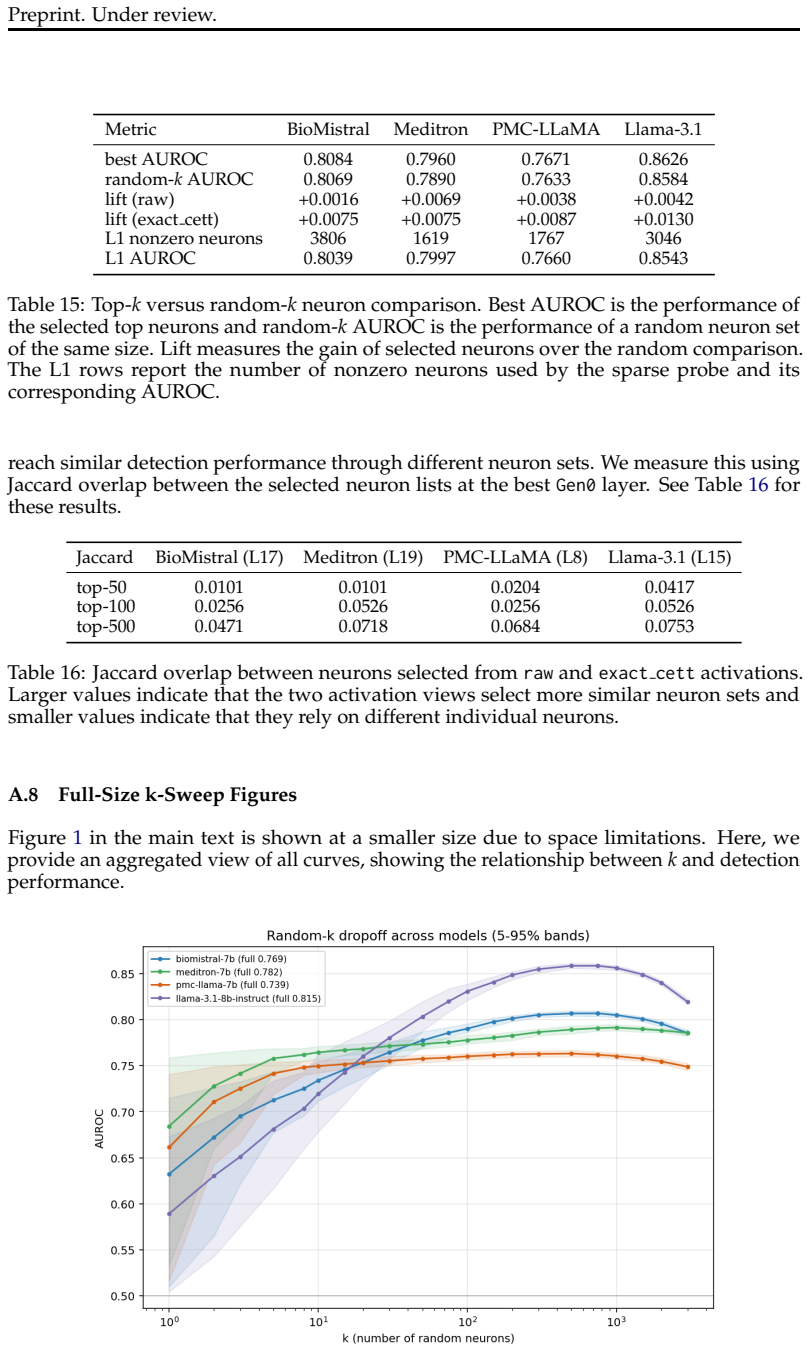
Hallucination remains one of the central obstacles to deploying medical LLMs. Yet, even when hallucination can be detected, it is still unclear whether the internal representations associated with it can be used for control rather than detection alone. Using four open-source models across a suite of medical question-answering datasets, we show that a simple, carefully conditioned probe can reliably detect hallucination, with AUROC scores between 0.77 and 0.86 in our case. We further show that this signal is distributed and redundant rather than narrowly localized. Systematically selected neurons outperform random neurons only at very small subset sizes, whereas random subsets of a few hundred neurons recover nearly the full signal, and low-dimensional random projections preserve most of the detection performance. Beyond detection, we test whether this representation is causally actionable. Across 16 model--dataset combinations, our results reveal a sharp gap between decodability and controllability. The same internal structure that makes hallucination easy to detect does not translate into reliable neuron-level control. These findings show that medical hallucination seems to be readily visible in internal activations, but not easily corrected by steering the neurons most associated with it. More broadly, our results suggest that hallucination mitigation is not simply a matter of identifying the right neurons, and point to a deeper separation between what representations reveal and what they allow us to change.
Editorial analysis
A structured set of objections, weighed in public.
Referee Report
Summary. The paper claims that hallucination in medical LLMs is reliably decodable from internal activations (AUROC 0.77-0.86 across four open-source models and multiple QA datasets) but that the same representations do not support reliable neuron-level causal control. The detection signal is shown to be distributed and redundant (selected neurons outperform random only at very small subset sizes; random subsets of a few hundred neurons recover nearly full performance; low-dimensional random projections preserve most signal). Across 16 model–dataset combinations, interventions on the probed neurons fail to produce controllable mitigation, indicating a separation between what representations reveal and what they allow to be changed.
Significance. If the gap between decodability and controllability is robust, the result has clear implications for interpretability-based safety work in high-stakes domains: detection does not automatically yield actionable control. The multi-model, multi-dataset design supplies a reasonably broad empirical foundation and the distributed-signal finding is a useful negative result against narrowly localized editing assumptions.
major comments (3)
- [Section 4] Controllability experiments (Section 4 / §4.2): the steering method (activation addition, scaling factor, layer selection, or ablation) is not described with sufficient specificity, nor are positive controls reported that verify the intervention actually shifts the probed representation in the expected direction. Given the paper’s own finding that the signal is distributed, absence of such controls leaves open the possibility that null controllability results are methodological rather than representational.
- [Section 4.3] Baseline comparisons for interventions (Section 4.3): no results are shown for random-neuron steering, opposite-direction steering, or full-layer interventions that would establish that the chosen neuron-level edits are capable of producing measurable output change when a signal is known to exist. This comparison is load-bearing for the central “sharp gap” claim.
- [Section 3] Probe conditioning and feature selection (Section 3): while the abstract states the probe is “carefully conditioned,” the exact conditioning procedure, regularization, and cross-validation scheme used to avoid overfitting to dataset artifacts are not stated, making it difficult to assess whether the reported AUROC range generalizes beyond the 16 combinations tested.
minor comments (2)
- [Figures 3-5] Figure captions and axis labels in the distributed-signal plots could explicitly state the number of random seeds and the exact subset sizes tested so readers can assess variability without returning to the text.
- [Abstract] The abstract’s phrase “systematically selected neurons outperform random neurons only at very small subset sizes” would benefit from a parenthetical reference to the precise subset-size threshold at which the crossover occurs.
Simulated Author's Rebuttal
We thank the referee for the constructive comments, which identify areas where methodological details can be clarified to strengthen the paper. We respond to each major comment below and indicate the revisions that will be incorporated.
read point-by-point responses
-
Referee: [Section 4] Controllability experiments (Section 4 / §4.2): the steering method (activation addition, scaling factor, layer selection, or ablation) is not described with sufficient specificity, nor are positive controls reported that verify the intervention actually shifts the probed representation in the expected direction. Given the paper’s own finding that the signal is distributed, absence of such controls leaves open the possibility that null controllability results are methodological rather than representational.
Authors: We agree that the description of the steering procedure in Section 4.2 requires expansion for reproducibility. The revised manuscript will specify the activation addition implementation (including exact scaling factors of 1×, 5×, and 10×), the layers chosen according to peak probe AUROC, and the ablation protocol. On positive controls, the distributed character of the signal (as shown by the random-subset and projection results) implies that intervening on a small number of neurons is unlikely to produce detectable shifts in the overall representation; this is consistent with our controllability findings rather than a methodological flaw. We will add an explicit discussion of this point and any post-hoc activation-shift diagnostics that are feasible with existing data. revision: partial
-
Referee: [Section 4.3] Baseline comparisons for interventions (Section 4.3): no results are shown for random-neuron steering, opposite-direction steering, or full-layer interventions that would establish that the chosen neuron-level edits are capable of producing measurable output change when a signal is known to exist. This comparison is load-bearing for the central “sharp gap” claim.
Authors: We accept that additional baselines would make the controllability gap more convincing. The detection experiments already compared selected versus random neurons, but the intervention results did not. In revision we will report random-neuron and sign-reversed steering outcomes for all 16 model–dataset pairs. We will also add full-layer intervention results for two representative models to demonstrate that activation edits can measurably alter outputs when applied more broadly, thereby confirming that the null neuron-level effects are not an artifact of an ineffective editing pipeline. revision: yes
-
Referee: [Section 3] Probe conditioning and feature selection (Section 3): while the abstract states the probe is “carefully conditioned,” the exact conditioning procedure, regularization, and cross-validation scheme used to avoid overfitting to dataset artifacts are not stated, making it difficult to assess whether the reported AUROC range generalizes beyond the 16 combinations tested.
Authors: We will expand Section 3 with the precise probe details omitted for brevity. The classifier is logistic regression with L2 regularization (C = 0.1), trained via stratified 5-fold cross-validation on balanced hallucination/non-hallucination splits. Training and test sets are strictly disjoint, and the same protocol is applied uniformly across all datasets. These choices were made to reduce dataset-specific overfitting; the stable AUROC range across four models and multiple medical QA sources already provides evidence of generalization, which the added description will make explicit. revision: yes
Circularity Check
No circularity: purely empirical probe and intervention results
full rationale
The manuscript reports AUROC scores from trained probes and outcomes from neuron interventions across 16 model-dataset pairs. No equations, derivations, fitted parameters renamed as predictions, or self-citation chains appear in the provided text. Detection performance and controllability gaps are measured outcomes, not quantities forced by construction from the same inputs. The analysis is self-contained against external benchmarks and contains no load-bearing self-referential steps.
Axiom & Free-Parameter Ledger
axioms (1)
- domain assumption Neuron activations contain detectable information about whether a generated answer is hallucinated
Reference graph
Works this paper leans on
-
[1]
Reducing hallucination in structured outputs via retrieval-augmented generation
Orlando Ayala and Patrice Bechard. Reducing hallucination in structured outputs via retrieval-augmented generation. InProceedings of the 2024 Conference of the North American Chapter of the Association for Computational Linguistics: Human Language Technologies (Volume 6: Industry Track), pp. 228–238,
2024
-
[2]
The internal state of an llm knows when it’s lying
Amos Azaria and Tom Mitchell. The internal state of an llm knows when it’s lying. In Findings of the Association for Computational Linguistics: EMNLP 2023, pp. 967–976,
2023
-
[3]
Discovering Latent Knowledge in Language Models Without Supervision
Collin Burns, Haotian Ye, Dan Klein, and Jacob Steinhardt. Discovering latent knowledge in language models without supervision.arXiv preprint arXiv:2212.03827,
work page internal anchor Pith review Pith/arXiv arXiv
-
[4]
H-neurons: On the existence, impact, and origin of hallucination-associated neurons in llms,
Cheng Gao, Huimin Chen, Chaojun Xiao, Zhiyi Chen, Zhiyuan Liu, and Maosong Sun. H-neurons: On the existence, impact, and origin of hallucination-associated neurons in llms.arXiv preprint arXiv:2512.01797,
-
[5]
Aaron Grattafiori, Abhimanyu Dubey, Abhinav Jauhri, Abhinav Pandey, Abhishek Kadian, Ahmad Al-Dahle, Aiesha Letman, Akhil Mathur, Alan Schelten, Alex Vaughan, et al. The llama 3 herd of models.arXiv preprint arXiv:2407.21783,
work page internal anchor Pith review Pith/arXiv arXiv
-
[6]
Medreflect: Teaching medical LLMs to self-improve via reflective correction
Yue Huang, Yanyuan Chen, Dexuan Xu, Weihua Yue, Huamin Zhang, Meikang Qiu, and Yu Huang. Medreflect: Teaching medical LLMs to self-improve via reflective correction. arXiv preprint arXiv:2510.03687,
-
[7]
PubMedQA: A dataset for biomedical research question answering
Qiao Jin, Bhuwan Dhingra, Zhengping Liu, William Cohen, and Xinghua Lu. PubMedQA: A dataset for biomedical research question answering. In Kentaro Inui, Jing Jiang, Vin- cent Ng, and Xiaojun Wan (eds.),Proceedings of the 2019 Conference on Empirical Meth- ods in Natural Language Processing and the 9th International Joint Conference on Natural Language Pro...
2019
-
[8]
Association for Computational Linguistics. doi: 10.18653/v1/D19-1259. URL https://aclanthology.org/D19-1259/. Yanis Labrak, Adrien Bazoge, Emmanuel Morin, Pierre-Antoine Gourraud, Mickael Rouvier, and Richard Dufour. BioMistral: A collection of open-source pretrained large language models for medical domains. In Lun-Wei Ku, Andre Martins, and Vivek Srikum...
-
[9]
doi: 10.18653/v1/ 2024.findings-acl.348
Association for Computational Linguistics. doi: 10.18653/v1/ 2024.findings-acl.348. URLhttps://aclanthology.org/2024.findings-acl.348/. Kenneth Li, Oam Patel, Fernanda Vi ´egas, Hanspeter Pfister, and Martin Wattenberg. Inference-time intervention: Eliciting truthful answers from a language model.Advances in Neural Information Processing Systems, 36:41451–41530,
-
[10]
Selfcheckgpt: Zero-resource black-box hallucination detection for generative large language models
Potsawee Manakul, Adian Liusie, and Mark Gales. Selfcheckgpt: Zero-resource black-box hallucination detection for generative large language models. InProceedings of the 2023 conference on empirical methods in natural language processing, pp. 9004–9017,
2023
-
[11]
Steering Llama 2 via Contrastive Activation Addition
Nina Panickssery, Nick Gabrieli, Julian Schulz, Meg Tong, Evan Hubinger, and Alexan- der Matt Turner. Steering llama 2 via contrastive activation addition.arXiv preprint arXiv:2312.06681,
work page internal anchor Pith review Pith/arXiv arXiv
-
[12]
Do Hallucination Neurons Generalize? Evidence from Cross-Domain Transfer in LLMs
Snehit Vaddi and Pujith Vaddi. Do hallucination neurons generalize? evidence from cross-domain transfer in llms.arXiv preprint arXiv:2604.19765,
work page internal anchor Pith review Pith/arXiv arXiv
-
[13]
Hallucination is Inevitable: An Innate Limitation of Large Language Models
Ziwei Xu, Sanjay Jain, and Mohan Kankanhalli. Hallucination is inevitable: An innate limitation of large language models.arXiv preprint arXiv:2401.11817,
work page internal anchor Pith review Pith/arXiv arXiv
-
[14]
Zhengyan Zhang, Yixin Song, Guanghui Yu, Xu Han, Yankai Lin, Chaojun Xiao, Chenyang Song, Zhiyuan Liu, Zeyu Mi, and Maosong Sun. ReLU 2 wins: Discovering efficient activation functions for sparse llms.arXiv preprint arXiv:2402.03804,
discussion (0)
Sign in with ORCID, Apple, or X to comment. Anyone can read and Pith papers without signing in.