Fully Distributed T\^atonnement for Chores Markets
Pith reviewed 2026-07-02 00:54 UTC · model grok-4.3
The pith
Multiplicative tâtonnement converges to a competitive equilibrium in chores Fisher markets using only local updates.
A machine-rendered reading of the paper's core claim, the machinery that carries it, and where it could break.
Core claim
Multiplicative tâtonnement is a fully distributed dynamics in which each chore price p_j is updated multiplicatively using only its current price and its own excess-demand signal. The authors prove that this process converges to a competitive equilibrium for any chores Fisher market whose disutilities are continuous, convex, and 1-homogeneous. For convex CES disutilities the dynamics further attains an O(1/ε²) convergence rate to an approximate equilibrium, with improved dependence on problem constants compared to prior relative tâtonnement.
What carries the argument
The multiplicative tâtonnement update rule, which adjusts each chore price independently using its excess demand without explicit normalization.
If this is right
- Convergence holds for all continuous convex 1-homogeneous disutility functions.
- For convex CES disutilities an approximate competitive equilibrium is reached after O(1/ε²) iterations.
- The dynamics requires no explicit global coupling or averaging of excess-demand signals.
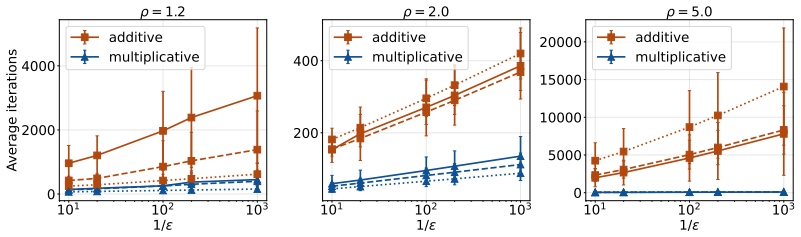
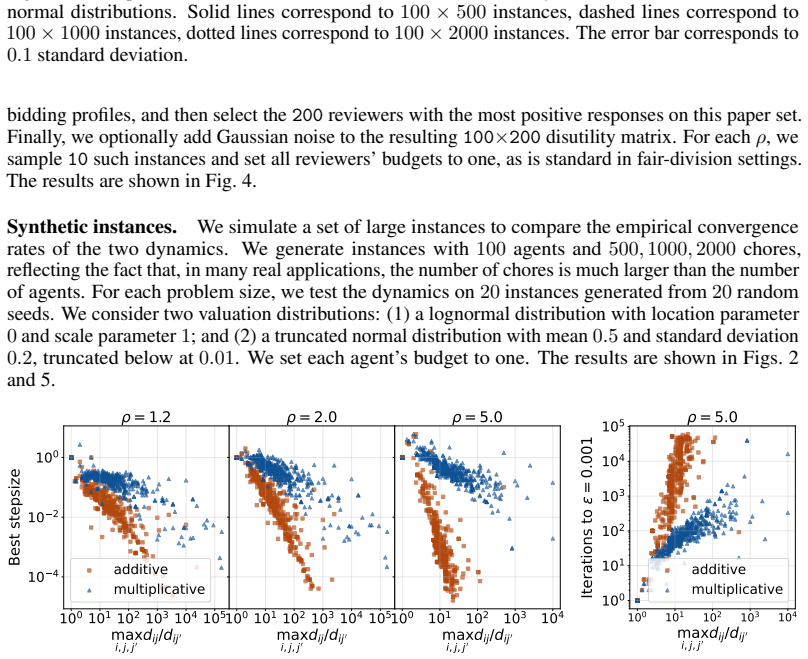
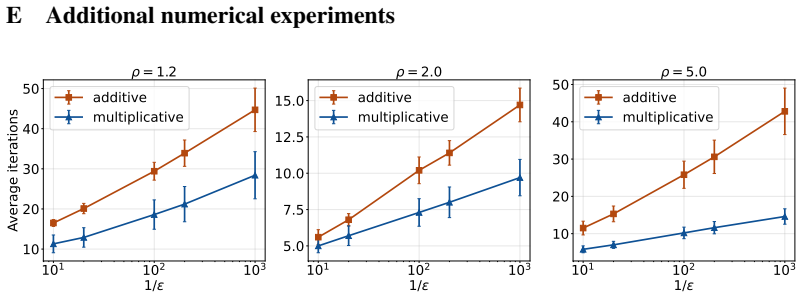
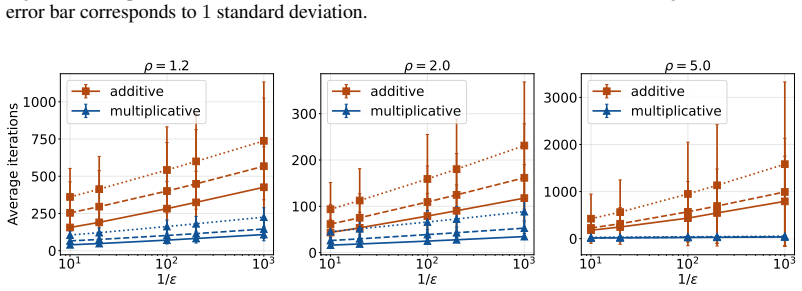
- Empirical running time is often an order of magnitude faster than relative tâtonnement on real-world and simulated instances.
Where Pith is reading between the lines
- The same local multiplicative form may apply to other market models where global signals were previously required to enforce price normalization.
- Because each update uses only local information, the method is immediately parallelizable across chores.
- The approach may extend to mixed goods-and-chores markets if the 1-homogeneity condition can be maintained on the chore side.
Load-bearing premise
The disutilities must be continuous, convex, and 1-homogeneous for the local multiplicative updates to preserve the geometry required for convergence.
What would settle it
A chores market instance with continuous convex disutilities that are not 1-homogeneous in which the multiplicative updates diverge or cycle away from equilibrium.
Figures

read the original abstract
We study price-adjustment dynamics for computing competitive equilibria (CE) in Fisher markets with chores. Unlike in classical goods markets, prices in chores markets are payments for taking on undesirable tasks, and natural excess-demand dynamics can fail; even the na\"ive analogue of Walrasian t\^atonnement may diverge. Recent work of Chaudhury et al. [2025] overcomes this obstacle via relative t\^atonnement, which subtracts the average excess-demand signal from the excess demand vector. This recovers convergence, but at the cost of coupling the price updates across all chores. This leaves open whether such global coupling is inherent, or whether convergent t\^atonnement can be recovered through a genuinely local update in which each chore reacts only to its own excess demand. We answer this question affirmatively through multiplicative t\^atonnement, a fully distributed dynamics in which each chore price is updated using only its current price and its own excess-demand signal. Although the update contains no explicit normalization term, Walras' law and the multiplicative form of the update implicitly preserve the relevant aggregate price geometry. We prove that multiplicative t\^atonnement converges to a CE in any chores Fisher market with continuous, convex, and $1$-homogeneous (CCH) disutilities. For convex CES disutilities, we further prove an approximate-CE convergence rate with the same $O(1/\varepsilon^2)$ dependence as relative t\^atonnement, but with improved dependence on problem constants. Experiments on real-world and simulated instances show that multiplicative t\^atonnement is substantially faster in practice, often by an order of magnitude.
Editorial analysis
A structured set of objections, weighed in public.
Referee Report
Summary. The paper introduces multiplicative tâtonnement, a fully distributed price-adjustment dynamics for chores Fisher markets in which each chore's price is updated using only its own excess-demand signal and current price. It proves convergence to a competitive equilibrium for any market with continuous, convex, and 1-homogeneous (CCH) disutilities, establishes an O(1/ε²) approximate-CE rate for convex CES disutilities (with improved dependence on problem constants relative to relative tâtonnement), and reports that the dynamics is substantially faster in practice than the coupled alternative of Chaudhury et al. [2025].
Significance. If the stated convergence proofs hold, the result is significant because it shows that global coupling across chores is not required to obtain convergent tâtonnement in chores markets; the multiplicative form together with Walras' law and 1-homogeneity suffices to preserve the necessary aggregate price geometry. This yields a genuinely local update rule, matching the best-known rate while improving constant factors and delivering order-of-magnitude practical speedups on the reported instances. The work thereby strengthens the algorithmic toolkit for distributed equilibrium computation under the CCH structural assumption.
minor comments (3)
- Abstract: the claim that experiments show 'substantially faster' performance 'often by an order of magnitude' should be supported by at least one quantitative table or figure reference (e.g., iteration counts or wall-clock times versus relative tâtonnement on the same instances) so that the empirical contribution can be assessed.
- The manuscript should explicitly state whether the CCH class is closed under the operations used in the convergence argument or whether additional regularity (e.g., strict convexity or interiority of the equilibrium) is tacitly required for the local update to remain well-defined when excess demand is zero for some chores.
- Notation: the precise definition of the multiplicative update rule (including any implicit normalization or handling of zero prices) should appear in the main text before the convergence theorem, rather than being left to the abstract's high-level description.
Simulated Author's Rebuttal
We thank the referee for their positive summary of our work on multiplicative tâtonnement and for recommending minor revision. We appreciate the recognition that the result demonstrates local updates suffice under the CCH assumption and that the practical speedups are notable. No major comments were raised in the report.
Circularity Check
No significant circularity identified
full rationale
The paper establishes convergence of multiplicative tâtonnement to competitive equilibrium for CCH disutilities via a direct mathematical argument that invokes the local update rule, Walras' law, and 1-homogeneity to preserve price geometry. This is presented as an independent proof, not a reduction of any claimed result to a fitted parameter, self-referential definition, or prior self-citation. The reference to Chaudhury et al. [2025] supplies only background on relative tâtonnement and does not carry the load of the new fully-distributed convergence claim. No steps in the described derivation chain match any of the enumerated circularity patterns.
Axiom & Free-Parameter Ledger
axioms (1)
- domain assumption Disutilities are continuous, convex, and 1-homogeneous (CCH)
Reference graph
Works this paper leans on
-
[1]
Graphical economies with resale
Gabriel Andrade, Rafael Frongillo, Sharadha Srinivasan, and Elliot Gorokhovsky. Graphical economies with resale. InProceedings of the 22nd ACM Conference on Economics and Computation, pages 71–90, 2021
2021
-
[2]
On the stability of the competitive equilibrium, ii.Econometrica: Journal of the Econometric Society, pages 82–109, 1959
Kenneth J Arrow, Henry D Block, and Leonid Hurwicz. On the stability of the competitive equilibrium, ii.Econometrica: Journal of the Econometric Society, pages 82–109, 1959
1959
-
[3]
On the stability of the competitive equilibrium, i
Kenneth J Arrow and Leonid Hurwicz. On the stability of the competitive equilibrium, i. Econometrica: Journal of the Econometric Society, pages 522–552, 1958
1958
-
[4]
A descent lemma beyond lipschitz gradient continuity: first-order methods revisited and applications.Mathematics of Operations Research, 42(2):330–348, 2017
Heinz H Bauschke, Jérôme Bolte, and Marc Teboulle. A descent lemma beyond lipschitz gradient continuity: first-order methods revisited and applications.Mathematics of Operations Research, 42(2):330–348, 2017
2017
-
[5]
Distributed algorithms via gradient descent for fisher markets
Benjamin Birnbaum, Nikhil R Devanur, and Lin Xiao. Distributed algorithms via gradient descent for fisher markets. InProceedings of the 12th ACM conference on Electronic commerce, pages 127–136. ACM, 2011
2011
-
[6]
Competitive division of a mixed manna.Econometrica, 85(6):1847–1871, 2017
Anna Bogomolnaia, Hervé Moulin, Fedor Sandomirskiy, and Elena Yanovskaya. Competitive division of a mixed manna.Econometrica, 85(6):1847–1871, 2017
2017
-
[7]
Polynomial time algorithms to find an approximate competitive equilibrium for chores
Shant Boodaghians, Bhaskar Ray Chaudhury, and Ruta Mehta. Polynomial time algorithms to find an approximate competitive equilibrium for chores. InSODA, pages 2285–2302. SIAM, 2022
2022
-
[8]
Proportional dynamics in exchange economies
Simina Brânzei, Nikhil Devanur, and Yuval Rabani. Proportional dynamics in exchange economies. InProceedings of the 22nd ACM Conference on Economics and Computation, pages 180–201, 2021
2021
-
[9]
Algorithms for competitive division of chores.Math
Simina Brânzei and Fedor Sandomirskiy. Algorithms for competitive division of chores.Math. Oper. Res., 49(1):398–429, 2024
2024
-
[10]
Competitive equilibrium with chores: Combinatorial algorithm and hardness
Bhaskar Ray Chaudhury, Jugal Garg, Peter McGlaughlin, and Ruta Mehta. Competitive equilibrium with chores: Combinatorial algorithm and hardness. InEC, pages 1106–1107. ACM, 2022
2022
-
[11]
Competitive equilib- rium for chores: from dual eisenberg-gale to a fast, greedy, lp-based algorithm
Bhaskar Ray Chaudhury, Christian Kroer, Ruta Mehta, and Tianlong Nan. Competitive equilib- rium for chores: from dual eisenberg-gale to a fast, greedy, lp-based algorithm. InProceedings of the 25th ACM Conference on Economics and Computation, pages 40–40, 2024. 10
2024
-
[12]
Tâtonnement dynamics for fisher markets with chores.arXiv preprint arXiv:2511.21162, 2025
Bhaskar Ray Chaudhury, Christian Kroer, Ruta Mehta, and Tianlong Nan. Tâtonnement dynamics for fisher markets with chores.arXiv preprint arXiv:2511.21162, 2025
-
[13]
He Chen, Chonghe Jiang, and Anthony Man-Cho So. Accelerated price adjustment for fisher markets with exact recovery of competitive equilibrium.arXiv preprint arXiv:2510.07759, 2025
-
[14]
Tatonnement beyond gross substitutes? gradient descent to the rescue
Yun Kuen Cheung, Richard Cole, and Nikhil Devanur. Tatonnement beyond gross substitutes? gradient descent to the rescue. InProceedings of the forty-fifth annual ACM symposium on Theory of computing, pages 191–200, 2013
2013
-
[15]
Tatonnement beyond gross substitutes? gradient descent to the rescue.Games and Economic Behavior, 2019
Yun Kuen Cheung, Richard Cole, and Nikhil R Devanur. Tatonnement beyond gross substitutes? gradient descent to the rescue.Games and Economic Behavior, 2019
2019
-
[16]
Tatonnement in ongoing markets of complementary goods
Yun Kuen Cheung, Richard Cole, and Ashish Rastogi. Tatonnement in ongoing markets of complementary goods. InProceedings of the 13th ACM Conference on Electronic Commerce, pages 337–354, 2012
2012
-
[17]
Dynamics of distributed updating in fisher markets
Yun Kuen Cheung, Richard Cole, and Yixin Tao. Dynamics of distributed updating in fisher markets. InProceedings of the 2018 ACM Conference on Economics and Computation, pages 351–368, 2018
2018
-
[18]
Proportional response dynamics in gross substitutes markets.arXiv preprint arXiv:2506.02852, 2025
Yun Kuen Cheung, Richard Cole, and Yixin Tao. Proportional response dynamics in gross substitutes markets.arXiv preprint arXiv:2506.02852, 2025
-
[19]
Market equilibrium via the excess demand function
Bruno Codenotti, Benton McCune, and Kasturi Varadarajan. Market equilibrium via the excess demand function. InProceedings of the thirty-seventh annual ACM symposium on Theory of computing, pages 74–83, 2005
2005
-
[20]
Fast-converging tatonnement algorithms for one-time and ongoing market problems
Richard Cole and Lisa Fleischer. Fast-converging tatonnement algorithms for one-time and ongoing market problems. InProceedings of the fortieth annual ACM symposium on Theory of computing, pages 315–324, 2008
2008
-
[21]
Balancing the robustness and convergence of tatonnement.arXiv preprint arXiv:1908.00844, 2019
Richard Cole and Yixin Tao. Balancing the robustness and convergence of tatonnement.arXiv preprint arXiv:1908.00844, 2019
-
[22]
Devanur and Ravi Kannan
Nikhil R. Devanur and Ravi Kannan. Market equilibria in polynomial time for fixed number of goods or agents. In49th Annual IEEE Symposium on Foundations of Computer Science (FOCS), pages 45–53. IEEE Computer Society, 2008
2008
-
[23]
Market equilibrium via a primal-dual algorithm for a convex program.Journal of the ACM (JACM), 55(5):1–18, 2008
Nikhil R Devanur, Christos H Papadimitriou, Amin Saberi, and Vijay V Vazirani. Market equilibrium via a primal-dual algorithm for a convex program.Journal of the ACM (JACM), 55(5):1–18, 2008
2008
-
[24]
Kuangyu Ding and Kim-Chuan Toh. Stochastic bregman subgradient methods for nonsmooth nonconvex optimization problems.arXiv preprint arXiv:2404.17386, 2024
-
[25]
A combinatorial polynomial algorithm for the linear arrow– debreu market.Information and Computation, 243:112–132, 2015
Ran Duan and Kurt Mehlhorn. A combinatorial polynomial algorithm for the linear arrow– debreu market.Information and Computation, 243:112–132, 2015
2015
-
[26]
A finite algorithm for the linear exchange model
B Curtis Eaves. A finite algorithm for the linear exchange model. 1975
1975
-
[27]
Consensus of subjective probabilities: The pari-mutuel method.The Annals of Mathematical Statistics, 30(1):165–168, 1959
Edmund Eisenberg and David Gale. Consensus of subjective probabilities: The pari-mutuel method.The Annals of Mathematical Statistics, 30(1):165–168, 1959
1959
-
[28]
First-order methods for large-scale market equilibrium computa- tion
Yuan Gao and Christian Kroer. First-order methods for large-scale market equilibrium computa- tion. InNeural Information Processing Systems 2020, NeurIPS 2020, 2020
2020
-
[29]
Computing competitive equilibria with mixed manna
Jugal Garg and Peter McGlaughlin. Computing competitive equilibria with mixed manna. In AAMAS Conference proceedings, 2020
2020
-
[30]
A consumer-theoretic characterization of fisher market equilibria
Denizalp Goktas, Enrique Areyan Viqueira, and Amy Greenwald. A consumer-theoretic characterization of fisher market equilibria. InInternational Conference on Web and Internet Economics, pages 334–351. Springer, 2021. 11
2021
-
[31]
Tâtonnement in homothetic fisher markets
Denizalp Goktas, Jiayi Zhao, and Amy Greenwald. Tâtonnement in homothetic fisher markets. InProceedings of the 24th ACM Conference on Economics and Computation, EC’23, pages 760–781, 2023
2023
-
[32]
Spliddit: Unleashing fair division algorithms.ACM SIGecom Exchanges, 13(2):41–46, 2015
Jonathan Goldman and Ariel D Procaccia. Spliddit: Unleashing fair division algorithms.ACM SIGecom Exchanges, 13(2):41–46, 2015
2015
-
[33]
The use of knowledge in society.The American economic review, 35(4):519–530, 1945
Friedrich August Hayek. The use of knowledge in society.The American economic review, 35(4):519–530, 1945
1945
-
[34]
A polynomial time algorithm for computing an arrow–debreu market equilibrium for linear utilities.SIAM Journal on Computing, 37(1):303–318, 2007
Kamal Jain. A polynomial time algorithm for computing an arrow–debreu market equilibrium for linear utilities.SIAM Journal on Computing, 37(1):303–318, 2007
2007
-
[35]
Vazirani, and Yinyu Ye
Kamal Jain, Vijay V . Vazirani, and Yinyu Ye. Market equilibria for homothetic, quasi-concave utilities and economies of scale in production. InProceedings of the Sixteenth Annual ACM- SIAM Symposium on Discrete Algorithms (SODA), pages 63–71. SIAM, 2005
2005
-
[36]
Graphical economics
Sham M Kakade, Michael Kearns, and Luis E Ortiz. Graphical economics. InInternational Conference on Computational Learning Theory, pages 17–32. Springer, 2004
2004
-
[37]
Relatively smooth convex optimization by first-order methods, and applications.SIAM Journal on Optimization, 28(1):333–354, 2018
Haihao Lu, Robert M Freund, and Yurii Nesterov. Relatively smooth convex optimization by first-order methods, and applications.SIAM Journal on Optimization, 28(1):333–354, 2018
2018
-
[38]
Preflib: A library for preferences http://www.preflib.org
Nicholas Mattei and Toby Walsh. Preflib: A library for preferences http://www.preflib.org. In Patrice Perny, Marc Pirlot, and Alexis Tsoukiàs, editors,Algorithmic Decision Theory - Third International Conference, ADT 2013, Bruxelles, Belgium, November 12-14, 2013, Proceedings, Lecture Notes in Computer Science, pages 259–270. Springer, 2013
2013
-
[39]
Fast and interpretable dynamics for fisher markets via block-coordinate updates
Tianlong Nan, Yuan Gao, and Christian Kroer. Fast and interpretable dynamics for fisher markets via block-coordinate updates. InProceedings of the AAAI Conference on Artificial Intelligence, volume 37, pages 5832–5840, 2023
2023
-
[40]
On the convergence of tâtonnement for linear fisher markets
Tianlong Nan, Yuan Gao, and Christian Kroer. On the convergence of tâtonnement for linear fisher markets. InProceedings of the AAAI Conference on Artificial Intelligence, volume 39, pages 14027–14035, 2025
2025
-
[41]
One algorithm for finding solutions of the arrow-debreu model
EI Nenakov and ME Primak. One algorithm for finding solutions of the arrow-debreu model. Kibernetica, 3:127–128, 1983
1983
-
[42]
James B. Orlin. Improved algorithms for computing fisher’s market clearing prices: computing fisher’s market clearing prices. InSTOC, pages 291–300. ACM, 2010
2010
-
[43]
The stability of equilibrium: comparative statics and dynamics.Economet- rica: Journal of the Econometric Society, pages 97–120, 1941
Paul A Samuelson. The stability of equilibrium: comparative statics and dynamics.Economet- rica: Journal of the Econometric Society, pages 97–120, 1941
1941
-
[44]
An algorithm for finding equilibrium in the linear exchange model with fixed budgets.Journal of Applied and Industrial Mathematics, 3(4):505, 2009
Vadim I Shmyrev. An algorithm for finding equilibrium in the linear exchange model with fixed budgets.Journal of Applied and Industrial Mathematics, 3(4):505, 2009
2009
-
[45]
Yixin Tao and Weiqiang Zheng. Fisher meets lindahl: A unified duality framework for market equilibrium.arXiv preprint arXiv:2511.04572, 2025
-
[46]
Eléments d’économie pure.Economica, 1874
Léon Walras. Eléments d’économie pure.Economica, 1874
-
[47]
Proportional response dynamics leads to market equilibrium
Fang Wu and Li Zhang. Proportional response dynamics leads to market equilibrium. In Proceedings of the thirty-ninth annual ACM symposium on Theory of computing, pages 354– 363, 2007
2007
-
[48]
A path to the arrow–debreu competitive market equilibrium.Mathematical Program- ming, 111(1):315–348, 2008
Yinyu Ye. A path to the arrow–debreu competitive market equilibrium.Mathematical Program- ming, 111(1):315–348, 2008
2008
-
[49]
Chuwen Zhang, Chang He, Bo Jiang, and Yinyu Ye. The second-order t \ˆ atonnement: De- centralized interior-point methods for market equilibrium.arXiv preprint arXiv:2508.04822, 2025. 12
-
[50]
Proportional response dynamics in the fisher market.Theoretical Computer Science, 412(24):2691–2698, 2011
Li Zhang. Proportional response dynamics in the fisher market.Theoretical Computer Science, 412(24):2691–2698, 2011
2011
-
[51]
Fisher markets with social influence
Jiayi Zhao, Denizalp Goktas, and Amy Greenwald. Fisher markets with social influence. In Proceedings of the AAAI Conference on Artificial Intelligence, volume 37, pages 5900–5909, 2023. 13 Appendix A Additional related work Computation of CE in Fisher markets.A series of foundational works established convex pro- gramming and linear complementarity proble...
2023
-
[52]
For anyp k ∈∆ B,p k+1 ∈∆ B
-
[53]
For anyp k ∈∆ B and eachj∈[m], ifp k j ≤ℓ 0 thenp k+1 j > p k j + 1 2 ηk
-
[54]
The first fact is true because of Proposition 1
For anyp k ∈R m + and eachj∈[m], ifp k j > ℓ 0, thenp k+1 j > ℓ0 2 . The first fact is true because of Proposition 1. The second fact follows from Lemma 6. The third fact is true because of the following: for any yk ∈Y(p k), we have |yk j | ≤β . Thus, pk+1 j = pk j (1 +η kyk j )> p k j (1−η kβ)≥ 1 2 pk j > ℓ0 2 . Then, we prove Lemma 2. The first statemen...
2000
discussion (0)
Sign in with ORCID, Apple, or X to comment. Anyone can read and Pith papers without signing in.