CloudyGUI: A Novel Python-based Framework for Auto-Scaling and Cloud Workload Analysis
Pith reviewed 2026-07-02 06:41 UTC · model grok-4.3
The pith
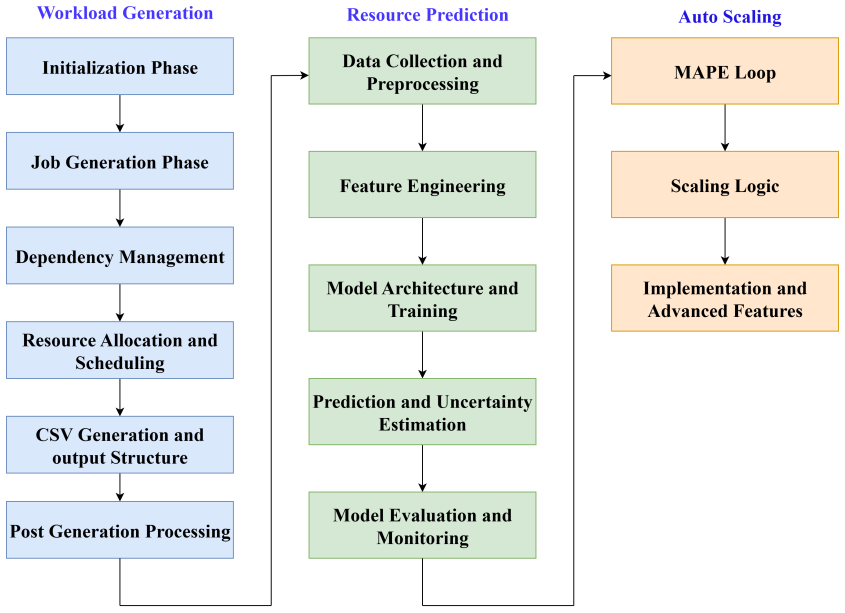
CloudyGUI supplies a Python GUI framework that simulates cloud auto-scaling through workload generation, XGBoost/LSTM prediction, and MAPE-loop control.
A machine-rendered reading of the paper's core claim, the machinery that carries it, and where it could break.
Core claim
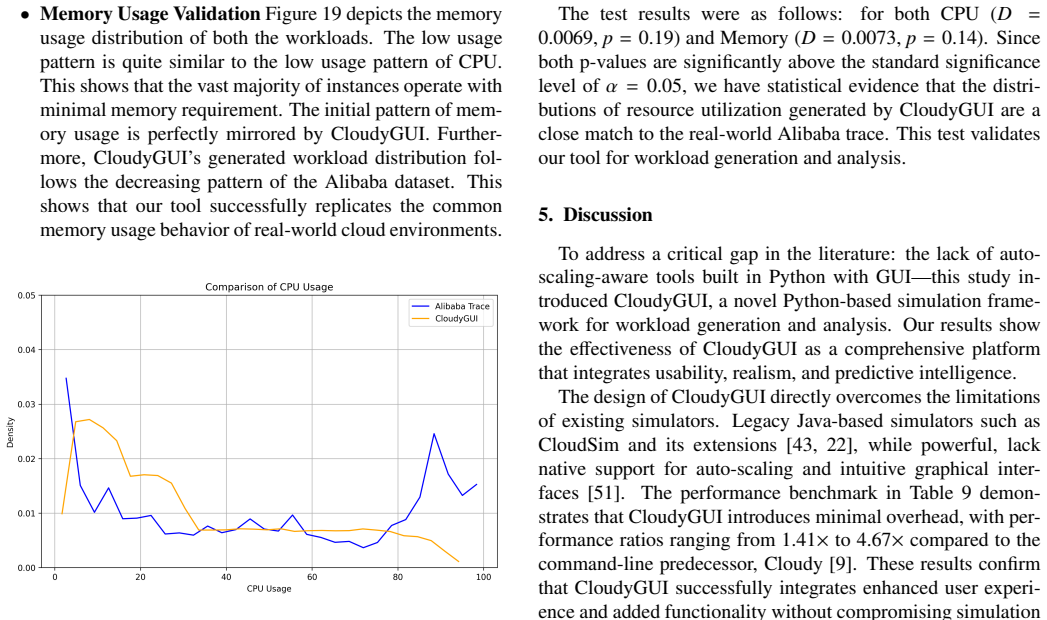
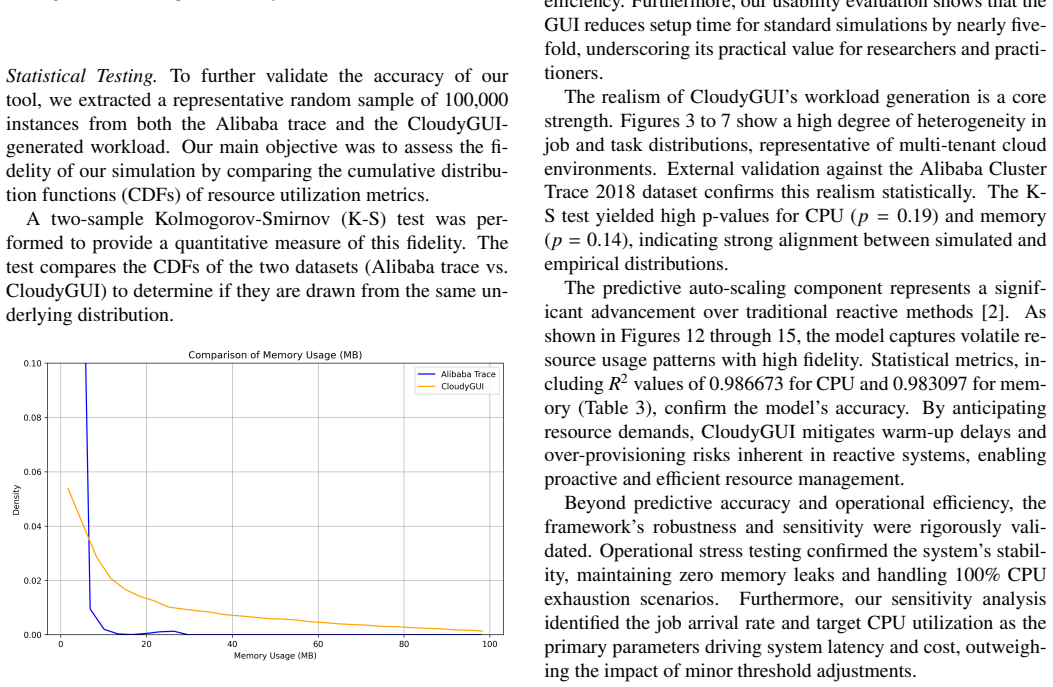
CloudyGUI is a simulation framework whose generated CPU and memory workloads pass a two-sample Kolmogorov-Smirnov test against real traces (p = 0.19 and p = 0.14), whose prediction-plus-MAPE auto-scaling pipeline can be exercised through an interactive GUI at 1.4x–4.67x the cost of a command-line equivalent, and whose realism is further confirmed by expert review.
What carries the argument
The three-stage pipeline of workload generation, XGBoost/LSTM prediction, and MAPE-loop auto-scaling, together with internal, intermediate, and external validation steps.
If this is right
- Researchers can now run repeatable auto-scaling trials without provisioning live cloud instances.
- Workload traces produced by the generator can serve as standardized inputs for comparing different scaling policies.
- The modest GUI overhead suggests that interactive exploration remains practical for rapid policy prototyping.
- Expert-validated realism supports using the tool for teaching and preliminary algorithm development.
- The open Python implementation allows direct inspection and modification of each pipeline stage.
Where Pith is reading between the lines
- The same pipeline structure could be reused as a plug-in module inside larger cloud simulators that currently lack workload generation or GUI layers.
- If the XGBoost and LSTM components were swapped for newer models, the framework would immediately provide a controlled test bed for measuring improvement in scaling accuracy.
- Publishing the validation datasets alongside the code would let independent groups rerun the K-S tests on their own traces.
- Extending the GUI to export scaling traces in standard formats would ease integration with existing performance-analysis toolchains.
Load-bearing premise
The generated workloads and the decisions produced by the prediction-plus-MAPE pipeline will continue to resemble the behavior of actual cloud systems when used outside the tested datasets.
What would settle it
A new Kolmogorov-Smirnov test on an independent cloud trace that returns p-values below 0.05 for both CPU and memory would indicate that the synthetic workloads no longer match real distributions.
Figures




read the original abstract
Purpose: Cloud computing environments are highly dynamic, creating major challenges for resource management. Accurate workload prediction is therefore essential for effective auto-scaling. To address this, we present CloudyGUI, a Python simulation framework with an easy-to-use GUI that allows researchers to test and validate resource management strategies. Methods: This framework employs a three-stage pipeline: workload generation, prediction (utilizing XGBoost and LSTM), and an auto-scaling system based on the MAPE loop. Validation includes internal, intermediate, and external methods to ensure system reliability. Results: CloudyGUI's generated workloads closely match real-world datasets. A two-sample K-S test confirms this alignment, showing strong p-values of 0.19 for CPU and 0.14 for memory. When compared to a command-line tool, the GUI adds only a minimal overhead of 1.4x-4.67x. Furthermore, expert review validates the tool's realism and practical usefulness. Conclusion: CloudyGUI fills a critical gap by providing an accessible and efficient platform for simulating auto-scaling in cloud applications, helping researchers develop advanced cloud management solutions.
Editorial analysis
A structured set of objections, weighed in public.
Referee Report
Summary. The manuscript presents CloudyGUI, a Python-based simulation framework with GUI for cloud workload analysis and auto-scaling. It describes a three-stage pipeline consisting of workload generation, prediction via XGBoost and LSTM, and MAPE-loop auto-scaling, with validation via internal/intermediate/external methods. Results claim that generated workloads match real datasets per two-sample K-S tests (p=0.19 CPU, p=0.14 memory), GUI overhead is 1.4x-4.67x versus CLI, and expert review confirms realism and usefulness. The conclusion asserts that the tool fills a gap by enabling accessible simulation of auto-scaling strategies for researchers.
Significance. If the full pipeline were shown to produce realistic simulations with quantified prediction accuracy and scaling performance, CloudyGUI could serve as a practical open tool for cloud resource management research. The current manuscript, however, supplies quantitative support only for the workload-generation stage and overhead; absent metrics for the prediction and auto-scaling stages, the claimed utility for developing advanced management solutions remains unestablished.
major comments (2)
- [Results] Results section: only K-S p-values are reported for workload generation; no RMSE, MAPE, or other accuracy metrics are given for the XGBoost/LSTM prediction models, nor any evaluation of MAPE-loop outcomes (SLA violations, utilization, cost) against real traces.
- [Methods] Methods / Validation: the internal, intermediate, and external validation methods are named but supply no quantitative results beyond input-distribution matching, leaving the sufficiency of the three-stage pipeline for producing reliable simulations unestablished.
minor comments (1)
- [Abstract] Abstract: the phrase 'strong p-values' for 0.19 and 0.14 is imprecise; these values indicate failure to reject the null hypothesis of distributional equality rather than affirmative strength of match.
Simulated Author's Rebuttal
We thank the referee for the constructive feedback. The comments correctly identify that the current manuscript provides limited quantitative support for the prediction and auto-scaling stages. We address each point below and will revise the manuscript accordingly.
read point-by-point responses
-
Referee: [Results] Results section: only K-S p-values are reported for workload generation; no RMSE, MAPE, or other accuracy metrics are given for the XGBoost/LSTM prediction models, nor any evaluation of MAPE-loop outcomes (SLA violations, utilization, cost) against real traces.
Authors: We agree that the Results section reports only K-S tests for workload generation and GUI overhead. No prediction accuracy metrics (RMSE, MAPE) or auto-scaling performance metrics (SLA violations, utilization, cost) are provided. This is a genuine limitation of the current manuscript. In the revision we will add these evaluations using the existing XGBoost/LSTM implementations and MAPE-loop on both generated and real traces. revision: yes
-
Referee: [Methods] Methods / Validation: the internal, intermediate, and external validation methods are named but supply no quantitative results beyond input-distribution matching, leaving the sufficiency of the three-stage pipeline for producing reliable simulations unestablished.
Authors: The three validation methods are described, yet only distribution-matching results (K-S tests) are quantified. We accept that this leaves the full pipeline's reliability insufficiently demonstrated. The revision will expand the Validation section with additional quantitative results for the intermediate and external stages of the complete pipeline. revision: yes
Circularity Check
No circularity: tool framework with direct empirical validation metrics
full rationale
The paper presents CloudyGUI as a Python framework implementing a three-stage pipeline (workload generation, XGBoost/LSTM prediction, MAPE-loop auto-scaling) and reports standalone validation results including K-S test p-values (0.19 CPU, 0.14 memory), GUI overhead factors (1.4x-4.67x), and expert review. No equations, parameter fits, or derivations are described that reduce claims to self-defined quantities. No self-citations are invoked as load-bearing uniqueness theorems or ansatzes. The central claim of filling a gap via an accessible simulation platform rests on the reported metrics themselves rather than any reduction to inputs by construction. This is a standard non-derivational tool paper whose validation steps are independent measurements.
Axiom & Free-Parameter Ledger
Reference graph
Works this paper leans on
-
[1]
Mansouri, R
N. Mansouri, R. Ghafari, B. M. H. Zade, Cloud computing simulators: A comprehensive review, Simulation Modelling Practice and Theory 104 (2020) 102144
2020
-
[2]
Z. Cai, Q. Li, X. Li, Elasticsim: A toolkit for simulating workflows with cloud resource runtime auto-scaling and stochastic task execution times, Journal of Grid Computing 15 (2017) 257–272
2017
-
[3]
S. K. Rout, J. Ravindra, A. Meda, S. N. Mohanty, V . Kavididevi, A dy- namic scalable auto-scaling model as a load balancer in the cloud com- puting environment., EAI Endorsed Transactions on Scalable Information Systems 10 (5) (2023)
2023
-
[4]
Sabry, Cloud computing for dynamic systems, International Journal of Information and Communication Technology 3 (4) (2011) 354–369
K. Sabry, Cloud computing for dynamic systems, International Journal of Information and Communication Technology 3 (4) (2011) 354–369
2011
-
[5]
Asir Antony Gnana Singh, R
D. Asir Antony Gnana Singh, R. Priyadharshini, E. Jebamalar Leavline, Analysis of cloud environment using cloudsim, in: Artificial Intelligence and Evolutionary Computations in Engineering Systems: Proceedings of ICAIECES 2017, Springer, 2018, pp. 325–333
2017
-
[6]
E. T. Ngharamike, G. K. Ijemaru, O. Akinsanmi, O. Folorunsho, Cloud- based simulation tools for cloud testing: a review, FUOYE Journal of Engineering and Technology 3 (1) (2018)
2018
-
[7]
T. Umar, M. Nadeem, M. Sajid, Simulation tools for cloud computing: A comparative study, in: Advances in Data-driven Computing and Intel- ligent Systems: Selected Papers from ADCIS 2022, V olume 2, Springer, 2023, pp. 239–251
2022
-
[8]
Pandey, S
R. Pandey, S. Gonnade, Comparative study of simulation tools in cloud computing environment, Int. J. Sci. Eng. Res 5 (5) (2014)
2014
-
[9]
Siavashi, M
A. Siavashi, M. Momtazpour, Cloudy: A pythonic cloud simulator, in: 2024 32nd International Conference on Electrical Engineering (ICEE), IEEE, 2024, pp. 1–5
2024
-
[10]
Kapil, V
D. Kapil, V . Mittal, A. Gupta, Cloud computing and simulation paradigms: A technical exploration and analysis, in: 2024 15th Interna- tional Conference on Computing Communication and Networking Tech- nologies (ICCCNT), IEEE, 2024, pp. 1–6
2024
-
[11]
Sajitha, A
A. Sajitha, A. Subhajini, Analysis of cloud sim toolkit for implement- ing energy efficient green cloud data centers, International Journal for Research in Applied Science & Engineering Technology (IJRASET) 6 (2018) 4613–4624
2018
-
[12]
Kathiravelu, L
P. Kathiravelu, L. Veiga, An adaptive distributed simulator for cloud and mapreduce algorithms and architectures, in: 2014 IEEE/ACM 7th Inter- national Conference on Utility and Cloud computing, IEEE, 2014, pp. 79–88
2014
-
[13]
Maarouf, A
A. Maarouf, A. Marzouk, A. Haqiq, Comparative study of simulators for cloud computing, in: 2015 International Conference on Cloud Technolo- gies and Applications (CloudTech), IEEE, 2015, pp. 1–8
2015
-
[14]
K. Goga, O. Terzo, P. Ruiu, F. Xhafa, Simulation, modeling, and perfor- mance evaluation tools for cloud applications, in: 2014 Eighth Interna- tional Conference on Complex, Intelligent and Software Intensive Sys- tems, 2014, pp. 226–232.doi:10.1109/CISIS.2014.32
-
[15]
M. A. Shahid, M. M. Alam, M. M. Su’ud, A systematic parameter anal- ysis of cloud simulation tools in cloud computing environments, Applied Sciences 13 (15) (2023) 8785
2023
-
[16]
Kumar, R
P. Kumar, R. Kumar, Issues and challenges of load balancing techniques in cloud computing: A survey, ACM computing surveys (CSUR) 51 (6) (2019) 1–35
2019
-
[17]
Fakhfakh, H
F. Fakhfakh, H. H. Kacem, A. H. Kacem, Simulation tools for cloud com- puting: A survey and comparative study, in: 2017 IEEE/ACIS 16th Inter- national Conference on Computer and Information Science (ICIS), IEEE, 2017, pp. 221–226
2017
-
[18]
Sakellari, G
G. Sakellari, G. Loukas, A survey of mathematical models, simulation approaches and testbeds used for research in cloud computing, Simulation Modelling Practice and Theory 39 (2013) 92–103
2013
-
[19]
Bashar, Modeling and simulation frameworks for cloud computing en- vironment: A critical evaluation, in: International Conference on Cloud Computing and Services Science, 2014, pp
A. Bashar, Modeling and simulation frameworks for cloud computing en- vironment: A critical evaluation, in: International Conference on Cloud Computing and Services Science, 2014, pp. 1–6
2014
-
[20]
Núñez, J
A. Núñez, J. L. Vázquez-Poletti, A. C. Caminero, G. G. Castañé, J. Car- retero, I. M. Llorente, icancloud: A flexible and scalable cloud infrastruc- ture simulator, Journal of Grid Computing 10 (2012) 185–209
2012
-
[21]
X. Li, X. Jiang, P. Huang, K. Ye, Dartcsim: An enhanced user-friendly cloud simulation system based on cloudsim with better performance, in: 2012 IEEE 2nd International Conference on Cloud Computing and Intel- ligence Systems, V ol. 1, IEEE, 2012, pp. 392–396
2012
-
[22]
M. S. Aslanpour, A. N. Toosi, J. Taheri, R. Gaire, Autoscalesim: A sim- ulation toolkit for auto-scaling web applications in clouds, Simulation Modelling Practice and Theory 108 (2021) 102245
2021
-
[23]
A. V . Papadopoulos, A. Ali-Eldin, K.-E. Årzén, J. Tordsson, E. Elmroth, Peas: A performance evaluation framework for auto-scaling strategies in cloud applications, ACM Transactions on Modeling and Performance Evaluation of Computing Systems (TOMPECS) 1 (4) (2016) 1–31. 26
2016
-
[24]
I. K. Kim, W. Wang, M. Humphrey, Pics: A public iaas cloud simulator, in: 2015 IEEE 8th International Conference on Cloud Computing, IEEE, 2015, pp. 211–220
2015
-
[25]
O. D. Segun-Falade, O. S. Osundare, W. E. Kedi, P. A. Okeleke, T. I. Ijomah, O. Y . Abdul-Azeez, Assessing the transformative impact of cloud computing on software deployment and management, Computer Science & IT Research Journal 5 (8) (2024)
2024
-
[26]
S. J. Shri, G. Karthiyayini, L. Vignesh, T. Upender, D. Shobana, L. S. K. Patra, Optimizing resource management and data security in cloud com- puting environments, in: 2024 3rd International Conference for Advance- ment in Technology (ICONAT), IEEE, 2024, pp. 1–6
2024
-
[27]
P. Reddy, A. Verma, K. Verma, A. Singh, A. Soni, Efficient resource al- location in cloud computing environments: A modelling perspective, In- ternational Journal of Technology and Management 2 (2) (2023) 99–112. doi:10.63876/ijtm.v2i2.124. URLhttps://doi.org/10.63876/ijtm.v2i2.124
-
[28]
S. Alshathri, Comparative study on cloud computing simulation plat- forms, WSEAS Transactions on Computers 14 (2020) 172–177.doi: 10.46300/91015.2020.14.22. URLhttps://doi.org/10.46300/91015.2020.14.22
-
[29]
Sanjalawe, et al., Cloud computing simulators: A review, in: 2023 24th International Arab Conference on Information Technology (ACIT), IEEE, 2023, pp
Y . Sanjalawe, et al., Cloud computing simulators: A review, in: 2023 24th International Arab Conference on Information Technology (ACIT), IEEE, 2023, pp. 1–14
2023
-
[30]
Vemasani, S
P. Vemasani, S. M. Vuppalapati, S. Modi, S. Ponnusamy, Achieving agility through auto-scaling: Strategies for dynamic resource allocation in cloud computing, International Journal for Research in Applied Sci- ence and Engineering Technology (2024). URLhttps://api.semanticscholar.org/CorpusID:269314674
2024
-
[31]
M. J. Karamthulla, J. N. A. Malaiyappan, R. Tillu, Optimizing resource allocation in cloud infrastructure through ai automation: A comparative study, Journal of Knowledge Learning and Science Technology ISSN: 2959-6386 (online) 2 (2) (2023) 315–326.doi:10.60087/jklst. vol2.n2.p326
-
[32]
M. B. Taha, S. Fraihat, Y . Sanjalawe, A. Al-Daraiseh, S. R. Al-E’mari, Proactive auto-scaling for service function chains in cloud computing based on deep learning, IEEE Access 12 (2024) 38575–38587
2024
-
[33]
M. C. Silva Filho, R. L. Oliveira, C. C. Monteiro, P. R. Inácio, M. M. Freire, Cloudsim plus: a cloud computing simulation framework pursu- ing software engineering principles for improved modularity, extensibility and correctness, in: 2017 IFIP/IEEE symposium on integrated network and service management (IM), IEEE, 2017, pp. 400–406
2017
-
[34]
S. F. Piraghaj, A. V . Dastjerdi, R. N. Calheiros, R. Buyya, Container- cloudsim: An environment for modeling and simulation of containers in cloud data centers, Software: Practice and Experience 47 (4) (2017) 505– 521
2017
-
[35]
Siavashi, M
A. Siavashi, M. Momtazpour, Gpucloudsim: an extension of cloudsim for modeling and simulation of gpus in cloud data centers, The Journal of Supercomputing 75 (5) (2019) 2535–2561
2019
-
[36]
Tighe, G
M. Tighe, G. Keller, M. Bauer, H. Lutfiyya, Dcsim: A data centre sim- ulation tool for evaluating dynamic virtualized resource management, in: 2012 8th international conference on network and service management (cnsm) and 2012 workshop on systems virtualiztion management (svm), IEEE, 2012, pp. 385–392
2012
-
[37]
S.-H. Lim, B. Sharma, G. Nam, E. K. Kim, C. R. Das, Mdcsim: A multi- tier data center simulation, platform, in: 2009 IEEE International Confer- ence on Cluster Computing and Workshops, IEEE, 2009, pp. 1–9
2009
-
[38]
Sriram, Speci, a simulation tool exploring cloud-scale data centres, in: Cloud Computing: First International Conference, CloudCom 2009, Bei- jing, China, December 1-4, 2009
I. Sriram, Speci, a simulation tool exploring cloud-scale data centres, in: Cloud Computing: First International Conference, CloudCom 2009, Bei- jing, China, December 1-4, 2009. Proceedings 1, Springer, 2009, pp. 381– 392
2009
-
[39]
Ostermann, K
S. Ostermann, K. Plankensteiner, R. Prodan, T. Fahringer, Groudsim: An event-based simulation framework for computational grids and clouds, in: European Conference on Parallel Processing, Springer, 2010, pp. 305– 313
2010
-
[40]
S. K. Garg, R. Buyya, Networkcloudsim: Modelling parallel applications in cloud simulations, in: 2011 Fourth IEEE International Conference on Utility and Cloud Computing, IEEE, 2011, pp. 105–113
2011
-
[41]
Badii, P
C. Badii, P. Bellini, I. Bruno, D. Cenni, R. Mariucci, P. Nesi, Icaro cloud simulator exploiting knowledge base, Simulation Modelling Practice and Theory 62 (2016) 1–13
2016
-
[42]
J. Son, A. V . Dastjerdi, R. N. Calheiros, X. Ji, Y . Yoon, R. Buyya, Cloudsimsdn: Modeling and simulation of software-defined cloud data centers, in: 2015 15th IEEE/ACM International Symposium on Cluster, Cloud and Grid Computing, IEEE, 2015, pp. 475–484
2015
-
[43]
Wickremasinghe, R
B. Wickremasinghe, R. N. Calheiros, R. Buyya, Cloudanalyst: A cloudsim-based visual modeller for analysing cloud computing environ- ments and applications, in: 2010 24th IEEE international conference on advanced information networking and applications, IEEE, 2010, pp. 446– 452
2010
-
[44]
Teixeira Sá, R
T. Teixeira Sá, R. N. Calheiros, D. G. Gomes, Cloudreports: An exten- sible simulation tool for energy-aware cloud computing environments, Cloud computing: Challenges, limitations and R&D solutions (2014) 127–142
2014
-
[45]
R. N. Calheiros, R. Ranjan, A. Beloglazov, C. A. De Rose, R. Buyya, Cloudsim: a toolkit for modeling and simulation of cloud computing en- vironments and evaluation of resource provisioning algorithms, Software: Practice and experience 41 (1) (2011) 23–50
2011
-
[46]
L. Liu, H. Wang, X. Liu, X. Jin, W. B. He, Q. B. Wang, Y . Chen, Green- cloud: a new architecture for green data center, in: Proceedings of the 6th international conference industry session on Autonomic computing and communications industry session, 2009, pp. 29–38
2009
-
[47]
W. Chen, E. Deelman, Workflowsim: A toolkit for simulating scientific workflows in distributed environments, in: 2012 IEEE 8th international conference on E-science, IEEE, 2012, pp. 1–8
2012
-
[48]
R. N. Calheiros, M. A. Netto, C. A. De Rose, R. Buyya, Emusim: an in- tegrated emulation and simulation environment for modeling, evaluation, and validation of performance of cloud computing applications, Software: Practice and Experience 43 (5) (2013) 595–612
2013
-
[49]
Fittkau, S
F. Fittkau, S. Frey, W. Hasselbring, Cdosim: Simulating cloud deploy- ment options for software migration support, in: 2012 IEEE 6th Interna- tional Workshop on the Maintenance and Evolution of Service-Oriented and Cloud-Based Systems (MESOCA), IEEE, 2012, pp. 37–46
2012
-
[50]
A. Zhou, S. Wang, Q. Sun, H. Zou, F. Yang, Ftcloudsim: a simulation tool for cloud service reliability enhancement mechanisms, in: Proceedings Demo & Poster Track of ACM/IFIP/USENIX International Middleware Conference, 2013, pp. 1–2
2013
-
[51]
Koltuk, A
F. Koltuk, A. Yazar, E. G. Schmidt, Cloudgen: Workload generation for the evaluation of cloud computing systems, in: 2019 27th Signal Process- ing and Communications Applications Conference (SIU), IEEE, 2019, pp. 1–4
2019
-
[52]
T. B. Hewage, S. Ilager, M. A. Rodriguez, R. Buyya, Cloudsim express: A novel framework for rapid low code simulation of cloud computing environments, Software: Practice and Experience 54 (3) (2024) 483–500
2024
-
[53]
Jacquet, T
P. Jacquet, T. Ledoux, R. Rouvoy, Cloudfactory: An open toolkit to gen- erate production-like workloads for cloud infrastructures, in: 2023 IEEE International Conference on Cloud Engineering (IC2E), IEEE, 2023, pp. 81–91
2023
-
[54]
D. Chen, Y . Peng, J. Yue, L. Cheng, S. Gong, Error distribution smoothing for low-dimensional imbalanced regression, Knowledge-Based Systems 336 (2026) 115299.doi:https://doi.org/10.1016/j.knosys. 2026.115299. URLhttps://www.sciencedirect.com/science/article/pii/ S0950705126000432
-
[55]
J. Bawa, K. Kaur Chahal, K. Kaur, Improving cloud resource manage- ment: an ensemble learning approach for workload prediction, The Jour- nal of Supercomputing 81 (10) (2025) 1138
2025
-
[56]
Al-Dhaqm, S
A. Al-Dhaqm, S. Razak, R. A. Ikuesan, V . R. Kebande, S. Hajar Othman, Face validation of database forensic investigation metamodel, Infrastruc- tures 6 (2) (2021) 13. 27
2021
discussion (0)
Sign in with ORCID, Apple, or X to comment. Anyone can read and Pith papers without signing in.