Entropy-Driven Structural Phase Transition in Nb₃Cl₈ via Density Functional Theory and an Effective Model
Pith reviewed 2026-07-02 10:28 UTC · model grok-4.3
The pith
The structural phase transition at 90 K in Nb₃Cl₈ arises from phonon softening and spin entropy stabilizing the high-temperature α phase against interlayer dimerization in the β phase.
A machine-rendered reading of the paper's core claim, the machinery that carries it, and where it could break.
Core claim
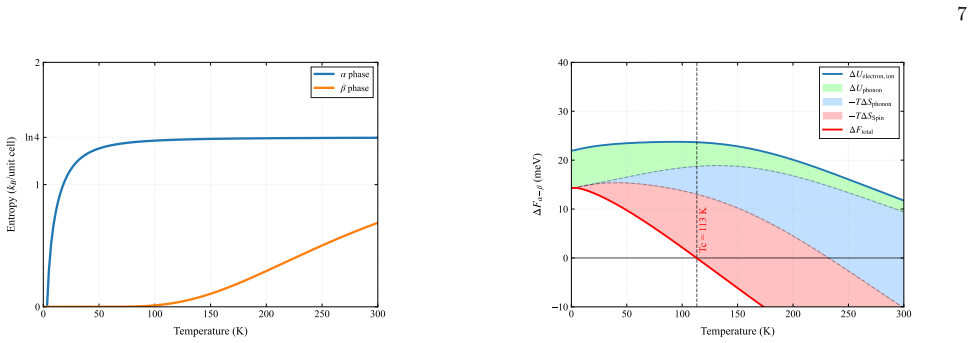
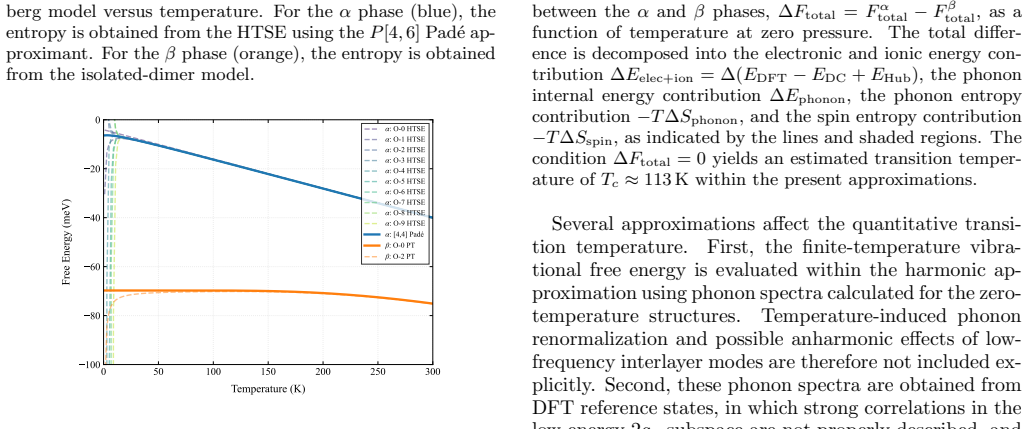
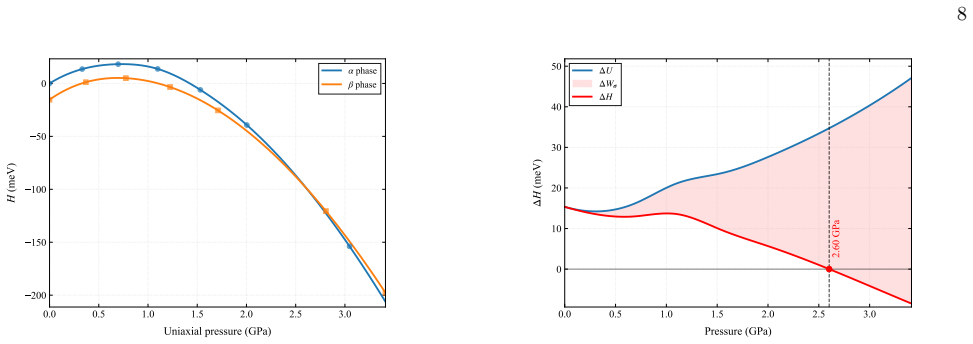
The transition is jointly driven by phonon and spin entropy: the α phase is stabilized by softer phonons and larger paramagnetic spin entropy, whereas the β phase is favored by interlayer dimerization, which hardens the phonons and quenches the spin entropy through singlet formation. Evaluating the pressure-dependent generalized enthalpy supplies a thermodynamic account for the suppression of the transition under c-axis uniaxial pressure.
What carries the argument
unified free-energy framework built from density functional theory phonon calculations and an extended Hubbard model for spin entropy, used to compare phase stability as a function of temperature and pressure
If this is right
- Softer phonon modes and larger paramagnetic spin entropy keep the α phase lower in free energy above the transition temperature.
- Interlayer dimerization hardens phonons and forms spin singlets, lowering the free energy of the β phase below the transition temperature.
- C-axis uniaxial pressure alters the enthalpy balance and thereby raises the stability range of the α phase.
- Stabilizing the α phase at low temperature under pressure opens a window to study its candidate quantum spin liquid regime.
Where Pith is reading between the lines
- The same free-energy construction could be applied to other cluster Mott insulators on triangular lattices to predict whether entropy competition produces analogous transitions.
- Magnetic-field dependence of the spin-entropy term offers a route to shift the transition temperature that the calculations leave unexamined.
- If the pressure suppression is general, uniaxial strain engineering may serve as a practical method to access quantum spin liquid candidates that are otherwise masked by structural transitions.
Load-bearing premise
The density functional theory calculations and extended Hubbard model supply quantitatively accurate phonon frequencies, spin entropies, and pressure-dependent enthalpies without dominant errors from functional choice or parameter selection.
What would settle it
Inelastic neutron scattering or Raman measurements that find phonon frequencies in the two phases differing substantially from the calculated values, or a specific-heat jump whose magnitude contradicts the predicted entropy difference, would falsify the entropy-driven mechanism.
Figures
read the original abstract
As a prototypical flat-band cluster Mott insulator on an effective triangular lattice, Nb$_3$Cl$_8$ is a potential candidate for hosting a quantum spin liquid (QSL) state. Nevertheless, a first-order structural phase transition around 90K transforms the high-temperature paramagnetic $\alpha$ phase into the low-temperature nonmagnetic $\beta$ phase, suppressing the candidate QSL regime of the $\alpha$ phase. To clarify the microscopic origin of this transition, we combine first-principles calculations with an extended Hubbard model to construct a unified free-energy framework. This framework reveals that the transition is jointly driven by phonon and spin entropy: the $\alpha$ phase is stabilized by softer phonons and larger paramagnetic spin entropy, whereas the $\beta$ phase is favored by interlayer dimerization, which hardens the phonons and quenches the spin entropy through singlet formation. Furthermore, by evaluating the pressure-dependent generalized enthalpy, we provide a thermodynamic explanation for the suppression of the transition under c-axis uniaxial pressure, where stabilizing the $\alpha$ phase may allow the candidate QSL regime of the $\alpha$ phase to be explored at low temperatures.
Editorial analysis
A structured set of objections, weighed in public.
Referee Report
Summary. The manuscript claims that the first-order structural phase transition in Nb₃Cl₈ around 90 K, from the high-temperature paramagnetic α phase to the low-temperature nonmagnetic β phase, is jointly driven by phonon and spin entropy within a unified free-energy framework constructed from DFT calculations and an extended Hubbard model. The α phase is stabilized by softer phonons and larger paramagnetic spin entropy, while the β phase is favored by interlayer dimerization that hardens phonons and quenches spin entropy via singlet formation; the framework also accounts for the suppression of the transition under c-axis uniaxial pressure.
Significance. If the computed entropy differences are quantitatively reliable, the work supplies a microscopic explanation for the suppression of the candidate quantum spin liquid regime in this flat-band cluster Mott insulator and identifies pressure as a control parameter for stabilizing the α phase, contributing to the broader understanding of entropy competition in such materials.
major comments (1)
- [free-energy framework and results sections] The central claim that phonon and spin entropy differences have the correct sign and sufficient magnitude to drive the transition (overcoming the interlayer dimerization enthalpy) depends on the quantitative accuracy of the DFT force constants and Hubbard-model spin entropies. No comparisons to experimental phonon frequencies, Raman spectra, or heat-capacity decompositions are reported to anchor these quantities or to test sensitivity to the exchange-correlation functional and Hubbard parameters.
Simulated Author's Rebuttal
We thank the referee for their thorough review and valuable feedback on our manuscript. We provide a point-by-point response to the major comment below.
read point-by-point responses
-
Referee: [free-energy framework and results sections] The central claim that phonon and spin entropy differences have the correct sign and sufficient magnitude to drive the transition (overcoming the interlayer dimerization enthalpy) depends on the quantitative accuracy of the DFT force constants and Hubbard-model spin entropies. No comparisons to experimental phonon frequencies, Raman spectra, or heat-capacity decompositions are reported to anchor these quantities or to test sensitivity to the exchange-correlation functional and Hubbard parameters.
Authors: The referee correctly notes that our manuscript does not include direct comparisons to experimental data on phonons or heat capacity, nor explicit tests of sensitivity to the functional and Hubbard parameters. This is a valid point regarding the quantitative reliability. We have performed additional calculations to assess the sensitivity to the Hubbard U value and different DFT functionals (PBE vs. PBEsol), finding that the qualitative conclusion—the sign of the entropy differences driving the transition—remains robust. We will incorporate these sensitivity analyses into the revised manuscript. However, detailed experimental phonon or Raman data for Nb₃Cl₈ appear to be lacking in the current literature, limiting direct validation at this time. We will add a note on this in the discussion section. revision: partial
- Provision of direct experimental comparisons for phonon frequencies, Raman spectra, or heat-capacity decompositions, due to the apparent absence of such detailed experimental reports in the literature.
Circularity Check
No circularity: free-energy comparison built from independent DFT phonons and Hubbard-model spin entropies
full rationale
The paper constructs its central claim by computing phonon frequencies and force constants via DFT, parametrizing an extended Hubbard model for magnetic degrees of freedom, then evaluating separate phonon and spin contributions to the free-energy difference between α and β phases. No equation or step is shown to define one quantity in terms of another derived from the same calculation, nor does any 'prediction' reduce to a fitted parameter that was already tuned to the target observable. The pressure-dependent enthalpy analysis likewise follows directly from the same first-principles inputs without self-referential closure. This is the standard, non-circular workflow for ab-initio thermodynamics.
Axiom & Free-Parameter Ledger
axioms (2)
- domain assumption Standard DFT functionals and the extended Hubbard model yield accurate phonon spectra and spin entropies for Nb3Cl8
- domain assumption Interlayer dimerization in the beta phase fully quenches spin entropy via singlet formation
Reference graph
Works this paper leans on
-
[1]
Imada, A
M. Imada, A. Fujimori, and Y. Tokura, Rev. Mod. Phys. 70, 1039 (1998)
1998
-
[2]
J. G. Bednorz and K. A. M¨ uller, Zeitschrift f¨ ur Physik B Condensed Matter64, 189 (1986)
1986
-
[3]
P. A. Lee, N. Nagaosa, and X.-G. Wen, Rev. Mod. Phys. 78, 17 (2006)
2006
-
[4]
Gr¨ uner, Rev
G. Gr¨ uner, Rev. Mod. Phys.60, 1129 (1988)
1988
-
[5]
Fazekas and E
P. Fazekas and E. Tosatti, Philosophical Magazine B39, 229 (1979)
1979
-
[6]
Rossnagel and N
K. Rossnagel and N. V. Smith, Phys. Rev. B73, 073106 (2006)
2006
-
[7]
Y. D. Wang, W. L. Yao, Z. M. Xin, T. T. Han, Z. G. Wang, L. Chen, C. Cai, Y. Li, and Y. Zhang, Nature Communications11, 4215 (2020)
2020
-
[8]
C. M. Pasco, I. El Baggari, E. Bianco, L. F. Kourkoutis, and T. M. McQueen, ACS Nano13, 9457 (2019), pMID: 31310516
2019
-
[9]
S. Gao, S. Zhang, C. Wang, S. Yan, X. Han, X. Ji, W. Tao, J. Liu, T. Wang, S. Yuan, G. Qu, Z. Chen, Y. Zhang, J. Huang, M. Pan, S. Peng, Y. Hu, H. Li, Y. Huang, H. Zhou, S. Meng, L. Yang, Z. Wang, Y. Yao, Z. Chen, M. Shi, H. Ding, H. Yang, K. Jiang, Y. Li, H. Lei, Y. Shi, H. Weng, and T. Qian, Phys. Rev. X13, 041049 (2023)
2023
-
[10]
Grytsiuk, M
S. Grytsiuk, M. I. Katsnelson, E. G. C. P. van Loon, and M. R¨ osner, npj Quantum Materials9, 8 (2024)
2024
-
[11]
H. Liu, W. Li, Z. Zhou, H. Qu, J. Zhang, W. Hu, C. Wen, N. Wang, H. Deng, G. Li, and S. Yan, Phys. Rev. Lett. 135, 076503 (2025)
2025
-
[12]
Q. Yang, M. Wu, J. Duan, Z. Ma, L. Li, Z. Huo, Z. Zhang, K. Watanabe, T. Taniguchi, X. Zhao, Y. Chen, Y. Shi, W. Jiang, K. Liu, and X. Lu, National Science Review 12, nwaf464 (2025)
2025
-
[13]
J. P. Sheckelton, K. W. Plumb, B. A. Trump, C. L. Bro- holm, and T. M. McQueen, Inorg. Chem. Front.4, 481 (2017)
2017
-
[14]
Haraguchi, C
Y. Haraguchi, C. Michioka, M. Ishikawa, Y. Nakano, H. Yamochi, H. Ueda, and K. Yoshimura, Inorganic Chemistry56, 3483 (2017), pMID: 28240540
2017
-
[15]
Z. Sun, H. Zhou, C. Wang, S. Kumar, D. Geng, S. Yue, X. Han, Y. Haraguchi, K. Shimada, P. Cheng, L. Chen, Y. Shi, K. Wu, S. Meng, and B. Feng, Nano Letters22, 4596 (2022)
2022
-
[16]
Y. Z. Zhou, X. Han, J. Luo, D. T. Wu, A. F. Fang, B. Shen, B. J. Feng, Y. G. Shi, J. Yang, and R. Zhou, Chin. Phys. Lett.42, 037303 (2025)
2025
-
[17]
J. Yoon, E. Lesne, K. Sklarek, J. Sheckelton, C. Pasco, S. S. P. Parkin, T. M. McQueen, and M. N. Ali, Journal of Physics: Condensed Matter32, 304004 (2020)
2020
-
[18]
Z. Su, J. Mi, S. Yan, J. Li, S. Xue, Z. Tao, E. Wang, X. Shi, H. Lei, Z. Xu, J. Guo, and X. Zhu, Phys. Rev. Lett.136, 106502 (2026)
2026
-
[19]
X. Huang, Y. Zhang, J. Huang, Z. Ma, C. Zhu, Y. Gao, S. Yang, B. Feng, Y. Shi, H. Weng, T. Yang, and Y. Ye, Newton 10.1016/j.newton.2025.100292 (2025)
- [20]
-
[21]
B. Liu, Y. Zhang, X. Han, J. Sun, H. Zhou, C. Li, J. Cheng, S. Yan, H. Lei, Y. Shi, H. Yang, and S. Li, Journal of Physics: Condensed Matter36, 155602 (2024)
2024
-
[22]
L. Yang, D. Wu, X. Han, J. Luo, B. Liu, X. Ma, H. Luo, J. Yang, B. Shen, R. Stewart, D. Adroja, Y. Shi, R. Zhou, and S. Li, Chinese Physics B34, 057501 (2025)
2025
-
[23]
J. D. Budai, J. Hong, M. E. Manley, E. D. Specht, C. W. Li, J. Z. Tischler, D. L. Abernathy, A. H. Said, B. M. Leu, L. A. Boatner, R. J. McQueeney, and O. Delaire, Nature515, 535 (2014)
2014
-
[24]
Souvatzis, O
P. Souvatzis, O. Eriksson, M. I. Katsnelson, and S. P. Rudin, Phys. Rev. Lett.100, 095901 (2008)
2008
-
[25]
M. P. Belov, A. B. Syzdykova, and I. A. Abrikosov, Phys. Rev. B101, 134303 (2020)
2020
-
[26]
J. Du, O. Malyi, S.-L. Shang, Y. Wang, X.-G. Zhao, F. Liu, A. Zunger, and Z.-K. Liu, Materials Today Physics27, 100805 (2022)
2022
-
[27]
Haule and T
K. Haule and T. Birol, Phys. Rev. Lett.115, 256402 (2015)
2015
-
[28]
Kresse and J
G. Kresse and J. Furthm¨ uller, Phys. Rev. B54, 11169 (1996)
1996
-
[29]
Kresse and D
G. Kresse and D. Joubert, Phys. Rev. B59, 1758 (1999)
1999
-
[30]
A. Togo, L. Chaput, T. Tadano, and I. Tanaka, J. Phys. Condens. Matter35, 353001 (2023)
2023
-
[31]
A. Togo, J. Phys. Soc. Jpn.92, 012001 (2023)
2023
-
[32]
A. A. Mostofi, J. R. Yates, Y.-S. Lee, I. Souza, D. Vander- bilt, and N. Marzari, Computer Physics Communications 178, 685 (2008)
2008
-
[33]
Aryasetiawan, M
F. Aryasetiawan, M. Imada, A. Georges, G. Kotliar, S. Biermann, and A. I. Lichtenstein, Phys. Rev. B70, 195104 (2004)
2004
-
[34]
Aretz, S
J. Aretz, S. Grytsiuk, X. Liu, G. Feraco, C. Knekna, M. Waseem, Z. Dan, M. Bianchi, P. Hofmann, M. N. Ali, M. I. Katsnelson, A. Grubiˇ si´ c-ˇCabo, H. U. R. Strand, E. G. C. P. van Loon, and M. R¨ osner, Phys. Rev. X15, 041042 (2025)
2025
-
[35]
Pierre, B
L. Pierre, B. Bernu, and L. Messio, SciPost Phys.17, 105 (2024)
2024
-
[36]
L. D. Landau and E. M. Lifshitz,Theory of Elasticity, 3rd ed., Course of Theoretical Physics, Vol. 7 (Butterworth- Heinemann, Oxford, 1986) translated from the Russian by J. B. Sykes and W. H. Reid
1986
-
[37]
K. Li, X. Han, H. Li, H. Mei, M. Tan, B. Lu, X. Li, W. Sang, X. Wang, A. Zhang, J. Ji, Y. Shi, F. Jin, and Q. Zhang, Phys. Rev. B112, 214116 (2025)
2025
-
[38]
D. A. Jeff, F. Gonzalez, K. Harrison, Y. Zhao, T. Fer- nando, S. Regmi, Z. Liu, H. R. Gutierrez, M. Neupane, J. Yang, J.-H. Chu, X. Xu, T. Cao, and S. I. Khondaker, 2D Materials10, 045030 (2023)
2023
-
[39]
J. Kim, Y. Lee, Y. W. Choi, T. S. Jung, S. Son, J. Kim, H. J. Choi, J.-G. Park, and J. H. Kim, ACS Omega8, 14190 (2023)
2023
-
[40]
Guan, X.-J
S.-H. Guan, X.-J. Zhang, and Z.-P. Liu, Journal of the American Chemical Society137, 8010 (2015), pMID: 26075311
2015
-
[41]
D. c. v. Plaˇ sienka, R. Martoˇ n´ ak, and M. C. Newton, Phys. Rev. B96, 054111 (2017). Supplemental Material for Entropy-Driven Structural Phase Transition in Nb 3Cl8 via DFT and an Effective Model Chenjie Zhu,1 Shuai Zhang,2 Zhong Fang,1 Zhijun Wang,1 Quansheng Wu,1 and Hongming Weng1,∗ 1Beijing National Laboratory for Condensed Matter Physics and Insti...
2017
-
[42]
A note on the quantum-mechanical perturbation theory.The Journal of Chemical Physics, 19(11):1396– 1401, 11 1951
Per-Olov L¨ owdin. A note on the quantum-mechanical perturbation theory.The Journal of Chemical Physics, 19(11):1396– 1401, 11 1951
1951
-
[43]
On the exponential solution of differential equations for a linear operator.Communications on Pure and Applied Mathematics, 7(4):649–673, 1954
Wilhelm Magnus. On the exponential solution of differential equations for a linear operator.Communications on Pure and Applied Mathematics, 7(4):649–673, 1954
1954
-
[44]
High temperature series expansions of S = 1/2 Heisenberg spin models: Algorithm to include the magnetic field with optimized complexity.SciPost Phys., 17:105, 2024
Laurent Pierre, Bernard Bernu, and Laura Messio. High temperature series expansions of S = 1/2 Heisenberg spin models: Algorithm to include the magnetic field with optimized complexity.SciPost Phys., 17:105, 2024
2024
discussion (0)
Sign in with ORCID, Apple, or X to comment. Anyone can read and Pith papers without signing in.