Low-regularity a priori estimates, blow-up criterion, and self-intersection singularities for free-boundary ideal magnetohydrodynamics with surface tension
Pith reviewed 2026-07-02 09:12 UTC · model grok-4.3
The pith
H^3 a priori estimates hold for free-boundary ideal MHD with surface tension in general bounded domains.
A machine-rendered reading of the paper's core claim, the machinery that carries it, and where it could break.
Core claim
The authors prove that H^3 a priori estimates hold for the incompressible free-boundary ideal MHD system with surface tension in general domains. The Lorentz force is controlled in the elliptic pressure equation at this regularity by the frozen-in property of the magnetic field together with the tangential boundary constraint. From these estimates they obtain a blow-up criterion that separates four distinct mechanisms, including an intrinsic magnetic asymmetry that requires extra control on ||∇² h||_L². They also exhibit regular initial data that develop finite-time boundary self-intersection while Sobolev regularity and curvature remain controlled up to the contact time.
What carries the argument
Elliptic pressure estimates that control the Lorentz-force term at H^3 regularity via the frozen-in magnetic field and the tangential boundary constraint.
If this is right
- The local well-posedness threshold for the free-boundary problem drops to H^3 regularity.
- Finite-time blow-up can occur solely through topological self-intersection while all Sobolev norms and curvature remain finite.
- Surface tension combined with ideal MHD coupling does not rule out boundary self-intersection.
- The blow-up criterion must track an additional L² norm of second derivatives of the magnetic field that has no direct velocity counterpart.
Where Pith is reading between the lines
- Similar low-regularity pressure estimates might apply to other free-boundary MHD models or to resistive MHD variants.
- Self-intersection singularities could be tested numerically by tracking the evolution of the magnetic field under the frozen-in constraint.
- The separation between topological and analytic blow-up may extend to related free-boundary problems in ideal fluids without surface tension.
- The magnetic asymmetry in the criterion suggests that velocity and magnetic field may play non-symmetric roles in controlling boundary topology.
Load-bearing premise
The Lorentz force contribution to the pressure estimates can be controlled at H^3 regularity using only the frozen-in property of the magnetic field and the tangential boundary constraint.
What would settle it
An explicit solution or high-resolution simulation in which boundary self-intersection occurs at finite time but ||∇² h||_L² blows up at the same instant would falsify the claim that self-intersection can be isolated from the extra magnetic term in the blow-up criterion.
Figures


read the original abstract
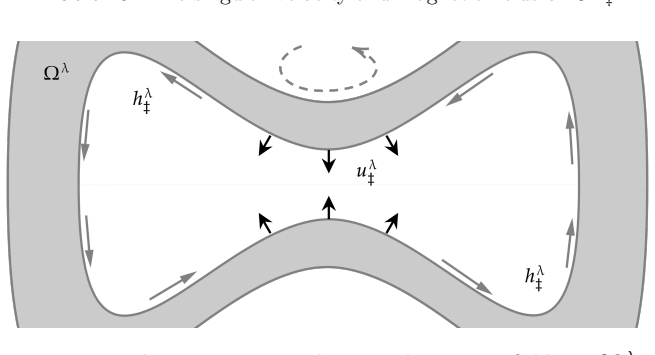
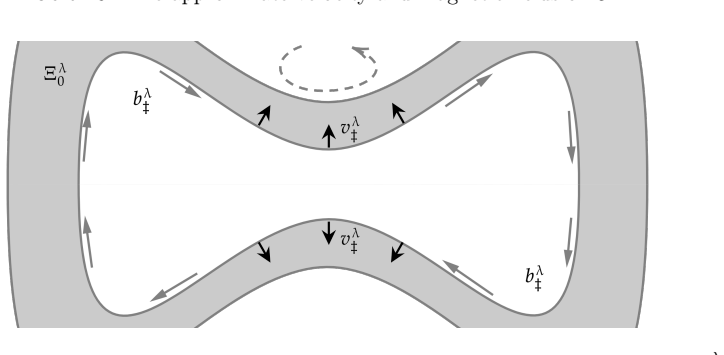
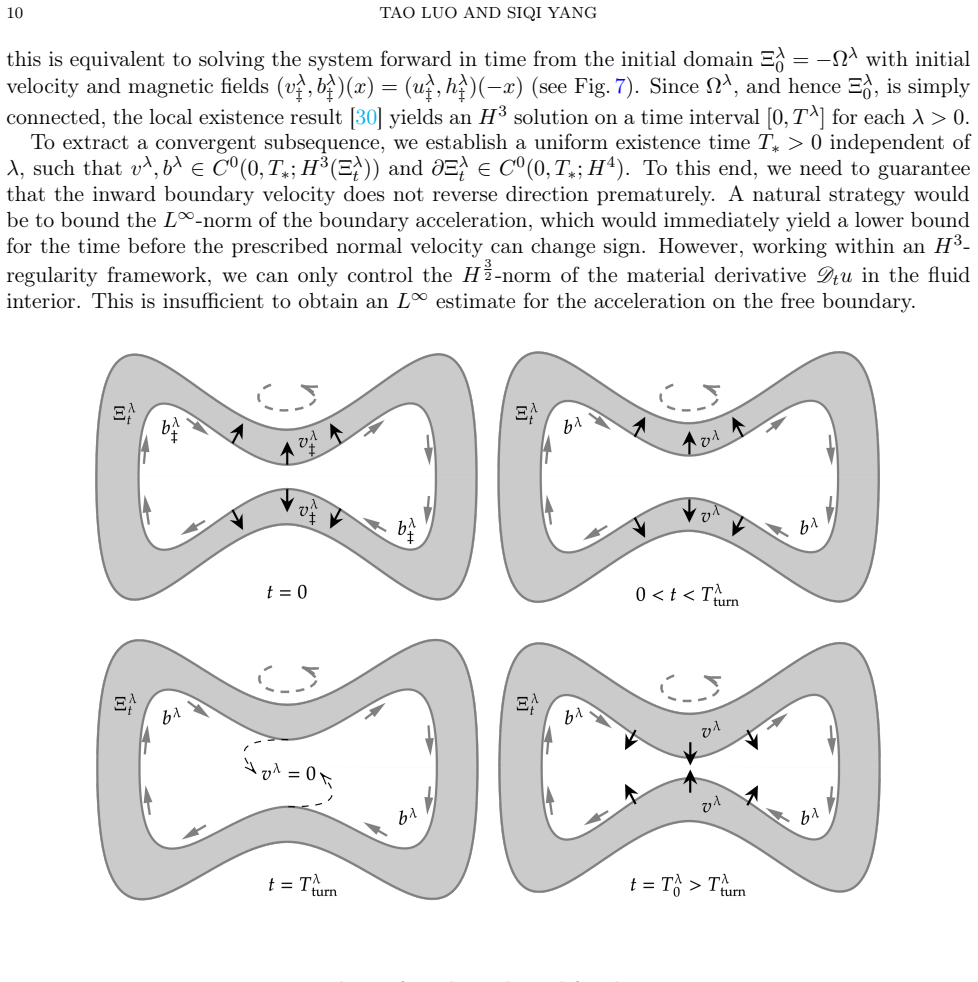
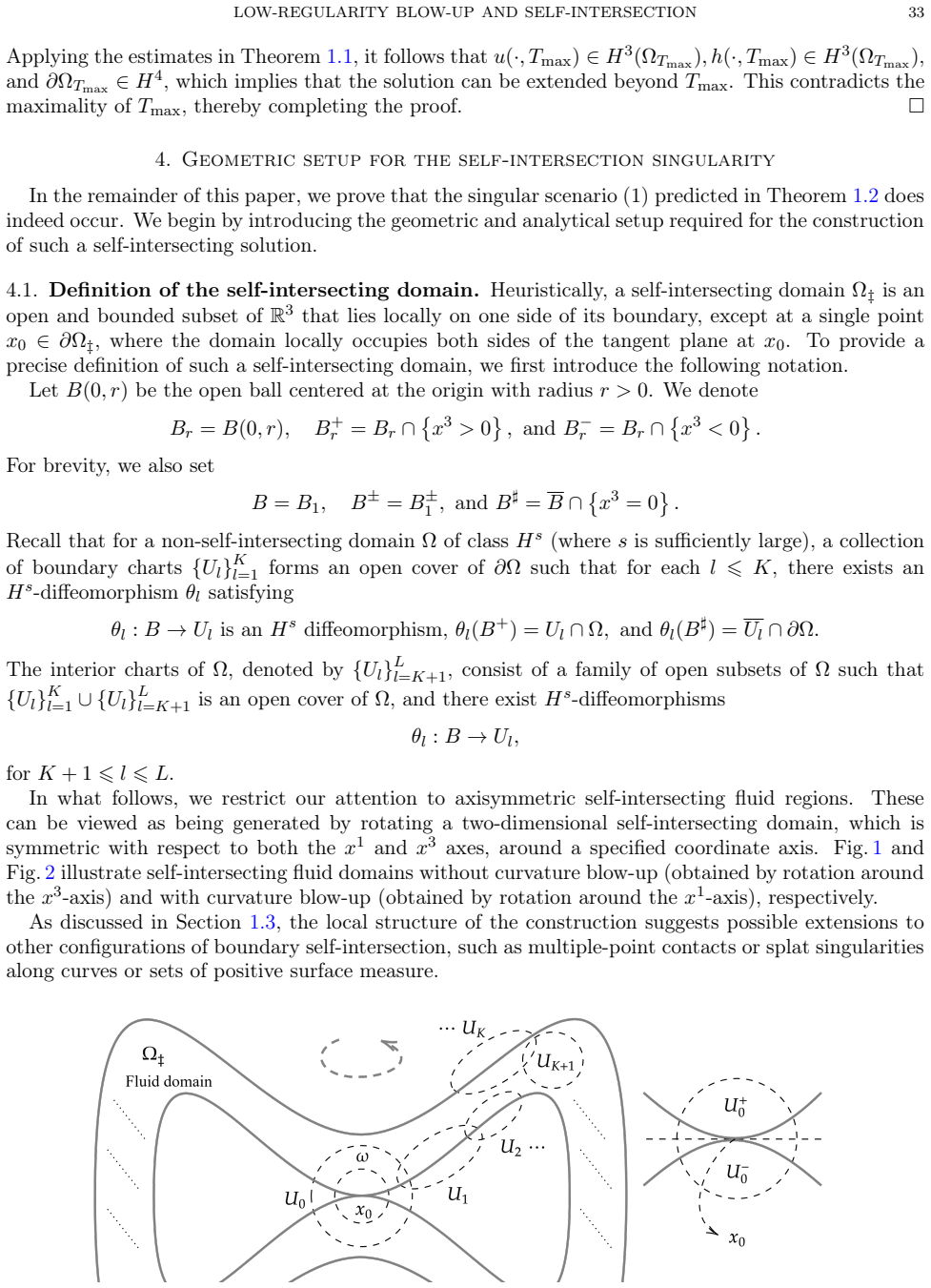
We study the three-dimensional incompressible free-boundary ideal magnetohydrodynamic (MHD) equations with surface tension and a closed free surface. Our first result establishes $H^3$ a priori estimates in general bounded domains, without graph structure, periodicity, or simple connectedness; in particular, for surface-tension ideal MHD in general domains this lowers the previously available threshold from $H^6$. Compared with the free-boundary problem for incompressible Euler equations, the feature is that the Lorentz force enters the elliptic pressure estimates, and the frozen-in magnetic field must preserve the tangential boundary constraint. Using these estimates, we prove a refined finite-time blow-up criterion for $H^3$ solutions that separates topological self-intersection, loss of boundary regularity, blow-up of the normal velocity, and interior MHD blow-up. The interior condition has an intrinsic magnetic-field asymmetry: besides $\|\nabla u\|_{L^\infty}$ and $\|\nabla h\|_{L^\infty}$, with $u$ and $h$ denoting the velocity and magnetic field, respectively, it requires the additional control of $\|\nabla^2 h\|_{L^2}$, a quantity arising from the Lorentz-force contribution to the pressure estimates and having no velocity analogue. Finally, we construct regular initial data whose solutions develop finite-time boundary self-intersection while the Sobolev regularity and curvature remain controlled up to the contact time. Thus, neither surface tension nor the ideal magnetic coupling precludes topological self-intersection of the free boundary.
Editorial analysis
A structured set of objections, weighed in public.
Referee Report
Summary. The paper establishes H^3 a priori estimates for the 3D incompressible free-boundary ideal MHD equations with surface tension on a closed free surface in general bounded domains (no graph structure or periodicity required). It derives a refined finite-time blow-up criterion separating topological self-intersection, loss of boundary regularity, normal velocity blow-up, and interior MHD blow-up (with an asymmetric interior condition involving ||∇²h||_L²), and constructs regular initial data whose solutions develop finite-time boundary self-intersection while Sobolev regularity and curvature remain controlled.
Significance. If the central estimates close, the work meaningfully lowers the regularity threshold for a priori bounds in free-boundary ideal MHD from the prior H^6 level and isolates the precise role of the Lorentz force in the pressure estimates. The self-intersection construction provides a concrete example that neither surface tension nor ideal magnetic coupling prevents topological singularities, while the asymmetric blow-up criterion highlights a structural difference from the pure Euler case.
major comments (2)
- [§4] §4 (elliptic pressure estimates): the claim that the Lorentz force term (roughly (curl h)×h) can be controlled in the H^3 pressure gradient recovery without derivative loss relies on boundary commutators and integration-by-parts identities involving the second fundamental form. These must be shown to close using only the frozen-in transport of h and the tangential constraint h·n=0; any unaccounted trace loss would force the estimate to H^4 or higher, undermining the H^3 threshold reduction.
- [§5] §5 (blow-up criterion): the interior condition requires separate control of ||∇²h||_L² in addition to ||∇u||_L^∞ and ||∇h||_L^∞. It is unclear whether this term is independent or can be absorbed into the other quantities via the a priori estimates; if independent, the criterion's sharpness relative to the Euler case needs explicit justification.
minor comments (2)
- The introduction would benefit from a brief comparison table of regularity thresholds across related free-boundary problems (Euler, MHD, with/without surface tension) to highlight the improvement.
- Notation for the magnetic field h and the precise statement of the tangential boundary constraint should be repeated in the statement of the main theorem for clarity.
Simulated Author's Rebuttal
We thank the referee for the careful reading and constructive feedback. We address the two major comments point by point below, providing clarifications based on the existing arguments in the manuscript.
read point-by-point responses
-
Referee: [§4] §4 (elliptic pressure estimates): the claim that the Lorentz force term (roughly (curl h)×h) can be controlled in the H^3 pressure gradient recovery without derivative loss relies on boundary commutators and integration-by-parts identities involving the second fundamental form. These must be shown to close using only the frozen-in transport of h and the tangential constraint h·n=0; any unaccounted trace loss would force the estimate to H^4 or higher, undermining the H^3 threshold reduction.
Authors: In §4 the Lorentz force is treated as a forcing term in the elliptic pressure equation. The boundary commutators and integration-by-parts identities that involve the second fundamental form are controlled at H^3 regularity by exploiting the frozen-in transport equation for h together with the pointwise constraint h·n=0. These identities are expanded explicitly in the proof of Proposition 4.2 and the subsequent pressure-gradient estimates; the transport structure converts any apparent trace loss into lower-order terms already bounded by the a priori H^3 assumptions on u and h. Consequently the estimates close without requiring an extra derivative, preserving the H^3 threshold. revision: no
-
Referee: [§5] §5 (blow-up criterion): the interior condition requires separate control of ||∇²h||_L² in addition to ||∇u||_L^∞ and ||∇h||_L^∞. It is unclear whether this term is independent or can be absorbed into the other quantities via the a priori estimates; if independent, the criterion's sharpness relative to the Euler case needs explicit justification.
Authors: The quantity ||∇²h||_L² appears independently because it originates from the Lorentz-force contribution inside the pressure estimates and has no velocity counterpart. It cannot be absorbed into ||∇u||_L^∞ or ||∇h||_L^∞ by the a priori bounds, as the magnetic transport equation lacks the divergence-free structure that would allow such absorption. The resulting asymmetry is therefore intrinsic to the MHD system. When h≡0 the extra term vanishes and the criterion reduces to the standard Euler form; the self-intersection construction of §6 shows that the magnetic term is necessary for the general case. A short clarifying paragraph will be added to the introduction and to the statement of the blow-up criterion. revision: partial
Circularity Check
No circularity: direct elliptic and transport estimates in general domains
full rationale
The paper derives H^3 a priori estimates for the free-boundary ideal MHD system via standard elliptic pressure recovery and the frozen-in transport of the magnetic field, which preserves the tangential constraint h·n=0. These steps rely on the intrinsic structure of the incompressible MHD equations and boundary conditions rather than any fitted parameters, self-referential predictions, or load-bearing self-citations. The claimed reduction from H^6 to H^3 is presented as a consequence of controlling Lorentz-force commutators at the stated regularity using only the given transport properties, without reducing the result to its own inputs by definition. No renaming of known results or ansatz smuggling occurs in the provided derivation outline.
Axiom & Free-Parameter Ledger
axioms (2)
- standard math Standard Sobolev embeddings and elliptic regularity estimates for the pressure in bounded domains with smooth boundary
- domain assumption The magnetic field is frozen into the fluid and preserves the tangential boundary constraint under the flow
Reference graph
Works this paper leans on
-
[1]
Castro, A., Córdoba, D., Fefferman, C., Gancedo, F., Gómez-Serrano, J.: Finite time singularities for water waves with surface tension. J. Math. Phys.53(11) 115622, 26 (2012). doi:10.1063/1.4765339
-
[2]
Castro, A., Córdoba, D., Fefferman, C., Gancedo, F., Gómez-Serrano, J.: Finite time singularities for the free boundary incompressible Euler equations. Ann. of Math. (2)178(3) 1061–1134 (2013). doi:10.4007/annals.2013. 178.3.6
-
[3]
Cheng, C.H.A., Coutand, D., Shkoller, S.: On the motion of vortex sheets with surface tension in three-dimensional Euler equations with vorticity. Comm. Pure Appl. Math.61(12) 1715–1752 (2008). doi:10.1002/cpa.20240
-
[4]
Córdoba, D., Enciso, A., Grubic, N.: Self-intersecting interfaces for stationary solutions of the two-fluid Euler equations. Ann. PDE7(1) Paper No. 12, 40 (2021). doi:10.1007/s40818-021-00101-6
-
[5]
Preprint, arXiv:2512.02144 (2025)
Córdoba, D., Enciso, A., Hernandez, M.: Splash-squeeze singularities and analytic breakdown in ideal incompressible MHD. Preprint, arXiv:2512.02144 (2025). doi:10.48550/arXiv.2512.02144
-
[6]
Coutand, D.: Finite-timesingularityformationforincompressibleEulermovinginterfacesintheplane.Arch.Ration. Mech. Anal.232(1) 337–387 (2019). doi:10.1007/s00205-018-1322-5
-
[7]
Coutand, D., Lindblad, H., Shkoller, S.: A priori estimates for the free-boundary 3D compressible Euler equations in physical vacuum. Comm. Math. Phys.296(2) 559–587 (2010). doi:10.1007/s00220-010-1028-5
-
[8]
Coutand, D., Shkoller, S.: On the finite-time splash and splat singularities for the 3-D free-surface Euler equations. Comm. Math. Phys.325(1) 143–183 (2014). doi:10.1007/s00220-013-1855-2
-
[9]
Dacorogna, B., Moser, J.: On a partial differential equation involving the Jacobian determinant. Ann. Inst. H. Poincaré C Anal. Non Linéaire7(1) 1–26 (1990). doi:10.1016/S0294-1449(16)30307-9
-
[10]
Disconzi, M.M., Ebin, D.G.: On the limit of large surface tension for a fluid motion with free boundary. Comm. Partial Differential Equations39(4) 740–779 (2014). doi:10.1080/03605302.2013.865058
-
[11]
Fefferman, C., Ionescu, A.D., Lie, V.: On the absence of splash singularities in the case of two-fluid interfaces. Duke Math. J.165(3) 417–462 (2016). doi:10.1215/00127094-3166629
-
[12]
Fu, J., Hao, C., Yang, S., Zhang, W.: A Beale-Kato-Majda criterion for free boundary incompressible ideal magne- tohydrodynamics. J. Math. Phys.64(9) Paper No. 091505, 16 (2023). doi:10.1063/5.0167954
-
[13]
Ginsberg, D.: On the breakdown of solutions to the incompressible Euler equations with free surface boundary. SIAM J. Math. Anal.53(3) 3366–3384 (2021). doi:10.1137/20M1360384
-
[14]
Nonlinearity35(12) 6349–6398 (2022)
Gu, X., Luo, C., Zhang, J.: Zero surface tension limit of the free-boundary problem in incompressible magnetohy- drodynamics. Nonlinearity35(12) 6349–6398 (2022)
2022
-
[15]
Gu, X., Luo, C., Zhang, J.: Local well-posedness of the free-boundary incompressible magnetohydrodynamics with surface tension. J. Math. Pures Appl. (9)18231–115 (2024). doi:10.1016/j.matpur.2023.12.009
-
[16]
Gu, X., Wang, Y.: On the construction of solutions to the free-surface incompressible ideal magnetohydrodynamic equations. J. Math. Pures Appl. (9)1281–41 (2019). doi:10.1016/j.matpur.2019.06.004
-
[17]
Hamilton, R.S.: Three-manifolds with positive Ricci curvature. J. Differential Geometry17(2) 255–306 (1982)
1982
-
[18]
Hao, C.: On the motion of free interface in ideal incompressible MHD. Arch. Ration. Mech. Anal.224(2) 515–553 (2017). doi:10.1007/s00205-017-1082-7
-
[19]
Hao, C., Luo, T.: A priori estimates for free boundary problem of incompressible inviscid magnetohydrodynamic flows. Arch. Ration. Mech. Anal.212(3) 805–847 (2014). doi:10.1007/s00205-013-0718-5
-
[20]
Hao, C., Luo, T.: Ill-posedness of free boundary problem of the incompressible ideal MHD. Comm. Math. Phys. 376(1) 259–286 (2020). doi:10.1007/s00220-019-03614-1
-
[21]
Preprint, arXiv:2507.10032 (2025)
Hao, C., Luo, T., Yang, S.: Classification of finite-time blow-up of strong solutions to the incompressible free boundary Euler equations with surface tension. Preprint, arXiv:2507.10032 (2025). doi:10.48550/arXiv.2507.10032
-
[22]
Hao, C., Yang, S.: Splash singularity for the free boundary incompressible viscous MHD. J. Differential Equations 37926–103 (2024). doi:10.1016/j.jde.2023.10.001
-
[23]
Hao, C., Yang, S.:A prioriestimates and a blow-up criterion for the incompressible ideal MHD equations with surfacetensionandaclosedfreesurface.Nonlinearity38(7)PaperNo.075009(2025).doi:10.1088/1361-6544/addd5a
-
[24]
Hong, G., Luo, T., Zhao, Z.: On the splash singularity for the free-boundary problem of the viscous and non- resistive incompressible magnetohydrodynamic equations in 3D. J. Differential Equations41940–80 (2025). doi: 10.1016/j.jde.2024.11.026 48 TAO LUO AND SIQI YANG
-
[25]
Preprint, arXiv:2412.15625 (2024)
Ifrim, M., Pineau, B., Tataru, D., Taylor, M.A.: Sharp well-posedness for the free boundary MHD equations. Preprint, arXiv:2412.15625 (2024). doi:10.48550/arXiv.2412.15625
-
[26]
Ifrim, M., Pineau, B., Tataru, D., Taylor, M.A.: Sharp Hadamard local well-posedness, enhanced uniqueness and pointwise continuation criterion for the incompressible free boundary Euler equations. Ann. PDE11(1) Paper No. 16 (2025). doi:10.1007/s40818-025-00204-4
-
[27]
Julin, V., La Manna, D.A.: A priori estimates for the motion of charged liquid drop: a dynamic approach via free boundary Euler equations. J. Math. Fluid Mech.26(3) Paper No. 48, 83 (2024). doi:10.1007/s00021-024-00883-2
-
[28]
Liu, S., Luo, T.: On the 2D plasma-vacuum interface problems for ideal incompressible MHD. J. Differential Equations453Paper No. 113886, 65 (2026). doi:10.1016/j.jde.2025.113886
-
[29]
Liu, S., Xin, Z.: Local well-posedness of the incompressible current-vortex sheet problems. Adv. Math.475Paper No. 110339, 90 (2025). doi:10.1016/j.aim.2025.110339
-
[30]
Liu, S., Xin, Z.: On the free boundary problems for the ideal incompressible MHD equations. Calc. Var. Partial Differential Equations64(3) Paper No. 82 (2025). doi:10.1007/s00526-025-02941-7
-
[31]
Nonlinearity33(4) 1499–1527 (2020)
Luo, C., Zhang, J.: A regularity result for the incompressible magnetohydrodynamics equations with free surface boundary. Nonlinearity33(4) 1499–1527 (2020). doi:10.1088/1361-6544/ab60d9
-
[32]
Luo, C., Zhang, J.: A priori estimates for the incompressible free-boundary magnetohydrodynamics equations with surface tension. SIAM J. Math. Anal.53(2) 2595–2630 (2021). doi:10.1137/19M1283938
-
[33]
Luo, C., Zhou, K.: A generalized Beale-Kato-Majda breakdown criterion for the free-boundary problem in Euler equations with surface tension. SIAM J. Math. Anal.56(1) 374–411 (2024). doi:10.1137/23M1563761
-
[34]
Mantegazza, C.: Smooth geometric evolutions of hypersurfaces. Geom. Funct. Anal.12(1) 138–182 (2002). doi: 10.1007/s00039-002-8241-0
-
[35]
Morando, A., Trakhinin, Y., Trebeschi, P.: Well-posedness of the linearized plasma-vacuum interface problem in ideal incompressible MHD. Quart. Appl. Math.72(3) 549–587 (2014). doi:10.1090/S0033-569X-2014-01346-7
-
[36]
Shatah, J., Zeng, C.: Geometry and a priori estimates for free boundary problems of the Euler equation. Comm. Pure Appl. Math.61(5) 698–744 (2008). doi:10.1002/cpa.20213
-
[37]
Shatah, J., Zeng, C.: Local well-posedness for fluid interface problems. Arch. Ration. Mech. Anal.199(2) 653–705 (2011). doi:10.1007/s00205-010-0335-5
-
[38]
Sun, Y., Wang, W., Zhang, Z.: Nonlinear stability of the current-vortex sheet to the incompressible MHD equations. Comm. Pure Appl. Math.71(2) 356–403 (2018). doi:10.1002/cpa.21710
-
[39]
Sun, Y., Wang, W., Zhang, Z.: Well-posedness of the plasma-vacuum interface problem for ideal incompressible MHD. Arch. Ration. Mech. Anal.234(1) 81–113 (2019). doi:10.1007/s00205-019-01386-5
-
[40]
Wang, C., Zhang, Z., Zhao, W., Zheng, Y.: Local well-posedness and break-down criterion of the incompressible Euler equations with free boundary. Mem. Amer. Math. Soc.270(1318) v + 119 (2021). doi:10.1090/memo/1318
-
[41]
Wang, Y.: Sharp nonlinear stability criterion of viscous non-resistive MHD internal waves in 3D. Arch. Ration. Mech. Anal.231(3) 1675–1743 (2019). doi:10.1007/s00205-018-1307-4
-
[42]
Wang, Y., Xin, Z.: Global well-posedness of free interface problems for the incompressible inviscid resistive MHD. Comm. Math. Phys.388(3) 1323–1401 (2021). doi:10.1007/s00220-021-04235-3
-
[43]
Zhao, W.: Local well-posedness of the plasma-vacuum interface problem for the ideal incompressible MHD. J. Differential Equations381151–184 (2024). doi:10.1016/j.jde.2023.11.004 Tao Luo Department of Mathematics, City University of Hong Kong, Hong Kong, China Siqi Yang School of Mathematics, Statistics and Mechanics, Beijing University of Technology, Beij...
discussion (0)
Sign in with ORCID, Apple, or X to comment. Anyone can read and Pith papers without signing in.