Tensor Network Solvers for Ultra-large Tight-binding Hamiltonians: Algorithms and Applications
Pith reviewed 2026-07-02 05:34 UTC · model grok-4.3
The pith
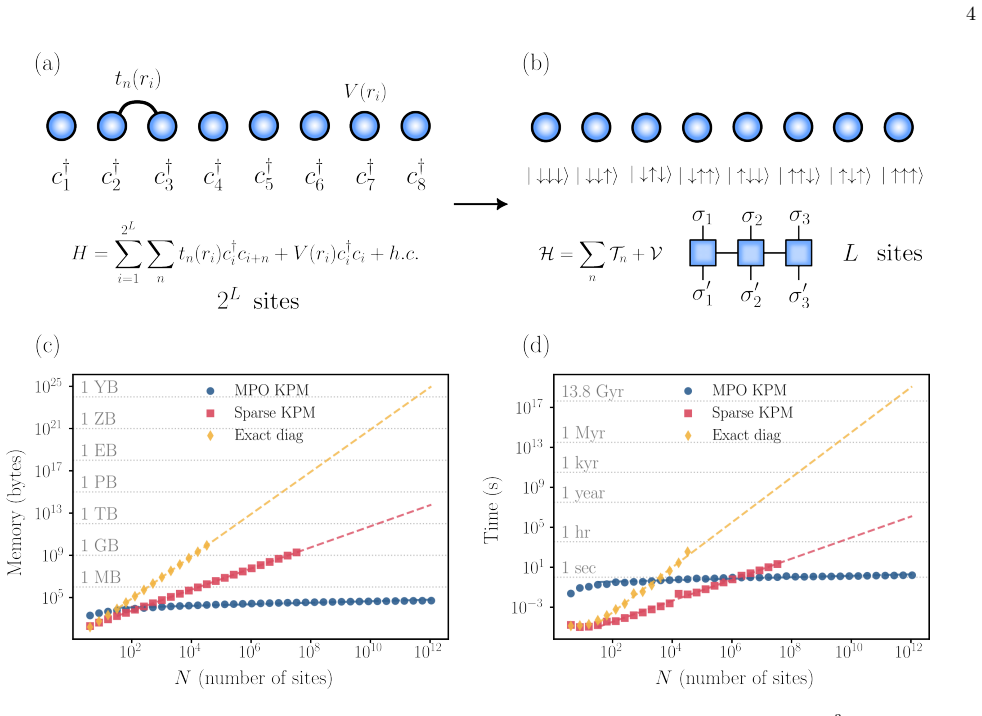
A tensor-network method maps tight-binding systems of 2^L sites to L pseudospins and solves them with bond dimensions of order tens independent of system size.
A machine-rendered reading of the paper's core claim, the machinery that carries it, and where it could break.
Core claim
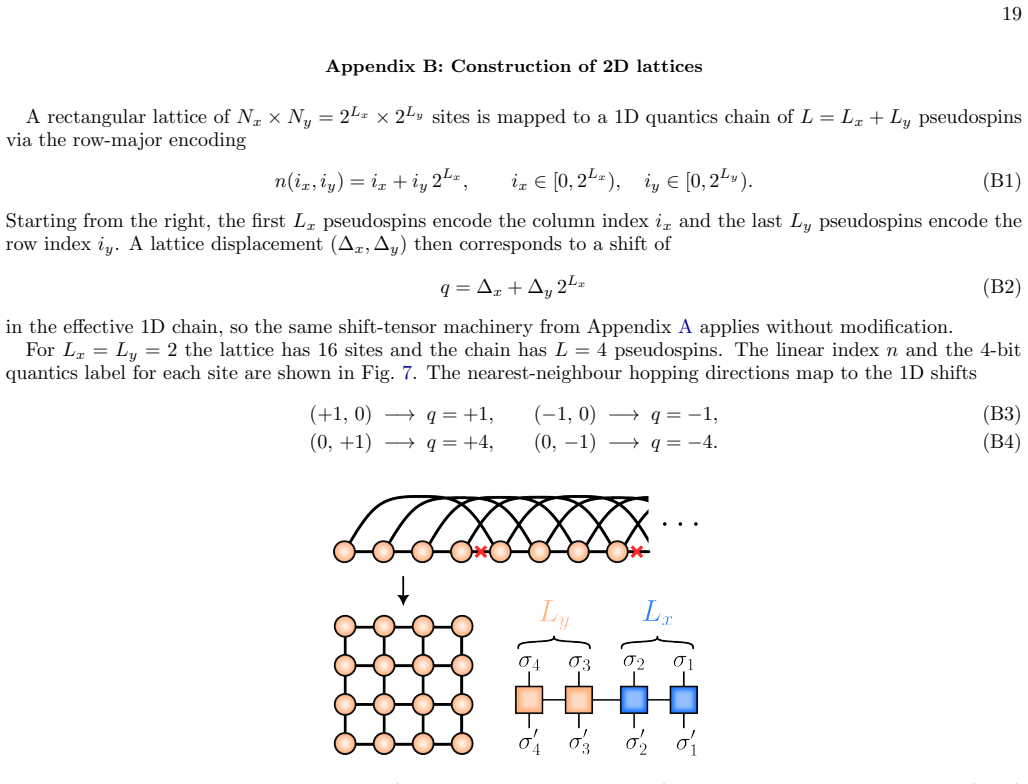
By mapping a tight-binding Hamiltonian on N equals 2 to the L sites onto a many-body problem of L pseudospins and solving the latter with tensor-network algorithms, the method yields accurate solutions for systems with billions of sites. For Hamiltonians with compressible real-space structure the bond dimension remains of order a few tens and independent of N. Hopping functions are constructed with quantics tensor cross interpolation, and every physical observable is evaluated entirely within tensor-network algebra without ever storing or diagonalizing an explicit matrix.
What carries the argument
The mapping of the N-site tight-binding problem to an L-site pseudospin many-body problem solved by tensor networks, together with quantics tensor cross interpolation to build representations of arbitrary hopping functions.
If this is right
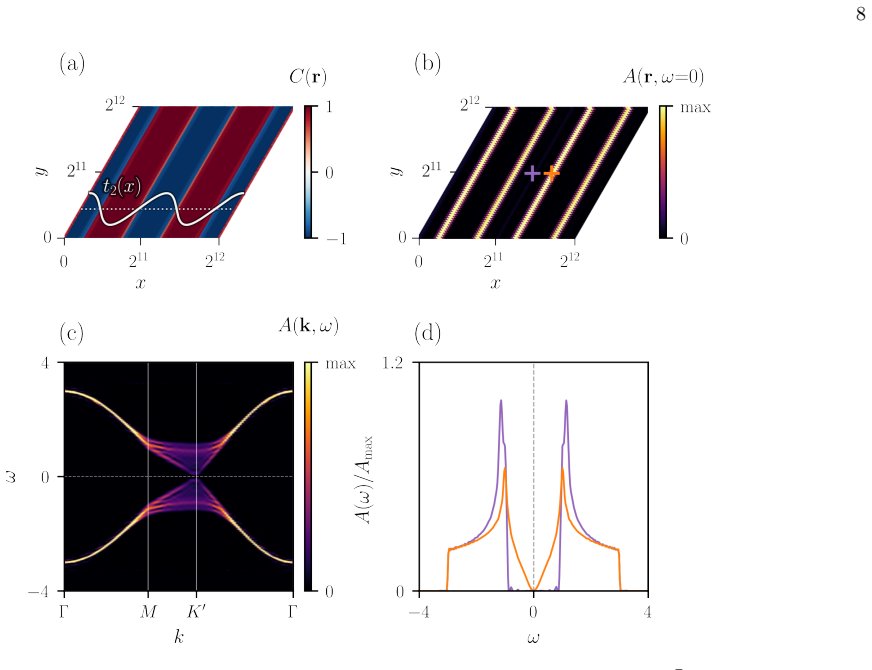
- Spectral functions and momentum-space spectra become computable via a tensor-network quantum Fourier transform at billion-site scales.
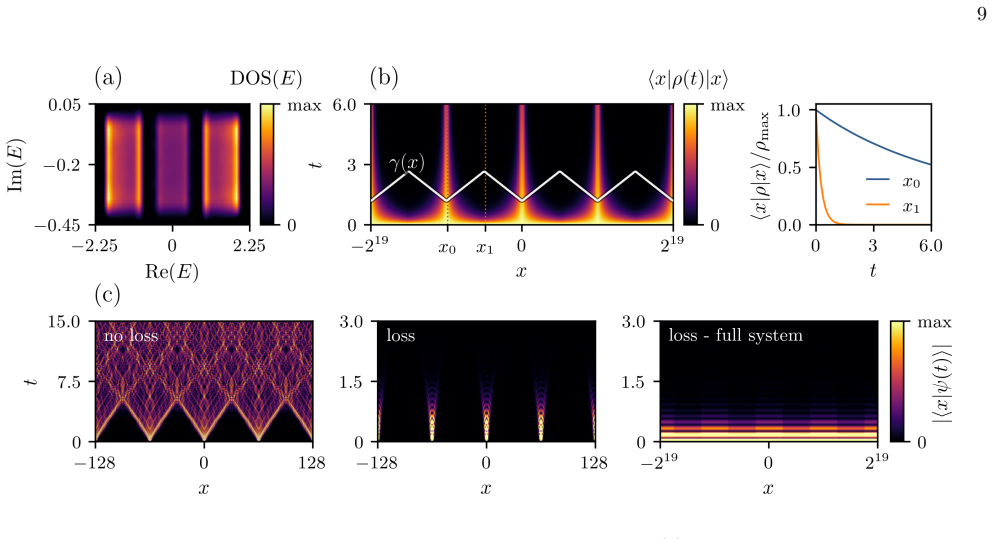
- Real-space topological invariants and real-time dynamics can be extracted without explicit matrix representations.
- Self-consistent mean-field calculations for correlation-induced symmetry breaking are feasible for ultra-large systems.
- Non-Hermitian phenomena and excitonic many-body effects can be studied in macroscopic heterostructures.
Where Pith is reading between the lines
- The same mapping and compression strategy could be tested on other lattice models whose real-space operators admit low-rank tensor representations.
- Hybrid schemes that feed the resulting tensor-network states into interacting many-body solvers might push the frontier further for systems with local interactions.
- The practical limit of the method is set by the compressibility of each specific physical Hamiltonian rather than by a universal scaling with N.
- Validation on moderate-sized systems where exact diagonalization is still possible would directly test whether the reported bond-dimension independence holds.
Load-bearing premise
The real-space structure of the Hamiltonian must be compressible enough for the tensor-network bond dimension to remain modest and independent of system size.
What would settle it
A direct comparison on a moire or quasicrystal Hamiltonian in which the bond dimension needed for converged observables grows linearly with the number of pseudospin sites L.
Figures






read the original abstract
Understanding quantum materials at meso and even macroscopic scales requires tight-binding calculations on system sizes where explicit matrix representations become prohibitively costly. This represents a major bottleneck to rationalize phenomena in moir\'e and super-moir\'e heterostructures and quasicrystals. Here, we present a unified tensor-network methodology to solve tight-binding problems at exceptionally large scales, by mapping a system of $N = 2^L$ sites onto a many-body problem of $L$ pseudospin sites, which is subsequently solved with tensor network algorithms. For Hamiltonians with compressible real-space structure, the tensor network bond dimension remains modest, typically of order a few tens, independent of $N$.Tensor network representations of arbitrary hopping functions including long-range, spatially modulated, and twisted-layer couplings are built with quantics tensor cross interpolation, and all physical observables are evaluated entirely with tensor network algebra without explicit matrix storage or diagonalization. We demonstrate applications to spectral functions, momentum-space spectra via the tensor-network quantum Fourier transform, real-space topological invariants, real-time dynamics, correlation induced symmetry breaking with self-consistent mean-field calculations, non-Hermitian phenomena, and excitonic many-body physics. Our methodology enables routinely solving systems with billions of sites, by leveraging the tensor network compressibility of real-space structures, and establishing a flexible framework to study quantum matter at ultra-large length scales. The methodology is implemented in the open-source Julia package TensorBinding.jl.
Editorial analysis
A structured set of objections, weighed in public.
Referee Report
Summary. The manuscript presents a unified tensor-network methodology for solving tight-binding Hamiltonians on ultra-large systems (N = 2^L sites) by mapping the problem onto L pseudospin sites. For Hamiltonians with compressible real-space structure, quantics tensor cross interpolation (TCI) is used to represent arbitrary hopping functions (including long-range and modulated couplings), after which tensor-network algorithms solve the effective many-body problem with bond dimension typically O(10) and independent of N. All observables are obtained via tensor-network algebra without explicit matrix storage or diagonalization. Demonstrated applications include spectral functions, tensor-network quantum Fourier transforms, real-space topological invariants, real-time dynamics, self-consistent mean-field calculations, non-Hermitian phenomena, and excitonic physics. The approach is implemented in the open-source Julia package TensorBinding.jl.
Significance. If the central scaling claim holds, the method would enable routine tight-binding calculations at meso- and macroscopic scales for moiré heterostructures, super-moiré systems, and quasicrystals, directly addressing a major computational bottleneck in condensed-matter theory. The open-source implementation and breadth of demonstrated applications (spectral, dynamical, topological, and many-body) add practical value; the conditional scope on compressible structures is explicitly stated rather than hidden.
major comments (2)
- [§4] §4 (Quantics TCI construction): the statement that bond dimension remains O(10) independent of N is load-bearing for the central claim, yet the manuscript provides only example values rather than a systematic scaling plot or analytic bound on the TCI rank for the hopping kernel as a function of system size or modulation wavelength.
- [§5.2] §5.2 (Tensor-network quantum Fourier transform): the reported momentum-space spectra for billion-site systems rely on the pseudospin mapping preserving translational symmetry; however, the error analysis for the QFT contraction (Eq. (12)) does not quantify accumulation of truncation errors across the L layers when the underlying real-space structure is only approximately compressible.
minor comments (2)
- [Figure 3] Figure 3 caption and surrounding text: the bond-dimension values are stated as 'typically a few tens' but lack error bars or dependence on the TCI tolerance parameter; adding this information would improve reproducibility.
- The manuscript cites the Julia package TensorBinding.jl but does not include a direct repository URL or version tag in the main text; this should be added for immediate accessibility.
Simulated Author's Rebuttal
We thank the referee for the constructive review and positive recommendation for minor revision. The comments identify opportunities to strengthen the supporting evidence for our central claims. We address each point below and will revise the manuscript accordingly.
read point-by-point responses
-
Referee: [§4] §4 (Quantics TCI construction): the statement that bond dimension remains O(10) independent of N is load-bearing for the central claim, yet the manuscript provides only example values rather than a systematic scaling plot or analytic bound on the TCI rank for the hopping kernel as a function of system size or modulation wavelength.
Authors: We agree that a systematic scaling study and analytic discussion would better substantiate the claim. In the revised manuscript we will add a new figure (or supplementary panel) plotting the TCI bond dimension versus L for representative hopping kernels (long-range, modulated, and twisted-layer) across several decades of system size. We will also include a short analytic paragraph explaining the expected rank scaling from the quantics tensor representation of functions with bounded variation or periodicity, which underpins the observed N-independence for compressible structures. revision: yes
-
Referee: [§5.2] §5.2 (Tensor-network quantum Fourier transform): the reported momentum-space spectra for billion-site systems rely on the pseudospin mapping preserving translational symmetry; however, the error analysis for the QFT contraction (Eq. (12)) does not quantify accumulation of truncation errors across the L layers when the underlying real-space structure is only approximately compressible.
Authors: We appreciate this observation. While the pseudospin mapping preserves translational symmetry for the periodic cases considered, we will expand the error discussion around Eq. (12) to provide a recursive bound on truncation-error accumulation across the L layers. The revision will also include numerical benchmarks of total QFT error versus L for approximately compressible kernels, confirming that the accumulated error remains controlled for the bond dimensions used in the billion-site demonstrations. revision: yes
Circularity Check
No significant circularity; direct algorithmic mapping for compressible Hamiltonians
full rationale
The paper presents a constructive methodology that maps an N-site tight-binding problem (N=2^L) onto an L-pseudospin many-body problem solved by tensor networks, with quantics tensor cross interpolation used to build representations of hoppings. All steps are algorithmic constructions that operate on the input Hamiltonian structure without reducing any claimed prediction or observable to a parameter fitted from the same data or to a self-citation chain. The modest, N-independent bond dimension is explicitly conditioned on the Hamiltonian possessing compressible real-space structure, which is stated as a scope restriction rather than derived internally. No self-definitional loops, fitted-input predictions, or uniqueness theorems imported from prior author work appear in the derivation chain; the framework is self-contained as a computational tool with open-source implementation.
Axiom & Free-Parameter Ledger
Reference graph
Works this paper leans on
-
[1]
D. M. Kennes, M. Claassen, L. Xian, A. Georges, A. J. Millis, J. Hone, C. R. Dean, D. N. Basov, A. N. Pasupathy, and A. Rubio, Moir´ e heterostructures as a condensed-matter quantum simulator, Nature Physics17, 155–163 (2021)
2021
-
[2]
Balents, C
L. Balents, C. R. Dean, D. K. Efetov, and A. F. Young, Superconductivity and strong correlations in moir´ e flat bands, Nature Physics16, 725–733 (2020)
2020
-
[3]
X. Lai, G. Li, A. M. Coe, J. H. Pixley, K. Watanabe, T. Taniguchi, and E. Y. Andrei, Moir´ e periodic and quasiperiodic crystals in heterostructures of twisted bilayer graphene on hexagonal boron nitride, Nature Materials24, 1019–1026 (2025)
2025
-
[4]
T. V. C. Ant˜ ao, Y. Sun, A. O. Fumega, and J. L. Lado, Tensor network method for real-space topology in quasicrystal chern mosaics, Phys. Rev. Lett.136, 156601 (2026)
2026
-
[5]
G. A. Dom´ ınguez-Castro and R. Paredes, The aubry–andr´ e model as a hobbyhorse for understanding the localization phenomenon, European Journal of Physics40, 045403 (2019)
2019
-
[6]
D. R. Hofstadter, Energy levels and wave functions of bloch electrons in rational and irrational magnetic fields, Phys. Rev. B14, 2239 (1976)
1976
-
[7]
M. Gon¸ calves, B. Amorim, E. Castro, and P. Ribeiro, Hidden dualities in 1d quasiperiodic lattice models, SciPost Physics 13, 10.21468/scipostphys.13.3.046 (2022)
-
[8]
Gon¸ calves, B
M. Gon¸ calves, B. Amorim, E. V. Castro, and P. Ribeiro, Critical phase dualities in 1d exactly solvable quasiperiodic models, Phys. Rev. Lett.131, 186303 (2023)
2023
-
[9]
C. W. Duncan, S. Manna, and A. E. B. Nielsen, Topological models in rotationally symmetric quasicrystals, Phys. Rev. B101, 115413 (2020)
2020
-
[10]
J. L. Lado and O. Zilberberg, Topological spin excitations in harper-heisenberg spin chains, Phys. Rev. Res.1, 033009 (2019)
2019
-
[11]
Khosravian and J
M. Khosravian and J. L. Lado, Quasiperiodic criticality and spin-triplet superconductivity in superconductor- antiferromagnet moir´ e patterns, Phys. Rev. Res.3, 013262 (2021)
2021
-
[12]
A. Uri, S. C. de la Barrera, M. T. Randeria, D. Rodan-Legrain, T. Devakul, P. J. D. Crowley, N. Paul, K. Watanabe, T. Taniguchi, R. Lifshitz, L. Fu, R. C. Ashoori, and P. Jarillo-Herrero, Superconductivity and strong interactions in a tunable moir´ e quasicrystal, Nature620, 762–767 (2023)
2023
-
[13]
C. S. Tsang, X. Zheng, T. Yang, Z. Yan, W. Han, L. W. Wong, H. Liu, S. Gao, K. H. Leung, C.-S. Lee, S. P. Lau, M. Yang, J. Zhao, and T. H. Ly, Polar and quasicrystal vortex observed in twisted-bilayer molybdenum disulfide, Science 386, 198–205 (2024)
2024
-
[14]
Y. Sun, M. Niedermeier, T. V. C. Ant˜ ao, A. O. Fumega, and J. L. Lado, Self-consistent tensor network method for correlated super-moir´ e matter beyond one billion sites, Phys. Rev. Res.7, 043288 (2025). 14
2025
-
[15]
Y. Cao, V. Fatemi, A. Demir, S. Fang, S. L. Tomarken, J. Y. Luo, J. D. Sanchez-Yamagishi, K. Watanabe, T. Taniguchi, E. Kaxiras, R. C. Ashoori, and P. Jarillo-Herrero, Correlated insulator behaviour at half-filling in magic-angle graphene superlattices, Nature556, 80 (2018)
2018
-
[16]
Y. Cao, V. Fatemi, S. Fang, K. Watanabe, T. Taniguchi, E. Kaxiras, and P. Jarillo-Herrero, Unconventional superconductivity in magic-angle graphene superlattices, Nature556, 43 (2018)
2018
-
[17]
Bistritzer and A
R. Bistritzer and A. H. MacDonald, Moir´ e bands in twisted double-layer graphene, Proceedings of the National Academy of Sciences108, 12233 (2011)
2011
-
[18]
E. Y. Andrei and A. H. MacDonald, Graphene bilayers with a twist, Nature Materials19, 1265 (2020)
2020
-
[19]
E. Y. Andrei, D. K. Efetov, P. Jarillo-Herrero, A. H. MacDonald, K. F. Mak, T. Senthil, E. Tutuc, A. Yazdani, and A. F. Young, The marvels of moir´ e materials, Nature Reviews Materials6, 201 (2021)
2021
-
[20]
K. P. Nuckolls and A. Yazdani, A microscopic perspective on moir´ e materials, Nature Reviews Materials9, 460–480 (2024)
2024
-
[21]
Grover, M
S. Grover, M. Bocarsly, A. Uri, P. Stepanov, G. Di Battista, I. Roy, J. Xiao, A. Y. Meltzer, Y. Myasoedov, K. Pareek, K. Watanabe, T. Taniguchi, B. Yan, A. Stern, E. Berg, D. K. Efetov, and E. Zeldov, Chern mosaic and berry-curvature magnetism in magic-angle graphene, Nature Physics18, 885–892 (2022)
2022
-
[22]
Y. Li, F. Zhang, V.-A. Ha, Y.-C. Lin, C. Dong, Q. Gao, Z. Liu, X. Liu, S. H. Ryu, H. Kim, C. Jozwiak, A. Bostwick, K. Watanabe, T. Taniguchi, B. Kousa, X. Li, E. Rotenberg, E. Khalaf, J. A. Robinson, F. Giustino, and C.-K. Shih, Tuning commensurability in twisted van der waals bilayers, Nature625, 494–499 (2024)
2024
-
[23]
C.-Y. Hao, Z. Zhan, P. A. Pantale´ on, J.-Q. He, Y.-X. Zhao, K. Watanabe, T. Taniguchi, F. Guinea, and L. He, Robust flat bands in twisted trilayer graphene moir´ e quasicrystals, Nature Communications15, 10.1038/s41467-024-52784-7 (2024)
-
[24]
L.-Q. Xia, S. C. de la Barrera, A. Uri, A. Sharpe, Y. H. Kwan, Z. Zhu, K. Watanabe, T. Taniguchi, D. Goldhaber-Gordon, L. Fu, T. Devakul, and P. Jarillo-Herrero, Topological bands and correlated states in helical trilayer graphene, Nature Physics21, 239–244 (2025)
2025
-
[25]
G. Yu, Z. Wu, Z. Zhan, M. I. Katsnelson, and S. Yuan, Dodecagonal bilayer graphene quasicrystal and its approximants, npj Computational Materials5, 10.1038/s41524-019-0258-0 (2019)
-
[26]
M. S. Rudner and N. H. Lindner, Band structure engineering and non-equilibrium dynamics in floquet topological insulators, Nature Reviews Physics2, 229–244 (2020)
2020
-
[27]
de la Torre, D
A. de la Torre, D. M. Kennes, M. Claassen, S. Gerber, J. W. McIver, and M. A. Sentef, Colloquium: Nonthermal pathways to ultrafast control in quantum materials, Rev. Mod. Phys.93, 041002 (2021)
2021
-
[28]
Onida, L
G. Onida, L. Reining, and A. Rubio, Electronic excitations: density-functional versus many-body green’s-function approaches, Rev. Mod. Phys.74, 601 (2002)
2002
-
[29]
Y. Li, Z. Zhan, X. Kuang, Y. Li, and S. Yuan, Tbplas: A tight-binding package for large-scale simulation, Computer Physics Communications285, 108632 (2023)
2023
-
[30]
Oka and S
T. Oka and S. Kitamura, Floquet engineering of quantum materials, Annual Review of Condensed Matter Physics10, 387 (2019)
2019
-
[31]
Moustaj, Y
A. Moustaj, Y. Sun, T. V. C. Ant˜ ao, L. Eek, and J. L. Lado, Tensor-network methodology for super-moir´ e excitons beyond one billion sites (2026)
2026
-
[32]
K. Tran, G. Moody, F. Wu, X. Lu, J. Choi, K. Kim, A. Rai, D. A. Sanchez, J. Quan, A. Singh, J. Embley, A. Zepeda, M. Campbell, T. Autry, T. Taniguchi, K. Watanabe, N. Lu, S. K. Banerjee, K. L. Silverman, S. Kim, E. Tutuc, L. Yang, A. H. MacDonald, and X. Li, Evidence for moir´ e excitons in van der waals heterostructures, Nature567, 71 (2019)
2019
-
[33]
F. Wu, T. Lovorn, and A. H. MacDonald, Theory of optical absorption by interlayer excitons in transition metal dichalcogenide heterobilayers, Phys. Rev. B97, 035306 (2018)
2018
-
[34]
S. A. Herrera-Gonz´ alez, H. A. Lara-Garc´ ıa, G. Pirruccio, D. A. Ruiz-Tijerina, and A. Camacho-Guardian, Moir´ e excitons and exciton–polaritons: a review, Journal of Physics: Condensed Matter37, 483002 (2025)
2025
-
[35]
Z. Gong, Y. Ashida, K. Kawabata, K. Takasan, S. Higashikawa, and M. Ueda, Topological phases of non-hermitian systems, Phys. Rev. X8, 031079 (2018)
2018
-
[36]
F. Song, S. Yao, and Z. Wang, Non-hermitian topological invariants in real space, Phys. Rev. Lett.123, 246801 (2019)
2019
-
[37]
Ashida, Z
Y. Ashida, Z. Gong, and M. Ueda, Non-hermitian physics, Advances in Physics69, 249 (2020)
2020
-
[38]
E. J. Bergholtz, J. C. Budich, and F. K. Kunst, Exceptional topology of non-hermitian systems, Reviews of Modern Physics93, 10.1103/revmodphys.93.015005 (2021)
-
[39]
Y. Sun, J. L. Lado, and G. Chen, Real-space spectral functions of three-dimensional billion-size topological non-hermitian matter with tensor networks (2026)
2026
-
[40]
Yao and Z
S. Yao and Z. Wang, Edge states and topological invariants of non-hermitian systems, Phys. Rev. Lett.121, 086803 (2018)
2018
-
[41]
Okuma, K
N. Okuma, K. Kawabata, K. Shiozaki, and M. Sato, Topological origin of non-hermitian skin effects, Phys. Rev. Lett. 124, 086801 (2020)
2020
-
[42]
Helbig, T
T. Helbig, T. Hofmann, S. Imhof, M. Abdelghany, T. Kiessling, L. W. Molenkamp, C. H. Lee, A. Szameit, M. Greiter, and R. Thomale, Generalized bulk–boundary correspondence in non-hermitian topolectrical circuits, Nature Physics16, 747 (2020)
2020
-
[43]
C. W. Groth, M. Wimmer, A. R. Akhmerov, and X. Waintal, New J. Phys.16, 063065 (2014)
2014
-
[44]
Coh and D
S. Coh and D. Vanderbilt, PythTB,https://www.physics.rutgers.edu/pythtb/
-
[45]
Gresch, TBmodels,https://tbmodels.greschd.ch/
D. Gresch, TBmodels,https://tbmodels.greschd.ch/
-
[46]
J. L. Lado, Pyqula,https://github.com/joselado/pyqula. 15
-
[47]
S. M. Jo˜ ao, M. An delkovi´ c, L. Covaci, T. G. Rappoport, J. M. V. P. Lopes, and A. Ferreira, Kite: high- performance accurate modelling of electronic structure and response functions of large molecules, disordered crystals and heterostructures, Royal Society Open Science7, 191809 (2020)
2020
-
[48]
San-Jose, Quantica.jl,https://github.com/pablosanjose/Quantica.jl
P. San-Jose, Quantica.jl,https://github.com/pablosanjose/Quantica.jl
-
[49]
M. Fishman, S. White, and E. Stoudenmire, The itensor software library for tensor network calculations, SciPost Physics Codebases 10.21468/scipostphyscodeb.4 (2022)
-
[50]
J. Hauschild and F. Pollmann, Efficient numerical simulations with tensor networks: Tensor network python (tenpy), SciPost Physics Lecture Notes 10.21468/scipostphyslectnotes.5 (2018)
-
[51]
Schollw¨ ock, The density-matrix renormalization group, Rev
U. Schollw¨ ock, The density-matrix renormalization group, Rev. Mod. Phys.77, 259 (2005)
2005
-
[52]
Schollw¨ ock, The density-matrix renormalization group in the age of matrix product states, Annals of Physics326, 96 (2011)
U. Schollw¨ ock, The density-matrix renormalization group in the age of matrix product states, Annals of Physics326, 96 (2011)
2011
-
[53]
Paeckel, T
S. Paeckel, T. K¨ ohler, A. Swoboda, S. R. Manmana, U. Schollw¨ ock, and C. Hubig, Time-evolution methods for matrix- product states, Annals of Physics411, 167998 (2019)
2019
-
[54]
S. R. White, Density matrix formulation for quantum renormalization groups, Phys. Rev. Lett.69, 2863 (1992)
1992
-
[55]
A. Akhmerov, Largest scale simulations, Journal Club for Condensed Matter Physics 10.36471/jccm october 2025 02 (2025)
-
[56]
Niedermeier, A
M. Niedermeier, A. Moulinas, T. Louvet, J. L. Lado, and X. Waintal, Solving the gross-pitaevskii equation on multiple different scales using the quantics tensor train representation, Phys. Rev. Res.8, 023006 (2026)
2026
-
[57]
Bou-Comas, M
A. Bou-Comas, M. P lodzie´ n, L. Tagliacozzo, and J. J. Garc´ ıa-Ripoll, Quantics tensor train for solving gross-pitaevskii equation (2025)
2025
-
[58]
R. D. Peddinti, S. Pisoni, A. Marini, P. Lott, H. Argentieri, E. Tiunov, and L. Aolita, Quantum-inspired framework for computational fluid dynamics, Communications Physics7, 10.1038/s42005-024-01623-8 (2024)
-
[59]
N. Gourianov, P. Givi, D. Jaksch, and S. B. Pope, Tensor networks enable the calculation of turbulence probability distributions, Science Advances11, 10.1126/sciadv.ads5990 (2025)
-
[60]
J.-W. Li, N. Jolly, and X. Waintal, Tailoring tensor network techniques to the quantics representation for highly inhomogeneous problems and few body problems (2026)
2026
-
[61]
N. Nakatani and G. K.-L. Chan, Efficient tree tensor network states (ttns) for quantum chemistry: Generalizations of the density matrix renormalization group algorithm, The Journal of Chemical Physics138, 10.1063/1.4798639 (2013)
-
[62]
Szalay, M
S. Szalay, M. Pfeffer, V. Murg, G. Barcza, F. Verstraete, R. Schneider, and O. Legeza, Tensor product methods and entanglement optimization for¡i¿ab initio¡/i¿quantum chemistry, International Journal of Quantum Chemistry115, 1342–1391 (2015)
2015
-
[63]
G. K.-L. Chan, A. Keselman, N. Nakatani, Z. Li, and S. R. White, Matrix product operators, matrix product states, and ¡i¿ab initio¡/i¿ density matrix renormalization group algorithms, The Journal of Chemical Physics145, 10.1063/1.4955108 (2016)
-
[64]
N´ u˜ nez Fern´ andez, M
Y. N´ u˜ nez Fern´ andez, M. Jeannin, P. T. Dumitrescu, T. Kloss, J. Kaye, O. Parcollet, and X. Waintal, Learning feynman diagrams with tensor trains, Phys. Rev. X12, 041018 (2022)
2022
-
[65]
Erpenbeck, W.-T
A. Erpenbeck, W.-T. Lin, T. Blommel, L. Zhang, S. Iskakov, L. Bernheimer, Y. N´ u˜ nez Fern´ andez, G. Cohen, O. Parcollet, X. Waintal, and E. Gull, Tensor train continuous time solver for quantum impurity models, Phys. Rev. B107, 245135 (2023)
2023
-
[66]
Murray, H
M. Murray, H. Shinaoka, and P. Werner, Nonequilibrium diagrammatic many-body simulations with quantics tensor trains, Phys. Rev. B109, 165135 (2024)
2024
-
[67]
Stoudenmire and D
E. Stoudenmire and D. Schwab, Supervised learning with tensor networks, inAdvances in Neural Information Processing Systems, Vol. 29, edited by D. Lee, M. Sugiyama, U. Luxburg, I. Guyon, and R. Garnett (Curran Associates, Inc., 2016)
2016
-
[68]
Z.-Y. Han, J. Wang, H. Fan, L. Wang, and P. Zhang, Unsupervised generative modeling using matrix product states, Phys. Rev. X8, 031012 (2018)
2018
-
[69]
Dilip, Y.-J
R. Dilip, Y.-J. Liu, A. Smith, and F. Pollmann, Data compression for quantum machine learning, Phys. Rev. Res.4, 043007 (2022)
2022
-
[70]
Y. Zhou, E. M. Stoudenmire, and X. Waintal, What limits the simulation of quantum computers?, Phys. Rev. X10, 041038 (2020)
2020
-
[71]
Huang, F
C. Huang, F. Zhang, M. Newman, X. Ni, D. Ding, J. Cai, X. Gao, T. Wang, F. Wu, G. Zhang, H.-S. Ku, Z. Tian, J. Wu, H. Xu, H. Yu, B. Yuan, M. Szegedy, Y. Shi, H.-H. Zhao, C. Deng, and J. Chen, Efficient parallelization of tensor network contraction for simulating quantum computation, Nature Computational Science1, 578–587 (2021)
2021
-
[72]
Farrelly, R
T. Farrelly, R. J. Harris, N. A. McMahon, and T. M. Stace, Tensor-network codes, Phys. Rev. Lett.127, 040507 (2021)
2021
-
[73]
Farrelly, N
T. Farrelly, N. Milicevic, R. J. Harris, N. A. McMahon, and T. M. Stace, Parallel decoding of multiple logical qubits in tensor-network codes, Phys. Rev. A105, 052446 (2022)
2022
-
[74]
B. N. Khoromskij,o(dlogn)-quantics approximation of n-d tensors in high-dimensional numerical modeling, Constructive Approximation34, 257 (2011)
2011
-
[75]
I. V. Oseledets, Tensor-train decomposition, SIAM Journal on Scientific Computing33, 2295 (2011)
2011
-
[76]
M. K. Ritter, Y. N´ u˜ nez Fern´ andez, M. Wallerberger, J. von Delft, H. Shinaoka, and X. Waintal, Quantics tensor cross interpolation for high-resolution parsimonious representations of multivariate functions, Phys. Rev. Lett.132, 056501 (2024)
2024
-
[77]
Y. N´ u˜ nez Fern´ andez, M. K. Ritter, M. Jeannin, J.-W. Li, T. Kloss, T. Louvet, S. Terasaki, O. Parcollet, J. von Delft, H. Shinaoka, and X. Waintal, Learning tensor networks with tensor cross interpolation: New algorithms and libraries, SciPost Physics18, 10.21468/scipostphys.18.3.104 (2025). 16
-
[78]
Jeannin, Y
M. Jeannin, Y. N´ u˜ nez Fern´ andez, T. Kloss, O. Parcollet, and X. Waintal, Cross-extrapolation reconstruction of low-rank functions and application to quantum many-body observables in the strong coupling regime, Phys. Rev. B110, 035124 (2024)
2024
-
[79]
Moustaj, Y
A. Moustaj, Y. Sun, T. V. C. Ant˜ ao, and J. L. Lado, Tensor network approach to momentum-resolved spectroscopy in nonperiodic super-moir´ e systems, Phys. Rev. Res.8, 023282 (2026)
2026
-
[80]
A. O. Fumega, M. Niedermeier, and J. L. Lado, 2D Mater.12, 015018 (2025)
2025
discussion (0)
Sign in with ORCID, Apple, or X to comment. Anyone can read and Pith papers without signing in.