Identifying Effective Program Comprehension Strategies through Gaze Transitions over Syntactic Elements
Pith reviewed 2026-07-02 08:17 UTC · model grok-4.3
The pith
Successful program readers show more systematic gaze transitions across syntactic code elements.
A machine-rendered reading of the paper's core claim, the machinery that carries it, and where it could break.
Core claim
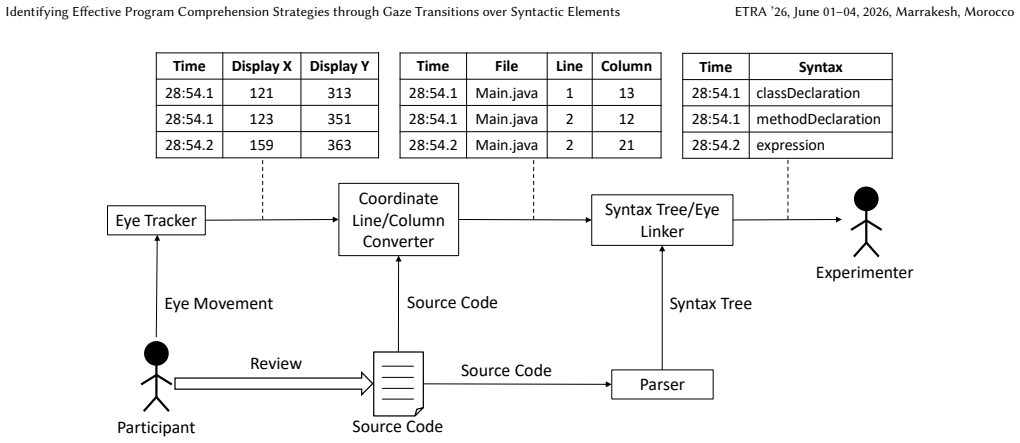
By converting raw gaze coordinates into transitions between abstract syntax tree nodes, the study establishes that participants who correctly comprehend the program display more systematic gaze transition patterns across syntactic elements than those who do not; these patterns are interpreted as signatures of structured reading strategies.
What carries the argument
Mapping of eye-tracking coordinates to transitions between nodes in an abstract syntax tree, used to measure syntactic-level gaze sequences instead of screen positions.
If this is right
- Correct task performance is linked to systematic transitions among syntactic elements such as statements, expressions, and declarations.
- Incorrect performance correlates with less organized or more random transitions across the same elements.
- Syntax-based gaze analysis can detect differences in strategy that conventional screen-coordinate metrics do not capture.
- Structured reading can be observed as a measurable property of eye-movement sequences rather than inferred only from final answers.
Where Pith is reading between the lines
- Training interventions could be designed around explicit practice in following systematic syntactic transition paths.
- The same mapping technique might be tested on debugging or maintenance tasks to check whether similar systematic patterns predict success.
- Code editors could eventually display real-time cues that encourage transitions between high-value syntactic nodes.
- Longitudinal studies could examine whether the observed patterns change as developers gain experience.
Load-bearing premise
The process that turns screen gaze coordinates into abstract syntax tree node transitions accurately reflects the programmer's cognitive attention to syntactic elements without introducing large mapping errors or biases.
What would settle it
A replication experiment that finds no reliable difference, or the opposite difference, in the frequency or order of syntactic node transitions between correct and incorrect groups would falsify the reported link between transition patterns and task correctness.
Figures
read the original abstract
Program comprehension is a central research topic in software engineering, focusing on how developers understand a program's structure, behavior, and intent. Eye-tracking studies have traditionally relied on display-based measurements, where gaze positions are represented as screen coordinates. However, syntax-based analyses have recently emerged. Prior work proposed methods to convert eye movements into transitions between nodes in an abstract syntax tree, but the relationship between task correctness and eye-movement features for specific syntactic elements remains unclear. This study converts eye-tracking data into transitions between syntactic nodes and analyzes fixation proportions and gaze transition patterns. We investigate the relationship between these patterns and task correctness, comparing correct and incorrect groups. Our results reveal distinct differences in gaze transition patterns between the two groups. In particular, successful participants exhibit more systematic transitions across syntactic elements, suggesting the use of structured reading strategies.
Editorial analysis
A structured set of objections, weighed in public.
Referee Report
Summary. The manuscript reports an eye-tracking study that maps raw gaze coordinates to transitions between nodes in a program's abstract syntax tree (AST). It compares fixation proportions and transition patterns between participants who correctly versus incorrectly performed program comprehension tasks, claiming that successful participants exhibit more systematic transitions across syntactic elements, which the authors interpret as evidence of structured reading strategies.
Significance. If the mapping step is shown to be accurate and the group differences prove robust after proper statistical controls, the work could contribute to software engineering by identifying measurable behavioral markers of effective comprehension strategies. This might support development of syntax-aware IDE features or training interventions. The paper builds on existing coordinate-to-AST conversion methods but does not yet supply the validation or statistical detail needed for strong field impact.
major comments (2)
- [Methods] Methods section: The conversion of eye-tracking coordinates to AST node transitions receives no validation (e.g., no precision/recall against manually labeled fixations, no error analysis by node type, and no sensitivity checks for scrolling or line wrapping). Because every reported transition pattern and group comparison inherits any systematic mapping bias, this step is load-bearing for the central claim that observed differences reflect cognitive strategies rather than artifacts.
- [Results] Results section: No sample size, no statistical tests (t-tests, ANOVA, or non-parametric equivalents), and no quantitative definition or metric for 'systematic' transitions (e.g., transition entropy, Markov order, or normalized transition probabilities) are supplied. Without these, the abstract's assertion of 'distinct differences' cannot be evaluated for reliability or effect size.
minor comments (1)
- [Abstract] Abstract: The phrase 'more systematic transitions' is used without an operational definition or reference to a specific figure or table that quantifies it.
Simulated Author's Rebuttal
We thank the referee for the constructive feedback, which identifies key gaps in validation and statistical reporting. We will revise the manuscript to address both major comments.
read point-by-point responses
-
Referee: [Methods] Methods section: The conversion of eye-tracking coordinates to AST node transitions receives no validation (e.g., no precision/recall against manually labeled fixations, no error analysis by node type, and no sensitivity checks for scrolling or line wrapping). Because every reported transition pattern and group comparison inherits any systematic mapping bias, this step is load-bearing for the central claim that observed differences reflect cognitive strategies rather than artifacts.
Authors: We agree that validation of the coordinate-to-AST mapping is essential. The revised manuscript will add a validation subsection reporting precision and recall against manually labeled fixations, error rates by node type, and sensitivity checks for scrolling and line wrapping. These additions will support that group differences arise from cognitive strategies rather than mapping artifacts. revision: yes
-
Referee: [Results] Results section: No sample size, no statistical tests (t-tests, ANOVA, or non-parametric equivalents), and no quantitative definition or metric for 'systematic' transitions (e.g., transition entropy, Markov order, or normalized transition probabilities) are supplied. Without these, the abstract's assertion of 'distinct differences' cannot be evaluated for reliability or effect size.
Authors: We acknowledge the current manuscript omits sample size, statistical tests, and a quantitative metric for systematic transitions. The revision will report the sample size, present results of appropriate statistical tests (t-tests or ANOVA) comparing correct versus incorrect groups, define systematic transitions via metrics such as transition entropy or normalized probabilities, and include effect sizes. revision: yes
Circularity Check
No circularity: empirical group comparison on observed data
full rationale
The paper reports an empirical analysis that converts eye-tracking fixations to AST node transitions and compares transition patterns between correct and incorrect task groups. No equations, parameter fits, or derivations are described that reduce any result to its own inputs by construction. The central claim rests on measured differences in the collected data rather than self-definition, renamed predictions, or load-bearing self-citations. The mapping step is a preprocessing choice whose accuracy is an external validity concern, not a circular reduction within the reported chain.
Axiom & Free-Parameter Ledger
Reference graph
Works this paper leans on
-
[1]
InProceedings of the 11th ACM Symposium on Eye Tracking Research & Applications
Using Developer Eye Movements to Externalize the Mental Model used in Code Summarization Tasks. InProceedings of the 11th ACM Symposium on Eye Tracking Research & Applications. Article 13, 9 pages. doi:10.1145/3314111.3319834 Roman Bednarik and Markku Tukiainen
-
[2]
An eye-tracking methodology for char- acterizing program comprehension processes. InProceedings of the 2006 Symposium on Eye Tracking Research & Applications(San Diego, California)(ETRA ’06). 125–132. doi:10.1145/1117309.1117356 Teresa Busjahn, Roman Bednarik, Andrew Begel, Martha Crosby, James H. Paterson, Carsten Schulte, Bonita Sharif, and Sascha Tamm
-
[3]
In2015 IEEE 23rd International Conference on Program Comprehension
Eye Movements in Code Reading: Relaxing the Linear Order. In2015 IEEE 23rd International Conference on Program Comprehension. 255–265. doi:10.1109/ICPC.2015.36 Drew T. Guarnera, Corey A. Bryant, Ashwin Mishra, Jonathan I. Maletic, and Bonita Sharif
-
[4]
iTrace: eye tracking infrastructure for development environments. In Proceedings of the 2018 ACM Symposium on Eye Tracking Research & Applications (Warsaw, Poland)(ETRA ’18). 1–3. doi:10.1145/3204493.3208343 Toyomi Ishida and Hidetake Uwano
-
[5]
InProceedings of the 6th International Workshop on Eye Movements in Programming
Synchronized analysis of eye movement and EEG during program comprehension. InProceedings of the 6th International Workshop on Eye Movements in Programming. 26–32. doi:10.1109/EMIP.2019.00012 Amy J. Ko, Brad A. Myers, Michael J. Coblenz, and Htet Htet Aung
-
[6]
InProceedings of the International Conference on Software Engineering (ICSE)
An Ex- ploratory Study of How Developers Seek, Relate, and Collect Relevant Information During Software Maintenance Tasks. InProceedings of the International Conference on Software Engineering (ICSE). 971–987. doi:10.1109/TSE.2006.116 Yu-Tzu Lin, Cheng-Chih Wu, Ting-Yun Hou, Yu-Chih Lin, Fang-Ying Yang, and Chia- Hu Chang
-
[7]
doi:10.1109/TE.2015.2487341 Paige Rodeghero, Collin McMillan, Paul W
Tracking Students’ Cognitive Processes During Program Debug- ging—An Eye-Movement Approach.IEEE Transactions on Education59, 3 (2016), 175–186. doi:10.1109/TE.2015.2487341 Paige Rodeghero, Collin McMillan, Paul W. McBurney, Nigel Bosch, and Sidney D’Mello
-
[8]
InProceedings of the 36th International Conference on Software Engineering (ICSE)
Improving Automated Source Code Summarization via an Eye-tracking Study of Programmers. InProceedings of the 36th International Conference on Software Engineering (ICSE). 390–401. doi:10.1145/2568225.2568247 Zohreh Sharafi, Ian Bertram, Michael Flanagan, and Westley Weimer
-
[9]
Eyes on Code: A Study on Developers’ Code Navigation Strategies.IEEE Transactions on Software Engineering48, 5 (2022), 1692–1704. doi:10.1109/TSE.2020.3032064 Janet Siegmund, Norman Peitek, Chris Parnin, Sven Apel, Johannes Hofmeister, Chris- tian Kästner, Andrew Begel, Anja Bethmann, and André Brechmann
-
[10]
InProceedings of the International Conference on Software Engineering (ICSE)
Measur- ing Neural Efficiency of Program Comprehension. InProceedings of the International Conference on Software Engineering (ICSE). 140–150. doi:10.1145/3106237.3106268 Haruhiko Yoshioka and Hidetake Uwano
-
[11]
Rethinking data augmentation for robust LiDAR semantic segmentation in adverse weather,
137–152. doi:10.1007/978-3-031- 53274-0_10 Mohammed J. Zaki
-
[12]
SPADE: An Efficient Algorithm for Mining Frequent Se- quences.Machine Learning42 (2001), 31–60. doi:10.1023/A:1007652502315
discussion (0)
Sign in with ORCID, Apple, or X to comment. Anyone can read and Pith papers without signing in.