An edge-spectral supersaturation of Mubayi's theorem for color-critical graphs
Pith reviewed 2026-07-02 10:13 UTC · model grok-4.3
The pith
For color-critical F with χ(F)≥4, spectral surplus q forces (B_F-o(1)) q m^{(f-2)/2} copies of F with sharp constant B_F.
A machine-rendered reading of the paper's core claim, the machinery that carries it, and where it could break.
Core claim
For every color-critical graph F with χ(F)=r+1≥4, there exists δ_F>0 such that if m is sufficiently large, 0<q≤δ_F√m, and G is an m-edge graph with λ²(G)≥2(1−1/r)m+q, then N_F(G)≥(B_F−o(1)) q m^{(f−2)/2}, where B_F:=α_F/4 (2r/(r−1))^{f/2}, and the constant B_F is best possible. This converts the spectral surplus q into a linear number of copies with a sharp constant, and it solves the conjecture of Fang, Lin and Zhai in a stronger form.
What carries the argument
The spectral surplus q = λ²(G) − 2(1−1/r)m, which is converted by the counting argument into a linear lower bound on N_F(G) with prefactor B_F.
If this is right
- Mubayi's theorem extends to the spectral-radius setting with the identical sharp constant B_F.
- The Fang-Lin-Zhai conjecture is settled in stronger form: the number of copies grows linearly with the surplus q rather than only polynomially.
- For q in the allowed range the o(1) term vanishes, yielding an asymptotic lower bound linear in q.
- The extremal examples achieving the constant B_F in the limit are suitable perturbations of the balanced complete r-partite Turán graphs.
Where Pith is reading between the lines
- The linear dependence on q may allow similar supersaturation statements for other spectral or matrix-norm extremal problems that admit stability.
- For concrete small F such as K_4 one could run numerical checks on random or perturbed graphs with a few hundred edges to test whether the predicted constant B_F appears.
- The result suggests the copy count N_F(G) behaves continuously with respect to the spectral surplus near the threshold, which could be used to study the width of the supersaturation window.
Load-bearing premise
The restriction that q is at most δ_F times sqrt(m) for some positive δ_F depending only on F, which is required to make the error term o(1) and keep the lower bound linear in q.
What would settle it
An m-edge graph G satisfying λ²(G) = 2(1−1/r)m + q with q ≤ δ_F sqrt(m) but N_F(G) < (B_F/2) q m^{(f−2)/2} for arbitrarily large m would disprove the claim.
Figures
read the original abstract
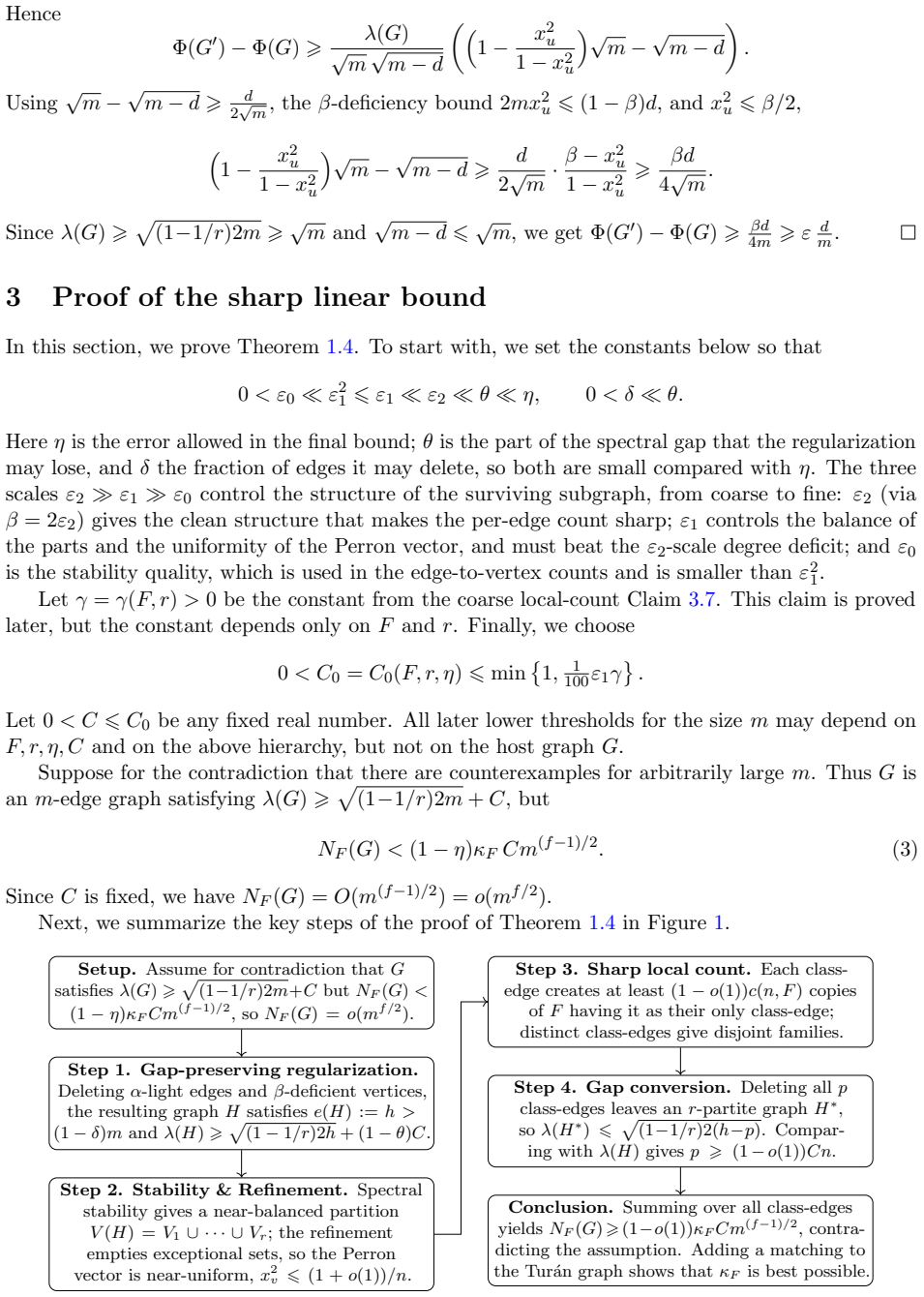
We study the supersaturation problem in its edge-spectral form. Let $\lambda(G)$ be the adjacency spectral radius of $G$. Nikiforov proved that every $K_{r+1}$-free graph $G$ with $m$ edges satisfies $\lambda (G)\le \sqrt{(1\!-\!1/r )2m}$. Recently, Li, Liu and Zhang proved the same bound for every $F$-free graph $G$, where $F$ is any color-critical graph with $\chi(F)=r+1\ge4$, with equality only for regular complete $r$-partite graphs. It is then natural to ask how many copies of $F$ are forced once $\lambda (G)$ exceeds this threshold. Fang, Lin and Zhai answered this at the threshold itself, and conjectured that for any fixed $C>0$, the condition $\lambda (G)\ge \sqrt{(1\!-\!{1}/{r})2m} +C$ forces $\Omega\!\left(m^{(f-1)/2}\right)$ copies. In this paper, we answer this question with the best possible constant, proving that for every color-critical graph $F$ with $\chi(F)=r+1\ge4$, there exists $\delta_F>0$ such that if $m$ is sufficiently large, $0<q\le\delta_F\sqrt m$, and $G$ is an $m$-edge graph with $\lambda^2(G)\ge 2\left(1-\tfrac1r\right)m+q$, then \[ N_F(G)\ge\bigl(B_F-o(1)\bigr)\,q\, m^{{(f-2)}/{2}}, \quad \text{where}~~ B_F:=\tfrac{\alpha_F}{4} (\tfrac{2r}{r-1} )^{{f}/{2}}, \] and the constant $B_F$ is best possible. Our result can be viewed as an edge-spectral counterpart of Mubayi's theorem, since it converts the spectral surplus $q$ into a linear number of copies with a sharp constant, and it solves the conjecture of Fang, Lin and Zhai in a stronger form.
Editorial analysis
A structured set of objections, weighed in public.
Referee Report
Summary. The manuscript proves an edge-spectral supersaturation result for color-critical graphs F with χ(F)=r+1≥4. For an m-edge graph G satisfying λ²(G)≥2(1−1/r)m + q with 0<q≤δ_F √m (m large), it establishes N_F(G)≥(B_F−o(1)) q m^{(f−2)/2} where B_F=α_F/4 (2r/(r−1))^{f/2} is best possible. This is framed as an edge-spectral analogue of Mubayi's theorem that strengthens the conjecture of Fang, Lin and Zhai.
Significance. If correct, the result supplies a sharp explicit constant for spectral supersaturation, directly converting a small spectral surplus q into a linear number of F-copies with the optimal prefactor B_F. The restriction to the regime q=O(√m) together with the best-possible constant constitute a precise quantitative advance over threshold-only results.
major comments (1)
- [Abstract (main theorem)] Abstract (main theorem statement): the linear lower bound with o(1) term is load-bearing on the hypothesis 0<q≤δ_F √m; the manuscript must verify that the stability or perturbation argument controlling the excess edges produces an error o(q) precisely when the surplus remains below the natural √m scale of the Turán graph, as larger q may allow higher-order global contributions to dominate the counting.
minor comments (2)
- [Abstract] The symbols f (order of F) and α_F are used without explicit definition in the abstract; they should be introduced at first appearance in the introduction or theorem statement.
- [Introduction] Notation for λ(G) (adjacency spectral radius) and N_F(G) (number of copies) is standard but should be recalled once in the introduction for self-contained reading.
Simulated Author's Rebuttal
We thank the referee for the careful reading, the positive assessment, and the recommendation for minor revision. The single major comment is addressed below; we agree that an explicit verification of the error control is helpful and will incorporate a clarifying remark.
read point-by-point responses
-
Referee: [Abstract (main theorem)] Abstract (main theorem statement): the linear lower bound with o(1) term is load-bearing on the hypothesis 0<q≤δ_F √m; the manuscript must verify that the stability or perturbation argument controlling the excess edges produces an error o(q) precisely when the surplus remains below the natural √m scale of the Turán graph, as larger q may allow higher-order global contributions to dominate the counting.
Authors: We thank the referee for this observation. The restriction q ≤ δ_F √m is chosen precisely so that the stability result (Lemma 2.3) yields a graph whose edge excess over the balanced complete r-partite graph is O(q), and the subsequent perturbation analysis in the proof of Theorem 1.1 (equations (3.5)–(3.12)) produces an additive error of o(q) m^{(f−2)/2}. Concretely, the quadratic and higher-order terms arising from the global structure are bounded by O(q²/√m + q^{3/2}), which is o(q) uniformly for q ≤ δ_F √m when δ_F is taken sufficiently small (depending only on F and r). This is why the o(1) term is valid exactly in the stated range; for q ≫ √m the same linear prefactor B_F need not hold. To make the dependence on the √m scale fully explicit we will insert a short explanatory paragraph after the statement of Theorem 1.1. revision: yes
Circularity Check
No significant circularity; derivation is self-contained
full rationale
The paper states a new supersaturation theorem converting spectral surplus q into N_F(G) ≳ q m^{(f-2)/2} with explicit constant B_F derived from α_F and r. The proof builds on the prior spectral stability result of Li-Liu-Zhang (cited for the base equality case) but the central counting step and the regime q ≤ δ_F √m are presented as technical conditions for the o(1) error, not as a definitional reduction or fitted input renamed as prediction. No self-definitional loop, no ansatz smuggled via citation, and the best-possible claim for B_F rests on separate extremal constructions. The derivation chain therefore contains independent content and does not reduce to its inputs by construction.
Axiom & Free-Parameter Ledger
axioms (2)
- domain assumption F is color-critical with χ(F)=r+1≥4
- standard math The Nikiforov bound λ(G)≤√((1-1/r)2m) holds for F-free graphs
Reference graph
Works this paper leans on
-
[1]
Balogh, F.C
J. Balogh, F.C. Clemen, On stability of the Erd˝ os–Rademacher problem, Illinois J. Math. 67 (1) (2023) 1–11
2023
-
[2]
Bollob´ as, V
B. Bollob´ as, V. Nikiforov, Cliques and the spectral radius, J. Combin. Theory Ser. B, 97 (2007), 859–865
2007
-
[3]
Chao, H.-H
T.-W. Chao, H.-H. H. Yu, When entropy meets Tur´ an: New proofs and hypergraph Tur´ an results, J. Lond. Math. Soc., 113 (3) (2026), Paper No. e70473
2026
-
[4]
H. Chen, Y. Li, Q. Tang, More on Ning–Zhai’s spectral theorem: Triangles and books, (2026), submitted for publication
2026
-
[5]
Cioab˘ a, L
S. Cioab˘ a, L. Feng, M. Tait, X.-D. Zhang, The maximum spectral radius of graphs without friendship subgraphs, Electron. J. Combin. 27 (4) (2020), #P4.22
2020
-
[6]
Erd˝ os, On a theorem of Rademacher–Tur´ an, Illinois J
P. Erd˝ os, On a theorem of Rademacher–Tur´ an, Illinois J. Math. 6 (1962) 122–127
1962
-
[7]
Erd˝ os, On the number of triangles contained in certain graphs, Canad
P. Erd˝ os, On the number of triangles contained in certain graphs, Canad. Math. Bull. 7 (1) (1964) 53–56
1964
-
[8]
Erd˝ os, M
P. Erd˝ os, M. Simonovits, Supersaturated graphs and hypergraphs, Combinatorica 3 (2) (1983) 181–192
1983
- [9]
- [10]
- [11]
-
[12]
L. Kang, V. Nikiforov, Extremal problems for the p-spectral radius of graphs, Electron. J. Combin. 21 (2014), Paper No. 3.21
2014
-
[13]
M. Kang, T. Makai, O. Pikhurko, Supersaturation problem for the bowtie, European J. Combin. 88 (2020), Paper No. 103107
2020
-
[14]
S. Li, S. Zhao, L. Zou, Spectral extrema of graphs with fixed size: Forbidden a fan graph, a friendship graph or a theta graph, J. Graph Theory, 110 (4) (2025) 483–495
2025
-
[15]
X. Li, M. Zhai, J. Shu, A Brualdi–Hoffman–Tur´ an problem on cycles, European J. Combin., 120 (2024), No. 103966
2024
-
[16]
Y. Li, L. Feng, Y. Peng, A spectral Erd˝ os–Faudree–Rousseau theorem, J. Graph Theory 110 (4) (2025) 408–425
2025
-
[17]
Y. Li, L. Feng, Y. Peng, Spectral supersaturation: Triangles and bowties, European J. Combin. 128 (2025), No. 104171
2025
- [18]
-
[19]
Y. Li, H. Liu, S. Zhang, More on Nosal’s spectral theorem: Books and 4-cycles, J. Combin. Theory, Ser. B 179 (2026) 219–249
2026
- [20]
- [21]
-
[22]
Y. Li, W. Lin, H. Liu, S. Zhang, Spectral Sidorenko inequalities and edge-spectral supersatura- tion, (2026), arXiv:2605.26614
work page internal anchor Pith review Pith/arXiv arXiv 2026
-
[23]
C. Liu, J. Li, S. Li, Y. Yu. A Brualdi–Hoffman–Tur´ an problem on theta graph. Adv. in Appl. Math., 173 (2026), Paper No. 103000
2026
-
[24]
H. Liu, O. Pikhurko, K. Staden, The exact minimum number of triangles in graphs of given order and size, Forum of Math. Pi 8, No. e8, (2020), 144 pages
2020
-
[25]
X. Liu, D. Mubayi, On a generalized Erd˝ os–Rademacher problem, J. Graph Theory 100 (2022) 101–126
2022
-
[26]
Z. Lou, L. Lu, M. Zhai, A refinement on spectral Mantel’s theorem, European J. Combin., 127 (2025), Paper No. 104142
2025
-
[27]
Lov´ asz, M
L. Lov´ asz, M. Simonovits, On the number of complete subgraphs of a graph, in: Proc. of Fifth British Comb. Conf., Aberdeen, 1975, pp. 431–442
1975
-
[28]
Lov´ asz, M
L. Lov´ asz, M. Simonovits, On the number of complete subgraphs of a graph II, in: Studies in Pure Math, Birkh¨ auser (dedicated to P. Tur´ an), 1983, pp. 459–495
1983
-
[29]
Ma, L.-T
J. Ma, L.-T. Yuan, Supersaturation beyond color-critical graphs, Combinatorica 45 (2) (2025), Paper No. 18
2025
-
[30]
J. Ma, T. Wang, T. Zhu, On clique-to-clique densities, (2026), arXiv:2606.31967
work page internal anchor Pith review Pith/arXiv arXiv 2026
-
[31]
Mubayi, Counting substructures I: Color critical graphs, Adv
D. Mubayi, Counting substructures I: Color critical graphs, Adv. Math. 225 (2010), 2731–2740. 20
2010
-
[32]
Nikiforov, Some inequalities for the largest eigenvalue of a graph, Combin
V. Nikiforov, Some inequalities for the largest eigenvalue of a graph, Combin. Probab. Comput. 11 (2002), 179–189
2002
-
[33]
Nikiforov, Walks and the spectral radius of graphs, Linear Algebra Appl
V. Nikiforov, Walks and the spectral radius of graphs, Linear Algebra Appl. 418 (1) (2006) 257–268
2006
-
[34]
Nikiforov, More spectral bounds on the clique and independence numbers, J
V. Nikiforov, More spectral bounds on the clique and independence numbers, J. Combin. Theory Ser. B 99 (6) (2009) 819–826
2009
-
[35]
Nikiforov, Spectral saturation: Inverting the spectral Tur´ an theorem, Electron
V. Nikiforov, Spectral saturation: Inverting the spectral Tur´ an theorem, Electron. J. Combin., 16 (1) (2009), Paper No. 33
2009
-
[36]
Nikiforov, On a theorem of Nosal, (2021), arXiv:2104.12171
V. Nikiforov, On a theorem of Nosal, (2021), arXiv:2104.12171
-
[37]
B. Ning, M. Zhai, Counting substructures and eigenvalues I: Triangles, European J. Combin., 110 (2023), Paper No. 103685
2023
-
[38]
B. Ning, M. Zhai, Counting substructures and eigenvalues II: Quadrilaterals, Electron. J. Combin., 32 (4) (2025), Paper No. 4.1
2025
-
[39]
Pikhurko, Z.B
O. Pikhurko, Z.B. Yilma, Supersaturation problem for color-critical graphs, J. Combin. Theory Ser. B 123 (2017) 148–185
2017
-
[40]
Reiher, The clique density theorem, Ann
C. Reiher, The clique density theorem, Ann. of Math. 184 (3) (2016) 683–707
2016
-
[41]
Simonovits, A method for solving extremal problems in graph theory, stability problems, in: Theory of Graphs, Proc
M. Simonovits, A method for solving extremal problems in graph theory, stability problems, in: Theory of Graphs, Proc. Colloq. Tihany 1966, Academic Press, 1968, 279–319
1966
-
[42]
Tur´ an, On an extremal problem in graph theory, Mat
P. Tur´ an, On an extremal problem in graph theory, Mat. Fiz. Lapok 48 (1941), pp. 436–452. (in Hungarian)
1941
-
[43]
Wilf, Spectral bounds for the clique and independence numbers of graphs, J
H. Wilf, Spectral bounds for the clique and independence numbers of graphs, J. Combin. Theory Ser. B 40 (1986) 113–117
1986
-
[44]
Xiao, G.O
C. Xiao, G.O. Katona, The number of triangles is more when they have no common vertex, Discrete Math. 344 (2021), No. 112330
2021
-
[45]
M. Zhai, H. Lin, J. Shu, Spectral extrema of graphs with fixed size: Cycles and complete bipartite graphs, European J. Combin. 95 (2021), No. 103322
2021
- [46]
-
[47]
Zheng, Y
J. Zheng, Y. Li, H. Li, The signless Laplacian spectral Tur´ an problems for color-critical graphs, Linear Algebra Appl. 730 (2026) 546–565
2026
-
[48]
Zheng, Y
J. Zheng, Y. Li, Y.-Z. Fan, Some Tur´ an-type results for the signless Laplacian spectral radius, European J. Combin. 135 (2026), Paper No. 104373. 21
2026
discussion (0)
Sign in with ORCID, Apple, or X to comment. Anyone can read and Pith papers without signing in.