Universal Short-Imaginary-Time Quantum Critical Dynamics Near Boundaries
Pith reviewed 2026-07-02 04:30 UTC · model grok-4.3
The pith
Short-imaginary-time quantum critical dynamics near boundaries follow scaling forms set by static boundary universality classes
A machine-rendered reading of the paper's core claim, the machinery that carries it, and where it could break.
Core claim
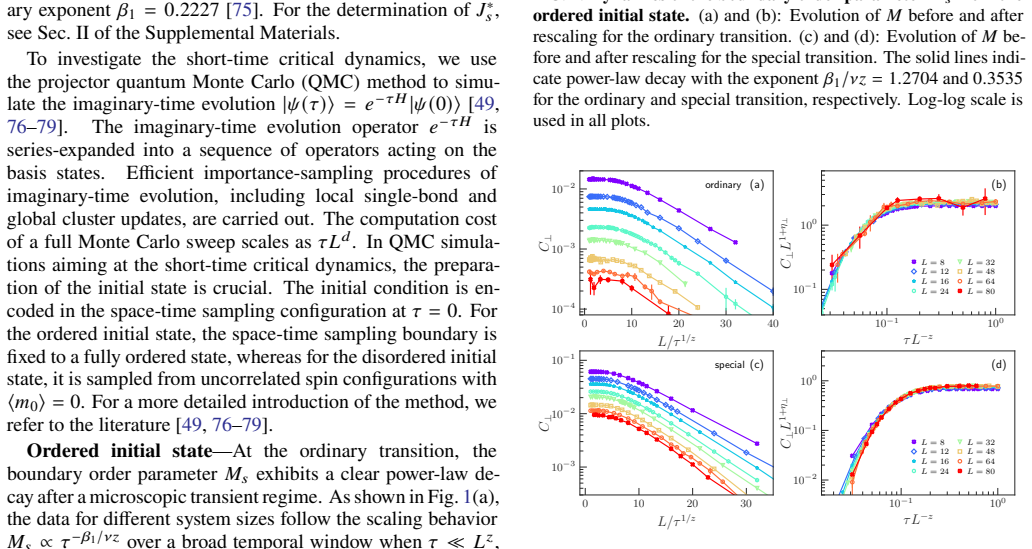
A universal scaling theory is developed for short-imaginary-time critical dynamics in quantum systems with boundaries and verified in the two-dimensional quantum Ising model. For ordered initial states, the boundary order parameter Ms decays with imaginary time τ as Ms ∝ τ^{-β1/νz}. For disordered initial states, the autocorrelation of the boundary order parameter is governed by a novel critical exponent θ1, which is closely related to the critical initial slip behavior of Ms characterized by the corresponding exponent θ1'. In contrast to its positive bulk counterpart, the boundary initial-slip exponent θ1' is negative for the ordinary transition while remaining positive for the special tran
What carries the argument
Scaling forms for short imaginary time τ based on boundary universality classes (ordinary versus special transition), with the boundary order parameter exponent β1 and the new boundary initial-slip exponent θ1'
If this is right
- The boundary order parameter decays as Ms ∝ τ^{-β1/νz} when starting from ordered states.
- Autocorrelation of the boundary order parameter follows a power law set by the novel exponent θ1 when starting from disordered states.
- The boundary initial-slip exponent θ1' is negative at the ordinary transition and positive at the special transition.
- The exponent θ1 breaks the conventional quantum-classical mapping that holds for static classes.
- These scalings extend to more exotic forms of boundary criticality.
Where Pith is reading between the lines
- If the scaling holds in other models, it could provide a practical way to extract boundary exponents from short-time imaginary-time simulations on quantum devices.
- The sign change in θ1' between transitions suggests that boundary effects can either suppress or enhance initial correlations depending on the surface universality class.
- Testing the theory in three-dimensional quantum systems would check whether the departure from quantum-classical mapping persists beyond the Ising case.
Load-bearing premise
The short-imaginary-time regime is assumed to be governed by the static boundary universality classes without significant corrections from non-universal microscopic details or higher-order irrelevant operators.
What would settle it
A numerical calculation in the two-dimensional quantum Ising model showing that the boundary order parameter decay deviates from the predicted power law Ms ∝ τ^{-β1/νz} for ordered initial states at short imaginary times would falsify the universal scaling theory.
Figures


read the original abstract
While imaginary-time evolution has long served as a standard paradigm for ground-state preparation in numerical simulations and quantum devices, its intrinsic dynamical properties has been largely overlooked. Here, we investigate the short-imaginary-time critical dynamics in quantum systems with boundaries. A universal scaling theory is developed and verified in the two-dimensional quantum Ising model, uncovering rich dynamic critical behaviors dictated by boundary universality classes. For ordered initial states, the boundary order parameter $M_s$ decays with imaginary time $\tau$ as $M_s \propto \tau^{-\beta_1/\nu z}$, where $\beta_1$ denotes the boundary order parameter exponent, and $\nu$ and $z$ correspond to the correlation length exponent and the dynamic exponent, respectively. For disordered initial states, the autocorrelation of the boundary order parameter is governed by a novel critical exponent $\theta_1$, which is closely related to the critical initial slip behavior of $M_s$ characterized by the corresponding exponent $\theta_1'$. In contrast to its positive bulk counterpart, the boundary initial-slip exponent $\theta_1'$ is negative for the ordinary transition while remaining positive for the special transition. Although the static universality classes of $d$-dimensional quantum phase transitions generally coincide with those of $(d+1)$-dimensional classical phase transitions, we show that $\theta_1$ does not follow this conventional quantum-classical mapping. We further discuss the implications of our results for more exotic forms of boundary criticality. Our findings provide new physical insights into boundary critical dynamics and offer a novel route for probing exotic boundary critical behaviors in quantum many-body systems.
Editorial analysis
A structured set of objections, weighed in public.
Referee Report
Summary. The manuscript develops a universal scaling theory for short-imaginary-time critical dynamics near boundaries in quantum critical systems. For ordered initial states the boundary order parameter decays as Ms ∝ τ^{-β1/νz}; for disordered initial states the boundary autocorrelation is controlled by a new exponent θ1 (related to the initial-slip exponent θ1'). The work reports that θ1' is negative at the ordinary transition and positive at the special transition, that θ1 violates the conventional quantum-classical mapping, and that these behaviors are verified numerically in the two-dimensional quantum Ising model. Implications for exotic boundary criticality are discussed.
Significance. If the central claims hold, the results supply a new dynamical probe of boundary universality classes in imaginary time, with direct relevance to ground-state preparation protocols on quantum devices and in tensor-network simulations. The construction of distinct scaling forms for ordinary versus special transitions and the reported breakdown of the quantum-classical mapping for θ1 constitute the main advance. The paper is credited for formulating the short-τ scaling ansatz and for performing the numerical test in a concrete lattice model.
major comments (2)
- [Scaling theory (abstract and § on scaling forms)] The scaling forms (Ms(τ) ∝ τ^{-β1/νz} and the definition of θ1) are obtained by direct substitution of static boundary exponents into the short-imaginary-time ansatz. This substitution presupposes that the chosen τ window is simultaneously short enough for the static boundary fixed point to dominate and long enough for universality to emerge, with higher-order irrelevant operators remaining negligible. No scaling dimensions of those operators are computed, rendering the assumption load-bearing for both the existence of θ1 and the claimed violation of the quantum-classical mapping.
- [Numerical results (§ on 2D Ising simulations)] The 2D quantum Ising numerics are taken as representative of the general d-dimensional quantum case, yet the manuscript does not report an explicit test that the fitted values of θ1 and θ1' remain stable when the τ-fitting window or the lattice regulator is varied. Without such a check the extracted power laws cannot be unambiguously attributed to the static boundary classes rather than to residual corrections or cutoff effects.
minor comments (1)
- [Abstract] The abstract contains a subject-verb agreement error ('its intrinsic dynamical properties has been largely overlooked').
Simulated Author's Rebuttal
We thank the referee for the careful reading of our manuscript and the constructive comments. We address each major comment below and indicate the revisions we will make.
read point-by-point responses
-
Referee: The scaling forms (Ms(τ) ∝ τ^{-β1/νz} and the definition of θ1) are obtained by direct substitution of static boundary exponents into the short-imaginary-time ansatz. This substitution presupposes that the chosen τ window is simultaneously short enough for the static boundary fixed point to dominate and long enough for universality to emerge, with higher-order irrelevant operators remaining negligible. No scaling dimensions of those operators are computed, rendering the assumption load-bearing for both the existence of θ1 and the claimed violation of the quantum-classical mapping.
Authors: We thank the referee for this observation. The scaling forms follow from applying the short-imaginary-time ansatz to the known static boundary exponents, in direct analogy with established short-time dynamical scaling. The numerical data in the 2D quantum Ising model show clean power-law regimes consistent with these forms, supporting that the chosen τ window lies within the universal regime. While we have not performed an explicit renormalization-group calculation of the scaling dimensions of higher-order irrelevant operators at the boundary fixed points, such computations are outside the scope of the present work. In the revised manuscript we will add a paragraph discussing the assumptions underlying the ansatz, the expected irrelevance of subleading operators, and the empirical support provided by the observed scaling. revision: partial
-
Referee: The 2D quantum Ising numerics are taken as representative of the general d-dimensional quantum case, yet the manuscript does not report an explicit test that the fitted values of θ1 and θ1' remain stable when the τ-fitting window or the lattice regulator is varied. Without such a check the extracted power laws cannot be unambiguously attributed to the static boundary classes rather than to residual corrections or cutoff effects.
Authors: We agree that explicit stability tests would strengthen the numerical section. Although the original fits were performed over several overlapping τ intervals and multiple lattice sizes, with consistent exponent values obtained, we did not include a systematic scan of the fitting window or regulator. In the revised manuscript we will add supplementary analysis (including plots of fitted θ1 versus lower and upper τ cutoffs) demonstrating that the extracted exponents remain stable within the scaling regime and are insensitive to moderate changes in the lattice spacing. revision: yes
Circularity Check
No significant circularity; scaling forms and new exponents are independent constructions
full rationale
The paper posits the short-imaginary-time scaling Ms(τ) ∝ τ^{-β1/νz} by direct use of known static boundary exponents and defines novel dynamical exponents θ1, θ1' from the initial-slip autocorrelation behavior. These relations do not reduce by construction to any fitted parameters or self-referential definitions inside the paper; the 2D Ising numerics serve as external verification rather than input. No self-citation chains, uniqueness theorems, or ansatzes smuggled via prior work are invoked to force the central claims. The assumption that the short-τ window is controlled by static boundary classes is a standard scaling hypothesis, not a circular reduction of the reported results to the inputs.
Axiom & Free-Parameter Ledger
axioms (1)
- domain assumption Static boundary universality classes (ordinary and special transitions) dictate the short-imaginary-time dynamic scaling forms
Reference graph
Works this paper leans on
-
[1]
In contrast to its positive bulk counterpart, the boundary initial-slip exponent 𝜃′ 1 is negative for the ordi- nary transition while remaining positive for the special transition. Although the static universality classes of 𝑑-dimensional quantum phase transitions generally coincide with those of (𝑑 + 1)-dimensional classical phase transitions, we show th...
work page internal anchor Pith review Pith/arXiv arXiv 2026
-
[2]
should be introduced to characterize the critical initial slip behaviors at the boundary. Remarkably, 𝜃1 (𝜃′
-
[3]
We further uncover the scaling relation between 𝜃1 (𝜃′
is negative for the ordinary transition but positive for the special transition. We further uncover the scaling relation between 𝜃1 (𝜃′
-
[4]
and the bulk initial-slip exponent 𝜃. These results establish the framework of short-imaginary-time criti- cal dynamics near boundaries and reveal rich nonequilibrium scaling behavior associated with boundary universality classes, thereby bringing boundary criticality into the realm of short- imaginary-time dynamics. Scaling theory—In equilibrium, the bul...
-
[5]
Furthermore, 𝜃′ 1 is even larger than its bulk counterpart, indicating that boundary criticality further enhances domain growth. Summary and discussion —In this work, we investigate short-imaginary-time quantum critical dynamics near bound- aries. We establish a scaling theory for boundary short- imaginary-time dynamics and identify a boundary initial-sli...
-
[6]
For the special transition, enhanced boundary correlations reinforce domain formation near the boundary and drive 𝜃1 positive. Un- like the static boundary exponents, 𝜃1 and 𝜃′ 1 are dynamic ex- ponents and generally differ between quantum and classical systems. The present work establishes a general framework for boundary short-imaginary-time quantum cri...
-
[7]
C. Domb and J. L. Lebowitz, eds., Phase Transitions and Criti- cal Phenomena, Vol. 8 (Academic Press, 1983)
work page 1983
-
[8]
C. Domb and J. L. Lebowitz, eds., Phase Transitions and Criti- cal Phenomena, Vol. 10 (Academic Press, 1986)
work page 1986
-
[9]
H. W. Diehl, International Journal of Modern Physics B 11, 3503 (1997)
work page 1997
-
[10]
Pleimling, Journal of Physics A: Mathematical and General 37, R79 (2004)
M. Pleimling, Journal of Physics A: Mathematical and General 37, R79 (2004)
work page 2004
- [11]
- [12]
-
[13]
D. P . Landau and K. Binder, Phys. Rev. B 41, 4633 (1990)
work page 1990
- [14]
-
[15]
Y . Deng, H. W. J. Blöte, and M. P . Nightingale,Phys. Rev. E 72, 016128 (2005)
work page 2005
- [16]
- [17]
- [18]
- [19]
-
[20]
S. Z. Lin and B. Zheng, Phys. Rev. E 78, 011127 (2008)
work page 2008
-
[21]
M. A. Metlitski, SciPost Phys. 12, 131 (2022)
work page 2022
- [22]
-
[23]
M. Hu, Y . Deng, and J.-P . Lv, Phys. Rev. Lett. 127, 120603 (2021)
work page 2021
-
[24]
F. Parisen Toldin and M. A. Metlitski, Phys. Rev. Lett. 128, 215701 (2022)
work page 2022
-
[25]
J. Padayasi, A. Krishnan, M. A. Metlitski, I. A. Gruzberg, and M. Meineri, SciPost Phys. 12, 190 (2022)
work page 2022
-
[26]
Y . Sun, J. Lyu, and J.-P . Lv,Phys. Rev. B 106, 174516 (2022)
work page 2022
- [27]
- [28]
- [29]
- [30]
- [31]
- [32]
-
[33]
Z. Wang, S.-Q. Ning, Z. Liu, J. Rong, Y .-C. Wang, Z. Y an, and W. Guo, Phys. Rev. B 110, 115122 (2024)
work page 2024
- [34]
- [35]
- [36]
-
[37]
X.-C. Wu, Y . Xu, H. Geng, C.-M. Jian, and C. Xu, Phys. Rev. B 101, 174406 (2020)
work page 2020
- [38]
-
[39]
C. Ding, L. Zhang, and W. Guo, Phys. Rev. Lett. 120, 235701 (2018)
work page 2018
- [40]
-
[41]
R. Verresen, R. Thorngren, N. G. Jones, and F. Pollmann, Phys. Rev. X 11, 041059 (2021)
work page 2021
-
[42]
W. Zhu, C. Ding, L. Zhang, and W. Guo, Phys. Rev. B 103, 024412 (2021)
work page 2021
- [43]
-
[44]
H. K. Janssen, B. Schaub, and B. Schmittmann, Zeitschrift für Physik B Condensed Matter 73, 539 (1989)
work page 1989
-
[45]
Z. B. Li, L. Schülke, and B. Zheng, Phys. Rev. Lett. 74, 3396 (1995)
work page 1995
- [46]
-
[47]
E. V . Albano, M. A. Bab, G. Baglietto, R. A. Borzi, T. S. Grigera, E. S. Loscar, D. E. Rodriguez, M. L. R. Puzzo, and G. P . Saracco, Reports on Progress in Physics 74, 026501 (2011)
work page 2011
-
[48]
A. Chiocchetta, M. Tavora, A. Gambassi, and A. Mitra, Phys. Rev. B 91, 220302(R) (2015)
work page 2015
-
[49]
A. Chiocchetta, M. Tavora, A. Gambassi, and A. Mitra, Phys. Rev. B 94, 134311 (2016)
work page 2016
-
[50]
A. Chiocchetta, A. Gambassi, S. Diehl, and J. Marino,Phys. Rev. Lett. 118, 135701 (2017)
work page 2017
-
[51]
S.-K. Jian, S. Yin, and B. Swingle, Phys. Rev. Lett.123, 170606 (2019)
work page 2019
- [52]
-
[53]
S. Yin, P . Mai, and F. Zhong, Phys. Rev. B 89, 094108 (2014)
work page 2014
- [54]
-
[55]
A. W. Sandvik, AIP Conference Proceedings 1297, 135 (2010)
work page 2010
- [56]
- [57]
- [58]
-
[59]
H. C. Jiang, Z. Y . Weng, and T. Xiang, Phys. Rev. Lett. 101, 090603 (2008)
work page 2008
-
[60]
F. Assaad and H. Evertz, World-line and determinantal quan- tum monte carlo methods for spins, phonons and electrons, in Computational Many-Particle Physics , edited by H. Fehske, R. Schneider, and A. Weiße (Springer Berlin Heidelberg, Berlin, Heidelberg, 2008) pp. 277–356
work page 2008
- [61]
- [62]
- [63]
- [64]
-
[65]
Y .-R. Shu, S. Yin, and D.-X. Y ao, Phys. Rev. B 96, 094304 (2017)
work page 2017
- [66]
- [67]
-
[68]
Y .-K. Yu, Z. Zeng, Y .-R. Shu, Z.-X. Li, and S. Yin, Phys. Rev. Lett. 136, 086502 (2026)
work page 2026
- [69]
-
[70]
H.- Y . Lin, S. Yin, Z. Y . Xie, and Z.- Y . Lu, Phys. Rev. B 113, 245108 (2026)
work page 2026
- [71]
- [72]
-
[73]
S. Dietrich and H. W. Diehl, Zeitschrift für Physik B Condensed Matter 51, 343 (1983)
work page 1983
- [74]
-
[75]
H. W. Diehl, Phys. Rev. B 49, 2846 (1994)
work page 1994
-
[76]
Symanzik, Nuclear Physics B 190, 1 (1981)
K. Symanzik, Nuclear Physics B 190, 1 (1981)
work page 1981
-
[77]
M. Campostrini, A. Pelissetto, P . Rossi, and E. Vicari,Phys. Rev. E 65, 066127 (2002)
work page 2002
-
[78]
Simmons-Duffin, Journal of High Energy Physics 2017, 86 (2017)
D. Simmons-Duffin, Journal of High Energy Physics 2017, 86 (2017)
work page 2017
-
[79]
Sachdev, Quantum Phase Transitions (Cambridge University Press, Cambridge, 1999)
S. Sachdev, Quantum Phase Transitions (Cambridge University Press, Cambridge, 1999)
work page 1999
- [80]
discussion (0)
Sign in with ORCID, Apple, or X to comment. Anyone can read and Pith papers without signing in.