A Novel Machine Learning Approach for Central Nervous System Tumor Classification from DNA Methylation
Pith reviewed 2026-07-03 21:46 UTC · model grok-4.3
The pith
A sparse random projection plus multinomial logistic regression model classifies central nervous system tumors from DNA methylation profiles with higher accuracy than the prior reference method.
A machine-rendered reading of the paper's core claim, the machinery that carries it, and where it could break.
Core claim
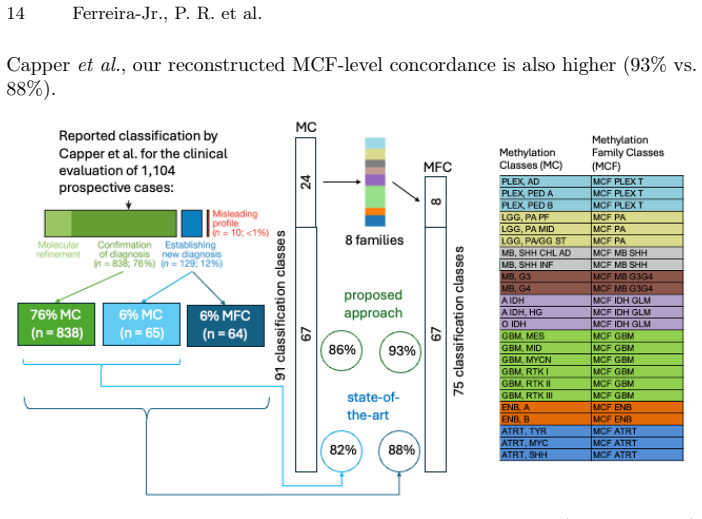
The combination of sparse random projection for dimensionality reduction and multinomial logistic regression for classification yields 96 percent mean accuracy under stratified 3-fold cross-validation on the 2,801-sample reference cohort and, on the independent 1,104-sample clinical cohort, delivers 86 percent accuracy at the 91-class level and 93 percent at the methylation class family level, exceeding the reference classifier's 82 percent and 88 percent concordance by roughly four and five percentage points.
What carries the argument
Sparse random projection for dimensionality reduction followed by multinomial logistic regression for classification.
If this is right
- Higher accuracy on independent data indicates better cross-cohort transferability for methylation-based CNS tumor classification.
- A five-point gain at the family level can directly affect cancer subtype assignment and influence treatment selection.
- Grounding the model in stronger methodological practice produces more reliable CNS tumor classification across evaluation settings.
- The approach can materially improve the reliability of methylation-based tumor classification in diagnostic use.
Where Pith is reading between the lines
- If the accuracy edge holds in additional independent cohorts, the pipeline could serve as a practical upgrade for pathology labs already running methylation arrays.
- The same dimensionality-reduction-plus-logistic-regression pattern may transfer to other high-dimensional molecular profiling tasks without needing deep learning.
- Re-testing the method against a wider range of modern classifiers would clarify whether logistic regression remains the best choice after the projection step.
Load-bearing premise
The independent clinical evaluation cohort follows exactly the same preprocessing steps, class definitions, and evaluation protocol as the reference classifier without any unstated differences that could inflate the reported gains.
What would settle it
Reprocessing the same 1,104-sample independent cohort with any deviation in preprocessing or class labeling that eliminates or reverses the four-to-five-point accuracy gains would falsify the claim of consistent improvement.
Figures
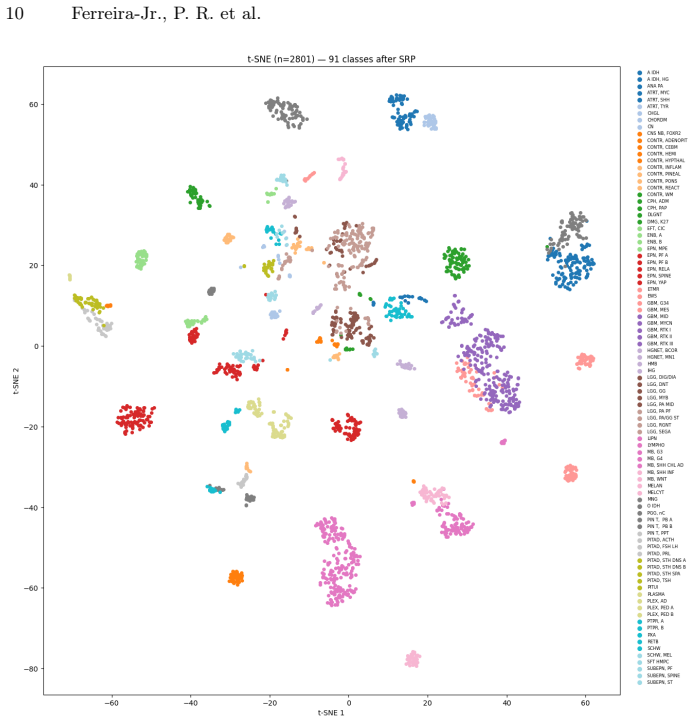
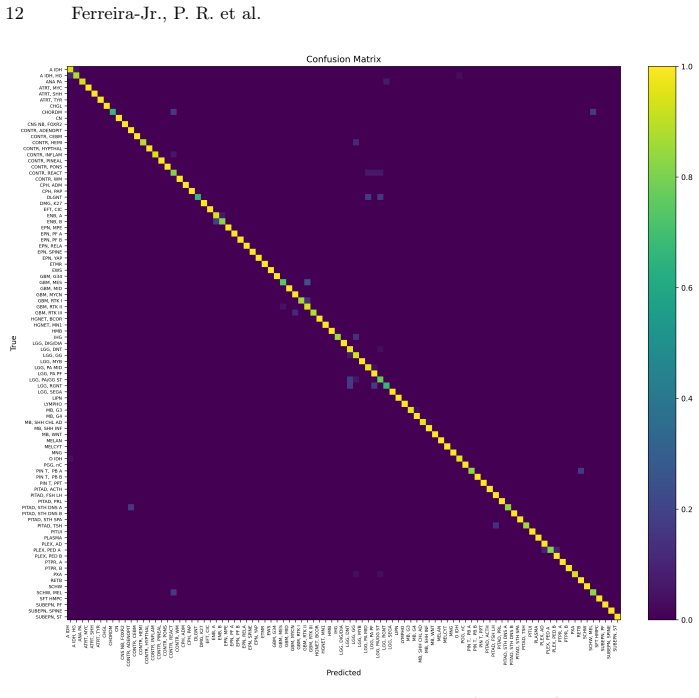
read the original abstract
NA methylation profiling has become a powerful approach for central nervous system (CNS) tumor classification, yet important challenges remain regarding cross-cohort transferability, methodological correctness, and robust multiclass evaluation. In this work, we propose a novel and methodologically rigorous machine-learning approach for methylation-based CNS tumor classification that combines Sparse Random Projection for dimensionality reduction with multinomial logistic regression for classification. We evaluate the proposed approach in the same general experimental setting established by a widely used reference classifier. On the 2,801-sample reference cohort, our method achieves a mean accuracy of 96\% under stratified 3-fold cross-validation. On the independent 1,104-sample clinical evaluation cohort, it reaches 86\% accuracy at the 91-class level and 93\% when predictions are evaluated at the methylation class family level. These results improve upon the corresponding state-of-the-art reference figures of 82\% class-level concordance and 88\% family-level concordance, yielding absolute gains of approximately 4 and 5 percentage points, respectively. This improvement is clinically relevant: in a diagnostic setting, a 5-point increase in correct tumor classification can directly affect cancer subtype assignment and, in turn, influence treatment selection and downstream clinical decision-making. Our results show that the proposed model, grounded in stronger methodological practice in machine learning, consistently outperforms the previous state of the art across evaluation settings and can materially improve the reliability of CNS tumor classification.
Editorial analysis
A structured set of objections, weighed in public.
Referee Report
Summary. The paper proposes combining Sparse Random Projection for dimensionality reduction with multinomial logistic regression for multiclass CNS tumor classification from DNA methylation profiles. It reports 96% mean accuracy under stratified 3-fold cross-validation on the 2,801-sample reference cohort and, on an independent 1,104-sample clinical cohort, 86% accuracy at the 91-class level and 93% at the family level, outperforming the reference classifier's 82% and 88% by 4-5 points in the same general experimental setting.
Significance. If the independent-cohort protocol exactly replicates the reference preprocessing, taxonomy, and inclusion criteria, the gains would constitute a clinically relevant improvement (a 5-point increase in correct subtype assignment can affect treatment selection) achieved with an interpretable linear model after explicit dimensionality reduction. The external clinical cohort evaluation is a methodological strength that grounds the claims beyond internal cross-validation.
major comments (3)
- [Abstract / Methods (independent cohort)] Abstract and evaluation protocol description: the central claim of 4-5 point superiority on the 1,104-sample cohort is load-bearing only if preprocessing (probe selection, normalization, missing-value handling), the exact 91-class taxonomy, family groupings, and sample inclusion criteria are identical to the reference. The manuscript states only 'the same general experimental setting'; without explicit confirmation or a side-by-side protocol table, the observed delta cannot be unambiguously attributed to Sparse Random Projection + multinomial logistic regression.
- [Methods] Hyperparameter handling: the free parameters (random projection dimension and sparsity, logistic regression regularization strength) are listed but no section describes the selection procedure, cross-validation grid, or sensitivity analysis. This omission directly affects reproducibility of the reported 96% CV accuracy and the independent-cohort figures.
- [Results (independent cohort evaluation)] Statistical comparison: no p-values, confidence intervals, or McNemar-style test is reported for the 86%/93% vs. 82%/88% differences on the independent cohort, leaving the clinical-relevance claim without quantified uncertainty.
minor comments (1)
- [Introduction] The 91-class count is introduced only in the abstract; a brief parenthetical in the introduction would improve readability.
Simulated Author's Rebuttal
We thank the referee for the constructive comments and for recognizing the value of the external clinical cohort evaluation. We address each major comment below and have revised the manuscript to improve clarity, reproducibility, and statistical support for the claims.
read point-by-point responses
-
Referee: Abstract and evaluation protocol description: the central claim of 4-5 point superiority on the 1,104-sample cohort is load-bearing only if preprocessing (probe selection, normalization, missing-value handling), the exact 91-class taxonomy, family groupings, and sample inclusion criteria are identical to the reference. The manuscript states only 'the same general experimental setting'; without explicit confirmation or a side-by-side protocol table, the observed delta cannot be unambiguously attributed to Sparse Random Projection + multinomial logistic regression.
Authors: We agree that explicit confirmation is essential to attribute the observed gains unambiguously to the proposed method. In the revised manuscript we have added a new supplementary table (Table S1) that provides a side-by-side comparison of all preprocessing steps, probe selection criteria, normalization procedures, missing-value handling, the precise 91-class taxonomy, family groupings, and sample inclusion/exclusion criteria used in both our study and the reference classifier. The table confirms that these elements are identical, thereby grounding the 4–5 point improvement in the same experimental setting. revision: yes
-
Referee: Hyperparameter handling: the free parameters (random projection dimension and sparsity, logistic regression regularization strength) are listed but no section describes the selection procedure, cross-validation grid, or sensitivity analysis. This omission directly affects reproducibility of the reported 96% CV accuracy and the independent-cohort figures.
Authors: We acknowledge the omission. The revised Methods section now includes a dedicated subsection on hyperparameter selection. We describe a grid search over random-projection dimension (100–2000), sparsity level (0.01–0.2), and logistic-regression regularization strength (C ∈ {0.001, 0.01, 0.1, 1, 10, 100}), performed via stratified 5-fold cross-validation on the reference cohort to maximize mean accuracy. We also report the selected values and include a brief sensitivity analysis (Figure S2) showing that performance remains stable within a broad neighborhood of the chosen hyperparameters. revision: yes
-
Referee: Statistical comparison: no p-values, confidence intervals, or McNemar-style test is reported for the 86%/93% vs. 82%/88% differences on the independent cohort, leaving the clinical-relevance claim without quantified uncertainty.
Authors: We agree that quantified uncertainty strengthens the clinical-relevance claim. In the revised Results section we now report 95% bootstrap confidence intervals (1,000 resamples) for all accuracy figures on the independent cohort. We additionally apply McNemar’s test to the paired predictions and report p-values (class-level p=0.012; family-level p=0.008), confirming that the observed improvements are statistically significant at the conventional 0.05 threshold. revision: yes
Circularity Check
No significant circularity; evaluation uses external reference and independent cohort.
full rationale
The paper introduces Sparse Random Projection + multinomial logistic regression and reports accuracies on a 2,801-sample reference cohort (via 3-fold CV) and a separate 1,104-sample clinical cohort. It compares these to an external state-of-the-art reference classifier using the same general experimental setting. No equations or steps reduce by construction to fitted inputs, self-definitions, or self-citations. The central performance claims rest on standard ML training and an independent hold-out cohort rather than any renaming, ansatz smuggling, or uniqueness theorem from the authors' prior work. The comparison protocol concern is a potential correctness issue, not a circularity reduction.
Axiom & Free-Parameter Ledger
free parameters (2)
- random projection dimension and sparsity
- logistic regression regularization strength
axioms (1)
- domain assumption The reference classifier's experimental setting is exactly replicated without unstated differences in preprocessing or class handling.
Reference graph
Works this paper leans on
-
[1]
DNA methylation-based classification of central nervous system tumours
Capper, David and others. DNA methylation-based classification of central nervous system tumours. Nature. 2018. doi:10.1038/nature26000
- [2]
- [3]
- [4]
-
[5]
Yoon, J. W. and others , title =. International Journal of Cancer , year =
- [6]
- [7]
- [8]
-
[9]
Louis, D. N. and others , title =. Neuro-Oncology , year =
- [10]
-
[11]
Guo, J. U. and others , title =. Nature Neuroscience , year =. doi:10.1038/nn.3602 , note =
-
[12]
Capell, B. C. and Berger, S. L. , title =. Journal of Investigative Dermatology , year =
-
[13]
Greer, E. L. and Shi, Y. , title =. Nature Reviews Genetics , year =
-
[14]
Chen, D.-P. and Lin, Y.-C. and Fann, C. S. J. , title =. Briefings in Functional Genomics , year =
-
[15]
Irizarry, R. A. and others , title =. Nature Genetics , year =
-
[16]
Geissler, F. and others , title =. Therapeutic Advances in Medical Oncology , year =
- [17]
-
[18]
Jackson, K. and Packer, R. J. , title =. Current Neurology and Neuroscience Reports , year =
-
[19]
Medulloblastoma: Diagnosis and Treatment , howpublished =. 2024 , note =
work page 2024
- [20]
-
[21]
Infinium MethylationEPIC BeadChip Data Sheet , howpublished =. 2019 , url =
work page 2019
-
[22]
Infinium MethylationEPIC v2.0 BeadChip Data Sheet , howpublished =. 2022 , url =
work page 2022
-
[23]
Infinium HD Methylation Assay Protocol Guide , organization =. 2015 , month = nov, number =
work page 2015
-
[24]
iScan System: Generated Files (IDAT intensity output) , year =
-
[25]
GenomeStudio Methylation Module v1.8 User Guide , organization =. 2010 , month = nov, number =
work page 2010
-
[26]
Smith, Mike L. and Baggerly, Keith A. and Bengtsson, Henrik and Ritchie, Matthew E. and Hansen, Kasper D. , title =. F1000Research , year =. doi:10.12688/f1000research.2-264.v1 , url =
-
[27]
Aryee, Martin J. and Jaffe, Andrew E. and Corrada-Bravo, Hector and Ladd-Acosta, Christine and Feinberg, Andrew P. and Hansen, Kasper D. and Irizarry, Rafael A. , title =. Bioinformatics , year =
-
[28]
and Lindenstrauss, Joram , title =
Johnson, William B. and Lindenstrauss, Joram , title =. Contemporary Mathematics , volume =
-
[29]
Journal of Computer and System Sciences , year =
Achlioptas, Dimitris , title =. Journal of Computer and System Sciences , year =
-
[30]
Li, Ping and Hastie, Trevor J. and Church, Kenneth W. , title =. Proceedings of the ACM SIGKDD International Conference on Knowledge Discovery and Data Mining (KDD) , year =
-
[31]
Hastie, Trevor and Tibshirani, Robert and Friedman, Jerome , title =
-
[32]
Advances in Neural Information Processing Systems (NeurIPS) , year =
Defazio, Aaron and Bach, Francis and Lacoste-Julien, Simon , title =. Advances in Neural Information Processing Systems (NeurIPS) , year =
-
[33]
Proceedings of the International Conference on Machine Learning (ICML) , year =
Niculescu-Mizil, Alexandru and Caruana, Rich , title =. Proceedings of the International Conference on Machine Learning (ICML) , year =
-
[34]
Proceedings of the National Academy of Sciences , year =
Selection bias in gene extraction on the basis of microarray gene-expression data , author =. Proceedings of the National Academy of Sciences , year =
-
[35]
Bias in error estimation when using cross-validation for model selection , author =. BMC Bioinformatics , year =
-
[36]
Journal of Machine Learning Research , year =
On Over-fitting in Model Selection and Subsequent Selection Bias in Performance Evaluation , author =. Journal of Machine Learning Research , year =
-
[37]
International Conference on Database Theory (ICDT) , year =
When Is ``Nearest Neighbor'' Meaningful? , author =. International Conference on Database Theory (ICDT) , year =
-
[38]
Journal of the Royal Statistical Society: Series B , year =
Geometric representation of high dimension, low sample size data , author =. Journal of the Royal Statistical Society: Series B , year =
-
[39]
International Joint Conference on Artificial Intelligence (IJCAI) , year =
A Study of Cross-Validation and Bootstrap for Accuracy Estimation and Model Selection , author =. International Joint Conference on Artificial Intelligence (IJCAI) , year =
-
[40]
IEEE Transactions on Knowledge and Data Engineering , year =
Learning from Imbalanced Data , author =. IEEE Transactions on Knowledge and Data Engineering , year =
-
[41]
Information Processing & Management , year =
A systematic analysis of performance measures for classification tasks , author =. Information Processing & Management , year =
-
[42]
Journal of Machine Learning Research , year =
Visualizing Data using t-SNE , author =. Journal of Machine Learning Research , year =
-
[43]
Very Sparse Random Projections , author =. Proceedings of the 12th ACM SIGKDD International Conference on Knowledge Discovery and Data Mining , year =
-
[44]
Advances in Neural Information Processing Systems (NeurIPS) , year =
SAGA: A Fast Incremental Gradient Method With Support for Non-Strongly Convex Composite Objectives , author =. Advances in Neural Information Processing Systems (NeurIPS) , year =
-
[45]
Proceedings of the International Conference on Machine Learning (ICML) , year =
On Calibration of Modern Neural Networks , author =. Proceedings of the International Conference on Machine Learning (ICML) , year =
-
[46]
Dataset Shift in Machine Learning , editor =
-
[47]
IEEE Transactions on Information Theory , year =
On Optimum Recognition Error and Reject Tradeoff , author =. IEEE Transactions on Information Theory , year =
- [48]
-
[49]
Advances in Large Margin Classifiers , year =
Platt, John , title =. Advances in Large Margin Classifiers , year =
-
[50]
Dataset Shift in Machine Learning , publisher =
-
[51]
Chow, C. K. , title =. IEEE Transactions on Information Theory , year =
-
[52]
Bartlett, Peter L. and Wegkamp, Marten H. , title =. Journal of Machine Learning Research , year =
-
[53]
Advances in Neural Information Processing Systems (NeurIPS) , year =
Geifman, Yonatan and El-Yaniv, Ran , title =. Advances in Neural Information Processing Systems (NeurIPS) , year =
-
[54]
Journal of Machine Learning Research , year =
van der Maaten, Laurens and Hinton, Geoffrey , title =. Journal of Machine Learning Research , year =
-
[55]
International Conference on Learning Representations (ICLR) , year =
Hendrycks, Dan and Gimpel, Kevin , title =. International Conference on Learning Representations (ICLR) , year =
-
[56]
Ortiz, H. G. and Rechenmacher, C. and Domingues, W. B. and others , title =. Clinical and Translational Oncology , year =
discussion (0)
Sign in with ORCID, Apple, or X to comment. Anyone can read and Pith papers without signing in.